


 |
市場調查報告書
商品編碼
2123998
無線揚聲器:市場佔有率分析、產業趨勢與統計、成長預測(2026-2031)Wireless Speaker - Market Share Analysis, Industry Trends & Statistics, Growth Forecasts (2026 - 2031) |
||||||

※ 本網頁內容可能與最新版本有所差異。詳細情況請與我們聯繫。
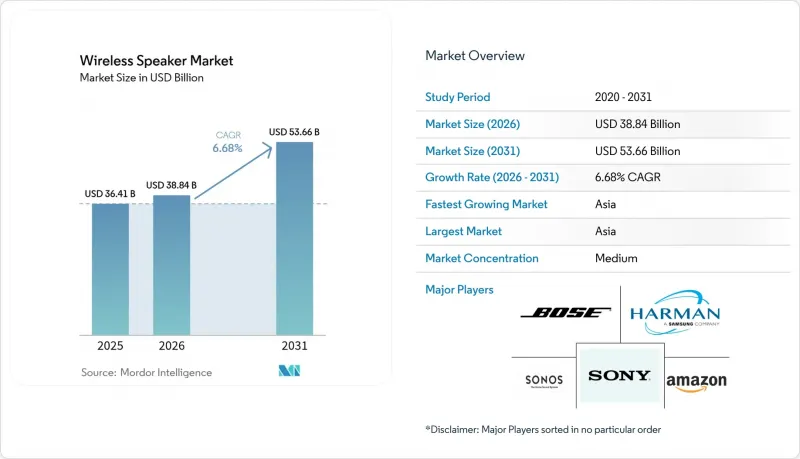
據 Mordor Intelligence 稱,2026 年全球無線揚聲器市場規模預計為 388.4 億美元,高於 2025 年的 364.1 億美元,預計到 2031 年將達到 536.6 億美元。
預計從 2026 年到 2031 年,其複合年成長率將達到 6.68%。
本報告按連接類型(藍牙、Wi-Fi、智慧音箱、蜂窩/LTE)、外形規格(可攜式迷你音箱、條形音箱、智慧顯示器等)、銷售管道(線上電商、音訊專賣店、量販店、OEM整合網路)、最終用戶(住宅、商業、飯店業等)和地區進行細分。市場預測以美元計價。
全球無線揚聲器市場趨勢與洞察
語音助理的整合正在加速智慧音箱在亞洲新興國家的普及。
在中國和印度,隨著廠商將支援本地語言的互動式人工智慧融入智慧音箱,並將入門價格控制在40美元以下,智慧音箱的普及率激增。亞馬遜的「Alexa+」於2025年2月發布,它是一款生成式人工智慧疊加層,可與現有的6億台Echo設備配合使用,延長硬體壽命,並帶來每月19.99美元的收入。谷歌轉向「Gemini AI」進行環境運算,顯示語音體驗架構正向雲端原生和多模態方向轉變。亞洲的原始設備製造商(OEM)透過授權使用成熟的語音技術堆疊而非自行開發解決方案,獲得了「快速追隨者」的優勢,從而降低了組件成本,同時提升了產品的智慧化程度。現有智慧家庭資產(例如智慧燈泡和攝影機)的網路效應進一步降低了首次購買者的進入門檻。
在中國和韓國的都市區,支援杜比全景聲的長條音箱升級正在推動平均售價 (ASP) 的成長。
這些市場的都市區消費者正從傳統的2.1聲道條形音箱轉向支援杜比全景聲(Dolby Atmos)的無線環繞聲系統。聯發科和杜比於2025年1月發布了「FlexConnect」技術,可使條形音箱自動與房間內相容的揚聲器進行校準,從而消除HDMI線的限制。SONY的「BRAVIA Theatre」系列採用「360空間音效映射」技術,無需吸頂揚聲器即可營造多揚聲器環境。這種高度沉浸式的音訊體驗正在推動300美元以上價位段的需求,並推高了整個無線揚聲器市場的平均售價,儘管銷量持平。
在法國和加拿大,人們對智慧音箱的隱私擔憂阻礙了它們在家庭中的廣泛普及。
法國國家資訊與自由委員會(CNIL)等監管機構警告用戶,語音資料可能被用於訓練機密演算法,這導致授權設定更加嚴格。調查顯示,法國和加拿大超過一半的家庭雖然認同語音助理帶來的便利,但也擔心通話會被意外竊聽。供應商正透過本地處理模式和實體靜音開關等功能來解決這個問題,但這種疑慮減緩了產品的更換速度,並導致目標市場規模低於鄰近市場。
細分市場分析
到2025年,藍牙將憑藉其高普及率和便利的配對方式佔據主導地位,佔據無線音箱市場51.62%的佔有率。智慧音箱連接功能在Wi-Fi雙頻晶片和邊緣人工智慧技術的推動下,預計將以8.12%的複合年成長率成長,逐步蠶食基礎藍牙產品的市場佔有率。雖然蜂窩網路無線音箱的市場規模仍然很小,但面向房車和船舶用戶的概念驗證衛星通訊技術預示著一個新的價格區間即將出現。諸如藍牙低功耗音訊(Bluetooth LE Audio)等新興技術,憑藉其降低延遲和提供廣播模式的功能(可將音樂會音訊串流傳輸到數百個個人音箱),在公共場所的重要性日益凸顯。隨著消費者對跨平台相容性的需求不斷成長,僅支援AirPlay的傳統裝置的市場持續萎縮。
在非智慧音箱領域中,以Wi-Fi為核心的揚聲器持續吸引著注重無損播放的音響發燒友的注意。多房間平台目前正陸續發布與Matter相容的規範,從而緩解了互通性的挑戰。隨著晶片組價格跌破8美元,一些亞洲二線廠商正計劃將其入門級產品升級到Wi-Fi+藍牙規格,以在成本和生態系統接入之間取得平衡。
可攜式迷你音箱在出貨量方面佔最大佔有率,預計到2025年將佔無線音箱市場規模的40.55%。然而,長條音箱在銷售成長方面表現較佳,年複合成長率高達8.95%。這主要歸功於戲院級杜比全景聲解碼功能帶來的平均價格上漲。派對音箱配備燈光秀和麥克風輸入,迎合了Z世代的社交影片消費習慣。堅固耐用的夾式音箱具備IP67防護等級和12小時續航時間,滿足騎乘和健行的音訊需求。落地架式無線音箱則佔據了利潤豐厚的細分市場,滿足了那些不喜歡音箱線纜的客廳音頻發燒友的需求。
智慧型顯示音箱繼續保持其混合型產品的特性,融合了語音、觸控和視訊聊天功能,並被廣泛應用於廚房,用於查看食譜說明和回放監視器影像。隨著迷你LED成本的降低,製造商正在嘗試推出配備旋轉支架的8吋面板,同時保持其緊湊的面積。
區域分析
預計到2025年,亞太地區將佔全球銷售額的34.42%,並以6.78%的複合年成長率成長,這主要得益於大規模的生產能力、具有成本競爭力的品牌以及5G設備的快速普及。中國是銷售的核心,將本土人工智慧平台與售價低於25美元的入門級機型結合。韓國和日本瞄準的是高階細分市場,但轉碼器的碎片化阻礙了發燒友的升級。在印度,進口關稅的提高促進了國內組裝,一些智慧型手機品牌正在多元化經營揚聲器領域,以滿足配件市場的需求。
在北美,高階市場依然大規模,這主要得益於將智慧音箱與家庭安防和媒體套餐整合在一起的訂閱生態系統。美國消費者願意為亞馬遜 Alexa+ 等增強型人工智慧功能付費,但在加拿大,出於對隱私的擔憂,智慧音箱在客廳的普及率受到限制,導致市場成長緩慢。墨西哥則受惠於履約中心,縮短了中價位產品的配送時間。
歐洲的市場情勢依然複雜。多房間音響系統在西歐蓬勃發展,而永續材料和易於維修的特性在斯堪地那維亞市場備受青睞。在法國,人們對始終開啟的聆聽設備持謹慎態度,這減緩了智慧音箱的普及速度;而在德國,高傳真音響愛好者則在等待統一無損藍牙技術的到來,才會考慮更換有線設備。在中歐和東歐,入門級藍牙產品透過電商通路的銷售正在成長,彌補了實體零售網路的不足。
在南美洲,市場對兼具超可攜式音箱和短影片平台內容創作功能的音箱需求強勁。由於巴西關稅高昂,各大品牌正考慮將最終組裝轉移到國內生產,或推出配備microSD卡的型號以避免產生串流資料通訊費用。在智利和哥倫比亞,隨著光纖寬頻的普及,中價位條形音箱的進口量也不斷增加。
其他好處:
- Excel格式的市場預測(ME)表
- 3個月的分析師支持
目錄
第1章:引言
- 研究假設和市場定義
- 調查範圍
第2章:調查方法
第3章執行摘要
第4章 市場狀況
- 市場概覽
- 市場促進因素
- 多房間音頻生態系統在北美和西歐日益普及
- 語音助理的整合正在加速智慧音箱在亞洲新興國家的普及。
- 在中國和韓國的都市區,對兼容杜比全景聲的條形音箱的更換需求正在推高平均售價(ASP)。
- 在南美洲,Z世代對影片的消費正在推動對超輕量音箱的需求。
- 高階電動車領域汽車製造商(OEM)與可拆卸揚聲器製造商的合作
- 混合辦公空間正在推動歐洲對企業級藍牙會議揚聲器的需求。
- 市場限制因素
- 藍牙轉碼器碎片化正在減緩日本和德國音響發燒友的升級速度。
- 巴西和印度對成品音響設備徵收高額進口關稅
- 在法國和加拿大,人們對智慧音箱的隱私擔憂阻礙了它們在家庭中的廣泛普及。
- 亞洲中型ODM製造商D級放大器IC供不應求而導致生產延誤。
- 產業價值鏈分析
- 監管和技術展望
- 波特五力分析
第5章 市場規模與成長預測
- 按連線類型
- Bluetooth
- Wi-Fi(含 Combo 型號,不含 Smart 型號)
- 智慧音箱
- 蜂窩/LTE揚聲器
- 按外形規格
- 可攜式迷你/口袋尺寸
- 條形音箱
- 智慧型顯示器音箱
- 落地架式/塔式
- 夾式耳機 / 運動戶外
- 透過分銷管道
- 線上電子商務
- 音響專賣店
- 綜合零售商/大賣場
- OEM 原始設備和安裝商網路
- 最終用戶
- 住宅
- 商業
- 旅館業/企業
- 汽車OEM廠商
- 其他(教育機構、公共設施)
- 按地區
- 北美洲
- 美國
- 加拿大
- 墨西哥
- 歐洲
- 德國
- 英國
- 法國
- 北歐的
- 其他歐洲國家
- 南美洲
- 巴西
- 其他南美國家
- 亞太地區
- 中國
- 日本
- 印度
- 東南亞
- 其他亞太國家
- 中東和非洲
- 中東
- 波灣合作理事會(GCC)成員國
- 土耳其
- 其他中東國家
- 非洲
- 南非
- 其他非洲國家
- 中東
- 北美洲
第6章 競爭情勢
- 市場集中度
- 策略趨勢
- 市佔率分析
- 公司簡介
- Amazon.com Inc.
- Google LLC
- Apple Inc.(Beats)
- Sonos Inc.
- Bose Corporation
- Samsung Electronics Co. Ltd(Harman)
- Sony Group Corp.
- LG Electronics Inc.
- Panasonic Corp.
- Logitech International SA
- Pioneer Electronic Corp.
- Bang and Olufsen A/S
- Xiaomi Corp.
- Baidu Inc.
- Sharp Corp.
- Anker Innovations Ltd.
- JBL(Harman)
- Klipsch Group Inc.
- Edifier Technology Co. Ltd.
- Marshall Group AB
第7章 市場機會與未來展望
According to Mordor Intelligence, the global wireless speaker market size size in 2026 is estimated at USD 38.84 billion, growing from 2025 value of USD 36.41 billion with 2031 projections showing USD 53.66 billion, growing at 6.68% CAGR over 2026-2031.
This report is Segmented by Connectivity Type (Bluetooth, Wi-Fi, Smart Speakers, and Cellular/LTE), Form Factor (Portable Mini, Soundbars, Smart-Display, and More), Distribution Channel (Online E-Commerce, Specialty Audio Retail, Mass-Merchandisers, and OEM-Fitted Networks), End-User (Residential, Commercial, Hospitality, and More), and Geography. The Market Forecasts are Provided in Terms of Value (USD).
Global Wireless Speaker Market Trends and Insights
Voice-assistant Integration Accelerating Smart-speaker Uptake in Emerging Asia
Smart-speaker adoption in China and India jumped when vendors embedded local-language, conversational AI and kept entry prices below USD 40. Amazon's February 2025 launch of Alexa+, a generative-AI overlay that works on 600 million existing Echo devices, extended hardware life and introduced a USD 19.99 monthly revenue stream. Google's pivot to Gemini AI for ambient computing signals a broader architectural shift toward cloud-native, multimodal voice experiences. Asian OEMs gain fast-follower advantage because they can license mature voice stacks instead of building proprietary solutions, cutting bill-of-material costs while raising perceived intelligence. Network effects from existing smart-home assets such as bulbs or cameras further lower adoption friction for first-time buyers.
Dolby Atmos Soundbar Upgrades Fueling ASP Growth in Urban China and South Korea
City-dwelling consumers in these markets are moving away from legacy 2.1-channel bars toward Dolby Atmos-enabled bundles that include wireless surrounds. MediaTek and Dolby unveiled FlexConnect in January 2025, allowing soundbars to auto-calibrate with any compatible speaker in the room, removing HDMI-cable constraints. Sony's BRAVIA Theatre line uses 360 Spatial Sound Mapping to simulate multi-speaker environments without ceiling drivers. Higher audio immersion supports USD 300-plus price points, lifting overall wireless speaker market average-selling-price even as unit volumes stay flat.
Smart-speaker Privacy Concerns Limiting Household Adoption in France and Canada
Supervisory authorities such as France's CNIL remind users that voice data may feed undisclosed algorithm training, prompting stricter consent settings. Surveys show over half of French and Canadian households fear unintentional eavesdropping despite appreciating convenience. Vendors respond with local-processing modes and physical mute toggles, yet scepticism slows replacement cycles and keeps the addressable base below neighbouring markets.
Other drivers and restraints analyzed in the detailed report include:
- Automotive OEM Detachable-speaker Partnerships in Premium EVs
- Hybrid Workspaces Driving Enterprise Bluetooth Conference Speakers in Europe
- Class-D Amplifier IC Shortages Delaying Mid-tier ODM Production in Asia
For complete list of drivers and restraints, kindly check the Table Of Contents.
Segment Analysis
Bluetooth held 51.62% of the wireless speaker market share in 2025, anchoring its dominance on ubiquity and pairing simplicity. Smart-speaker connectivity, helped by Wi-Fi dual-band chips and edge-AI advances, is forecast to rise at an 8.12% CAGR, gradually eating into basic Bluetooth volumes. The wireless speaker market size for cellular-enabled units remains low-single-digit, but satellite connectivity proofs-of-concept targeting RVs and maritime users hint at new price tiers. Emerging Bluetooth LE Audio with Auracast narrows latency, offering broadcast mode that can stream a concert feed to hundreds of personal speakers, reinforcing relevance for public venues. Legacy AirPlay-only devices continue to shrink as consumers request cross-platform support.
Wi-Fi-centric speakers outside the smart category sustain interest among audiophiles who prioritise lossless playback. Multi-room platforms now expose Matter-compatible schemas, easing interoperability pains. As chipset prices fall below USD 8, several tier-two Asian makers plan to upgrade entry-level models to Wi-Fi-plus-Bluetooth, balancing cost and ecosystem access.
Portable minis contributed the largest shipment volume, translating into 40.55% of the wireless speaker market size in 2025. Nevertheless, soundbars delivered superior revenue growth, advancing at a 8.95% CAGR, because cinema-grade Atmos decoding lifts average prices. Party speakers add light shows and microphone inputs, tapping Gen-Z social-video behaviour. Rugged clip-on variants meet demand for biking and hiking audio, featuring IP67 ratings and 12-hour batteries. Floor-standing wireless towers occupy a high-margin niche serving living-room audiophiles unwilling to route speaker cables.
Smart-display speakers remain a hybrid segment merging voice, touch and video chat, finding adoption in kitchens for recipe walkthroughs or surveillance camera feeds. As mini-LED costs fall, manufacturers experiment with eight-inch panels on swivel mounts, preserving compact footprints.
Complete Report Scope:
- By Connectivity Type
- Bluetooth
- Wi-Fi (incl. Combo, excl. Smart)
- Smart Speakers
- Cellular/LTE Speakers
- By Form Factor
- Portable Mini/Pocket-Sized
- Soundbars
- Smart-Display Speakers
- Floor-Standing/Tower
- Clip-on/Sports and Outdoor
- By Distribution Channel
- Online E-commerce
- Specialty Audio Retail
- Mass-Merchandisers/Hypermarkets
- OEM-Fitted and Installer Networks
- By End-User
- Residential
- Commercial
- Hospitality Corporate/Enterprise
- Automotive OEM
- Others (Education, Public Venues)
- By Geography
- North America
- United States
- Canada
- Mexico
- Europe
- Germany
- United Kingdom
- France
- Nordics
- Rest of Europe
- South America
- Brazil
- Rest of South America
- Asia-Pacific
- China
- Japan
- India
- South-East Asia
- Rest of Asia-Pacific
- Middle East and Africa
- Middle East
- Gulf Cooperation Council Countries
- Turkey
- Rest of Middle East
- Africa
- South Africa
- Rest of Africa
- Middle East
- North America
Geography Analysis
Asia-Pacific contributed 34.42% of 2025 revenue and is projected to rise at a 6.78% CAGR thanks to scale manufacturing, cost-competitive brands and rapid 5G handset take-up. China anchors volume, combining local AI platforms with sub-USD 25 entry devices. South Korea and Japan chase premium niches, though codec fragmentation postpones audiophile upgrades. India's import-tariff hikes encourage domestic assembly, with several handset brands diversifying into speakers to capture accessory spend.
North America retains a sizeable premium segment, driven by subscription ecosystems linking smart speakers to home-security and media bundles. United States consumers show willingness to pay for AI enhancements such as Amazon Alexa+, whereas Canada's adoption curve flattens because privacy concerns curb living-room placement. Mexico benefits from cross-border fulfilment centres that cut delivery times for mid-range products.
Europe remains a mixed picture. Western Europe outperforms on multi-room adoption, with Scandinavian markets favouring sustainable materials and repairability. France's cautious stance on always-listening devices slows smart-speaker uptake, while Germany's hi-fi enthusiasts wait for unified lossless Bluetooth before replacing wired rigs. Central and Eastern Europe expand entry-level Bluetooth sales via e-commerce, offsetting weaker retail networks.
South America sees brisk demand for ultra-portable speakers that double as content-creation props for short-video platforms. Brazil's high duties push brands to move final assembly onshore or consider MicroSD-equipped models that sidestep streaming data costs. Chile and Colombia import mid-priced soundbars as fibre broadband coverage widens.
- Amazon.com Inc.
- Google LLC
- Apple Inc. (Beats)
- Sonos Inc.
- Bose Corporation
- Samsung Electronics Co. Ltd (Harman)
- Sony Group Corp.
- LG Electronics Inc.
- Panasonic Corp.
- Logitech International S.A.
- Pioneer Electronic Corp.
- Bang and Olufsen A/S
- Xiaomi Corp.
- Baidu Inc.
- Sharp Corp.
- Anker Innovations Ltd.
- JBL (Harman)
- Klipsch Group Inc.
- Edifier Technology Co. Ltd.
- Marshall Group AB
Additional Benefits:
- The market estimate (ME) sheet in Excel format
- 3 months of analyst support
TABLE OF CONTENTS
1 INTRODUCTION
- 1.1 Study Assumptions and Market Definition
- 1.2 Scope of the Study
2 RESEARCH METHODOLOGY
3 EXECUTIVE SUMMARY
4 MARKET LANDSCAPE
- 4.1 Market Overview
- 4.2 Market Drivers
- 4.2.1 Increasing Multi-room Audio Ecosystems Adoption in North America and Western Europe
- 4.2.2 Voice-Assistant Integration Accelerating Smart-Speaker Uptake in Emerging Asia
- 4.2.3 Dolby Atmos Soundbar Upgrades Fueling ASP Growth in Urban China and South Korea
- 4.2.4 Gen-Z Short-Video Consumption Spurring Ultra-Portable Speaker Demand in South America
- 4.2.5 Automotive OEM Detachable Speaker Partnerships in Premium EVs
- 4.2.6 Hybrid Workspaces Driving Enterprise Bluetooth Conference Speakers in Europe
- 4.3 Market Restraints
- 4.3.1 Bluetooth Codec Fragmentation Dampening Audiophile Upgrades in Japan and Germany
- 4.3.2 High Import Tariffs on Finished Audio Devices in Brazil and India
- 4.3.3 Smart-Speaker Privacy Concerns Limiting Household Adoption in France and Canada
- 4.3.4 Class-D Amplifier IC Shortages Delaying Mid-Tier ODM Production in Asia
- 4.4 Industry Value Chain Analysis
- 4.5 Regulatory or Technological Outlook
- 4.6 Porter's Five Forces Analysis
- 4.6.1 Bargaining Power of Suppliers
- 4.6.2 Bargaining Power of Consumers
- 4.6.3 Threat of New Entrants
- 4.6.4 Threat of Substitute Products
- 4.6.5 Intensity of Competitive Rivalry
5 MARKET SIZE AND GROWTH FORECASTS (VALUES)
- 5.1 By Connectivity Type
- 5.1.1 Bluetooth
- 5.1.2 Wi-Fi (incl. Combo, excl. Smart)
- 5.1.3 Smart Speakers
- 5.1.4 Cellular/LTE Speakers
- 5.2 By Form Factor
- 5.2.1 Portable Mini/Pocket-Sized
- 5.2.2 Soundbars
- 5.2.3 Smart-Display Speakers
- 5.2.4 Floor-Standing/Tower
- 5.2.5 Clip-on/Sports and Outdoor
- 5.3 By Distribution Channel
- 5.3.1 Online E-commerce
- 5.3.2 Specialty Audio Retail
- 5.3.3 Mass-Merchandisers/Hypermarkets
- 5.3.4 OEM-Fitted and Installer Networks
- 5.4 By End-User
- 5.4.1 Residential
- 5.4.2 Commercial
- 5.4.3 Hospitality Corporate/Enterprise
- 5.4.4 Automotive OEM
- 5.4.5 Others (Education, Public Venues)
- 5.5 By Geography
- 5.5.1 North America
- 5.5.1.1 United States
- 5.5.1.2 Canada
- 5.5.1.3 Mexico
- 5.5.2 Europe
- 5.5.2.1 Germany
- 5.5.2.2 United Kingdom
- 5.5.2.3 France
- 5.5.2.4 Nordics
- 5.5.2.5 Rest of Europe
- 5.5.3 South America
- 5.5.3.1 Brazil
- 5.5.3.2 Rest of South America
- 5.5.4 Asia-Pacific
- 5.5.4.1 China
- 5.5.4.2 Japan
- 5.5.4.3 India
- 5.5.4.4 South-East Asia
- 5.5.4.5 Rest of Asia-Pacific
- 5.5.5 Middle East and Africa
- 5.5.5.1 Middle East
- 5.5.5.1.1 Gulf Cooperation Council Countries
- 5.5.5.1.2 Turkey
- 5.5.5.1.3 Rest of Middle East
- 5.5.5.2 Africa
- 5.5.5.2.1 South Africa
- 5.5.5.2.2 Rest of Africa
- 5.5.5.1 Middle East
- 5.5.1 North America
6 COMPETITIVE LANDSCAPE
- 6.1 Market Concentration
- 6.2 Strategic Moves
- 6.3 Market Share Analysis
- 6.4 Company Profiles {(includes Global level Overview, Market level overview, Core Segments, Financials as available, Strategic Information, Market Rank/Share for key companies, Products and Services, and Recent Developments)}
- 6.4.1 Amazon.com Inc.
- 6.4.2 Google LLC
- 6.4.3 Apple Inc. (Beats)
- 6.4.4 Sonos Inc.
- 6.4.5 Bose Corporation
- 6.4.6 Samsung Electronics Co. Ltd (Harman)
- 6.4.7 Sony Group Corp.
- 6.4.8 LG Electronics Inc.
- 6.4.9 Panasonic Corp.
- 6.4.10 Logitech International S.A.
- 6.4.11 Pioneer Electronic Corp.
- 6.4.12 Bang and Olufsen A/S
- 6.4.13 Xiaomi Corp.
- 6.4.14 Baidu Inc.
- 6.4.15 Sharp Corp.
- 6.4.16 Anker Innovations Ltd.
- 6.4.17 JBL (Harman)
- 6.4.18 Klipsch Group Inc.
- 6.4.19 Edifier Technology Co. Ltd.
- 6.4.20 Marshall Group AB
7 MARKET OPPORTUNITIES AND FUTURE OUTLOOK
- 7.1 White-space and Unmet-Need Assessment


