

 |
市場調查報告書
商品編碼
2123997
精釀烈酒:市場佔有率分析、產業趨勢與統計、成長預測(2026-2031)Craft Spirits - Market Share Analysis, Industry Trends & Statistics, Growth Forecasts (2026 - 2031) |
||||||

※ 本網頁內容可能與最新版本有所差異。詳細情況請與我們聯繫。
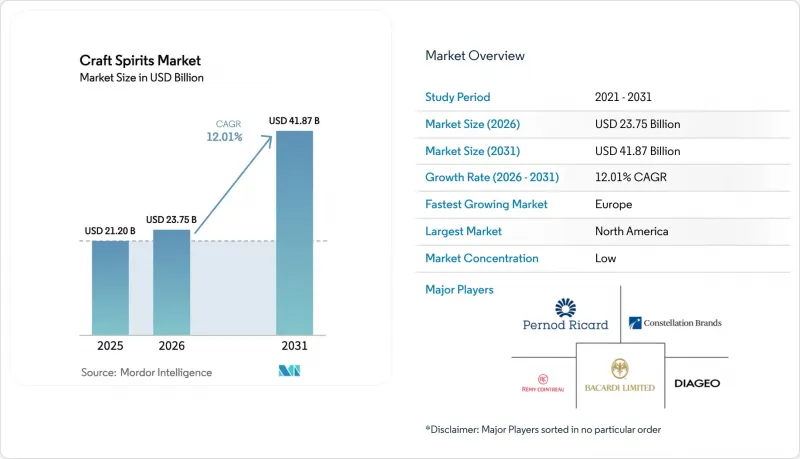
根據 Mordor Intelligence 預測,精釀烈酒市場規模將從 2025 年的 212 億美元和 2026 年的 237.5 億美元成長到 2031 年的 418.7 億美元,2026 年至 2031 年的年複合成長率(CAGR)為 12.01%。
本報告按產品類型(威士忌、金酒、伏特加、白蘭地及其他)、原料(穀物基、水果基、龍舌蘭基及其他)、分銷管道(On-Trade和Off-Trade)以及地區(北美、歐洲、亞太、南美以及中東和非洲)進行細分。市場預測以美元計價。
全球精釀烈酒市場趨勢及洞察
小型釀酒廠的興起正在推動對精釀烈酒。
小型釀酒廠的蓬勃發展,以及許多啤酒生產商將業務拓展至蒸餾領域,為精釀烈酒的發展奠定了堅實的基礎。根據美國精釀烈酒協會預測,到2024年,美國運作中中的精釀酒廠數量預計將達到3,069家,儘管市場環境充滿挑戰,但仍將成長11.5%。加州、紐約州、賓州、德克薩斯州和華盛頓州等州正在崛起為精釀烈酒生產的重要中心。小規模釀酒廠現在利用水果發酵技術製作自己的伏特加基酒,融合了精釀啤酒和蒸餾技術。產能的提升使這些生產商能夠提供小批量和限量版產品,從而提升消費者的興趣並擴大市場。預計這一趨勢將持續到2031年。
基於原料和酒精濃度的產品差異化
精釀酒廠正將產品差異化作為一項關鍵策略,透過採用獨特的原料和提供不同酒精濃度來實現這一目標。這種方法使他們能夠確立清晰的市場定位,並吸引特定的消費群體。市場正在不斷拓展酒精度數的選擇範圍,例如,Barrel Craft Spirits 於 2024 年 4 月推出了首款酒精濃度高達 123 度(61.5%)的“全醇波本威士忌”,以滿足消費者對更濃郁酒精濃度的需求。此外,低酒精和無酒精烈酒市場也在快速成長。喜力等大型公司計劃在 2025 年佔據無酒精產品 90% 的市場。這項策略旨在應對消費者日益成長的健康意識和不斷變化的飲酒習慣。這些趨勢凸顯了該產業致力於滿足多元化消費者偏好。
嚴格的政府法規
精釀烈酒產業面臨複雜的監管挑戰,影響市場准入和發展。在美國,三級分銷體系仍然是小規模生產商的一大障礙,儘管近期監管政策的調整帶來了一些新的機會。儘管85%的精釀烈酒消費者希望擁有更方便的購買管道,但目前只有9個州和華盛頓特區允許直接面對消費者(D2C)的配送(Crafted ERP)。貿易爭端進一步加劇了問題的複雜性,美國計劃於2025年第一季重新對鋼鐵和鋁徵收關稅,這可能導致歐盟對美國威士忌徵收50%的關稅,從而影響其出口(The Whiskey Lab)。此外,菸草稅收和貿易管理局(TTB)計劃強制推行“酒精含量標籤”,這將提高消費者的透明度,但也會增加精釀烈酒生產商的合規成本。
細分市場分析
到2025年,威士忌將佔據精釀烈酒市場26.77%的主導佔有率。這主要得益於消費者對高級產品日益成長的偏好以及對傳統釀造工藝的認可度不斷提高。然而,該品類也面臨供應過剩帶來的挑戰,導致價格上漲和庫存管理難題。 2025年5月,Radico採取策略性舉措,推出“TRIKAL印度單一麥芽威士忌”和“Morpheus超高階威士忌”,明確瞄準高階和超高階市場。
金酒市場預計將迎來最顯著的成長,2026年至2031年間的複合年成長率將達到12.25%。這一快速成長主要得益於創新風味的研發和區域性調整。許多國家的釀酒商正利用當地植物原料,打造出迎合國內外市場需求的獨特產品。伏特加仍佔重要市場佔有率,精釀酒商透過水果發酵等創新工藝,創造出獨特的基酒。白蘭地雖然市佔率較小,但其受歡迎程度正在迅速提升,尤其是在韓國等地區,這主要得益於頂級烈酒進口量的顯著成長。
區域分析
預計到2025年,北美將佔據最大的市場佔有率,達到38.75%。美國擁有強大的精釀蒸餾酒產業,根據美國精釀烈酒協會(American 精釀烈酒 Association)統計,目前有3069家活躍的蒸餾酒廠。然而,該協會報告稱,該產業在2023年首次下滑,產量下降3.6%,產值下降1.1%。監管趨勢也在發生變化,目前已有九個州和華盛頓特區允許直接向消費者配送烈酒。貿易緊張局勢仍構成挑戰,美國計畫於2025年3月對來自加拿大和墨西哥的進口商品徵收25%的關稅。這可能導致報復性措施和供應鏈中斷。
歐洲預計將成為成長最快的市場,2026年至2031年的複合年成長率預計為12.96%。這一成長得益於歐洲深厚的精釀烈酒傳統、成熟的雞尾酒文化以及對高級產品日益成長的需求。亞洲市場也在不斷擴張,尤其是在韓國。根據韓國海關統計,2023年韓國威士忌進口量達到創紀錄的30,586噸,年增13.1%。
南美洲、中東和非洲是新興市場。巴西和阿拉伯聯合大公國的頂級烈酒消費量正在成長。這些地區的釀酒商正在利用當地植物原料,為國內和國際市場生產獨特的金酒產品。這些地區為能夠適應當地法規並滿足消費者偏好的精釀烈酒生產商提供了發展機會。
其他好處:
- Excel格式的市場預測(ME)表
- 3個月的分析師支持
目錄
第1章:引言
- 研究假設和市場定義
- 調查範圍
第2章:調查方法
第3章執行摘要
第4章 市場狀況
- 市場概覽
- 市場促進因素
- 本地釀酒廠的增加正在推動對精釀烈酒的需求。
- 旅遊和體驗式行銷
- 基於原料和酒精濃度的產品差異化
- 高級酒類飲品需求激增
- 人們對創新口味的偏好日益成長
- 雞尾酒文化和調酒術的發展
- 市場限制因素
- 嚴格的政府法規
- 消費者對低酒精和無酒精烈酒的消費趨勢
- 供應鏈中斷影響設備和包裝材料。
- 精釀烈酒的高定價正受到價格敏感型消費者的抵制。
- 消費行為分析
- 監理展望
- 波特五力分析
第5章 市場規模與成長預測
- 依產品類型
- 威士忌酒
- 琴酒
- 伏特加酒
- 白蘭地
- 其他類型
- 按成分
- 穀物衍生
- 水果基
- 源自龍舌蘭
- 其他
- 透過分銷管道
- On-Trade
- Off-Trade
- 專賣店/酒類商店
- 其他Off-Trade通路
- 按地區
- 北美洲
- 美國
- 加拿大
- 墨西哥
- 其他北美國家
- 歐洲
- 德國
- 英國
- 義大利
- 法國
- 西班牙
- 荷蘭
- 波蘭
- 比利時
- 瑞典
- 其他歐洲國家
- 亞太地區
- 中國
- 印度
- 日本
- 澳洲
- 印尼
- 韓國
- 泰國
- 新加坡
- 其他亞太國家
- 南美洲
- 巴西
- 阿根廷
- 哥倫比亞
- 智利
- 秘魯
- 其他南美國家
- 中東和非洲
- 南非
- 沙烏地阿拉伯
- 阿拉伯聯合大公國
- 奈及利亞
- 埃及
- 摩洛哥
- 土耳其
- 其他中東和非洲國家
- 北美洲
第6章 競爭情勢
- 市場集中度
- 策略趨勢
- 市佔率分析
- 公司簡介
- Pernod Ricard SA
- Diageo PLC
- Bacardi Limited
- Constellation Brands Inc.
- Remy Cointreau SA
- Davide Campari-Milano NV
- William Grant & Sons Ltd
- Suntory Holdings Ltd
- Brown-Forman Corporation
- Heaven Hill Distilleries, Inc.
- Rogue Ales & Spirits
- Hotaling & Co.
- Kings County Distillery
- St. George Spirits Inc.
- Ian Macleod Distillers Ltd
- Copperworks Distilling Company
- Cotswolds Distillery Ltd
- Kweichow Moutai Co. Ltd.
- Allied Blenders And Distillers Limited(ABDL)
- Sazerac Company, Inc.
第7章 市場機會與未來展望
According to Mordor Intelligence, the craft spirits market size is projected to expand from USD 21.20 billion in 2025 and USD 23.75 billion in 2026 to USD 41.87 billion by 2031, registering a CAGR of 12.01% between 2026 to 2031.
This report is Segmented by Product Type (Whiskey, Gin, Vodka, Brandy, and Other Types), by Ingredient (Grain-Based, Fruit-Based, Agave-Based, and Others), by Distribution Channel (On-Trade and Off-Trade), and by Geography (North America, Europe, Asia-Pacific, South America, and Middle East and Africa). The Market Forecasts are Provided in Terms of Value (USD).
Global Craft Spirits Market Trends and Insights
Rising Number of Microbreweries Propelling the Demand for Craft Spirits
The growth of microbreweries has established a strong foundation for craft spirits development, as many beer producers have expanded into distillation operations. According to the American Craft Spirits Association, the number of active craft distillers in the United States reached 3,069 by 2024, showing an 11.5% increase despite challenging market conditions. States such as California, New York, Pennsylvania, Texas, and Washington have emerged as major centers for craft production . Micro-distilleries are now using fruit fermentation to create unique vodka bases, combining skills from craft brewing and distilling. Improved production capabilities have enabled these producers to offer small-batch and limited-edition products, increasing consumer interest and expanding the market. This trend is expected to continue until 2031.
Product Diffrentiation in Terms of Ingredients And Alcohol Content
Craft distillers are using product differentiation as a key strategy by incorporating unique ingredients and offering varied alcohol content levels. This approach helps them create distinct market positions and attract specific consumer groups. The market is expanding its alcohol content options, as seen in April 2024 when Barrell Craft Spirits launched its first Full Proof Bourbon at 123 proof (61.5% ABV) to meet the demand for stronger flavor profiles. Additionally, the low and no-alcohol spirits segment is growing rapidly. Leading companies like Heineken are planning to achieve a 90% market share in zero-alcohol options by 2025. This strategy addresses the rising demand from health-conscious consumers and changing drinking habits. These trends highlight the industry's focus on meeting diverse consumer preferences.
Stringent Government Regulations
The craft spirits industry faces complex regulatory challenges that affect market entry and growth. In the U.S., the three-tier distribution system remains a major hurdle for small producers, though recent changes in regulations have created new opportunities. Despite 85% of craft spirits consumers wanting easier access, only nine states and D.C. currently allow direct-to-consumer (D2C) spirits shipping (Crafted ERP). Trade disputes add further complications, with the U.S. reintroducing steel and aluminum tariffs in Q1 2025, which may lead to a 50% EU tariff on American whiskey, impacting exports (The Whiskey Lab). Additionally, the Tobacco Tax and Trade Bureau (TTB) plans to introduce mandatory "Alcohol Facts" labels. While this will improve transparency for consumers, it will also increase compliance costs for craft producers.
Other drivers and restraints analyzed in the detailed report include:
- Surge in Demand for Premium Alcoholic Beverages
- Increasing Preference For Innovative Flavors
- Consumers Inclination Towards low/no Alcohol Spirits
For complete list of drivers and restraints, kindly check the Table Of Contents.
Segment Analysis
In 2025, whiskey commands a dominant 26.77% share of the craft spirits market, buoyed by a consumer shift towards premium offerings and a nod to traditional production methods. However, this category grapples with challenges stemming from oversupply, leading to pricing pressures and inventory management dilemmas. In May 2025, Radico made a strategic move, unveiling TRIKAL Indian Single Malt and Morpheus Super Premium Whisky, aiming squarely at the luxury and super-premium segments.
Gin is poised for the most significant growth, projected to achieve a CAGR of 12.25% from 2026 to 2031. This surge is largely attributed to innovative flavor developments and regional adaptations. Distillers in numerous countries are harnessing local botanicals, crafting unique products tailored for both domestic and global markets. Vodka remains a staple segment, with craft producers innovating through fruit fermentation to craft distinctive base spirits. While brandy holds a smaller slice of the market, it's witnessing a surge in popularity, especially in regions like South Korea, where there's a notable uptick in premium spirit imports.
Complete Report Scope:
- By Product Type
- Whiskey
- Gin
- Vodka
- Brandy
- Other Types
- By Ingredient
- Grain-based
- Fruit-based
- Agave-based
- Others
- By Distribution Channel
- On-Trade
- Off-Trade
- Specialty/Liquor Stores
- Other Off Trade Channels
- By Geography
- North America
- United States
- Canada
- Mexico
- Rest of North America
- Europe
- Germany
- United Kingdom
- Italy
- France
- Spain
- Netherlands
- Poland
- Belgium
- Sweden
- Rest of Europe
- Asia-Pacific
- China
- India
- Japan
- Australia
- Indonesia
- South Korea
- Thailand
- Singapore
- Rest of Asia-Pacific
- South America
- Brazil
- Argentina
- Colombia
- Chile
- Peru
- Rest of South America
- Middle East and Africa
- South Africa
- Saudi Arabia
- United Arab Emirates
- Nigeria
- Egypt
- Morocco
- Turkey
- Rest of Middle East and Africa
- North America
Geography Analysis
In 2025, North America held the largest market share at 38.75%. The United States has a strong craft distilling industry, with 3,069 active craft distillers, according to the American Craft Spirits Association. However, the sector faced its first decline in 2023, with a 3.6% drop in production volumes and a 1.1% decrease in value, based on the same source. Regulations are changing, with nine states and Washington, D.C., now allowing direct-to-consumer spirits shipping. Trade tensions remain a challenge, as the U.S. planned to introduce a 25% tariff on Canadian and Mexican imports in March 2025. This could lead to retaliatory actions and disrupt supply chains.
Europe is expected to grow the fastest, with a projected CAGR of 12.96% from 2026 to 2031. This growth is driven by strong craft traditions, a well-established cocktail culture, and rising demand for premium products. In Asia, the market is expanding, especially in South Korea, where whisky imports reached a record 30,586 tons in 2023, a 13.1% increase from the previous year, according to the Korea Customs Service.
South America and the Middle East and Africa are emerging markets. Brazil and the UAE are seeing higher consumption of premium spirits. Distillers in these regions are using local botanicals to create unique gin products for both domestic and international markets. These regions offer growth opportunities for craft spirits manufacturers who can adapt to local regulations and meet consumer preferences.
- Pernod Ricard SA
- Diageo PLC
- Bacardi Limited
- Constellation Brands Inc.
- Remy Cointreau SA
- Davide Campari-Milano NV
- William Grant & Sons Ltd
- Suntory Holdings Ltd
- Brown-Forman Corporation
- Heaven Hill Distilleries, Inc.
- Rogue Ales & Spirits
- Hotaling & Co.
- Kings County Distillery
- St. George Spirits Inc.
- Ian Macleod Distillers Ltd
- Copperworks Distilling Company
- Cotswolds Distillery Ltd
- Kweichow Moutai Co. Ltd.
- Allied Blenders And Distillers Limited (ABDL)
- Sazerac Company, Inc.
Additional Benefits:
- The market estimate (ME) sheet in Excel format
- 3 months of analyst support
TABLE OF CONTENTS
1 INTRODUCTION
- 1.1 Study Assumptions and Market Definition
- 1.2 Scope of the Study
2 RESEARCH METHODOLOGY
3 EXECUTIVE SUMMARY
4 MARKET LANDSCAPE
- 4.1 Market Overview
- 4.2 Market Drivers
- 4.2.1 Rising Number of Microbreweries Propelling the Demand for Craft Spirits
- 4.2.2 Tourism and Experiential Marketing
- 4.2.3 Product Diffrentiation in Terms of Ingredients And Alcohol Content
- 4.2.4 Surge in Demand for Premium Alcoholic Beverages
- 4.2.5 Increasing Preference For Innovative Flavors
- 4.2.6 Growth of Cocktail Culture and Mixology
- 4.3 Market Restraints
- 4.3.1 Stringent Government Regulations
- 4.3.2 Consumers Inclination Towards low/no Alcohol Spirits
- 4.3.3 Supply chain disruptions affecting equipment and packaging
- 4.3.4 Premium pricing of craft spirits faces resistance from price-sensitive consumers
- 4.4 Consumer Behaviour Analysis
- 4.5 Regulatory Outlook
- 4.6 Porter's Five Forces Analysis
- 4.6.1 Bargaining Power of Suppliers
- 4.6.2 Bargaining Power of Buyers
- 4.6.3 Threat of New Entrants
- 4.6.4 Threat of Substitutes
- 4.6.5 Degree of Competition
5 MARKET SIZE AND GROWTH FORECASTS (VALUE)
- 5.1 By Product Type
- 5.1.1 Whiskey
- 5.1.2 Gin
- 5.1.3 Vodka
- 5.1.4 Brandy
- 5.1.5 Other Types
- 5.2 By Ingredient
- 5.2.1 Grain-based
- 5.2.2 Fruit-based
- 5.2.3 Agave-based
- 5.2.4 Others
- 5.3 By Distribution Channel
- 5.3.1 On-Trade
- 5.3.2 Off-Trade
- 5.3.2.1 Specialty/Liquor Stores
- 5.3.2.2 Other Off Trade Channels
- 5.4 By Geography
- 5.4.1 North America
- 5.4.1.1 United States
- 5.4.1.2 Canada
- 5.4.1.3 Mexico
- 5.4.1.4 Rest of North America
- 5.4.2 Europe
- 5.4.2.1 Germany
- 5.4.2.2 United Kingdom
- 5.4.2.3 Italy
- 5.4.2.4 France
- 5.4.2.5 Spain
- 5.4.2.6 Netherlands
- 5.4.2.7 Poland
- 5.4.2.8 Belgium
- 5.4.2.9 Sweden
- 5.4.2.10 Rest of Europe
- 5.4.3 Asia-Pacific
- 5.4.3.1 China
- 5.4.3.2 India
- 5.4.3.3 Japan
- 5.4.3.4 Australia
- 5.4.3.5 Indonesia
- 5.4.3.6 South Korea
- 5.4.3.7 Thailand
- 5.4.3.8 Singapore
- 5.4.3.9 Rest of Asia-Pacific
- 5.4.4 South America
- 5.4.4.1 Brazil
- 5.4.4.2 Argentina
- 5.4.4.3 Colombia
- 5.4.4.4 Chile
- 5.4.4.5 Peru
- 5.4.4.6 Rest of South America
- 5.4.5 Middle East and Africa
- 5.4.5.1 South Africa
- 5.4.5.2 Saudi Arabia
- 5.4.5.3 United Arab Emirates
- 5.4.5.4 Nigeria
- 5.4.5.5 Egypt
- 5.4.5.6 Morocco
- 5.4.5.7 Turkey
- 5.4.5.8 Rest of Middle East and Africa
- 5.4.1 North America
6 COMPETITIVE LANDSCAPE
- 6.1 Market Concentration
- 6.2 Strategic Moves
- 6.3 Market Share Analysis
- 6.4 Company Profiles (Includes Global-level Overview, Market-level Overview, Core Segments, Financials, Strategic Info, Market Rank/Share, Products and Services, Recent Developments)
- 6.4.1 Pernod Ricard SA
- 6.4.2 Diageo PLC
- 6.4.3 Bacardi Limited
- 6.4.4 Constellation Brands Inc.
- 6.4.5 Remy Cointreau SA
- 6.4.6 Davide Campari-Milano NV
- 6.4.7 William Grant & Sons Ltd
- 6.4.8 Suntory Holdings Ltd
- 6.4.9 Brown-Forman Corporation
- 6.4.10 Heaven Hill Distilleries, Inc.
- 6.4.11 Rogue Ales & Spirits
- 6.4.12 Hotaling & Co.
- 6.4.13 Kings County Distillery
- 6.4.14 St. George Spirits Inc.
- 6.4.15 Ian Macleod Distillers Ltd
- 6.4.16 Copperworks Distilling Company
- 6.4.17 Cotswolds Distillery Ltd
- 6.4.18 Kweichow Moutai Co. Ltd.
- 6.4.19 Allied Blenders And Distillers Limited (ABDL)
- 6.4.20 Sazerac Company, Inc.


