

 |
市場調查報告書
商品編碼
2123986
尿液檢查:市場佔有率分析、產業趨勢和統計數據、成長預測(2026-2031)Urinalysis - Market Share Analysis, Industry Trends & Statistics, Growth Forecasts (2026 - 2031) |
||||||

※ 本網頁內容可能與最新版本有所差異。詳細情況請與我們聯繫。
據 Mordor Intelligence 稱,2025 年尿液檢查市場價值為 39.6 億美元,預計到 2031 年將達到 56.8 億美元,而 2026 年為 41.9 億美元,預測期(2026-2031 年)的複合年成長率為 6.26%。
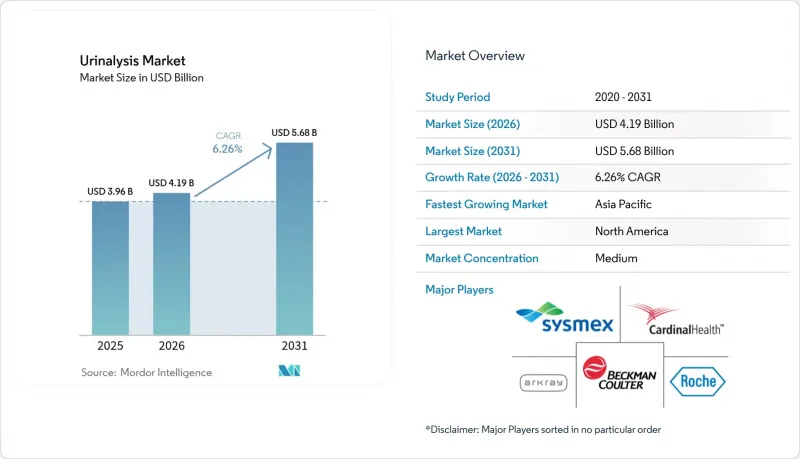
本報告按產品(耗材、設備[全自動分析儀、半自動分析儀]、即時檢驗 (POC) 設備)、檢測類型(生化尿液檢查、尿沉渣分析、妊娠和不孕症檢測等)、最終用戶(醫院等)以及地區(北美、歐洲、亞太、中東和非洲、南美)進行細分。市場預測以美元 (USD) 為單位。
全球尿液檢查市場趨勢與洞察
慢性腎臟病病盛行率增加
據估計,全球約有7.88億人患有慢性腎臟病(CKD),預計到2024年,美國成年人中將有14%被診斷出患有此病。因此,對糖尿病和高血壓患者進行蛋白尿和血尿的季度或半年篩檢已成為標準做法。醫院和診斷連鎖機構依賴每小時可處理240-480個檢體的分析設備,從而降低人事費用並實現當日臨床干預。印度二、三線城市「中心輻射式」模式的快速擴張進一步增加了送至集中檢測機構的檢體數。雖然每次強制性後續檢測都會增加試劑收入,但挑戰在於公共保險機構對每次檢測收費設定上限,這限制了報銷金額。
糖尿病患者人數不斷增加,因此需要定期尿液檢查。
根據國際糖尿病聯盟(IDF)的數據,2024年全球糖尿病成人患者人數為5.37億,預計2030年將超過6.4億人。尿液檢查可在糖尿病腎臟病早期階段檢測出微量白蛋白尿,並用於監測血糖控制不佳的糖尿病患者。公共醫療保險機構建議進行預防性檢測以避免終末期併發症,但在印度的“阿尤斯曼·巴拉特”(Ayushman Bharat)計劃中,由於對私立醫院的報銷不足,人們開始轉向成本更低的藥房和家庭檢測。提供血糖值和白蛋白測量試紙與藍牙讀取器結合的產品的供應商正在與南亞和中東各地的社區健康中心簽訂合約。
新興市場的贖回率
公共醫療保險計劃的報銷金額通常低於試劑成本,這阻礙了私人投資。 2025年馬哈拉斯特拉邦的一項調查發現,只有13%的私人醫院接受「阿尤斯曼·巴拉特」(Ayushman Bharat)醫療保險計劃的報銷標準,迫使患者前往公立醫院就診或自費。世界衛生組織指出,中低收入國家用於診斷檢測的醫療預算不到總預算的5%。供應商正在轉向使用成本較低的試紙,但利潤率仍然很低,分銷管道也仍然分散。
細分市場分析
2025年,尿液檢測耗材將佔尿液檢查市場收入的49.82%,凸顯了專用試劑條因針對特定分析儀校正而造成的市場鎖定效應。自動化分析儀分為用於核心檢查室的全自動工作站和每日可處理60至240個樣本的半自動桌上型設備。儘管集中採購導致單次檢測利潤率下降,但尿液檢查耗材市場預計仍將穩定成長。在2024年的競標中,中國醫院為全自動分析儀支付的平均價格為53,300元人民幣(約7,400美元),國內品牌提供的試劑和服務合約更受青睞。
隨著智慧型手機連接式讀卡機和微流體晶片在藥局和居家醫療項目中日益普及,預計到2031年,即時檢測(POC)設備將以7.06%的複合年成長率成長。該領域的銷售受益於對CLINITEK Novus和DxU Iris平台的資本投資,這些平台整合了試紙分析、數位顯微鏡和人工智慧驅動的顆粒識別技術。在印度和拉丁美洲預算有限的二線醫院中,半自動分析儀仍然發揮著至關重要的作用。獸醫和寵物醫院仍然是小眾市場,但隨著寵物飼養量的成長,對耗材的需求逐漸增加。
區域分析
預計到2025年,北美將佔據尿液檢查市場36.78%的佔有率,這得益於其完善的保險報銷體係以及對人工智慧尿沉渣分析平台的早期應用。美國食品藥物管理局(FDA)於2024年發布的網路安全指南明確了510(k)申請流程,並加速了產品開發。人手不足正促使醫院轉向自動化,而這與高通量分析儀的資本投資密切相關。在加拿大,省級篩檢計畫正在推動相關投資,而墨西哥則出現了更多專注於糖尿病監測的私人實驗室連鎖機構。保險報銷率的下降抑制了收入,但預防性醫療保健檢測的增加在一定程度上抵消了價格下降的影響。
亞太地區是成長最快的地區,預計2026年至2031年複合年成長率將達到9.28%。中國的集中採購政策正在推動對優利特、迪瑞和邁瑞等國產分析儀器的需求,這些公司提供的整合試劑在2024年佔合約總額的73.61%。日本市場依然成熟,尿液檢查試紙在2023年佔英研化學銷售額的11%。此外,日本厚生勞動省2024年發布的指導方針支援將醫療設備軟體(SaM)納入健保報銷範圍。在強大的遠端醫療基礎設施的推動下,澳洲和韓國的連網家庭設備正在迅速普及。
歐洲憑藉其全民健保系統和ISO 15189標準的實施,佔據了相當大的市場佔有率。德國和英國在自動化分析儀的應用方面處於領先地位,但GDPR的實施提高了雲端連接設備的合規性門檻。東歐的醫院正利用歐盟醫療保健基金的津貼進行現代化改造,但預算限制限制了高效能分析儀的普及。拉丁美洲、中東和非洲的市場佔有率較小,但隨著私立醫院診斷能力的提升,這些地區的市場佔有率正穩步成長。然而,外匯波動和保險報銷體系的碎片化仍然是持續存在的風險。
其他好處:
- Excel格式的市場預測(ME)表
- 3個月的分析師支持
目錄
第1章:引言
- 研究假設和市場定義
- 調查範圍
第2章:調查方法
第3章執行摘要
第4章 市場狀況
- 市場概覽
- 市場促進因素
- 慢性腎臟病病盛行率增加
- 糖尿病患者人數不斷增加,因此需要定期尿液檢查。
- 過渡到自動化、高通量尿液檢查平台
- 將人工智慧影像分析技術應用於沉積物調查
- 自測檢測套組和遠端尿液檢查盒的廣泛應用
- 擴大尿液生物標記在癌症篩檢的應用
- 市場限制因素
- 新興市場的贖回率
- 熟練的醫療技術人員短缺
- 對家庭連網型設備資料隱私的擔憂
- 試劑級化學品供應鏈的脆弱性
- 監理情勢
- 技術展望
- 波特五力分析
第5章 市場規模與成長預測
- 依產品
- 耗材(試劑和試紙)
- 裝置
- 自動分析儀
- 半自動分析儀
- 即時檢測設備
- 按測試類型
- 尿液檢查
- 沉積物分析
- 妊娠和不孕症檢查
- 藥物濫用檢測
- 感染疾病檢測
- 最終用戶
- 醫院
- 診斷檢查室
- 居家醫療
- 學術研究機構
- 動物診所
- 按地區
- 北美洲
- 美國
- 加拿大
- 墨西哥
- 歐洲
- 德國
- 英國
- 法國
- 義大利
- 西班牙
- 其他歐洲國家
- 亞太地區
- 中國
- 日本
- 印度
- 澳洲
- 韓國
- 其他亞太國家
- 中東和非洲
- GCC
- 南非
- 其他中東和非洲國家
- 南美洲
- 巴西
- 阿根廷
- 其他南美國家
- 北美洲
第6章 競爭情勢
- 市場集中度
- 市佔率分析
- 公司簡介
- Abbott Laboratories
- ACON Laboratories, Inc.
- ARKRAY Inc.
- Bio-Rad Laboratories Inc.
- Beckman Coulter Inc.
- Cardinal Health, Inc.
- Danaher Corporation
- DIRUI Industrial Co., Ltd.
- EKF Diagnostics Holdings plc
- F. Hoffmann-La Roche Ltd
- HORIBA, Ltd.
- Idexx Laboratories, Inc.
- Medica Corporation
- Mindray Bio-Medical Electronics Co., Ltd.
- QuidelOrtho Corporation
- Shenzhen Mindel Medical Co., Ltd.
- Siemens Healthineers AG
- Sysmex Corporation
- Thermo Fisher Scientific Inc.
- Trinity Biotech plc
第7章 市場機會與未來展望
According to Mordor Intelligence, the urinalysis market size was valued at USD 3.96 billion in 2025 and is estimated to grow from USD 4.19 billion in 2026 to reach USD 5.68 billion by 2031, at a CAGR of 6.26% during the forecast period (2026-2031).
This report is Segmented by Product (Consumables, Instruments [Automated Analyzers, Semi-Automated Analyzers], Point-Of-Care Devices), Test Type (Biochemical Urinalysis, Sediment Analysis, Pregnancy & Fertility Testing, and More), End User (Hospitals, and More), and Geography (North America, Europe, Asia-Pacific, Middle East & Africa, South America). The Market Forecasts are Provided in Terms of Value (USD).
Global Urinalysis Market Trends and Insights
Rising Prevalence of Chronic Kidney Diseases
Worldwide, an estimated 788 million people live with CKD, and 14% of U.S. adults carried a diagnosis in 2024. Quarterly or semi-annual urine screening for proteinuria and hematuria has therefore become standard for diabetics and hypertensives. Hospitals and diagnostic chains rely on analyzers that process 240-480 samples per hour, reducing labor costs and enabling same-day clinical intervention. Rapid hub-and-spoke expansion in India's tier-2 and tier-3 cities channels additional volumes to centralized labs. Recurring reagent revenue rises with every mandated follow-up but faces reimbursement caps when public insurers fix per-test fees.
Growing Diabetic Population Necessitating Routine Urine Testing
The International Diabetes Federation counted 537 million adults with diabetes in 2024 and expects the figure to top 640 million by 2030. Urinalysis detects microalbuminuria early in diabetic nephropathy and monitors glycosuria in uncontrolled patients. Public insurers favor preventive testing to avoid late-stage complications, yet India's Ayushman Bharat program under-reimburses private hospitals, prompting a shift toward lower-cost pharmacy and home testing. Vendors pairing glucose and albumin strips with Bluetooth readers have secured contracts in community health centers across South Asia and the Middle East.
Reimbursement Gaps Across Emerging Markets
Public insurance programs often reimburse below the cost of reagents, discouraging private investment. Only 13% of private hospitals in a 2025 Maharashtra survey accepted Ayushman Bharat rates, pushing patients toward public facilities or cash payments. WHO noted that low- and middle-income countries spend less than 5% of their health budgets on diagnostics. Suppliers pivot to low-cost strips, but margins remain tight and distribution fragmented.
Other drivers and restraints analyzed in the detailed report include:
- Shift Toward Automated, High-Throughput Platforms
- Integration of AI-Powered Image Analysis for Sediment Examination
- Shortage of Skilled Laboratory Technicians
For complete list of drivers and restraints, kindly check the Table Of Contents.
Segment Analysis
Consumables generated 49.82% of urinalysis market revenue in 2025, underscoring the lock-in created by proprietary reagent strips calibrated for specific analyzers. Automated analyzers split into fully automatic workcells serving core laboratories and semi-automatic benchtop units addressing 60-240 daily tests. The urinalysis market for consumables is projected to grow steadily, even as pricing pressure from centralized procurement compresses per-test margins. Hospitals in China paid an average of RMB 53,300 (USD 7,400) for fully automatic analyzers during 2024 tenders, favoring domestic brands that bundled reagents and service contracts.
Point-of-care devices grow at a 7.06% CAGR through 2031 as pharmacies and home-health programs adopt smartphone-linked readers and microfluidic cartridges. Instruments segment revenue benefits from capital purchases of CLINITEK Novus and DxU Iris platforms, which integrate strip analysis with digital microscopy and AI particle recognition. Semi-automated analyzers remain relevant in tier-2 hospitals across India and Latin America, where budgets are tight. Veterinary clinics and companion-animal hospitals are a niche but expanding outlet, adding incremental demand for consumables as pet ownership rises.
Complete Report Scope:
- By Product
- Consumables (Reagents & Strips)
- Instruments
- Automated Analyzers
- Semi-Automated Analyzers
- Point-of-Care Devices
- By Test Type
- Biochemical Urinalysis
- Sediment Analysis
- Pregnancy & Fertility Testing
- Drug-of-Abuse Testing
- Infectious Disease Detection
- By End User
- Hospitals
- Diagnostic Laboratories
- Home-Care Settings
- Academic & Research Institutes
- Veterinary Clinics
- By Geography
- North America
- United States
- Canada
- Mexico
- Europe
- Germany
- United Kingdom
- France
- Italy
- Spain
- Rest of Europe
- Asia-Pacific
- China
- Japan
- India
- Australia
- South Korea
- Rest of Asia-Pacific
- Middle East & Africa
- GCC
- South Africa
- Rest of Middle East & Africa
- South America
- Brazil
- Argentina
- Rest of South America
- North America
Geography Analysis
North America accounted for 36.78% of the urinalysis market share in 2025, owing to established reimbursement pathways and early uptake of AI sediment platforms. The FDA's 2024 cybersecurity guidance clarified 510(k) routes, speeding commercial launches. Workforce shortages drive hospitals to automate, aligning with capital spend on high-throughput analyzers. Canada invests through provincial screening initiatives, whereas Mexico increases private-sector laboratory chains focused on diabetes monitoring. Reimbursement cuts temper revenue, but rising preventive-health volumes partly offset price erosion.
Asia-Pacific is the fastest-growing region, with a 9.28% CAGR projected for 2026-2031. China's centralized tenders shifted volumes toward domestically produced analyzers from Youlite, Dirui, and Mindray, whose integrated reagent offers secured 73.61% of 2024 contract value. Japan maintains a mature market with 11% of Eiken Chemical's 2023 revenue from urinalysis strips, and the 2024 MoH guidebook supports software-as-a-medical-device reimbursement. Australia and South Korea are quickly adopting connected home devices due to their robust telemedicine infrastructure.
Europe holds a significant stake thanks to universal coverage and the enforcement of ISO 15189. Germany and the United Kingdom lead automated-analyzer uptake, while GDPR raises compliance hurdles for cloud-connected devices. Eastern European hospitals modernize under EU health-fund grants, yet constrained budgets limit premium analyzer penetration. Latin America and the Middle East & Africa contribute smaller portions but register steady growth as private hospitals expand diagnostics capacity, although currency volatility and fragmented reimbursement pose ongoing risks.
- Abbott Laboratories
- Acon Laboratories
- Arkray
- Bio-Rad Laboratories
- Beckton Dickinson
- Cardinal Health
- Danaher
- DIRUI Industrial Co., Ltd.
- EKF Diagnostics Holdings plc
- Roche
- HORIBA
- IDEXX
- Medica Corporation
- Mindray Bio-Medical Electronics Co., Ltd.
- QuidelOrtho
- Shenzhen Mindel Medical Co., Ltd.
- Siemens Healthineers
- Sysmex
- Thermo Fisher Scientific
- Trinity Biotech plc
Additional Benefits:
- The market estimate (ME) sheet in Excel format
- 3 months of analyst support
TABLE OF CONTENTS
1 Introduction
- 1.1 Study Assumptions & Market Definition
- 1.2 Scope of the Study
2 Research Methodology
3 Executive Summary
4 Market Landscape
- 4.1 Market Overview
- 4.2 Market Drivers
- 4.2.1 Rising Prevalence of Chronic Kidney Diseases
- 4.2.2 Growing Diabetic Population Necessitating Routine Urine Testing
- 4.2.3 Shift Toward Automated, High-Throughput Urinalysis Platforms
- 4.2.4 Integration of AI-Powered Image Analysis for Sediment Examination
- 4.2.5 Expansion of Self-Testing & Tele-Urinalysis Kits
- 4.2.6 Increasing Adoption of Urinary Biomarkers for Oncology Screening
- 4.3 Market Restraints
- 4.3.1 Reimbursement Gaps Across Emerging Markets
- 4.3.2 Shortage of Skilled Laboratory Technicians
- 4.3.3 Data-Privacy Concerns in At-Home Connected Devices
- 4.3.4 Supply-Chain Vulnerability in Reagent-Grade Chemicals
- 4.4 Regulatory Landscape
- 4.5 Technological Outlook
- 4.6 Porter's Five Forces Analysis
- 4.6.1 Threat of New Entrants
- 4.6.2 Bargaining Power of Buyers
- 4.6.3 Bargaining Power of Suppliers
- 4.6.4 Threat of Substitute Products
- 4.6.5 Intensity of Competitive Rivalry
5 Market Size & Growth Forecasts
- 5.1 By Product
- 5.1.1 Consumables (Reagents & Strips)
- 5.1.2 Instruments
- 5.1.2.1 Automated Analyzers
- 5.1.2.2 Semi-Automated Analyzers
- 5.1.3 Point-of-Care Devices
- 5.2 By Test Type
- 5.2.1 Biochemical Urinalysis
- 5.2.2 Sediment Analysis
- 5.2.3 Pregnancy & Fertility Testing
- 5.2.4 Drug-of-Abuse Testing
- 5.2.5 Infectious Disease Detection
- 5.3 By End User
- 5.3.1 Hospitals
- 5.3.2 Diagnostic Laboratories
- 5.3.3 Home-Care Settings
- 5.3.4 Academic & Research Institutes
- 5.3.5 Veterinary Clinics
- 5.4 By Geography
- 5.4.1 North America
- 5.4.1.1 United States
- 5.4.1.2 Canada
- 5.4.1.3 Mexico
- 5.4.2 Europe
- 5.4.2.1 Germany
- 5.4.2.2 United Kingdom
- 5.4.2.3 France
- 5.4.2.4 Italy
- 5.4.2.5 Spain
- 5.4.2.6 Rest of Europe
- 5.4.3 Asia-Pacific
- 5.4.3.1 China
- 5.4.3.2 Japan
- 5.4.3.3 India
- 5.4.3.4 Australia
- 5.4.3.5 South Korea
- 5.4.3.6 Rest of Asia-Pacific
- 5.4.4 Middle East & Africa
- 5.4.4.1 GCC
- 5.4.4.2 South Africa
- 5.4.4.3 Rest of Middle East & Africa
- 5.4.5 South America
- 5.4.5.1 Brazil
- 5.4.5.2 Argentina
- 5.4.5.3 Rest of South America
- 5.4.1 North America
6 Competitive Landscape
- 6.1 Market Concentration
- 6.2 Market Share Analysis
- 6.3 Company Profiles (includes Global Level Overview, Market Level Overview, Core Segments, Financials as Available, Strategic Information, Market Rank/Share for Key Companies, Products & Services, and Recent Developments)
- 6.3.1 Abbott Laboratories
- 6.3.2 ACON Laboratories, Inc.
- 6.3.3 ARKRAY Inc.
- 6.3.4 Bio-Rad Laboratories Inc.
- 6.3.5 Beckman Coulter Inc.
- 6.3.6 Cardinal Health, Inc.
- 6.3.7 Danaher Corporation
- 6.3.8 DIRUI Industrial Co., Ltd.
- 6.3.9 EKF Diagnostics Holdings plc
- 6.3.10 F. Hoffmann-La Roche Ltd
- 6.3.11 HORIBA, Ltd.
- 6.3.12 Idexx Laboratories, Inc.
- 6.3.13 Medica Corporation
- 6.3.14 Mindray Bio-Medical Electronics Co., Ltd.
- 6.3.15 QuidelOrtho Corporation
- 6.3.16 Shenzhen Mindel Medical Co., Ltd.
- 6.3.17 Siemens Healthineers AG
- 6.3.18 Sysmex Corporation
- 6.3.19 Thermo Fisher Scientific Inc.
- 6.3.20 Trinity Biotech plc
7 Market Opportunities & Future Outlook
- 7.1 White-space & Unmet-Need Assessment

 尿液檢查市場:2026-2032年全球市場預測(依產品類型、檢測類型、技術、應用、最終用戶及通路分類)
 2026 年至 2035 年尿液檢查的市場機會、成長要素、產業趨勢分析與預測。
 尿液檢查市場:依產品類型、檢測類型、應用和地區分類
 全球尿液檢查市場規模、佔有率、趨勢和成長分析報告(2026-2034年)
 尿液尿液檢查市場規模、佔有率和成長分析:按檢測類型、應用、最終用戶、分銷管道、地區和行業預測,2026-2033年
 獸用尿液檢查產品市場規模、佔有率和成長分析:按產品類型、動物種類、應用、最終用戶、銷售管道和地區分類 - 2026-2033 年行業預測
 尿液檢查市場規模、佔有率和成長分析(按檢測方法、應用、最終用戶和地區分類)—產業預測(2026-2033 年)
 尿液檢查市場規模、佔有率和成長分析(按產品類型、檢測類型、應用、最終用戶和地區分類)-2026-2033年產業預測
 尿液分析儀:全球市佔率及排名、總收入及需求預測(2025-2031年)
 2025年全球尿沉渣檢測市場報告