


 |
市場調查報告書
商品編碼
2123985
生物基聚丙烯:市場佔有率分析、行業趨勢和統計數據以及成長預測(2026-2031 年)Bio-based Polypropylene - Market Share Analysis, Industry Trends & Statistics, Growth Forecasts (2026 - 2031) |
||||||

※ 本網頁內容可能與最新版本有所差異。詳細情況請與我們聯繫。
據 Mordor Intelligence 稱,2025 年生物基聚丙烯市場價值為 34.84 千噸,預計在預測期(2026-2031 年)內將以 21.16% 的複合年成長率 (CAGR) 成長,從 2026 年的 42.21 千噸。
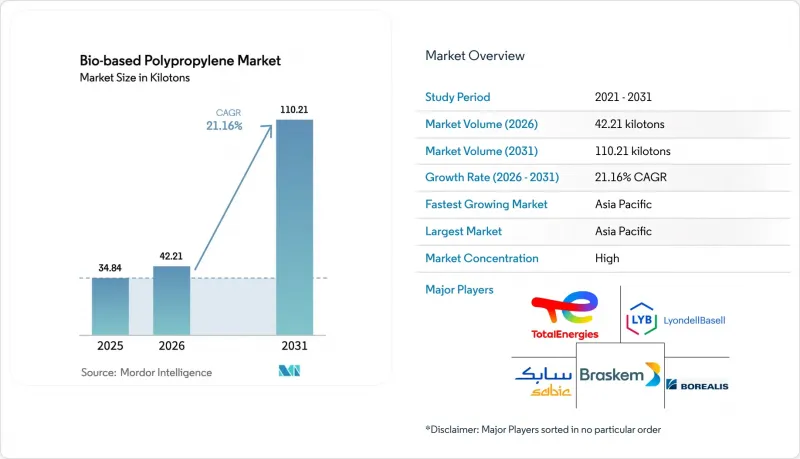
本報告按原料(如甘蔗、玉米、纖維素生質能)、產品類型(如均聚物)、應用(例如射出成型、薄膜)、終端用戶產業(如包裝、汽車、消費品)和地區(亞太地區、北美、歐洲、南美、中東和非洲)進行細分。市場預測以噸為單位。
全球生物基聚丙烯市場趨勢與洞察
歐盟對包裝中再生材料含量的嚴格要求正在推動對硬質生物基聚丙烯的需求。
《包裝及包裝廢棄物法規》於2025年2月生效,規定歐盟境內銷售的所有塑膠包裝到2030年必須達到30%的再生材料含量,到2040年必須達到50-65%。該法規設有一項例外條款,允許在食品級回收技術實現商業化應用之前,將生物基原料納入上述基準值。歐盟委員會計劃在2028年2月前對該條款進行審查。因此,硬質聚丙烯容器、瓶蓋和包裝箱將獲得監管方面的“保障”,零售商正努力在法規實施前確保獲得物料平衡認證的原料來源。該法規還禁止在食品接觸應用中使用全氟烷基和多氟烷基物質(PFAS),並鼓勵將先前在耐油應用中占主導地位的含氟塗層轉向生物基聚丙烯。因此,跨國公司正在加快採購合約的簽訂,以規避合規風險。
汽車原始設備製造商為減輕車重和實現淨零排放所做的努力
BMW的目標是到2030年使其熱塑性塑膠的再生材料含量達到40%,目前正在試驗使用生物基聚丙烯車門面板和儀表板,這些面板可以直接用於現有模具,無需重新認證。沃爾沃計劃在2030年使其所有車型使用30%的再生塑膠,並在內飾件中使用可再生聚丙烯以確保碰撞安全性。福特已獲得美國能源局250萬美元的津貼,用於開發一種將二氧化碳轉化為多元醇的化學反應技術,可與生物基丙烯衍生物結合使用。作為回應,北歐化工推出了其「Bornewables」化合物,該化合物透過ISCC Plus配額實現了高達100%的可再生原料含量。同時,Lignin Industries的核心添加劑「Renol」射出成型成型共聚物的零件重量降低10%,並將生產週期縮短30%。
與化石基聚丙烯相比,其生產成本較高。
生物基聚丙烯的交易價格比化石燃料高出20%至50%。這是因為原料物流、加氫和小規模脫水設備增加了固定成本,而這些成本在傳統的石腦油裂解裝置中早在幾十年前就已經攤銷完畢。 Neste位於新加坡的工廠每年利用廢棄食用油生產130萬噸可再生烴,但回收和預處理的成本使得其交付成本遠高於化石燃料石腦油。 Lyonel Basel正將這些成本差異轉嫁到其「Circulen Plus」產品線中,旨在透過限制銷售對象為能夠累計企業目標的客戶來提高市場滲透率。纖維素基生產流程需要酵素水解和多步驟催化反應,導致其資本投資成本比第一代甘蔗乙醇高出40%。因此,生物基產品主要集中在高附加價值應用領域,在這些領域,永續性帶來的差異化優勢超過了利潤率的降低。
細分市場分析
2025年,在巴西成熟的乙醇生產鏈的推動下,甘蔗衍生產品將佔生物基聚丙烯市場的61.17%。然而,隨著酵素經濟效益的提高,纖維素原料的市場規模預計將以25.21%的複合年成長率成長。甘蔗糖廠供應一水乙醇,在歐洲根據ISCC Plus配額脫水製乙烯,並進一步寡聚物丙烯。因此,甘蔗衍生生物基聚丙烯的市場規模預計將穩定成長,但隨著農業殘餘物利用率的提高,其在整體市場中的佔有率將會下降。
玉米秸稈、玉米葉、麥秸和甘蔗渣等纖維素殘渣具有良好的市場前景,能夠滿足北美和中國日益成長的需求,因為它們可以降低間接土地利用變化的風險,並符合獲得額外永續發展積分的條件。 LanzaTech公司採用一種將乙醇氣體發酵與催化劑升級結合的工藝,而Neste公司則完全省略發酵過程,直接處理廢油和廢脂肪。原料多樣化可以降低供應衝擊的風險,並穩定生物基聚丙烯市場,但對於綜合農業中心以外的地區而言,長途運輸低密度殘渣仍然是一項成本負擔。
到2025年,均聚物將佔生物基聚丙烯市場57.89%的佔有率,並因其剛性和透明度要求,成為硬質容器和瓶蓋的首選材料。預計到2031年,抗衝共聚物將以23.78%的複合年成長率成長,因為汽車門板、手套箱和側覆層即使在零度以下的溫度下也需要高韌性。因此,隨著原始設備製造商(OEM)將範圍3指標納入其設計要求,抗衝共聚物在生物基聚丙烯市場的佔有率將會擴大。
由於在薄膜領域面臨聚乙烯的直接競爭,無規共聚物的發展一直舉步維艱。然而,隨著日常消費品(FMCG) 品牌所有者將糖果甜點包裝轉向單層聚丙烯結構,需求可能會復甦。北歐化工 (Borealis)、沙烏地基礎工業公司 (SABIC) 和巴塞爾 (Lyoner Basell) 已推出針對高速水平成型、填充和封口 (HFFS) 設備最佳化了封口起始溫度的無規共聚物產品。目前,由無規共聚物製成的生物基聚丙烯已被指定用於醫療設備機殼,以實現透明度和高壓釜滅菌性能。這一細分市場的價格溢價足以抵銷額外的原料成本。
區域分析
預計到2025年,亞太地區將佔全球生物基聚丙烯市場規模的41.28%,並將以24.71%的複合年成長率持續成長至2031年。生物基材料被中國列為「十四五」規劃的戰略支柱,而印度對一次性塑膠的禁令也催生了國內對可再生聚合物的需求。日本的綠色創新基金和韓國的K-Circular經濟計畫正在為先導工廠提供津貼,並促進該地區原料的多樣化。
歐洲仍然是監管合規的標竿。 《包裝和包裝廢棄物法規》規定,到2030年,包裝材料中必須含有30%的再生材料,但明確允許使用生物基替代品,從而確保了對ISCC-Plus級進口產品的持續需求。北美受益於《通貨膨脹控制法案》和《無污染燃料法規》,這些法規支持汽車行業的試點測試和從搖籃到大門的碳排放追蹤。南美洲以巴西甘蔗制乙醇為基礎,但缺乏亞洲那樣廣泛的市場需求。中東和非洲正在逐步增加供應,但面臨認證壁壘,阻礙了它們進入高階進口市場。
其他好處:
- Excel格式的市場預測(ME)表
- 3個月的分析師支持
目錄
第1章:引言
- 研究假設和市場定義
- 調查範圍
第2章:調查方法
第3章執行摘要
第4章 市場狀況
- 市場概覽
- 市場促進因素
- 歐盟對包裝材料中再生材料的含量提出了嚴格的要求,這推動了對硬質生物基聚丙烯的需求。
- 汽車製造商為減輕車重和實現淨零排放所做的努力
- 全球快速消費品市場向單層PP軟性薄膜的轉變。
- 3D列印技術在醫療原型製作領域(生物聚丙烯絲材)的快速發展
- 航運業向ISCC-Plus物料平衡托盤的過渡
- 市場限制因素
- 與化石燃料衍生聚丙烯相比,生產成本溢價較高
- 由於其熱變形溫度較低,因此在引擎蓋下的使用受到限制。
- 中東和北非地區缺乏統一的生質能平衡認證
- 價值鏈分析
- 監理展望
- 波特五力模型
第5章 市場規模與成長預測
- 按原料
- 甘蔗
- 玉米
- 纖維素生質能
- 廢棄食用油及廢油
- 其他物質(藻類、木質素等)
- 依產品類型
- 均聚物
- 無規則共聚物
- 耐衝擊共聚物
- 透過使用
- 射出成型
- 電影
- 紡織品
- 其他應用(發泡體、吹塑成型、擠壓塗布)
- 按最終用戶行業分類
- 包裝
- 車
- 消費品
- 紡織品
- 醫療保健
- 其他終端使用者產業(電子、建築施工、農業)
- 按地區
- 亞太地區
- 中國
- 印度
- 日本
- 韓國
- 東南亞國協
- 其他亞太國家
- 北美洲
- 美國
- 加拿大
- 墨西哥
- 歐洲
- 德國
- 英國
- 法國
- 義大利
- 其他歐洲國家
- 南美洲
- 巴西
- 阿根廷
- 其他南美國家
- 中東和非洲
- 沙烏地阿拉伯
- 南非
- 其他中東和非洲國家
- 亞太地區
第6章 競爭情勢
- 市場集中度
- 策略趨勢
- 市佔率和排名分析
- 公司簡介
- Avient Corporation
- Borealis GmbH
- Braskem
- Danimer Scientific
- FKuR
- Global Bioenergies
- Impact Recycling
- LanzaTech
- LyondellBasell Industries Holdings BV
- Mitsui Chemicals, Inc.
- Neste
- Reliance Industries Limited
- SABIC
- Solvay
- TotalEnergies
- Toyota Tsusho Corporation
- Trifilon AB
第7章 市場機會與未來展望
According to Mordor Intelligence, the bio-based polypropylene market size was valued at 34.84 kilotons in 2025 and is estimated to grow from 42.21 kilotons in 2026 to reach 110.21 kilotons by 2031, at a CAGR of 21.16% during the forecast period (2026-2031).
This report is Segmented by Feedstock (Sugarcane, Corn, Cellulosic Biomass, and More), Product Type (Homopolymer, and More), Application (Injection Molding, Films, and More), End-User Industry (Packaging, Automotive, Consumer Goods, and More), and Geography (Asia-Pacific, North America, Europe, South America, and Middle-East and Africa). The Market Forecasts are Provided in Terms of Volume (tons).
Global Bio-based Polypropylene Market Trends and Insights
European Union Strict Packaging Recycled-Content Mandates Spur Rigid Bio-PP Demand
The Packaging and Packaging Waste Regulation that came into force in February 2025 obligates all plastic packaging sold in the bloc to achieve 30% recycled content by 2030 and 50%-65% by 2040. A carve-out enables bio-based feedstock to count toward these thresholds until viable food-grade recycling technology is commercialized, a clause that the Commission will review by February 2028. Rigid polypropylene tubs, caps, and crates, therefore, gain a regulatory "insurance policy," prompting retailers to line up mass-balance-certified supply ahead of enforcement. The Regulation simultaneously bans PFAS in food-contact formats, nudging grease-resistant use-cases formerly dominated by fluorinated coatings toward bio-attributed polypropylene grades. Multinationals are thus front-loading procurement contracts to hedge against compliance risk.
Automotive OEM Lightweighting and Net-Zero Commitments
BMW targets 40% recycled content in thermoplastics by 2030 and is piloting bio-based polypropylene door panels and instrument clusters that slot into extant molds without requalification. Volvo plans 30% recycled plastics across its fleet by 2030, assigning renewable polypropylene to interior trim parts to preserve crash-worthiness. Ford received a USD 2.5 million US DOE grant to advance CO2-to-polyol chemistry that could dovetail with bio-attributed propylene derivatives. Borealis counters with Bornewables compounds that deliver up to 100% renewable content via ISCC Plus allocation, while Lignin Industries' Renol nucleating agent trims part weight by 10% and cycle time by 30% in injection-molded copolymers.
Production Cost Premium vs. Fossil PP
Bio-based polypropylene trades at a 20%-50% premium because feedstock logistics, hydro-processing, and small-scale dehydration units add fixed costs that legacy naphtha crackers amortized decades ago. Neste's Singapore complex produces 1.3 million t/y renewable hydrocarbons from waste cooking oil, yet collection and pre-treatment inflate delivered cost relative to fossil naphtha. LyondellBasell passes these differentials through its Circulen Plus line, limiting penetration to customers who can book carbon savings against corporate targets. Cellulosic pathways require enzymatic hydrolysis and multi-step catalysis, pushing capex 40% above first-generation sugarcane ethanol. Consequently, bio-attributed grades concentrate in high-value applications where sustainability differentiation outweighs margin erosion.
Other drivers and restraints analyzed in the detailed report include:
- Global FMCG Shift to Mono-PP Flexible Films
- Rapid Growth of 3-D Printing in Medical Prototyping (Bio-PP Filaments)
- Lower Heat-Deflection Temperature Limits Under-Hood Use
For complete list of drivers and restraints, kindly check the Table Of Contents.
Segment Analysis
Sugarcane accounted for 61.17% of the bio-based polypropylene market in 2025, owing to Brazil's mature ethanol chain, but cellulosic inputs are forecast to register a 25.21% CAGR as enzyme economics improve. Sugarcane mills supply monohydrate ethanol that is dehydrated to ethylene and oligomerized to propylene in Europe under ISCC Plus allocation. The bio-based polypropylene market size derived from sugarcane is therefore expected to rise steadily, yet its overall proportional share will erode as agricultural residues scale.
Cellulosic residues such as corn stover, wheat straw, and bagasse lower indirect land-use change risk and qualify for additional sustainability credits, positioning them to capture incremental volume in North America and China. LanzaTech blends gas-fermentation ethanol with catalytic upgrading, while Neste processes waste oils and fats that bypass fermentation altogether. Feedstock diversification de-risks supply shocks and stabilizes the bio-based polypropylene market, yet long-haul transport of low-density residues still taxes delivered cost outside integrated agro-industrial hubs.
Homopolymers held a 57.89% share of the bio-based polypropylene market size in 2025, favored for rigid containers and closures requiring stiffness and clarity. Impact copolymers are expected to grow at a 23.78% CAGR through 2031 because automotive door panels, glove boxes, and side-claddings demand high toughness at sub-zero temperatures. The bio-based polypropylene market share attributed to impact copolymers will thus widen as OEMs integrate Scope 3 metrics in design briefs.
Random copolymers trail owing to head-to-head competition with polyethylene in films, yet FMCG brand owners are shifting confectionery wrappers to mono-polypropylene structures, which could resurrect demand. Borealis, SABIC, and LyondellBasell have launched random-copolymer grades with tailored seal-initiation temperatures that align with high-speed horizontal form-fill-seal equipment. Medical-device housings now specify random-copolymer bio-based polypropylene to pair clarity with autoclave resistance, a niche that commands price premiums sufficient to absorb feedstock surcharges.
Complete Report Scope:
- By Feedstock
- Sugarcane
- Corn
- Cellulosic Biomass
- Waste Cooking Oil and Used Oils
- Others (Algae, Lignin, etc.)
- By Product Type
- Homopolymer
- Random Copolymer
- Impact Copolymer
- By Application
- Injection Molding
- Films
- Textiles
- Other Applications (Foams, Blow Molding, Extrusion Coating)
- By End-user Industry
- Packaging
- Automotive
- Consumer Goods
- Textile
- Medical and Healthcare
- Other End-user Industries (Electronics, Building and Construction, Agriculture)
- By Geography
- Asia-Pacific
- China
- India
- Japan
- South Korea
- ASEAN Countries
- Rest of Asia-Pacific
- North America
- United States
- Canada
- Mexico
- Europe
- Germany
- United Kingdom
- France
- Italy
- Rest of Europe
- South America
- Brazil
- Argentina
- Rest of South America
- Middle-East and Africa
- Saudi Arabia
- South Africa
- Rest of Middle-East and Africa
- Asia-Pacific
Geography Analysis
Asia-Pacific contributed 41.28% of the global bio-based polypropylene market volume in 2025 and is forecast to climb at a 24.71% CAGR to 2031. China's 14th Five-Year Plan earmarks bio-based materials as a strategic pillar, while India's single-use plastic ban seeds domestic demand for renewable polymers. Japan's Green Innovation Fund and South Korea's K-Circular Economy Plan inject grant capital across pilot plants, expanding regional feedstock diversity.
Europe remains the compliance bellwether. The Packaging and Packaging Waste Regulation codifies 30% recycled content by 2030 but explicitly allows bio-based substitution, ensuring continued import demand for ISCC-Plus grades. North America benefits from the Inflation Reduction Act and Clean Fuel Regulations, underwriting automotive trials and cradle-to-gate carbon tracking. South America leverages Brazil's sugarcane-ethanol backbone yet lacks the demand breadth seen in Asia. The Middle East and Africa add incremental supply but confront certification barriers that impede entry into premium import markets.
- Avient Corporation
- Borealis GmbH
- Braskem
- Danimer Scientific
- FKuR
- Global Bioenergies
- Impact Recycling
- LanzaTech
- LyondellBasell Industries Holdings B.V.
- Mitsui Chemicals, Inc.
- Neste
- Reliance Industries Limited
- SABIC
- Solvay
- TotalEnergies
- Toyota Tsusho Corporation
- Trifilon AB
Additional Benefits:
- The market estimate (ME) sheet in Excel format
- 3 months of analyst support
TABLE OF CONTENTS
1 Introduction
- 1.1 Study Assumptions and Market Definition
- 1.2 Scope of the Study
2 Research Methodology
3 Executive Summary
4 Market Landscape
- 4.1 Market Overview
- 4.2 Market Drivers
- 4.2.1 European Union strict packaging recycled-content mandates spur rigid bio-PP demand
- 4.2.2 Automotive OEM lightweighting and net-zero commitments
- 4.2.3 Global FMCG shift to mono-PP flexible films
- 4.2.4 Rapid growth of 3-D printing in medical prototyping (bio-PP filaments)
- 4.2.5 Shipping-industry move toward ISCC-Plus mass-balance pallets
- 4.3 Market Restraints
- 4.3.1 Production cost premium vs. fossil PP
- 4.3.2 Lower heat-deflection temperature limits under-hood use
- 4.3.3 Lack of unified biomass-balance certification in Middle-East and North Africa
- 4.4 Value Chain Analysis
- 4.5 Regulatory Outlook
- 4.6 Porter's Five Forces
- 4.6.1 Bargaining Power of Suppliers
- 4.6.2 Bargaining Power of Buyers
- 4.6.3 Threat of New Entrants
- 4.6.4 Threat of Substitutes
- 4.6.5 Degree of Competition
5 Market Size and Growth Forecasts (Volume)
- 5.1 By Feedstock
- 5.1.1 Sugarcane
- 5.1.2 Corn
- 5.1.3 Cellulosic Biomass
- 5.1.4 Waste Cooking Oil and Used Oils
- 5.1.5 Others (Algae, Lignin, etc.)
- 5.2 By Product Type
- 5.2.1 Homopolymer
- 5.2.2 Random Copolymer
- 5.2.3 Impact Copolymer
- 5.3 By Application
- 5.3.1 Injection Molding
- 5.3.2 Films
- 5.3.3 Textiles
- 5.3.4 Other Applications (Foams, Blow Molding, Extrusion Coating)
- 5.4 By End-user Industry
- 5.4.1 Packaging
- 5.4.2 Automotive
- 5.4.3 Consumer Goods
- 5.4.4 Textile
- 5.4.5 Medical and Healthcare
- 5.4.6 Other End-user Industries (Electronics, Building and Construction, Agriculture)
- 5.5 By Geography
- 5.5.1 Asia-Pacific
- 5.5.1.1 China
- 5.5.1.2 India
- 5.5.1.3 Japan
- 5.5.1.4 South Korea
- 5.5.1.5 ASEAN Countries
- 5.5.1.6 Rest of Asia-Pacific
- 5.5.2 North America
- 5.5.2.1 United States
- 5.5.2.2 Canada
- 5.5.2.3 Mexico
- 5.5.3 Europe
- 5.5.3.1 Germany
- 5.5.3.2 United Kingdom
- 5.5.3.3 France
- 5.5.3.4 Italy
- 5.5.3.5 Rest of Europe
- 5.5.4 South America
- 5.5.4.1 Brazil
- 5.5.4.2 Argentina
- 5.5.4.3 Rest of South America
- 5.5.5 Middle-East and Africa
- 5.5.5.1 Saudi Arabia
- 5.5.5.2 South Africa
- 5.5.5.3 Rest of Middle-East and Africa
- 5.5.1 Asia-Pacific
6 Competitive Landscape
- 6.1 Market Concentration
- 6.2 Strategic Moves
- 6.3 Market Share (%)/Ranking Analysis
- 6.4 Company Profiles (includes Global-level Overview, Market-level Overview, Core Segments, Financials as available, Strategic Information, Products and Services, and Recent Developments)
- 6.4.1 Avient Corporation
- 6.4.2 Borealis GmbH
- 6.4.3 Braskem
- 6.4.4 Danimer Scientific
- 6.4.5 FKuR
- 6.4.6 Global Bioenergies
- 6.4.7 Impact Recycling
- 6.4.8 LanzaTech
- 6.4.9 LyondellBasell Industries Holdings B.V.
- 6.4.10 Mitsui Chemicals, Inc.
- 6.4.11 Neste
- 6.4.12 Reliance Industries Limited
- 6.4.13 SABIC
- 6.4.14 Solvay
- 6.4.15 TotalEnergies
- 6.4.16 Toyota Tsusho Corporation
- 6.4.17 Trifilon AB
7 Market Opportunities and Future Outlook
- 7.1 White-space and Unmet-Need Assessment
- 7.2 Increasing Demand for Sustainable Agricultural Practices

 全球聚四亞甲基醚二醇市場規模、佔有率、趨勢和成長分析報告(2026-2034)
 生物基聚丙烯市場:依原料、製造技術、形態、應用及最終用途產業分類-2026-2032年全球市場預測
 生物聚丙烯市場報告:按應用和地區分類 2026-2034 年全球生物基聚丙烯市場規模、佔有率、趨勢和成長分析報告(2026-2034)生物基聚丙烯市場規模、佔有率、成長和全球產業分析:按類型、應用和地區的洞察,2026-2034年的預測
 生物基聚丙烯醫療設備市場-全球產業規模、佔有率、趨勢、機會和預測:按應用、地區和競爭格局分類,2021-2031年
 聚四亞甲基醚二醇市場:市場機會、成長促進因素、產業趨勢分析及預測(2026-2035)
 生物基聚丙烯市場規模、佔有率和趨勢分析報告:按應用、地區和細分市場預測(2026-2033 年)
 生物基聚丙烯市場規模、佔有率和成長分析(按原料、製造流程、擠出類型、應用和地區分類)-2026-2033年產業預測
 全球醫療設備生物基聚丙烯市場