


 |
市場調查報告書
商品編碼
2123754
製造執行系統:市場佔有率分析、產業趨勢與統計資料、成長預測(2026-2031 年)Manufacturing Execution Systems - Market Share Analysis, Industry Trends & Statistics, Growth Forecasts (2026 - 2031) |
||||||

※ 本網頁內容可能與最新版本有所差異。詳細情況請與我們聯繫。
根據 Mordor Intelligence 預測,製造執行系統 (MES) 市場將從 2025 年的 172.7 億美元成長到 2026 年的 188.7 億美元,到 2031 年將達到 293.5 億美元,2026 年至 2031 年的複合年成長率為 9.3%。
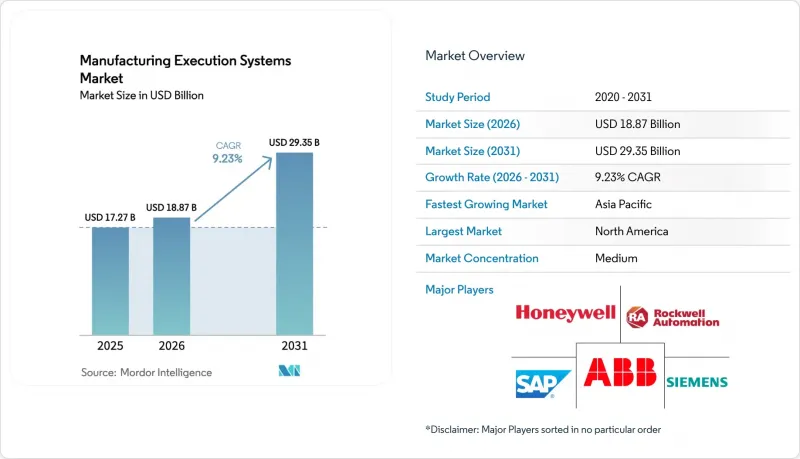
本報告按交付方式(軟體和服務)、部署方式(本地部署、雲端部署、邊緣部署)、最終用戶行業(食品飲料、石油天然氣、汽車等)、公司規模(大型企業、中小企業)、流程類型(離散製造、流程製造等)和地區進行細分。市場預測以美元計價。
全球製造執行系統 (MES) 市場趨勢與洞察
工業4.0和智慧工廠的實施
世界各地的製造政策都在持續降低投資數位孿生技術所帶來的風險。在美國,能源部智慧製造創新實驗室資助了一項運作試驗,旨在到2025年將能源強度降低兩位數。德國的「製造X」(Manufacturing-X)框架強制要求使用可互通的資產管理平台,使每台連網機器都能發佈自身狀態,而無需洩漏專有技術。愛爾蘭已向科克和利默里克製藥產業叢集津貼,幫助契約製造製造商(CMO)從電子表格轉向模組化執行平台。英國將創新券與檢驗的缺陷率降低掛鉤,以鼓勵中型供應商採用平台無關的資料模型。總而言之,這些努力正在將抽象的政策轉化為對製造執行系統(MES)市場的直接需求。
對即時生產可視化的需求
2024年的供應鏈中斷凸顯了現場資料延遲所帶來的成本。汽車原始設備製造商(OEM)現在要求一級供應商按小時進行電子資料交換,而紙本記錄無法滿足此要求。半導體晶圓廠正在部署邊緣閘道器,將測量資料流傳輸到先進的製程控制演算法,將偏差檢測時間從數小時縮短到數秒。到2025年,感測器成本將降至每個節點5美元以下,即使對於從事多品種、小批量生產的契約製造製造商而言,實施連續監控也變得合理。能源管理層現在將機器運轉率掛鉤,在實施間隔計量的地區,尖峰時段的費用降低了15-20%。因此,即時儀錶板正在成為製造執行系統(MES)市場的必需品,而不僅僅是差異化優勢。
與原廠OT和ERP系統的初始整合成本。
棕地設施通常依賴專有的現場匯流排網路,例如 Modbus 和 Profibus,這些網路早於現代 API。連接這些「孤島」需要協議閘道器和自訂腳本,根據 MESA 2025 年的一項調查,這將使專案預算增加 40% 到 60%。製藥廠還增加了驗證方面的額外開銷,因為每一次變更都需要安裝、運行和性能合格,這可能需要數月時間,花費數十萬美元。此類整合負擔會影響第一年的投資報酬率模型,延遲董事會批准新增模組,並減緩製造執行系統 (MES) 市場的成長。
細分市場分析
隨著製造商將整合、驗證和分析外包,預計到2031年,業務收益將超過軟體收入。儘管2025年軟體佔總需求的58.64%,但隨著多工廠部署變得日益複雜,託管服務正經歷兩位數的成長。 「檢驗即服務」方案已將製藥業的合格週期從9個月縮短至12週,這也解釋了為什麼在製造執行系統(MES)市場中,專家支援的價值超過了許可費用。包含預測性維護和切換最佳化功能的遠端監控軟體包在缺乏內部數據科學家的汽車行業一級供應商中尤其受歡迎。
託管服務也扮演人才橋樑的角色。由於ISA-95架構師和雲端原生DevOps工程師的短缺,工廠擴大採用基於結果的合約。透過讓供應商負責運作、修補程式和升級,資本投資有效轉化為營運支出(OPEX)。這種重組使公司的現金流量優先事項與持續改善週期保持一致,從而推動了製造執行系統(MES)市場的發展。
到2025年,製藥和半導體產業嚴格的驗證法規將推動本地部署系統在製造執行系統(MES)市場佔據62.46%的佔有率。然而,隨著中小企業和契約製造製造商優先考慮快速配置而非伺服器所有權,雲端平台正以每年10.12%的速度成長。邊緣原生混合系統透過在本地運行時間受限的循環處理,同時將聚合指標同步到雲端儀表板,從而解決了延遲和資料主權問題。 《晶片與科學法案》為具有數位孿生功能的良率儀表板提供資金,供分散式團隊訪問,從而加速了美國新建晶圓廠採用雲端技術。
網路安全仍然是最大的障礙。 IEC 62443 雲端服務認證落後於本地部署標準,而製藥契約製造商 (CMO) 正在協商資料居住條款,以確定其伺服器的位置。儘管如此,歐洲的「數位產品護照」及類似法規仍要求提供安全的 API,而雲端基礎設施比本地入口網站更具成本效益地提供此類 API。隨著法律規範的不斷完善,製造執行系統 (MES) 市場的部署配置正向混合雲端轉變。
區域分析
北美在半導體產業的主導地位得益於高達527億美元的激勵政策以及強大的製藥產業基礎。英特爾位於俄亥俄州和亞利桑那州的晶圓廠,以及台積電位於鳳凰城的工廠,都已部署了基於數位孿生技術的良率儀表板,並以此作為其執行預算的基礎。新澤西州和波多黎各的製藥中心正在對連續反應器進行改造,使其符合FDA的序列化和製程檢驗法規。在加拿大安大略省的汽車產業走廊,隨著電動車產量的成長,電池組的可追溯性正在逐步整合;與此同時,墨西哥巴希奧地區的中小型企業正在採用雲端平台,以便快速回應IATF 16949審核。
亞太地區預計11.94%的複合年成長率反映了政策和供應鏈的變化。中國工業和資訊化部正在支持工業網際網路試點項目,這些項目目前正朝著全面部署的方向發展。印度的補貼計畫要求數位化證明,這促進了電子和製藥業中小企業的數位轉型。東南亞正在接納從單一來源地區轉移的電子和汽車生產線,每家原始設備製造商(OEM)都將符合營運系統要求作為供應商准入的必要條件。日本正致力於預測性維護以應對勞動力短缺問題,而澳洲和紐西蘭則正在引入可追溯性來保護其食品出口品牌。
歐洲在監管壓力下正向前邁進。在德國,電池生產線正在進行維修,以滿足數位護照法規的要求。英國製藥公司正在資助一個連續生產試點項目,以抵消英國脫歐帶來的成本壓力。法國國防工廠傾向採用本地部署、空氣間隙的方案,以符合《國際武器貿易條例》(ITAR)的要求。一家獲得義大利原產地保護認證(PDO)的食品加工商正在使用執行層來認證原產地,而一家西班牙一級汽車零件供應商正在採用雲端平台來促進跨境工廠協作。一家俄羅斯煉油廠正在透過與歷史資料庫整合來最佳化其運營,即便制裁限制了其獲得西方許可的途徑。
其他好處:
- Excel格式的市場預測(ME)表
- 3個月的分析師支持
目錄
第1章:引言
- 研究假設和市場定義
- 調查範圍
第2章:調查方法
第3章執行摘要
第4章 市場狀況
- 市場概覽
- 市場促進因素
- 工業4.0和智慧工廠的實施
- 需要即時可視化生產狀態
- 合規主導的數位化可追溯性
- SaaS 定價降低了二級供應商的資本支出 (CapEx) 門檻。
- 中小企業中低程式碼可組合式MES的興起
- OEE即服務與工業物聯網邊緣分析的整合
- 市場限制因素
- 與原廠OT和ERP系統的初始整合成本。
- 雲端連線工廠的網路安全風險
- OT 和 IT 方面的技能差距阻礙了先進 MES 的採用。
- 人們對契約製造洩漏智慧財產權的擔憂
- 產業價值/價值鏈分析
- 監理情勢
- 技術展望
- 宏觀經濟因素對市場的影響
- 波特五力分析
第5章 市場規模與成長預測
- 報價
- 軟體
- 服務
- 部署模式
- 現場
- 雲
- 邊緣底座
- 按最終用戶行業分類
- 食品/飲料
- 石油和天然氣
- 製藥和生命科學
- 車
- 電子和半導體
- 化學品
- 金屬和採礦
- 紙漿和造紙
- 航太/國防
- 其他終端用戶產業
- 按公司規模
- 大公司
- 小型企業
- 依工藝類型
- 離散製造
- 工藝製造
- 混合
- 按地區
- 北美洲
- 美國
- 加拿大
- 墨西哥
- 南美洲
- 巴西
- 阿根廷
- 其他南美國家
- 歐洲
- 德國
- 英國
- 法國
- 義大利
- 西班牙
- 俄羅斯
- 其他歐洲國家
- 亞太地區
- 中國
- 日本
- 韓國
- 印度
- 澳洲和紐西蘭
- 其他亞太國家
- 中東
- 沙烏地阿拉伯
- 阿拉伯聯合大公國
- 土耳其
- 其他中東國家
- 非洲
- 南非
- 奈及利亞
- 其他非洲國家
- 北美洲
第6章 競爭情勢
- 市場集中度
- 策略趨勢
- 市佔率分析
- 公司簡介
- Siemens AG
- Rockwell Automation Inc.
- SAP SE
- ABB Ltd.
- Honeywell International Inc.
- Dassault Systemes SE
- Schneider Electric SE
- Applied Materials Inc.
- Oracle Corporation
- GE Vernova
- Emerson Electric Co.
- Epicor Software Corp.
- Yokogawa Electric Corp.
- AVEVA Group plc
- Korber AG(Werum)
- MPDV Mikrolab GmbH
- Plex Systems
- iBASEt
- Parsec Automation Corp.
- Critical Manufacturing SA
- Aegis Software
- Aspen Technology Inc.
- Mitsubishi Electric Corp.
- Infor Inc.
- Tata Consultancy Services
- LandT Technology Services
第7章 市場機會與未來展望
According to Mordor Intelligence, the manufacturing execution systems market size is expected to grow from USD 17.27 billion in 2025 to USD 18.87 billion in 2026 and is forecast to reach USD 29.35 billion by 2031 at 9.23% CAGR over 2026-2031.
This report is Segmented by Offering (Software, and Service), Deployment (On-Premise, Cloud, and Edge-Based), End-User Industry (Food and Beverage, Oil and Gas, Automotive, and More), Enterprise Size (Large Enterprises, Small and Medium Enterprises (SMEs)), Process Type (Discrete Manufacturing, Process Manufacturing, and More), and Geography. The Market Forecasts are Provided in Terms of Value (USD).
Global Manufacturing Execution Systems Market Trends and Insights
Industry 4.0 And Smart-Factory Roll-outs
National manufacturing agendas continue to de-risk digital-twin investments. In the United States, the Department of Energy's Smart Manufacturing Innovation Institute funded live production trials in 2025 that cut energy intensity by double-digit percentages. Germany's Manufacturing-X framework requires interoperable asset-administration shells, ensuring that each connected machine can publish status without revealing proprietary know-how. Ireland earmarked grants for pharmaceutical clusters in Cork and Limerick, prompting contract manufacturers to swap spreadsheets for modular execution platforms. The United Kingdom tied innovation vouchers to verifiable scrap-rate reductions, prompting mid-tier suppliers to adopt platform-agnostic data models. Collectively, these initiatives convert abstract policy into direct demand for the manufacturing execution systems (MES) market.
Need For Real-Time Production Visibility
Supply-chain disruptions in 2024 exposed the cost of delayed shop-floor data. Automotive OEMs now require hourly electronic data interchange from tier-1 suppliers, an expectation that paper logs cannot meet. Semiconductor fabs deploy edge gateways that stream metrology readings to advanced process-control algorithms, shrinking excursion detection windows from hours to seconds. By 2025, sensor costs fell below USD 5 per node, enabling high-mix job shops to justify continuous monitoring. Energy-management layers now link machine utilization with time-of-use tariffs, carving 15%-20% off peak charges in regions with interval metering. As a result, live dashboards are becoming table stakes rather than differentiators in the manufacturing execution systems market.
Up-Front Integration Cost With Legacy OT And ERP
Brownfield facilities often rely on proprietary fieldbus networks such as Modbus or Profibus that predate modern APIs. Bridging these islands requires protocol gateways and custom scripts, inflating project budgets by 40%-60% according to a 2025 MESA survey. Pharmaceutical sites add validation overhead, where every change triggers installation, operational, and performance qualifications that consume months and hundreds of thousands of dollars. Such integration burdens can exhaust the first year of ROI models, delaying board approval for incremental modules and tempering growth in the manufacturing execution systems (MES) market.
Other drivers and restraints analyzed in the detailed report include:
- Compliance-Driven Digital Traceability
- SaaS Pricing Lowers CapEx Barriers
- Cyber-Security Risks In Cloud-Connected Plants
For complete list of drivers and restraints, kindly check the Table Of Contents.
Segment Analysis
Services revenue is set to outpace software through 2031 as manufacturers outsource integration, validation, and analytics. In 2025, software generated 58.64% of topline demand, yet the growing complexity of multi-plant roll-outs is unlocking double-digit expansion for managed services. Validation-as-a-service bundles shorten pharmaceutical qualification phases from nine months to twelve weeks, illustrating why professional support is eclipsing license fees in the manufacturing execution systems (MES) market size. Remote monitoring packages embedding predictive maintenance and changeover optimization are especially popular among automotive tiers that lack in-house data scientists.
Managed services also act as a talent bridge. Scarcity of ISA-95 architects and cloud-native DevOps engineers prompts factories to contract outcome-based agreements. Vendors assume responsibility for uptime, patching, and upgrades, effectively converting capital purchases into opex lines. This realignment aligns corporate cash-flow preferences with continuous improvement cycles, bolstering the manufacturing execution systems market.
On-premise systems held a 62.46% manufacturing execution systems market share in 2025 due to stringent pharma and semiconductor validation rules. Cloud platforms, however, are growing 10.12% annually as SMEs and contract manufacturers favor rapid configuration over server ownership. Edge-native hybrids satisfy latency and data-sovereignty concerns by performing time-critical loops locally while syncing aggregated metrics to cloud dashboards. The CHIPS and Science Act now ties funding to digital-twin yield dashboards accessible to distributed teams, catalyzing cloud adoption in new U.S. fabs.
Cybersecurity remains the chief hurdle. IEC 62443 certification for cloud services trails on-premise norms, and pharma CMOs negotiate data-residency clauses to lock server locations. Even so, Europe's Digital Product Passport and similar regulations require secure APIs that cloud infrastructure delivers more cost-effectively than on-premise portals. As regulatory glue hardens, the deployment mix within the manufacturing execution systems market is tilting toward hybrid-cloud.
Complete Report Scope:
- By Offering
- Software
- Services
- By Deployment Mode
- On-Premise
- Cloud
- Edge-Based
- By End-User Industry
- Food and Beverage
- Oil and Gas
- Pharmaceutical and Life Sciences
- Automotive
- Electronics and Semiconductor
- Chemicals
- Metals and Mining
- Pulp and Paper
- Aerospace and Defense
- Other End-User Industries
- By Enterprise Size
- Large Enterprises
- Small and Medium Enterprises
- By Process Type
- Discrete Manufacturing
- Process Manufacturing
- Hybrid
- By Geography
- North America
- United States
- Canada
- Mexico
- South America
- Brazil
- Argentina
- Rest of South America
- Europe
- Germany
- United Kingdom
- France
- Italy
- Spain
- Russia
- Rest of Europe
- Asia Pacific
- China
- Japan
- South Korea
- India
- Australia and New Zealand
- Rest of Asia Pacific
- Middle East
- Saudi Arabia
- United Arab Emirates
- Turkey
- Rest of Middle East
- Africa
- South Africa
- Nigeria
- Rest of Africa
- North America
Geography Analysis
North America's leadership stems from USD 52.7 billion in semiconductor incentives and a robust pharmaceutical base. Intel's Ohio and Arizona fabs and TSMC's Phoenix site embed digital-twin yield dashboards, anchoring execution budgets. Pharmaceutical hubs in New Jersey and Puerto Rico retrofit batch suites with continuous reactors to satisfy FDA serialization and process-verification rules. Canada's Ontario auto corridor now integrates battery-pack traceability as EV volumes scale, while Mexico's Bajio SMEs deploy cloud suites to meet IATF 16949 audits rapidly.
Asia Pacific's 11.94% forecast CAGR reflects policy and supply-chain shifts. China's Ministry of Industry and Information Technology backs industrial-internet pilots that graduate into full-scale deployments. India's subsidies hinge on proof of digitization, driving adoption among electronics and pharma SMEs. Southeast Asia absorbs electronics and automotive lines relocating from single-source geographies, and each OEM mandates execution-system compliance as supplier entry criteria. Japan focuses on predictive maintenance to counteract labor shortages, while Australia and New Zealand embed traceability to protect food-export brands.
Europe advances under the weight of regulation. Germany retrofits battery-cell lines to meet digital passport rules. United Kingdom pharma centers fund continuous-manufacturing pilots to offset Brexit-related cost pressures. France's defense plants favor on-premise, air-gapped deployments for ITAR compliance. Italy's PDO food processors use execution layers to authenticate provenance, and Spain's tier-1 automotive suppliers adopt cloud platforms to synchronize cross-border plants. Russia's refinery optimizations rely on historian integrations, even as sanctions curb Western licenses.
- Siemens AG
- Rockwell Automation Inc.
- SAP SE
- ABB Ltd.
- Honeywell International Inc.
- Dassault Systemes SE
- Schneider Electric SE
- Applied Materials Inc.
- Oracle Corporation
- GE Vernova
- Emerson Electric Co.
- Epicor Software Corp.
- Yokogawa Electric Corp.
- AVEVA Group plc
- Korber AG (Werum)
- MPDV Mikrolab GmbH
- Plex Systems
- iBASEt
- Parsec Automation Corp.
- Critical Manufacturing SA
- Aegis Software
- Aspen Technology Inc.
- Mitsubishi Electric Corp.
- Infor Inc.
- Tata Consultancy Services
- LandT Technology Services
Additional Benefits:
- The market estimate (ME) sheet in Excel format
- 3 months of analyst support
TABLE OF CONTENTS
1 INTRODUCTION
- 1.1 Study Assumptions and Market Definition
- 1.2 Scope of the Study
2 RESEARCH METHODOLOGY
3 EXECUTIVE SUMMARY
4 MARKET LANDSCAPE
- 4.1 Market Overview
- 4.2 Market Drivers
- 4.2.1 Industry 4.0 and Smart-Factory Roll-outs
- 4.2.2 Need for Real-Time Production Visibility
- 4.2.3 Compliance-Driven Digital Traceability
- 4.2.4 SaaS Pricing Lowers CapEx Barriers for Tier-2 Suppliers
- 4.2.5 Rise of Low-Code Composable MES Among SMEs
- 4.2.6 OEE-as-a-Service Linked to IIoT Edge Analytics
- 4.3 Market Restraints
- 4.3.1 Up-Front Integration Cost with Legacy OT and ERP
- 4.3.2 Cyber-Security Risks in Cloud-Connected Plants
- 4.3.3 OT and IT Skill-Gap Stalling Advanced MES Roll-outs
- 4.3.4 IP-Exposure Fears Among Contract Manufacturers
- 4.4 Industry Value / Supply-Chain Analysis
- 4.5 Regulatory Landscape
- 4.6 Technological Outlook
- 4.7 Impact of Macroeconomic Factors on the Market
- 4.8 Porter's Five Forces Analysis
- 4.8.1 Bargaining Power of Suppliers
- 4.8.2 Bargaining Power of Buyers
- 4.8.3 Threat of New Entrants
- 4.8.4 Threat of Substitute Products
- 4.8.5 Degree of Competition
5 MARKET SIZE AND GROWTH FORECASTS (VALUE)
- 5.1 By Offering
- 5.1.1 Software
- 5.1.2 Services
- 5.2 By Deployment Mode
- 5.2.1 On-Premise
- 5.2.2 Cloud
- 5.2.3 Edge-Based
- 5.3 By End-User Industry
- 5.3.1 Food and Beverage
- 5.3.2 Oil and Gas
- 5.3.3 Pharmaceutical and Life Sciences
- 5.3.4 Automotive
- 5.3.5 Electronics and Semiconductor
- 5.3.6 Chemicals
- 5.3.7 Metals and Mining
- 5.3.8 Pulp and Paper
- 5.3.9 Aerospace and Defense
- 5.3.10 Other End-User Industries
- 5.4 By Enterprise Size
- 5.4.1 Large Enterprises
- 5.4.2 Small and Medium Enterprises
- 5.5 By Process Type
- 5.5.1 Discrete Manufacturing
- 5.5.2 Process Manufacturing
- 5.5.3 Hybrid
- 5.6 By Geography
- 5.6.1 North America
- 5.6.1.1 United States
- 5.6.1.2 Canada
- 5.6.1.3 Mexico
- 5.6.2 South America
- 5.6.2.1 Brazil
- 5.6.2.2 Argentina
- 5.6.2.3 Rest of South America
- 5.6.3 Europe
- 5.6.3.1 Germany
- 5.6.3.2 United Kingdom
- 5.6.3.3 France
- 5.6.3.4 Italy
- 5.6.3.5 Spain
- 5.6.3.6 Russia
- 5.6.3.7 Rest of Europe
- 5.6.4 Asia Pacific
- 5.6.4.1 China
- 5.6.4.2 Japan
- 5.6.4.3 South Korea
- 5.6.4.4 India
- 5.6.4.5 Australia and New Zealand
- 5.6.4.6 Rest of Asia Pacific
- 5.6.5 Middle East
- 5.6.5.1 Saudi Arabia
- 5.6.5.2 United Arab Emirates
- 5.6.5.3 Turkey
- 5.6.5.4 Rest of Middle East
- 5.6.6 Africa
- 5.6.6.1 South Africa
- 5.6.6.2 Nigeria
- 5.6.6.3 Rest of Africa
- 5.6.1 North America
6 COMPETITIVE LANDSCAPE
- 6.1 Market Concentration
- 6.2 Strategic Moves
- 6.3 Market Share Analysis
- 6.4 Company Profiles (includes Global Level Overview, Market Level Overview, Core Segments, Financials as Available, Strategic Information, Market Rank/Share for Key Companies, Products and Services, and Recent Developments)
- 6.4.1 Siemens AG
- 6.4.2 Rockwell Automation Inc.
- 6.4.3 SAP SE
- 6.4.4 ABB Ltd.
- 6.4.5 Honeywell International Inc.
- 6.4.6 Dassault Systemes SE
- 6.4.7 Schneider Electric SE
- 6.4.8 Applied Materials Inc.
- 6.4.9 Oracle Corporation
- 6.4.10 GE Vernova
- 6.4.11 Emerson Electric Co.
- 6.4.12 Epicor Software Corp.
- 6.4.13 Yokogawa Electric Corp.
- 6.4.14 AVEVA Group plc
- 6.4.15 Korber AG (Werum)
- 6.4.16 MPDV Mikrolab GmbH
- 6.4.17 Plex Systems
- 6.4.18 iBASEt
- 6.4.19 Parsec Automation Corp.
- 6.4.20 Critical Manufacturing SA
- 6.4.21 Aegis Software
- 6.4.22 Aspen Technology Inc.
- 6.4.23 Mitsubishi Electric Corp.
- 6.4.24 Infor Inc.
- 6.4.25 Tata Consultancy Services
- 6.4.26 LandT Technology Services
7 MARKET OPPORTUNITIES AND FUTURE OUTLOOK
- 7.1 White-Space and Unmet-Need Assessment

 超越MES:製造營運管理(MOM)及類似MOM解決方案的現狀
 數位製造執行系統 (DMES) 市場預測至 2034 年—按部署類型、功能、技術、應用、最終用戶和地區分類的全球分析人工智慧在製造執行系統 (MES) 軟體中的應用:關鍵用例和市場領導特色技術創新者:製造執行系統 (MES)
 製造執行系統 (MES) 市場:按組件、生產類型、應用、產業、部署和組織規模分類-2026-2032 年全球市場預測
 製造執行系統(MES)市場規模及預測(2021-2034年),全球及區域佔有率、趨勢及成長機會分析。研究範圍:組件、部署模式、組織規模、最終使用者和地區。
 製造執行系統和軟體 (MES) 市場:按組件、部署類型、行業和地區分類微型工廠系統市場預測至2034年-全球分析(按組件、生產模式、部署模式、技術、應用、最終用戶和地區分類)全球製造執行系統 (MES) 市場:按部署類型、產品/服務、流程產業、離散製造業和地區分類 - 市場規模、產業動態、機會分析和預測 (2026–2035)
 2026年全球雲端製造執行系統(MES)市場報告