


 |
市場調查報告書
商品編碼
2123748
汽車邊緣運算:市場佔有率分析、產業趨勢與統計及成長預測(2026-2031 年)Edge Computing In Automotive - Market Share Analysis, Industry Trends & Statistics, Growth Forecasts (2026 - 2031) |
||||||

※ 本網頁內容可能與最新版本有所差異。詳細情況請與我們聯繫。
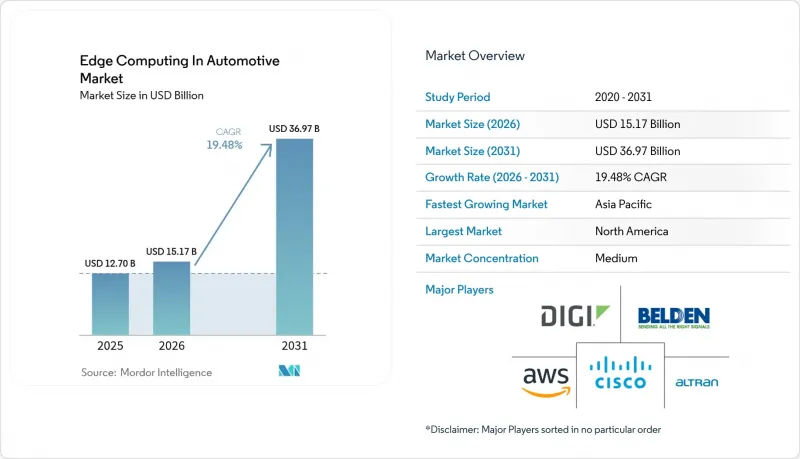
預計到 2026 年,汽車邊緣運算市場規模將達到 151.7 億美元,高於 2025 年的 127 億美元,預計到 2031 年將達到 369.7 億美元。
預計從 2026 年到 2031 年,其複合年成長率將達到 19.48%。
本報告按組件(硬體、軟體等)、部署模式(汽車邊緣、網路/MEC邊緣等)、車輛類型(乘用車、輕型商用車等)、應用(聯網汽車(資訊娛樂和OTA)、ADAS和自動駕駛、交通管理和V2I等)以及地區進行細分。市場預測以價值(美元)表示。
全球汽車邊緣運算市場趨勢及洞察
關鍵趨勢-車載感測器的普及和5G的部署
現代汽車配備多達 200 個感測器,每小時傳輸 25 GB 的資料。如此龐大的資料量,傳統架構已無法處理。德國電信和諾基亞的 Car2MEC 測試表明,5G 無線存取的延遲已低於 10 毫秒,V2X 延遲更是降低至 30 毫秒以下。因此,汽車製造商正在整合本地處理能力,以便在將關鍵資訊傳輸到雲端之前,對資料進行分類、壓縮並應對風險。這正推動著運算方式從集中式向分散式的重大轉變,進而刺激了硬體需求的成長,並推動了汽車市場邊緣運算的快速複合年成長率 (CAGR)。
主流化-OEM廠商向軟體定義汽車(SDV)的轉型
製造商正圍繞程式碼更新和數位化能力重組經營模式。博世和大眾汽車子公司Cariad已投入1,000名工程師,共同開發一個用於計畫於2025年發布的車輛的人工智慧平台。全天候線上的汽車需要高性能的車載運算能力,以及安全的空中下載(OTA)軟體交付路徑,以實現安全的程式碼檢驗和回滾。這些工作流程正在拓展業務收益來源,並將邊緣運算定位為汽車市場獲利的核心支柱。
主流化-高額初始基礎設施投資(資本支出)
完整的邊緣運算堆疊包含運算節點、私人5G網路和增強型安全功能,這些組合使得Verizon和奧迪在德國的測試基地預算超過1000萬美元。由於該技術屬於資本密集型,小型汽車製造商對進入市場持謹慎態度,因此專案在價格敏感地區也因此停滯不前。因此,部署工作優先考慮能夠立即提升安全性的功能,而更廣泛的最佳化則被推遲到成本下降之後。
細分市場分析
預計到2025年,硬體銷售額將佔43.45%,凸顯了高效能處理器、AI加速器和溫度控管解決方案在汽車環境中的關鍵作用。這一比例代表了汽車邊緣運算市場的最大佔有率,這得益於能夠承受振動和125 度C環境溫度的半導體。雖然汽車邊緣運算硬體市場預計將繼續成長,但服務領域的複合年成長率(CAGR)以金額為準,達到24.89%,因為整合商正在為全球各種車隊管理空中下載(OTA)部署。由於功能安全、網路安全和即時調度方面的學習曲線陡峭,汽車製造商正傾向於承包服務。英特爾(在收購Silicon Mobility後)等供應商正在將中間件和長期更新合約與晶片捆綁銷售。這種轉變進一步加速了服務的發展勢頭,因為利潤率正從純硬體業務轉向服務,平台供應商被迫透過與雲端供應商合作提供聯合生命週期解決方案。
預計到2025年,汽車計算將佔汽車總收入的46.02%,這反映了汽車製造商對自主型可靠性的重視。然而,隨著智慧城市預算的增加,路側設備的部署使得車輛能夠超越單一車輛的情境察覺,基礎設施節點正以21.55%的複合年成長率快速擴張。這種成長正在擴大汽車市場邊緣運算在公共邊緣資產中的規模,促使電信業者和市政當局參與收益共享機制。混合拓撲結構正在興起,車輛、網路和路側處理器協同工作。汽車邊緣運算聯盟正在推動這些分散式運算框架的發展,以最佳化成本和延遲。汽車製造商現在需要對不同領域的軟體進行認證,這推動了互通性工具鏈的發展,並加速了標準化進程。
區域分析
北美地區憑藉早期5G部署、有序的頻率政策以及OEM廠商與科技公司之間的緊密夥伴關係,預計將引領潮流,到2025年將佔全球收入的34.95%。特斯拉、通用汽車和福特正與英特爾、英偉達和高通合作,共同設計專用處理器和測試系統。 Verizon的專用網路計畫表明,該地區已準備好擴展低延遲的汽車工作負載。州和聯邦政府的資助措施進一步推動了邊緣實驗室和試點走廊的建設。預計到2031年,亞太地區的複合年成長率將達到24.12%。中國透過結合電動車補貼、龐大的消費群和城市主導的智慧交通規劃,正為汽車市場的邊緣運算創造沃土。華為在內蒙古部署的100輛自動駕駛5G-A礦用卡車生動地展示了在嚴苛環境下進行工業級部署的能力。日本和韓國供應先進的半導體節點,而印度已發展成為為全球汽車製造商開發車上用軟體的人才中心。歐洲憑藉豪華汽車品牌和嚴格的安全法規保持著強勁的發展勢頭。聯合國歐洲經濟委員會WP.29工作小組和GDPR強制要求嚴格的網路安全和資料本地化,提高了邊緣解決方案的標準。博世和微軟目前正在共同開發符合ISO 26262功能安全標準的生成式人工智慧工具鏈。一項跨歐盟的數位化戰略和跨境5G走廊將使自動駕駛卡車能夠在德國、奧地利和義大利之間實現無縫漫遊。
其他好處:
- Excel格式的市場預測(ME)表
- 3個月的分析師支持
目錄
第1章:引言
- 研究假設和市場定義
- 調查範圍
第2章:調查方法
第3章執行摘要
第4章 市場狀況
- 市場概覽
- 市場促進因素
- 車載感測器的普及和5G的部署
- 主要汽車製造商向軟體定義汽車轉型
- V2X安全標準獲得廣泛的監管支持
- 每個設備的物聯網數據流量增加
- 各城市引入路邊微邊緣節點
- 車載AI加速器採用節能技術,降低整體擁有成本
- 市場限制因素
- 主流基礎設施投資需要較高的初始投資。
- 與主流網路安全和資料主權相關的風險
- 汽車邊緣組件供不應求
- MEC互通性標準的碎片化
- 產業價值鏈分析
- 監理情勢
- 技術展望
- 波特五力分析
第5章 市場規模與成長預測
- 按組件
- 硬體
- 軟體
- 服務
- 按部署模式
- 車內邊緣
- 網路/MEC邊緣
- 基礎設施邊緣(路邊和智慧城市)
- 車輛類型
- 搭乘用車
- 輕型商用車
- 大型商用車輛
- 非公路用車及特殊車輛
- 透過使用
- 聯網汽車(資訊娛樂和OTA)
- ADAS和自動駕駛
- 交通管理和車聯網
- 車輛和物流最佳化
- 智慧城市服務
- 按地區
- 北美洲
- 美國
- 加拿大
- 墨西哥
- 南美洲
- 巴西
- 阿根廷
- 智利
- 哥倫比亞
- 歐洲
- 德國
- 英國
- 法國
- 義大利
- 西班牙
- 俄羅斯
- 亞太地區
- 中國
- 日本
- 印度
- 韓國
- 澳洲
- 印尼
- 中東和非洲
- 中東
- 阿拉伯聯合大公國
- 沙烏地阿拉伯
- 土耳其
- 以色列
- 非洲
- 南非
- 奈及利亞
- 埃及
- 中東
- 北美洲
第6章 競爭情勢
- 市場集中度
- 策略趨勢
- 市佔率分析
- 公司簡介
- Amazon Web Services, Inc.
- Cisco Systems, Inc.
- Huawei Technologies Co., Ltd.
- Hewlett Packard Enterprise Development LP
- IBM Corporation
- Intel Corporation
- NVIDIA Corporation
- Qualcomm Technologies, Inc.
- Ericsson AB
- Siemens AG
- Robert Bosch GmbH
- Continental AG
- Verizon Communications Inc.
- Vodafone Group Plc
- Belden Inc.
- Digi International Inc.
- Litmus Automation Inc.
- Azion Technologies Ltd.
- Altran Technologies SA
第7章 市場機會與未來展望
According to Mordor Intelligence, the edge computing in automotive market size in 2026 is estimated at USD 15.17 billion, growing from 2025 value of USD 12.7 billion with 2031 projections showing USD 36.97 billion, growing at 19.48% CAGR over 2026-2031.
This report is Segmented by Component (Hardware, Software and More), Deployment Model (On-Board Vehicle Edge, Network/MEC Edge and More), Vehicle Type (Passenger Cars, Light Commercial Vehicles and More), Application (Connected Cars (Infotainment and OTA), ADAS and Autonomous Driving, Traffic Management and V2I, and More), and Geography. The Market Forecasts are Provided in Terms of Value (USD).
Global Edge Computing In Automotive Market Trends and Insights
Mainstream - Proliferation of Vehicle Sensors and 5G Rollouts
Modern cars host up to 200 sensors that stream 25 GB of data per hour, a volume that overwhelms legacy architectures. 5G radio access now delivers sub-10 ms latency, demonstrated when Deutsche Telekom and Nokia cut V2X delays below 30 ms in the Car2MEC trials. Carmakers therefore embed local processing to classify, compress, and react to hazards before forwarding essential insights to the cloud. The outcome is a decisive tilt from central to distributed compute, which underpins rising hardware demand and reinforces the edge computing in automotive market's rapid CAGR.
Mainstream - OEM Shift Toward Software-Defined Vehicles
Manufacturers rewrite their business models around code updates and digital features. Bosch and Volkswagen's Cariad arm assigned 1,000 engineers to co-develop AI platforms slated for 2025 vehicles. Always-connected cars now require secure, over-the-air software pipes plus high-performance in-vehicle compute to validate and roll back code safely. These workflows enlarge service revenue pools and elevate the edge computing in automotive market as a core monetization pillar.
Mainstream - High Upfront Infrastructure Capex
Complete edge stacks bundle compute nodes, private 5G, and hardened security, a combination that pushed Verizon and Audi's German test site budget past USD 10 million. Capital intensity deters smaller OEMs and stalls projects in price-sensitive regions. Consequently, deployments prioritize functions that yield immediate safety payback while broader optimization waits for cost curves to drop.
Other drivers and restraints analyzed in the detailed report include:
- Under-the-radar - Curb-side Micro-edge Nodes by Cities
- Under-the-radar - Battery-friendly In-vehicle AI Accelerators Cut TCO
- Mainstream - Cyber-security and Data-sovereignty Risks
For complete list of drivers and restraints, kindly check the Table Of Contents.
Segment Analysis
Hardware captured 43.45% revenue in 2025, underscoring the essential role of rugged processors, AI accelerators, and thermal solutions inside vehicles. This slice translates to the largest edge computing in automotive market share thanks to silicon that tolerates vibration and 125 °C ambient. In dollar terms the edge computing in automotive market size for hardware will still climb, yet services enjoy a steeper 24.89% CAGR as integrators manage over-the-air rollouts for mixed global fleets. Automakers gravitate toward turnkey services because the learning curve for functional safety, cybersecurity, and real-time scheduling is steep. Suppliers such as Intel-after absorbing Silicon Mobility-bundle chips with middleware and long-term update contracts. The shift channels margin away from pure-play hardware and pushes platform vendors to partner with cloud operators for joint lifecycle offerings, reinforcing service momentum.
On-board compute retained 46.02% of 2025 revenue, underlining OEM confidence in self-contained reliability. Still, infrastructure nodes are tracking a 21.55% CAGR as smart-city budgets finance roadside boxes that extend awareness beyond a single car. This growth enlarges the edge computing in automotive market size for public edge assets and invites telecom carriers and municipalities into revenue-sharing schemes. Hybrid topologies are emerging whereby vehicle, network, and curb-side processors cooperate. The Automotive Edge Computing Consortium promotes such split-compute frameworks to optimize cost and latency. Carmakers must now certify software across heterogeneous domains, elevating interoperability toolchains and driving standards activity.
Complete Report Scope:
- By Component
- Hardware
- Software
- Services
- By Deployment Model
- On-board Vehicle Edge
- Network/MEC Edge
- Infrastructure Edge (Road-side and Smart City)
- By Vehicle Type
- Passenger Cars
- Light Commercial Vehicles
- Heavy Commercial Vehicles
- Off-highway and Specialty Vehicles
- By Application
- Connected Cars (Infotainment and OTA)
- ADAS and Autonomous Driving
- Traffic Management and V2I
- Fleet and Logistics Optimisation
- Smart Cities Services
- By Geography
- North America
- United States
- Canada
- Mexico
- South America
- Brazil
- Argentina
- Chile
- Colombia
- Europe
- Germany
- United Kingdom
- France
- Italy
- Spain
- Russia
- Asia-Pacific
- China
- Japan
- India
- South Korea
- Australia
- Indonesia
- Middle East and Africa
- Middle East
- United Arab Emirates
- Saudi Arabia
- Turkey
- Israel
- Africa
- South Africa
- Nigeria
- Egypt
- Middle East
- North America
Geography Analysis
North America led with 34.95% revenue in 2025, supported by early 5G rollouts, orderly spectrum policy, and tight OEM-tech partnerships. Tesla, General Motors, and Ford pair with Intel, NVIDIA, and Qualcomm to co-design application-specific processors and testing regimes. Verizon's private-network program underscores the region's readiness to scale low-latency automotive workloads. Funding incentives at state and federal levels further anchor edge labs and pilot corridors. Asia-Pacific is forecast to register a 24.12% CAGR to 2031. China merges electric-vehicle subsidies, vast consumer volumes, and city-led smart-transport schemes, creating a fertile edge computing in automotive market. Huawei's launch of 100 autonomous 5G-A mine trucks in Inner Mongolia illustrates industrial-grade deployment under harsh conditions. Japan and South Korea supply advanced semiconductor nodes, while India positions talent hubs that write in-vehicle software for global OEMs. Europe maintains momentum through premium marques and strict safety law. UNECE WP.29 and GDPR force rigorous cybersecurity and data-localization, raising the baseline for edge solutions. Bosch and Microsoft now co-produce generative-AI toolchains that comply with ISO 26262 functional-safety standards. Pan-EU digital strategies and cross-border 5G corridors allow continuous roaming for autonomous trucks between Germany, Austria, and Italy.
- Amazon Web Services, Inc.
- Cisco Systems, Inc.
- Huawei Technologies Co., Ltd.
- Hewlett Packard Enterprise Development LP
- IBM Corporation
- Intel Corporation
- NVIDIA Corporation
- Qualcomm Technologies, Inc.
- Ericsson AB
- Siemens AG
- Robert Bosch GmbH
- Continental AG
- Verizon Communications Inc.
- Vodafone Group Plc
- Belden Inc.
- Digi International Inc.
- Litmus Automation Inc.
- Azion Technologies Ltd.
- Altran Technologies SA
Additional Benefits:
- The market estimate (ME) sheet in Excel format
- 3 months of analyst support
TABLE OF CONTENTS
1 INTRODUCTION
- 1.1 Study Assumptions and Market Definition
- 1.2 Scope of the Study
2 RESEARCH METHODOLOGY
3 EXECUTIVE SUMMARY
4 MARKET LANDSCAPE
- 4.1 Market Overview
- 4.2 Market Drivers
- 4.2.1 Mainstream Proliferation of Vehicle Sensors And 5G Rollouts
- 4.2.2 Mainstream OEM Shift Toward Software-Defined Vehicles
- 4.2.3 Mainstream Regulatory Support for V2X Safety Mandates
- 4.2.4 Mainstream Rising IoT Data Traffic Per Car
- 4.2.5 Deployment of Curb-Side Micro-Edge Nodes by Cities
- 4.2.6 Battery-Friendly In-Vehicle AI Accelerators Cut TCO
- 4.3 Market Restraints
- 4.3.1 Mainstream High Upfront Infrastructure Capex
- 4.3.2 Mainstream Cyber-Security and Data-Sovereignty Risks
- 4.3.3 Scarcity of Automotive-Grade Edge Silicon Supply
- 4.3.4 Fragmented MEC Interoperability Standards
- 4.4 Industry Value Chain Analysis
- 4.5 Regulatory Landscape
- 4.6 Technological Outlook
- 4.7 Porter's Five Forces Analysis
- 4.7.1 Bargaining Power of Buyers/Consumers
- 4.7.2 Bargaining Power of Suppliers
- 4.7.3 Threat of New Entrants
- 4.7.4 Threat of Substitute Products
- 4.7.5 Intensity of Competitive Rivalry
5 MARKET SIZE AND GROWTH FORECASTS (VALUE)
- 5.1 By Component
- 5.1.1 Hardware
- 5.1.2 Software
- 5.1.3 Services
- 5.2 By Deployment Model
- 5.2.1 On-board Vehicle Edge
- 5.2.2 Network/MEC Edge
- 5.2.3 Infrastructure Edge (Road-side and Smart City)
- 5.3 By Vehicle Type
- 5.3.1 Passenger Cars
- 5.3.2 Light Commercial Vehicles
- 5.3.3 Heavy Commercial Vehicles
- 5.3.4 Off-highway and Specialty Vehicles
- 5.4 By Application
- 5.4.1 Connected Cars (Infotainment and OTA)
- 5.4.2 ADAS and Autonomous Driving
- 5.4.3 Traffic Management and V2I
- 5.4.4 Fleet and Logistics Optimisation
- 5.4.5 Smart Cities Services
- 5.5 By Geography
- 5.5.1 North America
- 5.5.1.1 United States
- 5.5.1.2 Canada
- 5.5.1.3 Mexico
- 5.5.2 South America
- 5.5.2.1 Brazil
- 5.5.2.2 Argentina
- 5.5.2.3 Chile
- 5.5.2.4 Colombia
- 5.5.3 Europe
- 5.5.3.1 Germany
- 5.5.3.2 United Kingdom
- 5.5.3.3 France
- 5.5.3.4 Italy
- 5.5.3.5 Spain
- 5.5.3.6 Russia
- 5.5.4 Asia-Pacific
- 5.5.4.1 China
- 5.5.4.2 Japan
- 5.5.4.3 India
- 5.5.4.4 South Korea
- 5.5.4.5 Australia
- 5.5.4.6 Indonesia
- 5.5.5 Middle East and Africa
- 5.5.5.1 Middle East
- 5.5.5.1.1 United Arab Emirates
- 5.5.5.1.2 Saudi Arabia
- 5.5.5.1.3 Turkey
- 5.5.5.1.4 Israel
- 5.5.5.2 Africa
- 5.5.5.2.1 South Africa
- 5.5.5.2.2 Nigeria
- 5.5.5.2.3 Egypt
- 5.5.5.1 Middle East
- 5.5.1 North America
6 COMPETITIVE LANDSCAPE
- 6.1 Market Concentration
- 6.2 Strategic Moves
- 6.3 Market Share Analysis
- 6.4 Company Profiles (includes Global level Overview, Market level overview, Core Segments, Financials as available, Strategic Information, Market Rank/Share for key companies, Products and Services, and Recent Developments)
- 6.4.1 Amazon Web Services, Inc.
- 6.4.2 Cisco Systems, Inc.
- 6.4.3 Huawei Technologies Co., Ltd.
- 6.4.4 Hewlett Packard Enterprise Development LP
- 6.4.5 IBM Corporation
- 6.4.6 Intel Corporation
- 6.4.7 NVIDIA Corporation
- 6.4.8 Qualcomm Technologies, Inc.
- 6.4.9 Ericsson AB
- 6.4.10 Siemens AG
- 6.4.11 Robert Bosch GmbH
- 6.4.12 Continental AG
- 6.4.13 Verizon Communications Inc.
- 6.4.14 Vodafone Group Plc
- 6.4.15 Belden Inc.
- 6.4.16 Digi International Inc.
- 6.4.17 Litmus Automation Inc.
- 6.4.18 Azion Technologies Ltd.
- 6.4.19 Altran Technologies SA
7 MARKET OPPORTUNITIES AND FUTURE OUTLOOK
- 7.1 White-space and Unmet-need Assessment

 工業邊緣運算:市場佔有率分析、產業趨勢與統計及成長預測(2026-2031 年)
 2026-2030年全球工業邊緣運算市場
 全球邊緣運算市場規模、佔有率、趨勢和成長分析報告(2026-2034)
 工業邊緣運算平台市場預測至2034年-按平台類型、部署模式、技術、應用、最終用戶和地區分類的全球分析網格邊緣運算市場預測至2034年—按組件、部署模式、應用、最終用戶和地區分類的全球分析邊緣運算:市場佔有率分析、產業趨勢與統計及成長預測(2026-2031 年)
 醫療保健產業邊緣運算市場:全球市場預測(2026-2032年)人工智慧邊緣運算市場 - 全球市場預測(2026-2032年)
 全球邊緣運算市場:依產品/服務、應用、部署模式、組織規模、產業和地區分類-預測至2031年邊緣運算市場預測至2034年-全球分析(按組件、部署位置、應用、產業、最終用戶和地區分類)-產業特定分析