


 |
市場調查報告書
商品編碼
2123746
丁腈橡膠(NBR):市場佔有率分析、行業趨勢和統計數據、成長預測(2026-2031)Nitrile Butadiene Rubber (NBR) - Market Share Analysis, Industry Trends & Statistics, Growth Forecasts (2026 - 2031) |
||||||

※ 本網頁內容可能與最新版本有所差異。詳細情況請與我們聯繫。
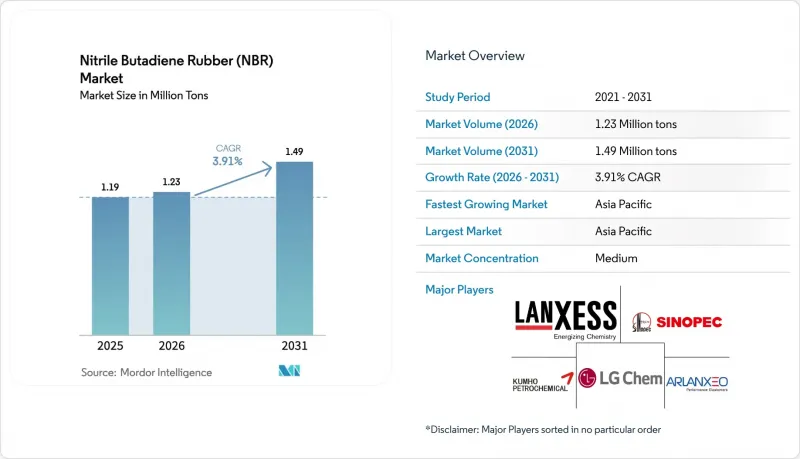
根據 Mordor Intelligence 預測,丁腈橡膠 (NBR) 市場預計將從 2025 年的 119 萬噸成長到 2026 年的 123 萬噸,到 2031 年將達到 149 萬噸,2026 年至 2031 年的複合年成長率為 3.91%。
本報告按產品形態(捆包、粉末、乳膠)、製造流程(乳液聚合等)、應用領域(軟管等)、終端用戶產業(汽車/運輸、工業等)和地區(亞太地區、北美、歐洲、南美、中東和非洲)進行細分。市場預測以噸為單位。
全球丁腈橡膠(NBR)市場趨勢及洞察
提高一次性丁腈手套的產能
自2024年以來,美國已投資15億美元,用於在維吉尼亞、巴爾的摩和俄亥俄州新建手套生產線。日本昭和手套公司已追加投資150億美元用於國內擴張,馬來西亞鴻盛公司也已累計30億馬幣用於新的乳膠生產。與醫療系統簽訂的多年期外包協議為本地供應商提供了支援。減少對低成本進口的策略性依賴,更加重視增強自身韌性,從而促進了本地丁腈橡膠(NBR)乳膠的銷售成長。能夠持續保證共聚物純度的製造商正搶佔先機,獲得早期合約。
內燃機 (ICE) 和電動車 (EV)動力傳動系統。
由於丁腈橡膠 (NBR) 能夠在適中的熱環境下耐受石油基流體,因此其約佔汽車 O 型環需求的 60%。即使在電動車領域,變速箱和冷卻迴路等指定使用 NBR 的零件仍在使用。氫化丁腈橡膠 (HNBR) 僅在溫度高於 120 度C時取代 NBR,而雙平台生產模式維持了基本需求。目前,原始設備製造商 (OEM) 傾向於維護混合密封產品系列,而不是完全取代現有材料。這項策略使得丁腈橡膠 (NBR) 市場得以穩定成長,其表現優於整個彈性體市場的平均水準。
丁二烯供應短缺、價格波動與激增
2025年5月,美國墨西哥灣沿岸的丁二烯現貨價格為每噸956美元,而中國為每噸1,380美元,價格相差44%。如果生產中斷,沒有單體供應的生產商將面臨利潤率承壓的風險。儘管預計到2030年亞洲每年將新增491萬噸裂解產能,但短期內供應短缺預計仍將持續。大型石化企業正利用垂直整合以低於傳統丁腈橡膠經銷商的價格供貨,這正在推動產業整合並改變丁腈橡膠市場的格局。
細分市場分析
預計到2025年,包膠將佔總銷售量的55.23%,凸顯其作為混料生產商多功能旗艦產品的地位。同時,受手套市場擴張和水性黏合劑日益普及的推動,乳膠級產品預計將以4.59%的複合年成長率成長。粉狀丁腈橡膠(NBR)市場雖仍屬小眾,但盈利豐厚,前五大供應商佔據了該細分市場65%的佔有率。
羧基化乳膠符合汽車內裝和鞋類產業的VOC(揮發性有機化合物)法規要求。儘管原物料價格波動,但亞洲的混煉廠基礎設施支撐了對捆包產品的需求。粉末產品在PVC改質和電線塗層等領域佔據更高的價格區間,這些領域對無溶劑加工的要求很高。這些產品的相互作用促進了丁腈橡膠市場的均衡成長。
由於成本優勢和規模經濟,乳液聚合預計在2025年將佔總產量的62.56%。溶液聚合正以每年4.81%的速度成長,因為醫療和電子產業的買家對低殘留單體的需求不斷成長。美國食品藥物管理局(FDA)關於藥品塞子的指引建議使用溶液級純度的產品。
為了滿足這種高附加價值需求,JSR 和 ARLANXEO 分別在四日市和勒沃庫森投資建立以溶液為基礎的生產能力。乳化製程在汽車軟管和墊圈領域仍保持著成本優勢。因此,這兩種生產流程將丁腈橡膠市場分類為通用產品和特殊產品兩個細分市場,彼此之間不存在直接的需求蠶食。
區域分析
亞太地區到2025年將佔全球產量的57.81%,預計到2031年將以4.38%的複合年成長率成長,這主要得益於中國合成橡膠產量的成長。中石化、中油和中油是該地區的市場領導者,經營該地區最大的丁腈橡膠(NBR)生產設施。在東南亞,馬來西亞、泰國和越南的手套生產基地預計將消耗越來越多的乳膠,這主要得益於宏森投資30億馬幣、計劃於2026年運作的工廠。
在北美,受美國2024-2025年計畫實施的大量投資項目的推動,醫用手套產能正在擴張。 Medicom公司正在加拿大蒙特婁進行巨額投資,而墨西哥的汽車供應鏈則將目光投向墨西哥灣沿岸地區的裂解裝置,希望從中獲取大包裝的丁腈橡膠(NBR)進口。然而,原物料價格的波動仍然是一個挑戰。
在歐洲,丁腈橡膠的需求正以穩定的複合年成長率成長,主要由汽車密封劑和符合VOC標準的黏合劑推動,預計到2032年消費量將顯著成長。阿朗新科(ARLANXEO)從其位於勒沃庫森的工廠供應特種等級的丁腈橡膠,而西布爾(SIBUR)的俄羅斯工廠則在應對貿易緊張局勢的同時,為東歐市場提供服務。南美和中東的大部分需求嚴重依賴進口,但巴西售後市場和南非礦業軟管的需求正為丁腈橡膠市場帶來適度但穩定的成長。
其他好處:
- Excel格式的市場預測(ME)表
- 3個月的分析師支持
目錄
第1章:引言
- 研究假設和市場定義
- 調查範圍
第2章:調查方法
第3章執行摘要
第4章 市場狀況
- 市場概覽
- 市場促進因素
- 提高一次性丁腈手套的產能
- 內燃機 (ICE) 和電動車 (EV)動力傳動系統中,OEM 對耐油密封件和軟管的需求不斷成長。
- 亞洲輕工業中心工業機械MRO(維修、修理及大修)業務的拓展
- 用於氫燃料電池汽車的丁腈橡膠密封件需求正在迅速成長。
- 半導體潔淨室用耐油手套的發展
- 市場限制因素
- 丁二烯供應緊張導致價格波動和上漲
- 對溶劑型丁腈橡膠黏合劑實施嚴格的VOC法規
- 在高溫密封應用中,HNBR 正逐漸被其他材料取代。
- 價值鏈分析
- 波特五力模型
第5章 市場規模與成長預測
- 按產品形式
- 面紗
- 粉末
- 乳膠
- 透過製造程序
- 乳化
- 溶液聚合
- 透過使用
- 軟管
- 皮帶和電纜
- 手套
- 黏合劑和密封劑
- 墊片和O形圈
- 其他用途(消費品)
- 按最終用戶行業分類
- 汽車和運輸業
- 產業
- 建築/施工
- 醫學領域
- 其他終端用戶產業(石油天然氣和航太)
- 按地區
- 亞太地區
- 中國
- 印度
- 日本
- 韓國
- 印尼
- 泰國
- 馬來西亞
- 越南
- 其他亞太國家
- 北美洲
- 美國
- 加拿大
- 墨西哥
- 歐洲
- 德國
- 英國
- 法國
- 義大利
- 西班牙
- 北歐國家
- 土耳其
- 俄羅斯
- 其他歐洲國家
- 南美洲
- 巴西
- 阿根廷
- 哥倫比亞
- 其他南美國家
- 中東和非洲
- 沙烏地阿拉伯
- 阿拉伯聯合大公國
- 卡達
- 南非
- 奈及利亞
- 埃及
- 其他中東和非洲國家
- 亞太地區
第6章 競爭情勢
- 市場集中度
- 策略趨勢
- 市佔率和排名分析
- 公司簡介
- Apcotex
- ARLANXEO
- Atlantic Rubber Company Inc
- China Petrochemical Corporation
- Dynasol Group
- ENEOS Corporation
- JSR Corporation
- KUMHO PETROCHEMICAL
- LANXESS
- LG Chem
- NANTEX Industry Co., Ltd.
- Nitrile Rubber India Limited
- PetroChina Company Limited
- SIBUR Holding PJSC
- Synthomer plc
- Synthos
- Trinseo
- TSRC
- ZEON CORPORATION
第7章 市場機會與未來展望
According to Mordor Intelligence, the nitrile butadiene rubber market size is expected to grow from 1.19 million tons in 2025 to 1.23 million tons in 2026 and is forecast to reach 1.49 million tons by 2031 at a 3.91% CAGR over 2026-2031.
This report is Segmented by Product Form (Bales, Powder, and Latex), Manufacturing Process (Emulsion Polymerisation and More), Application (Hoses and More), End-User Industry (Automotive and Transportation, Industrial, and More), and Geography (Asia-Pacific, North America, Europe, South America, and the Middle East and Africa). The Market Forecasts are Provided in Terms of Volume (tons).
Global Nitrile Butadiene Rubber (NBR) Market Trends and Insights
Rise In Disposable Nitrile Glove Capacity
United States investments of USD 1.5 billion since 2024 secured new glove lines in Virginia, Baltimore, and Ohio. Japan's Showa Glove added JPY 15 billion for domestic expansion, and Malaysia's Hong Seng earmarked RM 3 billion for fresh latex output. Multiyear offtake deals with health systems underpin regional suppliers. The strategic pivot from low-cost imports to resilience elevates local NBR latex sales. Producers that guarantee consistent copolymer purity win the early contracts.
Growing OEM Demand For Oil-Resistant Seals And Hoses In ICE And EV Powertrains
NBR covers around 60% of automotive O-ring needs because it withstands petroleum fluids at moderate heat. Electric vehicles still use gearboxes and cooling circuits that specify NBR. HNBR only displaces NBR where temperatures exceed 120°C, so dual-platform production preserves base demand. OEMs now maintain mixed seal portfolios rather than full material swaps. This strategy supports steady nitrile butadiene rubber market growth above the broader elastomer average.
Tight Butadiene Supply Volatility And Price Spikes
Spot butadiene ranged from USD 956 per t in the US Gulf to USD 1,380 per t in China during May 2025, a 44% gap. Producers lacking a captive monomer risk margin compression when outages occur. Asia will add 4.91 million t per year of new cracker capacity by 2030, yet near-term tightness persists. Petrochemical majors leverage integration to undercut merchant NBR sellers, which fuels consolidation and reshapes the nitrile butadiene rubber market.
Other drivers and restraints analyzed in the detailed report include:
- Expansion Of Industrial Machinery MRO In Asia's Light-Manufacturing Hubs
- Surge In NBR Seals For Hydrogen Fuel-Cell Vehicles
- Stringent VOC Limits On Solvent-Borne NBR Adhesives
For complete list of drivers and restraints, kindly check the Table Of Contents.
Segment Analysis
Bales accounted for 55.23% of volume in 2025, underscoring their status as the flexible workhorse for compounders. Latex grades, however, post a 4.59% CAGR on the back of glove expansion and waterborne adhesive uptake. Powder NBR stays niche but profitable, with the top five vendors holding 65% of the sub-segment.
Carboxylated latex addresses VOC rules in automotive interiors and footwear. Bale demand rides Asia's mixing-mill infrastructure despite feedstock volatility. Powder commands premiums in PVC modification and wire coatings where solvent-free handling is vital. The interplay of these formats supports balanced growth for the nitrile butadiene rubber market.
Emulsion polymerization supplied 62.56% of the 2025 output owing to cost and scale advantages. Solution routes grow 4.81% per year as medical and electronics buyers specify low residual monomer. FDA guidance for pharmaceutical stoppers favors solution-grade purity.
JSR and ARLANXEO invest in solution capacity at Yokkaichi and Leverkusen to serve this premium. Emulsion remains the cost leader for automotive hoses and gaskets. The two processes thus segment the nitrile butadiene rubber market into commodity and specialty lanes without direct cannibalization.
Complete Report Scope:
- By Product Form
- Bales
- Powder
- Latex
- By Manufacturing Process
- Emulsion Polymerisation
- Solution Polymerisation
- By Application
- Hoses
- Belts and Cables
- Gloves
- Adhesives and Sealants
- Gaskets and O-Rings
- Other Applications (Consumer Goods)
- By End-user Industry
- Automotive and Transportation
- Industrial
- Building and Construction
- Medical
- Other End-user Industries (Oil and Gas and Aerospace)
- By Geography
- Asia-Pacific
- China
- India
- Japan
- South Korea
- Indonesia
- Thailand
- Malaysia
- Vietnam
- Rest of Asia-Pacific
- North America
- United States
- Canada
- Mexico
- Europe
- Germany
- United Kingdom
- France
- Italy
- Spain
- NORDIC
- Turkey
- Russia
- Rest of Europe
- South America
- Brazil
- Argentina
- Colombia
- Rest of South America
- Middle East and Africa
- Saudi Arabia
- United Arab Emirates
- Qatar
- South Africa
- Nigeria
- Egypt
- Rest of Middle East and Africa
- Asia-Pacific
Geography Analysis
Asia-Pacific held 57.81% of the 2025 volume and is forecast to grow at a 4.38% CAGR to 2031 as China increases its synthetic-rubber output. Sinopec, PetroChina, and CNPC lead the way in operating the largest local NBR facilities. In Southeast Asia, the glove clusters in Malaysia, Thailand, and Vietnam are set to absorb an increasing tonnage of latex, bolstered by Hong Seng's RM 3 billion plant, which is slated to come online in 2026.
North America is ramping up its capacity for medical gloves, fueled by significant investment in U.S. projects scheduled between 2024 and 2025. In Montreal, Canada's Medicom has poured in substantial funding, while Mexico's auto supply chain is turning to Gulf Coast crackers for their bale NBR imports. However, feedstock fluctuations pose a challenge.
Europe is on track to consume significant volumes by 2032, growing at a steady CAGR, primarily driven by demand in automotive sealing and VOC-compliant adhesives. While ARLANXEO is supplying specialty grades from its Leverkusen facility, SIBUR's plants in Russia are catering to Eastern Europe, navigating through trade frictions. Both South America and the Middle East find themselves importing the majority of their requirements, but Brazil's aftermarket and South Africa's mining hose demand are providing a modest yet consistent boost to the nitrile butadiene rubber market.
- Apcotex
- ARLANXEO
- Atlantic Rubber Company Inc
- China Petrochemical Corporation
- Dynasol Group
- ENEOS Corporation
- JSR Corporation
- KUMHO PETROCHEMICAL
- LANXESS
- LG Chem
- NANTEX Industry Co., Ltd.
- Nitrile Rubber India Limited
- PetroChina Company Limited
- SIBUR Holding PJSC
- Synthomer plc
- Synthos
- Trinseo
- TSRC
- ZEON CORPORATION
Additional Benefits:
- The market estimate (ME) sheet in Excel format
- 3 months of analyst support
TABLE OF CONTENTS
1 Introduction
- 1.1 Study Assumptions & Market Definition
- 1.2 Scope of the Study
2 Research Methodology
3 Executive Summary
4 Market Landscape
- 4.1 Market Overview
- 4.2 Market Drivers
- 4.2.1 Rise in disposable nitrile glove capacity
- 4.2.2 Growing OEM demand for oil-resistant seals and hoses in ICE and EV powertrains
- 4.2.3 Expansion of industrial machinery MRO in Asia's light-manufacturing hubs
- 4.2.4 Surge in NBR seals for hydrogen fuel-cell vehicles
- 4.2.5 Growth of oil-resistant gloves for semiconductor cleanrooms
- 4.3 Market Restraints
- 4.3.1 Tight butadiene supply volatility and price spikes
- 4.3.2 Stringent VOC limits on solvent-borne NBR adhesives
- 4.3.3 Rising substitution by HNBR in high-temperature sealing
- 4.4 Value Chain Analysis
- 4.5 Porter's Five Forces
- 4.5.1 Bargaining Power of Suppliers
- 4.5.2 Bargaining Power of Buyers
- 4.5.3 Threat of New Entrants
- 4.5.4 Threat of Substitutes
- 4.5.5 Industry Rivalry
5 Market Size and Growth Forecasts (Volume)
- 5.1 By Product Form
- 5.1.1 Bales
- 5.1.2 Powder
- 5.1.3 Latex
- 5.2 By Manufacturing Process
- 5.2.1 Emulsion Polymerisation
- 5.2.2 Solution Polymerisation
- 5.3 By Application
- 5.3.1 Hoses
- 5.3.2 Belts and Cables
- 5.3.3 Gloves
- 5.3.4 Adhesives and Sealants
- 5.3.5 Gaskets and O-Rings
- 5.3.6 Other Applications (Consumer Goods)
- 5.4 By End-user Industry
- 5.4.1 Automotive and Transportation
- 5.4.2 Industrial
- 5.4.3 Building and Construction
- 5.4.4 Medical
- 5.4.5 Other End-user Industries (Oil and Gas and Aerospace)
- 5.5 By Geography
- 5.5.1 Asia-Pacific
- 5.5.1.1 China
- 5.5.1.2 India
- 5.5.1.3 Japan
- 5.5.1.4 South Korea
- 5.5.1.5 Indonesia
- 5.5.1.6 Thailand
- 5.5.1.7 Malaysia
- 5.5.1.8 Vietnam
- 5.5.1.9 Rest of Asia-Pacific
- 5.5.2 North America
- 5.5.2.1 United States
- 5.5.2.2 Canada
- 5.5.2.3 Mexico
- 5.5.3 Europe
- 5.5.3.1 Germany
- 5.5.3.2 United Kingdom
- 5.5.3.3 France
- 5.5.3.4 Italy
- 5.5.3.5 Spain
- 5.5.3.6 NORDIC
- 5.5.3.7 Turkey
- 5.5.3.8 Russia
- 5.5.3.9 Rest of Europe
- 5.5.4 South America
- 5.5.4.1 Brazil
- 5.5.4.2 Argentina
- 5.5.4.3 Colombia
- 5.5.4.4 Rest of South America
- 5.5.5 Middle East and Africa
- 5.5.5.1 Saudi Arabia
- 5.5.5.2 United Arab Emirates
- 5.5.5.3 Qatar
- 5.5.5.4 South Africa
- 5.5.5.5 Nigeria
- 5.5.5.6 Egypt
- 5.5.5.7 Rest of Middle East and Africa
- 5.5.1 Asia-Pacific
6 Competitive Landscape
- 6.1 Market Concentration
- 6.2 Strategic Moves
- 6.3 Market Share(%)/Ranking Analysis
- 6.4 Company Profiles (includes Global Overview, Market Overview, Core Segments, Financials, Strategy, Products and Services, Recent Developments)
- 6.4.1 Apcotex
- 6.4.2 ARLANXEO
- 6.4.3 Atlantic Rubber Company Inc
- 6.4.4 China Petrochemical Corporation
- 6.4.5 Dynasol Group
- 6.4.6 ENEOS Corporation
- 6.4.7 JSR Corporation
- 6.4.8 KUMHO PETROCHEMICAL
- 6.4.9 LANXESS
- 6.4.10 LG Chem
- 6.4.11 NANTEX Industry Co., Ltd.
- 6.4.12 Nitrile Rubber India Limited
- 6.4.13 PetroChina Company Limited
- 6.4.14 SIBUR Holding PJSC
- 6.4.15 Synthomer plc
- 6.4.16 Synthos
- 6.4.17 Trinseo
- 6.4.18 TSRC
- 6.4.19 ZEON CORPORATION
7 Market Opportunities and Future Outlook
- 7.1 White-Space and Unmet-Need Assessment
- 7.2 Increasing Demand from Renewable Energy Sector

 2026年全球特殊丁腈橡膠市場報告
 丁腈橡膠市場-2026-2032年全球市場預測
 氫化丁腈橡膠:市場佔有率分析、產業趨勢與統計、成長預測(2026-2031)
 丁腈橡膠市場:按應用、最終用戶和地區分類
 丁腈橡膠市場:市場規模、佔有率和趨勢分析(按產品、應用和地區分類),細分市場預測(2026-2033 年)
 丁腈橡膠粉市場分析及預測(至2035年):類型、產品類型、應用、形態、材料類型、製程、最終用戶、技術、功能
 全球快速硫化丁腈橡膠市場規模、佔有率、趨勢和成長分析報告(2026-2034)
 全球氫化丁腈橡膠(HNBR)市場:產能、需求與預測分析(2018-2034)丙烯腈丁二烯乳膠市場按應用、終端用戶產業、類型、等級、形態和銷售管道-2026-2032年全球預測
 丁腈橡膠市場規模、佔有率及成長分析(按產品類型、終端用戶產業及地區分類)-2026-2033年產業預測