


 |
市場調查報告書
商品編碼
2061997
氫化丁腈橡膠:市場佔有率分析、產業趨勢與統計、成長預測(2026-2031)Hydrogenated Nitrile Butadiene Rubber - Market Share Analysis, Industry Trends & Statistics, Growth Forecasts (2026 - 2031) |
||||||

※ 本網頁內容可能與最新版本有所差異。詳細情況請與我們聯繫。
根據 Mordor Intelligence 預測,氫化丁腈橡膠 (HNB) 的市場規模預計將從 2025 年的 7.8 億美元成長到 2026 年的 8.3 億美元,到 2031 年達到 11.8 億美元。
預計 2026 年至 2031 年的年複合成長率(CAGR)為 7.29%。
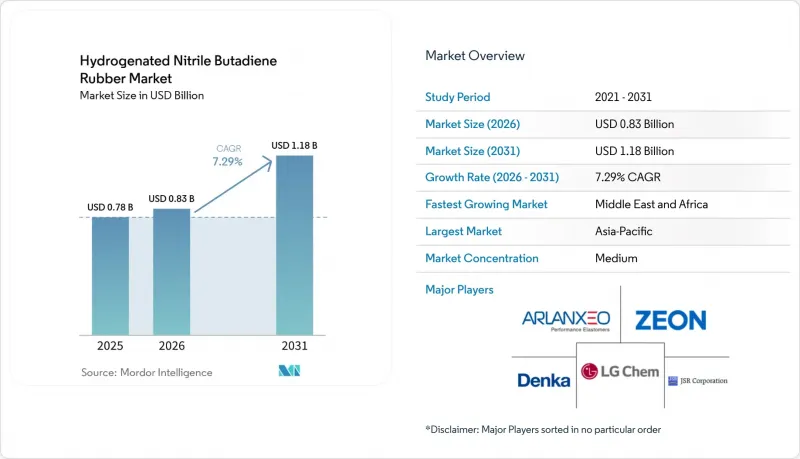
本報告按產品(低ACN、中ACN、高ACN)、應用(密封件和墊圈、O型圈、軟管和管材、皮帶等)、終端用戶行業(汽車、石油天然氣、工業機械、航太等)以及地區(亞太、北美、歐洲、南美、中東和非洲)進行細分。市場預測以美元計價。
全球氫化丁腈橡膠(HNBR)市場趨勢及洞察
先進內燃機和混合動力傳動系統對密封件的需求
混合動力平台雖然延長了內燃機的效用,但也對正時皮帶、曲軸油封和渦輪增壓器墊片提出了更高的運作要求。與傳統丁腈橡膠相比,氫化丁腈橡膠具有更優異的抗臭氧開裂和抗熱氧化性能,從而延長了保養週期並降低了保固成本。在中國,截至2026年2月,新能源車出貨量將達到72.3萬輛,其中24.6萬輛為插電式混合動力汽車,這些車款目前仍依賴耐油彈性體。獲得IATF 16949認證的供應商目前正向全球出口氫化丁腈橡膠製成的正時皮帶,隨著低摩擦塗層需求的成長,具有最佳化粘合性能的特種化合物的次市場正在形成。隨著雷射蝕刻齒面與過氧化物硫化化合物黏合等加工技術的進步,這種材料在混合動力汽車產量趨於穩定後,正日益成為推進系統中不可或缺的材料。
石油和天然氣產業對深井彈性體的需求:溫度高於 200 度C
在超深井中,密封件需承受 200 度C的高溫、150 巴的壓力以及超過 10% 的硫化氫濃度。特瑞堡 (Trelleborg) 的 XploR H9T20 級橡膠已通過 NORSOK M-710 認證,能夠承受海底防噴系統內部的快速氣體減壓。現場測試表明,高乙腈含量的氫化丁腈橡膠在 16% 硫化氫濃度下浸泡 30 天後仍能保持其硬度,性能優於標準丁腈橡膠。西方石油公司 (Occidental) 位於德克薩斯州的 Brown Pelican 二氧化碳隔離井指定使用氫化丁腈橡膠製成的封隔器,這表明油田材料標準同樣適用於碳回收技術。目前,工具串製造商正向容積式馬達提供昂貴的過氧化物硫化定子,聲稱在發生彈性體擠出之前,其運作可提高 20%。
與傳統彈性體相比的價格差異
在北美,氫化丁腈橡膠的售價為每公斤4美元,比標準丁腈橡膠高出約60%。這主要是由於氫化反應器的資本投資成本以及高純度丙烯腈原料價格的波動。 2026年3月,丁二烯現貨價格較上季波動0.8%,使得年度合約談判變得複雜。中國的齊魯石化等一體化企業從鄰近的裂解裝置採購低成本原料,然後以高價出口,這給歐美市場的利潤率帶來了壓力。因此,除非故障風險足以抵消投資優質材料所帶來的損失,否則工業機械的原始設備製造商(OEM)擴大採用價格較低的聚氨酯。
細分市場分析
2025年,高乙腈(ACN)牌號的橡膠銷量佔比達到46.42%,鞏固了其在油田燃油系統、油壓缸和防爆(BOP)設備中的應用地位。這些應用由於長期暴露於碳氫化合物環境中,需要極高的極性。中乙腈牌號的橡膠在通用密封件中兼顧了耐油性和加工性能。低乙腈牌號的橡膠透過引入側鏈乙烯基官能基,並利用過氧化物固化化學技術將玻璃化轉變溫度降低至約-40 度C,預計到2031年將以8.56%的複合年成長率成長。此前,只有氟橡膠才能達到如此高的溫度範圍。
高丙烯腈(ACN)配方符合NORSOK M-710酸性氣體井口標準,而中丙烯腈配方在電動車冷卻液軟管市場正不斷擴大市場佔有率,該市場對乙二醇相容性要求極高。 Versalis的BALANCE低丙烯腈氫化丁腈橡膠為原始設備製造商(OEM)提供了一種在不犧牲性能的前提下滿足再生材料含量法規要求的方法。關於再生炭黑的研究仍處於實驗階段。當填充材替代率超過30%時,由於過氧化物硫化作用,密度會降低,這在分散技術改進之前會限制其循環經濟效益。
區域分析
受中國汽車生產和綜合石化產能的推動,亞太地區預計到2025年將佔全球銷售額的42.18%。 2026年2月,阿朗新科推出一條生產線,透過氧化製程新增5,000噸年產能,此排放可減少80%的排放。齊魯石化等中國生產商的加氫轉換率已超過99%,其低廉的價格正對西方老牌企業構成壓力。由於國內產能有限,印度機械出口成長受限。
北美和歐洲佔據了相當大的市場佔有率,這得益於嚴格的排放法規和成熟的鑽井作業。阿朗新科位於美國德克薩斯州橘子和德國勒沃庫森的工廠構成了一條強大的供應鏈,而ZEON公司位於美國的年產能4400噸的工廠儘管因授權問題導致擴建延遲,但仍能滿足汽車行業的需求。在歐洲,隨著原始設備製造商(OEM)致力於提高再生材料的使用比例,生物基氫化丁腈橡膠(NBR)正日益受到青睞。墨西哥灣的頁岩氣和海上作業者正在指定使用符合NORSOK標準的硫化氫區域密封件。
預計到2031年,中東和非洲地區的年均成長率將達到8.21%。東非大裂谷的地熱鑽探和阿拉伯灣的近海平台都需要高溫彈性體,而新興的碳捕獲計畫也正在採用油田密封標準。拉丁美洲的規模仍然較小,但由於巴西汽車產業的蓬勃發展和阿根廷頁岩氣開發的推動,其需求正在不斷成長,儘管該地區仍然嚴重依賴進口。
其他好處:
- Excel格式的市場預測(ME)表
- 3個月的分析師支持
目錄
第1章:引言
- 市場分析與定義的前提條件
- 分析範圍
第2章 分析方法
第3章執行摘要
第4章 市場狀況
- 市場概覽
- 市場促進因素
- 對先進內燃機和混合動力傳動系統密封件的需求。
- 深層油氣井(溫度高於 200 度C)對彈性體的需求
- 一種突破性的過氧化物固化低溫HNBR等級產品。
- 在注重成本效益的電動車熱迴路中,以氟橡膠取代氟橡膠的進展
- 超深地熱鑽探對新一代彈性體的需求
- 市場限制因素
- 與傳統彈性體相比的價格差異
- 加工製程的複雜性和填料適用性的限制。
- 加強對生物基彈性體的監管
- 價值鏈分析
- 監理情勢
- 波特五力分析
第5章:預測市場規模與成長率
- 依產品
- 低ACN(低於30%)
- 中等ACN(31-40%)
- 高 ACN (>40%)
- 透過使用
- 密封件和墊圈
- O型圈
- 軟管和管子
- 皮帶(正時、支撐)
- 電線電纜絕緣體
- 滾筒和其他
- 按最終用戶行業分類
- 車
- 石油和天然氣
- 工業機械
- 航太
- 醫療設備
- 其他終端用戶產業
- 按地區
- 北美洲
- 美國
- 加拿大
- 墨西哥
- 南美洲
- 巴西
- 阿根廷
- 其他南美國家
- 歐洲
- 德國
- 英國
- 法國
- 義大利
- 西班牙
- 俄羅斯
- 北歐國家
- 其他歐洲國家
- 亞太地區
- 中國
- 日本
- 印度
- 韓國
- 其他亞太國家
- 中東和非洲
- 沙烏地阿拉伯
- 阿拉伯聯合大公國
- 南非
- 其他中東國家
- 北美洲
第6章 競爭情勢
- 市場集中度
- 關鍵策略趨勢
- 市佔率和排名分析
- 公司簡介
- ACRO Industries
- ARLANXEO
- Dawn Group
- Denka Company Limited
- Exxon Mobil Corporation
- Freudenberg Sealing
- Hutchinson
- JSR Corporation
- Kumho Petrochemical
- LANXESS
- LG Chem
- Lianda Corporation
- Nanjing Dongrun Special Rubber Co., Ltd
- Parker Hannifin Corp
- Polycomp
- Sinopec Mitsui Elastomers
- Sundow Polymers Co., Ltd
- Trelleborg Group
- TSRC
- ZEON CORPORATION
第7章 市場機會與未來展望
According to Mordor Intelligence, the hydrogenated nitrile butadiene rubber market size is projected to grow from USD 0.78 billion in 2025 to USD 0.83 billion in 2026, and reach USD 1.18 billion by 2031, growing at a CAGR of 7.29% from 2026 to 2031.
This report is Segmented by Product (Low ACN, Medium ACN, High ACN), Application (Seals and Gaskets, O-Rings, Hoses and Tubing, Belts, and More), End-User Industry (Automotive, Oil and Gas, Industrial Machinery, Aerospace, and More), and Geography (Asia-Pacific, North America, Europe, South America, Middle East and Africa). Market Forecasts are Provided in Terms of Value (USD).
Global Hydrogenated Nitrile Butadiene Rubber Market Trends and Insights
Demand From Advanced ICE and Hybrid Powertrain Seals
Hybrid platforms prolong internal-combustion relevance while imposing harsher duty cycles on timing belts, crankshaft seals, and turbocharger gaskets. Hydrogenated nitrile butadiene rubber resists ozone cracking and thermal oxidation better than conventional nitrile, thereby extending service intervals and lowering warranty costs. China shipped 723,000 new-energy vehicles in February 2026, including 246,000 plug-in hybrids that continue to rely on oil-resistant elastomers. Suppliers certified to IATF 16949 now export hydrogenated nitrile butadiene rubber timing belts worldwide, and demand for low-friction coatings builds a secondary market for specialty adhesion-optimized compounds. Processing gains-such as laser-etched tooth surfaces bonded with peroxide-cured compounds-further entrench the material in propulsion systems as hybrid volumes plateau.
Oil and Gas Deep-Well Elastomer Demands greater than 200 °C
Ultra-deep wells expose seals to 200 °C temperatures, 150 bar pressure, and hydrogen-sulfide levels above 10%. Trelleborg's XploR H9T20 grade, certified under NORSOK M-710, withstands rapid gas decompression inside subsea blowout preventers. Field tests show high-ACN hydrogenated nitrile butadiene rubber maintains hardness after 30 days in 16% H2S, outperforming standard nitrile. Occidental's Brown Pelican CO2-sequestration well in Texas specifies hydrogenated nitrile butadiene rubber packers, signaling that carbon-capture will mirror oil-field material standards. Tool string manufacturers now quote premium-priced peroxide-cured stators for positive-displacement motors, citing 20% longer run time before elastomer extrusion.
Price Premium Versus Conventional Elastomers
Hydrogenated nitrile butadiene rubber sells for USD 4.00 per kg in North America, roughly 60% above standard nitrile rubber, driven by hydrogenation reactor capital cost and high-purity acrylonitrile feedstock volatility. Spot butadiene moved 0.8% month-on-month in March 2026, complicating annual contract negotiations. Integrated Chinese sites, such as Qilu Petrochemical, siphon low-cost feedstocks from adjacent crackers, exporting at prices that erode Western margins. Consequently, industrial machinery OEMs often default to cheaper polyurethane unless the failure risk justifies premium material spend.
Other drivers and restraints analyzed in the detailed report include:
- Breakthrough Peroxide-Cured Low-Temperature Grades
- Rising Replacement of FKM in Cost-Sensitive EV Thermal Loops
- Processing Complexity and Filler Compatibility Limits
For complete list of drivers and restraints, kindly check the Table Of Contents.
Segment Analysis
High-ACN grades captured 46.42% of 2025 revenue, cementing their role in fuel systems, hydraulic cylinders, and oil-field blowout preventers where aggressive hydrocarbon exposure necessitates maximum polarity. Medium-ACN formulations balance oil resistance and processability across general-purpose seals. Low-ACN variants, boosted by pendant-vinyl functionalization, are forecast to grow at an 8.56% CAGR through 2031 because peroxide-cured chemistries now unlock glass-transition points near -40 °C, a realm once reserved for fluoroelastomers.
High-ACN compounds comply with NORSOK M-710 for sour-gas wellheads, while medium-ACN gains share in EV coolant hoses where glycol compatibility is critical. Versalis BALANCE low-ACN hydrogenated nitrile butadiene rubber provides OEMs a route to meet recycled-content mandates without sacrificing performance. Recycled-carbon-black programs remain experimental; above 30% filler substitution, peroxide-cure density drops, constraining circular-economy claims until dispersion technology improves.
Geography Analysis
Asia-Pacific generated 42.18% of 2025 revenue, driven by China's vehicle output and integrated petrochemical capacity. ARLANXEO launched a USD 210 million Changzhou line in February 2026, adding 5,000 tons/year via an oxidation process that cuts emissions by 80%. Chinese producers like Qilu Petrochemical achieve ≥99% hydrogenation conversion, offering lower pricing that pressures Western incumbents. India's machinery export growth is limited due to its limited domestic production.
North America and Europe split a significant share, supported by stringent emissions rules and mature drilling activity. ARLANXEO's Orange, Texas, and Leverkusen, Germany sites form a resilient supply chain, while Zeon's 4,400-tone U.S. plant feeds automotive demand despite postponed expansion amid permitting delays. Bio-attributed hydrogenated nitrile butadiene rubber gains traction in Europe as OEMs target higher recycled-content quotas. Shale and offshore operators in the Gulf of Mexico specify NORSOK-compliant seals for hydrogen-sulfide zones.
The Middle East and Africa are forecast to grow 8.21% annually to 2031. East African Rift geothermal drilling and Arabian Gulf offshore platforms require high-temperature elastomers, while emerging carbon-capture projects adopt oil-field sealing standards. Latin America remains smaller; Brazil's automotive sector and Argentina's shale play add incremental volumes yet rely on imports.
- ACRO Industries
- ARLANXEO
- Dawn Group
- Denka Company Limited
- Exxon Mobil Corporation
- Freudenberg Sealing
- Hutchinson
- JSR Corporation
- Kumho Petrochemical
- LANXESS
- LG Chem
- Lianda Corporation
- Nanjing Dongrun Special Rubber Co., Ltd
- Parker Hannifin Corp
- Polycomp
- Sinopec Mitsui Elastomers
- Sundow Polymers Co., Ltd
- Trelleborg Group
- TSRC
- ZEON CORPORATION
Additional Benefits:
- The market estimate (ME) sheet in Excel format
- 3 months of analyst support
TABLE OF CONTENTS
1 Introduction
- 1.1 Study Assumptions and Market Definition
- 1.2 Scope of the Study
2 Research Methodology
3 Executive Summary
4 Market Landscape
- 4.1 Market Overview
- 4.2 Market Drivers
- 4.2.1 Demand from advanced ICE and hybrid power-train seals
- 4.2.2 Oil- and gas deep-well elastomer demands >200 °C
- 4.2.3 Breakthrough peroxide-cured low-temperature HNBR grades
- 4.2.4 Rising replacement of FKM in cost-sensitive EV thermal loops
- 4.2.5 Next-gen ultra-deep geothermal drilling elastomer demand
- 4.3 Market Restraints
- 4.3.1 Price premium vs. conventional elastomers
- 4.3.2 Processing complexity and filler compatibility limits
- 4.3.3 Growing regulatory push toward bio-based elastomers
- 4.4 Value Chain Analysis
- 4.5 Regulatory Landscape
- 4.6 Porter's Five Forces
- 4.6.1 Bargaining Power of Suppliers
- 4.6.2 Bargaining Power of Buyers
- 4.6.3 Threat of New Entrants
- 4.6.4 Threat of Substitutes
- 4.6.5 Competitive Rivalry
5 Market Size and Growth Forecasts (Value)
- 5.1 By Product
- 5.1.1 Low ACN (Less than 30%)
- 5.1.2 Medium ACN (31-40%)
- 5.1.3 High ACN (More than 40%)
- 5.2 By Application
- 5.2.1 Seals and Gaskets
- 5.2.2 O-Rings
- 5.2.3 Hoses and Tubing
- 5.2.4 Belts (Timing, Auxiliary)
- 5.2.5 Wire and Cable Insulation
- 5.2.6 Rollers and Others
- 5.3 By End-user Industry
- 5.3.1 Automotive
- 5.3.2 Oil and Gas
- 5.3.3 Industrial Machinery
- 5.3.4 Aerospace
- 5.3.5 Medical Devices
- 5.3.6 Other End-user Industries
- 5.4 By Geography
- 5.4.1 North America
- 5.4.1.1 United States
- 5.4.1.2 Canada
- 5.4.1.3 Mexico
- 5.4.2 South America
- 5.4.2.1 Brazil
- 5.4.2.2 Argentina
- 5.4.2.3 Rest of South America
- 5.4.3 Europe
- 5.4.3.1 Germany
- 5.4.3.2 United Kingdom
- 5.4.3.3 France
- 5.4.3.4 Italy
- 5.4.3.5 Spain
- 5.4.3.6 Russia
- 5.4.3.7 Nordic Countries
- 5.4.3.8 Rest of Europe
- 5.4.4 Asia-Pacific
- 5.4.4.1 China
- 5.4.4.2 Japan
- 5.4.4.3 India
- 5.4.4.4 South Korea
- 5.4.4.5 Rest of Asia-Pacific
- 5.4.5 Middle-East and Africa
- 5.4.5.1 Saudi Arabia
- 5.4.5.2 United Arab Emirates
- 5.4.5.3 South Africa
- 5.4.5.4 Rest of Middle East
- 5.4.1 North America
6 Competitive Landscape
- 6.1 Market Concentration
- 6.2 Key Strategic Moves
- 6.3 Market Share(%)/Ranking Analysis
- 6.4 Company Profiles (includes Global level Overview, Market level overview, Core Segments, Financials as available, Strategic Information, Products and Services, and Recent Developments)
- 6.4.1 ACRO Industries
- 6.4.2 ARLANXEO
- 6.4.3 Dawn Group
- 6.4.4 Denka Company Limited
- 6.4.5 Exxon Mobil Corporation
- 6.4.6 Freudenberg Sealing
- 6.4.7 Hutchinson
- 6.4.8 JSR Corporation
- 6.4.9 Kumho Petrochemical
- 6.4.10 LANXESS
- 6.4.11 LG Chem
- 6.4.12 Lianda Corporation
- 6.4.13 Nanjing Dongrun Special Rubber Co., Ltd
- 6.4.14 Parker Hannifin Corp
- 6.4.15 Polycomp
- 6.4.16 Sinopec Mitsui Elastomers
- 6.4.17 Sundow Polymers Co., Ltd
- 6.4.18 Trelleborg Group
- 6.4.19 TSRC
- 6.4.20 ZEON CORPORATION
7 Market Opportunities and Future Outlook
- 7.1 White-space and Unmet-need Assessment
- 7.2 Ultra-deep geothermal sealing solutions
- 7.3 Bio-sourced HNBR and circular-economy plays

 2026年全球特殊丁腈橡膠市場報告
 丁腈橡膠(NBR):市場佔有率分析、行業趨勢和統計數據、成長預測(2026-2031)
 丁腈橡膠市場-2026-2032年全球市場預測
 丁腈橡膠市場:按應用、最終用戶和地區分類
 丁腈橡膠市場:市場規模、佔有率和趨勢分析(按產品、應用和地區分類),細分市場預測(2026-2033 年)
 丁腈橡膠粉市場分析及預測(至2035年):類型、產品類型、應用、形態、材料類型、製程、最終用戶、技術、功能
 全球快速硫化丁腈橡膠市場規模、佔有率、趨勢和成長分析報告(2026-2034)
 全球氫化丁腈橡膠(HNBR)市場:產能、需求與預測分析(2018-2034)丙烯腈丁二烯乳膠市場按應用、終端用戶產業、類型、等級、形態和銷售管道-2026-2032年全球預測
 丁腈橡膠市場規模、佔有率及成長分析(按產品類型、終端用戶產業及地區分類)-2026-2033年產業預測