


 |
市場調查報告書
商品編碼
2123744
棒狀包裝:市場佔有率分析、產業趨勢與統計、成長預測(2026-2031)Stick Packaging - Market Share Analysis, Industry Trends & Statistics, Growth Forecasts (2026 - 2031) |
||||||

※ 本網頁內容可能與最新版本有所差異。詳細情況請與我們聯繫。
預計棒狀包裝市場將從 2025 年的 14.9 億美元和 2026 年的 15.8 億美元成長到 2031 年的 20.7 億美元,2026 年至 2031 年的複合年成長率為 5.54%。
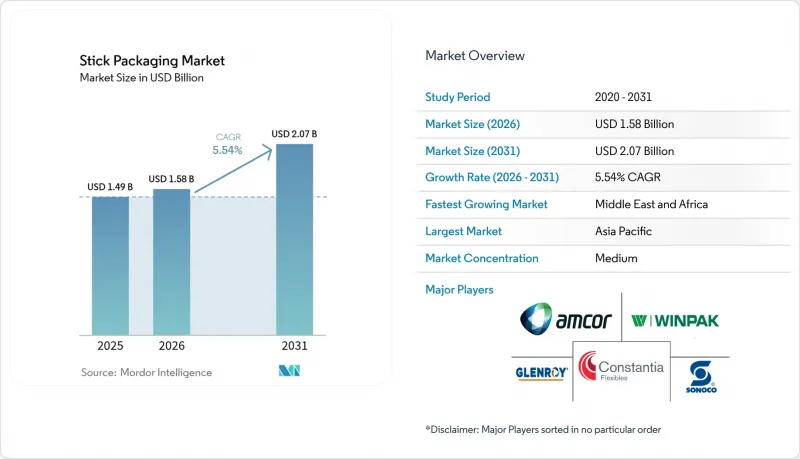
本報告按材料(塑膠、紙張、金屬箔、生質塑膠)、產品形態(粉末、顆粒、液體、半固體)、終端用戶產業(食品飲料、製藥、化妝品及個人護理、工業及家用)、包裝器材線數量(1-3條生產線、4-10條生產線、11-20條及以上)及地區進行細分。市場預測以美元計價。
全球棒狀包裝市場趨勢及洞察
便利性和「隨時隨地消費」的蓬勃發展
千禧世代和Z世代消費者偏好便於攜帶的單份包裝,例如可以輕鬆放入背包、健身包和餐飲托盤中的產品。因此,即溶咖啡、電解質飲料和益生菌粉等產品現在都以訂閱套裝的形式銷售,為代工包裝公司帶來了穩定可預測的銷售量。超過95%的空瓶回收率最大限度地減少了產品浪費,這在新興經濟體中尤其重要,因為這些地區的可支配收入成長速度超過了回收基礎設施的發展速度。自動販賣機業者和辦公室餐飲服務商正在購買250至1000件一箱的產品,以減少補貨的麻煩。同時,耐力運動品牌也推出了可客製化的電解質棒,作為笨重瓶裝電解質飲料的替代品。
對減少材料和重量的需求
與枕形袋相比,超薄包裝可減少10%至40%的薄膜用量,從而降低每單位貨物的碳排放量,並協同降低大批量粉狀飲料運輸的成本。加工商透過拉伸單聚乙烯薄膜來使用超薄箔,同時將水蒸氣透過率控制在0.5 g/m²·d以下。此外,諸如「功能性阻隔紙終極版」(FunctionalBarrier Paper Ultimate)之類的新型纖維基結構無需塑膠塗層即可實現防油防潮性能。據醫藥冷鏈運輸商稱,包裝重量的減輕提高了每個箱子的裝載效率,並減少了溫控運輸路線中乾冰的使用量。
加強對一次性塑膠製品的監管
各個司法管轄區對一次性塑膠包裝實施禁令、課稅或報告要求,這使得無法透過資源回收設施分揀的多層複合材料處於不利地位。在加州,可回收和不可回收塑膠的價格差異可高達50%;加拿大的國家塑膠註冊系統要求每年報告噸位,這造成了行政負擔,阻礙了複雜薄膜的推廣應用。因此,加工商正在增加對紙基和生物基聚乙烯棒材的研發投入,導致認證週期延長和資本投資增加。
細分市場分析
到2025年,塑膠將佔棒狀包裝市場銷售額的56.74%。這是因為聚乙烯在成本、密封強度和防潮性方面保持了良好的平衡。雖然塑膠棒狀包裝市場規模依然龐大,但隨著品牌商對工業可堆肥性的需求日益成長,生質塑膠預計將以6.34%的複合年成長率成長。聚乳酸和聚羥基烷酯酯薄膜在西歐可以作為有機廢棄物,但其水蒸氣透過率(5 g/m²·d)限制了低水分活度粉末的使用。纖維素基可堆肥小袋目前正進入調味品和化妝品樣品等細分市場,但在氧氣透過率必須低於0.01 cm³/m²·d的領域,鋁箔仍然不可或缺。
由於無塗布的牛皮紙可以直接用於現有的紙張回收工藝,紙棒包裝在糖和甜味劑應用領域正逐漸佔據市場佔有率。然而,由於紙張的孔隙率較高,加工商不得不運作較高的密封溫度,導致能耗增加。只有當低玻璃化轉變溫度的熱封漆被廣泛應用時,紙棒包裝的市場佔有率才有可能進一步成長。在濕度高達80%的熱帶地區,維生素氧化速度加快,因此金屬箔預計將繼續用於藥品物流。
預計到2025年,粉狀產品將佔銷售額的42.34%,但液體產品正以6.29%的複合年成長率成長,這得益於無菌多通道灌裝機現在可以處理濃度高達5000 cP的懸浮液,且不會出現滴漏或空隙。契約製造正在運作20通道生產線,每分鐘可生產1,600包,這使得液體棒狀包裝市場成為所有產品形式中成長最快的市場。熱填充酸性飲料可承受85 度C的滅菌溫度,而益生菌則需要ISO 7級冷灌裝室。
顆粒劑介於粉末和片劑之間,其流動性優勢使其能夠快速填充口服補液鹽。而半固態凝膠則利用棒狀包裝的衛生、一次性使用優勢,廣泛應用於外用軟膏和眼霜。伺服驅動的螺旋輸送器和重量檢測回饋迴路可將填充量偏差控制在±1%以下,這對於兒童用藥的精確性至關重要。不斷改進的防滲頸部密封設計,有效減少了液體製劑初期出現的洩漏申訴。
區域分析
預計到2025年,亞太地區將佔全球銷售額的32.76%,主要得益於中國薄膜擠出生產基地和印度抗生素小袋的出口。 2024年,當地加工商進口了價值2.032億美元的灌裝機,年增32.8%。這顯示該地區的條狀包裝市場正朝著現代化自動化方向發展。在印度,單劑量抗生素被用於沒有冷藏設施的農村診所,而日本伺服驅動灌裝機因其能夠以微米級精度控制填充重量,在北美市場需求旺盛。
預計到2031年,中東地區的複合年成長率將達到6.52%,這主要得益於沙烏地阿拉伯旨在促進本地製藥業發展的「2030願景」計畫以及阿拉伯聯合大公國的無毒區。 2024年,該地區包裝器材進口額達13億歐元(14.6億美元),年增25.4%。配備阿拉伯語人機介面的無塵室級生產線將使出口商無需冷鏈即可服務於氣候炎熱的市場。
雖然北美和歐洲的市場應用已趨於成熟,但為了滿足回收法規的要求,資本投資主要集中在單一材料薄膜擠出機上。 2024年,德國向海外出口了價值3.626億歐元(4.07億美元)的設備,其中相當一部分流向了亞洲的合資包裝公司。在南美洲,巴西和阿根廷的市場發展勢頭強勁,但外匯波動使得進口設備的投資回收變得更加複雜。在非洲,除南非和埃及外,出口量仍然小規模,但捐助者資助的瘧疾控制和口服補液鹽(ORS)計畫可能會成為長期需求的種子。
其他好處:
- Excel格式的市場預測(ME)表
- 3個月的分析師支持
目錄
第1章:引言
- 研究假設和市場定義
- 調查範圍
第2章:調查方法
第3章執行摘要
第4章 市場狀況
- 市場概覽
- 市場促進因素
- 便利性和「隨時隨地消費」的蓬勃發展
- 對材料和輕量化的需求
- 軟包裝的永續性要求
- 藥物微劑量和兒童製劑
- 一種智慧的濕氣活化阻隔塗層,可製造無需乾燥劑的包裝袋。
- 微型倉配暗店中機能飲料條狀包裝的興起
- 市場限制因素
- 加強對一次性塑膠製品的監管
- 多層薄膜可回收性的局限性
- 阻隔級單層材料薄膜供不應求
- 揮發性亞硝胺造成的污染風險限制了棒狀包裝袋在製藥業的使用。
- 產業價值/價值鏈分析
- 監理情勢
- 技術展望
- 波特五力分析
- 宏觀經濟因素對市場的影響
- 關鍵績效指標(KPI)
第5章 市場規模與成長預測
- 材料
- 塑膠
- 紙
- 金屬箔
- 生質塑膠
- 按產品形式
- 粉末
- 顆粒
- 液體
- 半固態製劑
- 按最終用戶行業分類
- 食品/飲料
- 即溶飲料
- 營養功能粉
- 糖和甜味劑
- 製藥
- OTC
- Rx
- 化妝品和個人護理
- 工業和家用
- 食品/飲料
- 按通道數分類的包裝器材
- 1-3號車道
- 4-10條車道
- 第11-20泳道
- 超過20條車道
- 按地區
- 北美洲
- 美國
- 加拿大
- 墨西哥
- 歐洲
- 英國
- 德國
- 法國
- 義大利
- 其他歐洲國家
- 亞太地區
- 中國
- 日本
- 印度
- 韓國
- 其他亞太國家
- 中東
- 以色列
- 沙烏地阿拉伯
- 阿拉伯聯合大公國
- 土耳其
- 其他中東國家
- 非洲
- 南非
- 埃及
- 其他非洲國家
- 南美洲
- 巴西
- 阿根廷
- 其他南美國家
- 北美洲
第6章 競爭情勢
- 市場集中度
- 策略趨勢
- 市佔率分析
- 公司簡介
- Amcor plc
- Constantia Flexibles Group GmbH
- Glenroy, Inc.
- Aranow Packaging Machinery SL
- Fres-Co System USA, Inc.
- Catalent, Inc.
- Winpak Ltd.
- Sonoco Products Company
- ePac Holdings, LLC
- GFR Pharma Ltd.
- Sonic Packaging Industries, Inc.
- Viking Masek Global Packaging Technologies sro
- Nichrome India Ltd.
- Unither Pharmaceuticals SAS
- Marchesini Group SpA
- Huhtamaki Oyj
- ProAmpac LLC
- Rengo Co., Ltd.
- Stick Pack Company Inc.
第7章 市場機會與未來展望
According to Mordor Intelligence, the stick packaging market size is projected to expand from USD 1.49 billion in 2025 and USD 1.58 billion in 2026 to USD 2.07 billion by 2031, registering a CAGR of 5.54% between 2026 to 2031.
This report is Segmented by Material (Plastics, Paper, Metal Foils, and Bioplastics), Product Form (Powders, Granules, Liquids, and Semi-Solids), End-User Industry (Food and Beverages, Pharmaceuticals, Cosmetics and Personal Care, and Industrial and Household), Packaging-Machinery Lane Count (1-3 Lanes, 4-10 Lanes, 11-20 Lanes, and More), and Geography. The Market Forecasts are Provided in Terms of Value (USD).
Global Stick Packaging Market Trends and Insights
Convenience and On-The-Go Consumption Boom
Millennial and Gen Z shoppers favor single-serve formats that slip into backpacks, gym bags, and hospitality trays, so instant coffee, electrolyte mixes, and probiotic powders now appear in subscription bundles that create predictable annuity volumes for co-packers. The empty rate of more than 95% minimizes product waste, an attribute valued in emerging economies where disposable incomes rise faster than recycling infrastructure. Vending operators and office caterers buy 250- to 1,000-count cases to reduce restocking labor, while endurance-sports brands release customizable electrolyte sticks that replace heavy ready-to-drink bottles.
Demand For Material and Weight Reduction
Slim sticks use 10-40% less film than pillow pouches, lowering carbon per shipped unit and unlocking freight savings that compound across high-volume beverage powders. Converters stretch mono-polyethylene films and deploy ultra-thin foils that still keep moisture-vapor transmission below 0.5 g/m2-day, and new fiber-based structures like FunctionalBarrier Paper Ultimate achieve grease and moisture resistance without plastic coatings. Pharmaceutical cold-chain shippers report that lighter pack weight improves box payload efficiency and trims dry-ice use in temperature-controlled lanes.
Single-Use Plastic Regulation Tightening
Jurisdictions impose bans, taxes, or reporting duties on disposable plastic packs, penalizing multi-layer laminates that cannot pass material-recovery facility sortation. California's fee differential can reach 50% between recyclable and non-recyclable formats, and Canada's nationwide plastics registry requires annual tonnage reports, adding an administrative layer that discourages complex films . As a result, converters accelerate R&D spending on paper and bio-PE sticks, lengthening qualification cycles and increasing capital outlays.
Other drivers and restraints analyzed in the detailed report include:
- Sustainability Mandates For Flexible Packs
- Pharma Micro-Dosing And Pediatric Formats
- Volatile Nitrosamine Contamination Risk Limits Stick Sachet Use In Pharma
For complete list of drivers and restraints, kindly check the Table Of Contents.
Segment Analysis
Plastics accounted for 56.74% of the stick packaging market revenue in 2025 because polyethylene balances cost, seal strength, and moisture protection. The stick packaging market size for plastics remains significant, yet bioplastics are forecast to post a 6.34% CAGR as brand owners seek industrial-composting claims. Polylactic acid and polyhydroxyalkanoate films enable organic waste bin disposal in Western Europe, but their 5 g/m2-day moisture-vapor transmission rate throttles the use of low-water-activity powders. Cellulose-based compostable sachets now enter condiment and cosmetic sample niches, while aluminum foil stays indispensable where oxygen transmission below 0.01 cm3/m2-day is mandatory.
Paper sticks gain share in sugar and sweetener applications thanks to uncoated kraft that can be dropped directly into existing paper recycling streams. Yet converters must run at higher sealing temperatures to overcome paper porosity, thereby increasing energy use. The paper stick packaging market share is likely to rise only if heat-seal lacquers with lower glass transition temperatures launch at scale. Metal foils will persist for tropical pharmaceutical logistics, where 80% humidity accelerates vitamin oxidation.
Powders retained 42.34% of 2025 revenue, but liquids are on pace for a 6.29% CAGR, as aseptic multi-lane fillers now handle suspensions up to 5,000 cP without drip or voids. Contract manufacturers operate 20-lane lines that turn out 1,600 packed units per minute, making the stick packaging market for liquids the fastest-growing among product forms. Hot-fill acidic beverages tolerate 85 °C lethality, while probiotics need ISO Class 7 cold-fill rooms.
Granules sit between powders and tablets, offering flow advantages for high-speed dosing of oral rehydration salts, and semi-solid gels exploit sticks' hygienic single-use promise in topical ointments and eye creams. Servo-driven augers and weight-check feedback loops cut fill variance below +-1%, essential for pediatric dosing accuracy. Continuous improvement in neck-proof seals reduces leak complaints that once occurred with liquid adoption.
Complete Report Scope:
- By Material
- Plastics
- Paper
- Metal Foils
- Bioplastics
- By Product Form
- Powders
- Granules
- Liquids
- Semi-Solids
- By End-User Industry
- Food and Beverages
- Instant Beverages
- Nutraceutical Powders
- Sugar and Sweeteners
- Pharmaceuticals
- OTC
- Rx
- Cosmetics and Personal Care
- Industrial and Household
- Food and Beverages
- By Packaging-Machinery Lane Count
- 1-3 Lanes
- 4-10 Lanes
- 11-20 Lanes
- Greater Than 20 Lanes
- By Geography
- North America
- United States
- Canada
- Mexico
- Europe
- United Kingdom
- Germany
- France
- Italy
- Rest of Europe
- Asia-Pacific
- China
- Japan
- India
- South Korea
- Rest of Asia-Pacific
- Middle East
- Israel
- Saudi Arabia
- United Arab Emirates
- Turkey
- Rest of Middle East
- Africa
- South Africa
- Egypt
- Rest of Africa
- South America
- Brazil
- Argentina
- Rest of South America
- North America
Geography Analysis
Asia-Pacific accounted for 32.76% of 2025 revenue, driven by China's film extrusion base and India's antibiotic sachet exports. Local converters imported USD 203.2 million of filling machinery in 2024, up 32.8% year-over-year, showing that the stick packaging market there is scaling modern automation. India uses unit-dose antibiotics for rural clinics lacking refrigeration, and Japanese servo-driven equipment finds buyers in North America because of micron-accurate fill weight.
The Middle East is projected to log a 6.52% CAGR to 2031, spurred by Saudi Vision 2030 mandates for local drug manufacturing and the UAE's pharmaceutical free zones. Regional imports of packaging machinery hit EUR 1.3 billion (USD 1.46 billion) in 2024, a 25.4% annual jump. Cleanroom-grade stick lines equipped with Arabic human-machine interfaces allow exporters to serve hot-climate markets without a cold chain.
North America and Europe display mature adoption but funnel capex toward mono-material film extrusion to satisfy recycling rules. Germany shipped EUR 362.6 million (USD 407 million) of machinery abroad in 2024, with a notable share headed to Asian co-packers. South America gains momentum in Brazil and Argentina, though currency swings complicate the payback of imported equipment. Africa's volumes remain modest outside South Africa and Egypt, but donor-funded malaria and ORS programs could seed long-term demand.
- Amcor plc
- Constantia Flexibles Group GmbH
- Glenroy, Inc.
- Aranow Packaging Machinery S.L.
- Fres-Co System USA, Inc.
- Catalent, Inc.
- Winpak Ltd.
- Sonoco Products Company
- ePac Holdings, LLC
- GFR Pharma Ltd.
- Sonic Packaging Industries, Inc.
- Viking Masek Global Packaging Technologies s.r.o.
- Nichrome India Ltd.
- Unither Pharmaceuticals SAS
- Marchesini Group S.p.A.
- Huhtamaki Oyj
- ProAmpac LLC
- Rengo Co., Ltd.
- Stick Pack Company Inc.
Additional Benefits:
- The market estimate (ME) sheet in Excel format
- 3 months of analyst support
TABLE OF CONTENTS
1 INTRODUCTION
- 1.1 Study Assumptions and Market Definition
- 1.2 Scope of the Study
2 RESEARCH METHODOLOGY
3 EXECUTIVE SUMMARY
4 MARKET LANDSCAPE
- 4.1 Market Overview
- 4.2 Market Drivers
- 4.2.1 Convenience and On-the-Go Consumption Boom
- 4.2.2 Demand for Material and Weight Reduction
- 4.2.3 Sustainability Mandates for Flexible Packs
- 4.2.4 Pharma Micro-Dosing and Pediatric Formats
- 4.2.5 Smart Moisture-Activated Barrier Coatings Enabling Desiccant-Free Sachets
- 4.2.6 Rise of Functional Beverage Stick Packs in Micro-Fulfilment Dark Stores
- 4.3 Market Restraints
- 4.3.1 Single-Use-Plastic Regulation Tightening
- 4.3.2 Limited Recyclability of Multi-Layer Films
- 4.3.3 Barrier-Grade Mono-Material Film Shortage
- 4.3.4 Volatile Nitrosamine Contamination Risk Limits Stick Sachet Use in Pharma
- 4.4 Industry Value / Supply-Chain Analysis
- 4.5 Regulatory Landscape
- 4.6 Technological Outlook
- 4.7 Porter's Five Forces Analysis
- 4.7.1 Bargaining Power of Suppliers
- 4.7.2 Bargaining Power of Consumers
- 4.7.3 Threat of New Entrants
- 4.7.4 Threat of Substitutes
- 4.7.5 Intensity of Rivalry
- 4.8 Impact of Macroeconomic Factors on the Market
- 4.9 Key Performance Indicators (KPIs)
5 MARKET SIZE AND GROWTH FORECASTS (VALUE)
- 5.1 By Material
- 5.1.1 Plastics
- 5.1.2 Paper
- 5.1.3 Metal Foils
- 5.1.4 Bioplastics
- 5.2 By Product Form
- 5.2.1 Powders
- 5.2.2 Granules
- 5.2.3 Liquids
- 5.2.4 Semi-Solids
- 5.3 By End-User Industry
- 5.3.1 Food and Beverages
- 5.3.1.1 Instant Beverages
- 5.3.1.2 Nutraceutical Powders
- 5.3.1.3 Sugar and Sweeteners
- 5.3.2 Pharmaceuticals
- 5.3.2.1 OTC
- 5.3.2.2 Rx
- 5.3.3 Cosmetics and Personal Care
- 5.3.4 Industrial and Household
- 5.3.1 Food and Beverages
- 5.4 By Packaging-Machinery Lane Count
- 5.4.1 1-3 Lanes
- 5.4.2 4-10 Lanes
- 5.4.3 11-20 Lanes
- 5.4.4 Greater Than 20 Lanes
- 5.5 By Geography
- 5.5.1 North America
- 5.5.1.1 United States
- 5.5.1.2 Canada
- 5.5.1.3 Mexico
- 5.5.2 Europe
- 5.5.2.1 United Kingdom
- 5.5.2.2 Germany
- 5.5.2.3 France
- 5.5.2.4 Italy
- 5.5.2.5 Rest of Europe
- 5.5.3 Asia-Pacific
- 5.5.3.1 China
- 5.5.3.2 Japan
- 5.5.3.3 India
- 5.5.3.4 South Korea
- 5.5.3.5 Rest of Asia-Pacific
- 5.5.4 Middle East
- 5.5.4.1 Israel
- 5.5.4.2 Saudi Arabia
- 5.5.4.3 United Arab Emirates
- 5.5.4.4 Turkey
- 5.5.4.5 Rest of Middle East
- 5.5.5 Africa
- 5.5.5.1 South Africa
- 5.5.5.2 Egypt
- 5.5.5.3 Rest of Africa
- 5.5.6 South America
- 5.5.6.1 Brazil
- 5.5.6.2 Argentina
- 5.5.6.3 Rest of South America
- 5.5.1 North America
6 COMPETITIVE LANDSCAPE
- 6.1 Market Concentration
- 6.2 Strategic Moves
- 6.3 Market Share Analysis
- 6.4 Company Profiles (includes Global Level Overview, Market Level Overview, Core Segments, Financials As Available, Strategic Information, Market Rank/Share, Products And Services, Recent Developments)
- 6.4.1 Amcor plc
- 6.4.2 Constantia Flexibles Group GmbH
- 6.4.3 Glenroy, Inc.
- 6.4.4 Aranow Packaging Machinery S.L.
- 6.4.5 Fres-Co System USA, Inc.
- 6.4.6 Catalent, Inc.
- 6.4.7 Winpak Ltd.
- 6.4.8 Sonoco Products Company
- 6.4.9 ePac Holdings, LLC
- 6.4.10 GFR Pharma Ltd.
- 6.4.11 Sonic Packaging Industries, Inc.
- 6.4.12 Viking Masek Global Packaging Technologies s.r.o.
- 6.4.13 Nichrome India Ltd.
- 6.4.14 Unither Pharmaceuticals SAS
- 6.4.15 Marchesini Group S.p.A.
- 6.4.16 Huhtamaki Oyj
- 6.4.17 ProAmpac LLC
- 6.4.18 Rengo Co., Ltd.
- 6.4.19 Stick Pack Company Inc.
7 MARKET OPPORTUNITIES AND FUTURE OUTLOOK
- 7.1 White-Space and Unmet-Need Assessment

 糖包裝:市場佔有率分析、產業趨勢與統計、成長預測(2026-2031)
 棒狀包裝市場:按材料、產品類型、應用、分銷管道和地區分類
 棒狀包裝市場:依產品類型、材料類型、產品形式、包裝尺寸、封口方式及最終用途分類-全球預測,2026-2032年
 條狀包裝市場報告:按材料、填充類型、容量、應用和地區分類(2026-2034 年)
 全球條狀包裝市場規模、佔有率、趨勢和成長分析報告(2026-2034年)楝樹棒市場:依產品類型、應用程式、最終用戶、通路和地區分類。
 條狀包裝市場規模、佔有率及成長分析(按材料、終端用途產業及地區分類)-2026-2033年產業預測
 棒狀包裝市場規模、佔有率和趨勢分析報告:按材料、應用、地區和細分市場預測(2025-2033 年)北美棒狀包裝:市場佔有率分析、行業趨勢和成長預測(2025-2030 年)
 棒包裝市場機會、成長動力、產業趨勢分析及 2024 年至 2032 年預測