


 |
市場調查報告書
商品編碼
2123646
柔版印刷機:市場佔有率分析、產業趨勢與統計、成長預測(2026-2031)Flexographic Printing Machine - Market Share Analysis, Industry Trends & Statistics, Growth Forecasts (2026 - 2031) |
||||||

※ 本網頁內容可能與最新版本有所差異。詳細情況請與我們聯繫。
據 Mordor Intelligence 稱,柔版印刷機市場預計到 2026 年價值 43.5 億美元,高於 2025 年的 42.2 億美元,預計到 2031 年將達到 50.6 億美元。
預計 2026 年至 2031 年的複合年成長率為 3.09%。
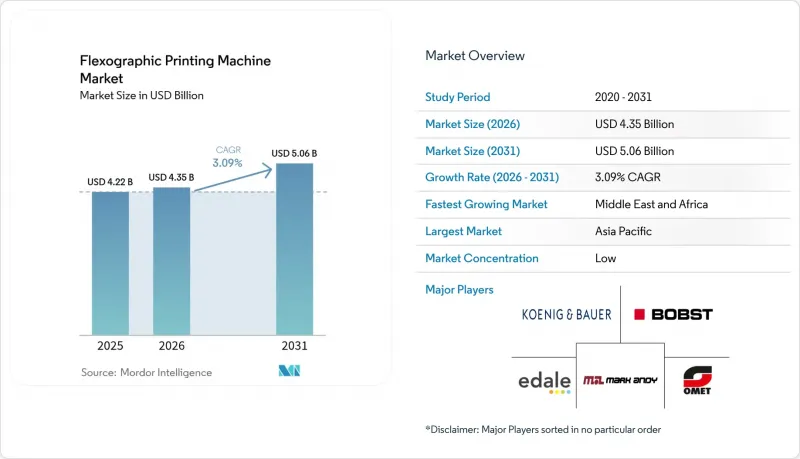
本報告按材料(紙張和紙板、塑膠薄膜、瓦楞紙板等)、印刷機類型(中央壓印機、堆疊式印刷機、聯線/模組化印刷機)、終端用戶行業(食品飲料、製藥和醫療保健等)、自動化程度(傳統型、智慧/物聯網型)以及地區進行細分。市場規模和預測均以美元計價。
全球柔版印刷機市場趨勢與洞察
經濟高效的小批量包裝能力
柔版印刷機製造商大幅縮短了設定時間,將最低損益平衡批量從5000公尺降至近500公尺。更短的生產週期使得擁有季節性或區域性SKU的品牌能夠以較低的成本實現客製化圖形。 MacDermid的LUX ITP印版將從製版到出貨的時間從兩天縮短至八小時,消除了加工商在隔天完成圖稿更換時面臨的主要瓶頸。更快的製版速度和更快捷的換版流程相結合,使得柔版印刷能夠重新奪回先前由數位印刷機承接的工作。因此,加工商正在投資建造兼顧速度和柔軟性的中型模組化生產線,以滿足柔版印刷機市場的整體設備需求。
食品級永續軟性包裝需求激增
歐洲和北美的法規要求消除 PFAS,同時要求產品完全可回收。 Saica Flex 計劃在 2030 年打造一條 100% 可回收產品線,其中 5% 為再生塑膠 (PCR),凸顯了加工商在展現其對循環經濟承諾方面所面臨的壓力。 INX 的 GelFlex EB 墨水在保持阻隔性能的同時,透過省去複合層來減輕包裝的整體重量 (inxinternational.com)。與 Solenis 和 Heidelberg 等線上阻隔塗料供應商的合作進一步減少了二次加工工序。隨著加工商爭相在歐盟 2026 年 8 月 PFAS 法規上限生效前獲得新化學成分的認證,能夠以具有競爭力的速度印刷水性油墨和電子束固化油墨的印刷機的需求正在成長,這對柔版印刷機市場產生了積極影響。
一台多色CI印刷機需要巨額資金投入。
一條完整的1300毫米連續印刷生產線造價高達400萬美元,遠遠超過模組化替代機型的價格。因此,即使是全球主要客戶也推遲了2024年的訂單,博斯特的連續印刷訂單下降了24%。隨著平均批量縮小,中型加工商不願為購買昂貴的印刷機資金籌措,減緩了柔版印刷機市場的更新換代週期。
細分市場分析
到2025年,紙張和紙板將成為柔版印刷市場的主要驅動力,佔45.10%的市場佔有率,這主要得益於零售電商對紙盒和再生牛皮紙襯紙的需求。加工商依靠紙張易於回收的特性來滿足品牌需求,而塗層技術的進步則延長了常溫保存食品的保存期限。然而,塑膠薄膜的複合年成長率最高,達到6.33%,因為單一材料複合薄膜和PCR(消費後再生塑膠)混合物滿足了循環經濟和阻隔性的需求。
INX的EB油墨加劇了材料替代領域的競爭,因為它們可以省去薄膜結構中的複合層,在不影響阻隔性能的前提下降低厚度。 UFlex在埃及新建的PET樹脂產能反映了全球樹脂自給自足、縮短供應鏈的趨勢。總體而言,造紙企業正在擴大其瓦楞紙板生產設備的規模,而薄膜供應商則在積極滿足市場對阻隔性包裝袋的需求,從而維持了整個柔版印刷市場對特定承印物專用印刷機的設備需求。
預計到2025年,線上/模組化印刷系統將佔據39.00%的銷售佔有率,這得益於其相對較低的初始投資和靈活的作業切換能力,深受自有品牌食品和獨立化妝品製造商的青睞。儘管中央壓印(CI)印刷機的初始投資較高,但其成長速度最快,複合年成長率達5.28%,這主要得益於品牌對收縮套標和寬幅捲筒零嘴零食精準套色的需求。
混合式設計模糊了傳統印刷和現代印刷之間的界線。 Uteco 的「OnyxOMNIA」將噴墨印表機頭整合到 8 色柔版印刷機中,實現了可變資料印刷,同時印刷速度高達 400 公尺/分鐘。隨著基於 CI 的 OEM 廠商引入自動化印版管和數位孿生診斷技術,24/6 輪換式轉換器正變得越來越高階,推動柔版印刷機市場向高規格平台發展。
區域分析
到2025年,亞太地區將佔全球銷售額的40.10%。這主要得益於中國產能的提升以及補貼主導的設備升級,這些升級優先採用符合「綠色智慧」標準的CI印刷機。在日本,人事費用的上升正在加速機器人物料搬運技術的引入;而韓國和東協地區的加工商則在投資建造軟包裝生產線,以滿足當地零嘴零食和個人護理品牌的需求。
中東和非洲是成長最快的地區,年複合成長率達5.96%。人口成長、冷鏈設施的完善以及日常消費品(FMCG)的日益普及,推動了新型軟包裝工廠的建設,並吸引了大量投資,這些投資構成了當地樹脂供應的基礎,例如UFlex在埃及的PET切片工廠。海灣國家也正在試行推廣水性油墨,以實現其循環經濟目標。
儘管北美和歐洲市場已趨於成熟,但在日益嚴格的 PFAS 和 VOC 法規下,它們仍然保持著技術領先地位。歐盟將於 2026 年 8 月生效的 PFAS 限量標準(25 ppb)迫使印刷加工商徹底重新思考其阻隔塗層技術。由於各州對溶劑的監管規定,北美印刷商也面臨類似的壓力,這促使他們對密封式刮刀系統和熱固型空氣管理系統進行升級。因此,這些地區的宏觀經濟生產成長正在放緩,但由於設備更新換代的需求,柔版印刷機市場卻蓬勃發展。
其他好處
- Excel格式的市場預測(ME)表
- 3個月的分析師支持
目錄
第1章:引言
- 研究假設和市場定義
- 調查範圍
第2章:調查方法
第3章執行摘要
第4章 市場狀況
- 市場概覽
- 市場促進因素
- 經濟高效的小批量包裝能力
- 食品級永續軟性包裝需求激增
- 電子商務履約中瓦楞紙板產能的快速擴張
- 北美和歐盟強制使用水性、低VOC油墨。
- 在加工生產線中引入基於數位孿生和人工智慧的預測性維護
- 中國「2026綠色印刷」計畫下的CI柔版印刷設備補貼
- 市場限制因素
- 一台多色CI印刷機需要巨額資金投入。
- 歐洲和日本缺乏熟練的印刷操作員
- 超小批量生產中製版前置作業時間的瓶頸。
- 加強對阻隔塗層合格性的 PFAS 法規
- 供應鏈分析
- 監理情勢
- 技術展望
- 波特五力分析
第5章 市場規模與成長預測
- 材料
- 紙張和紙板
- 塑膠薄膜
- 金屬薄膜和箔
- 紙板
- 其他材料(生質塑膠、層壓材料)
- 依印表機類型
- 中央印象(CI)
- 堆疊
- 內嵌/模組化
- 按最終用戶行業分類
- 飲食
- 製藥和醫療保健
- 個人護理和化妝品
- 家用電子電器
- 物流與電子商務
- 其他
- 按自動化級別
- 傳統的
- 智慧/物聯網相容
- 按地區
- 北美洲
- 美國
- 加拿大
- 墨西哥
- 歐洲
- 德國
- 法國
- 義大利
- 英國
- 西班牙
- 其他歐洲國家
- 亞太地區
- 中國
- 日本
- 印度
- 韓國
- ASEAN
- 其他亞太國家
- 南美洲
- 巴西
- 阿根廷
- 其他南美國家
- 中東和非洲
- 中東
- 沙烏地阿拉伯
- 阿拉伯聯合大公國
- 土耳其
- 其他中東國家
- 非洲
- 南非
- 肯亞
- 其他非洲地區
- 中東
- 北美洲
第6章 競爭情勢
- 市場集中度
- 策略趨勢
- 市佔率分析
- 公司簡介
- Bobst Group SA
- Windmoller and Holscher KG
- Koenig and Bauer AG
- Mark Andy Inc.
- Uteco Group
- Heidelberger Druckmaschinen AG
- OMET Srl
- MPS Systems BV
- Nilpeter A/S
- Gallus Ferd. Ruesch AG
- Soma Engineering
- PCMC(Barry-Wehmiller)
- Star Flex International
- Orient Sogyo Co. Ltd.
- Taiyo Kikai Ltd.
- Comexi Group
- Rotatek SA
- Wolverine Flexographic LLC
- Zhejiang Weigang Machinery
- Edale Ltd.
第7章 市場機會與未來展望
According to Mordor Intelligence, flexographic printing machine market size in 2026 is estimated at USD 4.35 billion, growing from 2025 value of USD 4.22 billion with 2031 projections showing USD 5.06 billion, growing at 3.09% CAGR over 2026-2031.
This report is Segmented by Material (Paper and Paperboard, Plastic Films, Corrugated Board, and More), Press Type (Central-Impression (CI), Stack, and In-Line / Modular), End-User Industry (Food and Beverage, Pharmaceutical and Healthcare, and More), Automation Level (Conventional, and Smart / IoT-Enabled), and Geography. The Market Sizes and Forecasts are Provided in Terms of Value (USD).
Global Flexographic Printing Machine Market Trends and Insights
Cost-effective short-run packaging capability
Flexographic press builders have slashed setup times, taking profitable minimum runs from 5,000 m to close to 500 m. Shorter cycles mean brands with seasonal or regional SKUs can deploy custom graphics without prohibitive costs. MacDermid's LUX ITP plates now leave the plate room in eight hours, down from two days, which removes a key bottleneck for converters targeting next-day art changes. Together, faster plates and rapid changeovers allow flexography to reclaim work that once defaulted to digital presses. Converters are therefore investing in mid-range modular lines that balance speed with flexibility, underpinning equipment demand across the flexographic printing machine market.
Surge in food-grade sustainable flexible packaging
European and North American regulations are eliminating PFAS while demanding full recyclability. Saica Flex plans a 100% recyclable portfolio by 2030 with 5% PCR content, showcasing the pressure on converters to prove circularity. INX's GelFlex EB inks remove lamination layers, cutting total pack weight yet maintaining barrier integrity inxinternational.com. Inline barrier-coating partnerships, such as Solenis-Heidelberg, further reduce secondary processes. As converters race to certify new chemistries before the EU's August 2026 PFAS cap, demand crescendos for presses that can run water-based or EB curing inks at competitive speeds benefiting the flexographic printing machine market.
Cap-ex intensive multi-color CI presses
A fully optioned 1,300 mm CI line can command USD 4 million, well above modular alternatives. As a result, even global accounts deferred orders in 2024, cutting Bobst CI bookings by 24%. Mid-market converters hesitate to finance premium presses when average run lengths are shrinking, slowing replacement cycles in the flexographic printing machine market.
Other drivers and restraints analyzed in the detailed report include:
- Rapid corrugated capacity additions in e-commerce fulfillment
- Mandates on water-based low-VOC inks
- Skilled press-operator shortage in Europe and Japan
For complete list of drivers and restraints, kindly check the Table Of Contents.
Segment Analysis
Paper and paperboard led the flexographic printing machine market with 45.10% share in 2025, buoyed by retail e-commerce cartons and recycled kraft liners. Converters rely on paper's easy recyclability to satisfy brand mandates, while improved coatings are extending shelf life for ambient foods. Plastic films, however, chart the fastest 6.33% CAGR as mono-material laminates and PCR blends solve circularity and barrier needs.
The substitution battle intensifies as INX's EB inks allow film structures to drop a lamination layer, cutting gauge without compromising barrier. UFlex's new PET resin capacity in Egypt reflects global resin self-sufficiency moves to shorten supply chains. Overall, paper converters expand corrugator fleets, whereas film suppliers chase high-barrier pouches together sustaining equipment demand across the flexographic printing machine market size for substrate-specific presses.
In-line/modular systems held 39.00% revenue share in 2025 thanks to affordable acquisition costs and nimble job changes traits favored by private-label food and indie cosmetics. Central-impression presses, though capital-heavy, are gaining fastest at 5.28% CAGR, propelled by brand demands for tight color-to-color register on shrink sleeves and wide web snacks.
Hybrid designs blur former lines: Uteco's OnyxOMNIA stitches inkjet heads onto an eight-color flexo deck, delivering 400 m/min while enabling variable data . As CI OEMs roll out automatic plate cylinders and digital-twin diagnostics, converters with 24/6 shifts migrate upscale, driving the flexographic printing machine market toward higher-spec platforms.
Complete Report Scope:
- By Material
- Paper and Paperboard
- Plastic Films
- Metallic Films and Foils
- Corrugated Board
- Others Material (Bioplastics, Laminates)
- By Press Type
- Central-Impression (CI)
- Stack
- In-Line / Modular
- By End-User Industry
- Food and Beverage
- Pharmaceutical and Healthcare
- Personal-Care and Cosmetics
- Consumer Electronics
- Logistics and E-commerce
- Other End-user Industry
- By Automation Level
- Conventional
- Smart / IoT-Enabled
- By Geography
- North America
- United States
- Canada
- Mexico
- Europe
- Germany
- France
- Italy
- United Kingdom
- Spain
- Rest of Europe
- Asia-Pacific
- China
- Japan
- India
- South Korea
- ASEAN
- Rest of Asia-Pacific
- South America
- Brazil
- Argentina
- Rest of South America
- Middle East and Africa
- Middle East
- Saudi Arabia
- United Arab Emirates
- Turkey
- Rest of Middle East
- Africa
- South Africa
- Kenya
- Rest of Africa
- Middle East
- North America
Geography Analysis
Asia-Pacific accounted for 40.10% of global revenues in 2025, aided by China's capacity expansions and subsidy-driven equipment renewals that favor CI presses meeting "green, intelligent" criteria. Japan's high labor costs accelerate adoption of robotic material handling, while South Korean and ASEAN converters invest in flexible packaging lines to serve regional snack and personal-care brands.
Middle East & Africa is the fastest-growing territory at 5.96% CAGR. Population growth, cold-chain improvements, and rising FMCG penetration spur new flexible packaging plants, drawing investments like UFlex's PET chip facility in Egypt which anchors local resin supply. Gulf States are also piloting water-based ink retrofits to meet circular-economy targets.
North America and Europe, though mature, remain technology pacesetters as PFAS and VOC regulations tighten. The EU's 25 ppb PFAS ceiling effective August 2026 forces converters to overhaul barrier coatings. North American printers face similar pressure from state-level solvent rules, driving upgrades to enclosed-chamber doctor-blade systems and heat-set air management. Consequently, replacement demand keeps the flexographic printing machine market dynamic despite slower macro-volume growth in these regions.
- Bobst Group SA
- Windmoller and Holscher KG
- Koenig and Bauer AG
- Mark Andy Inc.
- Uteco Group
- Heidelberger Druckmaschinen AG
- OMET Srl
- MPS Systems BV
- Nilpeter A/S
- Gallus Ferd. Ruesch AG
- Soma Engineering
- PCMC (Barry-Wehmiller)
- Star Flex International
- Orient Sogyo Co. Ltd.
- Taiyo Kikai Ltd.
- Comexi Group
- Rotatek SA
- Wolverine Flexographic LLC
- Zhejiang Weigang Machinery
- Edale Ltd.
Additional Benefits:
- The market estimate (ME) sheet in Excel format
- 3 months of analyst support
TABLE OF CONTENTS
1 INTRODUCTION
- 1.1 Study Assumptions and Market Definition
- 1.2 Scope of the Study
2 RESEARCH METHODOLOGY
3 EXECUTIVE SUMMARY
4 MARKET LANDSCAPE
- 4.1 Market Overview
- 4.2 Market Drivers
- 4.2.1 Cost-effective short-run packaging capability
- 4.2.2 Surge in food-grade sustainable flexible packaging
- 4.2.3 Rapid corrugated capacity additions in e-commerce fulfilment
- 4.2.4 Mandates on water-based low-VOC inks in North America and EU
- 4.2.5 Converting-line digital twin and AI predictive-maintenance adoption
- 4.2.6 China 2026 Green Press subsidy for CI-flexo equipment
- 4.3 Market Restraints
- 4.3.1 Cap-ex intensive multi-colour CI presses
- 4.3.2 Skilled press-operator shortage in Europe and Japan
- 4.3.3 Plate-making lead-time bottlenecks for ultra-short runs
- 4.3.4 Tightening PFAS restrictions on barrier coating compatibility
- 4.4 Supply-Chain Analysis
- 4.5 Regulatory Landscape
- 4.6 Technological Outlook
- 4.7 Porter's Five Forces Analysis
- 4.7.1 Threat of New Entrants
- 4.7.2 Bargaining Power of Buyers
- 4.7.3 Bargaining Power of Suppliers
- 4.7.4 Threat of Substitutes
- 4.7.5 Intensity of Competitive Rivalry
5 MARKET SIZE AND GROWTH FORECASTS (VALUE)
- 5.1 By Material
- 5.1.1 Paper and Paperboard
- 5.1.2 Plastic Films
- 5.1.3 Metallic Films and Foils
- 5.1.4 Corrugated Board
- 5.1.5 Others Material (Bioplastics, Laminates)
- 5.2 By Press Type
- 5.2.1 Central-Impression (CI)
- 5.2.2 Stack
- 5.2.3 In-Line / Modular
- 5.3 By End-User Industry
- 5.3.1 Food and Beverage
- 5.3.2 Pharmaceutical and Healthcare
- 5.3.3 Personal-Care and Cosmetics
- 5.3.4 Consumer Electronics
- 5.3.5 Logistics and E-commerce
- 5.3.6 Other End-user Industry
- 5.4 By Automation Level
- 5.4.1 Conventional
- 5.4.2 Smart / IoT-Enabled
- 5.5 By Geography
- 5.5.1 North America
- 5.5.1.1 United States
- 5.5.1.2 Canada
- 5.5.1.3 Mexico
- 5.5.2 Europe
- 5.5.2.1 Germany
- 5.5.2.2 France
- 5.5.2.3 Italy
- 5.5.2.4 United Kingdom
- 5.5.2.5 Spain
- 5.5.2.6 Rest of Europe
- 5.5.3 Asia-Pacific
- 5.5.3.1 China
- 5.5.3.2 Japan
- 5.5.3.3 India
- 5.5.3.4 South Korea
- 5.5.3.5 ASEAN
- 5.5.3.6 Rest of Asia-Pacific
- 5.5.4 South America
- 5.5.4.1 Brazil
- 5.5.4.2 Argentina
- 5.5.4.3 Rest of South America
- 5.5.5 Middle East and Africa
- 5.5.5.1 Middle East
- 5.5.5.1.1 Saudi Arabia
- 5.5.5.1.2 United Arab Emirates
- 5.5.5.1.3 Turkey
- 5.5.5.1.4 Rest of Middle East
- 5.5.5.2 Africa
- 5.5.5.2.1 South Africa
- 5.5.5.2.2 Kenya
- 5.5.5.2.3 Rest of Africa
- 5.5.5.1 Middle East
- 5.5.1 North America
6 COMPETITIVE LANDSCAPE
- 6.1 Market Concentration
- 6.2 Strategic Moves
- 6.3 Market Share Analysis
- 6.4 Company Profiles (includes Global level Overview, Market level overview, Core Segments, Financials as available, Strategic Information, Market Rank/Share for key companies, Products and Services, and Recent Developments)
- 6.4.1 Bobst Group SA
- 6.4.2 Windmoller and Holscher KG
- 6.4.3 Koenig and Bauer AG
- 6.4.4 Mark Andy Inc.
- 6.4.5 Uteco Group
- 6.4.6 Heidelberger Druckmaschinen AG
- 6.4.7 OMET Srl
- 6.4.8 MPS Systems BV
- 6.4.9 Nilpeter A/S
- 6.4.10 Gallus Ferd. Ruesch AG
- 6.4.11 Soma Engineering
- 6.4.12 PCMC (Barry-Wehmiller)
- 6.4.13 Star Flex International
- 6.4.14 Orient Sogyo Co. Ltd.
- 6.4.15 Taiyo Kikai Ltd.
- 6.4.16 Comexi Group
- 6.4.17 Rotatek SA
- 6.4.18 Wolverine Flexographic LLC
- 6.4.19 Zhejiang Weigang Machinery
- 6.4.20 Edale Ltd.
7 MARKET OPPORTUNITIES AND FUTURE OUTLOOK
- 7.1 White-space and Unmet-need Assessment

 柔版印刷:市場佔有率分析、產業趨勢與統計、成長預測(2026-2031)
 柔版印刷機市場:按類型、技術、印刷材料、油墨類型、應用和最終用途行業分類-全球市場預測(2026-2032 年)
 2026年全球柔版印刷技術市場報告柔版折疊糊盒機市場:依自動化程度、機器類型、操作模式、材料類型、最終用途產業和銷售管道,全球預測,2026-2032年
 柔版印刷電子市場分析及預測(至2035年):依類型、產品、技術、應用、材料類型、組件、製程、最終用戶及功能分類
 全球柔版印刷機市場規模、佔有率、趨勢及成長分析報告(2026-2034)2026年全球柔版印刷市場報告2026年全球柔版印刷機市場報告
 柔版印刷機市場規模、佔有率及成長分析(按印刷類型、印刷技術、應用、組件、最終用戶和地區分類)-2026-2033年產業預測柔版印刷版市場依技術、版型、版厚、印刷方法、裝版方法、應用及最終用途產業分類,全球預測(2026-2032年)