


 |
市場調查報告書
商品編碼
2123495
柔版印刷:市場佔有率分析、產業趨勢與統計、成長預測(2026-2031)Flexographic Printing - Market Share Analysis, Industry Trends & Statistics, Growth Forecasts (2026 - 2031) |
||||||

※ 本網頁內容可能與最新版本有所差異。詳細情況請與我們聯繫。
據 Mordor Intelligence 稱,2025 年柔版印刷市場價值為 198 億美元,預計到 2031 年將達到 277.1 億美元,而 2026 年為 209.4 億美元,預測期(2026-2031 年)的複合年成長率為 5.76%。
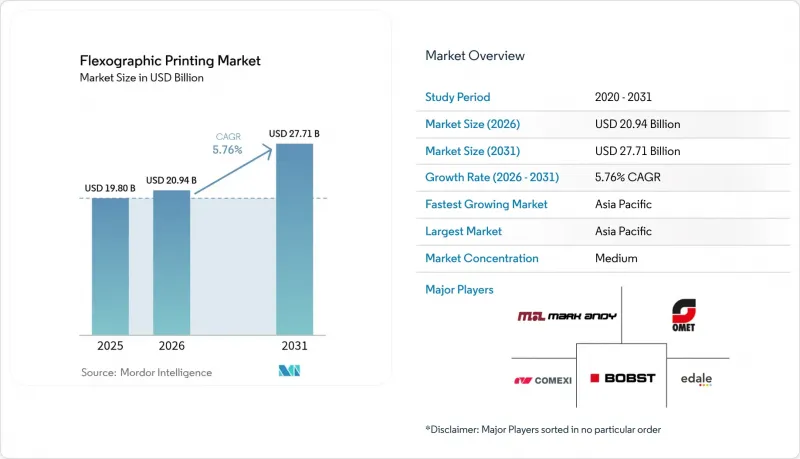
本報告按印刷設備類型(窄幅捲筒紙、中型捲筒紙等)、油墨類型(水性油墨、溶劑型油墨等)、承印物類型(紙/紙板、柔軟性塑膠薄膜等)、應用領域(瓦楞紙箱、折疊紙盒等)、終端用戶行業(食品飲料等)和地區進行細分。市場預測以美元(USD)為單位。
全球柔版印刷市場趨勢與洞察
品牌擁有者對縮短 SKU 更新週期的需求
消費者偏好正以前所未有的速度變化,迫使品牌經理經常更新包裝設計。為了應對這項挑戰,印刷商正在採用窄幅輪換印刷機,這種印刷機可在幾分鐘內完成換版,從而減少停機時間和材料浪費。 Onyx GO 等解決方案可實現主動套準控制,將設定廢品率降低 30%。小批量生產也使零售商能夠在不積壓過多庫存的情況下測試季節性產品,從而減輕柔版印刷市場的營運資金負擔。同時,基於雲端的工作流程軟體正在加速設計稿核准流程,使新設計能夠在幾週內從概念轉化為商店。
經濟高效的大規模生產包裝印刷
對於印量超過數百萬份的印刷品,柔版印刷仍然是單位成本最低的選擇。光敏樹脂印版可承受數十萬次的循環使用,而節能型烘乾機則能降低營運成本。以杜邦公司的Orion印刷機為例,從凹版印刷過渡到柔版印刷後,溶劑用量減少了30%,工作場所的安全性也得到了提升。這些經濟優勢使得傳統的消費品生產線在柔版印刷市場中佔據穩固地位,維持了印刷機的運轉率,並保證了對原始設備製造商(OEM)的備件銷售。許多運作三班制的亞洲加工商正利用這些成本優勢來滿足出口主導的需求。
數位噴墨技術對短時印刷市場的侵蝕
壓電噴頭和水性分散油墨技術的進步,使得可變資料印刷和媲美膠印的影像品質得以實現,且每次點擊成本更具競爭力。製藥包裝製造商正將數位化生產線與ERP軟體整合,並透過按需生產特定國家/地區的附加檔,將庫存降至零。作為回應,柔版印刷市場正轉向混合型印刷機,將線上噴墨單元與傳統單元結合,在保持現有印後加工流程的同時,增加了序列化功能。
細分市場分析
加工商對能夠在大量生產和個人化批量生產之間切換的單一生產線的需求,推動了新型數位混合印刷機安裝佔有率的成長。預計到2025年,窄幅印刷機將佔銷售額的30.52%,而混合印刷機的複合年成長率預計將達到9.09%,顯著高於柔版印刷市場的整體成長率。典型的配置包括一個用於品牌顏色的10色柔版印刷單元,以及一個位於複捲機正前方的CMYK噴墨印刷單元。這種配置將作業切換時間縮短至五分鐘以內,即使平均訂單量低於5000米,也能維持生產線的盈利。中型印刷機仍然是衛生紙重疊包裝和零食包裝的首選,而寬幅CI柔版印刷機則繼續在立式袋領域佔據主導地位。單張紙印刷機用於生產可折疊瓦楞紙箱,這類紙箱需要在下游進行精確的模切加工。
採用模組化平台的加工設備可依客戶產品配置的變化,增加電暈處理單元、冷卻輥或第二個噴墨條。 「SapphireLUCE」正是這種模組化設計的完美體現,它兼具1200 x 1200 DPI的解析度和150公尺/分鐘的列印速度。服務等級協定通常包含預測性維護分析,可將意外運作控制在正常運作時間的2%以下。即使在面臨新興市場翻新印刷機帶來的競爭壓力的情況下,這些功能也使OEM製造商能夠維持定價權。
水性油墨系統氣味低,且在大多數地區獲準直接接觸食品,預計2025年將佔銷售額的40.42%。這些油墨是瓦楞紙箱、折疊紙盒和紙質包裝的基本化學成分。同時,由於紫外光固化油墨能夠適應更高的生產線速度,並且在非多孔薄膜上具有優異的抗刮性,預計到2031年將保持8.28%的複合年成長率。能量固化解決方案採用緊湊型LED燈,其能耗比汞弧燈低65%,降低了工廠的電力成本。另一方面,溶劑型油墨的市佔率持續下降,受到美國環保署(EPA)第59部分法規中更嚴格的VOC(揮發性有機化合物)規定的限制。電子束固化油墨仍屬於小眾產品,滲透率低於2%,但被認為在乳製品蓋和無菌紙盒方面具有應用前景。
油墨供應商正透過顏料分散穩定性、流變控制和低遷移添加劑包裝來提升自身競爭力。 INX International 的 GelFlex EB 墨水在某些休閒食品應用中無需覆膜,從而可以使用更薄的紙張並減少箔材用量。這些創新與柔版印刷市場日益成長的永續性不謀而合。
區域分析
預計到2025年,亞太地區將佔據最大的銷售佔有率,達到38.05%,並在2031年之前以9.06%的複合年成長率持續成長。中國供應基材、油墨和機械設備,實現了成本協同效應;印度則憑藉電子商務小包裹兩位數的成長,推動了國內包裝需求的成長。日本和韓國正致力於自動化,並引領採用協作機器人(cobot)的捲筒更換印刷生產線的開發。東南亞國協政府的回收目標正在推動水性油墨和單材料包裝袋設計的發展,從而拓展了柔版印刷市場的商機。
北美仍然是技術領域的先驅,目前正在進行人工智慧驅動的檢測攝影機和雲端連接黏度控制設備的試點計畫。品牌所有者正在評估那些能夠展示符合FDA標準的低轉移工作流程的加工商,這有助於保持每平方公尺印刷品的高附加價值。勞動力短缺問題持續存在,促使Ricoh推出高級職業教育計劃,該計劃旨在培訓操作人員進行並排數據分析。近岸外包趨勢正在將消費品製造地從亞洲轉移到墨西哥,刺激了北美對CI柔版印刷生產線的新投資。
在歐洲,嚴格的法律規範得以維持,在「零污染」框架下,市場迫切需要快速採用植物來源光引發劑和不含礦物油的油墨。德國正憑藉其卓越的工程技術能力,法國正加速推進生質塑膠包裝的發展,義大利則在擴大其窄幅印刷技術中心的規模,例如博斯特公司位於佛羅倫斯的中心(佔地1200平方公尺)。東歐的印刷加工商正利用有利的工資結構來消化大量訂單,從而鞏固該地區在柔版印刷市場的多元化地位。
其他好處:
- Excel格式的市場預測(ME)表
- 3個月的分析師支持
目錄
第1章:引言
- 研究假設和市場定義
- 調查範圍
第2章:調查方法
第3章執行摘要
第4章 市場狀況
- 市場概覽
- 市場促進因素
- 品牌擁有者對縮短 SKU 更新週期的需求
- 經濟高效的長期包裝印刷
- 採用水性油墨以滿足食品接觸相容性要求。
- 向永續瓦楞紙板物流轉型
- 人工智慧驅動的印刷機自動化和減少廢棄物
- 電子商務正在加速多層壁郵件包裝袋的普及。
- 市場限制因素
- 數位噴墨技術在小批量生產中的市場滲透率
- 光敏聚合物版價格波動劇烈
- 加強對溶劑型揮發性有機化合物的監管
- 熟練印刷操作員短缺
- 供應鏈分析
- 監理展望
- 技術展望
- 波特五力分析
- 投資分析
第5章 市場規模與成長預測
- 按印刷設備類型
- 窄幅網
- 中等寬度捲紙
- 萬維網
- 單張紙進紙
- 數位混合
- 按墨水類型
- 水溶液
- 溶劑型
- 紫外線固化型
- 電子束
- 依基材類型
- 紙張和紙板
- 軟塑膠薄膜
- 金屬箔
- 其他基質類型
- 透過使用
- 瓦楞紙箱
- 折疊紙箱
- 軟包裝
- 標籤
- 印刷媒體
- 其他用途
- 按最終用戶行業分類
- 食品/飲料
- 醫療和藥品
- 個人護理化妝品
- 產業
- 其他終端用戶產業
- 按地區
- 北美洲
- 美國
- 加拿大
- 墨西哥
- 歐洲
- 德國
- 英國
- 法國
- 義大利
- 西班牙
- 俄羅斯
- 其他歐洲國家
- 亞太地區
- 中國
- 印度
- 日本
- 韓國
- 澳洲和紐西蘭
- 其他亞太國家
- 中東和非洲
- 中東
- 阿拉伯聯合大公國
- 沙烏地阿拉伯
- 土耳其
- 其他中東國家
- 非洲
- 南非
- 奈及利亞
- 埃及
- 其他非洲國家
- 中東
- 南美洲
- 巴西
- 阿根廷
- 其他南美國家
- 北美洲
第6章 競爭情勢
- 市場集中度
- 策略趨勢
- 市佔率分析
- 公司簡介
- Bobst Group SA
- Heidelberger Druckmaschinen AG
- Mark Andy Inc.
- Comexi Group
- Koenig and Bauer AG
- Windmoller & Holscher KG
- Uteco Group
- OMET SRL
- Edale Ltd.
- Star Flex International
- InterFlex Group
- Flexopack SA
- Pepin Manufacturing Inc.
- Wolverine Flexographic LLC
- Siva Group
- Gallus Ferd. Ruesch AG
- Nilpeter A/S
- Soma Engineering
- PCMC(Barry-Wehmiller)
- Tresu Group
- MPS Systems BV
第7章 市場機會與未來展望
According to Mordor Intelligence, the flexographic printing market size was valued at USD 19.80 billion in 2025 and estimated to grow from USD 20.94 billion in 2026 to reach USD 27.71 billion by 2031, at a CAGR of 5.76% during the forecast period (2026-2031).
This report is Segmented by Printing Equipment Type (Narrow Web, Medium Web, and More), Ink Type (Water-Based, Solvent-Based, and More), Substrate Type (Paper and Paperboard, Flexible Plastic Films, and More), Application (Corrugated Boxes, Folding Carton, and More), End-User Industry (Food and Beverage, and More), and Geography. The Market Forecasts are Provided in Terms of Value (USD).
Global Flexographic Printing Market Trends and Insights
Brand-owner Demand for Shorter SKU Cycles
Consumer preferences now turn over faster than ever, pushing brand managers to refresh packaging artwork frequently. Converters respond by leaning on narrow-web presses that complete plate changes in minutes, curbing downtime and material waste. Solutions such as the Onyx GO deliver active register control that lowers setup scrap by 30%. Shorter runs also let retailers pilot seasonal editions without carrying surplus inventory, reducing the working-capital burden throughout the flexographic printing market. In parallel, cloud-based workflow software accelerates artwork approvals, ensuring that new designs progress from concept to shelf within weeks.
Cost-Effective Long-Run Package Printing
Where volumes exceed millions of impressions, flexography still offers the lowest unit cost. Photopolymer plates last hundreds of thousands of cycles, while energy-efficient dryers reduce operating expenses. DuPont's Orion case illustrates 30% solvent savings after migrating from gravure to flexo, along with safer shop-floor conditions. Such economics keep legacy consumer-goods lines anchored in the flexographic printing market, preserving press utilization and spare-parts sales for OEMs. Asian converters, often running three shifts, maximize these cost advantages to meet export-driven demand.
Digital Inkjet Cannibalisation in Short Runs
Advances in piezo-electric heads and aqueous dispersion inks enable variable data and near-offset image quality at competitive click rates. Pharmaceutical packagers integrate digital lines with ERP software to produce country-specific leaflets on demand, cutting inventory to zero. In response, the flexographic printing market is pivoting to hybrid presses that merge in-line inkjet stations with conventional units, preserving established finishing workflows while adding serialization capability.
Other drivers and restraints analyzed in the detailed report include:
- Water-Based Ink Adoption for Food Contact Compliance
- Shift Toward Sustainable Corrugated Logistics
- Volatile Photopolymer Plate Prices
For complete list of drivers and restraints, kindly check the Table Of Contents.
Segment Analysis
Digital-hybrid presses lifted their share of new installations as converters sought one line that could alternate between mass-production mode and personalized batches. Although narrow-web machines secured 30.52% of revenue in 2025, the hybrid cohort is on course for 9.09% CAGR, well above the overall flexographic printing market. Typical configurations combine 10-color flexo decks for brand colors with CMYK inkjet bars placed just before the rewinder. Such set-ups reduce job changeover time to under five minutes, keeping lines profitable even when average order quantities fall below 5,000 linear m. Medium-web lines remain favored in tissue overwraps and snack wrappers, while wide-web CI flexo retains dominance in stand-up pouches. Sheet-fed presses serve folding cartons that require precise die-cutting stations downstream.
Converters equipping themselves with modular platforms can later bolt on corona treaters, chill rolls, or second inkjet bars as client mixes evolve. The SapphireLUCE exemplifies this modular path, pairing 1200 X 1200 DPI resolution with speeds of 150 mpm. Service-level agreements often bundle predictive-maintenance analytics, shrinking unplanned downtime below 2% of available hours. These feature sets sustain pricing power for OEMs, even as the broader flexographic printing market experiences competitive pressure from refurbished presses in emerging economies.
Water-based systems commanded 40.42% revenue in 2025 thanks to low odour and direct-food-contact approval in most jurisdictions. They form the baseline chemistry for corrugated boxes, folding cartons, and paper wraps. UV-curable inks, however, are projected to register 8.28% CAGR through 2031 because they support higher line speeds and excellent scratch resistance on non-porous films. Energy-curable solutions require compact LED lamps that draw 65% less power than mercury arc units, reducing plant electricity bills. Solvent variants, constrained by tightening VOC caps under the US EPA Part 59 ruling, continue to cede share. Electron-beam curables remain a niche at under 2% penetration but show promise in dairy lidding and aseptic cartons.
Ink suppliers differentiate through pigment dispersion stability, rheology control, and low-migration additive packages. INX International's GelFlex EB ink removes lamination in certain snack applications, dropping gauge weight and cutting foil usage. Such innovations echo the broader sustainability narrative resonating throughout the flexographic printing market.
Complete Report Scope:
- By Printing Equipment Type
- Narrow Web
- Medium Web
- Wide Web
- Sheet-Fed
- Digital-Hybrid
- By Ink Type
- Water-Based
- Solvent-Based
- UV-Curable
- Electron-Beam
- By Substrate Type
- Paper and Paperboard
- Flexible Plastic Films
- Metallic Foil
- Other Substrate Type
- By Application
- Corrugated Boxes
- Folding Carton
- Flexible Packaging
- Labels
- Print Media
- Other Application
- By End-user Industry
- Food and Beverage
- Healthcare and Pharmaceuticals
- Personal Care and Cosmetics
- Industrial
- Other End-user Industry
- By Geography
- North America
- United States
- Canada
- Mexico
- Europe
- Germany
- United Kingdom
- France
- Italy
- Spain
- Russia
- Rest of Europe
- Asia-Pacific
- China
- India
- Japan
- South Korea
- Australia and New Zealand
- Rest of Asia-Pacific
- Middle East and Africa
- Middle East
- United Arab Emirates
- Saudi Arabia
- Turkey
- Rest of Middle East
- Africa
- South Africa
- Nigeria
- Egypt
- Rest of Africa
- Middle East
- South America
- Brazil
- Argentina
- Rest of South America
- North America
Geography Analysis
Asia-Pacific generated the largest revenue slice at 38.05% in 2025 and is projected to compound at 9.06% CAGR to 2031. China supplies substrates, inks, and machinery, enabling integrated cost synergies, while India posts double-digit e-commerce parcel growth that fuels domestic packaging demand. Japan and South Korea emphasize automation, pioneering press lines equipped with cobot-assisted roll changes. Government recycling targets across ASEAN incentivize water-based inks and mono-material pouch designs, broadening addressable opportunities throughout the flexographic printing market.
North America remains the technology pione-er, hosting pilot runs for AI-driven inspection cameras and cloud-connected viscosity controllers. Brand owners reward converters that demonstrate FDA-compliant low-migration workflows, sustaining high value-added print per square meter. Labor shortages persist, prompting initiatives like Ricoh's Advanced Career Education program that trains operators in press-side data analytics. Nearshoring trends reroute consumer-goods manufacturing from Asia to Mexico, spurring fresh investments in CI flexo lines within North America.
Europe maintains keen regulatory oversight, compelling swift adoption of plant-based photoinitiators and mineral-oil-free ink sets under the Zero Pollution framework. Germany anchors engineering excellence, France accelerates bio-plastic packaging, and Italy scales narrow-web competence hubs such as Bobst's 1,200 sqm Florence center. Eastern European converters leverage favorable wage structures to absorb overflow orders, reinforcing the region's diverse role in the flexographic printing market.
- Bobst Group SA
- Heidelberger Druckmaschinen AG
- Mark Andy Inc.
- Comexi Group
- Koenig and Bauer AG
- Windmoller & Holscher KG
- Uteco Group
- OMET SRL
- Edale Ltd.
- Star Flex International
- InterFlex Group
- Flexopack SA
- Pepin Manufacturing Inc.
- Wolverine Flexographic LLC
- Siva Group
- Gallus Ferd. Ruesch AG
- Nilpeter A/S
- Soma Engineering
- PCMC (Barry-Wehmiller)
- Tresu Group
- MPS Systems B.V.
Additional Benefits:
- The market estimate (ME) sheet in Excel format
- 3 months of analyst support
TABLE OF CONTENTS
1 INTRODUCTION
- 1.1 Study Assumptions and Market Definition
- 1.2 Scope of the Study
2 RESEARCH METHODOLOGY
3 EXECUTIVE SUMMARY
4 MARKET LANDSCAPE
- 4.1 Market Overview
- 4.2 Market Drivers
- 4.2.1 Brand - owner demand for shorter SKU cycles
- 4.2.2 Cost-effective long-run package printing
- 4.2.3 Water-based ink adoption for food contact compliance
- 4.2.4 Shift toward sustainable corrugated logistics
- 4.2.5 AI-driven press automation and waste reduction
- 4.2.6 E-commerce accelerates multi-wall mailers
- 4.3 Market Restraints
- 4.3.1 Digital inkjet cannibalisation in short runs
- 4.3.2 Volatile photopolymer plate prices
- 4.3.3 Solvent-based VOC regulations tightening
- 4.3.4 Skilled press-operator shortage
- 4.4 Supply-Chain Analysis
- 4.5 Regulatory Outlook
- 4.6 Technological Outlook
- 4.7 Porter's Five Forces Analysis
- 4.7.1 Bargaining Power of Suppliers
- 4.7.2 Bargaining Power of Buyers
- 4.7.3 Threat of New Entrants
- 4.7.4 Threat of Substitute Products
- 4.7.5 Intensity of Competitive Rivalry
- 4.8 Investment Analysis
5 MARKET SIZE AND GROWTH FORECASTS (VALUE)
- 5.1 By Printing Equipment Type
- 5.1.1 Narrow Web
- 5.1.2 Medium Web
- 5.1.3 Wide Web
- 5.1.4 Sheet-Fed
- 5.1.5 Digital-Hybrid
- 5.2 By Ink Type
- 5.2.1 Water-Based
- 5.2.2 Solvent-Based
- 5.2.3 UV-Curable
- 5.2.4 Electron-Beam
- 5.3 By Substrate Type
- 5.3.1 Paper and Paperboard
- 5.3.2 Flexible Plastic Films
- 5.3.3 Metallic Foil
- 5.3.4 Other Substrate Type
- 5.4 By Application
- 5.4.1 Corrugated Boxes
- 5.4.2 Folding Carton
- 5.4.3 Flexible Packaging
- 5.4.4 Labels
- 5.4.5 Print Media
- 5.4.6 Other Application
- 5.5 By End-user Industry
- 5.5.1 Food and Beverage
- 5.5.2 Healthcare and Pharmaceuticals
- 5.5.3 Personal Care and Cosmetics
- 5.5.4 Industrial
- 5.5.5 Other End-user Industry
- 5.6 By Geography
- 5.6.1 North America
- 5.6.1.1 United States
- 5.6.1.2 Canada
- 5.6.1.3 Mexico
- 5.6.2 Europe
- 5.6.2.1 Germany
- 5.6.2.2 United Kingdom
- 5.6.2.3 France
- 5.6.2.4 Italy
- 5.6.2.5 Spain
- 5.6.2.6 Russia
- 5.6.2.7 Rest of Europe
- 5.6.3 Asia-Pacific
- 5.6.3.1 China
- 5.6.3.2 India
- 5.6.3.3 Japan
- 5.6.3.4 South Korea
- 5.6.3.5 Australia and New Zealand
- 5.6.3.6 Rest of Asia-Pacific
- 5.6.4 Middle East and Africa
- 5.6.4.1 Middle East
- 5.6.4.1.1 United Arab Emirates
- 5.6.4.1.2 Saudi Arabia
- 5.6.4.1.3 Turkey
- 5.6.4.1.4 Rest of Middle East
- 5.6.4.2 Africa
- 5.6.4.2.1 South Africa
- 5.6.4.2.2 Nigeria
- 5.6.4.2.3 Egypt
- 5.6.4.2.4 Rest of Africa
- 5.6.4.1 Middle East
- 5.6.5 South America
- 5.6.5.1 Brazil
- 5.6.5.2 Argentina
- 5.6.5.3 Rest of South America
- 5.6.1 North America
6 COMPETITIVE LANDSCAPE
- 6.1 Market Concentration
- 6.2 Strategic Moves
- 6.3 Market Share Analysis
- 6.4 Company Profiles (Includes Global level Overview, Market level overview, Core Segments, Financials as available, Strategic Information, Market Rank/Share for key companies, Products and Services, and Recent Developments)
- 6.4.1 Bobst Group SA
- 6.4.2 Heidelberger Druckmaschinen AG
- 6.4.3 Mark Andy Inc.
- 6.4.4 Comexi Group
- 6.4.5 Koenig and Bauer AG
- 6.4.6 Windmoller & Holscher KG
- 6.4.7 Uteco Group
- 6.4.8 OMET SRL
- 6.4.9 Edale Ltd.
- 6.4.10 Star Flex International
- 6.4.11 InterFlex Group
- 6.4.12 Flexopack SA
- 6.4.13 Pepin Manufacturing Inc.
- 6.4.14 Wolverine Flexographic LLC
- 6.4.15 Siva Group
- 6.4.16 Gallus Ferd. Ruesch AG
- 6.4.17 Nilpeter A/S
- 6.4.18 Soma Engineering
- 6.4.19 PCMC (Barry-Wehmiller)
- 6.4.20 Tresu Group
- 6.4.21 MPS Systems B.V.
7 MARKET OPPORTUNITIES AND FUTURE OUTLOOK
- 7.1 White-space and Unmet-Need Assessment

 柔版印刷機:市場佔有率分析、產業趨勢與統計、成長預測(2026-2031)
 柔版印刷機市場:按類型、技術、印刷材料、油墨類型、應用和最終用途行業分類-全球市場預測(2026-2032 年)
 2026年全球柔版印刷技術市場報告柔版折疊糊盒機市場:依自動化程度、機器類型、操作模式、材料類型、最終用途產業和銷售管道,全球預測,2026-2032年
 柔版印刷電子市場分析及預測(至2035年):依類型、產品、技術、應用、材料類型、組件、製程、最終用戶及功能分類
 全球柔版印刷機市場規模、佔有率、趨勢及成長分析報告(2026-2034)2026年全球柔版印刷市場報告2026年全球柔版印刷機市場報告
 柔版印刷機市場規模、佔有率及成長分析(按印刷類型、印刷技術、應用、組件、最終用戶和地區分類)-2026-2033年產業預測柔版印刷版市場依技術、版型、版厚、印刷方法、裝版方法、應用及最終用途產業分類,全球預測(2026-2032年)