


 |
市場調查報告書
商品編碼
2123614
紙張染料:市場佔有率分析、行業趨勢和統計數據、成長預測(2026-2031 年)Paper Dyes - Market Share Analysis, Industry Trends & Statistics, Growth Forecasts (2026 - 2031) |
||||||

※ 本網頁內容可能與最新版本有所差異。詳細情況請與我們聯繫。
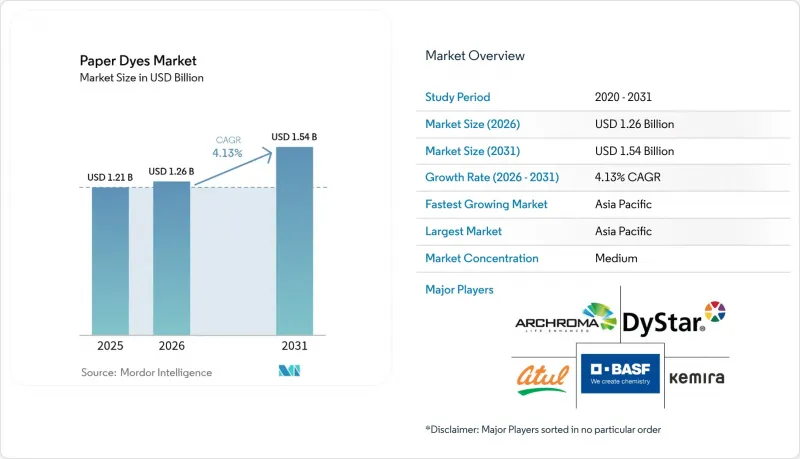
據 Mordor Intelligence 稱,2025 年紙張染料市場價值為 12.1 億美元,預計到 2031 年將達到 15.4 億美元,而 2026 年為 12.6 億美元,預測期(2026-2031 年)的複合年成長率為 4.13%。
本報告按形態(粉末和液體)、類型(酸性、鹼性及其他)、原料(有機和合成)、應用(印刷和書寫、包裝、特殊應用及其他)以及地區(亞太地區、北美及其他)對產業進行分類。市場預測以美元計價。
全球紙張染料市場趨勢及洞察
從塑膠包裝過渡到紙質包裝
為了遵守一次性塑膠禁令並滿足消費者對紙包裝的偏好,零售品牌正從石油基材料轉向可回收纖維基材料。包括雀巢和聯合利華在內的跨國公司目前已在某些產品規格中減少高達97%的塑膠用量,這加速了高性能染料的需求,這些染料即使經過多次回收處理也能保持顏色穩定性。歐盟一次性塑膠指令提供的監管確定性鼓勵了加工商的資本投資,他們需要食品接觸安全且無遷移的色素。消費者對永續包裝的溢價意願仍然強勁,這使得染料製造商能夠維持新型耐光配方的價格,這些配方能夠耐受再生纖維系統中的鹼性脫墨和氧化漂白。
電子商務推動了紙箱和郵寄包裝需求的激增。
超過 80% 的線上訂單採用紙箱包裝出貨,小包裹量持續成長,尤其是在亞太和北美地區。這導致對色彩鮮豔、能提升開箱體驗的包裝圖案的需求激增。履約中心需要採用快速週轉的噴墨生產線,並使用專為低維護印表機頭設計的液態染料,以實現大規模的當日個人化。 2024 年包裝廠廠房租賃協議的簽訂量比過去 20 年的平均值高出 45%。這清楚地徵兆了產能的結構性擴張,並將在整個預測期內支撐紙張染料市場的發展。
無紙化辦公室和電子文件的普及
隨著企業和教育機構加速推動數位化工作流程,對印刷用紙的需求急劇下降。歐洲造紙工業協會(CEPI)的數據顯示,2023年紙張和紙板產量下降了13%,其中印刷用紙的產量下降了28%。目前,遠距辦公指南仍然有效,該指南導致列印量減少了50%至70%,電子簽章平台的普及也降低了對紙張的需求。雖然包裝染料的需求在一定程度上彌補了損失,但印刷用紙需求的下降抑制了整體產量的成長,尤其是在成熟地區。
細分市場分析
預計到2025年,液體產品將佔銷售額的51.38%,年複合成長率達6.31%,進一步鞏固其在高速噴墨生產線中的關鍵作用,尤其是在支援版本控制的EC包裝方面。粉末級產品雖然易於散裝運輸,但仍需應對粉塵暴露法規和分散速度慢等挑戰。奈米封裝液體系統可使印字頭運作週期超過1000小時,最大限度地減少維護運作,並提高轉換器整體設備運轉率(OEE)。不受溫度波動影響的穩定黏度支持自動液體輸送,符合準時生產的目標。
微乳液和微流體控封裝技術的不斷進步延長了產品的保存期限,在25 度C下儲存可保持12個月以上的色彩鮮豔度,而標準配方僅為6個月。因此,加工商可以減少因庫存過期造成的損失。雖然粉末供應商正在透過壓縮和抑塵技術做出回應,但在數位化工廠方面,他們仍然落後於液體原料供應商。
直接染料因其廢水處理成本低廉而備受青睞,預計到2025年將佔銷售額的28.02%,繼續在大批量箱板紙廠佔據主導地位。然而,活性染料市場正以5.78%的複合年成長率成長,這主要得益於其優異的耐洗性。這項特性深受高階折疊瓦楞紙板用戶的青睞,他們要求即使在回收後,圖案也能保持完好無損。纖維測試表明,在富含棉纖維的特殊紙板中,活性染料的吸色率為41.45%,而其他化學染料的吸色率僅為35.68%。
供應商正在將標準反應浴溫度從 90 度C降低至 60 度C,同時保持固色效果,從而降低能源消耗,並擴大造紙廠對脫碳目標的接受度。直接染料由於其在中性 pH 值下易於附著,仍然是主流染料,但其市場佔有率正逐漸被符合循環經濟要求的高附加價值化學品所取代。
區域分析
預計亞太地區將繼續保持主導地位,到2025年將佔全球銷售額的44.25%,並持續以5.56%的複合年成長率成長至2031年。這反映了該地區作為全球製造地和快速成長的消費市場的地位。中國化工產業的龍頭企業,如亨利化工和萬華化工,正利用政府支持投資精細化工項目,從而提高區域自給自足能力。在越南,擁有7,500家紡織企業和430萬工人,瓦楞紙板和特種紙的區域消費量不斷成長,帶動了當地染料用量的成長。
北美地區以以金額為準計算排名第二,這主要得益於不斷成長的電子商務履約需求以及跨國食品飲料公司積極主動的塑膠減量承諾。 Alchroma位於南卡羅來納州的工廠和Solenis位於維吉尼亞的工廠負責本地供應,而PFAS法規的明確化正迫使加工商採用受監管的水性系統。儘管印刷用紙市場萎縮限制了整體銷量,但對優先使用環保染料的高檔紙張的訂單支撐了價格,使其高於通膨率。
在歐洲,嚴格的REACH法規修訂和紙漿價格波動(2024年4月,北方漂白軟木牛皮紙漿(NBSK)價格達到每噸1380歐元)給營業利潤率帶來了壓力。然而,由於該地區在循環經濟法規方面的領先地位以及對木質素衍生著色劑研發的投資,當地供應商在高價值、環保產品領域處於領先地位。加工商正在投資閉合迴路水處理系統以滿足廢水排放許可標準,這推動了對低鹽、高回收率染料的需求,而這些染料符合零液體排放目標。
其他好處
- Excel格式的市場預測(ME)表
- 3個月的分析師支持
目錄
第1章:引言
- 研究假設和市場定義
- 調查範圍
第2章:調查方法
第3章執行摘要
第4章 市場狀況
- 市場概覽
- 市場促進因素
- 從塑膠包裝過渡到紙質包裝
- 電子商務推動了紙箱和郵寄包裝袋需求的激增。
- 主要染料生產商擴大產能
- 生物基木質素相容性染料的突破性進展
- 奈米封裝染料可實現紙張上的數位噴墨印刷
- 市場限制因素
- 引入無紙化辦公室和電子文檔
- 有毒胺類物質和不斷上漲的REACH合規成本
- 木漿供應和價格的波動
- 價值鏈分析
- 波特五力分析
第5章 市場規模與成長預測
- 按形式
- 粉末
- 液體
- 按類型
- 酸性
- 基本的
- 直接地
- 按原料
- 有機的
- 合成
- 透過使用
- 列印/書寫
- 包裝
- 特殊用途
- 其他(紙巾、衛生用品)
- 按地區
- 亞太地區
- 中國
- 印度
- 日本
- 韓國
- 其他亞太國家
- 北美洲
- 美國
- 加拿大
- 墨西哥
- 歐洲
- 德國
- 英國
- 法國
- 義大利
- 其他歐洲國家
- 南美洲
- 巴西
- 阿根廷
- 其他南美國家
- 中東和非洲
- 沙烏地阿拉伯
- 南非
- 其他中東和非洲國家
- 亞太地區
第6章 競爭情勢
- 市場集中度
- 策略趨勢
- 市佔率和排名分析
- 公司簡介
- Archroma
- Ashok Alco-chem
- Atul Ltd.
- BASF
- Celanese Corporation
- ChromaScape
- DyStar Singapore Pte Ltd
- Kemira Oyj
- Kiri Industries Limited
- Lonza
- Merck KGaA
- Milliken
- Nitin Dye Chem Pvt. Ltd
- Setas Kimya
- Standard Colors, Inc.
- Steiner-Axyntis
- Sudarshan Chemical Industries Limited.
- Synthesia, as
- Thermax Limited
- Vipul Organics Ltd.
- Zhejiang Longsheng
第7章 市場機會與未來展望
According to Mordor Intelligence, the paper dyes market size was valued at USD 1.21 billion in 2025 and estimated to grow from USD 1.26 billion in 2026 to reach USD 1.54 billion by 2031, at a CAGR of 4.13% during the forecast period (2026-2031).
This report Segments the Industry by Form (Powder and Liquid), Type (Acidic, Basic, and More), Origin (Organic and Synthetic), Application (Printing and Writing, Packaging, Specialty, and More), and Geography (Asia-Pacific, North America, and More). The Market Forecasts are Provided in Terms of Value (USD).
Global Paper Dyes Market Trends and Insights
Shift from Plastic to Paper-Based Packaging
Retail brands continue to replace petroleum-based substrates with recyclable, fiber-based formats to comply with single-use plastic bans and to meet consumer preference for paper. Nestle, Unilever, and other multinationals now eliminate up to 97% of plastic from certain SKUs, accelerating orders for high-performance dyes that remain stable through multiple recycling loops. Regulatory certainty created by the European Union's Single-Use Plastics Directive supports capital investment in converters that require food-contact-compliant, migration-safe colorants. Consumer willingness to pay premiums for sustainable packaging has held steady, allowing dye producers to defend pricing for novel, colorfast formulations that tolerate alkaline de-inking and oxidative bleaching in recovered-fiber systems.
E-commerce-Fueled Boom in Corrugated & Mailer Demand
Over 80% of online orders ship in corrugated formats, and parcel volumes continue to rise-particularly in Asia-Pacific and North America-creating concentrated demand for vivid graphics that elevate the unboxing experience. Fulfillment centers require rapid-turn inkjet lines that run on liquid dyes engineered for low-maintenance printheads, enabling same-day personalization at scale. Building leases for packaging plants rose 45% above the 20-year average in 2024, a clear signal of structural capacity expansion that will sustain the paper dyes market over the forecast horizon.
Paperless Office & Digital Documents Adoption
Graphic-paper demand contracted sharply after corporate and educational users accelerated digital workflows. The Confederation of European Paper Industries recorded a 13% fall in paper and board production in 2023, with graphic grades alone down 28%. Remote-work protocols that cut printing volumes by 50-70% remain in force, while e-signature platforms reduce the need for hard copies. Although packaging dyes offset some losses, graphic-paper contraction limits overall tonnage growth, particularly in mature regions.
Other drivers and restraints analyzed in the detailed report include:
- Capacity Expansions by Major Dye Manufacturers
- Breakthroughs in Bio-Based Lignin-Compatible Dyes
- Toxic Amines & Rising REACH Compliance Costs
For complete list of drivers and restraints, kindly check the Table Of Contents.
Segment Analysis
Liquid offerings held 51.38% of 2025 revenue and are projected to expand at a 6.31% CAGR, reinforcing their pivotal role in high-speed inkjet lines that power versioned e-commerce packaging. Powder grades, although easier to transport in bulk, must contend with dust-exposure rules and slower dispersion times. Nano-encapsulated liquid systems now enable print-head duty cycles exceeding 1,000 hours, minimizing maintenance shutdowns and improving OEE for converters. Stable viscosity across temperature swings supports automated dosing, aligning with just-in-time production targets.
Ongoing advances in mini-emulsion and microfluidic encapsulation increase shelf life, preserving hue intensity for over 12 months when stored at 25 °C, compared with six months for standard formulations. As a result, converters see reduced write-offs from expired stocks. Powder suppliers respond with compaction and dust-suppressant technologies but still trail liquid rivals in digitally enabled plants.
Direct dyes, favored for cost-efficient exhaust processes, commanded 28.02% of 2025 sales, maintaining dominance in high-volume linerboard mills. Yet the reactive segment is advancing at a 5.78% CAGR on the strength of superior wash-fastness, an attribute prized by premium folding-carton users who require graphics to survive recycling. According to fiber-specific trials, cotton-fiber-rich specialty grades register dye uptake of 41.45% with reactivatives versus 35.68% for other chemistries.
Suppliers reduce typical reactive-bath temperatures from 90 °C to 60 °C without sacrificing fixation, lowering energy loads, and broadening adoption in mills constrained by decarbonization targets. Direct dyes remain a staple because they attach readily under neutral pH, but their market share is gradually ceded to higher-value chemistries that align with circular-economy mandates.
Complete Report Scope:
- By Form
- Powder
- Liquid
- By Type
- Acidic
- Basic
- Direct
- By Origin
- Organic
- Synthetic
- By Application
- Printing and Writing
- Packaging
- Specialty
- Others (Tissue and Hygiene)
- By Geography
- Asia-Pacific
- China
- India
- Japan
- South Korea
- Rest of Asia-Pacific
- North America
- United States
- Canada
- Mexico
- Europe
- Germany
- United Kingdom
- France
- Italy
- Rest of Europe
- South America
- Brazil
- Argentina
- Rest of South America
- Middle East and Africa
- Saudi Arabia
- South Africa
- Rest of Middle East and Africa
- Asia-Pacific
Geography Analysis
Asia-Pacific retained leadership with 44.25% of 2025 revenue and is forecast to rise at a 5.56% CAGR to 2031, reflecting its status as a global manufacturing nucleus and fast-expanding consumer market. China's chemical champions-Hengli, Wanhua, and peers-channel government incentives into fine-chemical projects that lift regional self-sufficiency. Vietnam, hosting 7,500 textile enterprises employing 4.3 million workers, boosts regional consumption of corrugated and specialty papers, translating into higher local dye usage.
North America ranks second by value, propelled by e-commerce fulfillment growth and aggressive plastic-reduction pledges from food and beverage multinationals. Archroma's South Carolina site and Solenis's Virginia complex provide localized supply, while regulatory clarity on PFAS pushes converters to adopt compliant, water-based systems. Although graphic-paper contraction tempers total tonnage, premium-grade orders that favor environmentally optimized dyes support above-inflation price realization.
Europe grapples with stringent REACH amendments and pulp-price volatility-Northern Bleached Softwood Kraft touched EUR 1,380 / t in April 2024-pressuring operating margins. Yet the bloc's leadership in circular-economy regulation and R&D funding for lignin-derived colorants positions local suppliers at the forefront of high-value, eco-optimized offerings. Converters invest in closed-loop water treatment to meet discharge permits, raising demand for low-salt, high-exhaustion dyes that align with zero-liquid-discharge ambitions.
- Archroma
- Ashok Alco-chem
- Atul Ltd.
- BASF
- Celanese Corporation
- ChromaScape
- DyStar Singapore Pte Ltd
- Kemira Oyj
- Kiri Industries Limited
- Lonza
- Merck KGaA
- Milliken
- Nitin Dye Chem Pvt. Ltd
- Setas Kimya
- Standard Colors, Inc.
- Steiner-Axyntis
- Sudarshan Chemical Industries Limited.
- Synthesia, a.s.
- Thermax Limited
- Vipul Organics Ltd.
- Zhejiang Longsheng
Additional Benefits:
- The market estimate (ME) sheet in Excel format
- 3 months of analyst support
TABLE OF CONTENTS
1 Introduction
- 1.1 Study Assumptions & Market Definition
- 1.2 Scope of the Study
2 Research Methodology
3 Executive Summary
4 Market Landscape
- 4.1 Market Overview
- 4.2 Market Drivers
- 4.2.1 Shift from plastic to paper-based packaging
- 4.2.2 E-commerce-fuelled boom in corrugated & mailer demand
- 4.2.3 Capacity expansions by major dye manufacturers
- 4.2.4 Breakthroughs in bio-based lignin-compatible dyes
- 4.2.5 Nano-encapsulated dyes enabling digital inkjet printing on paper
- 4.3 Market Restraints
- 4.3.1 Paperless office & digital documents adoption
- 4.3.2 Toxic amines & rising REACH compliance costs
- 4.3.3 Volatility in wood-pulp availability & pricing
- 4.4 Value Chain Analysis
- 4.5 Porter's Five Forces Analysis
- 4.5.1 Threat of New Entrants
- 4.5.2 Bargaining Power of Buyers
- 4.5.3 Bargaining Power of Suppliers
- 4.5.4 Threat of Substitute Products
- 4.5.5 Degree of Competition
5 Market Size & Growth Forecasts (Value)
- 5.1 By Form
- 5.1.1 Powder
- 5.1.2 Liquid
- 5.2 By Type
- 5.2.1 Acidic
- 5.2.2 Basic
- 5.2.3 Direct
- 5.3 By Origin
- 5.3.1 Organic
- 5.3.2 Synthetic
- 5.4 By Application
- 5.4.1 Printing and Writing
- 5.4.2 Packaging
- 5.4.3 Specialty
- 5.4.4 Others (Tissue and Hygiene)
- 5.5 By Geography
- 5.5.1 Asia-Pacific
- 5.5.1.1 China
- 5.5.1.2 India
- 5.5.1.3 Japan
- 5.5.1.4 South Korea
- 5.5.1.5 Rest of Asia-Pacific
- 5.5.2 North America
- 5.5.2.1 United States
- 5.5.2.2 Canada
- 5.5.2.3 Mexico
- 5.5.3 Europe
- 5.5.3.1 Germany
- 5.5.3.2 United Kingdom
- 5.5.3.3 France
- 5.5.3.4 Italy
- 5.5.3.5 Rest of Europe
- 5.5.4 South America
- 5.5.4.1 Brazil
- 5.5.4.2 Argentina
- 5.5.4.3 Rest of South America
- 5.5.5 Middle East and Africa
- 5.5.5.1 Saudi Arabia
- 5.5.5.2 South Africa
- 5.5.5.3 Rest of Middle East and Africa
- 5.5.1 Asia-Pacific
6 Competitive Landscape
- 6.1 Market Concentration
- 6.2 Strategic Moves
- 6.3 Market Share(%)/Ranking Analysis
- 6.4 Company Profiles (includes Global level Overview, Market level overview, Core Segments, Financials as available, Strategic Information, Market Rank/Share for key companies, Products & Services, and Recent Developments)
- 6.4.1 Archroma
- 6.4.2 Ashok Alco-chem
- 6.4.3 Atul Ltd.
- 6.4.4 BASF
- 6.4.5 Celanese Corporation
- 6.4.6 ChromaScape
- 6.4.7 DyStar Singapore Pte Ltd
- 6.4.8 Kemira Oyj
- 6.4.9 Kiri Industries Limited
- 6.4.10 Lonza
- 6.4.11 Merck KGaA
- 6.4.12 Milliken
- 6.4.13 Nitin Dye Chem Pvt. Ltd
- 6.4.14 Setas Kimya
- 6.4.15 Standard Colors, Inc.
- 6.4.16 Steiner-Axyntis
- 6.4.17 Sudarshan Chemical Industries Limited.
- 6.4.18 Synthesia, a.s.
- 6.4.19 Thermax Limited
- 6.4.20 Vipul Organics Ltd.
- 6.4.21 Zhejiang Longsheng
7 Market Opportunities & Future Outlook
- 7.1 White-space & Unmet-need Assessment

 造紙顏料:市場佔有率分析、產業趨勢與統計資料、成長預測(2026-2031 年)
 紙張顏料市場:按類型、等級、分銷管道、應用和最終用戶分類-2026-2032年全球市場預測
 紙張染料市場規模、佔有率和成長分析:按類型、形態、應用、溶解度、最終用戶、分銷管道和地區分類-2026-2033年產業預測造紙用鹼性染料市場:依染料類型、應用和終端用戶產業分類-2026-2032年全球預測
 紙張染料市場分析及預測(至2035年):依類型、產品、應用、形式、最終使用者、技術、製程、成分及功能分類
 全球紙張染料市場規模、佔有率、趨勢和成長分析報告:2026-2034年
 紙張顏料市場規模、佔有率及成長分析(按類型、應用、產業和地區分類)-產業預測,2026-2033年
 紙張顏料市場-全球產業規模、佔有率、趨勢、機會和預測,按類型(碳酸鈣、高嶺土、其他)、應用(塗佈紙、非塗佈紙)、地區和競爭格局分類,2020-2030年預測造紙顏料市場:2025-2030 年預測
 世界造紙顏料市場:市場規模、佔有率、趨勢分析(按應用、類型)、區域前景、未來預測(2024-2031)