


 |
市場調查報告書
商品編碼
2114873
造紙顏料:市場佔有率分析、產業趨勢與統計資料、成長預測(2026-2031 年)Paper Pigment - Market Share Analysis, Industry Trends & Statistics, Growth Forecasts (2026 - 2031) |
||||||

※ 本網頁內容可能與最新版本有所差異。詳細情況請與我們聯繫。
據 Mordor Intelligence 稱,2025 年紙張顏料市值為 196.5 億美元,預計到 2031 年將達到 269.6 億美元,而 2026 年為 207.1 億美元,預測期(2026-2031 年)的複合年成長率為 5.41%。
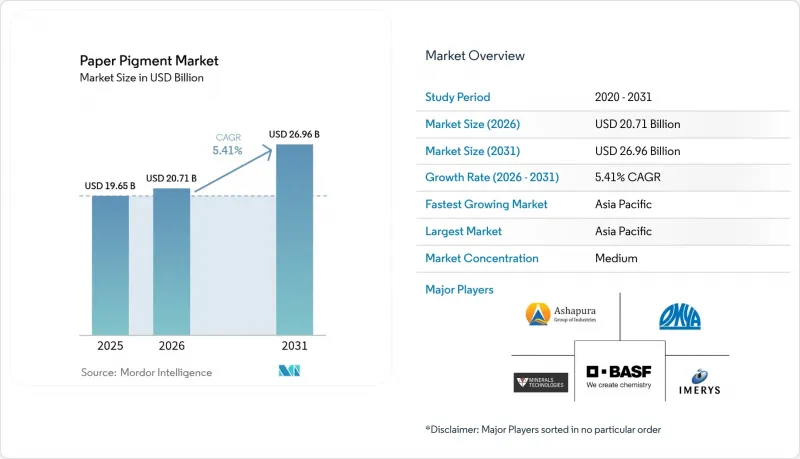
本報告按顏料類型(碳酸鈣、高嶺土及其他顏料類型)、應用領域(無塗布紙紙和塗佈紙)、終端用戶行業(包裝、印刷和書寫、標籤和特種圖形、紙巾和衛生用品)以及地區(亞太地區、北美、歐洲、南美以及中東和非洲)對行業進行細分。市場預測以美元計價。
全球紙張顏料市場趨勢及洞察
包裝產業對紙張的需求不斷成長
瓦楞紙板和折疊紙盒製造商目前正在尋找符合印刷適性、亮度及食品接觸要求的顏料。維美德公司為安徽臨平工廠安裝的OptiConcept M生產線,使再生箱板紙的日產能提高了1808噸,凸顯了市場對確保表面均勻性的顏料日益成長的需求。從塑膠包裝轉向紡織品包裝的品牌商需要高遮蓋力和遷移安全性高的顏料體系,BASF位於海倫芬的新型水性分散裝置正是專為此類基材而設計的。因此,以包裝產業為中心的地區,紙張顏料市場的需求量和平均售價均有所成長。
擴大碳酸鈣填料的使用範圍以降低生產成本
精細研磨沉澱的碳酸鈣可取代高達20個百分點的二氧化鈦,同時保持紙張的白度,從而立即提高面臨能源成本波動的造紙企業的利潤率。擁有自有石灰石礦的供應商,例如伊梅里斯(Imerys)和大宮(Omiya),可提供現場碳酸鈣(PCC)衛星工廠,從而降低物流成本,並幫助客戶最佳化其在紙張顏料市場的供應鏈。在加工商利潤率較低的新興市場,向富含碳酸鈣(GCC)配方的轉變正在加速,進一步鞏固了碳酸鈣的市場主導地位。
數位化正在導致印刷和書寫用紙的需求下降。
數位轉型為傳統紙張顏料應用帶來了結構性阻力,隨著數位化進程的加速,美國印刷業在 2002 年至 2021 年間就業人數下降了 47.3%。主要專注於大規模生產膠印紙的顏料供應商現在面臨工廠運轉率下降的問題,需要將業務重組到包裝紙、衛生紙和功能性紙張領域。
細分市場分析
預計到2025年,碳酸鈣將佔紙張顏料市場52.35%的佔有率。這一佔有率主要得益於其能夠取代價格更高的二氧化鈦,以及其作為填料和塗料顏料的雙重用途。每種等級的碳酸鈣(GCC)和碳酸鈣(PCC)都能降低配方成本高達20%,這在能源價格上漲推高造紙廠整體成本的情況下,是一項顯著優勢。隨著亞洲紙板廠附近新建碳酸鈣衛星工廠的運作,分配給碳酸鈣等級的紙張顏料市場規模預計將進一步擴大。
同時,其他類型的顏料——二氧化鈦、高嶺土奈米雜化物和新興的生物基顏料——預計到2031年將以6.71%的複合年成長率成長。二氧化鈦仍然是高階裝飾紙和標籤紙的必需顏料,但供應商正在採用奈米技術來提高顏料的遮蓋力,同時減少其用量。由於造紙商需要輕薄而色彩鮮豔的紙張,擁有表面處理和分散技術專長的專業製造商可以在紙張顏料行業中設定更高的價格。
區域分析
預計到2025年,亞太地區將佔據全球紙張顏料市場44.05%的佔有率,年複合成長率達6.14%。該地區持續成長的動力源自於紙板生產設備的增加以及對電子商務包裝投資的加強。中國先進造紙廠的現代化改造,以及印度產能的提升,確保了對PCC和特殊顏料的長期需求。供應商不僅受益於接近性石灰石蘊藏量,還受益於較低的生產成本,從而能夠提供具有競爭力的出口價格。
在北美,包裝和紙巾市場依然強勁,抵消了印刷業的下滑。品牌永續性措施正推動加工商逐步淘汰塑膠,轉而使用可回收纖維,促使顏料製造商在美國和加拿大的造紙廠認證不含 PFAS 且無過渡風險的系統。用於快速交付的折疊瓦楞紙箱和瓦楞紙板直接印刷的數位印刷機需要新的表面處理技術,顏料供應商和原始設備製造商 (OEM) 正在進行合作開發。
在歐洲,生態設計和減少碳足跡是重中之重。儘管2023年紙張產量下降了13%,但對優質阻隔塗層和二氧化碳最佳化型造紙廠的投資仍在持續。例如,斯莫菲卡帕(Smurfit Kappa)的祖爾皮(Zulpih)工廠維修項目每年減少了5.5萬噸的碳排放。南美洲、中東和非洲雖然基數較小,但得益於大型紙漿項目(例如安德里茨(Andritz)年產255萬噸的蘇扎諾(Suzano)造紙生產線)以及高白度紙漿出口帶來的顏料需求成長,這些地區的紙張產量均高於平均水平。
其他福利
- Excel格式的市場預測(ME)表
- 3個月的分析師支持
目錄
第1章:引言
- 研究假設和市場定義
- 調查範圍
第2章:調查方法
第3章執行摘要
第4章 市場狀況
- 市場概覽
- 市場促進因素
- 包裝產業對紙張的需求不斷成長
- 擴大碳酸鈣填料的使用範圍以降低生產成本
- 電子商務的擴張正在促進瓦楞紙板的生產。
- 塗佈紙和特殊印刷紙的消耗量增加
- 利用奈米結構顏料製造更輕更不透明的紙張
- 市場限制因素
- 數位化正在導致印刷和書寫用紙的需求下降。
- 環境問題和不足的回收基礎設施
- 透過在包裝上直接進行數位印刷來放寬塗層要求
- 價值鏈分析
- 波特五力模型
第5章 市場規模與成長預測
- 依顏料類型
- 碳酸鈣
- 高嶺土
- 其他顏料種類(二氧化鈦等)
- 透過使用
- 無塗布紙
- 塗佈紙
- 按最終用途行業分類
- 包裝
- 列印/書寫
- 標籤和特殊圖形
- 紙巾和衛生用品
- 按地區
- 亞太地區
- 中國
- 印度
- 日本
- 韓國
- 泰國
- 印尼
- 越南
- 馬來西亞
- 菲律賓
- 其他亞太國家
- 北美洲
- 美國
- 加拿大
- 墨西哥
- 歐洲
- 德國
- 英國
- 法國
- 義大利
- 西班牙
- 俄羅斯
- 北歐國家
- 土耳其
- 其他歐洲國家
- 南美洲
- 巴西
- 阿根廷
- 哥倫比亞
- 其他南美國家
- 中東和非洲
- 沙烏地阿拉伯
- 阿拉伯聯合大公國
- 卡達
- 南非
- 奈及利亞
- 埃及
- 其他中東和非洲國家
- 亞太地區
第6章 競爭情勢
- 市場集中度
- 策略趨勢
- 市佔率和排名分析
- 公司簡介
- Ashapura Group
- BASF
- Clariant
- FP-Pigments Oy
- Heubach GmbH
- Imerys
- LANXESS
- Minerals Technologies Inc.
- Nordkalk Corp.
- Omya AG
- PurpurLab
- Solenis
- Sun Chemical
- Thiele Kaolin Company
- Tronox Holdings plc
第7章 市場機會與未來展望
According to Mordor Intelligence, the paper pigment market size was valued at USD 19.65 billion in 2025 and estimated to grow from USD 20.71 billion in 2026 to reach USD 26.96 billion by 2031, at a CAGR of 5.41% during the forecast period (2026-2031).
This report Segments the Industry by Pigment Type (Calcium Carbonate, Kaolin, and Other Pigment Types), Application (Uncoated Paper and Coated Paper), End-Use Industry (Packaging, Printing and Writing, Labels and Specialty Graphics and Tissue and Hygiene) and Geography (Asia-Pacific, North America, Europe, South America, and Middle-East and Africa). The Market Forecasts are Provided in Terms of Value (USD).
Global Paper Pigment Market Trends and Insights
Growing Demand for Paper from the Packaging Industry
Corrugated and folding carton producers now demand pigments that meet printability, brightness and food-contact requirements. Valmet's OptiConcept M line for Anhui Linping adds 1,808 tonnes per day of recycled linerboard capacity, underscoring the volume pull for pigments that ensure surface uniformity. Brand owners shifting from plastics to fiber packaging rely on highly opaque and migration-safe pigment systems, and BASF's new water-based dispersion plant in Heerenveen is designed specifically for these substrates. As a result, the paper pigments market is capturing increased tonnage and higher average selling prices in packaging-centric regions.
Rising Adoption of Calcium Carbonate Fillers to Cut Production Cost
Ground and precipitated calcium carbonate can replace titanium dioxide at up to 20 percentage points while preserving brightness, generating immediate margin relief for mills coping with volatile energy charges. Suppliers with captive limestone quarries, such as Imerys and Omya, offer on-site PCC satellite plants that lower logistics costs and help customers to optimize the paper pigments market supply chain. Emerging economies, where converter margins are slimmer, are rapidly pivoting toward GCC-rich formulations, reinforcing calcium carbonate's dominant share.
Digitalization Reducing Demand for Printing & Writing Paper
Digital transformation creates structural headwinds for traditional paper pigment applications, with the US printing industry experiencing 47.3% employment reduction from 2002-2021 as digitalization accelerated . Pigment suppliers built around high-volume offset stocks now face under-utilized plants and must realign toward packaging, tissue or functional papers.
Other drivers and restraints analyzed in the detailed report include:
- Expansion of E-commerce Boosting Corrugated Board Output
- Increasing Consumption of Coated & Specialty Graphic Papers
- Digitalization Reducing Demand for Printing & Writing Paper
For complete list of drivers and restraints, kindly check the Table Of Contents.
Segment Analysis
Calcium carbonate commanded 52.35% of the paper pigments market in 2025, a share built on its ability to displace high-priced TiO2 and to double as filler and coating pigment. GCC and PCC variants can cut formulation cost by up to 20%, a critical benefit when energy inflates overall mill expense. The paper pigments market size allocated to calcium carbonate grades is expected to grow in lock-step with new satellite PCC plants coming onstream near Asian board mills.
Meanwhile, the "Other Types" basket-titanium dioxide, kaolin-nano hybrids and emerging bio-based pigments-posts a 6.71% CAGR to 2031. Titanium dioxide remains indispensable in high-grade decor and label stock, yet suppliers add nanotechnology to boost opacity at lower dosages. Specialty players that master surface treatment and dispersion can charge premiums in the paper pigments industry as converters seek lightweight yet vivid sheets.
Complete Report Scope:
- By Pigment Type
- Calcium Carbonate
- Kaolin
- Other Pigment Types (Titanium Dioxide, etc.)
- By Application
- Uncoated Paper
- Coated Paper
- By End-use Industry
- Packaging
- Printing and Writing
- Labels and Specialty Graphics
- Tissue and Hygiene
- By Geography
- Asia-Pacific
- China
- India
- Japan
- South Korea
- Thailand
- Indonesia
- Vietnam
- Malaysia
- Philippines
- Rest of Asia-Pacific
- North America
- United States
- Canada
- Mexico
- Europe
- Germany
- United Kingdom
- France
- Italy
- Spain
- Russia
- NORDIC Countries
- Turkey
- Rest of Europe
- South America
- Brazil
- Argentina
- Colombia
- Rest of South America
- Middle East and Africa
- Saudi Arabia
- United Arab Emirates
- Qatar
- South Africa
- Nigeria
- Egypt
- Rest of Middle East and Africa
- Asia-Pacific
Geography Analysis
Asia-Pacific held 44.05% of the paper pigments market in 2025 and is expanding at a 6.14% CAGR as the region adds board machines and invests in e-commerce-oriented packaging. China's latest mill upgrades, together with India's capacity builds, secure long-run volume for PCC and specialty pigments. Suppliers benefit not only from proximity to limestone reserves but also from lower production costs that allow competitive export pricing.
North America remains anchored in packaging and tissue, offsetting graphic decline. Brand sustainability pledges have led converters to phase out plastics in favor of recyclable fiber, leading pigment producers to qualify PFAS-free, migration-safe systems at mills across the United States and Canada. Digital presses for short-run folding cartons and direct-to-corrugate printing require new surface chemistries, prompting collaborative development between pigment suppliers and OEMs.
Europe emphasizes eco-design and carbon-footprint cuts. Despite a 13% fall in paper production during 2023, investment continues in premium barrier coatings and CO2-optimized mills, such as Smurfit Kappa's Zulpich upgrade that trims 55,000 tonnes of annual emissions. South America and the Middle East & Africa register smaller bases but above-average growth, supported by mega-pulp projects like ANDRITZ's 2.55 million-ton Suzano line that boosts pigment demand for high-brightness pulp exports.
- Ashapura Group
- BASF
- Clariant
- FP-Pigments Oy
- Heubach GmbH
- Imerys
- LANXESS
- Minerals Technologies Inc.
- Nordkalk Corp.
- Omya AG
- PurpurLab
- Solenis
- Sun Chemical
- Thiele Kaolin Company
- Tronox Holdings plc
Additional Benefits:
- The market estimate (ME) sheet in Excel format
- 3 months of analyst support
TABLE OF CONTENTS
1 Introduction
- 1.1 Study Assumptions and Market Definition
- 1.2 Scope of the Study
2 Research Methodology
3 Executive Summary
4 Market Landscape
- 4.1 Market Overview
- 4.2 Market Drivers
- 4.2.1 Growing Demand for Paper from the Packaging Industry
- 4.2.2 Rising Adoption of Calcium Carbonate Fillers to cut Production Cost
- 4.2.3 Expansion of E-Commerce Boosting Corrugated Board Output
- 4.2.4 Increasing Consumption of Coated and Specialty Graphic Papers
- 4.2.5 Nano-Structured Pigments Enabling Lighter High-Opacity Paper
- 4.3 Market Restraints
- 4.3.1 Digitalization Reducing Demand for Printing and Writing Paper
- 4.3.2 Environmental Concerns and Inadequate Recycling Infrastructure
- 4.3.3 Direct-to-Package Digital Printing Lowering Coating Requirements
- 4.4 Value Chain Analysis
- 4.5 Porter's Five Forces
- 4.5.1 Bargaining Power of Suppliers
- 4.5.2 Bargaining Power of Buyers
- 4.5.3 Threat of New Entrants
- 4.5.4 Threat of Substitutes
- 4.5.5 Degree of Competition
5 Market Size and Growth Forecasts (Value)
- 5.1 By Pigment Type
- 5.1.1 Calcium Carbonate
- 5.1.2 Kaolin
- 5.1.3 Other Pigment Types (Titanium Dioxide, etc.)
- 5.2 By Application
- 5.2.1 Uncoated Paper
- 5.2.2 Coated Paper
- 5.3 By End-use Industry
- 5.3.1 Packaging
- 5.3.2 Printing and Writing
- 5.3.3 Labels and Specialty Graphics
- 5.3.4 Tissue and Hygiene
- 5.4 By Geography
- 5.4.1 Asia-Pacific
- 5.4.1.1 China
- 5.4.1.2 India
- 5.4.1.3 Japan
- 5.4.1.4 South Korea
- 5.4.1.5 Thailand
- 5.4.1.6 Indonesia
- 5.4.1.7 Vietnam
- 5.4.1.8 Malaysia
- 5.4.1.9 Philippines
- 5.4.1.10 Rest of Asia-Pacific
- 5.4.2 North America
- 5.4.2.1 United States
- 5.4.2.2 Canada
- 5.4.2.3 Mexico
- 5.4.3 Europe
- 5.4.3.1 Germany
- 5.4.3.2 United Kingdom
- 5.4.3.3 France
- 5.4.3.4 Italy
- 5.4.3.5 Spain
- 5.4.3.6 Russia
- 5.4.3.7 NORDIC Countries
- 5.4.3.8 Turkey
- 5.4.3.9 Rest of Europe
- 5.4.4 South America
- 5.4.4.1 Brazil
- 5.4.4.2 Argentina
- 5.4.4.3 Colombia
- 5.4.4.4 Rest of South America
- 5.4.5 Middle East and Africa
- 5.4.5.1 Saudi Arabia
- 5.4.5.2 United Arab Emirates
- 5.4.5.3 Qatar
- 5.4.5.4 South Africa
- 5.4.5.5 Nigeria
- 5.4.5.6 Egypt
- 5.4.5.7 Rest of Middle East and Africa
- 5.4.1 Asia-Pacific
6 Competitive Landscape
- 6.1 Market Concentration
- 6.2 Strategic Moves
- 6.3 Market Share(%)/Ranking Analysis
- 6.4 Company Profiles (includes Global level Overview, Market level overview, Core Segments, Financials as available, Strategic Information, Market Rank/Share for key companies, Products and Services, and Recent Developments)
- 6.4.1 Ashapura Group
- 6.4.2 BASF
- 6.4.3 Clariant
- 6.4.4 FP-Pigments Oy
- 6.4.5 Heubach GmbH
- 6.4.6 Imerys
- 6.4.7 LANXESS
- 6.4.8 Minerals Technologies Inc.
- 6.4.9 Nordkalk Corp.
- 6.4.10 Omya AG
- 6.4.11 PurpurLab
- 6.4.12 Solenis
- 6.4.13 Sun Chemical
- 6.4.14 Thiele Kaolin Company
- 6.4.15 Tronox Holdings plc
7 Market Opportunities and Future Outlook
- 7.1 White-space and Unmet-Need Assessment

 紙張染料:市場佔有率分析、行業趨勢和統計數據、成長預測(2026-2031 年)
 紙張顏料市場:按類型、等級、分銷管道、應用和最終用戶分類-2026-2032年全球市場預測
 紙張染料市場規模、佔有率和成長分析:按類型、形態、應用、溶解度、最終用戶、分銷管道和地區分類-2026-2033年產業預測造紙用鹼性染料市場:依染料類型、應用和終端用戶產業分類-2026-2032年全球預測
 紙張染料市場分析及預測(至2035年):依類型、產品、應用、形式、最終使用者、技術、製程、成分及功能分類
 全球紙張染料市場規模、佔有率、趨勢和成長分析報告:2026-2034年
 紙張顏料市場規模、佔有率及成長分析(按類型、應用、產業和地區分類)-產業預測,2026-2033年
 紙張顏料市場-全球產業規模、佔有率、趨勢、機會和預測,按類型(碳酸鈣、高嶺土、其他)、應用(塗佈紙、非塗佈紙)、地區和競爭格局分類,2020-2030年預測造紙顏料市場:2025-2030 年預測
 世界造紙顏料市場:市場規模、佔有率、趨勢分析(按應用、類型)、區域前景、未來預測(2024-2031)