


 |
市場調查報告書
商品編碼
2123494
永續食品服務包裝:市場佔有率分析、產業趨勢與統計及成長預測(2026-2031 年)Sustainable Foodservice Packaging - Market Share Analysis, Industry Trends & Statistics, Growth Forecasts (2026 - 2031) |
||||||

※ 本網頁內容可能與最新版本有所差異。詳細情況請與我們聯繫。
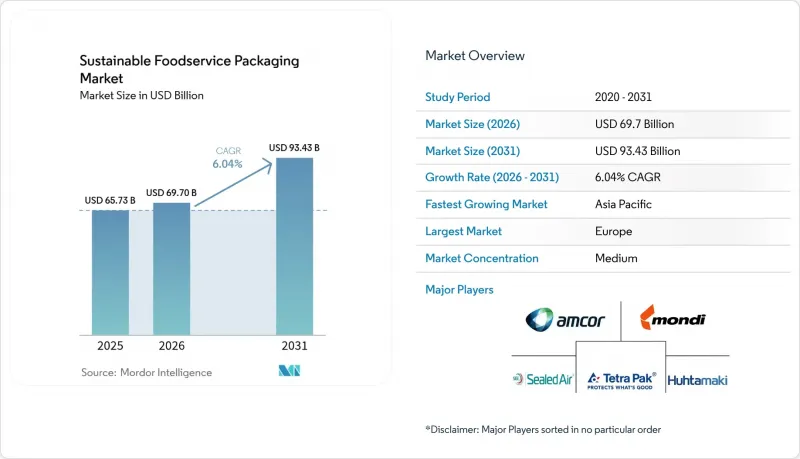
根據 Mordor Intelligence 預測,永續餐飲包裝市場規模將從 2025 年的 657.3 億美元成長到 2026 年的 697 億美元,然後在 2031 年達到 934.3 億美元,2026 年至 2031 年的複合年成長率為 6.04%。
本報告按材料類型(再生紙和紙板、甘蔗渣和其他農業纖維、聚乳酸(PLA)等)、產品類型(瓦楞紙箱和紙盒、托盤等)、包裝形式(硬質、軟質)、最終用戶(快餐店(QSR)、正餐餐廳(FSR)等)和地區進行細分。市場預測以美元(USD)為單位。
全球永續食品服務包裝市場趨勢與洞察
線上食品訂購和配送平台的激增
聚合應用程式的迅速崛起導致外帶激增,對標準化纖維基托盤、碗和保溫包裝的需求空前高漲,這些包裝即使在較長的配送時間內也能保持產品品質。麥當勞透露,到2024年,其客戶包裝的採購量將達到108.71萬噸,並指出已完成向100%可再生、回收或認證原料過渡的86.7%。這項里程碑式的進展在數千家加盟店中日益凸顯其重要性。訂單的集中化使得加工商能夠擴大生產規模,從而攤銷其在乾模成型纖維和PHA生產線上的投資,最終降低了成本溢價,此前這些溢價比塑膠替代品高出15%至40%。
嚴格禁止使用一次性塑膠製品和發泡聚苯乙烯。
加州SB 54法案和歐盟包裝法規要求分階段減少全氟烷基和多氟烷基物質(PFAS)的使用,並規定了再生材料含量配額,從而加速了刀叉餐具、吸管和發泡聚苯乙烯替代品等細分市場的「紙化」進程。麥當勞已提前完成法定目標,在2024年底前,已在其99.5%的客戶包裝中消除了故意添加的PFAS。這凸顯了那些在法規遵循方面走在前面的供應商所享有的優勢。紙製品在2030年之前可豁免部分再生材料含量要求,目前市場需求強勁,抵銷了原生紙漿短缺導致成本上升等不利因素的影響。
與傳統替代品相比,價格溢價較高
植物來源聚合物和認證纖維的價格通常比一般塑膠高出15%至40%,在通膨環境下,這給快餐店的利潤率帶來了壓力。安姆科和貝瑞全球的合併計畫預計每年將產生6.5億美元的協同效應,旨在降低單位成本,此舉預計在24個月內縮小價格差距。連鎖餐廳和飯店集團之間的大量採購合作關係,透過確保多年採購量,進一步抑制了價格溢價。
細分市場分析
預計到2025年,在成熟的供應鏈和關於再生材料含量的臨時監管豁免政策的支持下,再生紙和再生紙板將佔據永續餐飲包裝市場40.78%的佔有率,從而鞏固對三明治包裝紙、翻蓋式容器和沙拉碗的需求。此外,Metsä Amkor公司推出的「Muoto」模塑纖維產品也推動了這一領域的成長。 「Muoto」是一種硬質材料,它將高阻隔薄膜與纖維外殼相結合,實現了超過80%的回收率。儘管市場規模較小,但聚羥基烷酯(PHA)預計將以8.21%的複合年成長率超越所有其他競爭產品,這與全球解決廢棄物問題和展示海洋生物分解性的趨勢相符。
甘蔗渣和其他農作物纖維的產量受天氣影響波動較大,迫使加工商投資乾燥和倉儲設施,以確保全年原料供應。聚乳酸(PLA)雖然品牌知名度高,但其應用仍受限於工業堆肥設施的普及化。再生PET共混物依靠物料平衡監管鏈審核來證明其再生材料含量,而模塑纖維漿的產能則因達特容器公司位於密西根州的干式模塑纖維生產線而不斷擴大,該生產線的運作速度比傳統模塑技術快10倍。
預計到2025年,托盤和碗將佔永續食品服務包裝市場37.85%的佔有率,成為最大佔有率。這是因為它們已成為食材自煮包、沙拉和主菜配送的首選,這些產品需要具備防漏、堅固和可堆疊等特性。麥當勞在歐洲部分地區試行使用可再生材料塗層的沙拉盒,凸顯了該領域對紡織基材的依賴。同時,隨著氣候溫暖地區冷飲消費量的成長以及咖啡文化在亞洲二線城市的傳播,預計到2031年,杯子和杯蓋市場將以7.5%的複合年成長率推動整個行業成長。為此,Hootamaki計劃在2024年底將其位於北愛爾蘭的紡織杯蓋產能提高三倍。
紙盒包裝正受惠於電商食品包裝的「紙化」趨勢,而翻蓋式容器則難以適應不斷變化的EPS(發泡聚苯乙烯)禁令。袋裝和小包裝食品擴大採用生物基薄膜來盛裝醬料和調味品,而像OxBarrier的吸氧咖啡膠囊這樣的利基應用則凸顯了可堆肥解決方案正向高階飲品服務領域轉移。
區域分析
預計到2025年,歐洲將成為永續食品服務包裝銷售的主要驅動力,佔據37.92%的市場。這反映了數十年來歐洲家庭垃圾收集系統的發展,以及歐盟《包裝和包裝廢棄物法規》即將生效的影響。斯堪地那維亞和比荷盧經濟聯盟各城市的可堆肥廢棄物收集系統,使得向甘蔗渣托盤和PLA刀叉餐具的過渡成為可能,且無需額外成本。此外,紙製品在再生材料含量配額方面獲得了暫緩執行期,這有助於在2030年截止日期前快速轉向紡織材料。
亞太地區以8.18%的複合年成長率實現了最高的成長率,這主要得益於主要城市禁止使用發泡聚苯乙烯翻蓋式容器、日益成長的健康外賣意識,以及中國主要城市和印度智慧城市走廊的堆肥設施資金流入。該地區擁有豐富的農業纖維原料,如甘蔗渣和稻殼,但物流網路分散,導致非收穫季節的收整合本居高不下。北美在採用率方面落後於歐洲,但正受益於州級立法,例如加州的SB 54法案和強制性廚餘垃圾回收範圍的擴大,這些立法激勵了對可堆肥內襯和模塑纖維蓋的補貼。以密西根州Dart公司的乾式模塑生產線為例,本地材料轉換可以縮短前置作業時間,並在美元走強的環境下降低外匯風險。在南美洲,糖廠過剩的甘蔗渣產能正在被利用,但在中東和非洲,由於有機廢棄物處理設施有限以及對進口認證纖維捲的高度依賴,實施仍處於早期階段。
其他好處:
- Excel格式的市場預測(ME)表
- 3個月的分析師支持
目錄
第1章:引言
- 研究假設和市場定義
- 調查範圍
第2章:調查方法
第3章執行摘要
第4章 市場狀況
- 市場概覽
- 市場促進因素
- 線上食品訂購和配送平台的激增
- 對一次性塑膠和發泡聚苯乙烯的嚴格監管
- 企業ESG措施正在加速永續採購。
- 生物基阻隔塗層技術的進步提高了保存期限。
- 一線城市地方政府擴大堆肥基礎設施
- 基於區塊鏈的可追溯性用於檢驗回收成分
- 市場限制因素
- 與傳統替代品相比,它的價格溢價更高。
- 高溫和充滿油脂環境下的功能性能差異
- 農業纖維殘渣供應鏈的波動性
- 對 PFAS 和其他阻隔化學物質的監管
- 產業價值鏈分析
- 監理情勢
- 技術展望
- 波特五力分析
- 宏觀經濟因素對市場的影響
第5章 市場規模與成長預測
- 材料類型
- 再生紙和紙板
- 甘蔗渣和其他農業纖維
- 聚乳酸(PLA)
- 聚羥基烷酯(PHA)
- 再生PET和rPET混合物
- 模塑纖維漿
- 依產品類型
- 瓦楞紙箱和紙盒
- 托盤和碗
- 蛤殼
- 杯子和蓋子
- 小袋和小袋
- 其他產品類型
- 按包裝類型
- 死板的
- 靈活的
- 最終用戶
- 速食店(QSR)
- 全方位服務餐廳 (FSR)
- 商用餐飲
- 飯店及休閒
- 其他最終用戶
- 按地區
- 北美洲
- 美國
- 加拿大
- 墨西哥
- 南美洲
- 巴西
- 阿根廷
- 智利
- 其他南美國家
- 歐洲
- 德國
- 英國
- 法國
- 義大利
- 西班牙
- 其他歐洲國家
- 亞太地區
- 中國
- 日本
- 印度
- 韓國
- 澳洲
- 其他亞太國家
- 中東和非洲
- 中東
- 沙烏地阿拉伯
- 阿拉伯聯合大公國
- 土耳其
- 其他中東國家
- 非洲
- 南非
- 奈及利亞
- 肯亞
- 其他非洲國家
- 中東
- 北美洲
第6章 競爭情勢
- 市場集中度
- 策略趨勢
- 市佔率分析
- 公司簡介
- Amcor plc
- Huhtamaki Oyj
- Smurfit WestRock
- Sealed Air Corporation
- Mondi plc
- Tetra Pak International SA
- Sonoco Products Company
- Winpak Ltd.
- Dart Container Corporation
- Graphic Packaging Holding Company
- Novolex Holdings LLC
- Pactiv Evergreen Inc.
- Sabert Corporation
- Genpak LLC
- BioPak Pty Ltd.
- Vegware Ltd.
- Eco-Products Inc.
- Earthpack(Advanced Container Print)
- Amhil North America
第7章 市場機會與未來展望
According to Mordor Intelligence, the sustainable foodservice packaging market size is expected to grow from USD 65.73 billion in 2025 to USD 69.7 billion in 2026 and is forecast to reach USD 93.43 billion by 2031 at 6.04% CAGR over 2026-2031.
This report is Segmented by Material Type (Recycled Paper and Board, Bagasse and Other Agro-Fibers, Polylactic Acid (PLA), and More), Product Type (Corrugated Boxes and Cartons, Trays, and More), Packaging Format (Rigid, and Flexible), End User (Quick Service Restaurants (QSR), Full-Service Restaurants (FSR), and More) and Geography. The Market Forecasts are Provided in Terms of Value (USD)
Global Sustainable Foodservice Packaging Market Trends and Insights
Surge in Online Food-Ordering and Delivery Platforms
Rapid rise of aggregator apps boosted take-out volumes, funneling unprecedented demand for standardized fiber-based trays, bowls, and insulated wraps that preserve product integrity during longer delivery windows. McDonald's disclosed procurement of 1,080,710 metric tons of guest packaging in 2024, noting 86.7% progress toward 100% renewable, recycled, or certified inputs, a milestone magnified across thousands of franchise outlets. Concentrated ordering volumes give converters the scale needed to amortize investments in dry-molded fiber and PHA lines, thereby eroding the 15-40% cost premium over plastic alternatives
Stringent Bans on Single-Use Plastics and Styrofoam
California's SB 54 and the EU Packaging Regulation impose phased reduction and recycled-content quotas, incentivizing rapid "paperization" in cutlery, straw, and foam-replacement niches. McDonald's eliminated intentionally added PFAS from 99.5% of guest packaging by late-2024, beating statutory deadlines and illustrating first-mover supplier advantages in regulatory compliance. Paper products, exempt from some recycled-content mandates until 2030, enjoy a demand tailwind that offsets cost headwinds tied to virgin-fiber scarcity.
High Price Premium versus Conventional Alternatives
Plant-based polymers and certified fibers often cost 15-40% more than commodity plastics, squeezing QSR margins in inflationary climates. Amcor's planned merger with Berry Global projects USD 650 million in annual synergies aimed at trimming unit costs, a move expected to narrow price gaps within 24 months. Bulk-buying alliances between franchise chains and hospitality groups further temper premiums by guaranteeing multi-year offtake volumes.
Other drivers and restraints analyzed in the detailed report include:
- Corporate ESG Commitments Accelerating Sustainable Procurement
- Advances in Bio-Based Barrier Coatings Improving Shelf Life
- Functional Performance Gaps under High Heat or Grease
For complete list of drivers and restraints, kindly check the Table Of Contents.
Segment Analysis
Recycled paper and board claimed 40.78% sustainable foodservice packaging market share in 2025 on the back of mature supply chains and temporary regulatory exemptions for recycled content, locking in volume for sandwich wraps, clamshells, and salad bowls. The segment also benefits from Metsa-Amcor's Muoto molded-fiber launch, a rigid format that pairs high-barrier film with fiber shells to achieve over 80% recyclability scores. Polyhydroxyalkanoates, while commanding a smaller base, are forecast to outpace all rivals at an 8.21% CAGR because of verified marine biodegradability that aligns with global anti-litter narratives.
Bagasse and other agro-fibers face weather-linked yield volatility, pressing converters to invest in drying and warehousing to secure year-round feedstock. Polylactic acid (PLA) enjoys brand familiarity yet remains constrained by industrial composting availability. Recycled PET blends rely on mass-balance chain-of-custody audits to legitimate recycled-content claims, while molded-fiber pulp receives capacity boosts from Dart Container's dry-molded fiber line in Michigan, which operates 10 times faster than legacy forming technologies.
Trays and bowls held the largest slice of the sustainable foodservice packaging market size 37.85% in 2025 because they are the default choice for meal kits, salads, and entree deliveries that demand leakproof rigidity and stackability. McDonald's piloted renewable-coated salad boxes across parts of Europe, underlining the segment's dependency on fiber substrates. Conversely, cups and lids are projected to pace the field with 7.5% CAGR through 2031 as cold-drink volumes climb in hot-weather regions and coffee culture spreads into tier-two Asian cities, prompting Huhtamaki to triple fiber-lid capacity in Northern Ireland by late-2024.
Corrugated cartons profit from "paperization" in e-commerce food kits, while clamshells scramble to meet evolving EPS bans. Pouches and sachets are exploring high-bio-content films for sauces and condiments, and niche applications such as OxBarrier's oxygen-scavenging coffee capsules highlight the migration of compostable solutions into premium beverage service
Complete Report Scope:
- By Material Type
- Recycled Paper and Board
- Bagasse and Other Agro-fibers
- Polylactic Acid (PLA)
- Polyhydroxyalkanoates (PHA)
- Recycled PET and rPET Blends
- Molded Fiber Pulp
- By Product Type
- Corrugated Boxes and Cartons
- Trays and Bowls
- Clamshells
- Cups and Lids
- Pouches and Sachets
- Other Product Types
- By Packaging Format
- Rigid
- Flexible
- By End User
- Quick Service Restaurants (QSR)
- Full-Service Restaurants (FSR)
- Institutional Catering
- Hospitality and Leisure
- Other End Users
- By Geography
- North America
- United States
- Canada
- Mexico
- South America
- Brazil
- Argentina
- Chile
- Rest of South America
- Europe
- Germany
- United Kingdom
- France
- Italy
- Spain
- Rest of Europe
- Asia-Pacific
- China
- Japan
- India
- South Korea
- Australia
- Rest of Asia-Pacific
- Middle East and Africa
- Middle East
- Saudi Arabia
- United Arab Emirates
- Turkey
- Rest of Middle East
- Africa
- South Africa
- Nigeria
- Kenya
- Rest of Africa
- Middle East
- North America
Geography Analysis
Europe dominated 2025 revenue with a 37.92% share of the sustainable foodservice packaging market, reflecting decades-old curbside recycling schemes and looming mandates under the EU Packaging and Packaging Waste Regulation. Compostable waste pickup in Scandinavia and Benelux cities enables cost-neutral switchovers to bagasse trays and PLA cutlery. Moreover, paper-based items enjoy an interim reprieve from recycled-content quotas, encouraging rapid fiber substitution before the 2030 deadline.
Asia-Pacific logged the highest growth rate 8.18% CAGR propelled by megacity bans on foam clamshells, escalating health-conscious delivery culture, and capital inflows into composting facilities in China's tier-one hubs and India's smart-city corridors. The region also houses abundant agro-fiber feedstock such as bagasse and rice husk, but logistic fragmentation inflates collection costs during off-harvest seasons. North America, while trailing Europe in penetration, benefits from state-level legislation like California SB 54 and expanding organics diversion mandates that direct subsidies toward compostable liners and molded-fiber lids. Local material conversion typified by Dart's dry-molded line in Michigan shortens lead times and cushions currency-risk exposure in a strong-USD scenario. South America leverages surplus bagasse capacity from sugar mills, whereas Middle East and Africa adoption remains nascent because of limited organic-waste processing assets and higher import dependence for certified fiber reels.
- Amcor plc
- Huhtamaki Oyj
- Smurfit WestRock
- Sealed Air Corporation
- Mondi plc
- Tetra Pak International SA
- Sonoco Products Company
- Winpak Ltd.
- Dart Container Corporation
- Graphic Packaging Holding Company
- Novolex Holdings LLC
- Pactiv Evergreen Inc.
- Sabert Corporation
- Genpak LLC
- BioPak Pty Ltd.
- Vegware Ltd.
- Eco-Products Inc.
- Earthpack (Advanced Container Print)
- Amhil North America
Additional Benefits:
- The market estimate (ME) sheet in Excel format
- 3 months of analyst support
TABLE OF CONTENTS
1 INTRODUCTION
- 1.1 Study Assumptions and Market Definition
- 1.2 Scope of the Study
2 RESEARCH METHODOLOGY
3 EXECUTIVE SUMMARY
4 MARKET LANDSCAPE
- 4.1 Market Overview
- 4.2 Market Drivers
- 4.2.1 Surge in online food-ordering and delivery platforms
- 4.2.2 Stringent bans on single-use plastics and styro-foam
- 4.2.3 Corporate ESG commitments accelerating sustainable procurement
- 4.2.4 Advances in bio-based barrier coatings improving shelf-life
- 4.2.5 Expansion of municipal composting infrastructure in tier-1 cities
- 4.2.6 Blockchain-enabled traceability for recycled content verification
- 4.3 Market Restraints
- 4.3.1 High price premium versus conventional alternatives
- 4.3.2 Functional performance gaps under high heat / grease
- 4.3.3 Supply-chain volatility for agro-fiber residues
- 4.3.4 Regulatory scrutiny of PFAS and other barrier chemicals
- 4.4 Industry Value Chain Analysis
- 4.5 Regulatory Landscape
- 4.6 Technological Outlook
- 4.7 Porters Five Forces Analysis
- 4.7.1 Bargaining Power of Suppliers
- 4.7.2 Bargaining Power of Buyers
- 4.7.3 Threat of New Entrants
- 4.7.4 Degree of Competition
- 4.7.5 Threat of Substitutes
- 4.8 The Impact of Macroeconomic Factors on the Market
5 MARKET SIZE AND GROWTH FORECASTS
- 5.1 By Material Type
- 5.1.1 Recycled Paper and Board
- 5.1.2 Bagasse and Other Agro-fibers
- 5.1.3 Polylactic Acid (PLA)
- 5.1.4 Polyhydroxyalkanoates (PHA)
- 5.1.5 Recycled PET and rPET Blends
- 5.1.6 Molded Fiber Pulp
- 5.2 By Product Type
- 5.2.1 Corrugated Boxes and Cartons
- 5.2.2 Trays and Bowls
- 5.2.3 Clamshells
- 5.2.4 Cups and Lids
- 5.2.5 Pouches and Sachets
- 5.2.6 Other Product Types
- 5.3 By Packaging Format
- 5.3.1 Rigid
- 5.3.2 Flexible
- 5.4 By End User
- 5.4.1 Quick Service Restaurants (QSR)
- 5.4.2 Full-Service Restaurants (FSR)
- 5.4.3 Institutional Catering
- 5.4.4 Hospitality and Leisure
- 5.4.5 Other End Users
- 5.5 By Geography
- 5.5.1 North America
- 5.5.1.1 United States
- 5.5.1.2 Canada
- 5.5.1.3 Mexico
- 5.5.2 South America
- 5.5.2.1 Brazil
- 5.5.2.2 Argentina
- 5.5.2.3 Chile
- 5.5.2.4 Rest of South America
- 5.5.3 Europe
- 5.5.3.1 Germany
- 5.5.3.2 United Kingdom
- 5.5.3.3 France
- 5.5.3.4 Italy
- 5.5.3.5 Spain
- 5.5.3.6 Rest of Europe
- 5.5.4 Asia-Pacific
- 5.5.4.1 China
- 5.5.4.2 Japan
- 5.5.4.3 India
- 5.5.4.4 South Korea
- 5.5.4.5 Australia
- 5.5.4.6 Rest of Asia-Pacific
- 5.5.5 Middle East and Africa
- 5.5.5.1 Middle East
- 5.5.5.1.1 Saudi Arabia
- 5.5.5.1.2 United Arab Emirates
- 5.5.5.1.3 Turkey
- 5.5.5.1.4 Rest of Middle East
- 5.5.5.2 Africa
- 5.5.5.2.1 South Africa
- 5.5.5.2.2 Nigeria
- 5.5.5.2.3 Kenya
- 5.5.5.2.4 Rest of Africa
- 5.5.5.1 Middle East
- 5.5.1 North America
6 COMPETITIVE LANDSCAPE
- 6.1 Market Concentration
- 6.2 Strategic Moves
- 6.3 Market Share Analysis
- 6.4 Company Profiles (includes Global level Overview, Market level overview, Core Segments, Financials as available, Strategic Information, Market Rank/Share for key companies, Products and Services, and Recent Developments)
- 6.4.1 Amcor plc
- 6.4.2 Huhtamaki Oyj
- 6.4.3 Smurfit WestRock
- 6.4.4 Sealed Air Corporation
- 6.4.5 Mondi plc
- 6.4.6 Tetra Pak International SA
- 6.4.7 Sonoco Products Company
- 6.4.8 Winpak Ltd.
- 6.4.9 Dart Container Corporation
- 6.4.10 Graphic Packaging Holding Company
- 6.4.11 Novolex Holdings LLC
- 6.4.12 Pactiv Evergreen Inc.
- 6.4.13 Sabert Corporation
- 6.4.14 Genpak LLC
- 6.4.15 BioPak Pty Ltd.
- 6.4.16 Vegware Ltd.
- 6.4.17 Eco-Products Inc.
- 6.4.18 Earthpack (Advanced Container Print)
- 6.4.19 Amhil North America
7 MARKET OPPORTUNITIES AND FUTURE OUTLOOK
- 7.1 White-space and Unmet-Need Assessment

 全球永續包裝市場規模、佔有率、趨勢和成長分析報告(2026-2034)
 永續包裝:市場佔有率分析、產業趨勢與統計、成長預測(2026-2031)永續材料市場規模、佔有率、成長率、全球產業分析、區域趨勢以及 2026 年至 2034 年的預測。
 生物基軟性包裝市場預測至2034年-全球原料、聚合物類型、包裝形式、材料特性、應用、最終用戶及地區分析
 永續包裝市場規模、佔有率、成長和行業分析:按類型、產品類型、最終用途和地區分類,預測至2034年
 永續包裝市場:按材料、永續性類型、應用和分銷管道分類-2026-2032年全球市場預測永續快速消費品包裝市場預測至2034年-按包裝類型、材料類型、永續發展措施、應用和最終用戶分類的全球分析健康永續包裝市場:預測(至2034年)-按材料類型、包裝類型、包裝流程、應用、分銷管道、最終用戶和地區分類的全球分析
 永續產品市場規模、佔有率和成長分析:按產品類型、原料來源、價格範圍、認證類型、分銷管道、最終用戶細分市場和地區分類-2026-2033年產業預測永續包裝材料市場預測至2034年—按材料類型、包裝形式、技術、應用、最終用戶和地區分類的全球分析