


 |
市場調查報告書
商品編碼
2123465
杯子和杯蓋:市場佔有率分析、行業趨勢和統計數據、成長預測(2026-2031 年)Cups And Lids - Market Share Analysis, Industry Trends & Statistics, Growth Forecasts (2026 - 2031) |
||||||

※ 本網頁內容可能與最新版本有所差異。詳細情況請與我們聯繫。
根據 Mordor Intelligence 估計,2026 年杯子和杯蓋市值將達到 183.4 億美元,高於 2025 年的 177.4 億美元,預計到 2031 年將達到 216.4 億美元。
預計 2026 年至 2031 年的複合年成長率為 3.37%。
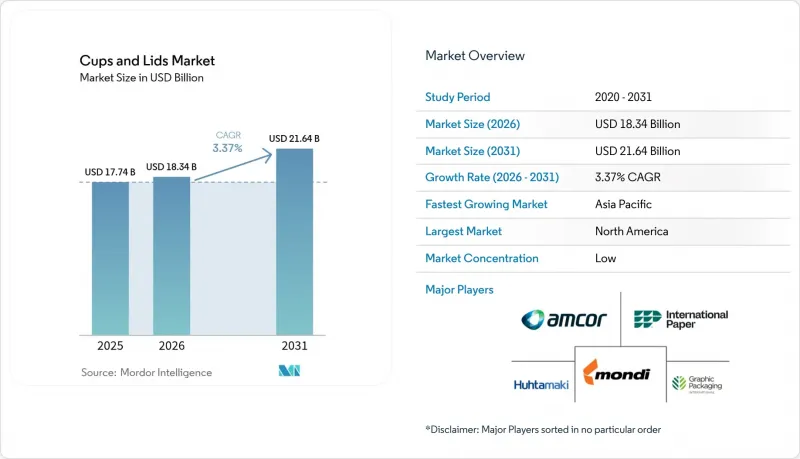
本報告按材料(塑膠、紙張和紙板、發泡聚苯乙烯(EPS)、模塑纖維和甘蔗渣等)、產品類型(飲料杯、分發和包裝杯、杯蓋)、最終用戶(食品飲料、餐飲服務業、零售和電子商務等)以及地區進行細分。市場預測以價值(美元)表示。
全球杯蓋市場趨勢與洞察
快餐店和食品配送業務快速成長
快餐店(QSR)的快速擴張和外帶訂單兩位數的成長正在推動對單份包裝的需求。麥當勞計畫在2024年分店超過1,100家新店,而DoorDash在2025年第一季的訂單總額達到187億美元,較去年同期成長18%。外送餐通常包含多種飲品,因此需要使用防漏杯和防篡改杯蓋,以確保食品在運輸過程中的安全。為了因應這一成長,包裝加工商正致力於將整合通風系統、QR碼追蹤和多隔層設計融入產品中。儘管亞洲市場的速食店滲透率低於歐洲和美國,但仍保持著兩位數的成長,進一步推高了對一次性容器的需求,並展現出強勁的成長勢頭。
外帶飲料的成長
2024年,隨著都市區通勤者開始需要外帶飲品,全球咖啡店的客流量增加了12%。這一趨勢也蔓延至冷萃咖啡、蛋白奶昔和鮮榨果汁等領域,這些飲品對包裝的阻隔性能和耐熱性都有特定的要求。星巴克在3萬家門市取消了吸管,改用吸管蓋。此舉每年減少了10億根吸管的使用,充分展現了消費者行為如何推動包裝蓋的重新設計。製造商們也積極回應,推出了不含聚丙烯的包裝蓋和熱填充測試的紙質透氣孔,並利用ESG(環境、社會和治理)訊息來爭取優質的展示空間。
塑膠法規
歐盟一次性塑膠指令和加州SB 54法案要求製造商為每個杯子支付0.05至0.15歐元的新費用,並在2032年前將塑膠使用量減少25%。遵守這些法規將增加與材料轉型相關的資本成本,並促使企業開發針對特定地區的產品系列。小規模加工商可能面臨不成比例的負擔,並被迫退出杯子和杯蓋市場,這可能導致該行業進一步重組。
細分市場分析
預計到2031年,紙張和紙板的年複合成長率(CAGR)將達到4.55%,超過塑膠。然而,截至2025年,塑膠在杯子和杯蓋市場仍佔據60.78%的市場。隨著咖啡連鎖店試用符合熱填充要求的模塑纖維杯蓋,使用纖維材料的杯子和杯蓋市場規模預計將穩定成長。由於越來越多的城市禁止使用發泡聚苯乙烯,其市佔率持續下降,而生質塑膠由於原料成本高昂,仍處於小眾市場。
為了遵守不同的管理體制,加工商需要確保多種供應來源,而資本配置正轉向可在PET、rPET和塗佈紙之間切換的靈活生產線。 Dart Container公司投資1.8億美元的紙杯生產線能夠快速響應訂單變化,凸顯了大型製造商如何在追求環保標籤需求的同時分散材料風險。品牌商正在尋求不含化學物質的阻隔塗層以規避PFAS法規,這推動了對可耐受高達100 度C溫度的飲料用水性分散體的投資。
區域分析
預計到2025年,北美將維持38.96%的杯子和杯蓋市場佔有率。這得歸功於北美成熟的免下車餐飲文化以及消費者願意為永續包裝升級買單。加拿大於2024年實施的一次性塑膠禁令推動了塗層紙杯的普及,而墨西哥快餐店(QSR)的擴張也促進了低成本PET杯的銷售成長。美國食品藥物管理局(FDA)的食品接觸法規對新進者構成了准入壁壘,同時也保護了擁有完善合規體系的現有企業。
亞太地區預計將以4.44%的複合年成長率領跑,並將繼續成為產能擴張的重點區域。在中國,預計2024年咖啡消費量將成長20%,這將推動對能夠保持外帶時咖啡油脂質感的專用杯蓋的需求。在印度價值700億美元的零售業中,杯子上的標準化容量標記現已成為強制性要求,這有利於大規模生產和採用壁更薄的設計,從而減少塑膠的使用。區域工資優勢也吸引了跨國加工製造商,他們正在建立出口基地,向中東買家供貨。
儘管歐洲的成長依然溫和,但它在創新方面仍然處於領先地位。這主要歸功於嚴格的生產者延伸責任制(EPR)收費政策,該政策優先考慮可回收的單一材料系統。德國的目標是到2025年實現70%的回收率,品牌所有者正在推廣使用透明PET杯和配套的PET杯蓋,這有利於單一流回收。歐盟委員會的循環經濟行動計畫引入了押金制度,每個杯子加收0.05至0.15歐元,從而刺激了對更輕產品的需求,降低了總體成本。大型飲料連鎖店優先選擇擁有可追溯的再生材料含量認證的供應商。
其他好處:
- Excel格式的市場預測(ME)表
- 3個月的分析師支持
目錄
第1章:引言
- 研究假設和市場定義
- 調查範圍
第2章:調查方法
第3章執行摘要
第4章 市場狀況
- 市場概覽
- 市場促進因素
- 快餐和食品配送的蓬勃發展
- 攜帶式飲料的成長
- 從玻璃到塑膠的轉變
- 自有品牌產品的興起
- 乾式模塑纖維技術
- 人工智慧驅動的庫存最佳化
- 市場限制因素
- 塑膠製品相關法規
- 樹脂價格波動
- 再利用文化的傳播
- 關於禁止使用 PFAS 的措施
- 產業供應鏈分析
- 監理情勢
- 技術展望
- 波特五力分析
第5章 市場規模與成長預測
- 材料
- 塑膠
- 紙張和紙板
- 發泡材(EPS)
- 模塑纖維/甘蔗渣
- 其他材料類型
- 依產品類型
- 飲料杯
- 量杯和包裝杯
- 蓋
- 最終用戶
- 食品/飲料
- 食品服務
- 零售與電子商務
- 其他最終用戶
- 按地區
- 北美洲
- 美國
- 加拿大
- 墨西哥
- 南美洲
- 巴西
- 阿根廷
- 智利
- 其他南美國家
- 歐洲
- 英國
- 德國
- 法國
- 義大利
- 西班牙
- 俄羅斯
- 其他歐洲國家
- 亞太地區
- 中國
- 印度
- 日本
- 韓國
- 澳洲
- 其他亞太國家
- 中東和非洲
- 中東
- 沙烏地阿拉伯
- 阿拉伯聯合大公國
- 土耳其
- 其他中東國家
- 非洲
- 南非
- 奈及利亞
- 其他非洲國家
- 中東
- 北美洲
第6章 競爭情勢
- 市場集中度
- 策略趨勢
- 市佔率分析
- 公司簡介
- Amcor plc
- Dart Container Corporation
- Huhtamaki Oyj
- Graphic Packaging Holding Company
- Greiner Packaging International GmbH
- Novolex Holdings LLC
- Reynolds Consumer Products Inc.
- WinCup, Inc.
- Seda International Packaging Group SpA
- Lollicup USA, Inc.
- Mondi plc
- Printpack, Inc.
- Sabert Corporation
- CP Flexible Packaging, Inc.
- DETMOLD PACKAGING PTY. LTD.
- International Paper Company
- Coveris Holdings SA
第7章 市場機會與未來展望
According to Mordor Intelligence, the cups and lids market size in 2026 is estimated at USD 18.34 billion, growing from 2025 value of USD 17.74 billion with 2031 projections showing USD 21.64 billion, growing at 3.37% CAGR over 2026-2031.
This report is Segmented by Material (Plastic, Paper and Paperboard, Foam (EPS), Molded-fiber/Bagasse, and More), Product Type (Drinking Cups, Portion and Packaging Cups, and Lids), End-User (Food and Beverage, Foodservice, Retail and E-Commerce, and More), and Geography. The Market Forecasts are Provided in Terms of Value (USD).
Global Cups And Lids Market Trends and Insights
QSR and Food-delivery Boom
Rapid expansion of quick-service restaurants and double-digit growth in delivery orders heighten the need for single-serve packaging. McDonald's opened over 1,100 new outlets in 2024, while DoorDash posted an 18% year-over-year rise in gross order value to USD 18.7 billion in Q1 2025. Each delivery meal typically contains multiple beverages, requiring leak-proof cups and tamper-evident lids that protect food safety during transit. The surge encourages converters to add integrated venting, QR code tracking, and multi-compartment formats. Asian markets gain strongly because QSR penetration remains below Western levels yet grows in double digits, creating incremental demand for disposables.
Growth in On-the-go Drinks
Global coffee shop visits increased by 12% in 2024 as urban commuters sought takeaway beverages. The trend extends to cold brews, protein shakes, and fresh juices, each requiring distinct barrier properties and temperature resilience. Starbucks removed plastic straws by converting to sipper lids across 30,000 locations, eliminating 1 billion straws annually and illustrating how consumer behavior drives lid redesign. Manufacturers respond with polypropylene-free lids and paper-based vents that pass hot-fill tests, leveraging ESG messaging to capture premium shelf space.
Plastics Regulations
The European Single-Use Plastics Directive and California's SB 54 mandate require producers to pay new fees of EUR 0.05-0.15 per cup and mandate a 25% reduction in plastic use by 2032. Compliance adds capital costs for material conversion and encourages region-specific product portfolios. Smaller converters face disproportionate burdens and may exit the cups and lids market, leading to higher consolidation.
Other drivers and restraints analyzed in the detailed report include:
- Rise of Private-label SKUs
- Dry-molded-fiber Technology
- Volatile Resin Prices
For complete list of drivers and restraints, kindly check the Table Of Contents.
Segment Analysis
Paper and paperboard recorded a 4.55% CAGR through 2031, outpacing plastics, even though the latter still held a 60.78% market share in cups and lids in 2025. The cups and lids market size for fiber-based formats is projected to expand steadily as coffee chains trial molded-fiber lids that pass hot-fill requirements. Foam polystyrene continues to decline as municipal bans expand, while bioplastics remain a niche market due to high feedstock costs.
Converters must dual-source to serve mixed regulatory regimes, so capital allocation pivots toward flexible lines that switch between PET, rPET, and coated paperboard. Dart Container's USD 180 million paper cup line enables rapid order changes, highlighting how leading producers diversify material risk while pursuing eco-label demand. Brands demand chemical-free barrier coatings to avoid PFAS restrictions, prompting investment in water-based dispersions that still withstand temperatures of 100 °C for beverages.
Complete Report Scope:
- By Material
- Plastic
- Paper and Paperboard
- Foam (EPS)
- Molded-fiber / Bagasse
- Other Material Types
- By Product Type
- Drinking Cups
- Portion and Packaging Cups
- Lids
- By End-User
- Food and Beverage
- Foodservice
- Retail and E-commerce
- Other End-User
- By Geography
- North America
- United States
- Canada
- Mexico
- South America
- Brazil
- Argentina
- Chile
- Rest of South America
- Europe
- United Kingdom
- Germany
- France
- Italy
- Spain
- Russia
- Rest of Europe
- Asia-Pacific
- China
- India
- Japan
- South Korea
- Australia
- Rest of Asia-Pacific
- Middle East and Africa
- Middle East
- Saudi Arabia
- United Arab Emirates
- Turkey
- Rest of Middle East
- Africa
- South Africa
- Nigeria
- Rest of Africa
- Middle East
- North America
Geography Analysis
North America retained a 38.96% market share of cups and lids in 2025, supported by a well-established drive-thru culture and consumers willing to pay for sustainable packaging upgrades. Canada's single-use plastic ban in 2024 fueled migration to coated paperboard, while Mexico's growing QSR footprint supplied volume growth for low-cost PET cups. FDA food-contact regulations raise barriers for new entrants yet protect incumbents with strong compliance teams.
Asia-Pacific delivered the highest 4.44% CAGR and remains the focal point for capacity expansions. China experienced a 20% increase in coffee consumption in 2024, which heightened demand for specialty lids that preserve the crema texture during takeaway service. India's USD 70 billion organized retail sector now specifies standardized volume markers on cups, supporting large production runs and thin-wall designs that cut resin use. Regional wage advantages also attract multinational converters, who are building export hubs that ship to buyers in the Middle East.
Europe grew modestly yet remains the innovation leader, largely due to stringent Extended Producer Responsibility fees that favor recyclable mono-material systems. Germany's 70% recycling rate target for 2025 encourages brand owners to adopt clear PET cups with matching PET lids, thereby enhancing single-stream collection. The European Commission's Circular Economy Action Plan layers deposit schemes that add EUR 0.05-0.15 per unit, creating demand for lightweight formats that defend total cost. Suppliers with traceable recycled content certification receive procurement preference from large beverage chains.
- Amcor plc
- Dart Container Corporation
- Huhtamaki Oyj
- Graphic Packaging Holding Company
- Greiner Packaging International GmbH
- Novolex Holdings LLC
- Reynolds Consumer Products Inc.
- WinCup, Inc.
- Seda International Packaging Group S.p.A.
- Lollicup USA, Inc.
- Mondi plc
- Printpack, Inc.
- Sabert Corporation
- C-P Flexible Packaging, Inc.
- DETMOLD PACKAGING PTY. LTD.
- International Paper Company
- Coveris Holdings S.A.
Additional Benefits:
- The market estimate (ME) sheet in Excel format
- 3 months of analyst support
TABLE OF CONTENTS
1 INTRODUCTION
- 1.1 Study Assumptions and Market Definition
- 1.2 Scope of the Study
2 RESEARCH METHODOLOGY
3 EXECUTIVE SUMMARY
4 MARKET LANDSCAPE
- 4.1 Market Overview
- 4.2 Market Drivers
- 4.2.1 QSR and Food-delivery Boom
- 4.2.2 Growth in On-the-go Drinks
- 4.2.3 Shift from Glass to Plastic
- 4.2.4 Rise of Private-label SKUs
- 4.2.5 Dry-molded-fiber Technology
- 4.2.6 AI-optimised Inventory
- 4.3 Market Restraints
- 4.3.1 Plastics Regulations
- 4.3.2 Volatile Resin Prices
- 4.3.3 Growing Reusable Culture
- 4.3.4 PFAS Barrier Bans
- 4.4 Industry Supply-Chain Analysis
- 4.5 Regulatory Landscape
- 4.6 Technological Outlook
- 4.7 Porter's Five Forces Analysis
- 4.7.1 Threat of New Entrants
- 4.7.2 Bargaining Power of Suppliers
- 4.7.3 Bargaining Power of Buyers
- 4.7.4 Threat of Substitutes
- 4.7.5 Industry Rivalry
5 MARKET SIZE AND GROWTH FORECASTS (VALUE)
- 5.1 By Material
- 5.1.1 Plastic
- 5.1.2 Paper and Paperboard
- 5.1.3 Foam (EPS)
- 5.1.4 Molded-fiber / Bagasse
- 5.1.5 Other Material Types
- 5.2 By Product Type
- 5.2.1 Drinking Cups
- 5.2.2 Portion and Packaging Cups
- 5.2.3 Lids
- 5.3 By End-User
- 5.3.1 Food and Beverage
- 5.3.2 Foodservice
- 5.3.3 Retail and E-commerce
- 5.3.4 Other End-User
- 5.4 By Geography
- 5.4.1 North America
- 5.4.1.1 United States
- 5.4.1.2 Canada
- 5.4.1.3 Mexico
- 5.4.2 South America
- 5.4.2.1 Brazil
- 5.4.2.2 Argentina
- 5.4.2.3 Chile
- 5.4.2.4 Rest of South America
- 5.4.3 Europe
- 5.4.3.1 United Kingdom
- 5.4.3.2 Germany
- 5.4.3.3 France
- 5.4.3.4 Italy
- 5.4.3.5 Spain
- 5.4.3.6 Russia
- 5.4.3.7 Rest of Europe
- 5.4.4 Asia-Pacific
- 5.4.4.1 China
- 5.4.4.2 India
- 5.4.4.3 Japan
- 5.4.4.4 South Korea
- 5.4.4.5 Australia
- 5.4.4.6 Rest of Asia-Pacific
- 5.4.5 Middle East and Africa
- 5.4.5.1 Middle East
- 5.4.5.1.1 Saudi Arabia
- 5.4.5.1.2 United Arab Emirates
- 5.4.5.1.3 Turkey
- 5.4.5.1.4 Rest of Middle East
- 5.4.5.2 Africa
- 5.4.5.2.1 South Africa
- 5.4.5.2.2 Nigeria
- 5.4.5.2.3 Rest of Africa
- 5.4.5.1 Middle East
- 5.4.1 North America
6 COMPETITIVE LANDSCAPE
- 6.1 Market Concentration
- 6.2 Strategic Moves
- 6.3 Market Share Analysis
- 6.4 Company Profiles (includes Global level Overview, Market level overview, Core Segments, Financials as available, Strategic Information, Market Rank/Share for key companies, Products and Services, and Recent Developments)
- 6.4.1 Amcor plc
- 6.4.2 Dart Container Corporation
- 6.4.3 Huhtamaki Oyj
- 6.4.4 Graphic Packaging Holding Company
- 6.4.5 Greiner Packaging International GmbH
- 6.4.6 Novolex Holdings LLC
- 6.4.7 Reynolds Consumer Products Inc.
- 6.4.8 WinCup, Inc.
- 6.4.9 Seda International Packaging Group S.p.A.
- 6.4.10 Lollicup USA, Inc.
- 6.4.11 Mondi plc
- 6.4.12 Printpack, Inc.
- 6.4.13 Sabert Corporation
- 6.4.14 C-P Flexible Packaging, Inc.
- 6.4.15 DETMOLD PACKAGING PTY. LTD.
- 6.4.16 International Paper Company
- 6.4.17 Coveris Holdings S.A.
7 MARKET OPPORTUNITIES AND FUTURE OUTLOOK
- 7.1 White-space and Unmet-need Assessment

 玻璃蓋市場:全球市場預測,2026-2032年
 回收杯市場:商業機會、成長要素、產業趨勢分析及2026-2035年預測一次性杯子市場:2026-2032年全球市場預測(按產品類型、產能、材料類型、最終用戶、應用和分銷管道分類)雙層保溫杯市場:按材料、應用、容量、分銷管道和最終用途分類-2026-2032年全球市場預測
 2026年全球可回收杯市場報告
 全球一次性杯子市場規模、佔有率、趨勢和成長分析報告(2026-2034年)全球發泡杯市場規模、佔有率、趨勢和成長分析報告(2026-2034年)2026年全球攜帶式杯市場報告2026年全球杯蓋包裝市場報告2026年全球杯蓋市場報告