


 |
市場調查報告書
商品編碼
2123405
隧道自動化:市場佔有率分析、產業趨勢與統計、成長預測(2026-2031)Tunnel Automation - Market Share Analysis, Industry Trends & Statistics, Growth Forecasts (2026 - 2031) |
||||||

※ 本網頁內容可能與最新版本有所差異。詳細情況請與我們聯繫。
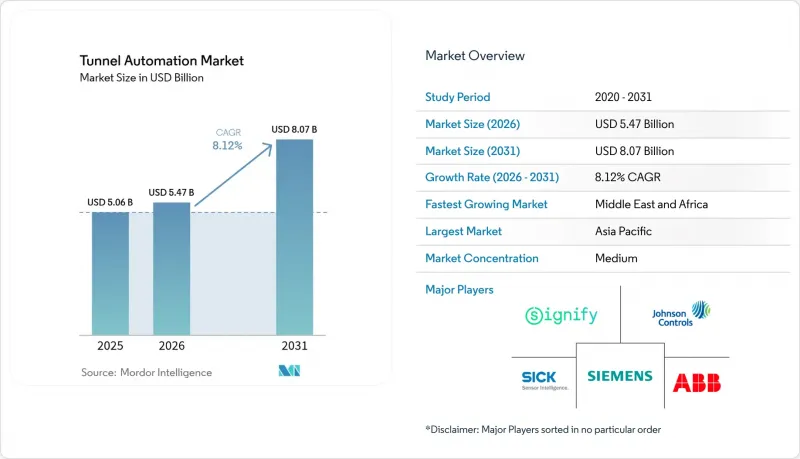
據 Mordor Intelligence 稱,2025 年隧道自動化市場價值為 50.6 億美元,預計到 2031 年將從 2026 年的 54.7 億美元成長至 80.7 億美元,預測期(2026-2031 年)複合年成長率為 8.12%。
[1] 美國聯邦公路管理局的國家隧道檢測標準、ecfr.gov網站上日益嚴格的監管要求、物聯網賦能的監控與數據採集(SCADA)平台的普及以及公共部門對交通走廊的持續投入,共同推動了隧道自動化市場的成長。本報告按交付類型(硬體、軟體、服務)、組件(照明與電力、號誌與控制、其他)、自動化程度(半自動化、全自動)、應用領域(交通管理與SCADA、其他)、隧道類型(公路、鐵路與地鐵、其他)以及地區進行細分。市場預測以美元計價。
全球隧道自動化市場趨勢與洞察
政府法規要求提高隧道安全性和永續性。
全球政策框架正在加速隧道自動化技術的應用。美國國家隧道檢查標準規定每兩年進行一次檢查,並透過強制操作員實施自動化安全系統,有效地建立了一個強制性更新週期。泛歐交通網路(TEN-T)的類似指令要求採用先進的監控系統,以便在布倫納基線隧道等項目中將5000萬噸貨物從道路運輸運輸轉移到鐵路運輸。節能方面的法律目標透過推廣LED照明和高效通風系統,推動了環保工作。中國監管機構目前正在強制要求新高速公路採用智慧化管理,天山勝利隧道的獨特自動化技術就是一個例子。這些法規共同促成了大規模的合規主導支出,從而避免了常見的資本預算延期問題。
物聯網賦能的SCADA系統與雲端分析的整合正在穩步推進。
即時分析使營運商能夠將隧道運作減少高達 40%,延長設備使用壽命,並使營運與預測性維護策略保持一致。西門子在西班牙索姆波特隧道進行的升級改造,將 SIMATIC WinCC OA 與冗餘的 S7-1500H PLC 整合,實現了統一的緊急應變和資產管理。雖然先進的雲端平台將機器學習演算法應用於空氣品質和設備資料的模式分析,但它們也擴大了惡意攻擊者的攻擊面。彌合這一知識差距需要對維護人員進行再培訓,並建立一個能夠將操作技術(OT) 和資訊技術 (IT) 最佳實踐相結合的網路安全管治模型。
高昂的初始資本支出 (CAPEX) 和複雜的整合
全面自動化需要大量資金投入。特別是現有隧道,需要進行客製化的重新維修和分階段實施,這可能會使專案工期延長長達兩年。美國聯邦政府針對淨零排放設施制定的P100標準提高了基本要求,導致初始預算增加。能源績效合約可以部分抵銷這些成本。江森自控在科布縣開展的580萬美元計畫表明,績效保證可以開闢新的資金籌措管道,並透過降低能源成本節省了206萬美元。熟練技術人員的長期短缺進一步增加了整合過程的複雜性。
細分市場分析
到2025年,硬體將佔隧道自動化市場45.75%的佔有率,這反映了對感測器、控制器和電力基礎設施的基本需求。然而,軟體預計將超越所有其他產品和服務,以9.62%的複合年成長率成長,這主要得益於人工智慧驅動的分析技術,這些技術能夠實現預測性維護和自主決策。
海瑞克的「互聯」平台體現了這一轉型,它能夠追蹤全球隧道掘進機的性能,並提供即時洞察,從而減少停機時間。服務(安裝、校準和生命週期管理)完善了產品組合,隨著營運商將專業知識外包,這些服務在經常性收入中所佔的佔有率也在不斷成長。
照明和電力系統佔38.10%的市場佔有率,凸顯了節能LED和智慧電源控制的重要性。隨著預防事故法規日益嚴格,安全和火災偵測感測器預計將以9.28%的複合年成長率推動市場成長。
ABB的變速通風驅動裝置安裝在亞洲最長的公路隧道中,是組件整合在改善空氣品質管理並降低能源成本的典型案例。多參數感測器的日益普及使得以前無法實現的即時結構完整性監測成為可能。
區域分析
亞太地區在隧道自動化市場佔據42.10%的佔有率,這主要得益於持續的資本投資、政府主導的產業政策以及「工業4.0」標準的廣泛應用。中國的規模經濟正在縮短建設週期,透過廣泛的自動化,專案前置作業時間幾乎縮短了一半,新疆天山勝利隧道便是例證。新加坡樟宜機場計畫凸顯了該地區在將航空基礎設施與先進隧道系統相結合方面的專業能力,而澳洲的自主式隧道掘進機則展現了其技術成熟度。官民合作關係(PPP)已實現標準化,使營運商的獎勵與長期的能源和安全目標保持一致。
中東地區正經歷快速成長,預計年複合成長率將達到10.72%。沙烏地阿拉伯的「2030願景」正在津貼大規模智慧城市走廊建設,這些走廊融合了機器人製造、人工智慧監控和碳中和目標。在卡達的鐵路擴建計畫和阿拉伯聯合大公國的地鐵網路中,預裝物聯網感測器的模組化隧道組件正在被應用,從而減少了現場配置工作。在競爭性採購框架下,能夠提供承包、完全整合生態系統的供應商更受青睞。
在歐洲,在嚴格的合規體系和跨國大型企劃的支撐下,穩定成長仍在繼續。布倫納隧道(Brenner base tunnel)正獲得歐盟聯合資助,以實現其交通方式轉型目標;德國的南聯輸電線路(SudLink transport line)則採用海瑞克(Herrenknecht)的隧道掘進機(TBM)鋪設輸電管道,助力電網脫碳。棕地維修計畫正逐漸成為主流,尤其是LED燈具的更換,已證實可達到高達60%的節能效果。
其他好處:
- Excel格式的市場預測(ME)表
- 3個月的分析師支持
目錄
第1章:引言
- 研究假設和市場定義
- 調查範圍
第2章:調查方法
第3章執行摘要
第4章 市場狀況
- 市場概覽
- 市場促進因素
- 政府法規要求提高隧道安全性和永續性。
- 物聯網賦能的SCADA系統與雲端分析的整合正在穩步推進。
- 全球交通基礎建設投資激增
- 人工智慧驅動的照明和通風預測最佳化
- 自主式隧道鑽掘機正在縮短專案工期。
- 既有建築維修的能源績效合約模式
- 市場限制因素
- 高昂的初始資本支出 (CAPEX) 和複雜的整合
- 互聯資產中的網路安全和資料隱私風險
- 不同運輸方式的採購標準有差異。
- 鄉村地區隧道自動化人員短缺
- 價值供應鏈分析
- 監理情勢
- 技術展望
- 波特五力模型
- 投資和資金籌措趨勢
第5章 市場規模與成長預測
- 報價
- 硬體
- 軟體
- 服務
- 按組件
- 照明和電源
- 訊號與控制
- 暖通空調和通風
- 安全/火災偵測感測器
- 其他規則
- 按自動化級別
- 半自動
- 全自動
- 透過使用
- 交通管理和SCADA
- 環境監測及通風
- 照明控制
- 應急和安全系統
- 依隧道類型
- 普通公路和高速公路
- 鐵路和地鐵
- 供水/公共工程管道
- 採礦和能源
- 按地區
- 北美洲
- 美國
- 加拿大
- 墨西哥
- 南美洲
- 巴西
- 阿根廷
- 其他南美國家
- 歐洲
- 德國
- 英國
- 法國
- 義大利
- 西班牙
- 俄羅斯
- 其他歐洲國家
- 亞太地區
- 中國
- 日本
- 韓國
- 印度
- 澳洲和紐西蘭
- ASEAN-5
- 其他亞太國家
- 中東和非洲
- 中東
- 沙烏地阿拉伯
- 阿拉伯聯合大公國
- 土耳其
- 卡達
- 其他中東國家
- 非洲
- 南非
- 埃及
- 奈及利亞
- 其他非洲國家
- 中東
- 北美洲
第6章 競爭情勢
- 市場集中度
- 策略趨勢
- 市佔率分析
- 公司簡介
- Siemens AG
- ABB Ltd
- Johnson Controls International plc
- Signify Holding BV
- SICK AG
- SICE Tecnologiay Sistemas
- Agidens NV
- Indra Sistemas SA
- Advantech Co., Ltd.
- CODEL International Ltd
- Herrenknecht AG
- Schreder Group
- Nyx Hemera Technologies
- Tunnelsoft GmbH
- Epiroc AB
- Sandvik AB
- CRCHI(China Railway Construction Heavy Industry)
- CREC(Holding)
- LNSS China
- Phoenix Contact GmbH
- SITECO GmbH
第7章 市場機會與未來展望
According to Mordor Intelligence, the tunnel automation market size was valued at USD 5.06 billion in 2025 and estimated to grow from USD 5.47 billion in 2026 to reach USD 8.07 billion by 2031, at a CAGR of 8.12% during the forecast period (2026-2031).
[1] Federal Highway Administration, "National Tunnel Inspection Standards," ecfr.gov Intensifying regulatory mandates, widespread adoption of IoT-enabled supervisory control and data acquisition (SCADA) platforms, and sustained public-sector funding for transportation corridors are reinforcing the growth trajectory of the tunnel automation market. This report is Segmented by Offering (Hardware, Software, Services), Component (Lighting and Power Supply, Signalization and Control, and More), Automation Level (Semi-Automated, Fully-Automated), Application (Traffic Management and SCADA, and More), Tunnel Type (Roadways and Highways, Railways and Metros, and More), and by Geography. The Market Forecasts are Provided in Terms of Value (USD).
Global Tunnel Automation Market Trends and Insights
Government Regulations Mandating Tunnel Safety and Sustainability Upgrades
Worldwide policy frameworks are accelerating the adoption curve of tunnel automation market deployments. The US National Tunnel Inspection Standards require biennial reviews and force operators to introduce automated safety systems, effectively creating a mandatory replacement cycle. Comparable directives within the Trans-European Transport Network compel projects like the Brenner Base Tunnel to employ advanced monitoring that can shift 50 million tonnes of freight from road to rail.Legislated targets for energy savings add an environmental dimension by encouraging LED lighting retrofits and high-efficiency ventilation. China's oversight bodies now require intelligent management across new expressways, as demonstrated by the Tianshan Shengli Tunnel's in-house automation technology. The cumulative effect of these mandates is a sizeable, compliance-driven spending pool that shields capital budgets from typical deferment cycles.
Rising Integration of IoT-enabled SCADA and Cloud Analytics
Real-time analytics allow operators to reduce tunnel downtime by up to 40%, extending equipment life and aligning operations with predictive maintenance strategies. Siemens' upgrades at Spain's Somport Tunnel merged SIMATIC WinCC OA with redundant S7-1500H PLCs, delivering unified emergency and asset management. Advanced cloud platforms apply machine-learning algorithms to patterns in air-quality and equipment data, yet also widen the attack surface for malicious actors. Bridging this knowledge gap requires reskilling maintenance crews and formalizing cyber-security governance models that align operational technology (OT) with IT best practices.
High Upfront CAPEX and Integration Complexity
Comprehensive automation requires significant capital, especially where legacy tunnels demand bespoke retrofit designs and phased rollouts that can stretch timelines by up to two years. US federal P100 standards for net-zero-ready facilities increase baseline specifications and thus initial budgets. Energy-performance contracts partly offset these costs; Johnson Controls' USD 5.8 million Cobb County program generated USD 2.06 million in utility savings, proving that guaranteed performance can unlock new funding channels. Persistent shortages of specialist technicians further complicate integration workstreams.
Other drivers and restraints analyzed in the detailed report include:
- Global Surge in Transportation Infrastructure Investments
- AI-driven Predictive Lighting and Ventilation Optimisation
- Cyber-security and Data-privacy Risks in Connected Assets
For complete list of drivers and restraints, kindly check the Table Of Contents.
Segment Analysis
Hardware accounted for 45.75% of the tunnel automation market in 2025, reflecting the foundational need for sensors, controllers, and power infrastructure. Software, however, is set to outpace all other offerings with a 9.62% CAGR, propelled by AI-enabled analytics that facilitate predictive maintenance and autonomous decision-making.
Herrenknecht's Connected platform illustrates the transition by tracking TBM performance globally and providing real-time insights that cut downtime. Services-installation, calibration, and lifecycle management-round out the portfolio and embody a rising share of recurring revenue as operators outsource expertise.
Lighting and power supply systems dominated with 38.10% share, emphasizing the importance of energy-efficient LEDs and smart power controls. Safety and fire-detection sensors are forecast to lead growth at 9.28% CAGR, aligned with stricter incident-prevention regulations.
ABB's variable-speed ventilation drives inside Asia's longest road tunnel exemplify component integration that enhances air-quality management while cutting energy costs ABB. The rising proliferation of multi-parameter sensors enables real-time structural health monitoring that was previously unattainable.
Complete Report Scope:
- By Offering
- Hardware
- Software
- Services
- By Component
- Lighting and Power Supply
- Signalisation and Control
- HVAC and Ventilation
- Safety / Fire-Detection Sensors
- Other Components
- By Automation Level
- Semi-Automated
- Fully-Automated
- By Application
- Traffic Management and SCADA
- Environmental Monitoring and Ventilation
- Lighting Control
- Emergency and Safety Systems
- By Tunnel Type
- Roadways and Highways
- Railways and Metros
- Water and Utility Conveyance
- Mining and Energy
- By Geography
- North America
- United States
- Canada
- Mexico
- South America
- Brazil
- Argentina
- Rest of South America
- Europe
- Germany
- United Kingdom
- France
- Italy
- Spain
- Russia
- Rest of Europe
- Asia Pacific
- China
- Japan
- South Korea
- India
- Australia and New Zealand
- ASEAN-5
- Rest of Asia Pacific
- Middle East and Africa
- Middle East
- Saudi Arabia
- United Arab Emirates
- Turkey
- Qatar
- Rest of Middle East
- Africa
- South Africa
- Egypt
- Nigeria
- Rest of Africa
- Middle East
- North America
Geography Analysis
Asia-Pacific's 42.10% hold on the tunnel automation market stems from relentless capital investment, state-backed industrial policies, and the widespread embrace of Industry 4.0 norms. China's scale advantage enables shorter construction cycles, cutting project lead-times nearly in half through extensive automation, as demonstrated in Xinjiang's Tianshan Shengli tunnel. Singapore's Changi project underscores regional proficiency in integrating aviation infrastructure with state-of-the-art tunnel systems, while Australia's autonomous TBMs confirm technical maturity. Public-private partnerships are standard, aligning operator incentives with long-run energy and safety objectives.
The Middle East is on a rapid ascent with a 10.72% CAGR outlook. Saudi Arabia's Vision 2030 subsidizes large-scale, smart-city corridors where robotic fabrication, AI-assisted monitoring, and carbon-neutral targets converge. Qatar's rail build-out and the UAE's metro networks deploy modular tunnel packages that are pre-fitted with IoT sensors, reducing on-site configuration. Competitive procurement frameworks prioritize vendors that can deliver turnkey, fully integrated ecosystems.
Europe sustains measured growth supported by strict compliance regimes and cross-border megaprojects. The Brenner Base Tunnel attracts EU co-funding for modal-shift objectives, while Germany's SudLink electricity link uses Herrenknecht TBMs to lay power conduits that decarbonize the grid. Brownfield retrofits dominate, particularly LED replacements that achieve documented 60% energy savings.
- Siemens AG
- ABB Ltd
- Johnson Controls International plc
- Signify Holding B.V.
- SICK AG
- SICE Tecnologiay Sistemas
- Agidens NV
- Indra Sistemas S.A.
- Advantech Co., Ltd.
- CODEL International Ltd
- Herrenknecht AG
- Schreder Group
- Nyx Hemera Technologies
- Tunnelsoft GmbH
- Epiroc AB
- Sandvik AB
- CRCHI (China Railway Construction Heavy Industry)
- CREC (Holding)
- LNSS China
- Phoenix Contact GmbH
- SITECO GmbH
Additional Benefits:
- The market estimate (ME) sheet in Excel format
- 3 months of analyst support
TABLE OF CONTENTS
1 INTRODUCTION
- 1.1 Study Assumptions and Market Definition
- 1.2 Scope of the Study
2 RESEARCH METHODOLOGY
3 EXECUTIVE SUMMARY
4 MARKET LANDSCAPE
- 4.1 Market Overview
- 4.2 Market Drivers
- 4.2.1 Government regulations mandating tunnel safety and sustainability upgrades
- 4.2.2 Rising integration of IoT-enabled SCADA and cloud analytics
- 4.2.3 Global surge in transportation infrastructure investments
- 4.2.4 AI-driven predictive lighting and ventilation optimisation
- 4.2.5 Autonomous TBMs accelerating project timelines
- 4.2.6 Energy-performance-contracting models for legacy retrofit
- 4.3 Market Restraints
- 4.3.1 High upfront CAPEX and integration complexity
- 4.3.2 Cyber-security and data-privacy risks in connected assets
- 4.3.3 Fragmented procurement standards across transport agencies
- 4.3.4 Shortage of tunnel-automation talent in remote regions
- 4.4 Value / Supply-Chain Analysis
- 4.5 Regulatory Landscape
- 4.6 Technological Outlook
- 4.7 Porter's Five Forces
- 4.7.1 Bargaining Power of Suppliers
- 4.7.2 Bargaining Power of Buyers
- 4.7.3 Threat of New Entrants
- 4.7.4 Threat of Substitutes
- 4.7.5 Competitive Rivalry
- 4.8 Investment and Funding Landscape
5 MARKET SIZE AND GROWTH FORECASTS (VALUE)
- 5.1 By Offering
- 5.1.1 Hardware
- 5.1.2 Software
- 5.1.3 Services
- 5.2 By Component
- 5.2.1 Lighting and Power Supply
- 5.2.2 Signalisation and Control
- 5.2.3 HVAC and Ventilation
- 5.2.4 Safety / Fire-Detection Sensors
- 5.2.5 Other Components
- 5.3 By Automation Level
- 5.3.1 Semi-Automated
- 5.3.2 Fully-Automated
- 5.4 By Application
- 5.4.1 Traffic Management and SCADA
- 5.4.2 Environmental Monitoring and Ventilation
- 5.4.3 Lighting Control
- 5.4.4 Emergency and Safety Systems
- 5.5 By Tunnel Type
- 5.5.1 Roadways and Highways
- 5.5.2 Railways and Metros
- 5.5.3 Water and Utility Conveyance
- 5.5.4 Mining and Energy
- 5.6 By Geography
- 5.6.1 North America
- 5.6.1.1 United States
- 5.6.1.2 Canada
- 5.6.1.3 Mexico
- 5.6.2 South America
- 5.6.2.1 Brazil
- 5.6.2.2 Argentina
- 5.6.2.3 Rest of South America
- 5.6.3 Europe
- 5.6.3.1 Germany
- 5.6.3.2 United Kingdom
- 5.6.3.3 France
- 5.6.3.4 Italy
- 5.6.3.5 Spain
- 5.6.3.6 Russia
- 5.6.3.7 Rest of Europe
- 5.6.4 Asia Pacific
- 5.6.4.1 China
- 5.6.4.2 Japan
- 5.6.4.3 South Korea
- 5.6.4.4 India
- 5.6.4.5 Australia and New Zealand
- 5.6.4.6 ASEAN-5
- 5.6.4.7 Rest of Asia Pacific
- 5.6.5 Middle East and Africa
- 5.6.5.1 Middle East
- 5.6.5.1.1 Saudi Arabia
- 5.6.5.1.2 United Arab Emirates
- 5.6.5.1.3 Turkey
- 5.6.5.1.4 Qatar
- 5.6.5.1.5 Rest of Middle East
- 5.6.5.2 Africa
- 5.6.5.2.1 South Africa
- 5.6.5.2.2 Egypt
- 5.6.5.2.3 Nigeria
- 5.6.5.2.4 Rest of Africa
- 5.6.5.1 Middle East
- 5.6.1 North America
6 COMPETITIVE LANDSCAPE
- 6.1 Market Concentration
- 6.2 Strategic Moves
- 6.3 Market Share Analysis
- 6.4 Company Profiles (includes Global level Overview, Market level overview, Core Segments, Financials as available, Strategic Information, Market Rank/Share, Products and Services, and Recent Developments)
- 6.4.1 Siemens AG
- 6.4.2 ABB Ltd
- 6.4.3 Johnson Controls International plc
- 6.4.4 Signify Holding B.V.
- 6.4.5 SICK AG
- 6.4.6 SICE Tecnologiay Sistemas
- 6.4.7 Agidens NV
- 6.4.8 Indra Sistemas S.A.
- 6.4.9 Advantech Co., Ltd.
- 6.4.10 CODEL International Ltd
- 6.4.11 Herrenknecht AG
- 6.4.12 Schreder Group
- 6.4.13 Nyx Hemera Technologies
- 6.4.14 Tunnelsoft GmbH
- 6.4.15 Epiroc AB
- 6.4.16 Sandvik AB
- 6.4.17 CRCHI (China Railway Construction Heavy Industry)
- 6.4.18 CREC (Holding)
- 6.4.19 LNSS China
- 6.4.20 Phoenix Contact GmbH
- 6.4.21 SITECO GmbH
7 MARKET OPPORTUNITIES AND FUTURE OUTLOOK
- 7.1 White-Space and Unmet-Need Assessment


