


 |
市場調查報告書
商品編碼
2109266
隧道自動化市場:商業機會、成長要素、產業趨勢分析及2026-2035年預測Tunnel Automation Market Opportunity, Growth Drivers, Industry Trend Analysis, and Forecast 2026 - 2035 |
||||||

全球隧道自動化市場預計到 2025 年將達到 51 億美元,年複合成長率為 8.2%,到 2035 年將達到 112 億美元。
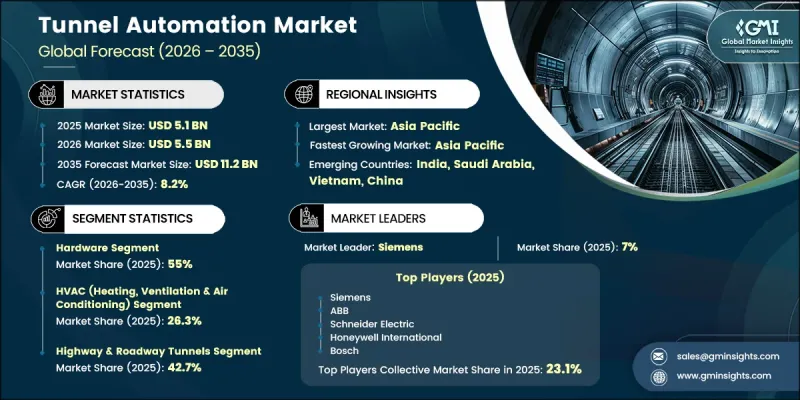
隨著主要經濟體政府持續增加對地下交通基礎設施的投資,隧道自動化產業正蓬勃發展。新建隧道投入的增加,以及現有基礎設施的現代化改造,將長期持續推動對先進自動化技術的需求。老化的隧道網路需要對電氣、通訊、監控和控制系統進行全面升級,以滿足不斷變化的營運和安全要求,這進一步加速了市場成長。此外,更嚴格的基礎設施法規和對營運效率日益成長的期望,促使隧道營運商採用先進的自動化解決方案,以提高可靠性和系統效能。數位技術和智慧監控系統的不斷進步,不僅支援了更完善的預防性維護和資產管理,也提高了隧道營運效率。此外,先進感測技術和整合自動化平台的日益普及,增強了基礎設施的韌性,並提升了整體營運安全性。這些因素,加上長期的基礎設施投資,預計將在預測期內推動全球隧道自動化市場穩步成長。
| 市場範圍 | |
|---|---|
| 開始年份 | 2025 |
| 預測期 | 2026-2035 |
| 上市時的市場規模 | 51億美元 |
| 預測金額 | 112億美元 |
| 複合年成長率 | 8.2% |
在整個隧道自動化市場中,合規性仍然對採購決策起著至關重要的作用。先進、耐用且經濟高效的感測技術的日益普及,使基礎設施營運商能夠部署更全面的監控系統,同時降低安裝成本。智慧監控設備的不斷改進,提高了運作可視性,有助於及早發現事故,並提升隧道整體安全性。此外,互聯自動化技術的普及也提高了基礎設施管理效率,並最佳化了系統效能。
預計到2025年,硬體部分將佔據55%的市場佔有率,並在2026年至2035年間以6.7%的複合年成長率成長。硬體仍然是隧道自動化系統的核心組成部分,為感測、控制、通訊、電源管理和生命安全功能提供必要的基礎設施。該部分包括用於支援監控、自動化、配電、照明、緊急應變、通訊和運行控制的設備,使其成為現代隧道基礎設施不可或缺的一部分。
預計到2025年,公路和傳統道路隧道將佔隧道自動化產業42.7%的市場佔有率,成為該產業最大的應用領域。龐大的交通隧道基礎設施持續推動對整合自動化解決方案的需求,這些解決方案能夠改善交通管理、通風、照明、監控、緊急通訊、電力管理和集中式營運控制。交通基礎設施現代化改造投資的增加預計將進一步提升該領域的需求。
中國隧道自動化市場佔57%的全球佔有率,預計2025年市場規模將達到13億美元。在交通運輸、公共產業、鐵路、地鐵和地下基礎設施建設等領域持續投資的推動下,中國仍然是全球最大的區域市場,也是成長最快的市場之一。隧道網路的不斷擴張和城市基礎設施的快速發展,推動了對先進自動化技術日益成長的需求,這些技術能夠提高營運效率、安全性、監控能力、通訊能力以及基礎設施的綜合管理水平。
目錄
第1章:調查方法
第2章執行摘要
第3章 行業洞察
- 產業生態系分析
- 供應商情況
- 利潤率分析
- 成本結構
- 每個階段增加的價值
- 影響價值鏈的因素
- 中斷
- 影響產業的因素
- 促進因素
- 全球隧道基礎設施投資正在激增。
- 政府實施的嚴格安全法規正在推動各類隧道系統整合發展。
- 擴大物聯網、SCADA 和邊緣運算在隧道營運的應用。
- 隧道營運商的能源效率和永續性目標要求
- 產業潛在風險與挑戰
- 引入全自動系統需要大量的初始資金投入。
- 老舊隧道基礎建設帶來的複雜整合挑戰
- 市場機遇
- 公共產業、供水和礦井隧道領域尚未開發的自動化潛力。
- 人工智慧驅動的預測性維護作為附加價值服務:成長的驅動力
- 歐洲和北美一些已有數十年歷史的隧道網亟需維修。
- 官民合作關係(PPP)模式,可為新興市場的隧道建設提供資金籌措。
- 促進因素
- 成長潛力分析
- 技術與創新展望
- 最新科技趨勢
- 新興技術
- 價格分析
- 對過去價格趨勢的分析
- 定價策略:按業務類型分類
- 監理情勢
- 北美洲
- 美國隧道偵測標準
- NFPA 502 公路隧道、橋樑和其他限制通行道路標準
- NIST SP 800-82 Rev. 3操作技術(OT) 安全指南
- 加拿大國際橋樑與隧道法案
- 加拿大鐵路安全法及鐵路客運安全條例
- 歐洲
- 關於跨大陸公路網隧道最低安全要求的2004/54/EC號指令
- 鐵路隧道安全互通性技術規範
- 歐盟智慧型運輸系統(ITS)指令
- 網路與資訊安全指令 2
- 歐盟網路韌性法案
- 亞太地區
- 中國 JTG D70/2-2014 公路隧道設計標準
- 中國公路隧道維護標準
- 日本道路結構條例對隧道的要求
- 日本鐵路技術監理標準
- 新加坡公路隧道防火措施實施指南
- 新加坡高速交通系統防火措施實施指南
- 印度地鐵通用規章和安全要求
- 拉丁美洲
- 巴西 ABNT NBR 15661 道路與都市隧道防火措施
- 巴西 ABNT NBR 5181 隧道照明
- 墨西哥公路隧道設計與施工手冊
- 墨西哥智慧公路隧道和控制中心的標準
- 智利公共工程部關於公路隧道安全和特許經營要求的規定。
- 中東和非洲
- 阿拉伯聯合大公國消防和生命安全規範
- 阿拉伯聯合大公國資訊安全法規
- 沙烏地阿拉伯營運技術的網路安全措施
- 沙烏地阿拉伯關鍵系統的網路安全措施
- 南非礦山安全與健康法及相關法規
- 北美洲
- 波特的分析
- PESTLE分析
- 專利分析
- 按技術領域分類的專利申請趨勢(暖通空調自動化、火災偵測、訊號控制)
- 主要專利擁有者與創新集中度
- 成本細分分析
- 人工智慧和生成式人工智慧對市場的影響
- 利用人工智慧改造現有經營模式
- 按細分市場分類的生成式人工智慧用例和部署藍圖
- 風險、限制和監管考量
- 生產能力和生產情況
- 按地區和主要製造商分類的安裝和生產能力
- 主要供應商的設備運轉率和擴張計劃
- 預測假設和情境分析
- 基本案例:驅動複合年成長率的關鍵宏觀經濟與產業變量
- 樂觀情境:宏觀經濟與產業的順風
- 悲觀情景:宏觀經濟放緩或產業逆風
第4章 競爭情勢
- 介紹
- 企業市佔率分析
- 北美洲
- 歐洲
- 亞太地區
- LATAM
- 中東和非洲
- 主要市場公司的競爭分析
- 競爭定位矩陣
- 主要進展
- 併購
- 夥伴關係和聯盟
- 新產品發布
- 業務拓展計劃及資金籌措
- 按公司規模進行基準測試
- 排名分類標準與遴選標準
- 按銷售額、地區和創新能力分類的層級定位矩陣。
第5章 市場估算與預測:依產品類型分類,2022-2035年
- 硬體
- 感測器和檢測器
- 執行器和控制器
- 控制面板和人機介面單元
- 相機和成像設備
- 軟體
- SCADA和隧道管理平台
- 人工智慧驅動的分析和決策支援軟體
- 網路安全和OT安全軟體
- 資產管理及維護軟體
- 服務
- 專業服務
- 託管服務
第6章 市場估計與預測:依組件分類,2022-2035年
- 暖通空調(暖氣、通風和空調)
- 照明/電源
- 訊號控制
- 火災偵測與撲滅
- 監測
- 通訊系統
- 其他
第7章 市場估價與預測:依隧道類型分類,2022-2035年
- 鐵路隧道
- 高速公路和普通公路隧道
- 公共產業和供水隧道
- 礦井隧道
第8章 市場估算與預測:依自動化程度分類,2022-2035年
- 半自動
- 全自動
第9章 市場估計與預測:依應用領域分類,2022-2035年
- 交通管理
- 安全、安保和監控
- 通風和環境控制
- 溝通/營運管理
第10章 市場估價與預測:依地區分類,2022-2035年
- 北美洲
- 美國
- 加拿大
- 歐洲
- 德國
- 英國
- 法國
- 義大利
- 西班牙
- 俄羅斯
- 挪威
- 荷蘭
- 瑞典
- 亞太地區
- 中國
- 印度
- 日本
- 澳洲
- 韓國
- 新加坡
- 泰國
- 印尼
- 越南
- 拉丁美洲
- 巴西
- 墨西哥
- 阿根廷
- 中東和非洲
- 南非
- 沙烏地阿拉伯
- UAE
- 土耳其
第11章:公司簡介
- 世界公司
- Siemens AG
- ABB Ltd.
- Schneider Electric SE
- Honeywell International Inc.
- Bosch Security Systems
- Johnson Controls International plc
- Eaton Corporation plc
- Rockwell Automation Inc.
- FlaktGroup
- Systemair AB
- SICK AG
- Phoenix Contact GmbH & Co. KG
- Egis Group
- Parsons Corporation
- Indra Sistemas SA
- 當地公司
- China Railway Signal & Communication Corporation
- CASCO Signal Ltd.
- Kapsch TrafficCom AG
- SWARCO AG
- Q-Free ASA
The Global Tunnel Automation Market was valued at USD 5.1 billion in 2025 and is estimated to grow at a CAGR of 8.2% to reach USD 11.2 billion by 2035.
The tunnel automation industry is experiencing momentum as governments continue investing heavily in underground transportation infrastructure across major economies. Increasing expenditure on new tunnel construction, combined with the modernization of existing infrastructure, is creating sustained demand for advanced automation technologies over the long term. Aging tunnel networks require comprehensive upgrades to electrical, communication, monitoring, and control systems to comply with evolving operational and safety requirements, further accelerating market growth. In addition, stricter infrastructure regulations and higher expectations for operational efficiency are encouraging tunnel operators to adopt advanced automation solutions that improve reliability and system performance. Continuous advancements in digital technologies and intelligent monitoring systems are enabling more efficient tunnel operations while supporting preventive maintenance and improved asset management. The growing deployment of advanced sensing technologies and integrated automation platforms is also strengthening infrastructure resilience and enhancing overall operational safety. These factors, together with long-term infrastructure investments, are expected to support consistent expansion of the global tunnel automation market throughout the forecast period.
| Market Scope | |
|---|---|
| Start Year | 2025 |
| Forecast Year | 2026-2035 |
| Start Value | $5.1 Billion |
| Forecast Value | $11.2 Billion |
| CAGR | 8.2% |
Regulatory compliance continues to play a significant role in shaping purchasing decisions across the tunnel automation market. The increasing availability of advanced, durable, and cost-effective sensing technologies is allowing infrastructure operators to deploy more comprehensive monitoring systems while reducing installation costs. Continuous improvements in intelligent monitoring equipment are enhancing operational visibility, supporting faster incident detection, and improving overall tunnel safety. The widespread adoption of connected automation technologies is also enabling more efficient infrastructure management and optimized system performance.
The hardware segment accounted for a 55% share in 2025 and is expected to grow at a CAGR of 6.7% from 2026 to 2035. Hardware remains the core component of tunnel automation systems, providing the essential infrastructure required for sensing, control, communication, power management, and life-safety functions. This segment includes equipment designed to support monitoring, automation, electrical distribution, lighting, emergency response, communication, and operational control, making it fundamental to modern tunnel infrastructure.
The highway and roadway tunnels segment held a 42.7% share in 2025, making it the largest application segment within the tunnel automation industry. Extensive transportation tunnel infrastructure continues to drive demand for integrated automation solutions that improve traffic management, ventilation, lighting, surveillance, emergency communications, power management, and centralized operational control. Increasing investments in transportation infrastructure modernization are expected to further strengthen demand across this segment.
China Tunnel Automation Market accounted for a 57% share, generating USD 1.3 billion in 2025. The country remains the largest regional market and one of the fastest-growing markets globally, supported by continuous investments in transportation, utility, railway, metro, and underground infrastructure development. Ongoing expansion of tunnel networks and rapid urban infrastructure development continue to increase demand for advanced automation technologies that enhance operational efficiency, safety, monitoring, communications, and integrated infrastructure management.
Major companies operating in the global tunnel automation market include Siemens, ABB, Schneider Electric, Honeywell International, Bosch, Kapsch TrafficCom, Indra Sistemas, Eaton Corporation, Rockwell Automation, and FlaktGroup. Companies operating in the tunnel automation market are strengthening their competitive position through continuous investments in digital technologies, automation platforms, and intelligent infrastructure solutions. Manufacturers are expanding their product portfolios by developing advanced monitoring, communication, and control systems that improve operational efficiency and infrastructure safety. Many companies are increasing research and development investments to enhance system integration, real-time data analytics, and predictive maintenance capabilities. Strategic partnerships with infrastructure developers, transportation authorities, and engineering firms are also helping businesses expand their project pipelines and regional presence. In addition, companies are focusing on software integration, energy-efficient technologies, lifecycle service offerings, and customized automation solutions to address evolving customer requirements.
Table of Contents
Chapter 1 Research Methodology
- 1.1 Research approach
- 1.2 Quality Commitments
- 1.2.1 GMI AI policy & data integrity commitment
- 1.2.1.1 Source consistency protocol
- 1.2.1 GMI AI policy & data integrity commitment
- 1.3 Research Trail & Confidence Scoring
- 1.3.1 Research Trail Components
- 1.3.2 Scoring Components
- 1.4 Data Collection
- 1.4.1 Partial list of primary sources
- 1.5 Data mining sources
- 1.5.1 Paid sources
- 1.5.1.1 Sources, by region
- 1.5.1 Paid sources
- 1.6 Base estimates and calculations
- 1.6.1 Base year calculation for any one approach
- 1.7 Forecast model
- 1.7.1 Quantified market impact analysis
- 1.7.1.1 Mathematical impact of growth parameters on forecast
- 1.7.1 Quantified market impact analysis
- 1.8 Research transparency addendum
- 1.8.1 Source attribution framework
- 1.8.2 Quality assurance metrics
- 1.8.3 Our commitment to trust
Chapter 2 Executive Summary
- 2.1 Industry 360° synopsis, 2022 – 2035
- 2.2 Key market trends
- 2.2.1 Regional
- 2.2.2 Offering
- 2.2.3 Component
- 2.2.4 Tunnel
- 2.2.5 Automation Level
- 2.2.6 Application
- 2.3 TAM Analysis, 2026-2035
- 2.4 CXO perspectives: Strategic imperatives
Chapter 3 Industry Insights
- 3.1 Industry ecosystem analysis
- 3.1.1 Supplier landscape
- 3.1.2 Profit margin analysis
- 3.1.3 Cost structure
- 3.1.4 Value addition at each stage
- 3.1.5 Factor affecting the value chain
- 3.1.6 Disruptions
- 3.2 Industry impact forces
- 3.2.1 Growth drivers
- 3.2.1.1 Surge in Global Tunnel Infrastructure Investment
- 3.2.1.2 Stringent Government Safety Mandates Driving System Integration Across Tunnel Types
- 3.2.1.3 Rising Adoption of IoT, SCADA, & Edge Computing in Tunnel Operations
- 3.2.1.4 Energy Efficiency Imperatives & Sustainability Targets Among Tunnel Operators
- 3.2.2 Industry pitfalls and challenges
- 3.2.2.1 High Upfront Capital Expenditure for Full Automation System Deployment
- 3.2.2.2 Complex Integration Challenges with Aging & Legacy Tunnel Infrastructure
- 3.2.3 Market opportunities
- 3.2.3.1 Untapped Automation Potential in Utility, Water & Mining Tunnel Segments
- 3.2.3.2 AI-Powered Predictive Maintenance as a Value-Added Services Growth Lever
- 3.2.3.3 Retrofitting Demand from Decades-Old European & North American Tunnel Networks
- 3.2.3.4 Public-Private Partnership Models Unlocking Capital for Emerging Market Tunnels
- 3.2.1 Growth drivers
- 3.3 Growth potential analysis
- 3.4 Technology and innovation landscape
- 3.4.1 Current technological trends
- 3.4.2 Emerging technologies
- 3.5 Pricing Analysis (Driven by primary research)
- 3.5.1 Historical Price Trend Analysis
- 3.5.2 Pricing Strategy by Player Type
- 3.6 Regulatory landscape
- 3.6.1 North America
- 3.6.1.1 U.S. National Tunnel Inspection Standards
- 3.6.1.2 NFPA 502 Standard for Road Tunnels, Bridges, and Other Limited Access Highways
- 3.6.1.3 NIST SP 800-82 Rev. 3 Guide to Operational Technology Security
- 3.6.1.4 Canada International Bridges and Tunnels Act
- 3.6.1.5 Canada Railway Safety Act and Passenger Rail Security Regulations
- 3.6.2 Europe
- 3.6.2.1 Directive 2004/54/EC on Minimum Safety Requirements for Tunnels in the Trans-European Road Network
- 3.6.2.2 Safety in Railway Tunnels Technical Specification for Interoperability
- 3.6.2.3 EU Intelligent Transport Systems Directive
- 3.6.2.4 Network and Information Security Directive 2
- 3.6.2.5 EU Cyber Resilience Act
- 3.6.3 Asia Pacific
- 3.6.3.1 China JTG D70/2-2014 Highway Tunnel Design Standard
- 3.6.3.2 China Highway Tunnel Maintenance Standards
- 3.6.3.3 Japan Road Structure Ordinance Tunnel Requirements
- 3.6.3.4 Japan Technical Regulatory Standards on Railways
- 3.6.3.5 Singapore Code of Practice for Fire Precautions in Road Tunnels
- 3.6.3.6 Singapore Code of Practice for Fire Precautions in Rapid Transit Systems
- 3.6.3.7 India Metro Railways General Rules and Underground Metro Safety Requirements
- 3.6.4 Latin America
- 3.6.4.1 Brazil ABNT NBR 15661 Fire Protection in Road and Urban Tunnels
- 3.6.4.2 Brazil ABNT NBR 5181 Tunnel Lighting
- 3.6.4.3 Mexico Manual for the Design and Construction of Road Tunnels
- 3.6.4.4 Mexico Intelligent Road Tunnel and Control Centre Standards
- 3.6.4.5 Chile Ministry of Public Works Road Tunnel Safety and Concession Requirements
- 3.6.5 Middle East & Africa
- 3.6.5.1 UAE Fire and Life Safety Code of Practice
- 3.6.5.2 UAE Information Assurance Regulation
- 3.6.5.3 Saudi Operational Technology Cybersecurity Controls
- 3.6.5.4 Saudi Critical Systems Cybersecurity Controls
- 3.6.5.5 South Africa Mine Health and Safety Act and Regulations
- 3.6.1 North America
- 3.7 Porter’s analysis
- 3.8 PESTEL analysis
- 3.9 Patent analysis (Driven by primary research)
- 3.9.1 Patent Filing Trends by Technology Area (HVAC Automation, Fire Detection, Signalization)
- 3.9.2 Leading Patent Holders & Innovation Concentration
- 3.10 Cost breakdown analysis
- 3.11 Impact of AI and Generative AI on the Market
- 3.11.1 AI Driven Disruption of Existing Business Models
- 3.11.2 GenAI Use Cases and Adoption Roadmap by Segment
- 3.11.3 Risks Limitations and Regulatory Considerations
- 3.12 Capacity & Production Landscape (Driven by Primary Research)
- 3.12.1 Installed Production Capacity by Region & Key Manufacturer
- 3.12.2 Capacity Utilization Rates & Expansion Pipelines Among Leading Suppliers
- 3.13 Forecast assumptions & scenario analysis (Driven by Primary Research)
- 3.13.1 Base Case- Key Macro & Industry Variables Driving CAGR
- 3.13.2 Optimistic Scenarios- Favorable macro and industry tailwinds
- 3.13.3 Pessimistic Scenario - Macroeconomic slowdown or industry headwinds
Chapter 4 Competitive Landscape, 2025
- 4.1 Introduction
- 4.2 Company market share analysis
- 4.2.1 North America
- 4.2.2 Europe
- 4.2.3 Asia Pacific
- 4.2.4 LATAM
- 4.2.5 MEA
- 4.3 Competitive analysis of major market players
- 4.4 Competitive positioning matrix
- 4.5 Key developments
- 4.5.1 Mergers & acquisitions
- 4.5.2 Partnerships & collaborations
- 4.5.3 New Product Launches
- 4.5.4 Expansion Plans and funding
- 4.6 Company tier benchmarking
- 4.6.1 Tier classification criteria & qualifying thresholds
- 4.6.2 Tier positioning matrix by revenue, geography & innovation
Chapter 5 Market Estimates & Forecast, By Offering, 2022 - 2035 (USD Bn)
- 5.1 Key trends
- 5.2 Hardware
- 5.2.1 Sensors & Detectors
- 5.2.2 Actuators & Controllers
- 5.2.3 Control Panels & HMI Units
- 5.2.4 Cameras & Imaging Devices
- 5.3 Software
- 5.3.1 SCADA & Tunnel Management Platforms
- 5.3.2 AI-Based Analytics & Decision Support Software
- 5.3.3 Cybersecurity & OT Security Software
- 5.3.4 Asset Management & Maintenance Software
- 5.4 Services
- 5.4.1 Professional Services
- 5.4.2 Managed Services
Chapter 6 Market Estimates & Forecast, By Component, 2022 - 2035 (USD Bn)
- 6.1 Key trends
- 6.2 HVAC (Heating, Ventilation & Air Conditioning)
- 6.3 Lighting & Power Supply
- 6.4 Signalization
- 6.5 Fire Detection & Suppression
- 6.6 Surveillance & Monitoring
- 6.7 Communication Systems
- 6.8 Others
Chapter 7 Market Estimates & Forecast, By Tunnel, 2022 - 2035 (USD Bn)
- 7.1 Key trends
- 7.2 Railway Tunnels
- 7.3 Highway & Roadway Tunnels
- 7.4 Utility & Water Tunnels
- 7.5 Mining Tunnels
Chapter 8 Market Estimates & Forecast, By Automation Level, 2022 - 2035 (USD Bn)
- 8.1 Key trends
- 8.2 Semi-Automated
- 8.3 Fully-Automated
Chapter 9 Market Estimates & Forecast, By Application, 2022 - 2035 (USD Bn)
- 9.1 Key trends
- 9.2 Traffic Management
- 9.3 Safety & Security & Monitoring
- 9.4 Ventilation & Environmental Control
- 9.5 Communication & Operations Management
Chapter 10 Market Estimates & Forecast, By Region, 2022 - 2035 (USD Bn)
- 10.1 Key trends
- 10.2 North America
- 10.2.1 US
- 10.2.2 Canada
- 10.3 Europe
- 10.3.1 Germany
- 10.3.2 UK
- 10.3.3 France
- 10.3.4 Italy
- 10.3.5 Spain
- 10.3.6 Russia
- 10.3.7 Norway
- 10.3.8 Netherlands
- 10.3.9 Sweden
- 10.4 Asia Pacific
- 10.4.1 China
- 10.4.2 India
- 10.4.3 Japan
- 10.4.4 Australia
- 10.4.5 South Korea
- 10.4.6 Singapore
- 10.4.7 Thailand
- 10.4.8 Indonesia
- 10.4.9 Vietnam
- 10.5 Latin America
- 10.5.1 Brazil
- 10.5.2 Mexico
- 10.5.3 Argentina
- 10.6 MEA
- 10.6.1 South Africa
- 10.6.2 Saudi Arabia
- 10.6.3 UAE
- 10.6.4 Turkey
Chapter 11 Company Profiles
- 11.1 Global Players
- 11.1.1 Siemens AG
- 11.1.2 ABB Ltd.
- 11.1.3 Schneider Electric SE
- 11.1.4 Honeywell International Inc.
- 11.1.5 Bosch Security Systems
- 11.1.6 Johnson Controls International plc
- 11.1.7 Eaton Corporation plc
- 11.1.8 Rockwell Automation Inc.
- 11.1.9 FlaktGroup
- 11.1.10 Systemair AB
- 11.1.11 SICK AG
- 11.1.12 Phoenix Contact GmbH & Co. KG
- 11.1.13 Egis Group
- 11.1.14 Parsons Corporation
- 11.1.15 Indra Sistemas S.A.
- 11.2 Regional Players
- 11.2.1 China Railway Signal & Communication Corporation
- 11.2.2 CASCO Signal Ltd.
- 11.2.3 Kapsch TrafficCom AG
- 11.2.4 SWARCO AG
- 11.2.5 Q-Free ASA


