


 |
市場調查報告書
商品編碼
2123397
收縮彈力套筒標籤:市場佔有率分析、行業趨勢和統計數據、成長預測(2026-2031)Shrink And Stretch Sleeve Labels - Market Share Analysis, Industry Trends & Statistics, Growth Forecasts (2026 - 2031) |
||||||

※ 本網頁內容可能與最新版本有所差異。詳細情況請與我們聯繫。
據 Mordor Intelligence 稱,2025 年收縮彈力套筒標籤市值為 162.6 億美元,預計到 2031 年將從 2026 年的 174.2 億美元成長至 245.7 億美元,預測期(2026-2031 年)複合年成長率為 7.12%。
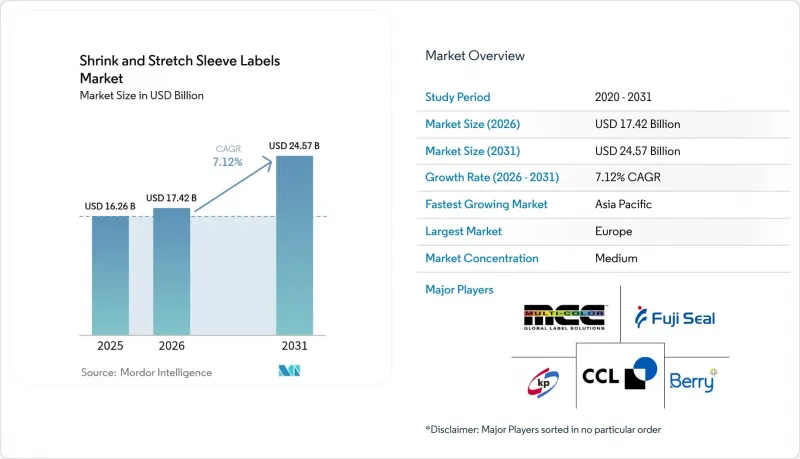
本報告按類型(收縮套管、拉伸套)、材料(PVC、PET/PET-G、PE、OPP 和 OPS、其他材料)、最終用戶(食品、軟性飲料、酒精飲料、化妝品和家居用品、藥品、其他最終用戶)以及地區(北美、南美、歐洲、亞太、中東和非洲)進行細分。市場預測以美元計價。
全球收縮及彈力套筒標籤市場趨勢及洞察
包裝飲料和機能飲料的成長
在機能飲料,縮膜技術用於保護光敏營養成分並放大營養資訊。目前,三分之一的消費者將「免疫力」視為首要購買標準,這帶動了對富含維生素C、接骨木莓和益生菌的飲料的需求成長。由於圖案可以印刷在整個瓶身上,品牌擁有比感壓標籤多150%的印刷面積,因此可以添加文字、QR碼和防偽封條。 Premier Protein公司透過改用有易撕線的遮光收縮膜的寶特瓶,減少了35%的塑膠用量。精釀啤酒製造商以前需要訂購10萬個裝飾罐,現在只需訂購7000個即可,這為季節性產品的上市提供了更多機會。
採用數位噴墨技術進行小批量印刷,可以降低小眾 SKU 的最小訂購量 (MOQ)。
水性噴墨印表機的生產速度是傳統系統的2.3倍,同時消除了食品包裝中溶劑殘留的隱憂。加工商克服了柔版印刷10萬件的最低訂購量限制,現在只需1000件的訂單即可獲利。這使得開發高度精準的SKU成為可能,例如針對特定地區的促銷活動和電商捆綁銷售產品。設計修改可在幾天內完成,而非幾週,為行銷人員提供即時回饋。預計到2029年,數位印刷在標籤總產量中的佔有率將達到9.7%,並以平方公尺4.4%的複合年成長率成長。整合噴墨印字頭和線上完工功能的收縮彈力套筒標籤市場參與企業,正獲得傳統凹版印刷生產線無法實現的靈活性。
與直接在立式袋和容器上印刷的競爭
與硬質瓶相比,輕質軟包裝袋可減少 60% 的塑膠用量,每單位成本僅為 0.20 美元,而同等規格的 PET 容器則為 0.50 美元。像 Velox 這樣的數位罐頭印刷機現在每分鐘可處理 500 個罐頭,並且完全無需使用套標薄膜,因此永續性的精釀品牌的青睞。直接裝飾流程無需熱縮管、邊角料和收縮線中常見的黏合劑。對於大規模生產的碳酸飲料而言,成本差異更為顯著,因為套標的單價是平版印刷的2 到 2.5 倍。儘管如此,收縮和彈力套筒標籤市場仍然保持著其重要性,因為它們可以滿足軟包裝袋或罐頭無法複製的異形容器的需求。
細分市場分析
到2025年,收縮套標將佔收縮和彈力套筒標籤市場72.60%的佔有率,這反映出其在複雜瓶型和防篡改密封方面的卓越適用性。高速自動化貼標機的處理能力超過每分鐘800瓶,錯誤率低於0.5%,其性能指標是其他方法難以企及的。拉伸套無需熱隧道,可降低高達40%的能耗,並且由於消費者在丟棄前可以輕鬆撕下,因此有助於回收。隨著歐洲飲料品牌採用低碳包裝以履行範圍3承諾,預計到2031年,該細分市場將以8.05%的複合年成長率成長,超過整體市場成長率。
儘管收縮包裝技術仍佔據主導地位,但未來的生產預計將發展成為一個雙效解決方案的生態系統。收縮包裝產品將在需要緊密貼合塗層的領域佔據重要地位,例如藥品管瓶、機能飲料和弧形家用清潔劑。拉伸套預計將在水、乳製品和低價可樂市場擴張,這些市場兼顧價格敏感度和永續性考量。生產線擴大將伺服驅動的軸式施用器與即時檢測套標位置的視覺系統相結合,從而最大限度地減少返工。據供應商稱,現在兩種套標均可使用相同的水性噴墨墨水,這簡化了圖形切換,並增強了收縮和彈力套筒標籤市場的靈活生產策略。
區域分析
在強而有力的環保政策和高階包裝文化的推動下,歐洲預計到2025年將佔全球銷售額的29.55%。德國、法國和英國正將大量資本投資用於配備節能紅外線隧道的套膜生產線。歐盟的《包裝和包裝廢棄物法規》要求在2030年實現包裝可回收利用,這推動了對易於在清洗廠輕鬆剝離的PET材質套膜的需求。由於高階酒類生產商對小批量生產和精細化圖形的要求,該地區每千個套膜的平均售價比全球平均高出12%。
亞太地區正以7.86%的複合年成長率(CAGR)保持著最快的成長勢頭,這主要得益於可支配收入的激增、都市化進程的加快以及機能飲料的興起。中國的快捷郵件包裝標準「GB 43352-2023」對油墨中的重金屬含量進行了嚴格規定,迫使中國本土加工商採用符合該標準的化學品。在泰國,一項無標籤寶特瓶試點計畫正在進行中,該產品將產品資料儲存在印於瓶蓋上的QR碼中,這不僅對傳統瓶套的需求構成了壓力,也為智慧互動薄膜開闢了新的發展道路。在日本,水性噴墨技術在柔軟性薄膜領域的早期應用符合《塑膠資源回收法》的要求,並正在推動本土創新,而這種創新正在向整個區域市場擴散。
北美擁有蓬勃發展的精釀啤酒生態系統和完善的醫療保健系統。藥品和市售營養補充品對防竄改功能的需求確保了穩定的需求基礎。南美PET樹脂供應充足,但易受外匯波動影響,這限制了對高階印刷機的投資。中東和非洲的產能相對滯後,但其高階進口烈酒和個人保健產品市場分散,這些產品依賴套筒標籤來提升品牌價值。總而言之,地域多樣性支撐了收縮和彈力套筒標籤市場的長期韌性。
其他好處:
- Excel格式的市場預測(ME)表
- 3個月的分析師支持
目錄
第1章:引言
- 研究假設和市場定義
- 調查範圍
第2章:調查方法
第3章執行摘要
第4章 市場狀況
- 市場概覽
- 市場促進因素
- 對 360 度高清影像的需求提升了產品展示的吸引力。
- 對防篡改和防偽包裝的需求日益成長。
- 包裝飲料和機能飲料的成長
- 過渡到可回收PETG和浮動套管薄膜
- 使用數位噴墨技術的小批量印刷正在降低小眾 SKU 的最低訂購量 (MOQ)。
- 智慧互動功能(熱感、QR碼)協助行銷
- 市場限制因素
- 回收多材料套管(會污染PET流)面臨的挑戰
- 透過在立式袋和容器上直接印刷來競爭
- 地緣政治供應衝擊導致樹脂價格波動
- 歐盟和北美對PVC套管的監管規定推高了合規成本。
- 供應鏈分析
- 監理情勢
- 技術展望
- 波特五力分析
- 對影響市場的宏觀經濟因素進行評估
第5章 市場規模與成長預測
- 按類型
- 收縮套
- 拉伸套
- 材料
- PVC
- PET/PET-G
- PE
- OPP 和 OPS
- 其他材料(PO、PLA 等)
- 最終用戶
- 食物
- 軟性飲料
- 酒精飲料
- 化妝品和家居用品
- 製藥
- 其他最終用戶
- 按地區
- 北美洲
- 美國
- 加拿大
- 南美洲
- 巴西
- 阿根廷
- 其他南美國家
- 歐洲
- 英國
- 德國
- 法國
- 義大利
- 西班牙
- 俄羅斯
- 其他歐洲國家
- 亞太地區
- 中國
- 印度
- 日本
- 韓國
- 澳洲和紐西蘭
- 其他亞太國家
- 中東和非洲
- 中東
- 沙烏地阿拉伯
- UAE
- 土耳其
- 其他中東國家
- 非洲
- 南非
- 埃及
- 奈及利亞
- 其他非洲國家
- 中東
- 北美洲
第6章 競爭情勢
- 市場集中度
- 策略趨勢
- 市佔率分析
- 公司簡介
- CCL Industries
- Fuji Seal International
- Berry Global Group
- Multi-Color Corporation
- KP Klockner Pentaplast
- Amcor PLC
- Huhtamaki Oyj
- Fort Dearborn Company
- Taghleef Industries
- Siegwerk Druckfarben
- Macfarlane Labels
- Avery Dennison Corp.
- Clondalkin Group
- Cenveo Worldwide
- Schur Flexibles
- Hammer Packaging
- Sleeve Seal Inc.
- PDC-Europe
- Fortalab Labels
- Akar Shrink Packs
第7章 市場機會與未來展望
According to Mordor Intelligence, the shrink and stretch sleeve labels market size was valued at USD 16.26 billion in 2025 and estimated to grow from USD 17.42 billion in 2026 to reach USD 24.57 billion by 2031, at a CAGR of 7.12% during the forecast period (2026-2031).
This report is Segmented by Type (Shrink Sleeve, Stretch Sleeve), Material (PVC, PET/PET-G, PE, OPP and OPS, Other Materials), End User (Food, Soft Drinks, Alcoholic Drinks, Cosmetics and Household, Pharmaceutical, Other End Users), and Geography (North America, South America, Europe, Asia-Pacific, Middle East and Africa). The Market Forecasts are Provided in Terms of Value (USD).
Global Shrink And Stretch Sleeve Labels Market Trends and Insights
Growth in Packaged Beverages and Functional Drinks
Functional drinks use sleeve technology to protect light-sensitive nutrients and display expanded nutritional panels. One in three shoppers now ranks immune support as a top purchase criterion, strengthening demand for drinks formulated with vitamin C, elderberry, and probiotics. Full-body graphics give brands 150% more printable area than pressure-sensitive labels, allowing claims, QR codes, and authenticity seals. Premier Protein trimmed plastic by 35% by migrating to PET bottles wrapped in light-blocking shrink sleeves that feature perforations for easy removal during recycling. Craft brewers that previously needed orders of 100,000 decorated cans now source as few as 7,000 cans fitted with shrink sleeves, widening access for seasonal releases.
Digital Inkjet Short-Run Printing Lowering MOQ for Niche SKUs
Water-based inkjet presses achieve production speeds 2.3 times higher than earlier systems while eliminating solvent residue concerns in food packaging. Converters now profitably accept 1,000-unit jobs versus the 100,000-unit threshold required for flexography, enabling hyper-targeted SKUs for regional promotions and e-commerce bundles. Design iterations finalize in days, not weeks, giving marketers real-time feedback loops. Digital volume is projected to reach 9.7% of total label output by 2029, expanding at a 4.4% CAGR in square-meter terms. Shrink and stretch sleeve labels market participants that integrate inline finishing with inkjet heads gain agility that legacy gravure lines cannot match.
Competition from Stand-Up Pouches and Direct-to-Container Printing
Lightweight pouches use 60% less plastic than rigid bottles and cost only USD 0.20 per unit compared with USD 0.50 for comparable PET containers.Digital can printers such as Velox now run 500 cans per minute, eliminating sleeve film altogether and appealing to sustainability-focused craft brands. Direct decoration removes the heat tunnel, trim scrap, and adhesive usage inherent to shrink lines. Cost differentials widen in high-volume carbonated beverages where sleeve application adds 2-2.5 times unit cost relative to offset printing. The shrink and stretch sleeve labels market nonetheless preserves relevance by serving irregular containers that pouches or cans cannot mimic.
Other drivers and restraints analyzed in the detailed report include:
- Demand for 360° High-Definition Graphics to Boost Shelf Appeal
- Shift Toward Recyclable PETG and Floatable Sleeve Films
- Resin-Price Volatility from Geopolitical Supply Shocks
For complete list of drivers and restraints, kindly check the Table Of Contents.
Segment Analysis
Shrink sleeves controlled 72.60% of the shrink and stretch sleeve labels market in 2025, reflecting their proven fit for complex bottle geometries and tamper-evident safety seals. High-speed automatic applicators run beyond 800 bottles per minute with error rates under 0.5%, a performance metric difficult for alternate formats. Stretch sleeves need no heat tunnel, trimming energy use by up to 40%, and support recycling because consumers can easily remove them before disposal. The segment's 8.05% CAGR through 2031 surpasses overall market pace as European beverage brands adopt low-carbon packaging to achieve Scope 3 commitments.
Although shrink technology retains primacy, future production likely evolves toward a dual-solution ecosystem. Shrink formats will secure pharmaceutical vials, functional drinks, and contoured household cleaners that demand form-fitting coverage. Stretch sleeves will expand in water, dairy, and economy cola where price sensitivity intersects with sustainability positioning. Production lines increasingly pair servo-driven mandrel applicators with vision systems that inspect sleeve placement in real time, minimizing rework. Suppliers confirm that both sleeve types now accept the same water-based inkjet inks, simplifying graphic changeovers and reinforcing flexible manufacturing strategies in the shrink and stretch sleeve labels market.
Complete Report Scope:
- By Type
- Shrink Sleeve
- Stretch Sleeve
- By Material
- PVC
- PET / PET-G
- PE
- OPP and OPS
- Other Materials (PO, PLA, etc.)
- By End User
- Food
- Soft Drinks
- Alcoholic Drinks
- Cosmetics and Household
- Pharmaceutical
- Other End Users
- By Geography
- North America
- United States
- Canada
- South America
- Brazil
- Argentina
- Rest of South America
- Europe
- United Kingdom
- Germany
- France
- Italy
- Spain
- Russia
- Rest of Europe
- Asia-Pacific
- China
- India
- Japan
- South Korea
- Australia and New Zealand
- Rest of Asia-Pacific
- Middle East and Africa
- Middle East
- Saudi Arabia
- UAE
- Turkey
- Rest of Middle East
- Africa
- South Africa
- Egypt
- Nigeria
- Rest of Africa
- Middle East
- North America
Geography Analysis
Europe retained 29.55% revenue in 2025 due to robust environmental policies and a culture of premium packaging. Germany, France, and the United Kingdom direct a sizable share of capital expenditure toward sleeve film lines fitted with energy-efficient infrared tunnels. EU Packaging and Packaging Waste Regulation stipulates recyclability by 2030, driving demand for PET-based sleeves that detach cleanly in wash plants. The region's average selling price per thousand sleeves exceeds the global mean by 12% because of sophisticated graphic requirements and low minimum runs requested by boutique spirits.
Asia-Pacific records the fastest trajectory at an 7.86% CAGR thanks to surging disposable income, urbanization, and the rise of functional beverages. China's express packaging standard GB 43352-2023 restricts heavy metals in inks, compelling local converters to adopt compliant chemistries. Thailand pilots label-free PET bottles that store product data in QR codes printed on caps, pressuring traditional sleeve volumes yet opening new avenues for smart interactive films. Japan's early adoption of water-based inkjet for flexible film aligns with its plastics resource circulation act, fostering home-grown innovations that resonate across regional markets.
North America benefits from a vibrant craft beer ecosystem and a well-established healthcare framework. Tamper-evident needs in pharmaceuticals and over-the-counter nutritional supplements ensure a baseline of steady demand. South America leverages abundant PET resin supply yet remains exposed to currency swings that limit capital spending on high-end presses. The Middle East and Africa trail in installed capacity but exhibit pockets of high value in premium imported spirits and personal care, which rely on sleeves for brand elevation. Taken together, geographic diversity underpins the long-term resilience of the shrink and stretch sleeve labels market.
- CCL Industries
- Fuji Seal International
- Berry Global Group
- Multi-Color Corporation
- KP Klockner Pentaplast
- Amcor PLC
- Huhtamaki Oyj
- Fort Dearborn Company
- Taghleef Industries
- Siegwerk Druckfarben
- Macfarlane Labels
- Avery Dennison Corp.
- Clondalkin Group
- Cenveo Worldwide
- Schur Flexibles
- Hammer Packaging
- Sleeve Seal Inc.
- PDC-Europe
- Fortalab Labels
- Akar Shrink Packs
Additional Benefits:
- The market estimate (ME) sheet in Excel format
- 3 months of analyst support
TABLE OF CONTENTS
1 INTRODUCTION
- 1.1 Study Assumptions and Market Definition
- 1.2 Scope of the Study
2 RESEARCH METHODOLOGY
3 EXECUTIVE SUMMARY
4 MARKET LANDSCAPE
- 4.1 Market Overview
- 4.2 Market Drivers
- 4.2.1 Demand for 360 degrees high-definition graphics to boost shelf appeal
- 4.2.2 Rising demand for tamper-evident and anti-counterfeit packaging
- 4.2.3 Growth in packaged beverages and functional drinks
- 4.2.4 Shift toward recyclable PETG and floatable sleeve films
- 4.2.5 Digital inkjet short-run printing lowering MOQ for niche SKUs
- 4.2.6 Smart interactive features (thermochromic, QR) enabling marketing
- 4.3 Market Restraints
- 4.3.1 Recycling hurdles of multimaterial sleeves contaminating PET streams
- 4.3.2 Competition from stand-up pouches and direct-to-container printing
- 4.3.3 Resin-price volatility from geopolitical supply shocks
- 4.3.4 EU/NA curbs on PVC sleeves inflating compliance costs
- 4.4 Supply-Chain Analysis
- 4.5 Regulatory Landscape
- 4.6 Technological Outlook
- 4.7 Porter's Five Forces Analysis
- 4.7.1 Bargaining Power of Suppliers
- 4.7.2 Bargaining Power of Buyers
- 4.7.3 Threat of New Entrants
- 4.7.4 Threat of Substitutes
- 4.7.5 Intensity of Rivalry
- 4.8 Assesment of macroeconomic Factors on the market
5 MARKET SIZE AND GROWTH FORECASTS (VALUE)
- 5.1 By Type
- 5.1.1 Shrink Sleeve
- 5.1.2 Stretch Sleeve
- 5.2 By Material
- 5.2.1 PVC
- 5.2.2 PET / PET-G
- 5.2.3 PE
- 5.2.4 OPP and OPS
- 5.2.5 Other Materials (PO, PLA, etc.)
- 5.3 By End User
- 5.3.1 Food
- 5.3.2 Soft Drinks
- 5.3.3 Alcoholic Drinks
- 5.3.4 Cosmetics and Household
- 5.3.5 Pharmaceutical
- 5.3.6 Other End Users
- 5.4 By Geography
- 5.4.1 North America
- 5.4.1.1 United States
- 5.4.1.2 Canada
- 5.4.2 South America
- 5.4.2.1 Brazil
- 5.4.2.2 Argentina
- 5.4.2.3 Rest of South America
- 5.4.3 Europe
- 5.4.3.1 United Kingdom
- 5.4.3.2 Germany
- 5.4.3.3 France
- 5.4.3.4 Italy
- 5.4.3.5 Spain
- 5.4.3.6 Russia
- 5.4.3.7 Rest of Europe
- 5.4.4 Asia-Pacific
- 5.4.4.1 China
- 5.4.4.2 India
- 5.4.4.3 Japan
- 5.4.4.4 South Korea
- 5.4.4.5 Australia and New Zealand
- 5.4.4.6 Rest of Asia-Pacific
- 5.4.5 Middle East and Africa
- 5.4.5.1 Middle East
- 5.4.5.1.1 Saudi Arabia
- 5.4.5.1.2 UAE
- 5.4.5.1.3 Turkey
- 5.4.5.1.4 Rest of Middle East
- 5.4.5.2 Africa
- 5.4.5.2.1 South Africa
- 5.4.5.2.2 Egypt
- 5.4.5.2.3 Nigeria
- 5.4.5.2.4 Rest of Africa
- 5.4.5.1 Middle East
- 5.4.1 North America
6 COMPETITIVE LANDSCAPE
- 6.1 Market Concentration
- 6.2 Strategic Moves
- 6.3 Market Share Analysis
- 6.4 Company Profiles (includes Global level Overview, Market level overview, Core Segments, Financials as available, Strategic Information, Market Rank/Share for key companies, Products and Services, and Recent Developments)
- 6.4.1 CCL Industries
- 6.4.2 Fuji Seal International
- 6.4.3 Berry Global Group
- 6.4.4 Multi-Color Corporation
- 6.4.5 KP Klockner Pentaplast
- 6.4.6 Amcor PLC
- 6.4.7 Huhtamaki Oyj
- 6.4.8 Fort Dearborn Company
- 6.4.9 Taghleef Industries
- 6.4.10 Siegwerk Druckfarben
- 6.4.11 Macfarlane Labels
- 6.4.12 Avery Dennison Corp.
- 6.4.13 Clondalkin Group
- 6.4.14 Cenveo Worldwide
- 6.4.15 Schur Flexibles
- 6.4.16 Hammer Packaging
- 6.4.17 Sleeve Seal Inc.
- 6.4.18 PDC-Europe
- 6.4.19 Fortalab Labels
- 6.4.20 Akar Shrink Packs
7 MARKET OPPORTUNITIES AND FUTURE OUTLOOK
- 7.1 White-space and Unmet-Need Assessment

 2026-2030年全球收縮套標與彈力套筒標籤市場
 套筒標籤市場(2026 年)
 歐洲收縮彈力套筒標籤:市場佔有率分析、行業趨勢和統計數據以及成長預測(2026-2031 年)
 拉伸套與收縮套筒標籤市場-全球市場預測(2026-2032年)
 套筒標籤市場:按類型、印刷技術、應用、最終用途和地區分類(2026-2034 年)
 熱縮套筒標籤市場規模、佔有率、成長及全球產業分析:按類型、應用和地區分類的洞察,2026-2034 年預測
 2026年全球拉伸套和收縮套筒標籤市場報告熱縮套筒標籤市場按材料類型、容器類型、印刷技術、厚度範圍和應用分類-2026年至2032年全球預測套筒標籤市場:2025-2030 年預測筆記型電腦內膽包市場:按材料、尺寸、保護類型、閉合類型、價格分佈、分銷管道和最終用戶 - 2025-2030 年全球預測