


 |
市場調查報告書
商品編碼
2123313
電信API:市場佔有率分析、產業趨勢與統計、成長預測(2026-2031年)Telecom API - Market Share Analysis, Industry Trends & Statistics, Growth Forecasts (2026 - 2031) |
||||||

※ 本網頁內容可能與最新版本有所差異。詳細情況請與我們聯繫。
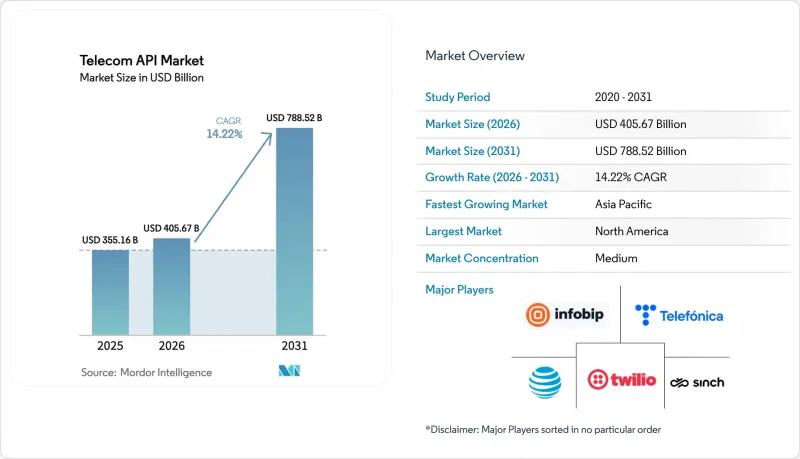
根據 Mordor Intelligence 預測,通訊 API 市場將從 2025 年的 3,551.6 億美元成長到 2026 年的 4,056.7 億美元,複合年成長率為 14.22%,到 2031 年將達到 7,885.2 億美元。
這凸顯了從單純提供連接服務到基於平台的經營模式的結構性轉變,該模式透過標準化的應用程式介面 (API) 將網路功能貨幣化。
本報告按服務類型(通訊/SMS、彩信、RCS API、語音/IVR 和語音控制 API 等)、部署類型(混合雲、多重雲端等)、最終用戶(企業開發者、營運商內部開發者等)、經營模式(與營運商直接合作、聚合商主導的CPaaS 等)和地區進行細分。市場預測以美元 (USD) 為單位。
全球電信API市場趨勢及洞察
Open Gateway 和 CAMARA 對網路 API 進行標準化
72家電信業者集團參與GSMA開放閘道器,創建了一個統一的號碼檢驗、SIM卡交換、終端定位和按需品質評估API目錄,並透過OAuth 2.0令牌提供這些API。以前需要簽訂多達15份雙邊合約的公司,現在只需一次整合即可完成,採購週期從季度縮短至每週。沃達豐和西班牙電信在英國、巴西、西班牙和德國推出商業服務,證明了商業性可行性,並使API請求-響應語法與超大規模資料中心業者平台規範保持一致,從而降低了雲端原生開發人員的認知負擔。 ETSI GS OPG 002條款正式確立了基於JSON Web代幣的安全性和RESTful設計,使監管機構能夠將核心網路功能視為關鍵數位基礎設施。因此,電信業者從被動的頻寬批發商轉型為能夠按交易收費的主動平台協調者。儘管與AWS和微軟在收入分成方面的爭議仍在繼續,但標準化API已經消除了全球擴展的一大障礙。
企業採用CPaaS的趨勢正在快速成長。
Twilio、Sinch 和 Infobip 三家公司 2024 年的總合營收預計將超過 35 億美元,這表明企業正在從單一的語音和簡訊服務轉向可程式設計通訊。使用 WhatsApp Business API 的零售商現在透過非同步管道處理 40% 的客戶服務互動,從而將客服中心回應時間縮短 18 分鐘,並將每次通話的人事費用降低 12 美元。 Twilio 的 Segment 整合將客戶資料圖與可程式 API 連接起來,使企業能夠在客戶放棄購物車後的 90 秒內聯繫到他們。 Infobip 的生成式 AI 機器人分析自然語言,自動呼叫付款和位置 API,即使是不具備專業知識的開發人員也能輕鬆使用。隨著隱私法規日益嚴格,企業越來越傾向於選擇在 API 層整契約意管理和加密功能的 CPaaS 供應商,而不是將合規性視為事後的考慮。
升級傳統OSS和BSS的瓶頸
開放雲端原生 API 需要即時收費和策略引擎,但遷移單體系統需要花費 5,000 萬至 2 億美元,耗時 3 至 5 年。基於 SOAP 的介面無法傳輸動態網路切片所需的毫秒級使用資料。在 150 家已採用 TM Forum 開放 API 的電信業者中,只有 22% 實現了完全合規。這是因為幾十年前的自訂程式碼使得重構變得複雜。資本支出不足的區域性營運商依賴 CPaaS 聚合商,實際上放棄了 API 貨幣化的機會。諾基亞和華為提供的容器化BSS 微服務支援分階段遷移,但遷移期間的雙堆疊操作會使營運成本增加高達 25%。
細分市場分析
預計2026年至2031年間,支付API的複合年成長率將達到14.88%,超過通訊API市場的整體成長率。 2025年,通訊將佔通訊API市場37.82%的佔有率。這主要得益於蘋果在iOS 18中引入RCS技術,使得iPhone和安卓設備之間的通訊能夠使用富媒體。語音、WebRTC和定位服務完善了全通路商務,而用戶ID API則簡化了透過簡訊發送動態密碼的流程,並在東南亞的一個銀行先導計畫中,將新帳戶的開戶時間縮短至90秒。
MTN Mobile Money 的 2 億個帳戶和 Vodafone M-Pesa 的商家 API 表明,繞過卡片付款管道可以顯著降低成本並促進電子商務的擴張。 Orange Money 與 Mastercard 的合作實現了 60 秒轉賬,預計到 2024 年將透過營運商收費創造 80 億美元的收入,並將新興市場的數位內容轉換率提高 30%。奈及利亞的 PSB 和印度的 UPI 等互通性法規正迫使營運商對其支付系統進行現代化改造,以符合 ISO 20022 標準。物聯網連接和詐欺偵測 API 雖然主要針對特定領域,但也正在拓展交叉銷售機會。
到 2025 年,混合部署將佔通訊 API 市場 56.82% 的佔有率,因為電信業者會在本地維護核心認證功能,同時在公共雲端上部署開發者閘道。同時,多雲預計將以 15.34% 的複合年成長率成長,因為基於多重雲端的服務網格可以在 AWS Wavelength、Azure for Operators 和 Google Distributed Cloud Edge 之間路由流量,從而避免廠商鎖定並最佳化延遲。
停機風險也是推動多元化發展的原因之一。 AWS 曾在 2024 年記錄到一次長達 14 小時的服務中斷。 Red Hat OpenShift 抽象化了多重雲端的複雜性,使德國電信能夠在幾天內將 API 部署到新的區域。雖然像 Gaia-X 這樣的歐洲託管市場已經出現,以確保資料主權,但開發人員仍然傾向於選擇美國超大規模資料中心業者,因為它們擁有更廣泛的工具。私有雲端和完全本地部署的解決方案在國防、醫療保健和關鍵基礎設施領域仍然很普遍,因為這些領域對資料居住的要求至關重要,但 FedRAMP 和 ISO 27001 認證正在降低這種抵觸情緒。
區域分析
到2025年,北美將佔通訊API市場38.73%的佔有率。 Verizon ThingSpace將擁有15,000名註冊企業開發者,AT&T的即時視訊API將為42個州的遠端醫療提供支持,T-Mobile將在12個大都會圈實現5G獨立組網(SA)的商業化。美國聯邦通訊委員會(FCC)的安全要求(預計每個網路需花費200萬至500萬美元)也提高了API的可靠性。 Rogers和Bell已加入Open Gateway,而America Movil正在墨西哥試點運營商支付API,以幫助銀行帳戶實現資金變現。
預計到2031年,亞太地區的複合年成長率將達到15.32%。 Reliance Jio的5G獨立用戶數將在2024年9月突破1億,其邊緣運算API正在協助擴增實境零售和即時翻譯。中國移動的5G連線數已達5億,並簽署了一份價值12億美元的智慧城市契約,用於部署網路切片API以進行交通控制。印度電信管理局(TRAI)已強制要求引入透明的API定價機制,而新加坡電信(Singtel)和MaxiS已向東南亞的物流運營商提供位置和服務品質(QoS)API。 NTT Docomo和SK Telecom正在以比消費者價格高出40%的價格,將網路切片技術應用於工廠自動化,而三星提供的邊緣節點則實現了12毫秒延遲的遊戲傳輸。
在歐洲,監管與創新之間保持平衡。 《一般資料保護規則》(GDPR) 和《數位市場法案》分別強制要求「隱私設計」和非歧視性 API 訪問,在規範信任框架的同時,也增加了合規的負擔。由德國電信、Orange、西班牙電信和沃達豐聯合運營的市場旨在從 CPaaS 聚合商收回利潤。隨著沃達豐英國服務的推出,開發者可以在 48 小時內配置 CAMARA API。中東一家電信業者推出了海外居民的匯款支付 API,預計到 2024 年將處理 40 億美元的交易。非洲的 MTN 大幅擴展了電子錢包的使用,而南美洲的西班牙電信巴西公司則透過為農業技術新創公司提供通訊和地點 API,凸顯了其區域多元化策略。
其他好處:
- Excel格式的市場預測(ME)表
- 3個月的分析師支持
目錄
第1章:引言
- 研究假設和市場定義
- 調查範圍
第2章:調查方法
第3章執行摘要
第4章 市場狀況
- 市場概覽
- 市場促進因素
- 企業採用CPaaS的趨勢正在快速成長。
- 利用開放閘道器和CAMARA實現網路API標準化
- 5G商業化的壓力正在推動按需QoS API的發展。
- 邊緣運算工作負載需要低延遲切片 API。
- 利用基因人工智慧的開發者工具正在降低進入門檻。
- 電信營運商(Telco)與金融科技公司之間的合作正在加速營運商計費和支付 API 的發展。
- 市場限制因素
- API 安全漏洞和訊號詐騙增多
- 升級傳統OSS/BSS的瓶頸
- 來自OTT CPaaS的競爭正在擠壓利潤空間。
- 與超大規模資料中心業者的收益分成模式尚不明確。
- 產業價值鏈分析
- 監理情勢
- 技術展望
- 波特五力分析
- 價格分析
- 通訊業的 API 用例
第5章 市場規模與成長預測
- 按服務類型
- 通訊/簡訊、彩信、RCS API
- 語音/互動語音應答與語音控制 API
- 支付 API
- WebRTC API
- 位置和地圖 API
- 用戶ID 管理和 SSO API
- 其他服務類型
- 依部署類型
- 混合
- 多重雲端
- 其他部署方法
- 最終用戶
- 企業開發者
- 內部溝通開發人員
- 合作夥伴開發商
- 長尾開發人員
- 按經營模式
- 與電信業者的直接交易
- 聚合器主導的CPaaS
- Platform-as-a-Service(PaaS)
- API市場/交易平台
- 按地區
- 北美洲
- 美國
- 加拿大
- 墨西哥
- 南美洲
- 巴西
- 阿根廷
- 其他南美國家
- 歐洲
- 德國
- 英國
- 法國
- 義大利
- 西班牙
- 其他歐洲國家
- 亞太地區
- 中國
- 日本
- 印度
- 韓國
- ASEAN
- 其他亞太國家
- 中東和非洲
- 中東
- 沙烏地阿拉伯
- 阿拉伯聯合大公國
- 其他中東國家
- 非洲
- 南非
- 奈及利亞
- 其他非洲國家
- 中東
- 北美洲
第6章 競爭情勢
- 市場集中度
- 策略趨勢
- 市佔率分析
- Vendor Capability Matrix
- Key Case Studies of Major Vendors
- 公司簡介
- AT&T Inc.
- Telefonica, SA
- Twilio Inc.
- Infobip doo
- Sinch AB
- Verizon Communications Inc.
- Orange SA
- Deutsche Telekom AG
- Ribbon Communications Inc.
- Huawei Technologies Co., Ltd.
- Telefonaktiebolaget LM Ericsson
- Cisco Systems, Inc.
- Google LLC
- Vodafone Group Plc
- Nokia Corporation
- Vonage Holdings Corp.
- MessageBird BV
- Bandwidth Inc.
- Telnyx LLC
- Syniverse Technologies LLC
- Route Mobile Limited
- Tata Communications Limited
- TeleSign Corporation
第7章 市場機會與未來展望
According to Mordor Intelligence, the telecom API market size reached USD 405.67 billion in 2026 from USD 355.16 billion in 2025, and is projected to register a 14.22% CAGR to touch USD 788.52 billion by 2031, underscoring a structural pivot from connectivity-only offerings toward platform business models that monetize network capabilities through standardized application programming interfaces.
This report is Segmented by Service Type (Messaging/SMS-MMS-RCS API, Voice/IVR and Voice Control API, and More), Deployment Type (Hybrid, Multi-Cloud, and More), End-User (Enterprise Developer, Internal Telecom Developer, and More), Business Model (Direct Carrier Exposure, Aggregator-Led CPaaS, and More), and Geography. The Market Forecasts are Provided in Terms of Value (USD).
Global Telecom API Market Trends and Insights
Open Gateway and CAMARA Standardization of Network APIs
The GSMA Open Gateway enrollment of 72 operator groups created a single federated catalog of number-verification, SIM-swap, device-location and quality-on-demand APIs, enforceable through OAuth 2.0 tokens. Enterprises once forced to negotiate fifteen bilateral contracts now integrate once, shrinking procurement cycles from quarters to weeks. Vodafone and Telefonica commercial launches in the United Kingdom, Brazil, Spain and Germany proved commercial feasibility and aligned API request-response syntax with hyperscaler conventions, lowering cognitive overhead for cloud-native developers. ETSI GS OPG 002 rules formalized JSON Web Token security and RESTful design, helping regulators treat core network capabilities as essential digital facilities. Operators have consequently shifted from passive bandwidth wholesalers to active platform orchestrators able to charge per-transaction fees. Although revenue-share disputes with AWS and Microsoft persist, standardized APIs have removed the primary inhibitor to global scalability.
Surge in CPaaS Adoption among Enterprises
Twilio, Sinch, and Infobip reported combined 2024 revenue above USD 3.5 billion, indicating that enterprises gravitate toward programmable communications rather than monolithic voice and SMS bundles. Retailers using WhatsApp Business API now route 40% of customer-service interactions through asynchronous channels, lowering call-center handle time by 18 minutes and labor cost by USD 12 per ticket. Twilio's Segment integration bridges customer-data graphs with programmable APIs, enabling abandoned-cart outreach within 90 seconds of checkout drop-off. Infobip's generative-AI bots parse natural language to automatically invoke payment or location APIs, thereby widening access for non-specialist developers. As privacy regulations tighten, enterprises favor CPaaS providers that embed consent management and encryption in the API layer rather than bolt-on compliance.
Legacy OSS and BSS Upgrade Bottlenecks
Cloud-native API exposure demands real-time billing and policy engines, yet migrating monolithic systems costs USD 50-200 million and takes three-to-five years. SOAP-based interfaces cannot relay per-millisecond usage data required for dynamic network-slicing. Only 22% of the 150 operators that adopted TM Forum Open APIs achieved full compliance because decades-old custom code complicates refactoring. Regional carriers lacking capex rely on CPaaS aggregators, effectively ceding API monetization. Containerized BSS microservices from Nokia and Huawei allow phased migration, yet dual-stack operations raise opex by up to 25% during transition.
Other drivers and restraints analyzed in the detailed report include:
- Monetization Pressure on 5G Driving QoS-on-Demand APIs
- Telco-Fintech Push Catalyzing Carrier-Billing and Payment APIs
- Escalating API-Security Breaches and Signaling Fraud
For complete list of drivers and restraints, kindly check the Table Of Contents.
Segment Analysis
Payment APIs are set to rise at a 14.88% CAGR from 2026-2031, outpacing the telecom API market. Messaging retained 37.82% of the telecom API market share in 2025 because Apple adopted RCS in iOS 18, enabling rich media across iPhone-Android exchanges. Voice, WebRTC, and location services complement omnichannel commerce, while subscriber identity APIs eliminate SMS one-time-password friction, cutting onboarding time to 90 seconds in Southeast Asian banking pilots.
MTN Mobile Money's 200 million accounts and Vodafone M-Pesa's merchant APIs prove that bypassing card rails can slash costs and broaden ecommerce. Orange Money-Mastercard integration accelerated 60-second remittances, and carrier billing generated USD 8 billion in 2024 revenue, lifting digital-content conversions by 30% in emerging regions. Interoperability mandates, such as Nigeria's PSB and India's UPI, require alignment with ISO 20022, pushing operators to modernize their settlement systems. IoT connectivity and fraud-detection APIs address smaller niches but add cross-sell potential.
Hybrid deployments owned 56.82% of telecom API market size in 2025 as carriers kept core authentication on-premises while placing developer gateways in public clouds. Multi-cloud, however, will expand at a 15.34% CAGR as Kubernetes-based service meshes route traffic across AWS Wavelength, Azure for Operators and Google Distributed Cloud Edge, avoiding lock-in and optimizing latency.
Downtime risk also drives diversification; AWS logged 14 hours of outages in 2024. Red Hat OpenShift abstracts multicloud complexity, letting Deutsche Telekom push APIs to new regions in days. Gaia-X inspired European-hosted marketplaces for data sovereignty, yet developers still gravitate toward U.S. hyperscalers for tooling breadth. Private-cloud and fully on-prem solutions linger in defense, health and critical-infrastructure sectors bound by residency mandates, though FedRAMP and ISO 27001 certifications shrink these holdouts.
Complete Report Scope:
- By Service Type
- Messaging / SMS-MMS-RCS API
- Voice / IVR and Voice Control API
- Payment API
- WebRTC API
- Location and Mapping API
- Subscriber ID Management and SSO API
- Other Service Types
- By Deployment Type
- Hybrid
- Multi-cloud
- Other Deployment Modes
- By End-User
- Enterprise Developer
- Internal Telecom Developer
- Partner Developer
- Long-tail Developer
- By Business Model
- Direct Carrier Exposure
- Aggregator-led CPaaS
- Platform-as-a-Service (PaaS)
- API Marketplace / Exchange
- By Geography
- North America
- United States
- Canada
- Mexico
- South America
- Brazil
- Argentina
- Rest of South America
- Europe
- Germany
- United Kingdom
- France
- Italy
- Spain
- Rest of Europe
- Asia-Pacific
- China
- Japan
- India
- South Korea
- ASEAN
- Rest of Asia-Pacific
- Middle East and Africa
- Middle East
- Saudi Arabia
- United Arab Emirates
- Rest of Middle East
- Africa
- South Africa
- Nigeria
- Rest of Africa
- Middle East
- North America
Geography Analysis
North America contributed 38.73% of telecom API market size in 2025. Verizon ThingSpace enrolled 15,000 enterprise developers, AT&T Live Video APIs underpinned telehealth sessions in 42 states and T-Mobile commercialized 5G standalone slices in 12 metropolitan areas. FCC security mandates, estimated at USD 2-5 million per network, also enhance API trustworthiness. Rogers and Bell joined Open Gateway, and America Movil piloted carrier-billing APIs across Mexico to monetize the unbanked.
Asia Pacific is forecast to post a 15.32% CAGR through 2031. Reliance Jio's 5G standalone base exceeded 100 million users by September 2024, its edge-computing APIs enable AR retail and real-time translation. China Mobile reached 500 million 5G connections and signed USD 1.2 billion in smart-city contracts to deploy network-slicing APIs for traffic control. India's TRAI mandated transparent API rate cards, while Singtel and Maxis exposed location and QoS APIs to logistics providers in Southeast Asia. NTT Docomo and SK Telecom monetize factory automation slices priced 40% above consumer rates, and Samsung-powered edge nodes enable 12-millisecond latency gaming streams.
Europe balances regulation and innovation. GDPR and the Digital Markets Act obligate privacy-by-design and nondiscriminatory API access, respectively, standardizing trust frameworks while raising compliance overhead. The Deutsche Telekom-Orange-Telefonica-Vodafone marketplace aims to recapture margin from CPaaS aggregators. Vodafone United Kingdom's launch allowed developers to provision CAMARA APIs within 48 hours. Middle East operators deploy payment APIs for expatriate remittances, processing USD 4 billion in 2024 transactions. Africa's MTN generated significant wallet activity, and South America's Telefonica Brasil exposed messaging and location APIs to agritech startups, highlighting regional diversification.
- AT&T Inc.
- Telefonica, S.A.
- Twilio Inc.
- Infobip d.o.o.
- Sinch AB
- Verizon Communications Inc.
- Orange S.A.
- Deutsche Telekom AG
- Ribbon Communications Inc.
- Huawei Technologies Co., Ltd.
- Telefonaktiebolaget LM Ericsson
- Cisco Systems, Inc.
- Google LLC
- Vodafone Group Plc
- Nokia Corporation
- Vonage Holdings Corp.
- MessageBird B.V.
- Bandwidth Inc.
- Telnyx LLC
- Syniverse Technologies LLC
- Route Mobile Limited
- Tata Communications Limited
- TeleSign Corporation
Additional Benefits:
- The market estimate (ME) sheet in Excel format
- 3 months of analyst support
TABLE OF CONTENTS
1 INTRODUCTION
- 1.1 Study Assumptions and Market Definition
- 1.2 Scope of the Study
2 RESEARCH METHODOLOGY
3 EXECUTIVE SUMMARY
4 MARKET LANDSCAPE
- 4.1 Market Overview
- 4.2 Market Drivers
- 4.2.1 Surge in CPaaS adoption among enterprises
- 4.2.2 Open Gateway and CAMARA standardization of network APIs
- 4.2.3 Monetisation pressure on 5G driving QoS-on-demand APIs
- 4.2.4 Edge-computing workloads need low-latency slicing APIs
- 4.2.5 Gen-AI-assisted developer tools lowering entry barriers
- 4.2.6 Telco-fintech push catalysing carrier-billing/payment APIs
- 4.3 Market Restraints
- 4.3.1 Escalating API-security breaches and signalling fraud
- 4.3.2 Legacy OSS/BSS upgrade bottlenecks
- 4.3.3 Margin compression from OTT CPaaS competitors
- 4.3.4 Unclear revenue-share models with hyperscalers
- 4.4 Industry Value Chain Analysis
- 4.5 Regulatory Landscape
- 4.6 Technological Outlook
- 4.7 Porter's Five Forces Analysis
- 4.7.1 Bargaining Power of Suppliers
- 4.7.2 Bargaining Power of Buyers
- 4.7.3 Threat of New Entrants
- 4.7.4 Intensity of Competitive Rivalry
- 4.7.5 Threat of Substitute Products
- 4.8 Pricing Analysis
- 4.9 API Use Cases in Telecom Industry
5 MARKET SIZE AND GROWTH FORECASTS (VALUE)
- 5.1 By Service Type
- 5.1.1 Messaging / SMS-MMS-RCS API
- 5.1.2 Voice / IVR and Voice Control API
- 5.1.3 Payment API
- 5.1.4 WebRTC API
- 5.1.5 Location and Mapping API
- 5.1.6 Subscriber ID Management and SSO API
- 5.1.7 Other Service Types
- 5.2 By Deployment Type
- 5.2.1 Hybrid
- 5.2.2 Multi-cloud
- 5.2.3 Other Deployment Modes
- 5.3 By End-User
- 5.3.1 Enterprise Developer
- 5.3.2 Internal Telecom Developer
- 5.3.3 Partner Developer
- 5.3.4 Long-tail Developer
- 5.4 By Business Model
- 5.4.1 Direct Carrier Exposure
- 5.4.2 Aggregator-led CPaaS
- 5.4.3 Platform-as-a-Service (PaaS)
- 5.4.4 API Marketplace / Exchange
- 5.5 By Geography
- 5.5.1 North America
- 5.5.1.1 United States
- 5.5.1.2 Canada
- 5.5.1.3 Mexico
- 5.5.2 South America
- 5.5.2.1 Brazil
- 5.5.2.2 Argentina
- 5.5.2.3 Rest of South America
- 5.5.3 Europe
- 5.5.3.1 Germany
- 5.5.3.2 United Kingdom
- 5.5.3.3 France
- 5.5.3.4 Italy
- 5.5.3.5 Spain
- 5.5.3.6 Rest of Europe
- 5.5.4 Asia-Pacific
- 5.5.4.1 China
- 5.5.4.2 Japan
- 5.5.4.3 India
- 5.5.4.4 South Korea
- 5.5.4.5 ASEAN
- 5.5.4.6 Rest of Asia-Pacific
- 5.5.5 Middle East and Africa
- 5.5.5.1 Middle East
- 5.5.5.1.1 Saudi Arabia
- 5.5.5.1.2 United Arab Emirates
- 5.5.5.1.3 Rest of Middle East
- 5.5.5.2 Africa
- 5.5.5.2.1 South Africa
- 5.5.5.2.2 Nigeria
- 5.5.5.2.3 Rest of Africa
- 5.5.5.1 Middle East
- 5.5.1 North America
6 COMPETITIVE LANDSCAPE
- 6.1 Market Concentration
- 6.2 Strategic Moves
- 6.3 Market Share Analysis
- 6.4 Vendor Capability Matrix
- 6.5 Key Case Studies of Major Vendors
- 6.6 Company Profiles (includes Global level Overview, Market level overview, Core Segments, Financials as available, Strategic Information, Market Rank/Share for key companies, Products and Services, and Recent Developments)
- 6.6.1 AT&T Inc.
- 6.6.2 Telefonica, S.A.
- 6.6.3 Twilio Inc.
- 6.6.4 Infobip d.o.o.
- 6.6.5 Sinch AB
- 6.6.6 Verizon Communications Inc.
- 6.6.7 Orange S.A.
- 6.6.8 Deutsche Telekom AG
- 6.6.9 Ribbon Communications Inc.
- 6.6.10 Huawei Technologies Co., Ltd.
- 6.6.11 Telefonaktiebolaget LM Ericsson
- 6.6.12 Cisco Systems, Inc.
- 6.6.13 Google LLC
- 6.6.14 Vodafone Group Plc
- 6.6.15 Nokia Corporation
- 6.6.16 Vonage Holdings Corp.
- 6.6.17 MessageBird B.V.
- 6.6.18 Bandwidth Inc.
- 6.6.19 Telnyx LLC
- 6.6.20 Syniverse Technologies LLC
- 6.6.21 Route Mobile Limited
- 6.6.22 Tata Communications Limited
- 6.6.23 TeleSign Corporation
7 MARKET OPPORTUNITIES AND FUTURE OUTLOOK
- 7.1 White-space and Unmet-need Assessment

 全球通訊API市場規模、佔有率、趨勢和成長分析報告(2026-2034年)
 通訊API市場-2026-2032年全球市場預測
 通訊API市場預測至2034年-按類型、部署模式、最終用戶、產業和地區分類的全球分析營運商級 API 安全市場預測至 2034 年—按組件、部署模式、安全類型、應用程式、最終用戶和地區分類的全球分析
 通訊API市場規模、佔有率、趨勢和預測:按類型、用戶類型、部署方式、行業和地區分類(2026-2034年)
 通訊API市場:按服務類型、類型和地區分類電信API平台市場預測至2034年-全球分析(按組件、API類型、功能、開發者類型、組織規模、最終用戶和地區分類)
 2026年全球網路應用程式介面(API)市場報告
 電信API市場規模、佔有率和成長分析(按API類型、部署模式、最終用戶、功能和地區分類)-2026-2033年產業預測電信API安全市場預測至2032年:按組件、API領域、安全功能、組織規模、網路類型、最終用戶和地區分類的全球分析