

 |
市場調查報告書
商品編碼
1885893
電信API市場機會、成長促進因素、產業趨勢分析及預測(2025-2034年)Telecom API Market Opportunity, Growth Drivers, Industry Trend Analysis, and Forecast 2025 - 2034 |
||||||

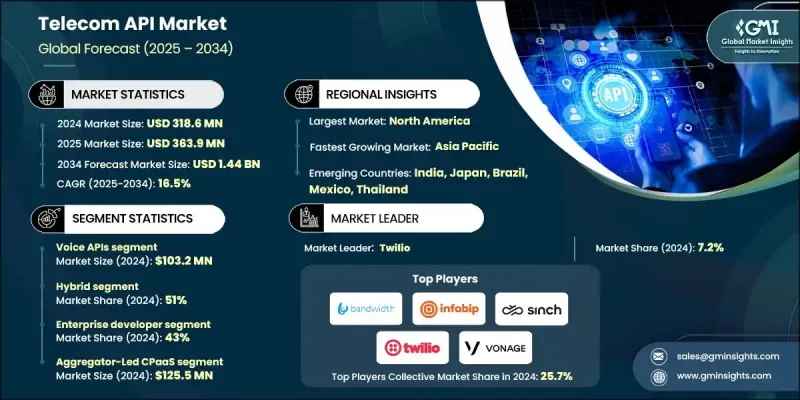
2024 年全球電信 API 市場價值為 3.186 億美元,預計到 2034 年將以 16.5% 的複合年成長率成長至 14.4 億美元。
向獨立組網的 5G 網路轉型正在重塑通訊環境,使營運商能夠從硬體密集型系統轉向基於 API 構建的雲端原生平台。隨著 5G 提供更高速度,營運商可以透過賦能開發者和企業的服務,推出支援新型收入模式的功能。各行各業的組織都在進行基礎設施現代化改造,並採用 API 驅動的架構,以支援即時通訊、統一數位管道,並利用人工智慧實現互動自動化,從而獲得更個人化的服務。電信 API 支援可擴展的通訊流,並增強全通路客戶互動。通訊平台即服務 (CPaaS) 的興起使企業無需部署自有基礎設施即可整合可程式通訊工具。隨著先進的 AI 功能變得更加易用,企業可以簡化工作流程、降低營運成本,並創建深度客製化的使用者互動體驗。
| 市場範圍 | |
|---|---|
| 起始年份 | 2024 |
| 預測年份 | 2025-2034 |
| 起始值 | 3.186億美元 |
| 預測值 | 14.4億美元 |
| 複合年成長率 | 16.5% |
2024年,語音API市場規模預計將達到1.032億美元,開發者可透過RESTful介面發起、接收、路由、錄製和管理呼叫,而無需維護電信系統。這些API使企業能夠控制與呼叫相關的任務,從而支援客戶互動、身份驗證流程、提醒和警報。隨著企業將語音功能嵌入現有系統、將傳統呼叫中心遷移到雲端環境以及應用人工智慧增強功能(例如智慧識別和情感評估),市場需求將持續成長。
預計到2024年,企業開發人員將佔據43%的市場。這些團隊負責建立內部和外部整合,將API與客戶支援、工作流程和通訊管理系統連接起來。持續的數位轉型以及人工智慧支援的低程式碼和無程式碼工具的日益普及,是推動該細分市場成長的主要因素。
2024年,美國電信API市場佔86%的佔有率,市場規模達9,370萬美元。美國營運商正優先考慮以安全為核心建構的電信API框架。包括聯邦網路安全指令在內的監管要求,促使企業採用能夠強化身分驗證、網路監控、合規措施和零信任原則的API,從而提升了企業需求。
活躍於電信API市場的公司包括Bandwidth、Telesign、Sinch、AT&T、諾基亞、Twilio、Infobip、Plivo、Vonage和MessageBird。電信API市場的關鍵參與者正透過強調平台可擴展性、更深入的企業整合和高級安全功能的策略來擴大其市場佔有率。許多公司正在加強與雲端供應商的合作,以拓寬部署選項並提升全球覆蓋範圍。各公司也致力於透過提供精簡的工具包、完善的文件和靈活的定價模式來提升開發者體驗。持續投資於人工智慧驅動的智慧技術,例如自動化意圖處理和預測分析,有助於公司提升其API的價值。此外,供應商也正在積極拓展區域市場、強化合規框架並採用模組化產品路線圖,以滿足不斷變化的企業需求並維持強大的競爭優勢。
目錄
第1章:方法論
- 市場範圍和定義
- 研究設計
- 研究方法
- 資料收集方法
- 資料探勘來源
- 全球的
- 地區/國家
- 基準估算和計算
- 基準年計算
- 市場估算的關鍵趨勢
- 初步研究和驗證
- 原始資料
- 預報
- 研究假設和局限性
第2章:執行概要
第3章:行業洞察
- 產業生態系分析
- 供應商格局
- 利潤率分析
- 成本結構
- 每個階段的價值增加
- 影響價值鏈的因素
- 中斷
- 產業影響因素
- 成長促進因素
- 全球電信合作
- 開發者生態系成長
- 5G獨立擴展
- 增強安全性和身份驗證
- 加速數位轉型
- 產業陷阱與挑戰
- 監理複雜性
- 整合挑戰
- 市場機遇
- 新企業服務
- 跨網路創新
- 人工智慧和分析整合
- 全球開發者市場
- 成長促進因素
- 成長潛力分析
- 監管環境
- 波特的分析
- PESTEL 分析
- 技術與創新格局
- 目前技術
- 新興技術
- 專利分析
- 定價分析
- 按交易(每次 API 呼叫)定價
- 分級捆綁定價
- 基於使用量的定價模式
- 收益分成安排
- 免費增值模式和開發者激勵計劃
- 企業合約結構
- 區域定價差異
- 關鍵市場缺口及產品創新因應措施
- 分散的多營運商 API 訪問
- 缺乏標準化的網路API規範
- 開發者體驗不佳、入職流程不順暢
- 即時防詐騙能力有限
3.10.5. 5G貨幣化模式不足
- 跨境API聯合與漫遊
- 缺乏人工智慧原生電信API
- 用例分析及產業影響
- 金融服務和銀行業用例
- 醫療保健和遠距醫療應用案例
- 零售和電子商務用例
- 製造業和工業物聯網應用案例
- 交通運輸與汽車應用案例
- 媒體與娛樂應用案例
- 智慧城市和公共部門用例
- 物流與供應鏈應用案例
- API交易量
第4章:競爭格局
- 介紹
- 公司市佔率分析
- 北美洲
- 歐洲
- 亞太地區
- 拉丁美洲
- MEA
- 主要市場參與者的競爭分析
- 競爭定位矩陣
- 戰略展望矩陣
- 重要新聞和舉措
- 併購
- 合作夥伴關係與合作
- 新產品發布
- 擴張計劃和資金
第5章:市場估算與預測:依通訊服務分類,2021-2034年
- 主要趨勢
- 嗓音
- 訊息傳遞
- 影片
第6章:市場估算與預測:依部署方式分類,2021-2034年
- 主要趨勢
- 混合
- 多雲端
- 本地部署
第7章:市場估算與預測:依最終用途分類,2021-2034年
- 主要趨勢
- 企業開發者
- 內部電信開發人員
- 合作夥伴開發商
- 長尾開發者
第8章:市場估算與預測:依商業模式分類,2021-2034年
- 主要趨勢
- 直接載體暴露
- 聚合器主導的CPaaS
- 平台即服務 (PaaS)
第9章:市場估計與預測:依地區分類,2021-2034年
- 主要趨勢
- 北美洲
- 美國
- 加拿大
- 歐洲
- 德國
- 英國
- 法國
- 義大利
- 西班牙
- 北歐
- 荷蘭
- 俄羅斯
- 亞太地區
- 中國
- 印度
- 日本
- 澳新銀行
- 新加坡
- 泰國
- 越南
- 韓國
- 拉丁美洲
- 巴西
- 墨西哥
- 阿根廷
- MEA
- 南非
- 沙烏地阿拉伯
- 阿拉伯聯合大公國
第10章:公司簡介
- 全球參與者
- AT&T
- Ericsson
- Infobip
- MessageBird
- Microsoft (Azure Communication Services)
- Nokia
- Plivo
- Sinch
- Telesign
- Twilio
- Vonage
- 區域玩家
- Bandwidth
- Deutsche Telekom
- Orange
- Reliance Jio Infocomm
- Singtel
- Telnyx
- 新興參與者和顛覆者
- Aduna Global
- Bridge Alliance
- Enstream (JT Global)
- Google Cloud
- Syniverse Technologies
- Tech Mahindra
- Wipro
The Global Telecom API Market was valued at USD 318.6 million in 2024 and is estimated to grow at a CAGR of 16.5% to reach USD 1.44 billion by 2034.
The transition toward standalone 5G networks is reshaping the communications environment, enabling operators to move from hardware-heavy systems to cloud-native platforms built around APIs. With 5G delivering higher speeds, providers can introduce capabilities that support new revenue models through services that empower developers and enterprises. Organizations across multiple sectors are modernizing infrastructure and adopting API-driven architectures to support real-time communication, unify digital channels, and automate interactions with AI for greater personalization. Telecom APIs support scalable communication flows and enhance omnichannel customer engagement. The rise of Communications Platform as a Service (CPaaS) allows businesses to integrate programmable communication tools without deploying their own infrastructure. With advanced AI-based functions becoming more accessible, companies can streamline workflows, lower operational costs, and create deeply customized user interactions.
| Market Scope | |
|---|---|
| Start Year | 2024 |
| Forecast Year | 2025-2034 |
| Start Value | $318.6 Million |
| Forecast Value | $1.44 Billion |
| CAGR | 16.5% |
The voice APIs generated USD 103.2 million in 2024, enabling developers to initiate, receive, route, record, and manage calls through RESTful interfaces without maintaining telecom systems. These APIs allow companies to control call-related tasks that support customer interactions, authentication processes, reminders, and alerts. Demand continues to climb as enterprises embed voice into existing systems, transition traditional contact centers to cloud environments, and apply AI-powered enhancements such as intelligent recognition and sentiment evaluation.
The enterprise developers segment held a 43% share in 2024. These teams build both internal and external integrations to connect APIs with systems that manage customer support, workflows, and communications. Segment growth is strongly influenced by ongoing digital transformation and rising adoption of low-code and no-code tools supported by AI.
United States Telecom API Market held an 86% share in 2024 and generated USD 93.7 million. Operators in the country are prioritizing telecom API frameworks built with security at their core. Regulatory expectations, including federal cybersecurity directives, are prompting the adoption of APIs that reinforce identity validation, network monitoring, compliance measures, and zero-trust principles, which is strengthening enterprise demand.
Companies active in the Telecom API Market include Bandwidth, Telesign, Sinch, AT&T, Nokia, Twilio, Infobip, Plivo, Vonage, and MessageBird. Key players in the Telecom API Market are expanding their presence through strategies that emphasize platform scalability, deeper enterprise integration, and advanced security capabilities. Many are strengthening partnerships with cloud providers to broaden deployment options and improve global reach. Firms are also focusing on enhancing developer experience by offering streamlined toolkits, robust documentation, and flexible pricing models. Continuous investment in AI-driven intelligence, such as automated intent handling and predictive analytics, helps companies elevate the value of their APIs. Additionally, providers are pursuing regional expansion, strengthening compliance frameworks, and adopting modular product roadmaps to meet evolving enterprise requirements and maintain a strong competitive position.
Table of Contents
Chapter 1 Methodology
- 1.1 Market scope and definition
- 1.2 Research design
- 1.2.1 Research approach
- 1.2.2 Data collection methods
- 1.3 Data mining sources
- 1.3.1 Global
- 1.3.2 Regional/Country
- 1.4 Base estimates and calculations
- 1.4.1 Base year calculation
- 1.4.2 Key trends for market estimation
- 1.5 Primary research and validation
- 1.5.1 Primary sources
- 1.6 Forecast
- 1.7 Research assumptions and limitations
Chapter 2 Executive Summary
- 2.1 Industry 3600 synopsis, 2021 - 2034
- 2.2 Key market trends
- 2.2.1 Communication service
- 2.2.2 Deployment
- 2.2.3 End use
- 2.2.4 Business model
- 2.2.5 Regional
- 2.3 TAM Analysis, 2026-2034
- 2.4 CXO perspectives: Strategic imperatives
- 2.4.1 Executive decision points
- 2.4.2 Critical success factors
- 2.5 Future outlook and strategic recommendations
Chapter 3 Industry Insights
- 3.1 Industry ecosystem analysis
- 3.1.1 Supplier landscape
- 3.1.2 Profit margin analysis
- 3.1.3 Cost structure
- 3.1.4 Value addition at each stage
- 3.1.5 Factor affecting the value chain
- 3.1.6 Disruptions
- 3.2 Industry impact forces
- 3.2.1 Growth drivers
- 3.2.1.1 Global telco collaboration
- 3.2.1.2 Developer ecosystem growth
- 3.2.1.3 5g standalone expansion
- 3.2.1.4 Enhanced security & identity verification
- 3.2.1.5 Accelerated digital transformation
- 3.2.2 Industry pitfalls and challenges
- 3.2.2.1 Regulatory complexity
- 3.2.2.2 Integration challenges
- 3.2.3 Market opportunities
- 3.2.3.1 New enterprise services
- 3.2.3.2 Cross-network innovation
- 3.2.3.3 Ai and analytics integration
- 3.2.3.4 Global developer marketplace
- 3.2.1 Growth drivers
- 3.3 Growth potential analysis
- 3.4 Regulatory landscape
- 3.4.1 North America
- 3.4.2 Europe
- 3.4.3 Asia Pacific
- 3.4.4 Latin America
- 3.4.5 Middle east and Africa
- 3.5 Porter's analysis
- 3.6 PESTEL analysis
- 3.7 Technology and Innovation landscape
- 3.7.1 Current technology
- 3.7.2 Emerging technology
- 3.8 Patent analysis
- 3.9 Pricing analysis
- 3.9.1 Transactional (per-api-call) pricing
- 3.9.2 Tiered bundle pricing
- 3.9.3 Usage-based pricing models
- 3.9.4 Revenue-sharing arrangements
- 3.9.5 Freemium & developer incentive programs
- 3.9.6 Enterprise contract structures
- 3.9.7 Regional pricing variations
- 3.10 Critical market gaps & product innovation response
- 3.10.1 Fragmented multi-operator API access
- 3.10.2 Lack of standardized network API specifications
- 3.10.3 Poor developer experience and onboarding friction
- 3.10.4 Limited real-time fraud prevention capabilities
3.10.5. Insufficient 5 G monetization models
- 3.10.6 Cross-border API federation and roaming
- 3.10.7 Lack of AI-native telecom APIs
- 3.11 Use case analysis & sector impact
- 3.11.1 Financial services & banking use cases
- 3.11.2 Healthcare & telemedicine use cases
- 3.11.3 Retail & e-commerce use cases
- 3.11.4 Manufacturing & industrial IoT use cases
- 3.11.5 Transportation & automotive use cases
- 3.11.6 Media & entertainment use cases
- 3.11.7 Smart cities & public sector use cases
- 3.11.8 Logistics & supply chain use cases
- 3.12 API transaction volume
Chapter 4 Competitive Landscape, 2024
- 4.1 Introduction
- 4.2 Company market share analysis
- 4.2.1 North America
- 4.2.2 Europe
- 4.2.3 Asia Pacific
- 4.2.4 LATAM
- 4.2.5 MEA
- 4.3 Competitive analysis of major market players
- 4.4 Competitive positioning matrix
- 4.5 Strategic outlook matrix
- 4.6 Key news and initiatives
- 4.6.1 Mergers & acquisitions
- 4.6.2 Partnerships & collaborations
- 4.6.3 New Product Launches
- 4.6.4 Expansion Plans and funding
Chapter 5 Market Estimates & Forecast, By Communication Service, 2021 - 2034 ($Mn)
- 5.1 Key trends
- 5.2 Voice
- 5.3 Messaging
- 5.4 Video
Chapter 6 Market Estimates & Forecast, By Deployment, 2021 - 2034 ($Mn)
- 6.1 Key trends
- 6.2 Hybrid
- 6.3 Multi-Cloud
- 6.4 On-Premises
Chapter 7 Market Estimates & Forecast, By End Use, 2021 - 2034 ($Mn)
- 7.1 Key trends
- 7.2 Enterprise Developer
- 7.3 Internal Telecom Developer
- 7.4 Partner Developer
- 7.5 Long-Tail Developer
Chapter 8 Market Estimates & Forecast, By Business Model, 2021 - 2034 ($Mn)
- 8.1 Key trends
- 8.2 Direct Carrier Exposure
- 8.3 Aggregator-Led CPaaS
- 8.4 Platform-as-a-Service (PaaS)
Chapter 9 Market Estimates & Forecast, By Region, 2021 - 2034 ($Mn)
- 9.1 Key trends
- 9.2 North America
- 9.2.1 US
- 9.2.2 Canada
- 9.3 Europe
- 9.3.1 Germany
- 9.3.2 UK
- 9.3.3 France
- 9.3.4 Italy
- 9.3.5 Spain
- 9.3.6 Nordics
- 9.3.7 Netherlands
- 9.3.8 Russia
- 9.4 Asia Pacific
- 9.4.1 China
- 9.4.2 India
- 9.4.3 Japan
- 9.4.4 ANZ
- 9.4.5 Singapore
- 9.4.6 Thailand
- 9.4.7 Vietnam
- 9.4.8 South Korea
- 9.5 Latin America
- 9.5.1 Brazil
- 9.5.2 Mexico
- 9.5.3 Argentina
- 9.6 MEA
- 9.6.1 South Africa
- 9.6.2 Saudi Arabia
- 9.6.3 UAE
Chapter 10 Company Profiles
- 10.1 Global Players
- 10.1.1 AT&T
- 10.1.2 Ericsson
- 10.1.3 Infobip
- 10.1.4 MessageBird
- 10.1.5 Microsoft (Azure Communication Services)
- 10.1.6 Nokia
- 10.1.7 Plivo
- 10.1.8 Sinch
- 10.1.9 Telesign
- 10.1.10 Twilio
- 10.1.11 Vonage
- 10.2 Regional Players
- 10.2.1 Bandwidth
- 10.2.2 Deutsche Telekom
- 10.2.3 Orange
- 10.2.4 Reliance Jio Infocomm
- 10.2.5 Singtel
- 10.2.6 Telnyx
- 10.3 Emerging players and disruptors
- 10.3.1 Aduna Global
- 10.3.2 Bridge Alliance
- 10.3.3 Enstream (JT Global)
- 10.3.4 Google Cloud
- 10.3.5 Syniverse Technologies
- 10.3.6 Tech Mahindra
- 10.3.7 Wipro

 全球通訊API市場規模、佔有率、趨勢和成長分析報告(2026-2034年)
 通訊API市場-2026-2032年全球市場預測
 通訊API市場預測至2034年-按類型、部署模式、最終用戶、產業和地區分類的全球分析營運商級 API 安全市場預測至 2034 年—按組件、部署模式、安全類型、應用程式、最終用戶和地區分類的全球分析
 通訊API市場規模、佔有率、趨勢和預測:按類型、用戶類型、部署方式、行業和地區分類(2026-2034年)
 通訊API市場:按服務類型、類型和地區分類電信API平台市場預測至2034年-全球分析(按組件、API類型、功能、開發者類型、組織規模、最終用戶和地區分類)
 2026年全球網路應用程式介面(API)市場報告
 電信API市場規模、佔有率和成長分析(按API類型、部署模式、最終用戶、功能和地區分類)-2026-2033年產業預測電信API安全市場預測至2032年:按組件、API領域、安全功能、組織規模、網路類型、最終用戶和地區分類的全球分析