


 |
市場調查報告書
商品編碼
2123308
光纖檢測設備(FOTE):市場佔有率分析、產業趨勢與統計、成長預測(2026-2031)Fiber Optic Test Equipment (FOTE) - Market Share Analysis, Industry Trends & Statistics, Growth Forecasts (2026 - 2031) |
||||||

※ 本網頁內容可能與最新版本有所差異。詳細情況請與我們聯繫。
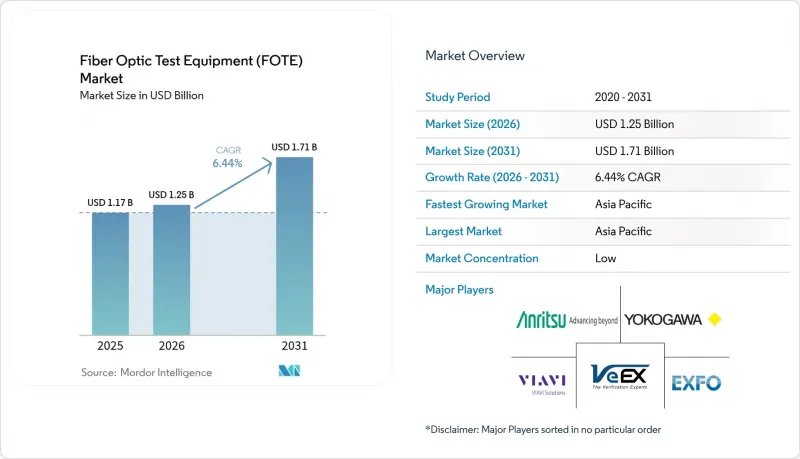
據 Mordor Intelligence 稱,2025 年光纖檢測設備(FOTE) 的市場規模為 11.7 億美元,預計到 2031 年將從 2026 年的 12.5 億美元成長到 17.1 億美元,預測期(2026-2031 年)的複合成長率為 6.44%。
本報告按設備類型(光學光源、光功率和損耗計、光時域反射儀等)、外形規格(手持式、桌上型、機架/模組式)、光纖模式(單模、多模)、最終用戶(電信服務供應商等)和地區進行細分。市場預測以美元計價。
全球光纖檢測設備(FOTE)市場趨勢與洞察
擴大光纖在 5G去程傳輸和回程傳輸的部署。
每個 5G大型基地台和小型基地台的光纖數量是 4G 的十倍,這給連貫反射儀 (OTDR) 平台帶來了前所未有的需求,以檢驗亞毫秒延遲、高階調製一致性和 DWDM 通道間隔。沙烏地電信公司在 2024 年新增了 8035 條專用 5G 光纖回程傳輸線路,這清楚地表明了基礎設施建設的規模,而這種規模如今已成為一級營運商的普遍做法。在人口稠密的都市區,土木工程施工造成的網路中斷十分頻繁,因此,自動故障定位和即時反射率測量對於確保服務水準合規性至關重要。供應商正在透過雙端口設計來解決這個問題,這種設計支援同時進行上行和下行測試,從而減少現場巡檢次數並縮短平均修復時間 (MTTR)。向 5.5G 甚至 6 GHz 頻段的重新分配正在持續推動對更高頻寬光纖的需求,從而支援營運商在其服務區域內更新測量設備。
新興經濟體中光纖到府/光纖到樓(FTTH/B)的快速普及
公共部門的數位化包容目標正推動跨國光纖到府(FTTH)網路向主要都會區以外的地區擴張。奈及利亞將其骨幹光纖網路從3.5萬公里擴展至12.5萬公里的藍圖清楚地展現了這一擴張的規模,也因此催生了對輕便、節能且易於操作的測試設備日益成長的需求,這些設備需要技術人員只需接受最少的培訓即可使用。 BICSI的「安裝人員2級光纖」課程報名人數的激增反映出,認證正在直接加速相容測試設備的採購。波灣合作理事會(GCC)成員國的在地採購義務有利於區域組裝夥伴關係,因為這樣可以縮短設備前置作業時間並處理當地服務物流。隨著光纖部署深入郊區和農村地區,光損耗測量和自動化端面檢測對於滿足與政府補貼相關的合約關鍵績效指標(KPI)至關重要。
連貫OTDR和OSA平台需要高額資本支出(CAPEX)。
隨著連貫光系統的普及,電信業者被迫投資昂貴的高速數位訊號處理器(DSP)和配備超窄線寬雷射的分析儀。小規模的業者通常依賴租賃池和託管測試服務,導致新硬體採購週期延長。強制性校準和高級用戶培訓進一步加重了這一負擔,並推高了總體擁有成本(TCO)。儘管供應商正在試行捆綁韌體更新、自動校準和人工智慧故障分析的訂閱模式以降低准入門檻,但在銷售成長之前,二三線業者對價格的敏感度依然存在。
細分市場分析
遠端光纖測試系統雖然只佔總出貨量的16%,卻已成為成長最快的品類,年複合成長率高達7.98%。電信業者高度重視這項功能,因為它使他們無需派遣人員即可識別數千公里外的故障,從而提高生產效率和網路可用性。儘管如此,預計到2025年,光功率計和光損耗計仍將佔據光纖測試設備市場28.95%的佔有率,其廣泛應用在初始安裝和定期認證中尤為明顯。 EXFO的OTH-7000引入了雲端API,可將測量資料包串流傳輸到營運商的OSS套件,競爭對手正在效倣此功能,以期提升銷售分析訂閱服務的銷售量。
在採購框架中,遠端監控節點與用於故障修復的手持設備捆綁銷售,自動化趨勢愈發明顯。隨著服務等級協定 (SLA) 違約處罰日益嚴格,業者認為即時光時域反射儀 (OTDR) 掃描對於城域環網和長途網路資產都至關重要。整合到頻譜分析儀中的 DWDM 通道分析功能在 400G 和 800G 部署加速的地區越來越受歡迎,而可視化故障定位設備正在發展成為可透過智慧型手機應用程式控制的設備,這些設備能夠自動將影像附加到故障單系統中。
即使到了2025年,手持設備仍將維持51.45%的市佔率。這是因為現場工作人員在故障識別和驗收測試中仍然發揮主導作用。由於技術人員需要在多個地點同時操作多種儀器,因此重量低於1公斤、電池續航力長達8小時已成為標準配備。同時,機架/模組化配置正以7.62%的複合年成長率快速成長,這主要得益於超大規模運營商將測試刀片直接整合到機架頂部交換機中,以實現始終線上可見性。這種方法支援封閉回路型自動化,其中編配軟體會觸發主動光纖清理和重新路由。
桌上型系統適用於製造和研發環境,在這些環境中,測量動態範圍和頻譜保真度比便攜性更為重要。安立公司的μOTDR模組體現了這種小型化趨勢,整合到PXI底盤後,可為OEM廠商提供線上生產測試功能。供應商擴大採用跨不同外形尺寸的通用韌體,使企業能夠利用單一的分析駕駛座,而無需考慮設備類型,從而縮短操作人員培訓時間並減輕支援負擔。
區域分析
預計2025年,亞太地區將為光纖檢測設備市場貢獻4.5億美元。這反映了骨幹網路的持續擴張,以及中國、日本和韓國等市場從GPON到10G PON的過渡。儘管區域製造能力能夠實現快速客製化,但國家安全指南正推動採購國產光纖設備的趨勢日益增強。在東南亞國協,數位經濟政策正在擴大FTTH的覆蓋範圍,並促進攜帶式OTDR的銷售,從而進一步推高市場需求。日本研究機構與韓國公共機構之間的學術合作正在加速連貫可插拔裝置等創新技術的研發,從而維持該地區對高精度測量台的需求。
儘管預計到2025年中東和非洲地區的市場規模僅為9,000萬美元,但由於千兆專案需要安全、高容量的骨幹網,該地區預計將以7.88%的複合年成長率實現該地區最高的成長率。光是沙烏地電信公司的ORYX地面系統就已建成數百公里的光纖線路,這需要持續的監控平台和強大的測試設備。沿岸地區的營運商正在將50G PON先導計畫與400G傳輸相結合,從而產生了對能夠使用統一用戶介面(UI)測試接入線路和長途線路的雙模分析儀的下游需求。新興的非洲市場從奈及利亞的全國骨幹網路建設目標中汲取靈感,正與設備OEM廠商合作,為測試線和適配器等耗材提供客製化培訓和本地化服務。
北美和歐洲在連貫反射儀(OTDR)和光頻譜分析領域保持著技術領先地位,預計到2025年,兩地在測試設備方面的總合支出將達到4.7億美元。在美國,聯邦政府的津貼鼓勵採購符合「建設美國,購買美國貨」標準的設備,而那些在國內組裝設備的供應商也更受青睞。歐盟大力推廣節能型資料中心,這催生了對機架內監控模組的新需求,這些模組能夠將即時功耗資料傳輸到編配堆疊。同時,南美的電信業者正在聯合採購設備,以獲得批量採購折扣和共用物流,這一趨勢有利於模組化多頻段測試儀,因為它們可以降低進口關稅負擔。
其他好處:
- Excel格式的市場預測(ME)表
- 3個月的分析師支持
目錄
第1章:引言
- 研究假設和市場定義
- 調查範圍
第2章:調查方法
第3章執行摘要
第4章 市場狀況
- 市場概覽
- 市場促進因素
- 擴大 5G去程傳輸和回程傳輸的光纖部署
- 新興國家光纖到府/光纖到樓(FTTH/B)普及率的爆炸性成長
- 政府支持農村地區寬頻和電網數位化的措施
- 超大規模資料中心向 PAM4 和 800G光纖通訊的過渡
- 在國防部門採用戰術級耐環境光纖鏈路
- 對自動化、人工智慧驅動的遠端光纖測試系統的需求日益成長。
- 市場限制因素
- 支援連貫技術的OTDR和OSA平台需要大量的資金投入。
- 二、三線城市缺乏合格的光纖技術人員
- 替代方案:將基於DSP的自診斷功能整合到收發器模組中
- 對先進光電元件的地緣政治出口限制
- 價值供應鏈分析
- 監理情勢
- 技術展望
- 波特五力模型
- 新冠疫情及宏觀經濟因素的影響
第5章 市場規模及成長預測(價值,十億美元)
- 依設備類型
- 光源
- LED光源
- 雷射光源
- 光功率和損耗計
- 光時域反射儀
- 頻譜儀
- 遠端光纖測試系統
- 其他(檢查顯微鏡、可視螢光透視儀等)
- 光源
- 按外形規格
- 手持式
- 桌上型
- 機架/模組化
- 光纖模式
- 單模
- 多模式
- 最終用戶
- 電信服務供應商
- 超大規模企業資料中心
- 工業和製造業
- 能源和公共產業(智慧電網、石油和天然氣)
- 政府/國防
- 其他(廣播、醫療、研發)
- 按地區
- 北美洲
- 美國
- 加拿大
- 南美洲
- 巴西
- 阿根廷
- 墨西哥
- 歐洲
- 德國
- 英國
- 法國
- 俄羅斯
- 亞太地區
- 中國
- 日本
- 印度
- 韓國
- 其他亞太國家
- 中東和非洲
- 阿拉伯聯合大公國
- 沙烏地阿拉伯
- 南非
- 北美洲
第6章 競爭情勢
- 市場集中度
- 策略趨勢
- 市佔率分析
- 公司簡介
- EXFO Inc.
- VIAVI Solutions Inc.
- Anritsu Corporation
- Yokogawa Electric Corporation
- AFL Global(Fujikura)
- Fluke Networks
- Keysight Technologies
- VeEX Inc.
- Kingfisher International
- Tektronix(Fortive)
- Deviser Instruments
- Trend Communications
- Corning Inc.
- Photon Kinetics
- Terahertz Technologies
- GAO Tek
- OptoTest
- Luna Innovations
- Tempo Communications
- VI-Systems GmbH
第7章 市場機會與未來展望
According to Mordor Intelligence, the fiber optic test equipment market size was valued at USD 1.17 billion in 2025 and estimated to grow from USD 1.25 billion in 2026 to reach USD 1.71 billion by 2031, at a CAGR of 6.44% during the forecast period (2026-2031).
This report is Segmented by Equipment Type (Optical Light Sources, Optical Power & Loss Meters, Optical Time-Domain Reflectometers, and More), Form Factor (Hand-Held, Benchtop, Rack/Module-based), Fiber Mode Tested (Single-Mode, Multi-Mode), End-User Application (Telecommunications Service Providers, and More), and Geography. The Market Forecasts are Provided in Terms of Value (USD).
Global Fiber Optic Test Equipment (FOTE) Market Trends and Insights
Proliferation of 5G Fronthaul and Backhaul Fiber Deployment
Each standalone 5G macro or small cell multiplies fiber strands tenfold compared with 4G, triggering unprecedented demand for coherent OTDR platforms that validate sub-10 ms latency, high-order modulation integrity, and DWDM channel spacing. Saudi Telecom Company added 8,035 dedicated fiber backhaul routes for 5G in 2024, illustrating the infrastructure intensity now routine among Tier-1 operators. Dense urban builds face frequent civil-works disruptions, making automated fault-localization and real-time reflectometry indispensable for service-level compliance. Equipment vendors answer with dual-port designs that support simultaneous upstream and downstream testing, reducing truck rolls and accelerating mean-time-to-repair. The push toward 5.5G and even 6 GHz spectrum refarming sustains the need for higher-bandwidth fiber, thereby underpinning test-instrument replacement cycles across operator footprints.
Explosion of FTTH/B Roll-outs in Emerging Economies
Public-sector digital-inclusion targets are fueling multi-country FTTH extensions well beyond primary metros. Nigeria's roadmap to stretch backbone fiber from 35,000 km to 125,000 km underscores the scale, demanding lightweight, battery-efficient meters technicians can operate after minimal training. Enrollment in BICSI's Installer 2-Optical Fiber curriculum has surged, reflecting how certification uptake directly boosts procurement of compatible test gear. Local-content mandates in Gulf Cooperation Council economies reward regional assembly partnerships that keep device lead times short and service logistics local. As fiber footprints permeate suburban and rural clusters, optical loss and automated end-face inspection become mandatory to meet contractual KPIs tied to government subsidies.
High CAPEX for Coherent-Ready OTDR and OSA Platforms
Transitioning to coherent optical systems obliges operators to invest in analyzers containing costly high-speed DSPs and ultra-narrow-linewidth lasers. Smaller carriers often resort to rental pools or managed-test services, elongating procurement cycles for new hardware. The burden is magnified by mandatory calibration routines and advanced user training that compound total cost of ownership. Vendors experiment with subscription models that bundle firmware updates, automated calibration, and AI fault-analytics to lower entry barriers, but price sensitivity among Tier-2/3 players persists until unit volumes rise.
Other drivers and restraints analyzed in the detailed report include:
- Government Stimulus for Rural Broadband and Power-Grid Digitalization
- Shift to PAM4 and 800 G Optics in Hyperscale Data Centers
- Shortage of Certified Fiber Technicians in Tier-2/3 Cities
For complete list of drivers and restraints, kindly check the Table Of Contents.
Segment Analysis
Remote fiber test systems, though only 16% of shipments, posted an 7.98% CAGR to become the fastest-expanding category. Operators prize their ability to localize faults across thousands of kilometers without dispatching crews, elevating productivity metrics and boosting network availability. Optical power and loss meters nonetheless retained a 28.95% fiber optic test equipment market share in 2025, underscoring their ubiquity during initial installation and periodic certification. EXFO's OTH-7000 introduced cloud APIs that stream measurement packets into operator OSS suites, a capability replicated by rivals aiming to upsell analytics subscriptions.
The pivot toward automation is even clearer in procurement frameworks that now bundle remote monitoring nodes with hand-held kits for corrective work. As SLA penalties tighten, carriers consider real-time OTDR sweeps indispensable for metro rings and long-haul assets alike. Integrated DWDM channel analysis inside spectrum analyzers wins favor in regions where 400 G and 800 G deployments accelerate, while visual fault locators evolve into smartphone-app-controlled devices that auto-attach images to trouble-ticket systems.
Hand-held testers maintained a 51.45% stake in 2025 because field crews still constitute the frontline of fault isolation and acceptance testing. Weight reduction below 1 kg and eight-hour battery lives are now baseline specifications as technicians juggle multiple instruments during multi-site assignments. The rack/module-based class, however, is expanding at a 7.62% CAGR, propelled by hyperscale operators embedding test blades directly into top-of-rack switches to deliver always-on visibility. This practice supports closed-loop automation where orchestration software triggers pre-emptive fiber cleaning or rerouting.
Benchtop systems serve manufacturing and RandD environments where measurement dynamic range and spectral fidelity trump portability. Anritsu's μOTDR module exemplifies miniaturization trends, slotting into PXI chassis to furnish OEMs with in-line production tests. Vendors increasingly adopt common firmware across form factors, allowing enterprises to leverage a single analytics cockpit regardless of device class, thereby reducing operator learning curves and support effort.
Complete Report Scope:
- By Equipment Type
- Optical Light Sources
- LED Sources
- Laser Sources
- Optical Power and Loss Meters
- Optical Time-Domain Reflectometers
- Optical Spectrum Analyzers
- Remote Fiber Test Systems
- Others (Inspection Microscopes, VFL, etc.)
- Optical Light Sources
- By Form Factor
- Hand-held
- Benchtop
- Rack/Module-based
- By Fiber Mode Tested
- Single-mode
- Multi-mode
- By End-user Application
- Telecommunications Service Providers
- Hyperscale and Enterprise Data Centers
- Industrial and Manufacturing
- Energy and Utilities (Smart-grid, Oil and Gas)
- Government and Defense
- Others (Broadcast, Healthcare, RandD)
- By Geography
- North America
- United States
- Canada
- South America
- Brazil
- Argentina
- Mexico
- Europe
- Germany
- United Kingdom
- France
- Russia
- Asia-Pacific
- China
- Japan
- India
- South Korea
- Rest of Asia-Pacific
- Middle East and Africa
- United Arab Emirates
- Saudi Arabia
- South Africa
- North America
Geography Analysis
Asia-Pacific contributed USD 0.45 billion to the fiber optic test equipment market size in 2025, reflecting unrelenting backbone expansion and the migration from GPON to 10G PON in markets such as China, Japan, and South Korea. Regional manufacturing capacity allows quick-turn customization, while national-security directives tilt procurement toward domestically produced optics. ASEAN countries add incremental demand as digital-economy policies broaden FTTH coverage, catalyzing hand-held OTDR sales. Academic collaboration between research labs in Japan and public institutes in South Korea accelerates innovations like coherent pluggables, sustaining local demand for high-precision measurement benches.
Middle East and Africa, though accounting for just USD 0.09 billion in 2025, registers the highest regional growth at 7.88% CAGR on the back of giga-projects requiring secure, high-capacity backbones. Saudi Telecom Company's ORYX terrestrial system alone contributes hundreds of fiber-route-kilometers that mandate continuous monitoring platforms and ruggedized inspection scopes. Gulf operators pair 50G PON pilots with 400 G transport, creating downstream demand for dual-mode analyzers able to handle access and long-haul tests using a unified UI. Emerging African markets take cues from Nigeria's national backbone targets, collaborating with equipment OEMs for tailored training and localization of consumables such as test leads and adaptors.
North America and Europe retain technological leadership in coherent-ready OTDR and optical-spectrum-analysis, collectively spending USD 0.47 billion on test gear in 2025. Federal grants in the United States incentivize purchase of devices that pass Build America, Buy America criteria, favoring vendors with domestic assembly. The European Union's push for energy-efficient data centers triggers fresh demand for in-rack monitoring modules that feed real-time power-consumption data to orchestration stacks. South American carriers, meanwhile, pool procurement to secure volume discounts and shared logistics, a trend benefiting modular, multi-band testers that alleviate import-duty burdens.
- EXFO Inc.
- VIAVI Solutions Inc.
- Anritsu Corporation
- Yokogawa Electric Corporation
- AFL Global (Fujikura)
- Fluke Networks
- Keysight Technologies
- VeEX Inc.
- Kingfisher International
- Tektronix (Fortive)
- Deviser Instruments
- Trend Communications
- Corning Inc.
- Photon Kinetics
- Terahertz Technologies
- GAO Tek
- OptoTest
- Luna Innovations
- Tempo Communications
- VI-Systems GmbH
Additional Benefits:
- The market estimate (ME) sheet in Excel format
- 3 months of analyst support
TABLE OF CONTENTS
1 INTRODUCTION
- 1.1 Study Assumptions and Market Definition
- 1.2 Scope of the Study
2 RESEARCH METHODOLOGY
3 EXECUTIVE SUMMARY
4 MARKET LANDSCAPE
- 4.1 Market Overview
- 4.2 Market Drivers
- 4.2.1 Proliferation of 5G fronthaul and backhaul fiber deployment
- 4.2.2 Explosion of FTTH/B roll-outs in emerging economies
- 4.2.3 Government stimulus for rural broadband and power grid digitalization
- 4.2.4 Shift to PAM4 and 800 G optics in hyperscale data centers
- 4.2.5 Defense adoption of tactical ruggedized fiber links
- 4.2.6 Growing need for automated, AI-driven remote fiber test systems (under-reported)
- 4.3 Market Restraints
- 4.3.1 High CAPEX for coherent-ready OTDR and OSA platforms
- 4.3.2 Shortage of certified fiber technicians in Tier-2/3 cities
- 4.3.3 Displacement by integrated DSP-based self-test in transceiver modules (under-reported)
- 4.3.4 Geo-political export controls on advanced photonic components (under-reported)
- 4.4 Value / Supply-Chain Analysis
- 4.5 Regulatory Landscape
- 4.6 Technological Outlook
- 4.7 Porter's Five Forces
- 4.7.1 Bargaining Power of Suppliers
- 4.7.2 Bargaining Power of Buyers
- 4.7.3 Threat of New Entrants
- 4.7.4 Threat of Substitutes
- 4.7.5 Intensity of Competitive Rivalry
- 4.8 Impact of COVID-19 and Macro-economic Factors
5 MARKET SIZE AND GROWTH FORECASTS (VALUE, USD BN)
- 5.1 By Equipment Type
- 5.1.1 Optical Light Sources
- 5.1.1.1 LED Sources
- 5.1.1.2 Laser Sources
- 5.1.2 Optical Power and Loss Meters
- 5.1.3 Optical Time-Domain Reflectometers
- 5.1.4 Optical Spectrum Analyzers
- 5.1.5 Remote Fiber Test Systems
- 5.1.6 Others (Inspection Microscopes, VFL, etc.)
- 5.1.1 Optical Light Sources
- 5.2 By Form Factor
- 5.2.1 Hand-held
- 5.2.2 Benchtop
- 5.2.3 Rack/Module-based
- 5.3 By Fiber Mode Tested
- 5.3.1 Single-mode
- 5.3.2 Multi-mode
- 5.4 By End-user Application
- 5.4.1 Telecommunications Service Providers
- 5.4.2 Hyperscale and Enterprise Data Centers
- 5.4.3 Industrial and Manufacturing
- 5.4.4 Energy and Utilities (Smart-grid, Oil and Gas)
- 5.4.5 Government and Defense
- 5.4.6 Others (Broadcast, Healthcare, RandD)
- 5.5 By Geography
- 5.5.1 North America
- 5.5.1.1 United States
- 5.5.1.2 Canada
- 5.5.2 South America
- 5.5.2.1 Brazil
- 5.5.2.2 Argentina
- 5.5.2.3 Mexico
- 5.5.3 Europe
- 5.5.3.1 Germany
- 5.5.3.2 United Kingdom
- 5.5.3.3 France
- 5.5.3.4 Russia
- 5.5.4 Asia-Pacific
- 5.5.4.1 China
- 5.5.4.2 Japan
- 5.5.4.3 India
- 5.5.4.4 South Korea
- 5.5.4.5 Rest of Asia-Pacific
- 5.5.5 Middle East and Africa
- 5.5.5.1 United Arab Emirates
- 5.5.5.2 Saudi Arabia
- 5.5.5.3 South Africa
- 5.5.1 North America
6 COMPETITIVE LANDSCAPE
- 6.1 Market Concentration
- 6.2 Strategic Moves
- 6.3 Market Share Analysis
- 6.4 Company Profiles (includes Global level Overview, Market level overview, Core Segments, Financials as available, Strategic Information, Market Rank/Share for key companies, Products and Services, and Recent Developments)
- 6.4.1 EXFO Inc.
- 6.4.2 VIAVI Solutions Inc.
- 6.4.3 Anritsu Corporation
- 6.4.4 Yokogawa Electric Corporation
- 6.4.5 AFL Global (Fujikura)
- 6.4.6 Fluke Networks
- 6.4.7 Keysight Technologies
- 6.4.8 VeEX Inc.
- 6.4.9 Kingfisher International
- 6.4.10 Tektronix (Fortive)
- 6.4.11 Deviser Instruments
- 6.4.12 Trend Communications
- 6.4.13 Corning Inc.
- 6.4.14 Photon Kinetics
- 6.4.15 Terahertz Technologies
- 6.4.16 GAO Tek
- 6.4.17 OptoTest
- 6.4.18 Luna Innovations
- 6.4.19 Tempo Communications
- 6.4.20 VI-Systems GmbH
7 MARKET OPPORTUNITIES AND FUTURE OUTLOOK
- 7.1 White-space and Unmet-need Assessment
