


 |
市場調查報告書
商品編碼
2123284
聲紋辨識:市場佔有率分析、產業趨勢與統計、成長預測(2026-2031)Voice Biometrics - Market Share Analysis, Industry Trends & Statistics, Growth Forecasts (2026 - 2031) |
||||||

※ 本網頁內容可能與最新版本有所差異。詳細情況請與我們聯繫。
預計聲紋認證市場將從 2025 年的 26.3 億美元成長到 2026 年的 30.6 億美元,然後在 2031 年達到 65.4 億美元,2026 年至 2031 年的複合年成長率為 16.41%。
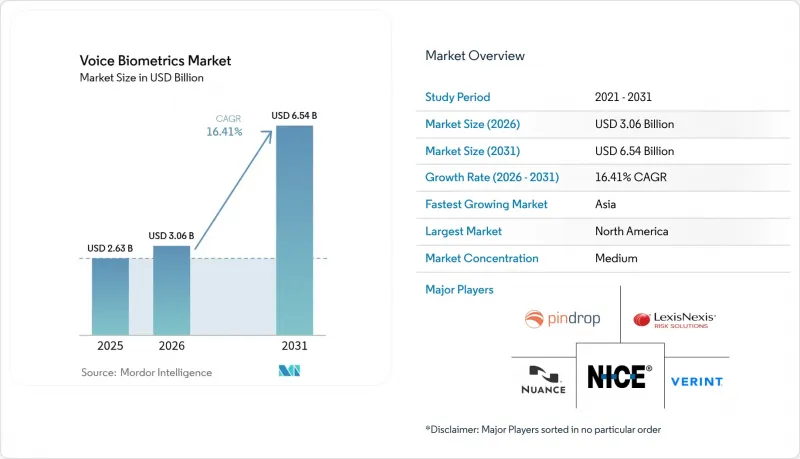
本報告按類型(主動式生物識別和被動式生物識別)、部署模式(本地部署和雲端部署)、企業規模(中小企業和大型企業)、最終用戶產業(銀行、金融服務、保險等)、應用程式(詐欺偵測和預防等)以及地區進行細分。市場預測以美元(USD)計價。
全球聲紋認證市場趨勢及洞察
行動銀行向無密碼認證過渡
銀行和電子錢包提供者正在用語音指紋取代靜態密碼,以降低登入放棄率並防止帳戶劫持詐騙。 81%的客服中心經理已經實施或計劃實施語音認證,而像愛爾蘭銀行這樣的領先金融機構已投資3600萬美元,將語音認證整合到其互動式語音應答(IVR)選單中。這種方法非常適合輸入速度慢且容易出錯的小螢幕,並且可以透過在通話期間進行持續認證來縮短回應時間,從而無需一次性驗證碼。
監管機構對加強客戶身份驗證施加壓力
諸如PSD2、印度儲備銀行指南以及美國即時支付系統等法規要求金融機構使用至少兩種獨立因素來驗證使用者身分。聲紋認證增加了一層獨特的安全保障,無需客戶安裝額外硬體即可滿足合規性要求。歐盟的《人工智慧法案》將語音認證列為高風險類別,要求服務提供者記錄模型管治、偏差檢查和事件回應,這正在加速認證平台的普及。
多語言和方言豐富模型中的偏差
學術基準測試顯示,某些口音、性別和年齡群體(這些數據並未充分反映)的單字辨識錯誤率較高,這引發了人們對公平性的擔憂。這種不平衡會損害信任,延緩公眾採用,並可能違反平等原則。目前,供應商正在擴充其學習語料庫,定期進行偏見審計,並發布透明的模型卡,以消除監管機構和民間社會監督機構的疑慮。
細分市場分析
截至2025年,被動檢驗在聲紋認證市場的市佔率將不到40%,但預計其成長速度將超過整體市場成長速度,複合年成長率(CAGR)將達到18.36%。被動驗證的優點在於能夠在自然對話中驗證來電者身份,無需預設回复,平均處理時間最多可縮短45秒。科羅拉多信用社證實,在取代基於小鍵盤的詢問方式後,被動驗證確實節省了時間。主動驗證仍佔61.20%的市佔率。這是因為指定的短語能夠提供強大的審計追蹤,這對於高價值轉帳和政府機構授權至關重要。此外,混合解決方案也正在出現,這些方案僅在風險評分超過可接受閾值時才會觸發主動驗證。
被動式解決方案受益於邊緣設備運行的即時訊號處理和說話者擴展技術的進步。會話期間的持續監控也有助於偵測帳戶共用和脅迫行為。另一方面,主動式引擎正在推動創新,例如在相容設備上實現更短的密碼短語和無需提示的身份驗證。隨著企業努力在可靠性和易用性之間取得平衡,這兩個領域正在攜手合作,共同推動聲紋認證市場的發展。
即使到了2025年,軟體支出仍將佔總支出的69.10%,這主要得益於核心語音特徵提取庫和模型管理主機。然而,專業服務和託管服務預計將以18.02%的複合年成長率成長,這反映了諸如針對數十種語言的引擎微調、與傳統IVR平台整合以及針對深度造假攻擊的紅隊測試等需求。通訊和業務流程外包商正與專業演算法供應商合作,提供包含託管、調優和持續詐欺監控的承包服務包。
諮詢顧問也會就不斷變化的隱私法律向客戶提供建議,編制資料保護影響評估報告,並設計使用者同意流程。託管服務合約包括針對資料外洩的快速回應團隊和季度偏差報告。隨著這些合約的成熟,與詐欺相關損失減少掛鉤的績效定價模式正變得越來越普遍,業務收益在聲紋認證市場也日趨穩固。
區域分析
北美在聲紋認證市場佔據最大佔有率,這主要得益於銀行、信用卡網路和醫療保健機構的早期採用。由於聯邦法規將聲紋歸類為高度敏感的身份識別訊息,供應商正在部署經 FedRAMP 認證的雲端和加密技術,以滿足政府審計要求。企業網路安全預算資助的客服中心現代化改造進一步推動了市場需求。創業投資也在支持語音安全領域的新創企業,從而持續推動該地區的創新發展。
亞太地區是成長最快的地區。印度的統一支付介面(UPI)和智慧型手機的迅速普及為包容性強、語言無關的身份驗證創造了沃土。在中國,說話者辨識技術正在超級應用生態系統中不斷擴展,而東協電信業者正在整合聲紋認證功能以打擊SIM卡交換詐騙。區域資料本地化法律鼓勵合資企業在境內開展相關項目,並促進國內能力建設。
歐洲擁有先進的基礎設施和全球最嚴格的隱私保護框架之一。由於《人工智慧法案》將說話者識別列為高風險技術,各公司正在部署具備可解釋推理能力和詳細審計日誌的認證工具包。愛爾蘭銀行宣布的3,400萬歐元(3,600萬美元)投資計畫等措施表明,預算仍在分配給那些能夠兼顧合規性和客戶便利性的領域。
拉丁美洲和非洲的絕對支出水準落後於其他地區,但成長潛力巨大。巴西和南非的電信業者正在部署語音互動語音應答(IVR)系統,以減輕營運商的工作量並驗證預付用戶的身份。獨立鐵塔營運商的部署正在擴大4G網路覆蓋範圍,並支援雲端推理。供應商正利用遷移學習和區域特定資料集來應對諸如本地口音多樣性和資源匱乏語言等挑戰,從而擴大聲紋認證市場的適用範圍。
其他好處:
- Excel格式的市場預測(ME)表
- 3個月的分析師支持
目錄
第1章:引言
- 研究假設和市場定義
- 調查範圍
第2章:調查方法
第3章執行摘要
第4章 市場狀況
- 市場概覽
- 市場促進因素
- 行動銀行向無密碼認證過渡
- 監管機構施壓,要求加強客戶身分驗證(PSD2、RBI、FedNow)
- 深度造假詐騙的激增促使客服中心系統進行升級。
- 亞洲新興市場金融科技主導支付市場快速成長
- 企業中零信任架構的日益普及
- 電信業者語音互動語音應答系統的成本降低要求
- 市場限制因素
- 多語言和方言豐富模型中的偏差
- 資料居住限制了雲端採用率。
- 遠端識別與驗證(視訊通話)中的聲學變異性
- 智慧家庭中因背景噪音導致的誤報率較高
- 價值供應鏈分析
- 監理情勢
- 技術展望
- 波特五力模型
- 投資分析
第5章 市場規模與成長預測
- 身份驗證方法
- 主動生物識別
- 被動生物識別
- 按組件
- 軟體/SDK
- 服務(整合、諮詢、管理)
- 按部署模式
- 雲
- 現場
- 按公司規模
- 小型企業
- 大公司
- 通道/網路基地台
- 互動式語音應答/客服中心
- 行動應用
- 網路和自助服務終端
- 智慧型設備/物聯網
- 透過使用
- 詐欺檢測與預防
- 客戶身份驗證和身份核實
- 支付和交易安全
- 勞動力管理/邏輯訪問
- 按最終用途行業分類
- 銀行業、金融服務業及保險業
- 政府和執法機關
- 通訊/IT
- 衛生保健
- 零售、電子商務、消費品
- 運輸和物流
- 其他(教育、酒店管理)
- 按地區
- 北美洲
- 美國
- 加拿大
- 墨西哥
- 南美洲
- 巴西
- 阿根廷
- 其他南美國家
- 歐洲
- 英國
- 德國
- 法國
- 義大利
- 西班牙
- 北歐的
- 其他歐洲國家
- 亞太地區
- 中國
- 印度
- 日本
- 韓國
- ASEAN-5
- 澳洲
- 紐西蘭
- 其他亞太國家
- 中東
- GCC
- 土耳其
- 其他中東國家
- 非洲
- 南非
- 奈及利亞
- 其他非洲國家
- 北美洲
第6章 競爭情勢
- 市場集中度
- 策略趨勢
- 市佔率分析
- 公司簡介
- Nuance Communications Inc.
- NICE Ltd
- Verint Systems Inc.
- Pindrop Security Inc.
- LexisNexis Risk Solutions Inc.
- LumenVox LLC
- Phonexia sro
- Auraya Inc.
- Aculab Plc
- Uniphore Software Systems
- SESTEK
- VoicePIN.com Sp. z oo
- Illuma
- BioCatch Ltd.
- Reality Defender
- Sensory Inc.
- Neustar Inc.
- Veridas
- ID R&D Inc.
- Synaptics Inc.
第7章 市場機會與未來展望
According to Mordor Intelligence, the voice biometrics market size is expected to grow from USD 2.63 billion in 2025 to USD 3.06 billion in 2026 and is forecast to reach USD 6.54 billion by 2031 at 16.41% CAGR over 2026-2031.
This report is Segmented by Type (Active Biometrics and Passive Biometrics), Deployment Model (On-Premises and Cloud), Enterprise Size (Small and Medium Enterprises and Large Enterprises), End-Use Industry (Banking, Financial Services and Insurance, and More), Application (Fraud Detection and Prevention and More), and Geography. The Market Forecasts are Provided in Terms of Value (USD).
Global Voice Biometrics Market Trends and Insights
Transition to password-less authentication in mobile banking
Banks and e-wallet providers substitute static passwords with voiceprints to decrease abandonment during log-in and to stop account-takeover fraud. 81% of contact-center leaders already deploy or plan voice verification, and flagship institutions such as Bank of Ireland invested USD 36 million to embed voice checks into interactive voice response menus. The method suits small screens where typing is slow and error-prone, while continuous authentication during a call trims handle time and removes one-time codes.
Regulatory pressure for strong customer authentication
Rules such as PSD2, the Reserve Bank of India's guidelines, and US instant-payment rails oblige financial firms to prove user identity with at least two independent factors. Voice biometrics adds an inherent layer that satisfies compliance without extra hardware for customers. The EU Artificial Intelligence Act labels voice verification a high-risk category, obliging providers to document model governance, bias testing, and incident response, accelerating procurement of certified platforms.
Bias in multilingual and dialect-rich models
Academic benchmarks show higher word-error rates for under-represented accents, genders, and age groups, triggering fairness debates. Disparities erode trust, slow public roll-outs, and may breach equality directives. Vendors now widen training corpora, run periodic bias audits, and issue transparent model cards to reassure regulators and civil-society observers.
Other drivers and restraints analyzed in the detailed report include:
- Deepfake-driven contact-center upgrades
- Fintech-led payment growth in emerging Asia
- Data-residency rules limiting cloud deployment
For complete list of drivers and restraints, kindly check the Table Of Contents.
Segment Analysis
Passive verification analyzed less than 40% of the voice biometrics market in 2025, yet is forecast to grow faster than the headline rate, moving at 18.36% CAGR. Its appeal lies in authenticating callers during natural conversation, eliminating scripted phrases, and shaving up to 45 seconds from average handle-time. The Credit Union of Colorado confirmed time savings after replacing keypad questions. Active methods retain 61.20% leadership because mandated phrases deliver robust audit trails critical for high-value transfers and government clearances. Hybrid stacks are emerging that trigger active fallback only when risk scores exceed tolerance.
Passive solutions benefit from advances in real-time signal processing and speaker diarization running on edge devices. Continuous monitoring throughout a session also helps detect account sharing and coercion. Meanwhile, active engines innovate with shorter passphrases and promptless verification on supported handsets. The two branches together reinforce the voice biometrics market as enterprises mix assurance and usability.
Software still provided 69.10% of spending in 2025 thanks to core speech-feature extraction libraries and model-management consoles. Yet professional and managed services are projected to advance 18.02% CAGR, reflecting the need to fine-tune engines for dozens of languages, connect to legacy IVR platforms, and run red-team tests against deepfake attacks. Telecom-business-process outsourcers partner with niche algorithm suppliers to offer turnkey packages that bundle hosting, tuning, and continuous fraud monitoring.
Consultants also steer clients through evolving privacy law, draft data-protection-impact assessments, and design consent flows. Managed-service contracts include rapid-response teams for breach events and quarterly bias reporting. As these engagements mature, outcome-based pricing linked to fraud-loss reduction gains traction, embedding service revenue deeper into the voice biometrics market.
Complete Report Scope:
- By Authentication Type
- Active Biometrics
- Passive Biometrics
- By Component
- Software/SDK
- Services (Integration, Consulting, Managed)
- By Deployment Model
- Cloud
- On-premise
- By Enterprise Size
- Small and Medium Enterprises
- Large Enterprises
- By Channel/Access Point
- IVR/Contact Center
- Mobile Apps
- Web and Kiosk
- Smart Devices/IoT
- By Application
- Fraud Detection and Prevention
- Customer Authentication and IDandV
- Payments and Transaction Security
- Workforce Management/Logical Access
- By End-use Industry
- Banking, Financial Services and Insurance
- Government and Law Enforcement
- Telecom and IT
- Healthcare
- Retail, E-commerce and CPG
- Transport and Logistics
- Others (Education, Hospitality)
- By Geography
- North America
- United States
- Canada
- Mexico
- South America
- Brazil
- Argentina
- Rest of South America
- Europe
- United Kingdom
- Germany
- France
- Italy
- Spain
- Nordics
- Rest of Europe
- APAC
- China
- India
- Japan
- South Korea
- ASEAN-5
- Australia
- New Zealand
- Rest of APAC
- Middle East
- GCC
- Turkey
- Rest of Middle East
- Africa
- South Africa
- Nigeria
- Rest of Africa
- North America
Geography Analysis
North America holds the largest portion of the voice biometrics market owing to early adoption by banks, card networks, and healthcare providers. Federal rules classify voiceprints as sensitive identifiers, so vendors deploy FedRAMP-authorized clouds and encryption to satisfy agency audits. Contact-center modernization funded under corporate cyber-resilience budgets further boosts demand. Venture capital also backs speech-security startups, keeping innovation local.
Asia Pacific is the swiftest-growing region. India's unified-payments interface and rapid smartphone uptake create fertile ground for inclusive, language-agnostic authentication. China scales speaker recognition across super-app ecosystems, while ASEAN telcos embed voice liveness to curb SIM-swap fraud. Regional data-localization laws encourage joint ventures that host models inside national borders, stimulating domestic capacity.
Europe combines advanced infrastructure with the world's strictest privacy framework. The Artificial Intelligence Act designates speaker recognition as high-risk, so enterprises procure certified toolkits with explainable inference and detailed audit logs. Investment announcements such as Bank of Ireland's EUR 34 million (USD 36 million) program show that budget still flows where compliance and customer convenience intersect.
Latin America and Africa trail in absolute spend but present sizable upside. Telecom operators in Brazil and South Africa deploy voice-enabled IVR to cut agent workload and verify prepaid subscribers. Independent tower roll-outs have improved 4G coverage, enabling cloud inference. Local accent diversity and low-resource languages are challenges that vendors address through transfer learning and regional datasets, thereby extending reach of the voice biometrics market.
- Nuance Communications Inc.
- NICE Ltd
- Verint Systems Inc.
- Pindrop Security Inc.
- LexisNexis Risk Solutions Inc.
- LumenVox LLC
- Phonexia s.r.o.
- Auraya Inc.
- Aculab Plc
- Uniphore Software Systems
- SESTEK
- VoicePIN.com Sp. z o.o.
- Illuma
- BioCatch Ltd.
- Reality Defender
- Sensory Inc.
- Neustar Inc.
- Veridas
- ID R&D Inc.
- Synaptics Inc.
Additional Benefits:
- The market estimate (ME) sheet in Excel format
- 3 months of analyst support
TABLE OF CONTENTS
1 INTRODUCTION
- 1.1 Study Assumptions and Market Definition
- 1.2 Scope of the Study
2 RESEARCH METHODOLOGY
3 EXECUTIVE SUMMARY
4 MARKET LANDSCAPE
- 4.1 Market Overview
- 4.2 Market Drivers
- 4.2.1 Transition to Password-less Authentication in Mobile Banking
- 4.2.2 Regulatory Pressure for Strong Customer Authentication (PSD2, RBI, FedNow)
- 4.2.3 Surge in Deep-Fake Fraud Driving Contact-Center Upgrades
- 4.2.4 Rapid FinTech-Led Payment Growth in Emerging Asia
- 4.2.5 Growing Adoption of Zero-Trust Architecture in Enterprises
- 4.2.6 Voice-Enabled IVR Cost-Saving Mandates in Telcos
- 4.3 Market Restraints
- 4.3.1 Bias in Multilingual & Dialect-Rich Models
- 4.3.2 Data-Residency Regulations Limiting Cloud Deployment
- 4.3.3 Acoustic Variability in Remote ID&V (Video Calls)
- 4.3.4 High False-Accept Rate from Background Speech in Smart Homes
- 4.4 Value/Supply-Chain Analysis
- 4.5 Regulatory Landscape
- 4.6 Technological Outlook
- 4.7 Porter's Five Forces
- 4.7.1 Bargaining Power of Suppliers
- 4.7.2 Bargaining Power of Buyers
- 4.7.3 Threat of New Entrants
- 4.7.4 Intensity of Competitive Rivalry
- 4.7.5 Threat of Substitutes
- 4.8 Investment Analysis
5 MARKET SIZE AND GROWTH FORECASTS (VALUE)
- 5.1 By Authentication Type
- 5.1.1 Active Biometrics
- 5.1.2 Passive Biometrics
- 5.2 By Component
- 5.2.1 Software/SDK
- 5.2.2 Services (Integration, Consulting, Managed)
- 5.3 By Deployment Model
- 5.3.1 Cloud
- 5.3.2 On-premise
- 5.4 By Enterprise Size
- 5.4.1 Small and Medium Enterprises
- 5.4.2 Large Enterprises
- 5.5 By Channel/Access Point
- 5.5.1 IVR/Contact Center
- 5.5.2 Mobile Apps
- 5.5.3 Web and Kiosk
- 5.5.4 Smart Devices/IoT
- 5.6 By Application
- 5.6.1 Fraud Detection and Prevention
- 5.6.2 Customer Authentication and IDandV
- 5.6.3 Payments and Transaction Security
- 5.6.4 Workforce Management/Logical Access
- 5.7 By End-use Industry
- 5.7.1 Banking, Financial Services and Insurance
- 5.7.2 Government and Law Enforcement
- 5.7.3 Telecom and IT
- 5.7.4 Healthcare
- 5.7.5 Retail, E-commerce and CPG
- 5.7.6 Transport and Logistics
- 5.7.7 Others (Education, Hospitality)
- 5.8 By Geography
- 5.8.1 North America
- 5.8.1.1 United States
- 5.8.1.2 Canada
- 5.8.1.3 Mexico
- 5.8.2 South America
- 5.8.2.1 Brazil
- 5.8.2.2 Argentina
- 5.8.2.3 Rest of South America
- 5.8.3 Europe
- 5.8.3.1 United Kingdom
- 5.8.3.2 Germany
- 5.8.3.3 France
- 5.8.3.4 Italy
- 5.8.3.5 Spain
- 5.8.3.6 Nordics
- 5.8.3.7 Rest of Europe
- 5.8.4 APAC
- 5.8.4.1 China
- 5.8.4.2 India
- 5.8.4.3 Japan
- 5.8.4.4 South Korea
- 5.8.4.5 ASEAN-5
- 5.8.4.6 Australia
- 5.8.4.7 New Zealand
- 5.8.4.8 Rest of APAC
- 5.8.5 Middle East
- 5.8.5.1 GCC
- 5.8.5.2 Turkey
- 5.8.5.3 Rest of Middle East
- 5.8.6 Africa
- 5.8.6.1 South Africa
- 5.8.6.2 Nigeria
- 5.8.6.3 Rest of Africa
- 5.8.1 North America
6 COMPETITIVE LANDSCAPE
- 6.1 Market Concentration
- 6.2 Strategic Moves
- 6.3 Market Share Analysis
- 6.4 Company Profiles {(includes Global level Overview, Market level overview, Core Segments, Financials as available, Strategic Information, Market Rank/Share for key companies, Products and Services, and Recent Developments)}
- 6.4.1 Nuance Communications Inc.
- 6.4.2 NICE Ltd
- 6.4.3 Verint Systems Inc.
- 6.4.4 Pindrop Security Inc.
- 6.4.5 LexisNexis Risk Solutions Inc.
- 6.4.6 LumenVox LLC
- 6.4.7 Phonexia s.r.o.
- 6.4.8 Auraya Inc.
- 6.4.9 Aculab Plc
- 6.4.10 Uniphore Software Systems
- 6.4.11 SESTEK
- 6.4.12 VoicePIN.com Sp. z o.o.
- 6.4.13 Illuma
- 6.4.14 BioCatch Ltd.
- 6.4.15 Reality Defender
- 6.4.16 Sensory Inc.
- 6.4.17 Neustar Inc.
- 6.4.18 Veridas
- 6.4.19 ID R&D Inc.
- 6.4.20 Synaptics Inc.
7 MARKET OPPORTUNITIES AND FUTURE OUTLOOK
- 7.1 White-space and Unmet-Need Assessment

 語音生物識別市場-2026-2032年全球市場預測語音生物識別解決方案市場:2026-2032年全球市場預測(按認證類型、組件、應用、最終用戶和部署模式分類)
 語音生物識別市場:按類型、部署方式、產業和地區分類
 語音生物識別市場分析及預測(至2035年):類型、產品類型、服務、技術、組件、應用、部署模式、最終用戶、功能、解決方案
 2026年全球語音生物辨識市場報告
 語音生物識別市場預測至2034年:按組件、部署模式、最終用戶和地區分類的全球分析
 語音生物識別市場 - 全球產業規模、佔有率、趨勢、機會及預測(按類型、部署模式、產業垂直領域、應用、地區和競爭格局分類,2021-2031年)
 語音生物辨識市場規模、佔有率、成長及全球產業分析:依類型、應用和地區劃分的洞察與未來預測(2026-2034)
 語音生物識別解決方案市場規模、佔有率和成長分析(按認證方法、解決方案類型、部署類型、產業垂直領域和地區分類)-2026-2033年產業預測
 語音生物辨識市場規模、佔有率和成長分析(按部署類型、產業垂直領域、公司規模和地區分類)-2026-2033年產業預測