

 |
市場調查報告書
商品編碼
2123158
電動工具電池:市場佔有率分析、產業趨勢與統計、成長預測(2026-2031)Power Tool Batteries - Market Share Analysis, Industry Trends & Statistics, Growth Forecasts (2026 - 2031) |
||||||

※ 本網頁內容可能與最新版本有所差異。詳細情況請與我們聯繫。
根據 Mordor Intelligence 估計,2026 年電動工具電池的市場規模為 37.2 億美元,預計在預測期(2026-2031 年)內將以 10.09% 的複合年成長率成長,到 2031 年達到 60.2 億美元。
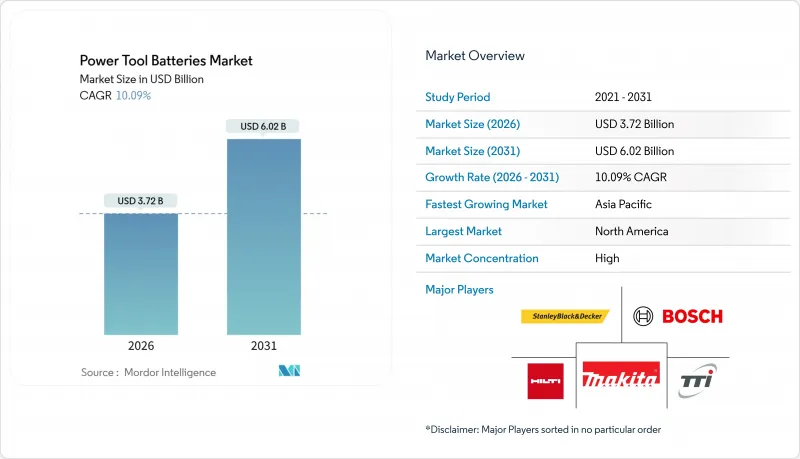
本報告按電池化學成分(鋰離子、鎳鎘、鎳氫和新興技術)、電池形狀(圓柱形、棱柱形、軟包)、電壓等級(低於 12 V、12–18 V、高於 18 V)、應用(商用/工業工具、戶外動力設備等)和地區(北美、歐洲、亞太地區、分類、南美、中東和非洲)進行分類。
全球電動工具電池市場趨勢與洞察
有線工具向無線工具的轉變正在加速。
到2025年,由於美國職業安全與健康管理局 (OSHA) 推出了關於墜落風險的指導方針,以及鋰離子電池成本的下降,北美專業建築行業無線工具的普及率將超過78%,這顯著降低了無線工具的總擁有成本 (TCO)。建設產業) 報告稱,2024年上半年無線產品的銷量年增14%,而有繩產品的銷量則下降了6%,這印證了需求結構的重組。在歐洲,超過5萬歐元的公共工程合約中,使用零排放工具已成為強制性要求,迫使地方政府轉向使用電池驅動工具。在東南亞,無線工具市場發展落後,市佔率僅40%,但在印尼和菲律賓,離網太陽能發電和儲能計畫正在推動其普及。這些變化共同推動了電動工具電池市場兩位數的成長。
鋰離子電池能量密度和運作時間的快速提升
由於矽負極和電解的改進,鎳錳鈷電池的能量密度預計到2025年將達到285 Wh/kg,比2022年增加12%。三星SDI的第五代圓柱形電芯在保持21700尺寸不變的情況下,將運作時間延長了20%,使牧田公司能夠生產更輕的18伏6安時電池組。 LG能源解決方案公司已證明其電池在80%放電深度下可循環使用1800次,從而為建築公司降低了30%的年度電池更換成本。磷酸鋰鐵鋰電池雖然能量密度低15%,但由於其3000次的循環壽命,正受到注重成本的消費者的青睞。 QuantumScape和Solid Power的固態電池試驗生產線可望將產量提高40%,但2028年之前不太可能實現大規模生產。
鋰離子電池初始成本高
商用電池組的零售價格介於120美元至250美元之間,約佔整套無線工具價格的30%至50%。這阻礙了印度和東南亞小規模承包商對無線工具的接受度,因為價格差異超過了兩週的工資。儘管預計到2025年,每組電池的成本將降至每千瓦時110美元以下,但原始設備製造商(OEM)仍維持著2.5至3倍的加價。在印度,無線工具的普及率仍低於35%,因為成本負擔優先於生產力提升。零售商推出的免利息分期付款政策使得2024年首次購買無線工具的用戶附件率提高了18%。寧德時代(CATL)的「電芯到電池組」架構預計在2027年之前將電池組價格降低15%,這對電動工具電池產業來說無疑是個好消息。
細分市場分析
2025年,鋰離子電池在電動工具電池市場仍維持62.9%的市場佔有率,這得益於鎳錳鈷合金和鎳鈷鋁合金的優勢,它們能夠維持40A的放電電流和285Wh/kg的能量密度。歐盟禁用鎘後,鎳鎘電池的市佔率跌至個位數,而鎳氫電池僅在照明等小眾領域勉強維持。隨著原始設備製造商(OEM)尋求具有固有熱穩定性並能避免鎳供應波動風險的化學體系,固態固態電池、鈉離子電池和鋰硫電池等新興技術預計將在2031年前以21.5%的複合年成長率成長。
儘管一款固態電池原型在2025年的試點生產線上實現了800Wh/L的能量密度,但良率仍低於60%,商業化至少要延後到2028年。寧德時代(CATL)的鈉離子電池能量密度達到160Wh/kg,成本僅為鋰離子電池的三分之一,因此適用於對重量要求不高的入門級消費性電子產品。磷酸鋰鐵鋰電池雖然能量密度低15%,但由於其3000次循環壽命和穩定的熱性能,目前正被廣泛用作戶外設備的電源。美國能源局向國內固態電池工廠津貼2億美元,顯示其政策支持能夠使供應鏈多元化的電池技術。這些變革在豐富電池技術組合的同時,也維持了電動工具電池的整體市場。
到2025年,圓柱形電池將佔電動工具電池市場42.5%的佔有率。這得歸功於18650和21700電池生產線的快速發展,使其成本降至每千瓦時100美元以下。軟包電池的年複合成長率(CAGR)為22.2%,體積效率達15%,散熱性能更佳。這使得史丹利百得的「POWERSTACK」電池組能夠在2安時的尺寸下提供相當於4安時的運作時間。
受 Milwaukee 和Ryobi等訂單的推動,LG Energy Solutions 預計 2025 年其軟包電池產量將增加 38%。這兩家公司優先考慮用於高空作業的輕型電池組。棱柱形電池在高壓應用領域仍保持 15% 的市場佔有率,其堅固的機殼有助於散熱。製造流程的複雜性限制了軟包電池的普及;軟性層壓材料需要加固的機殼和精細的自動化加工。然而,將於 2024 年生效的 IEC 62133-2 釘穿透標準將規範安全標準,並可能加速模具投資。Panasonic將於 2024 年推出的混合電池組,結合了圓柱形能量電池和軟包電池,展現了電動工具電池行業產品形式的多樣化趨勢。
區域分析
2025年,北美地區的銷售額佔全球總銷售額的39.3%。這主要得益於專業級無線工具78%的市場滲透率,以及由於無刷技術的普及而帶來的高更換週期。鑑於電工的平均時薪為62美元,儘管電池價格較高,但電工越來越願意採用能提高生產效率的電池平台。加拿大基礎設施的改善推動了專業工具需求成長9%,而墨西哥的近岸外包則促進了工業電池銷售成長14%,從而擴大了該地區電動工具電池的市場規模。高壓產品的普及程度在美國最為領先,預計到2025年,60伏特和80伏電池組將佔商用銷售額的22%。
亞太地區預計將成為成長最快的地區,到2031年複合年成長率將達到15.9%,這主要得益於三星SDI在泰米爾納德邦建設的15吉瓦時工廠以及寧德時代在印尼擴建鎳基儲能設施以降低供應鏈風險。中國市場預計將在2025年成長18%,這主要得益於新都市區建設和電商向三線城市的配送。儘管印度的無線產品滲透率仍維持在35%,但由於2024年開始實施的電池生產連結獎勵計畫(PLI)等政策利好,LG能源解決方案和比亞迪等公司正在加大投資。在澳洲和紐西蘭,戶外設備的電氣化進程正在加速,預計當地的排放法規將使電池驅動的割草機在2025年佔零售額的40%。
2025年,歐洲將佔全球市場佔有率的24%,並受到歐盟電池法規的影響,該法規要求在2030年電池回收率達到70%,鋰回收率達95%。在德國,零排放建築補貼推動了商用電池市場7%的成長,而在英國,勞動力短缺導致市場萎縮了3%。北歐國家禁止使用汽油動力割草機,使得該地區電池動力戶外工具的銷量增加了16%,但由於制裁,俄羅斯的市場規模仍然有限,鎳鎘電池繼續佔據當地市場30%的佔有率。南美和中東的銷售額合計佔全球市場的8%,這得益於巴西建設產業的復甦和阿拉伯聯合大公國的大型企劃,但價格差異和分銷挑戰限制了其成長。
其他好處:
- Excel格式的市場預測(ME)表
- 3個月的分析師支持
目錄
第1章:引言
- 市場分析與定義的前提條件
- 分析範圍
第2章 分析方法
第3章執行摘要
第4章 市場狀況
- 市場概覽
- 市場促進因素
- 有線工具向無線工具的轉變正在加速。
- 鋰離子電池能量密度和運行時間的快速提升
- OEM 18V/20V平台擴展
- 隨著無刷馬達的日益普及,放電需求也不斷成長。
- 60V+重型無線產品類型。
- 由於有關「維修權」的法律訂定,售後電池的銷售正在擴大。
- 市場限制因素
- 鋰離子電池組的初始成本很高。
- 過熱導致的產品召回損害了消費者信心。
- 鎳和石墨供應的波動給利潤率帶來了壓力。
- 品牌封閉的電池生態系統限制了與其他公司產品的兼容性。
- 供應鏈分析
- 監理情勢
- 技術趨勢(先進化學技術、BMS)
- 波特五力分析
第5章:預測市場規模與成長率
- 電池化學成分
- 鋰離子
- 鎳和鎘
- 鎳氫電池
- 新興技術
- 按細胞形狀
- 圓柱形
- 矩形的
- 袋式
- 電壓等級
- 12伏特或更低
- 12~18 V
- 18V 或更高(包括 60V高功率型)
- 透過使用
- 商用/工業工具
- 面向一般消費者的DIY工具
- 戶外電動設備
- 特殊無線系統
- 按地區
- 北美洲
- 美國
- 加拿大
- 墨西哥
- 歐洲
- 德國
- 英國
- 法國
- 義大利
- 西班牙
- 北歐國家
- 俄羅斯
- 其他歐洲國家
- 亞太地區
- 中國
- 印度
- 日本
- 韓國
- 東南亞國協
- 澳洲和紐西蘭
- 其他亞太國家
- 南美洲
- 巴西
- 阿根廷
- 智利
- 其他南美國家
- 中東和非洲
- 沙烏地阿拉伯
- 阿拉伯聯合大公國
- 南非
- 埃及
- 其他中東和非洲國家
- 北美洲
第6章 競爭情勢
- 市場集中度
- 策略趨勢(併購、聯盟、購電協議)
- 市場佔有率分析(主要公司的市場排名和市場佔有率)
- 公司簡介
- Robert Bosch GmbH
- Stanley Black & Decker Inc.
- Techtronic Industries Co. Ltd.
- Makita Corporation
- Hilti Corporation
- Hitachi Koki Holdings Co. Ltd.(Hikoki)
- Panasonic Corporation
- Samsung SDI Co. Ltd.
- LG Energy Solution
- Sony Group Corp./Murata Mfg.
- Atlas Copco AB
- Snap-on Incorporated
- CATL
- BYD Company Ltd.
- EVE Energy Co. Ltd.
- Metabo(HPT)
- Festool GmbH
- Skil Power Tools
- Positec Group(Worx)
- Chervon Holdings(eg Ego Power+)
第7章 市場機會與未來展望
According to Mordor Intelligence, the power tool batteries market size is estimated at USD 3.72 billion in 2026, and is expected to reach USD 6.02 billion by 2031, at a CAGR of 10.09% during the forecast period (2026-2031).
This report is Segmented by Battery Chemistry (Lithium-Ion, Nickel-Cadmium, Nickel-Metal Hydride, and Emerging Technologies), Cell Format (Cylindrical, Prismatic, and Pouch), Voltage Class (Up To 12 V, 12 To 18 V, and Above 18 V), Application (Professional/Industrial Tools, Outdoor Power Equipment, and More), and Geography (North America, Europe, Asia-Pacific, South America, and Middle East and Africa).
Global Power Tool Batteries Market Trends and Insights
Accelerating Shift from Corded to Cordless Tools
Cordless penetration crossed 78% in North American professional construction during 2025 after OSHA trip-hazard guidelines and falling lithium-ion costs tipped total cost-of-ownership economics decisively toward cordless. Techtronic Industries reported 14% year-over-year cordless revenue growth in H1 2024 while corded sales fell 6%, confirming structural demand realignment. European public-works contracts above EUR 50,000 now specify zero-emission tools, pushing municipalities to battery platforms. Southeast Asian markets lag at 40% cordless share, but off-grid solar-plus-storage projects are spurring adoption in Indonesia and the Philippines. Collectively, these shifts underpin the double-digit expansion of the power tool battery market.
Rapid Gains in Li-ion Energy Density and Runtime
Nickel-manganese-cobalt energy density reached 285 Wh/kg in 2025, a 12% jump since 2022, due to silicon-anode and electrolyte tuning. Samsung SDI's fifth-generation cylindrical cells extend runtime by 20% in the same 21700 footprint, enabling Makita's lighter 18-volt, 6 Ah packs. LG Energy Solution disclosed 1,800-cycle durability at 80% depth-of-discharge, trimming annual battery replacement cost by 30% for contractors. Lithium-iron-phosphate is winning cost-sensitive consumer segments by offering a 3,000-cycle life despite a 15% density penalty. Solid-state pilot lines at QuantumScape and Solid Power promise 40% volumetric gains, but mass production before 2028 is unlikely.
High Upfront Cost of Li-ion Packs
Professional packs retail between USD 120 and USD 250, equal to 30-50% of a cordless kit price, slowing uptake among small contractors in India and Southeast Asia, where the premium exceeds two weeks' wages. OEM mark-ups of 2.5-3X persist despite pack-level costs falling below USD 110 per kWh in 2025. India's cordless penetration remains under 35% because affordability outweighs productivity gains. Retailers introduced zero-interest financing that lifted attachment rates 18% among first-time cordless buyers in 2024. CATL's cell-to-pack architecture could shave 15% from pack prices by 2027, offering relief to the power tool battery industry.
Other drivers and restraints analyzed in the detailed report include:
- OEM 18-Volt and 20-Volt Platform Expansion
- Emergence of 60-Volt and Above Heavy-Duty Cordless Category
- Thermal-Runaway Recalls Denting Consumer Trust
For complete list of drivers and restraints, kindly check the Table Of Contents.
Segment Analysis
Lithium-ion retained 62.9% power tool battery market share in 2025 on the strength of nickel-manganese-cobalt and nickel-cobalt-aluminum blends that sustain 40 A discharge and 285 Wh/kg energy density. Nickel-cadmium receded to a single-digit share after EU cadmium bans, and nickel-metal-hydride persists only in niche lighting. The emerging-technologies cluster, solid-state, sodium-ion, and lithium-sulfur, will expand at 21.5% CAGR through 2031 as OEMs hedge against nickel supply shocks and seek chemistries with intrinsic thermal stability.
Solid-state prototypes recorded 800 Wh/L in 2025 pilot lines yet suffer sub-60% yields, delaying commercialization until at least 2028. CATL's sodium-ion cells deliver 160 Wh/kg at one-third lithium-ion cost, suiting entry-level consumer tools where weight is secondary. Lithium-iron-phosphate now powers outdoor equipment thanks to 3,000-cycle durability and benign thermal behavior, despite 15% energy-density sacrifice. U.S. Department of Energy grants totaling USD 200 million to domestic solid-state plants illustrate policy backing for chemistries that diversify supply chains. These shifts diversify chemistry portfolios while sustaining the broader power tool battery market.
Cylindrical cells accounted for 42.5% of the power tool battery market size in 2025, benefiting from high-speed 18650 and 21700 manufacturing lines that drive costs below USD 100 per kWh. Pouch cells are expanding at 22.2% CAGR because they deliver 15% volumetric efficiency and superior heat dissipation, enabling Stanley Black & Decker's POWERSTACK packs to match 4 Ah runtime in a 2 Ah footprint.
LG Energy Solution grew pouch output 38% in 2025 on orders from Milwaukee and Ryobi, which prioritize lighter packs for overhead work. Prismatic cells maintain a 15% niche share in high-voltage applications where rigid enclosures aid heat sinking. Manufacturing complexity limits pouch adoption, flexible laminates need reinforced casings and careful automated handling, yet IEC 62133-2 nail-penetration rules enacted in 2024 standardize safety benchmarks and may accelerate tooling investments. Hybrid packs mixing cylindrical energy cells with pouch power cells, introduced by Panasonic in 2024, indicate format pluralism in the power tool battery industry.
Complete Report Scope:
- By Battery Chemistry
- Lithium-ion
- Nickel-Cadmium
- Nickel-Metal Hydride
- Emerging Technologies
- By Cell Format
- Cylindrical
- Prismatic
- Pouch
- By Voltage Class
- Up to 12 V
- 12 to 18 V
- Above 18 V (incl. 60 V high-power)
- By Application
- Professional/Industrial Tools
- Consumer DIY Tools
- Outdoor Power Equipment
- Specialty Cordless Systems
- By Geography
- North America
- United States
- Canada
- Mexico
- Europe
- Germany
- United Kingdom
- France
- Italy
- Spain
- NORDIC Countries
- Russia
- Rest of Europe
- Asia-Pacific
- China
- India
- Japan
- South Korea
- ASEAN Countries
- Australia and New Zealand
- Rest of Asia-Pacific
- South America
- Brazil
- Argentina
- Chile
- Rest of South America
- Middle East and Africa
- Saudi Arabia
- United Arab Emirates
- South Africa
- Egypt
- Rest of Middle East and Africa
- North America
Geography Analysis
North America held 39.3% of revenue in 2025, anchored by 78% professional cordless penetration and high replacement cycles fueled by brushless upgrades. Electricians earn USD 62 per hour, incentivizing productivity-enhancing battery platforms despite premium prices. Canada's infrastructure push lifted professional tool demand 9%, and Mexico's nearshoring lifted industrial battery sales 14%, expanding the regional power tool battery market size. High-voltage adoption is deepest in the U.S., where 60-volt and 80-volt packs formed 22% of professional sales in 2025.
Asia-Pacific is the fastest-growing region at 15.9% CAGR through 2031, driven by Samsung SDI's 15 GWh Tamil Nadu plant and CATL's Indonesian nickel-backed expansion that lowers supply-chain risk. China's market soared 18% in 2025, pushed by urban new-builds and e-commerce distribution into tier-3 cities. India lags at 35% cordless penetration, but gains policy tailwinds from 2024 battery PLI incentives, attracting LG Energy Solution and BYD investments. Australia and New Zealand accelerated outdoor equipment electrification, with battery mowers reaching 40% of 2025 retail sales due to local emissions ordinances.
Europe accounted for 24% in 2025, shaped by the EU Battery Regulation mandating 70% collection and 95% lithium recovery by 2030. Germany posted 7% professional battery growth on zero-emission construction subsidies, while the U.K. contracted 3% amid labor shortages. Nordic bans on gasoline lawn equipment pushed battery outdoor tools up 16% regionally, whereas Russia remained subscale due to sanctions, with nickel-cadmium retaining 30% local share. South America and the Middle East combined for 8% of global revenue, buoyed by Brazil's construction rebound and UAE mega-projects, yet constrained by affordability gaps and distribution challenges.
- Robert Bosch GmbH
- Stanley Black & Decker Inc.
- Techtronic Industries Co. Ltd.
- Makita Corporation
- Hilti Corporation
- Hitachi Koki Holdings Co. Ltd. (Hikoki)
- Panasonic Corporation
- Samsung SDI Co. Ltd.
- LG Energy Solution
- Sony Group Corp. / Murata Mfg.
- Atlas Copco AB
- Snap-on Incorporated
- CATL
- BYD Company Ltd.
- EVE Energy Co. Ltd.
- Metabo (HPT)
- Festool GmbH
- Skil Power Tools
- Positec Group (Worx)
- Chervon Holdings (eg Ego Power+)
Additional Benefits:
- The market estimate (ME) sheet in Excel format
- 3 months of analyst support
TABLE OF CONTENTS
1 Introduction
- 1.1 Study Assumptions & Market Definition
- 1.2 Scope of the Study
2 Research Methodology
3 Executive Summary
4 Market Landscape
- 4.1 Market Overview
- 4.2 Market Drivers
- 4.2.1 Accelerating shift from corded to cordless tools
- 4.2.2 Rapid gains in Li-ion energy density & runtime
- 4.2.3 OEM 18-V/20-V platform expansion
- 4.2.4 Brushless-motor penetration raising discharge demand
- 4.2.5 Emergence of 60-V+ heavy-duty cordless category
- 4.2.6 Right-to-repair laws lifting aftermarket battery sales
- 4.3 Market Restraints
- 4.3.1 High upfront cost of Li-ion packs
- 4.3.2 Thermal-runaway recalls denting consumer trust
- 4.3.3 Nickel & graphite supply volatility squeezing margins
- 4.3.4 Brand-locked battery ecosystems limiting cross-compatibility
- 4.4 Supply-Chain Analysis
- 4.5 Regulatory Landscape
- 4.6 Technological Outlook (advanced chemistries, BMS)
- 4.7 Porter's Five Forces
- 4.7.1 Bargaining Power of Suppliers
- 4.7.2 Bargaining Power of Buyers
- 4.7.3 Threat of New Entrants
- 4.7.4 Threat of Substitutes
- 4.7.5 Competitive Rivalry
5 Market Size & Growth Forecasts
- 5.1 By Battery Chemistry
- 5.1.1 Lithium-ion
- 5.1.2 Nickel-Cadmium
- 5.1.3 Nickel-Metal Hydride
- 5.1.4 Emerging Technologies
- 5.2 By Cell Format
- 5.2.1 Cylindrical
- 5.2.2 Prismatic
- 5.2.3 Pouch
- 5.3 By Voltage Class
- 5.3.1 Up to 12 V
- 5.3.2 12 to 18 V
- 5.3.3 Above 18 V (incl. 60 V high-power)
- 5.4 By Application
- 5.4.1 Professional/Industrial Tools
- 5.4.2 Consumer DIY Tools
- 5.4.3 Outdoor Power Equipment
- 5.4.4 Specialty Cordless Systems
- 5.5 By Geography
- 5.5.1 North America
- 5.5.1.1 United States
- 5.5.1.2 Canada
- 5.5.1.3 Mexico
- 5.5.2 Europe
- 5.5.2.1 Germany
- 5.5.2.2 United Kingdom
- 5.5.2.3 France
- 5.5.2.4 Italy
- 5.5.2.5 Spain
- 5.5.2.6 NORDIC Countries
- 5.5.2.7 Russia
- 5.5.2.8 Rest of Europe
- 5.5.3 Asia-Pacific
- 5.5.3.1 China
- 5.5.3.2 India
- 5.5.3.3 Japan
- 5.5.3.4 South Korea
- 5.5.3.5 ASEAN Countries
- 5.5.3.6 Australia and New Zealand
- 5.5.3.7 Rest of Asia-Pacific
- 5.5.4 South America
- 5.5.4.1 Brazil
- 5.5.4.2 Argentina
- 5.5.4.3 Chile
- 5.5.4.4 Rest of South America
- 5.5.5 Middle East and Africa
- 5.5.5.1 Saudi Arabia
- 5.5.5.2 United Arab Emirates
- 5.5.5.3 South Africa
- 5.5.5.4 Egypt
- 5.5.5.5 Rest of Middle East and Africa
- 5.5.1 North America
6 Competitive Landscape
- 6.1 Market Concentration
- 6.2 Strategic Moves (M&A, Partnerships, PPAs)
- 6.3 Market Share Analysis (Market Rank/Share for key companies)
- 6.4 Company Profiles (includes Global level Overview, Market level overview, Core Segments, Financials as available, Strategic Information, Products & Services, and Recent Developments)
- 6.4.1 Robert Bosch GmbH
- 6.4.2 Stanley Black & Decker Inc.
- 6.4.3 Techtronic Industries Co. Ltd.
- 6.4.4 Makita Corporation
- 6.4.5 Hilti Corporation
- 6.4.6 Hitachi Koki Holdings Co. Ltd. (Hikoki)
- 6.4.7 Panasonic Corporation
- 6.4.8 Samsung SDI Co. Ltd.
- 6.4.9 LG Energy Solution
- 6.4.10 Sony Group Corp. / Murata Mfg.
- 6.4.11 Atlas Copco AB
- 6.4.12 Snap-on Incorporated
- 6.4.13 CATL
- 6.4.14 BYD Company Ltd.
- 6.4.15 EVE Energy Co. Ltd.
- 6.4.16 Metabo (HPT)
- 6.4.17 Festool GmbH
- 6.4.18 Skil Power Tools
- 6.4.19 Positec Group (Worx)
- 6.4.20 Chervon Holdings (eg Ego Power+)
7 Market Opportunities & Future Outlook
- 7.1 White-space & Unmet-need Assessment

 電動工具電池市場-全球市場預測(2026-2032)
 電動工具電池市場規模、佔有率和成長分析:按電池類型、電壓範圍、應用、容量、最終用戶、分銷管道和地區分類-2026-2033年產業預測
 2026-2030年全球電動工具電池市場
 電動工具替換電池市場報告:趨勢、預測與競爭分析(至2035年)
 2026年全球電動工具電池市場報告
 電動工具電池市場 - 全球產業規模、佔有率、趨勢、機會、預測:按類型、工具、應用、地區和競爭格局分類,2021-2031年
 電動工具電池的全球市場
 美國電動工具電池市場規模、佔有率和趨勢分析報告:按類型、應用和細分市場預測,2025-2030 年電動工具電池市場規模、佔有率、趨勢分析報告:按類型、應用、地區、細分市場預測,2025-2030 年
 2030年電動工具電池市場預測:按電池類型、工具類型、電壓範圍、銷售管道、應用和地區進行的全球分析