


 |
市場調查報告書
商品編碼
2123151
視覺檢測設備:市場佔有率分析、產業趨勢及統計、成長預測(2026-2031)Surface Vision & Inspection Equipment - Market Share Analysis, Industry Trends & Statistics, Growth Forecasts (2026 - 2031) |
||||||

※ 本網頁內容可能與最新版本有所差異。詳細情況請與我們聯繫。
根據 Mordor Intelligence 預測,視覺偵測設備的市場規模預計將從 2025 年的 47.2 億美元成長到 2026 年的 50.9 億美元,然後在 2031 年達到 74.6 億美元,2026 年至 2031 年的複合年成長率為 7.93%。
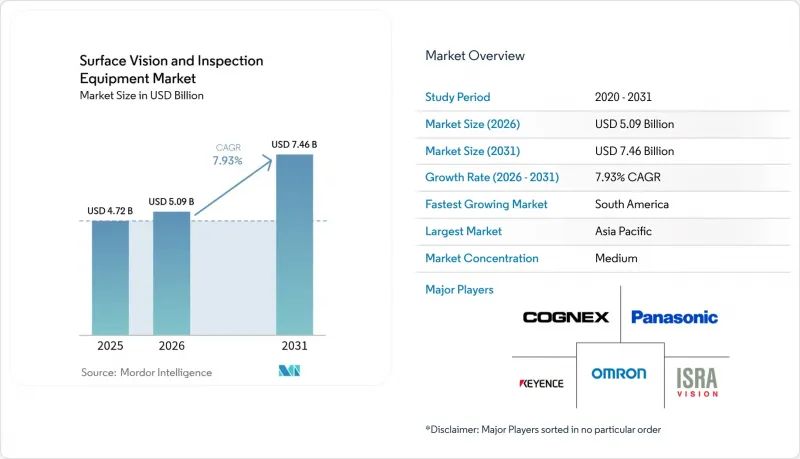
本報告按組件(攝影機、照明設備等)、系統類型(2D視覺系統、3D視覺系統、人工智慧視覺系統)、部署模式(線上檢測、離線檢測等)、應用產業(汽車、電氣電子等)和地區進行細分。市場預測以美元計價。
全球視覺檢測設備市場趨勢與分析
以低成本提高生產效率的需求日益成長。
自動化檢測技術的應用使製造商能夠將檢查週期從幾分鐘縮短到幾秒鐘,同時保持99%以上的檢測精度。例如,一個切削刀具系統運作檢測(assemblymag.com)。在中國,一些電子工廠採用「暗工廠」模式,實現了全天候生產,節能效果高達15-20%。因此,降低成本的壓力進一步提升了視覺檢測設備市場在離散製造和流程製造業的重要性。
精密產業對「零缺陷」品質的需求日益成長。
在尖端半導體節點、電動車電池組和植入式醫療設備領域,即使是最細微的潛在缺陷也是不可接受的。例如,Onto Innovation公司報告稱,2025年第一季與DRAM和環柵(GAA)結構相關的銷售額有所成長,凸顯了檢測對晶圓良率的直接影響。同樣,電池製造商正在實施全天候視覺分析,以防止下游製程出現安全問題。因此,視覺檢測設備市場正在推動高可靠性領域資本配置的成長。
熟練的視覺工程師短缺以及整合的複雜性。
僅19.5%的韓國中小企業表示已實施智慧工廠,並指出缺乏技術專長是最大的障礙。康耐視正透過將17%的收入投入研發,並透過低程式碼介面簡化設置,來解決勞動力短缺問題。然而,人力資本的限制仍然限制視覺檢測設備市場短期內的成長速度。
細分市場分析
預計到2025年,相機將佔總銷售額的43.60%,鞏固其作為任何偵測系統基礎組件的地位。感測器解析度、影格速率和紫外線靈敏度的提升,正在擴大半導體後端和微型LED生產線中可偵測缺陷的範圍。照明和光學元件與這些相機緊密配合,能夠可視化拋光金屬表面上的細微刮痕或檢測透明基板中的空隙。這一細分市場的規模構成了視覺檢測設備市場的支柱,同時也有助於獲得配套光學元件和影像擷取卡的批量折扣。
儘管人工智慧視覺平台市場規模較小,但預計到2031年將以9.08%的複合年成長率成長。將卷積類神經網路直接整合到智慧相機中,可以降低以往需要主機進行推理的延遲。康耐視(Cognex)於2024年4月推出的人工智慧整合3D設備,展示了供應商如何將多個子系統整合到單一機殼中。這種融合有望重塑成本結構,並擴展整個視覺檢測設備市場的應用情境。
由於條碼讀取、存在檢測和標籤檢驗等應用幾乎不需要深度數據,2D視覺仍保持 62.30% 的市場佔有率。隨著生產線速度的提升,這些傳統應用透過逐步升級持續創造效益。同時,人工智慧賦能的配置正以 8.55% 的複合年成長率快速成長,展現出對光照條件波動、形狀變形以及會干擾基於規則的腳本的重疊特徵的魯棒性。在推理引擎成本不斷下降的推動下,預計到 2031 年,人工智慧賦能的視覺檢測設備市場規模將達到 22.6 億美元。
儘管3D成像目前仍主要應用於變速箱殼體測量和航太緊固件深度檢驗等小眾領域,但結構光和神經網路推理的融合正逐漸模糊傳統界限。能夠將2D、3D和頻譜資訊整合到統一軟體套件中的供應商,預計在視覺檢測設備產業中獲得豐厚的交叉銷售收入。
區域分析
亞太地區受中國、日本和韓國大規模的電子和汽車供應鏈的驅動,預計到2025年將佔全球銷售額的38.40%。中國機器視覺供應商在2024年實現了超過30%的銷售成長,這得益於各國加強「智慧製造」政策的推動。韓國的機器人密度(每萬名工人擁有1012台機器人)清晰地表明了該地區對整合智慧光學技術的自動化硬體的強勁需求。
在歐洲和北美,強勁的需求依然存在,這主要得益於航太、半導體前端和受監管醫療設備等產業的推動,也因此支撐了較高的價格。預計到2031年,北美視覺檢測設備市場規模將接近19.2億美元,主要得益於電氣化和印刷電子項目的擴張。此外,製造商正優先考慮與能夠提供高水準服務的供應商接近性,以應對複雜的整合問題。
南美洲是成長最快的地區,複合年成長率達8.16%,這主要得益於巴西的現代化計畫以及阿根廷擴大汽車和農業機械出口的努力。智利和巴西對電池和太陽能的投資正在為視覺設備供應商創造新的市場機會。中東和非洲地區仍處於新興市場階段,但沙烏地阿拉伯和阿拉伯聯合大公國(阿拉伯聯合大公國)不斷擴大的藥品生產正在為未來的需求成長奠定基礎。
其他好處:
- Excel格式的市場預測(ME)表
- 3個月的分析師支持
目錄
第1章:引言
- 市場分析與定義的前提條件
- 分析範圍
第2章 分析方法
第3章執行摘要
第4章 市場狀況
- 市場概覽
- 市場促進因素
- 日益成長的以低成本提高生產效率的需求。
- 精密產業對「零缺陷」品質的需求日益成長。
- 工業4.0和智慧工廠自動化的實施
- 高光譜影像技術在檢測地下缺陷的應用日益廣泛
- 按次收費的服務模式降低了中小企業的資本投資門檻。
- 根據ESG原則對電池和太陽能發電廠生產線進行強制性檢查,以減少廢棄物。
- 市場限制因素
- 熟練的視覺工程師短缺以及整合的複雜性。
- 高解析度3D系統的初始成本很高。
- 互聯巡檢網路中的網路安全風險
- 產品配置變化速度過快,超過了演算法更新周期。
- 價值鍊和供應鏈分析
- 監理情勢
- 技術展望
- 波特五力分析
第5章 市場規模與成長預測
- 按組件
- 相機
- 照明設備
- 光學
- 影像擷取處理器
- 軟體
- 其他規則
- 依系統類型
- 2D視覺系統
- 3D視覺系統
- 人工智慧視覺系統
- 部署模式
- 線上/線上測試
- 離線測試
- 可攜式/手持系統
- 按應用行業分類
- 車
- 電氣和電子設備
- 半導體和印刷基板
- 醫療和製藥
- 食品/飲料、包裝
- 金屬和紙張
- 郵政和物流
- 其他行業
- 按地區
- 北美洲
- 美國
- 加拿大
- 墨西哥
- 南美洲
- 巴西
- 阿根廷
- 其他南美國家
- 歐洲
- 英國
- 德國
- 法國
- 義大利
- 西班牙
- 其他歐洲國家
- 亞太地區
- 中國
- 日本
- 印度
- 韓國
- 東南亞國協
- 澳洲
- 紐西蘭
- 其他亞太國家
- 中東和非洲
- 中東
- 波灣合作理事會(GCC)國家
- 土耳其
- 以色列
- 其他中東國家
- 非洲
- 南非
- 奈及利亞
- 埃及
- 其他非洲國家
- 中東
- 北美洲
第6章 競爭情勢
- 市場集中度
- 策略趨勢
- 市佔率分析
- 公司簡介
- Omron Corporation
- Cognex Corporation
- Keyence Corporation
- Isra Vision AG
- Teledyne DALSA
- Panasonic Corporation
- AMETEK Surface Vision
- Basler AG
- Stemmer Imaging AG
- Matrox Imaging Ltd.
- Edmund Optics Inc.
- Sick AG
- Sony Semiconductor Solutions
- Datalogic SpA
- Shenzhen Sipotek Technology Co., Ltd.
- Daitron Inc.
- Opto Engineering Srl
- FlexFilm Ltd.
- Comvis AG
- Omnitron Sensors
第7章 市場機會與未來展望
According to Mordor Intelligence, the surface vision and inspection equipment market size is expected to grow from USD 4.72 billion in 2025 to USD 5.09 billion in 2026 and is forecast to reach USD 7.46 billion by 2031 at 7.93% CAGR over 2026-2031.
This report is Segmented by Component (Camera, Lighting Equipment, and More), System Type (2D Vision Systems, 3D Vision Systems, AI-Enabled Vision Systems), Deployment Mode (In-line/On-line Inspection, Off-Line Inspection, and More), Application Industry (Automotive, Electrical and Electronics, and More), and by Geography. The Market Forecasts are Provided in Terms of Value (USD).
Global Surface Vision & Inspection Equipment Market Trends and Insights
Increasing need for higher manufacturing throughput at lower cost
Vision-enabled automation is enabling processors to compress inspection cycles from minutes to seconds while sustaining >=99% detection accuracy, as evidenced by cutting-tool systems running four-second cycles assemblymag.com. Electronics factories operating as "dark" facilities in China validate the 24/7 production model and capture energy savings of 15-20%. Cost-down pressures therefore reinforce the case for the surface vision and inspection equipment market across discrete and process manufacturing.
Rising demand for zero-defect quality in precision industries
Advanced semiconductor nodes, electric-vehicle battery packs, and implantable medical devices tolerate no latent defects. For example, Onto Innovation reported Q1 2025 revenue growth tied to DRAM and gate-all-around geometries, underscoring inspection's link to wafer yield. Battery cell producers are similarly adopting round-the-clock visual analytics to prevent downstream safety failures. Consequently, the surface vision and inspection equipment market captures rising capital allocations in high-reliability segments.
Scarcity of skilled vision engineers and integration complexity
Only 19.5% of South Korean SMEs report smart-factory uptake, citing limited technical capability as the top hurdle. Cognex is countering the talent gap by channeling 17% of revenue into R&D to simplify setup through low-code interfaces. Yet the human-capital constraint continues to temper the near-term expansion rate of the surface vision and inspection equipment market.
Other drivers and restraints analyzed in the detailed report include:
- Adoption of Industry 4.0 and smart-factory automation
- Emergence of hyperspectral imaging for sub-surface defect detection
- High upfront cost of high-resolution 3D systems
For complete list of drivers and restraints, kindly check the Table Of Contents.
Segment Analysis
Cameras represented 43.60% of 2025 revenue, cementing their status as the foundational element of any inspection stack. Progress in sensor resolution, frame rate, and ultraviolet sensitivity is expanding the attainable defect envelope in semiconductor back-end and micro-LED lines. Lighting and optics integrate tightly with those cameras to expose fine scratches on polished metals and detect voids in transparent substrates. The segment's scale anchors the surface vision and inspection equipment market and secures volume pricing on complementary optics and frame grabbers.
AI-enabled vision platforms, while a smaller base, are forecast to post a 9.08% CAGR to 2031. Embedding convolutional neural networks directly into smart cameras reduces latencies that previously mandated host-based inference. Cognex's April 2024 launch of an integrated 3D-with-AI device illustrates how suppliers now collapse multiple sub-systems into a single housing. This convergence is set to reshape the cost stack and expand addressable use cases across the surface vision and inspection equipment market.
2D vision keeps a 62.30% foothold thanks to barcode decoding, presence checks, and label verification that rarely require depth data. These legacy tasks continue to secure incremental refresh revenue as line speeds accelerate. At the same time, AI-enabled configurations are scaling quickly at an 8.55% CAGR, delivering robustness to variable lighting, shape deformation, and overlapping features that confound rule-based scripts. The surface vision and inspection equipment market size for AI-enabled systems is projected to reach USD 2.26 billion by 2031, supported by declining inference-engine costs.
3D imaging remains a niche for applications like gearbox housing measurement or aerospace fastener depth validation, but the blend of structured light and neural inference is starting to blur historical boundaries. Suppliers that merge 2D, 3D, and spectral content within unified software suites stand to capture cross-selling premiums in the surface vision and inspection equipment industry.
Complete Report Scope:
- By Component
- Camera
- Lighting Equipment
- Optics
- Frame Grabbers and Processors
- Software
- Other Components
- By System Type
- 2D Vision Systems
- 3D Vision Systems
- AI-enabled Vision Systems
- By Deployment Mode
- In-line / On-line Inspection
- Off-line Inspection
- Portable / Hand-held Systems
- By Application Industry
- Automotive
- Electrical and Electronics
- Semiconductor and PCB
- Medical and Pharmaceuticals
- Food and Beverage and Packaging
- Metals and Paper
- Postal and Logistics
- Other Industries
- By Geography
- North America
- United States
- Canada
- Mexico
- South America
- Brazil
- Argentina
- Rest of South America
- Europe
- United Kingdom
- Germany
- France
- Italy
- Spain
- Rest of Europe
- Asia Pacific
- China
- Japan
- India
- South Korea
- ASEAN
- Australia
- New Zealand
- Rest of Asia Pacific
- Middle East and Africa
- Middle East
- GCC
- Turkey
- Israel
- Rest of Middle East
- Africa
- South Africa
- Nigeria
- Egypt
- Rest of Africa
- Middle East
- North America
Geography Analysis
Asia Pacific captured 38.40% of global revenue in 2025, powered by large-scale electronics and auto supply chains in China, Japan, and South Korea. Chinese machine-vision vendors benefited from >=30% sales growth in 2024 as state policies reinforced "smart manufacturing" imperatives. South Korea's robot density of 1,012 units per 10,000 workers illustrates the region's appetite for automation hardware that embeds intelligent optics.
Europe and North America retain robust demand lines anchored in aerospace, semiconductor front-end, and regulated medical-device sectors that justify premium pricing. The surface vision and inspection equipment market size for North America is forecast to approach USD 1.92 billion by 2031 as electrification and printed-electronics projects proliferate. Manufacturers also value proximity to high-service vendors to navigate integration complexity.
South America is the fastest-growing territory with an 8.16% CAGR, underpinned by Brazil's modernization agenda and Argentina's push into automotive and agricultural-equipment exports. Battery and solar investments in Chile and Brazil offer fresh landing zones for vision suppliers. Although Middle East & Africa remains an emerging prospect, rising pharmaceutical production in Saudi Arabia and UAE is laying foundations for future uptake.
- Omron Corporation
- Cognex Corporation
- Keyence Corporation
- Isra Vision AG
- Teledyne DALSA
- Panasonic Corporation
- AMETEK Surface Vision
- Basler AG
- Stemmer Imaging AG
- Matrox Imaging Ltd.
- Edmund Optics Inc.
- Sick AG
- Sony Semiconductor Solutions
- Datalogic S.p.A.
- Shenzhen Sipotek Technology Co., Ltd.
- Daitron Inc.
- Opto Engineering Srl
- FlexFilm Ltd.
- Comvis AG
- Omnitron Sensors
Additional Benefits:
- The market estimate (ME) sheet in Excel format
- 3 months of analyst support
TABLE OF CONTENTS
1 INTRODUCTION
- 1.1 Study Assumptions and Market Definition
- 1.2 Scope of the Study
2 RESEARCH METHODOLOGY
3 EXECUTIVE SUMMARY
4 MARKET LANDSCAPE
- 4.1 Market Overview
- 4.2 Market Drivers
- 4.2.1 Increasing need for higher manufacturing throughput at lower cost
- 4.2.2 Rising demand for zero-defect quality in precision industries
- 4.2.3 Adoption of Industry 4.0 and smart-factory automation
- 4.2.4 Emergence of hyperspectral imaging for sub-surface defect detection
- 4.2.5 Pay-per-inspection service models lowering SME capex barriers
- 4.2.6 ESG-driven mandatory inspection in battery and solar lines to cut waste
- 4.3 Market Restraints
- 4.3.1 Scarcity of skilled vision engineers and integration complexity
- 4.3.2 High upfront cost of high-resolution 3D systems
- 4.3.3 Cyber-security risks in connected inspection networks
- 4.3.4 Rapid product-mix changes outpacing algorithm update cycles
- 4.4 Value / Supply-Chain Analysis
- 4.5 Regulatory Landscape
- 4.6 Technological Outlook
- 4.7 Porter's Five Forces
- 4.7.1 Threat of New Entrants
- 4.7.2 Bargaining Power of Buyers
- 4.7.3 Bargaining Power of Suppliers
- 4.7.4 Threat of Substitutes
- 4.7.5 Intensity of Competitive Rivalry
5 MARKET SIZE AND GROWTH FORECASTS (VALUE)
- 5.1 By Component
- 5.1.1 Camera
- 5.1.2 Lighting Equipment
- 5.1.3 Optics
- 5.1.4 Frame Grabbers and Processors
- 5.1.5 Software
- 5.1.6 Other Components
- 5.2 By System Type
- 5.2.1 2D Vision Systems
- 5.2.2 3D Vision Systems
- 5.2.3 AI-enabled Vision Systems
- 5.3 By Deployment Mode
- 5.3.1 In-line / On-line Inspection
- 5.3.2 Off-line Inspection
- 5.3.3 Portable / Hand-held Systems
- 5.4 By Application Industry
- 5.4.1 Automotive
- 5.4.2 Electrical and Electronics
- 5.4.3 Semiconductor and PCB
- 5.4.4 Medical and Pharmaceuticals
- 5.4.5 Food and Beverage and Packaging
- 5.4.6 Metals and Paper
- 5.4.7 Postal and Logistics
- 5.4.8 Other Industries
- 5.5 By Geography
- 5.5.1 North America
- 5.5.1.1 United States
- 5.5.1.2 Canada
- 5.5.1.3 Mexico
- 5.5.2 South America
- 5.5.2.1 Brazil
- 5.5.2.2 Argentina
- 5.5.2.3 Rest of South America
- 5.5.3 Europe
- 5.5.3.1 United Kingdom
- 5.5.3.2 Germany
- 5.5.3.3 France
- 5.5.3.4 Italy
- 5.5.3.5 Spain
- 5.5.3.6 Rest of Europe
- 5.5.4 Asia Pacific
- 5.5.4.1 China
- 5.5.4.2 Japan
- 5.5.4.3 India
- 5.5.4.4 South Korea
- 5.5.4.5 ASEAN
- 5.5.4.6 Australia
- 5.5.4.7 New Zealand
- 5.5.4.8 Rest of Asia Pacific
- 5.5.5 Middle East and Africa
- 5.5.5.1 Middle East
- 5.5.5.1.1 GCC
- 5.5.5.1.2 Turkey
- 5.5.5.1.3 Israel
- 5.5.5.1.4 Rest of Middle East
- 5.5.5.2 Africa
- 5.5.5.2.1 South Africa
- 5.5.5.2.2 Nigeria
- 5.5.5.2.3 Egypt
- 5.5.5.2.4 Rest of Africa
- 5.5.5.1 Middle East
- 5.5.1 North America
6 COMPETITIVE LANDSCAPE
- 6.1 Market Concentration
- 6.2 Strategic Moves
- 6.3 Market Share Analysis
- 6.4 Company Profiles {(includes Global level Overview, Market level overview, Core Segments, Financials as available, Strategic Information, Market Rank/Share for key companies, Products and Services, and Recent Developments)}
- 6.4.1 Omron Corporation
- 6.4.2 Cognex Corporation
- 6.4.3 Keyence Corporation
- 6.4.4 Isra Vision AG
- 6.4.5 Teledyne DALSA
- 6.4.6 Panasonic Corporation
- 6.4.7 AMETEK Surface Vision
- 6.4.8 Basler AG
- 6.4.9 Stemmer Imaging AG
- 6.4.10 Matrox Imaging Ltd.
- 6.4.11 Edmund Optics Inc.
- 6.4.12 Sick AG
- 6.4.13 Sony Semiconductor Solutions
- 6.4.14 Datalogic S.p.A.
- 6.4.15 Shenzhen Sipotek Technology Co., Ltd.
- 6.4.16 Daitron Inc.
- 6.4.17 Opto Engineering Srl
- 6.4.18 FlexFilm Ltd.
- 6.4.19 Comvis AG
- 6.4.20 Omnitron Sensors
7 MARKET OPPORTUNITIES AND FUTURE OUTLOOK
- 7.1 White-space and Unmet-Need Assessment

 2026-2034年全球人工智慧工業機器人市場規模、佔有率、趨勢和成長分析報告
 2026 年至 2035 年人工智慧驅動工業機器人的市場機會、成長要素、產業趨勢和預測。
 全球自學習工業機器人平台市場預測(至2034年):按產品、產品類型、組件、學習方法、最終用戶和地區分類
 表面視覺與檢測市場:2026-2032年全球市場預測(依產品類型、類別、組件、技術、應用、最終用戶產業和部署模式分類)
 表面成像與檢測市場規模、佔有率及成長分析:按組件、技術、應用、終端用戶產業和地區分類-2026-2033年產業預測人工智慧驅動的工業機器人市場預測至2034年——全球產品、機器人類型、部署模式、技術、最終用戶和區域分析
 表面檢測市場規模、佔有率、趨勢和預測:按組件類型、部署方式、系統類型、檢測表面、行業和地區分類,2026-2034 年
 表面影像處理與檢測市場:依系統類型、組件、應用、表面類型和區域分類
 2026年全球表面目視檢測市場報告
 表面視覺與檢測市場 - 全球產業規模、佔有率、趨勢、機會及預測(按組件、應用、地區和競爭格局分類,2021-2031年)