


 |
市場調查報告書
商品編碼
2123141
演算法交易:市場佔有率分析、產業趨勢與統計、成長預測(2026-2031)Algorithmic Trading - Market Share Analysis, Industry Trends & Statistics, Growth Forecasts (2026 - 2031) |
||||||

※ 本網頁內容可能與最新版本有所差異。詳細情況請與我們聯繫。
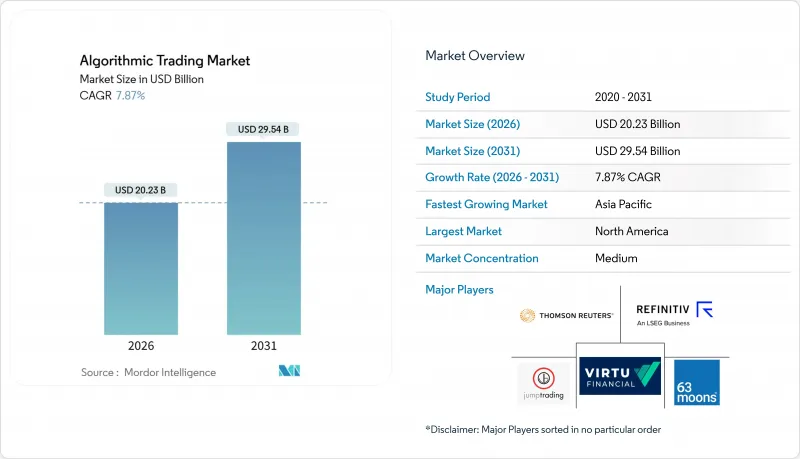
根據 Mordor Intelligence 預測,演算法交易市場規模預計將在 2026 年達到 202.3 億美元,到 2031 年達到 295.4 億美元,在預測期內複合年成長率為 7.87%。
本報告按交易者類型(機構投資者、個人投資者、長期交易者、短期交易者)、組件(解決方案和服務)、部署類型(雲端和本地部署)、組織規模(中小企業和大型企業)以及地區(北美、歐洲及其他地區)進行細分。市場預測以美元計價。
全球演算法交易市場趨勢及洞察
美國和日本股市對亞毫秒訂單執行的需求
延遲套利是現代流動性競爭的特徵之一。納斯達克的撮合引擎運轉速度低於500奈秒,東京證券交易所則採用光子鏈路在東京和大阪之間以200微秒的速度傳輸市場數據。高頻交易者利用現場可程式閘陣列(FPGA)邏輯確定性地路由訂單,從而縮小逆向選擇視窗並降低價差。芝加哥商品交易所集團(CME Group)奧羅拉園區的託管機架每月費用超過15,000美元,但大型交易平台認為這筆支出物有所值,因為它們可以捕捉到原本會在幾微秒內消失的瞬時價格差異。無法承擔如此高昂硬體預算的中小型企業則依賴雲端直連節點,接受一定程度的延遲以確保可擴展性。在美國證券市場,時間戳精度已提高到100微秒級別,未能達到此標準的參與者將面臨監管審查和失去競爭優勢的風險。
被動投資資產的激增正在推動歐洲的指數再平衡演算法。
預計到2025年,歐洲被動資產規模將超過3兆歐元(3.39兆美元)。斯托克50指數和富時100指數的定期再平衡,如今可帶來20-30個基點的可預測日內資金流入,而這些資金正被專業演算法充分利用。證券公司會提前數週分析指數編制機構的公告,並提前對沖成分股,從而為資產管理公司提供服務,以減少追蹤誤差和滑點,但同時也收取高額費用。因此,交易執行部門會整合智慧訂單路由和機器可讀規則手冊,以確保在交易所交易基金(ETF)必須完成交易的收盤競標之前,市場流動性充足。收盤時交易量的激增有利於那些能夠模擬擁擠風險並將訂單分發到暗池、多時段交易平台(MTF)和主要交易所,且不違反最佳執行審計的公司。對於演算法交易市場而言,這些季度再平衡週期代表著持續的收入來源,隨著被動投資佔有率的擴大,其收入將呈指數級成長。
交易所託管成本飆升,給中型內部交易部門帶來了壓力。
主要交易所的機架月使用費超過2萬美元,其中包括冗餘、交叉連接和電力消耗量等費用,使得年訂單量低於1000萬筆的中型自營交易平台難以收回成本。英國金融行為監理局(FCA)的研究表明,基礎設施成本佔這些公司技術相關總支出的40%之多,迫使它們放棄對延遲敏感的交易策略,轉而使用抖動更高的雲端節點。由此導致的市場重組擴大了先前競爭激烈的微套利貨幣對的價差,無意中增加了剩餘資金雄厚的參與者的利潤。雲端服務供應商正在透過在交易所內部部署邊緣節點來應對這項挑戰,提供適用於長期演算法的個位數毫秒往返延遲。然而,對於做市而言至關重要的奈秒確定性效能在虛擬化硬體上仍然無法實現,這導致演算法交易市場中存在兩級速度等級。
細分市場分析
預計到2025年,機構投資者交易部門將佔據最大的收入佔有率,佔演算法交易市場規模的61.16%。這主要得益於多元資產管理和專用託管設施的普及。長期量化基金經理人更傾向於使用基於雲端的回測集群,這些叢集能夠在數小時內複製多年的市場數據,並在無需承擔固定硬體成本的情況下最佳化因子敞口。相較之下,短期高頻交易者則在交易所資料中心部署亞微秒訂單路由系統,以捕捉瞬時買賣價差,但這種模式對大多數散戶投資者而言在經濟上並不划算。
到2031年,零售投資者群體將以8.32%的複合年成長率持續成長,尤其是在印度和新加坡。在這些國家,即插即用的腳本環境正透過與免佣金經紀公司的合作逐步整合。預計到2025年,MetaTrader 5的活躍交易帳戶數量將超過200萬,這一里程碑將使機構級工具的普及化。該平台的市場目前擁有數千個策略模板,包括付費和免費模板,使用戶能夠獲得經過驗證的程式碼許可,而無需從零開始創建程式。隨著教育內容的改進和應用程式介面(API)限制的放寬,零售投資者的加入正在成為數據供應商和託管服務提供商的新收入來源,演算法交易市場也正逐步向更加多元化的參與者群體重新平衡。
預計到2025年,整合分析平台授權的解決方案套件將佔演算法交易市場總支出(價值138.3億美元)的68.32%。湯森路透和Refinitiv透過訂閱協定提供一致的資料饋送、智慧訂單路由和交易記錄,並包含轉換成本,從而在該領域佔據領先地位。整合解決方案的主導地位源自於買方對單一供應商責任制的偏好,這種模式確保監管合規和營運支援均由單一服務台提供。
同時,服務業是成長最快的領域,複合年成長率高達9.14%。這是因為專業供應商擴大將演算法設計、模型檢驗和最佳執行報告外包出去。 AlgoTrader的託管服務業務以按需計量收費的雲端工作負載形式提供回測基礎設施,而InfoReach則提供託管執行平台,將客戶演算法整合到合規管理框架中。這種模組化方法與面臨管理費下降和審計要求日益嚴格的資產管理公司產生了強烈的共鳴。隨著時間的推移,軟體授權和諮詢合約之間的界線變得模糊,基於執行量按月計費的混合經營模式正在興起,演算法交易市場中供應商和客戶之間的相互依存關係也在不斷加深。
區域分析
預計到2025年,北美將佔全球收入的38.14%,擁有各大洲最大的演算法交易市場。紐約和芝加哥的資料中心聚集了絕大多數高頻交易平台,並由交易所設施提供支持,這些設施能夠以奈秒精度對交易進行時間採樣。監管現代化,包括美國證券交易委員會(SEC)的“次便士披露要求”,正在推動智慧訂單路由系統的持續升級,而彭博社和路孚特等科技巨頭則通過整合交易所連接和分析能力來強化這一生態系統。儘管加拿大和墨西哥的交易所也在逐步提升交易量,但大多數經驗豐富的參與者仍然集中在美國交易所,因為美國交易所充裕的流動性和高訊息處理能力為其資本密集型策略提供了支撐。
預計到2025年,亞太地區將憑藉其收入基礎實現成長,成為成長最快的地區,複合年成長率(CAGR)將達到8.73%,主要得益於印度和東南亞交易所個人投資者的參與。印度證券交易委員會(SEBI)已向所有成員開放託管服務,從而糾正了基礎設施不平衡的問題。東京的光子網路則創造了新的套利通道,將現貨股票與大阪證券交易所的衍生性商品連接起來。韓國和澳洲的監管機構已採用沙盒框架來試用人工智慧(AI)驅動的訂單類型,允許海外自營交易公司在無需獲得永久許可的情況下測試策略。儘管高頻交易在中國當地的滲透率仍然較低,但深圳和上海逐步開放市場預示著市場將逐步開放,隨著資本管制的放鬆,這可能會進一步刺激需求。
預計到2025年,歐洲將佔據相當大的支出佔有率,主要集中在英國的外匯流動性池以及STOXX歐洲600指數和FTSE 100指數的被動再平衡資金流上。基於MiFID II的最佳執行審計正在推動對交易成本分析的需求,而將合規邏輯融入其執行路徑的供應商也備受青睞。德意志交易所的法蘭克福託管設施和泛歐交易所的巴黎資料中心均達到美國延遲標準,從而支援跨交易所套利策略,即時分析超過30個交易平台。儘管南美洲和中東/非洲目前的規模較小,但巴西B3公司API的擴展以及阿布達比新建的託管設施有望提升當地的交易量。這代表著演算法交易市場正在密切關注的新成長機會。
其他好處:
- Excel格式的市場預測(ME)表
- 3個月的分析師支持
目錄
第1章:引言
- 研究假設和市場定義
- 調查範圍
第2章:調查方法
第3章執行摘要
第4章 市場狀況
- 市場概覽
- 市場促進因素
- 美國和日本股市對亞毫秒訂單執行的需求
- 在歐洲,被動投資資產管理規模(AUM)的激增正在推動指數再平衡演算法的發展。
- 東南亞加密貨幣交易所API流動性池的擴展
- 透過Reg-NMS促進最佳執法法規、MiFID II以及美國證券交易委員會(SEC)的現代化。
- 利用量子最佳化進行回測可以縮短策略上市時間。
- 開放原始碼演算法框架(PLUTUS、LEAN)正在廣泛普及機構級工具。
- 市場限制因素
- 交易所不斷飆升的託管費用給中型自營交易平台帶來了壓力。
- 與閃燃相關的流體真空風險
- 歐盟對高頻交易欺騙行為實施嚴格的市場監管和罰款
- 資料中心延遲競爭中碳足跡的上限
- 產業價值鏈分析
- 監理情勢
- 技術展望
- 波特五力分析
- 宏觀經濟因素對市場的影響
第5章 市場規模與成長預測
- 按交易者類型
- 機構投資者
- 個人投資者
- 長期交易者
- 短期交易者
- 按組件
- 解決方案
- 平台
- 軟體工具
- 服務
- 解決方案
- 不同的發展
- 雲
- 現場
- 按組織規模
- 小型企業
- 大公司
- 按地區
- 北美洲
- 美國
- 加拿大
- 墨西哥
- 南美洲
- 巴西
- 阿根廷
- 智利
- 其他南美國家
- 歐洲
- 德國
- 英國
- 法國
- 義大利
- 西班牙
- 荷蘭
- 俄羅斯
- 其他歐洲國家
- 亞太地區
- 中國
- 日本
- 韓國
- 印度
- ASEAN
- 澳洲
- 紐西蘭
- 其他亞太國家
- 中東
- GCC
- 土耳其
- 以色列
- 其他中東國家
- 非洲
- 南非
- 奈及利亞
- 肯亞
- 其他非洲國家
- 北美洲
第6章 競爭情勢
- 市場集中度
- 策略趨勢
- 市佔率分析
- 公司簡介
- Thomson Reuters Corporation
- Refinitiv Limited
- Virtu Financial Inc.
- Jump Trading LLC
- 63 Moons Technologies Ltd
- Citadel Securities LLC
- Hudson River Trading LLC
- Tower Research Capital LLC
- XTX Markets Limited
- Goldman Sachs Group Inc.
- JPMorgan Chase and Co.
- IG Group Holdings plc
- MetaQuotes Software Corp.
- Symphony Fintech Solutions Pvt Ltd
- InfoReach Inc.
- AlgoTrader AG
- ARGO SE
- Kuberre Systems Inc.
- DRW Holdings LLC
- Optiver BV
- Jane Street Group LLC
第7章 市場機會與未來展望
According to Mordor Intelligence, the algorithmic trading market size reached USD 20.23 billion in 2026 and is projected to advance to USD 29.54 billion by 2031, reflecting a 7.87% CAGR over the forecast period.
This report is Segmented by Types of Traders (Institutional Investors, Retail Investors, Long-Term Traders, and Short-Term Traders), Component (Solutions, and Services), Deployment (Cloud, and On-Premise), Organisation Size (Small and Medium Enterprises, and Large Enterprises), and Geography (North America, Europe, and More). The Market Forecasts are Provided in Terms of Value (USD).
Global Algorithmic Trading Market Trends and Insights
Demand for Sub-millisecond Order Execution on United States and Japanese Equities
Latency arbitrage defines the modern liquidity race, with Nasdaq's matching engine operating below 500 nanoseconds and Tokyo Stock Exchange adopting photonic links that move market data between Tokyo and Osaka in 200 microseconds. High-frequency principals deploy field-programmable-gate-array logic to route orders deterministically, shrinking adverse-selection windows and enabling tighter spreads. Colocation racks in CME Group's Aurora campus cost more than USD 15,000 per month, yet leading desks justify the spend by capturing fleeting price dislocations that would otherwise evaporate in microseconds. Smaller firms unable to match that hardware budget rely on cloud direct-connect nodes, accepting modest latency in exchange for elasticity. As United States securities markets upgrade time-stamping granularity to 100-microsecond precision, any participant failing to meet that benchmark risks regulatory scrutiny and competitive obsolescence.
Surging Passive-Investment Assets Fueling Index-Rebalance Algorithms in Europe
European passive assets surpassed EUR 3 trillion (USD 3.39 trillion) in 2025, and the scheduled rebalancing of STOXX and FTSE indices now generates predictable intraday flow spikes of 20-30 basis points that specialist algorithms exploit. Broker-dealers parse index-compiler announcements weeks in advance and pre-hedge constituents, offering asset managers reduced tracking-error slippage in exchange for sizable participation fees. Execution desks therefore integrate smart order routing with machine-readable rulebooks, ensuring liquidity is posted ahead of the closing auction when exchange-traded funds must finish their trades. The consequent surge in end-of-day volume rewards firms that can model crowding risk and stagger orders across dark pools, multilateral trading facilities, and primary exchanges without breaching best-execution audits. For the algorithmic trading market, these quarterly rebalance windows represent recurring revenue that compounds as passive share grows.
Rising Exchange Colocation Costs Squeezing Mid-tier Proprietary Desks
Monthly rack rates at major venues exceed USD 20,000 once redundancy, cross-connects, and power draws are included, a burden that mid-tier shops executing fewer than 10 million orders annually struggle to amortize. Financial Conduct Authority research shows infrastructure consumes up to 40% of total technology spend for such firms, prompting exits from latency-sensitive strategies or migrations to cloud nodes with higher jitter. The resulting consolidation enlarges spreads on previously crowded micro-arbitrage pairs, inadvertently increasing profits for the remaining capitalized participants. Cloud providers respond by placing edge nodes within exchange campuses, offering 1-digit-millisecond round trips that suit longer-horizon algorithms. Nevertheless, the deterministic nanosecond performance essential for market-making remains out of reach for virtualized hardware, preserving the two-tier speed hierarchy inside the algorithmic trading market.
Other drivers and restraints analyzed in the detailed report include:
- Expansion of Crypto-Exchange API Liquidity Pools in Southeast Asia
- Regulatory Push for Best Execution, MiFID II and SEC Reg-NMS Modernization
- Flash-Crash Liquidity Vacuum Risk
For complete list of drivers and restraints, kindly check the Table Of Contents.
Segment Analysis
Institutional desks generated the largest slice of 2025 revenue, and their share translated to a 61.16% portion of the algorithmic trading market size, backed by multi-asset mandates and dedicated colocation footprints. Long-term quant managers favor cloud-based back-testing clusters that replay years of market data in hours, optimizing factor exposure without incurring fixed hardware costs. Short-term high-frequency participants, in contrast, deploy sub-microsecond order routers inside exchange data centers to exploit fleeting bid-offer mispricing, a model financially prohibitive for most retail actors.
The retail segment is expanding at an 8.32% CAGR through 2031, particularly in India and Singapore, where zero-commission brokerage integrations embed plug-and-play scripting environments. MetaTrader 5 surpassed 2 million active trading accounts in 2025, a milestone that illustrates democratized access to institutional-grade tooling. Platform marketplaces now list thousands of paid and free strategy templates, allowing individuals to license proven code rather than program from scratch. As education content improves and application-programming-interface limits are relaxed, retail penetration introduces a growing revenue stream for data vendors and hosting providers, gradually rebalancing the algorithmic trading market toward a more diverse participant base.
Solutions packages platform licenses bundled with analytics captured 68.32% of 2025 spending, valued at USD 13.83 billion within the algorithmic trading market size. Thomson Reuters and Refinitiv anchor this segment by delivering cohesive data feeds, smart order routing, and trade blotters through subscription contracts that embed switching costs. The dominance of integrated stacks reflects buy-side preference for single-vendor accountability, ensuring regulatory and operational support arrives from one help desk.
Services, however, are the fastest-growing slice at a 9.14% CAGR because specialized vendors now assume algorithm design, model validation, and best-execution reporting on an outsourced basis. AlgoTrader's managed-service line delivers back-testing infrastructure as a consumption-priced cloud workload, while InfoReach offers hosted execution shells that wrap client algorithms inside compliance controls. This modular approach resonates with asset managers facing shrinking management fees yet escalating audit demands. Over time, the lines between software licence and consulting retainer blur, and hybrid commercial models emerge in which monthly invoices scale with executed volume, deepening vendor-client interdependence inside the algorithmic trading market.
Complete Report Scope:
- By Types of Traders
- Institutional Investors
- Retail Investors
- Long-term Traders
- Short-term Traders
- By Component
- Solutions
- Platforms
- Software Tools
- Services
- Solutions
- By Deployment
- Cloud
- On-premise
- By Organisation Size
- Small and Medium Enterprises
- Large Enterprises
- By Geography
- North America
- United States
- Canada
- Mexico
- South America
- Brazil
- Argentina
- Chile
- Rest of South America
- Europe
- Germany
- United Kingdom
- France
- Italy
- Spain
- Netherlands
- Russia
- Rest of Europe
- Asia Pacific
- China
- Japan
- South Korea
- India
- ASEAN
- Australia
- New Zealand
- Rest of Asia Pacific
- Middle East
- GCC
- Turkey
- Israel
- Rest of Middle East
- Africa
- South Africa
- Nigeria
- Kenya
- Rest of Africa
- North America
Geography Analysis
North America generated 38.14% of 2025 global revenue, giving the region the largest algorithmic trading market share among all continents. New York and Chicago colocation hubs house most high-frequency desks, supported by exchange facilities that time-stamp trades at nanosecond precision. Regulatory modernization, including the Securities and Exchange Commission's sub-penny disclosure mandate, compels continual upgrades to smart order routers, and technology stalwarts such as Bloomberg and Refinitiv reinforce the ecosystem by bundling venue connectivity with analytics. Canadian and Mexican exchanges contribute incremental volumes, yet the critical mass of sophisticated participants remains clustered in United States venues where deep liquidity and high message caps justify capital-intensive strategies.
Asia Pacific is projected to be the fastest-growing geography at an 8.73% CAGR, rising from a 2025 revenue base energized by retail participation on Indian and Southeast Asian exchanges. The Securities and Exchange Board of India's push to open colocation access for every member leveled infrastructure asymmetries, and Tokyo's photonic network has created new arbitrage arcs linking cash equities with Osaka Exchange derivatives. South Korean and Australian regulators adopted sandbox frameworks for testing artificial-intelligence-driven order types, inviting foreign proprietary houses to pilot strategies without permanent licensing. While high-frequency penetration in mainland China remains controlled, incremental liberalization in Shenzhen and Shanghai suggests a gradual opening that could unlock additional demand as capital-controls ease.
Europe captured a substantial slice of 2025 spending, anchored by the United Kingdom's foreign-exchange liquidity pools and passive rebalancing flows on STOXX Europe 600 and FTSE 100 indices. MiFID II best-execution audits increase demand for transaction-cost analytics, rewarding vendors that embed compliance logic inside execution paths. Deutsche Borse's Frankfurt colocation and Euronext's Paris data halls mirror United States latency benchmarks, enabling cross-venue arbitrage strategies that parse more than 30 trading platforms in real time. Although South America, the Middle East, and Africa currently represent smaller bases, Brazil's B3 API expansion and Abu Dhabi's new colocation hall could pivot local volumes upward, signaling nascent corridors of growth that the algorithmic trading market will monitor closely.
- Thomson Reuters Corporation
- Refinitiv Limited
- Virtu Financial Inc.
- Jump Trading LLC
- 63 Moons Technologies Ltd
- Citadel Securities LLC
- Hudson River Trading LLC
- Tower Research Capital LLC
- XTX Markets Limited
- Goldman Sachs Group Inc.
- JPMorgan Chase and Co.
- IG Group Holdings plc
- MetaQuotes Software Corp.
- Symphony Fintech Solutions Pvt Ltd
- InfoReach Inc.
- AlgoTrader AG
- ARGO SE
- Kuberre Systems Inc.
- DRW Holdings LLC
- Optiver BV
- Jane Street Group LLC
Additional Benefits:
- The market estimate (ME) sheet in Excel format
- 3 months of analyst support
TABLE OF CONTENTS
1 INTRODUCTION
- 1.1 Study Assumptions and Market Definition
- 1.2 Scope of the Study
2 RESEARCH METHODOLOGY
3 EXECUTIVE SUMMARY
4 MARKET LANDSCAPE
- 4.1 Market Overview
- 4.2 Market Drivers
- 4.2.1 Demand for Sub-millisecond Order Execution on US and Japanese Equities
- 4.2.2 Surging Passive-Investment AUM Fuelling Index-Rebalance Algorithms in Europe
- 4.2.3 Expansion of Crypto-Exchange API Liquidity Pools in South-East Asia
- 4.2.4 Regulatory Push for Best-Execution, MiFID II and SEC Reg-NMS Modernisation
- 4.2.5 Quantum-Optimised Back-Testing Cuts Strategy Time-to-Market
- 4.2.6 Open-Source Algo Frameworks (PLUTUS, LEAN) Democratise Institutional-Grade Tooling
- 4.3 Market Restraints
- 4.3.1 Rising Exchange Colocation Costs Squeezing Mid-tier Prop Desks
- 4.3.2 Flash-Crash Liquidity Vacuum Risk
- 4.3.3 Stringent Market-Surveillance Fines on HFT Spoofing in EU
- 4.3.4 Carbon-Footprint Caps on Data-Centre Latency Arms-Race
- 4.4 Industry Value Chain Analysis
- 4.5 Regulatory Landscape
- 4.6 Technological Outlook
- 4.7 Porter's Five Forces Analysis
- 4.7.1 Bargaining Power of Suppliers
- 4.7.2 Bargaining Power of Buyers and Investors
- 4.7.3 Threat of New Entrants
- 4.7.4 Threat of Substitutes
- 4.7.5 Intensity of Competitive Rivalry
- 4.8 Impact of Macroeconomic Factors on the Market
5 MARKET SIZE AND GROWTH FORECASTS (VALUE)
- 5.1 By Types of Traders
- 5.1.1 Institutional Investors
- 5.1.2 Retail Investors
- 5.1.3 Long-term Traders
- 5.1.4 Short-term Traders
- 5.2 By Component
- 5.2.1 Solutions
- 5.2.1.1 Platforms
- 5.2.1.2 Software Tools
- 5.2.2 Services
- 5.2.1 Solutions
- 5.3 By Deployment
- 5.3.1 Cloud
- 5.3.2 On-premise
- 5.4 By Organisation Size
- 5.4.1 Small and Medium Enterprises
- 5.4.2 Large Enterprises
- 5.5 By Geography
- 5.5.1 North America
- 5.5.1.1 United States
- 5.5.1.2 Canada
- 5.5.1.3 Mexico
- 5.5.2 South America
- 5.5.2.1 Brazil
- 5.5.2.2 Argentina
- 5.5.2.3 Chile
- 5.5.2.4 Rest of South America
- 5.5.3 Europe
- 5.5.3.1 Germany
- 5.5.3.2 United Kingdom
- 5.5.3.3 France
- 5.5.3.4 Italy
- 5.5.3.5 Spain
- 5.5.3.6 Netherlands
- 5.5.3.7 Russia
- 5.5.3.8 Rest of Europe
- 5.5.4 Asia Pacific
- 5.5.4.1 China
- 5.5.4.2 Japan
- 5.5.4.3 South Korea
- 5.5.4.4 India
- 5.5.4.5 ASEAN
- 5.5.4.6 Australia
- 5.5.4.7 New Zealand
- 5.5.4.8 Rest of Asia Pacific
- 5.5.5 Middle East
- 5.5.5.1 GCC
- 5.5.5.2 Turkey
- 5.5.5.3 Israel
- 5.5.5.4 Rest of Middle East
- 5.5.6 Africa
- 5.5.6.1 South Africa
- 5.5.6.2 Nigeria
- 5.5.6.3 Kenya
- 5.5.6.4 Rest of Africa
- 5.5.1 North America
6 COMPETITIVE LANDSCAPE
- 6.1 Market Concentration
- 6.2 Strategic Moves
- 6.3 Market Share Analysis
- 6.4 Company Profiles (includes Global Level Overview, Market Level Overview, Core Segments, Financials as Available, Strategic Information, Market Rank/Share for Key Companies, Products and Services, and Recent Developments)
- 6.4.1 Thomson Reuters Corporation
- 6.4.2 Refinitiv Limited
- 6.4.3 Virtu Financial Inc.
- 6.4.4 Jump Trading LLC
- 6.4.5 63 Moons Technologies Ltd
- 6.4.6 Citadel Securities LLC
- 6.4.7 Hudson River Trading LLC
- 6.4.8 Tower Research Capital LLC
- 6.4.9 XTX Markets Limited
- 6.4.10 Goldman Sachs Group Inc.
- 6.4.11 JPMorgan Chase and Co.
- 6.4.12 IG Group Holdings plc
- 6.4.13 MetaQuotes Software Corp.
- 6.4.14 Symphony Fintech Solutions Pvt Ltd
- 6.4.15 InfoReach Inc.
- 6.4.16 AlgoTrader AG
- 6.4.17 ARGO SE
- 6.4.18 Kuberre Systems Inc.
- 6.4.19 DRW Holdings LLC
- 6.4.20 Optiver BV
- 6.4.21 Jane Street Group LLC
7 MARKET OPPORTUNITIES AND FUTURE OUTLOOK
- 7.1 White-Space and Unmet-Need Assessment

 全球能源交易市場預測至2034年:依能源商品、合約類型、交易地點、市場參與企業及地區分類
 全球交易軟體市場規模、佔有率、趨勢和成長分析報告(2026-2034)
 演算法交易市場:按組件、交易模型、部署方式、應用領域和最終用戶分類-2026-2032年全球預測
 全球演算法交易市場演算法交易平台市場預測至2034年-按策略類型、資產類別、交易基礎設施、應用、最終用戶和地區分類的全球分析
 2026-2030年全球演算法交易市場
 演算法交易市場:按類型、部署方式、組織規模和地區分類全球演算法交易市場規模、佔有率、趨勢和成長分析報告(2026-2034)
 演算法交易市場規模、佔有率、趨勢和預測:按交易類型、組成部分、部署模式、組織規模和地區分類,2026-2034 年
 演算法交易市場分析及至2035年預測:按類型、產品類型、服務、技術、組件、應用、部署類型、最終用戶、功能及解決方案分類