


 |
市場調查報告書
商品編碼
2123111
工具機:市佔率分析、產業趨勢及統計、成長預測(2026-2031)Machine Tools - Market Share Analysis, Industry Trends & Statistics, Growth Forecasts (2026 - 2031) |
||||||

※ 本網頁內容可能與最新版本有所差異。詳細情況請與我們聯繫。
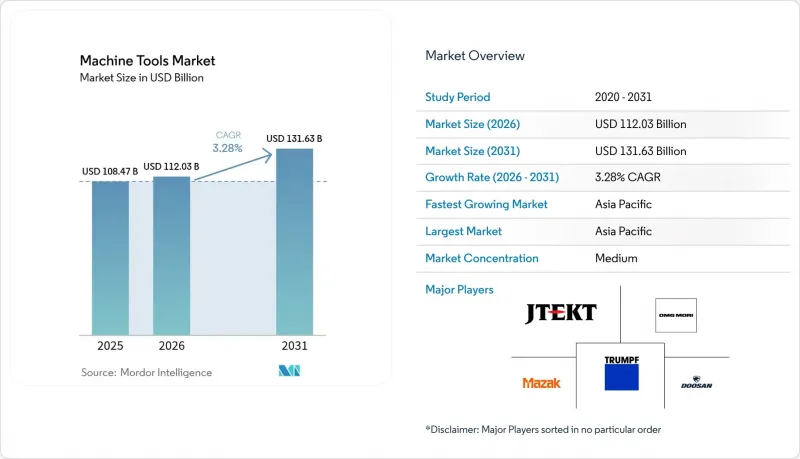
根據 Mordor Intelligence 估計,到 2026 年,工具機市值將達到 1,120.3 億美元,高於 2025 年的 1,084.7 億美元,預計到 2031 年將達到 1,316.3 億美元。
預計從 2026 年到 2031 年,其複合年成長率將達到 3.28%。
本報告按產品(切削刀具、金屬成型刀具)、技術(傳統工具機、CNC工具工具機等)、終端用戶產業(汽車、航太與國防等)、銷售管道(直銷等)及地區(北美、亞太、歐洲等)進行細分。報告提供了上述所有細分市場的市場規模和預測(以美元計)。
全球工具機市場趨勢與洞察
電氣化的快速發展正在推動精密電動動力傳動系統加工技術的發展。
電動車馬達工廠正致力於將公差控制在微米級,通常將自動定子插入和髮夾式繞線與五軸加工中心結合,因此無需二次表面處理工程。採埃孚的目標是到2030年實現其電動車動力總成生產線70%的自動化,而中國供應商預計到2034年,電動馬達的年產量將超過1.2億台。通用汽車和賓士都在推進馬達外殼生產的內部化,並優先選擇能夠加工鋁矽合金且不會產生振動的工具機。此外,對進程內測量、冷卻液管理以及封閉回路型補償的需求也在不斷成長,以抑制由微米級形狀誤差引起的電磁雜訊。
半導體製造廠的擴張需要超精密設備。
預計到2027年,全球對300毫米晶圓廠的投資將達到1,370億美元,其中美洲地區的投資預計將在三年內翻倍。 ASML的多噸級投影光學元件需要鑽石車削和氣浮研磨系統,這些系統能夠在1公尺的行程範圍內保持小於50奈米的形狀公差。台積電在亞利桑那州投資1650億美元的工廠清晰地表明,州政府主導的半導體項目如何創造了對超精密加工工廠的區域需求,這些工廠能夠在組裝過程中將重型部件留在州內。潔淨室相容性、靜壓滑軌和無污染潤滑系統現在已成為服務於此細分市場的設備製造商的標準配置。
先進數控系統需要高額資本投入和較長的投資回收期。
根據亞特蘭大聯邦儲備銀行的一項調查,80%的製造商在決定投資資本設備之前會優先考慮利率,而計劃於2025年上調基準利率進一步加劇了這一趨勢。一套頂級的五軸加工單元的安裝成本可能超過300萬美元,這使得中型代工製造商的損益平衡期長達五年以上。雖然設備即服務(EaaS)合約已成為一種臨時解決方案,但許多財務長仍然擔心軟體升級導致早期控制器過時所帶來的殘值風險。
細分市場分析
預計到2026年初,多軸工具機市場規模將達到262.9億美元,並有望在2031年以6.88%的複合年成長率成長。截至2025年,銑床仍將是最大的收入來源,佔市場佔有率的28.05%,但目前的成長主要集中在能夠一次完成複雜殼體精加工的五軸連動平台。汽車製造商正在用電動驅動殼體生產單元取代內燃機(ICE)缸體生產線,並採用多軸工具機來減少面積和搬運成本。航太產業的領先製造商正在部署高扭力傾斜主軸加工中心,以在1.2公尺的長度上保持0.015毫米的平面度,加工鈦合金齒輪。工具車間操作員仍然依賴三軸立式銑床,但配備數位顯示器和探針功能的改裝套件正在維護工作中佔據一席之地。
人工智慧驅動的參數嚮導降低了薄不銹鋼板的廢品率,從而帶動了雷射切割系統需求的復甦。電火花加工 (EDM) 在模腔加工領域仍佔據著獨特的地位,因為銑削難以經濟高效地加工出極小的角落半徑。結合定向能量沉積和精銑的混合型工具機正被引入原型實驗室,其縮短的加工週期足以彌補設備成本的增加。等離子切割和水刀切割平台正被用於大型結構的製造,並且兩者都開始整合封閉回路型高度控制功能,即使面對翹曲的金屬板材也能保持切割品質。
預計到2025年,CNC平台將佔工具機銷售額的68.55%,複合年成長率達6.08%,鞏固在工具機市場的核心地位。新興控制器採用GPU加速演算法,透過將STEP檔案直接轉換為最佳化的刀具路徑,顯著縮短了小批量零件的程式時間。中國第一自動化已籌集約1億元用於伺服驅動器和PLC堆疊的在地化,凸顯了其為降低依賴國外韌體所帶來的風險而採取的戰略舉措。雖然小規模車間和職業學校仍在使用傳統的手動機床,但越來越多的新工具機(即使沒有控制設備系統)也傾向於選擇伺服功能的機架,以便日後進行升級改造。混合積層製造和切割系統處於領先地位,它將雷射金屬積層製造和五軸銑床相結合,從而無需移除航太支架中的支撐結構。
數位孿生技術能夠模擬刀具撓曲和熱漂移,從而實現機外檢驗,並防止初始原型製作過程中發生碰撞。 ChatCNC™ 外掛程式可辨識矩形形狀,並自動產生從粗加工到精加工的製程,即使是經驗不足的程式設計師也能達到與經驗豐富的程式設計師相媲美的加工週期。預測分析平台能夠在關鍵故障發生前很久就偵測到主軸異常。這在無人值守加工中尤其重要,因為在無人值守加工中,操作員的監控作用會大大降低。
區域分析
隨著戰略轉型推進,亞太地區正處於主導,北美地區則將生產轉移回本土,而歐洲儘管面臨許多挑戰,仍在推動創新。預計到2026年,亞太地區將佔全球銷售額的45.10%,複合年成長率達6.05%,主要得益於各國政府對電動車、航太和半導體產業叢集的扶持政策。隨著美國即將對中端機械加徵25%的關稅,中國正將小型生產車間升級為高階CNC加工單元工廠。印度的生產連結獎勵計畫計畫正引導資金流向300毫米晶圓廠和國防航空航太製造業,從而為精密臥式和立式加工中心創造了訂單。日本憑藉數十年的運動控制經驗,出口可在多班次運作週期內維持亞微米級重複精度的超精密研磨。同時,韓國消費電子巨頭正投資於折疊式智慧型手機鉸鍊板和相機模組的加工能力。隨著原始設備製造商 (OEM) 採用強調地域風險分散的「中國+1」採購模式,越南和泰國等東南亞國協正在擴大其市場佔有率。
北美正受惠於旨在重建戰略製造業自給自足能力的回流政策。美國的市佔率已達到11.9%,創2001年以來的最高水準。這主要歸功於區域工具機製造商提高了用於航太發射結構的大型立式車床的產能。墨西哥9.1%的成長歸功於近岸汽車組裝,新萊昂州政府支持的工業園區正全天候運轉,以核准各種許可證。加拿大正從採礦業和低碳能源項目中獲得工具機訂單,但由於技術純熟勞工短缺(這是整個北美大陸通用的限制因素),整體成長勢頭正在放緩。
在歐洲,儘管電力成本飆升和外匯波動導致利潤率下降,但各公司在高精度五軸加工中心和雷射金屬沉積系統領域仍保持著主導地位。德國製造商正積極拓展售後服務合約和維修項目,以應對國內訂單疲軟的局面,其中包括承諾48小時內響應的主軸更換計劃。儘管銷售額下降了9%,TRUMPF仍計劃在2025年投入5.3億歐元用於研發,以保持其在光束源效率方面的優勢。北歐公司透過在每台新機器交付時提供碳足跡證書來彰顯其在永續性的領先地位,這種做法在公共部門競標中正日益成為強制性要求。
其他好處:
- Excel格式的市場預測(ME)表
- 3個月的分析師支持
目錄
第1章:引言
- 市場分析與定義的前提條件
- 分析範圍
第2章 分析方法
第3章執行摘要
第4章 市場狀況
- 市場概覽
- 市場促進因素
- 電氣化的快速發展正在推動精密電動動力傳動系統加工技術的發展。
- 工業4.0的普及應用正在推動對智慧數控平台的需求。
- 隨著輕質合金和複合材料的日益普及,對高速多軸加工工具的需求也不斷成長。
- 隨著半導體製造廠的擴張,需要超高精準度的設備。
- 全球老舊(20 年或以上)工具機的更換週期
- 透過靈活的加工流程實現多品種、小批量生產的自動化。
- 市場限制因素
- 特種鋼材和直線運動部件成本上漲
- 先進數控系統投資額高,投資回收期長。
- 全球範圍內,熟練的數控程式設計人員和操作人員嚴重短缺。
- 資本流向積層製造技術
- 價值鍊和供應鏈分析
- 監管展望(主要政府法規和措施)
- 技術概述
- 互聯自動化設備
- 先進的控制/運動系統
- 數位化和工業4.0
- 利用人工智慧提高金屬切削精度
- 金屬加工產業概覽
- 地緣政治對工具機市場的影響
- 產業吸引力:五力分析
- 供應商的議價能力
- 買方的議價能力
- 新進入者的威脅
- 替代品的威脅
- 競爭公司之間的競爭
第5章:預測市場規模與成長率
- 依產品
- 切削刀具
- 銑床
- 鑽孔機
- 車床
- 研磨
- 雷射切割機
- 電火花加工工具機(EDM)
- 水刀切割機
- 電漿切割機
- 多軸加工中心
- 其他(保齡球等)
- 金屬成型工具
- 壓平機(機械式、液壓式和伺服驅動式)
- 鍛造機
- 折彎機
- 其他工藝(剪切、擠壓、軋延等)
- 切削刀具
- 透過技術
- 傳統工具機(手動和半自動)
- CNC工具工具機
- 積層製造/混合型設備
- 按最終用戶行業分類
- 車
- 航太/國防
- 電氣和電子設備
- 工業機械和設備
- 醫療設備
- 造船/造船
- 精密工程
- 能源與電力
- 金屬加工(合約製造商等)
- 其他行業(鐵路、其他一般製造業等)
- 按銷售管道
- 直接銷售(從OEM廠商到最終用戶)
- 經銷商和銷售代理商
- 線上電子商務
- 其他(系統整合商、活動/展覽、再製造商/翻新產品等)
- 按地區
- 北美洲
- 美國
- 加拿大
- 墨西哥
- 南美洲
- 巴西
- 阿根廷
- 秘魯
- 其他南美國家
- 歐洲
- 英國
- 德國
- 法國
- 義大利
- 西班牙
- 比荷盧經濟聯盟(比利時、荷蘭、盧森堡)
- 北歐國家(丹麥、芬蘭、冰島、挪威、瑞典)
- 其他歐洲國家
- 亞太地區
- 中國
- 印度
- 日本
- 澳洲
- 韓國
- 東協(印尼、泰國、菲律賓、馬來西亞、越南)
- 其他亞太國家
- 中東和非洲
- 沙烏地阿拉伯
- 阿拉伯聯合大公國
- 卡達
- 科威特
- 土耳其
- 埃及
- 南非
- 奈及利亞
- 其他中東和非洲國家
- 北美洲
第6章 競爭情勢
- 市場集中度
- 策略趨勢
- 市佔率分析
- 公司簡介
- Yamazaki Mazak Corporation
- DMG MORI Co. Ltd
- TRUMPF Group
- JTEKT Corporation
- Doosan Machine Tools
- Okuma Corporation
- Makino Milling Machine Co. Ltd
- Haas Automation Inc.
- FANUC Corporation
- Hyundai Wia Corp.
- Schuler AG
- Sandvik AB(Seco & Walter)
- GF Machining Solutions
- Fives Group
- GROB-Werke GmbH & Co. KG
- Hermle AG
- EMAG GmbH & Co. KG
- Hardinge Inc.
- HURCO Companies Inc.
- Amada Co. Ltd
第7章 市場機會與未來展望
According to Mordor Intelligence, the machine tools market size in 2026 is estimated at USD 112.03 billion, growing from 2025 value of USD 108.47 billion with 2031 projections showing USD 131.63 billion, growing at 3.28% CAGR over 2026-2031.
This report is Segmented by Product (Metal Cutting Tools, Metal Forming Tools), by Technology (Conventional Machines, CNC Machines, and More), by End-User Industry (Automotive, Aerospace & Defense, and More), by Sales Channel (Direct Sales, and More), and by Geography (North America, Asia-Pacific, Europe, and More). The Report Offers Market Size and Forecasts in Value (USD) for all the Above Segments.
Global Machine Tools Market Trends and Insights
Electrification Surge Driving Precision e-Powertrain Machining
Electric-vehicle motor plants are pushing tolerances to micro-scale ranges, often pairing automated stator insertion and hairpin winding with five-axis machining centers that eliminate secondary finishing steps. ZF targets 70% automation for EV drive-train lines by 2030, and Chinese suppliers project annual output exceeding 120 million e-motors by 2034. General Motors and Mercedes-Benz have both insourced e-motor housing production, favouring machines that cut aluminum-silicon alloys without creating pass-off chatter. Demand is intensifying for in-process gauging, coolant management, and closed-loop compensation to suppress electromagnetic noise that would otherwise arise from micron-level form errors.
Semiconductor Fab Expansion Necessitating Ultra-Precision Equipment
Global 300 mm fab spending is forecast to hit USD 137 billion in 2027, with the Americas doubling outlays in three years. ASML's multi-ton projection optics require diamond-turning and air-bearing grinding systems that hold sub-50 nm form error over 1 m travel. TSMC's USD 165 billion Arizona complex exemplifies how sovereign chip programs create local pull for ultraprecision machine shops that can keep heavy components in-state during assembly. Clean-room compatibility, hydrostatic slideways, and contamination-free lubrication schemes are now baseline specifications for equipment makers serving this niche.
High Capex & Lengthy Payback for Advanced CNC Systems
Atlanta Fed surveys reveal that 80% of manufacturers weigh interest rates heavily before committing to capital equipment, a dynamic amplified by prime-rate increases in 2025. A top-tier five-axis cell can exceed USD 3 million installed, pushing breakeven past five years for medium-volume job shops. Equipment-as-a-service contracts are emerging as an interim solution, though many CFOs remain wary of residual value risk once software upgrades render early-generation controllers obsolete.
Other drivers and restraints analyzed in the detailed report include:
- Industry 4.0 Adoption Boosting Demand for Smart CNC Platforms
- Lightweight Alloy & Composite Uptake Requiring High-Speed Multi-Axis Tools
- Surging Specialty Steel & Linear-Motion Component Costs
For complete list of drivers and restraints, kindly check the Table Of Contents.
Segment Analysis
The multi-axis segment started 2026 commanding USD 26.29 billion of the machine tools market size and is heading toward a 6.88% CAGR to 2031. Milling machines retain the biggest revenue pool with 28.05% share in 2025, yet growth now concentrates on simultaneous five-axis platforms that finish complex housings in one clamp. Automakers replacing ICE cylinder-block lines with e-drive casing cells embrace multi-axis machines to lower floor-space and handling costs. Aerospace primes add high-torque tilt-spindle centres to mill titanium spars while maintaining 0.015 mm flatness over 1.2 m lengths. Toolroom operators still rely on three-axis knee mills, but retrofit kits with digital readouts and probing keep them competitive for maintenance work.
Demand for laser cutting systems is rebounding as AI-guided parameter wizards reduce scrap rates on thin-gauge stainless. Electrical-discharge machining maintains a niche in tool-and-die cavities that require micro-corner radii which mills cannot reach economically. Hybrid machines that mix directed-energy deposition with finish milling are entering prototype labs where cycle-time savings outweigh equipment cost. Plasma and waterjet platforms serve heavy-fabrication yards; however, both are starting to integrate closed-loop height control to maintain cut quality on warped plates.
CNC platforms represented 68.55% revenue in 2025 and will climb at 6.08% CAGR, solidifying their position at the heart of the machine tools market. Emerging controllers employ GPU-accelerated algorithmsthat translate STEP files directly to optimized toolpaths, slashing programming time for short-run parts. China's First Automation secured nearly RMB 100 million to localize servo drives and PLC stacks, highlighting strategic efforts to de-risk foreign firmware dependencies. Conventional manual machines endure in small workshops and vocational schools, yet new builds are trending toward servo-ready frames even when purchased without controls, anticipating future retrofits. Hybrid additive-subtractive systems occupy the cutting edge, combining laser metal deposition with five-axis milling to eliminate support-structure removal steps in aerospace brackets.
Digital twins now simulate tool deflection and thermal drift, allowing off-machine validation that prevents collision during first-article runs. ChatCNC(TM) plug-ins recognise prismatic features and auto-generate rough-to-finish sequences, enabling less-experienced programmers to achieve veteran-level cycle times. Predictive analytics platforms flag spindle anomalies well before catastrophic failure, an especially valuable feature for lights-out processing where operator oversight is minimal.
Complete Report Scope:
- By Product
- Metal Cutting Tools
- Milling Machines
- Drilling Machines
- Turning (Lathe) Machines
- Grinding Machines
- Laser Cutting Machines
- Electrical Discharge Machines (EDM)
- Waterjet Cutting Machines
- Plasma Cutting Machines
- Multi-Axis Machining Centres
- Others (Boring, etc.)
- Metal Forming Tools
- Presses (Mechanical, Hydraulic, Servo)
- Forging Machines
- Bending Machines
- Others (Shearing, Extrusion, Rolling, etc.)
- Metal Cutting Tools
- By Technology
- Conventional Machines (Manually or Semi-Manually)
- CNC Machines
- Additive Manufacturing / Hybrid Machines
- By End-User Industry
- Automotive
- Aerospace & Defence
- Electrical & Electronics
- Industrial Machinery & Equipment
- Medical Devices
- Shipbuilding & Marine
- Precision Engineering
- Energy & Power
- Metal Fabrication (Job Shops, etc.)
- Other Industries (Railway, Other General Manufacturing, etc.)
- By Sales Channel
- Direct Sales (OEMs to End Users)
- Dealers & Distributors
- Online / E-commerce
- Others (System Integrators, Events & Exhibitions, Rebuilders & Refurbished, etc.)
- By Geography
- North America
- United States
- Canada
- Mexico
- South America
- Brazil
- Argentina
- Peru
- Rest of South America
- Europe
- United Kingdom
- Germany
- France
- Italy
- Spain
- BENELUX (Belgium, Netherlands, and Luxembourg)
- NORDICS (Denmark, Finland, Iceland, Norway, and Sweden)
- Rest of Europe
- Asia-Pacific
- China
- India
- Japan
- Australia
- South Korea
- ASEAN (Indonesia, Thailand, Philippines, Malaysia, Vietnam)
- Rest of Asia-Pacific
- Middle East and Africa
- Saudi Arabia
- United Arab Emirates
- Qatar
- Kuwait
- Turkey
- Egypt
- South Africa
- Nigeria
- Rest of Middle East and Africa
- North America
Geography Analysis
Asia-Pacific Leads Amid Strategic Shifts, While North America Reshores and Europe Innovates Through Headwinds. Asia-Pacific entered 2026 with 45.10% of global revenue and a 6.05% CAGR outlook as governments funnel incentives into EV, aerospace, and semiconductor clusters. China is upgrading small-batch workshops into high-end CNC cell factories to offset looming 25% U.S. tariffs on mid-range machinery. India's production-linked incentive program is steering capital toward 300 mm wafer fabs and defence airframe work, generating orders for precision horizontals and vertical machining centres. Japan leverages decades of motion-control know-how to export ultra-precision grinders that hold sub-micron repeatability across multi-shift duty cycles, while South Korea's consumer-electronics conglomerates invest in machining capacity for foldable-phone hinge plates and camera modules. ASEAN nations such as Vietnam and Thailand gain share as OEMs adopt a China-plus-one sourcing model that values geographic risk dispersion.
North America benefits from reshoring policies aimed at rebuilding strategic manufacturing self-reliance. United States consumption reached its highest 11.9% share since 2001 as regional tool builders added capacity for large-format vertical lathes used in space-launch structures. Mexico's 9.1% uptick stems from near-shore vehicle assembly, with state-backed industrial parks in Nuevo Leon offering 24-hour permit approvals. Canada draws machine-tool orders from the mining sector and low-carbon energy projects, though overall momentum is tempered by skilled-labour shortages, a constraint echoed across the entire continent.
Europe faces margin erosion from elevated electricity costs and currency volatility, yet it preserves a commanding lead in high-accuracy five-axis and laser-metal-deposition systems. German builders are responding to soft domestic orders by pushing into after-sales contracts and retrofits, including spindle-exchange programmes that guarantee 48-hour turnaround. TRUMPF invested EUR 530 million in R&D during 2025 to maintain its edge in beam-source efficiency despite a 9% revenue dip. Nordic firms highlight sustainability leadership by offering carbon-footprint certificates with each new machine shipment, a feature increasingly mandated in public-sector tenders.
- Yamazaki Mazak Corporation
- DMG MORI Co. Ltd
- TRUMPF Group
- JTEKT Corporation
- Doosan Machine Tools
- Okuma Corporation
- Makino Milling Machine Co. Ltd
- Haas Automation Inc.
- FANUC Corporation
- Hyundai Wia Corp.
- Schuler AG
- Sandvik AB (Seco & Walter)
- GF Machining Solutions
- Fives Group
- GROB-Werke GmbH & Co. KG
- Hermle AG
- EMAG GmbH & Co. KG
- Hardinge Inc.
- HURCO Companies Inc.
- Amada Co. Ltd
Additional Benefits:
- The market estimate (ME) sheet in Excel format
- 3 months of analyst support
TABLE OF CONTENTS
1 Introduction
- 1.1 Study Assumptions & Market Definition
- 1.2 Scope of the Study
2 Research Methodology
3 Executive Summary
4 Market Landscape
- 4.1 Market Overview
- 4.2 Market Drivers
- 4.2.1 Electrification Surge Driving Precision e-Powertrain Machining
- 4.2.2 Industry 4.0 Adoption Boosting Demand for Smart CNC Platforms
- 4.2.3 Lightweight Alloy & Composite Uptake Requiring High-Speed Multi-Axis Tools
- 4.2.4 Semiconductor Fab Expansion Necessitating Ultra-Precision Equipment
- 4.2.5 Global Replacement Cycle of Ageing (>20 yrs) Machine Tool Fleet
- 4.2.6 Automation of High-Mix/Low-Volume Production Via Flexible Machining
- 4.3 Market Restraints
- 4.3.1 Surging Specialty Steel & Linear-Motion Component Costs
- 4.3.2 High Capex & Lengthy Payback for Advanced CNC Systems
- 4.3.3 Worldwide Shortage of Skilled CNC Programmers/Operators
- 4.3.4 Capital Diversion to Additive Manufacturing Technologies
- 4.4 Value / Supply-Chain Analysis
- 4.5 Regulatory Outlook (Key Government Regulations & Initiatives)
- 4.6 Technology Snapshot
- 4.6.1 Connected & Automated Machines
- 4.6.2 Advanced Controls / Motion Systems
- 4.6.3 Digitalisation & Industry 4.0
- 4.6.4 AI-Enhanced Metal Cutting Accuracy
- 4.7 Metalworking Industry Snapshot
- 4.8 Impact of Geopolitics on the Machine Tools Market
- 4.9 Industry Attractiveness - Porter's Five Forces
- 4.9.1 Bargaining Power of Suppliers
- 4.9.2 Bargaining Power of Buyers
- 4.9.3 Threat of New Entrants
- 4.9.4 Threat of Substitutes
- 4.9.5 Competitive Rivalry
5 Market Size & Growth Forecasts (Value, In USD Billion)
- 5.1 By Product
- 5.1.1 Metal Cutting Tools
- 5.1.1.1 Milling Machines
- 5.1.1.2 Drilling Machines
- 5.1.1.3 Turning (Lathe) Machines
- 5.1.1.4 Grinding Machines
- 5.1.1.5 Laser Cutting Machines
- 5.1.1.6 Electrical Discharge Machines (EDM)
- 5.1.1.7 Waterjet Cutting Machines
- 5.1.1.8 Plasma Cutting Machines
- 5.1.1.9 Multi-Axis Machining Centres
- 5.1.1.10 Others (Boring, etc.)
- 5.1.2 Metal Forming Tools
- 5.1.2.1 Presses (Mechanical, Hydraulic, Servo)
- 5.1.2.2 Forging Machines
- 5.1.2.3 Bending Machines
- 5.1.2.4 Others (Shearing, Extrusion, Rolling, etc.)
- 5.1.1 Metal Cutting Tools
- 5.2 By Technology
- 5.2.1 Conventional Machines (Manually or Semi-Manually)
- 5.2.2 CNC Machines
- 5.2.3 Additive Manufacturing / Hybrid Machines
- 5.3 By End-User Industry
- 5.3.1 Automotive
- 5.3.2 Aerospace & Defence
- 5.3.3 Electrical & Electronics
- 5.3.4 Industrial Machinery & Equipment
- 5.3.5 Medical Devices
- 5.3.6 Shipbuilding & Marine
- 5.3.7 Precision Engineering
- 5.3.8 Energy & Power
- 5.3.9 Metal Fabrication (Job Shops, etc.)
- 5.3.10 Other Industries (Railway, Other General Manufacturing, etc.)
- 5.4 By Sales Channel
- 5.4.1 Direct Sales (OEMs to End Users)
- 5.4.2 Dealers & Distributors
- 5.4.3 Online / E-commerce
- 5.4.4 Others (System Integrators, Events & Exhibitions, Rebuilders & Refurbished, etc.)
- 5.5 By Geography
- 5.5.1 North America
- 5.5.1.1 United States
- 5.5.1.2 Canada
- 5.5.1.3 Mexico
- 5.5.2 South America
- 5.5.2.1 Brazil
- 5.5.2.2 Argentina
- 5.5.2.3 Peru
- 5.5.2.4 Rest of South America
- 5.5.3 Europe
- 5.5.3.1 United Kingdom
- 5.5.3.2 Germany
- 5.5.3.3 France
- 5.5.3.4 Italy
- 5.5.3.5 Spain
- 5.5.3.6 BENELUX (Belgium, Netherlands, and Luxembourg)
- 5.5.3.7 NORDICS (Denmark, Finland, Iceland, Norway, and Sweden)
- 5.5.3.8 Rest of Europe
- 5.5.4 Asia-Pacific
- 5.5.4.1 China
- 5.5.4.2 India
- 5.5.4.3 Japan
- 5.5.4.4 Australia
- 5.5.4.5 South Korea
- 5.5.4.6 ASEAN (Indonesia, Thailand, Philippines, Malaysia, Vietnam)
- 5.5.4.7 Rest of Asia-Pacific
- 5.5.5 Middle East and Africa
- 5.5.5.1 Saudi Arabia
- 5.5.5.2 United Arab Emirates
- 5.5.5.3 Qatar
- 5.5.5.4 Kuwait
- 5.5.5.5 Turkey
- 5.5.5.6 Egypt
- 5.5.5.7 South Africa
- 5.5.5.8 Nigeria
- 5.5.5.9 Rest of Middle East and Africa
- 5.5.1 North America
6 Competitive Landscape
- 6.1 Market Concentration
- 6.2 Strategic Moves
- 6.3 Market Share Analysis
- 6.4 Company Profiles (includes Global-level Overview, Market-level Overview, Core Segments, Financials as available, Strategic Information, Products & Services, Recent Developments)
- 6.4.1 Yamazaki Mazak Corporation
- 6.4.2 DMG MORI Co. Ltd
- 6.4.3 TRUMPF Group
- 6.4.4 JTEKT Corporation
- 6.4.5 Doosan Machine Tools
- 6.4.6 Okuma Corporation
- 6.4.7 Makino Milling Machine Co. Ltd
- 6.4.8 Haas Automation Inc.
- 6.4.9 FANUC Corporation
- 6.4.10 Hyundai Wia Corp.
- 6.4.11 Schuler AG
- 6.4.12 Sandvik AB (Seco & Walter)
- 6.4.13 GF Machining Solutions
- 6.4.14 Fives Group
- 6.4.15 GROB-Werke GmbH & Co. KG
- 6.4.16 Hermle AG
- 6.4.17 EMAG GmbH & Co. KG
- 6.4.18 Hardinge Inc.
- 6.4.19 HURCO Companies Inc.
- 6.4.20 Amada Co. Ltd
7 Market Opportunities & Future Outlook

 工業硬化機市場:全球市場預測,2026-2032年磁磚安裝工具市場-全球預測(2026-2032年)
 電動主軸市場:依產品類型、應用、最終用戶、國家及地區分類-全球產業分析、市場規模、市場佔有率及2026-2033年預測
 工具機產業:全球,2023-2030 年工具機市場規模、佔有率、成長率、全球產業分析、區域趨勢及2026-2034年預測。
 全球工具機市場(至2033年):依產品類型(銑床、車床、研磨、電火花加工工具機、加工中心)、自動化類型(數控、傳統)、最終用戶產業、銷售管道和地區分類
 2026年全球快速更換刀具系統市場報告2026年全球自動定心虎鉗市場報告
 醫療設備:市場佔有率分析、產業趨勢與統計、成長預測(2026-2031)全球工具機市場規模、佔有率、趨勢和成長分析報告(2026-2034)