


 |
市場調查報告書
商品編碼
2118060
醫療設備:市場佔有率分析、產業趨勢與統計、成長預測(2026-2031)Medical Devices Machine Tools - Market Share Analysis, Industry Trends & Statistics, Growth Forecasts (2026 - 2031) |
||||||

※ 本網頁內容可能與最新版本有所差異。詳細情況請與我們聯繫。
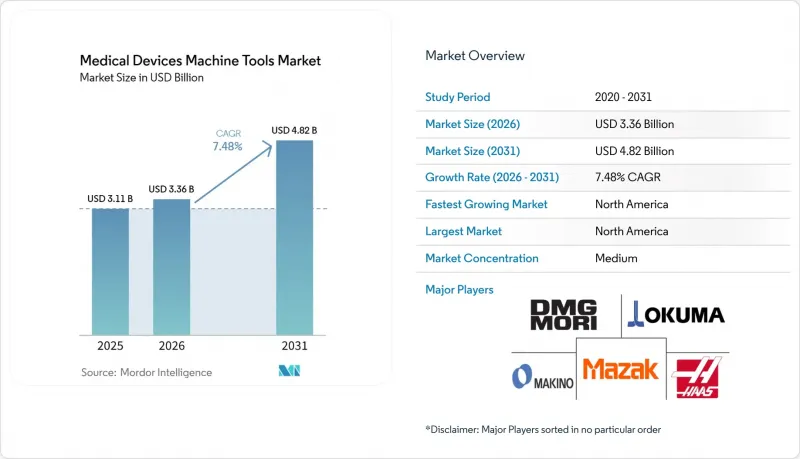
根據 Mordor Intelligence 預測,醫療設備工具機規模預計將在 2025 年達到 31.1 億美元,2026 年達到 33.6 億美元,到 2031 年達到 48.2 億美元,2026 年至 2031 年的複合年成長率為 7.48%。
本報告按工具機類型(CNC車床、數控加工中心等)、應用領域(外科和機器人器材、整形外科和創傷器材等)、最終用戶(醫療設備OEM廠商等)以及地區(北美、亞太、歐洲等)進行細分。報告提供了上述所有細分市場的市場規模和預測(以美元計)。
全球醫療設備工具機市場趨勢及洞察。
植入和外科手術部件的製造對超精密五軸加工的需求日益成長。
客製化患者專用髖關節柄、脛骨托盤和脊椎固定籠的製造需要複雜的機械加工和嚴格控制的表面光潔度。五軸銑削減少了製造過程中工件重新定位的次數。設定週期的減少降低了製造商必須根據 ISO 13485 標準檢驗的記錄數量。這推動了醫療設備工具機市場對進程內測量、刀具磨損補償和製程可追溯性的數控平台的需求。牧野的 N2-5XA 採用乾式無刀尖設計,旨在解決植入製造的污染控制問題。因此,工具機規格不僅越來越受到幾何性能的影響,也越來越受到清潔度和文件記錄要求的影響。
FDA 的 QMSR 與 ISO 13485 的一致性增加了對具備驗證功能的工具機的需求。
最終版品質管理系統法規(QMSR)於2026年2月2日生效,使21 CFR第820部分與ISO 13485:2016標準一致。醫療設備製造商現在需要在整個生產過程中實施更嚴格的文件記錄、風險管理和可追溯性。新設備的購買者需要符合這些要求的安裝、操作和加工資格確認證明文件。先前使用舊品質系統法規程序的現有工廠可能需要重新驗證或更換工具機。專門提供醫療合規支援的供應商可以減輕購買者的負擔。這提高了醫療設備工具機市場中已具備驗證條件的設備的價值。
高級資格確認、驗證和再驗證的負擔延緩了機器的部署。
新型數控加工單元必須經過合格才能生產受監管的醫療組件。工廠驗收測試、切削液驗證、無塵室安裝以及與製造執行系統 (MES) 的整合都會延長部署過程。軟體更新、重大修改和製程變更也可能需要部分或全部合格。 III 類植入和患者接觸組件的製造商必須維持關鍵特性所需的適當工藝,這限制了某些項目適用設備的選擇。這些要求可能導致醫療設備工具機市場高階領域的需求集中。即使製造商需要提高產能,這些要求也可能延遲新生產線的推出。
細分市場分析
在2025年的醫療設備工具機市場中,CNC加工中心佔了28.5%的佔有率。這一佔有率反映了這些工具機在植入和醫療器材大規模生產中的應用,這些應用既需要複雜的形狀,也需要規範的加工流程。五軸加工中心用於曲面加工以及整形外科和脊椎組件的同步加工。雷射切割和微加工設備預計將在2026年至2031年間以8.8%的複合年成長率成長。這些系統用於支架切割、器械標記以及可能被傳統切割方法損壞的零件進行消融。 2025年6月,通快(TRUMPF)發布了TruMicro 9010,用於對各種表面進行高生產率的超短脈衝加工。
數控車床在骨螺絲、空心緊固件和軸的製造中發揮著至關重要的作用。瑞士型車床和車銑複合機床能夠實現鈦合金和不銹鋼零件的大批量生產,同時保持高同心度。數控研磨和精加工機床支援植入表面處理以及其他需要精細表面光潔度的應用。電火花加工 (EDM) 仍然是加工硬化模具和微結構的關鍵,因為銑削加工難以避免毛邊。其他系統,例如超音波加工機、拉床和鑽孔機,則用於 PEEK植入和導管模具的專用加工。每種技術都滿足醫療設備工具機市場不同的生產需求。雷射參數合格尤其重要,因為製程設定必須按照品質管理系統規則 (QMSR) 框架進行記錄和控制。
區域分析
預計到2025年,北美將佔醫療設備工具機市場31.6%的佔有率,並在2031年之前以8.9%的複合年成長率成長。該地區受益於原始設備製造商 (OEM) 和契約製造工廠基於合格管理系統規範 (QMSR) 的認證營運。近岸外包也推動了對美國、加拿大和哥斯大黎加的投資。由於人口老化,整形外科和心血管器械的生產依然強勁。這些因素共同促成了合規相關支出與更多認證產能的需求之間的關聯。弗羅伊登貝格醫療公司於2025年擴大了在哥斯達黎加的業務,以生產電生理和結構性心臟導管。
歐洲仍然是主要的需求基地,這得益於德國的工具機生態系統和醫療技術生產。累計到2024年,德國醫療科技產業的銷售額將達到414億歐元(約466.3億美元),相當於450億美元(約507.9億美元),其中出口額佔68%。根據VDW的報告,儘管預計2025年德國工具機產量將下降8%,但醫療技術產業以及國防、航太和電子產業將支撐需求。瑞士、愛爾蘭和英國也為該地區的生產基地做出了貢獻。歐洲買家還必須考慮歐盟機械法規對連網機器的網路安全要求。這些因素正在推動醫療設備工具機市場的升級和改進投資。
亞太地區是北美以外的主要成長區域,日本、韓國、中國、馬來西亞、泰國和印度等國擁有強大的製造能力。 2025年,日本工具機訂單達1.6兆日圓(約106億美元),日本工具機協會預測,2026年訂單將達到1.7兆日圓(約113.6億美元)。日本的自動化基礎設施支撐著醫療、半導體和國防領域的需求。FANUC)公佈2025會計年度銷售額為8,578億日圓(約57.3億美元),並於2026年4月宣布將在北美投資9,000萬美元用於機器人生產。南美洲、中東和非洲的醫療加工市場規模仍然較小。由於接近性北美原始設備製造商(OEM)以及擁有越來越多的合格契約製造製造商,哥斯達黎加正逐漸成為精密製造的重要中心。
其他好處:
- Excel格式的市場預測(ME)表
- 3個月的分析師支持
目錄
第1章:引言
- 研究假設和市場定義
- 調查範圍
第2章:調查方法
第3章執行摘要
第4章 市場狀況
- 市場概覽
- 市場促進因素
- 植入和外科手術部件的製造對超精密五軸加工的需求日益成長。
- FDA 的 QMSR 與 ISO 13485 的一致性增加了對符合驗證要求的工具機的需求。
- 擴大醫療設備契約製造能力
- 將積層製造和機械加工相結合的混合工作流程在近淨成形醫療零件製造領域迅速普及。
- 加速無人生產以彌補熟練機械師短缺的問題
- 對進程內測量、刀具磨損補償和數位化可追溯性的需求日益成長。
- 市場限制因素
- 高級認證、檢驗和再檢驗的負擔延緩了設備的部署。
- 鈦和鈷鉻合金加工中模具、切削液和維護成本不斷上漲。
- 引入無塵室相容設備和整合 MES 的前置作業時間很長。
- 網路連接型數控單元的網路安全與資料完整性風險
- 價值和供應鏈分析
- 監理情勢
- 技術趨勢與創新展望
- 採購標準和供應商選擇因素
- 售後/改裝市場區隔分析
- 醫療設備市場概況及分析
- 宏觀經濟、貿易和地緣政治因素對市場的影響(關稅、出口限制、關鍵材料供應風險等)
第5章 市場規模與成長預測
- 按機器類型
- 數控車床(含瑞士型、走心式、車銑複合型)
- 數控加工中心(包括三軸、四軸和五軸工具機)
- 數控研磨和精加工設備(包括研磨、搪光機、研磨機和磨床)
- 電火花加工(EDM)工具機
- 雷射切割和微加工系統
- 其他類型的機器(鑽孔、拉削、超音波切割、切割等)
- 透過使用
- 手術和機器人器械
- 整形外科和創傷醫療設備
- 牙科設備
- 植入式醫療設備(心血管、神經血管及微創醫療設備)
- 診斷設備、醫學影像設備、內視鏡設備
- 眼科和助聽設備
- 藥物輸送裝置和其他醫療設備
- 最終用戶
- 醫療設備OEM製造商
- 合約研發生產組織(CDMO)
- 契約製造組織(CMO)和精密加工公司
- 其他(研究機構、原型/醫療技術中心)
- 按地區
- 北美洲
- 美國
- 加拿大
- 墨西哥
- 南美洲
- 巴西
- 哥斯大黎加
- 其他南美國家
- 歐洲
- 英國
- 愛爾蘭
- 德國
- 法國
- 義大利
- 西班牙
- 瑞士
- 比荷盧經濟聯盟(比利時、荷蘭、盧森堡)
- 北歐國家(丹麥、芬蘭、冰島、挪威、瑞典)
- 其他歐洲國家
- 亞太地區
- 中國
- 印度
- 日本
- 韓國
- 馬來西亞
- 台灣
- 澳洲
- 其他亞太國家
- 中東和非洲
- 沙烏地阿拉伯
- 以色列
- 土耳其
- 埃及
- 南非
- 其他中東和非洲國家
- 北美洲
第6章 競爭情勢
- 市場集中度
- 策略趨勢
- 市佔率分析
- 公司簡介
- DMG MORI Co., Ltd.
- Yamazaki Mazak Corporation
- Okuma Corporation
- Makino Milling Machine Co., Ltd.
- Haas Automation, Inc.
- FANUC Corporation
- GF Machining Solutions Management SA
- TRUMPF SE+Co. KG
- Doosan Machine Tools Co., Ltd.
- Hyundai WIA Corporation
- CHIRON Group SE
- EMAG GmbH & Co. KG
- Hermle AG
- HARDINGE INC.
- JTEKT Corporation
- Fives Group
- Siemens AG
- Mitsubishi Electric Corporation
- Hurco Companies, Inc.
- Rollomatic SA
第7章 市場機會與未來展望
According to Mordor Intelligence, the medical devices machine tools market size is projected to be USD 3.11 billion in 2025, USD 3.36 billion in 2026, and reach USD 4.82 billion by 2031, growing at a CAGR of 7.48% from 2026 to 2031.
This report is Segmented by Machine Type (CNC Turning Machines, CNC Machining Centers, and More), by Application (Surgical and Robotic Instruments, Orthopedic and Trauma Devices, and More), by End-User (Medical Device OEMs, and More), and by Geography (North America, Asia-Pacific, Europe, and More). The Report Offers Market Size and Forecasts in Value (USD) for all the Above Segments.
Global Medical Devices Machine Tools Market Trends and Insights
Rising Demand for Ultra-Precision 5-Axis Machining in Implant and Surgical Component Production
Patient-specific hip stems, tibial trays, and spinal fusion cages require complex machining and tightly controlled surfaces. Five-axis milling reduces the need to reposition workpieces during production. Fewer setups can reduce the number of records that manufacturers must validate under ISO 13485 requirements. This supports demand for CNC platforms with in-process metrology, tool wear compensation, and process traceability in the medical devices machine tools market. Makino's N2-5XA uses a dry-chip-less design intended to address contamination control in implant production. Machine specifications are therefore increasingly shaped by cleanliness and documentation needs as well as geometric capability.
FDA QMSR and ISO 13485 Alignment Increasing Demand for Validation-Ready Machine Tools
The QMSR Final Rule became effective on February 2, 2026, and aligned 21 CFR Part 820 with ISO 13485:2016. Medical device manufacturers now need stronger documentation, risk management, and traceability across production steps.Buyers of new equipment need installation, operational, and processing qualification documents that fit these requirements. Existing facilities that used legacy Quality System Regulation procedures may need to revalidate machines or replace them. Suppliers with dedicated medical compliance support can reduce the implementation burden on buyers. This increases the value of validation-ready equipment in the medical devices machine tools market.
High Qualification, Validation, and Revalidation Burden Slowing Machine Deployment
New CNC cells must undergo qualification before they can produce regulated medical components. Factory acceptance testing, coolant validation, cleanroom installation, and manufacturing execution system integration can lengthen the deployment process. Software updates, major modifications, and process changes can also trigger partial or full requalification. Class III implant and patient-contact component manufacturers must maintain capable processes on critical features, which limits the range of equipment suitable for some programs. These requirements can concentrate demand at the premium end of the medical device machine tool market. They can also delay the ramp-up of new production lines even when manufacturers have demand for additional capacity.
Other drivers and restraints analyzed in the detailed report include:
- Expansion of Contract Medical Device Manufacturing Capacity
- Rapid Adoption of Hybrid Additive-Subtractive Workflows for Near-Net Medical Parts
- Elevated Tooling, Coolant, and Maintenance Costs for Titanium and Cobalt-Chromium Machining
For complete list of drivers and restraints, kindly check the Table Of Contents.
Segment Analysis
CNC machining centers held 28.5% of the 2025 medical device machine tool market. Their position reflects their use in high-volume implant and instrument production, where complex geometry and documented processes are both required. Five-axis centers support contoured surfaces and simultaneous machining on orthopedic and spinal parts. Laser cutting and micromachining machines are forecast to grow at an 8.8% CAGR from 2026 to 2031. These systems serve stent cutting, device marking, and ablation work on components that can be damaged by conventional cutting. TRUMPF introduced the TruMicro 9010 in June 2025 for high-productivity ultra-short pulse processing of larger surfaces.
CNC turning machines play a substantial role in the production of bone screws, cannulated fasteners, and shafts. Swiss-type and turn-mill configurations can produce high volumes of titanium and stainless-steel parts with close concentricity. CNC grinding and finishing machines support implant surface preparation and other applications that need fine surface finishes. EDM remains necessary for hardened tooling and microfeatures that are difficult to produce by milling without burrs. Other systems, including ultrasonic, broaching, and drilling machines, handle specialized work for PEEK implants and catheter tooling. Each of these technologies serves a different production need in the medical device machine tools market. Laser parameter qualification is especially important because process settings must be documented and controlled under the QMSR framework.
Complete Report Scope:
- By Machine Type
- CNC Turning Machines (Including Swiss-Type, Sliding-Headstock and Turn-Mill Machines)
- CNC Machining Centers (Including 3-Axis, 4-Axis and 5-Axis Machines)
- CNC Grinding & Finishing Machines (Including Grinding, Honing, Lapping and Polishing Machines)
- Electrical Discharge Machining (EDM) Machines
- Laser Cutting and Micromachining Systems
- Other Machine Types (Drilling, Broaching, Ultrasonic, Sawing, etc.)
- By Application
- Surgical and Robotic Instruments
- Orthopedic and Trauma Devices
- Dental Devices
- Implantable Medical Devices (Cardiovascular, Neurovascular and Minimally Invasive Devices)
- Diagnostic, Medical Imaging and Endoscopy Equipment
- Ophthalmic and Hearing Devices
- Drug-Delivery and Other Medical Devices
- By End User
- Medical Device OEMs
- Contract Development and Manufacturing Organizations (CDMO)
- Contract Manufacturing Organizations (CMO) & Precision Job Shops
- Others (Research Institutes, Prototyping/ Medical Technology Centers)
- By Geography
- North America
- United States
- Canada
- Mexico
- South America
- Brazil
- Costa Rica
- Rest of South America
- Europe
- United Kingdom
- Ireland
- Germany
- France
- Italy
- Spain
- Switzerland
- BENELUX (Belgium, Netherlands, and Luxembourg)
- NORDICS (Denmark, Finland, Iceland, Norway, and Sweden)
- Rest of Europe
- Asia-Pacific
- China
- India
- Japan
- South Korea
- Malaysia
- Taiwan
- Australia
- Rest of Asia-Pacific
- Middle East and Africa
- Saudi Arabia
- Israel
- Turkey
- Egypt
- South Africa
- Rest of Middle East and Africa
- North America
Geography Analysis
North America held 31.6% of the medical devices machine tools market size in 2025 and is forecast to grow at an 8.9% CAGR through 2031. The region benefits from QMSR-driven qualification work at OEM and contract manufacturing facilities. Near-shoring also supports investment in the United States, Canadian, and Costa Rica. Aging populations continue to support orthopedic and cardiovascular device volumes. This combination links compliance spending with demand for additional qualified capacity. Freudenberg Medical expanded its Costa Rica operations in 2025 to produce electrophysiology and structural heart catheters.
Europe remains a major demand base, supported by Germany's machine tool ecosystem and medical technology production. Germany's medical technology sector generated EUR 41.4 billion (USD 46.63 billion) in 2024, equivalent to USD 45 billion (USD 50.79 billion), and had an export ratio of 68%. VDW reported that German machine tool production fell 8% in 2025, while medical technology provided demand support alongside defense, aerospace, and electronics. Switzerland, Ireland, and the United Kingdom add to the regional production base. European buyers must also consider cybersecurity requirements for networked machinery under the EU Machinery Regulation. These factors support replacement and capability investments in the medical devices machine tools market.
Asia-Pacific is the main growth area outside North America, with Japan, South Korea, China, Malaysia, Thailand, and India providing manufacturing capacity. Japan's machine tool orders reached JPY 1.6 trillion (USD 10.6 billion) in 2025, and the Japan Machine Tool Builders' Association expected JPY 1.7 trillion (USD 11.36 billion) in orders for 2026. Japan's automation base supports demand across medical, semiconductor, and defense applications. FANUC reported JPY 857.8 billion (USD 5.73 billion) in fiscal 2025 revenue and announced a USD 90 million investment in North American robot production capacity in April 2026.South America, the Middle East, and Africa remain smaller medical machining markets. Costa Rica has become an important location for precision manufacturing due to its proximity to North American OEMs and its growing pool of qualified contract manufacturers.
- DMG MORI Co., Ltd.
- Yamazaki Mazak Corporation
- Okuma Corporation
- Makino Milling Machine Co., Ltd.
- Haas Automation, Inc.
- FANUC Corporation
- GF Machining Solutions Management SA
- TRUMPF SE + Co. KG
- Doosan Machine Tools Co., Ltd.
- Hyundai WIA Corporation
- CHIRON Group SE
- EMAG GmbH & Co. KG
- Hermle AG
- HARDINGE INC.
- JTEKT Corporation
- Fives Group
- Siemens AG
- Mitsubishi Electric Corporation
- Hurco Companies, Inc.
- Rollomatic SA
Additional Benefits:
- The market estimate (ME) sheet in Excel format
- 3 months of analyst support
TABLE OF CONTENTS
1 INTRODUCTION
- 1.1 Study Assumptions and Market Definition
- 1.2 Scope of the Study
2 RESEARCH METHODOLOGY
3 EXECUTIVE SUMMARY
4 MARKET LANDSCAPE
- 4.1 Market Overview
- 4.2 Market Drivers
- 4.2.1 Rising Demand for Ultra-Precision 5-Axis Machining in Implant and Surgical Component Production
- 4.2.2 FDA QMSR and ISO 13485 Alignment Increasing Demand for Validation-Ready Machine Tools
- 4.2.3 Expansion of Contract Medical Device Manufacturing Capacity
- 4.2.4 Rapid Adoption of Hybrid Additive-Subtractive Workflows for Near-Net Medical Parts
- 4.2.5 Acceleration of Lights-Out Production to Offset Skilled Machinist Shortages
- 4.2.6 Rising Need for In-Process Metrology, Tool Wear Compensation, and Digital Traceability
- 4.3 Market Restraints
- 4.3.1 High Qualification, Validation, and Revalidation Burden Slowing Machine Deployment
- 4.3.2 Elevated Tooling, Coolant, and Maintenance Costs for Titanium and Cobalt-Chromium Machining
- 4.3.3 Long Lead Times for Cleanroom-Compatible Installation and MES Integration
- 4.3.4 Cybersecurity and Data-Integrity Risks in connected CNC Cells
- 4.4 Value and Supply-Chain Analysis
- 4.5 Regulatory Landscape
- 4.6 Technology Trends and Innovation Outlook
- 4.7 Purchasing Criteria and Vendor Selection Factors
- 4.8 Insights on Aftermarket/ Retrofit Market Segment
- 4.9 Medical Devices Market Overview & Insights
- 4.10 Impact of Macroeconomic, Trade and Geopolitical Factors on the Market (Tariffs, export controls, Critical-material supply risks, tariffs, etc.)
5 MARKET SIZE AND GROWTH FORECASTS (Values, In USD Billion)
- 5.1 By Machine Type
- 5.1.1 CNC Turning Machines (Including Swiss-Type, Sliding-Headstock and Turn-Mill Machines)
- 5.1.2 CNC Machining Centers (Including 3-Axis, 4-Axis and 5-Axis Machines)
- 5.1.3 CNC Grinding & Finishing Machines (Including Grinding, Honing, Lapping and Polishing Machines)
- 5.1.4 Electrical Discharge Machining (EDM) Machines
- 5.1.5 Laser Cutting and Micromachining Systems
- 5.1.6 Other Machine Types (Drilling, Broaching, Ultrasonic, Sawing, etc.)
- 5.2 By Application
- 5.2.1 Surgical and Robotic Instruments
- 5.2.2 Orthopedic and Trauma Devices
- 5.2.3 Dental Devices
- 5.2.4 Implantable Medical Devices (Cardiovascular, Neurovascular and Minimally Invasive Devices)
- 5.2.5 Diagnostic, Medical Imaging and Endoscopy Equipment
- 5.2.6 Ophthalmic and Hearing Devices
- 5.2.7 Drug-Delivery and Other Medical Devices
- 5.3 By End User
- 5.3.1 Medical Device OEMs
- 5.3.2 Contract Development and Manufacturing Organizations (CDMO)
- 5.3.3 Contract Manufacturing Organizations (CMO) & Precision Job Shops
- 5.3.4 Others (Research Institutes, Prototyping/ Medical Technology Centers)
- 5.4 By Geography
- 5.4.1 North America
- 5.4.1.1 United States
- 5.4.1.2 Canada
- 5.4.1.3 Mexico
- 5.4.2 South America
- 5.4.2.1 Brazil
- 5.4.2.2 Costa Rica
- 5.4.2.3 Rest of South America
- 5.4.3 Europe
- 5.4.3.1 United Kingdom
- 5.4.3.2 Ireland
- 5.4.3.3 Germany
- 5.4.3.4 France
- 5.4.3.5 Italy
- 5.4.3.6 Spain
- 5.4.3.7 Switzerland
- 5.4.3.8 BENELUX (Belgium, Netherlands, and Luxembourg)
- 5.4.3.9 NORDICS (Denmark, Finland, Iceland, Norway, and Sweden)
- 5.4.3.10 Rest of Europe
- 5.4.4 Asia-Pacific
- 5.4.4.1 China
- 5.4.4.2 India
- 5.4.4.3 Japan
- 5.4.4.4 South Korea
- 5.4.4.5 Malaysia
- 5.4.4.6 Taiwan
- 5.4.4.7 Australia
- 5.4.4.8 Rest of Asia-Pacific
- 5.4.5 Middle East and Africa
- 5.4.5.1 Saudi Arabia
- 5.4.5.2 Israel
- 5.4.5.3 Turkey
- 5.4.5.4 Egypt
- 5.4.5.5 South Africa
- 5.4.5.6 Rest of Middle East and Africa
- 5.4.1 North America
6 COMPETITIVE LANDSCAPE
- 6.1 Market Concentration
- 6.2 Strategic Moves
- 6.3 Market Share Analysis
- 6.4 Company Profiles (includes Global Level Overview, Market Level Overview, Core Segments, Financials as available, Strategic Information, Products and Services, Recent Developments)
- 6.4.1 DMG MORI Co., Ltd.
- 6.4.2 Yamazaki Mazak Corporation
- 6.4.3 Okuma Corporation
- 6.4.4 Makino Milling Machine Co., Ltd.
- 6.4.5 Haas Automation, Inc.
- 6.4.6 FANUC Corporation
- 6.4.7 GF Machining Solutions Management SA
- 6.4.8 TRUMPF SE + Co. KG
- 6.4.9 Doosan Machine Tools Co., Ltd.
- 6.4.10 Hyundai WIA Corporation
- 6.4.11 CHIRON Group SE
- 6.4.12 EMAG GmbH & Co. KG
- 6.4.13 Hermle AG
- 6.4.14 HARDINGE INC.
- 6.4.15 JTEKT Corporation
- 6.4.16 Fives Group
- 6.4.17 Siemens AG
- 6.4.18 Mitsubishi Electric Corporation
- 6.4.19 Hurco Companies, Inc.
- 6.4.20 Rollomatic SA
7 MARKET OPPORTUNITIES AND FUTURE OUTLOOK
- 7.1 White-Space and Unmet-Need Assessment

 工業硬化機市場:全球市場預測,2026-2032年磁磚安裝工具市場-全球預測(2026-2032年)
 電動主軸市場:依產品類型、應用、最終用戶、國家及地區分類-全球產業分析、市場規模、市場佔有率及2026-2033年預測
 工具機產業:全球,2023-2030 年工具機市場規模、佔有率、成長率、全球產業分析、區域趨勢及2026-2034年預測。
 工具機:市佔率分析、產業趨勢及統計、成長預測(2026-2031)
 全球工具機市場(至2033年):依產品類型(銑床、車床、研磨、電火花加工工具機、加工中心)、自動化類型(數控、傳統)、最終用戶產業、銷售管道和地區分類
 2026年全球快速更換刀具系統市場報告2026年全球自動定心虎鉗市場報告全球工具機市場規模、佔有率、趨勢和成長分析報告(2026-2034)