


 |
市場調查報告書
商品編碼
2123106
公司管治、風險與合規 (GRC):市場佔有率分析、產業趨勢與統計、成長預測 (2026-2031)Enterprise Governance, Risk And Compliance - Market Share Analysis, Industry Trends & Statistics, Growth Forecasts (2026 - 2031) |
||||||

※ 本網頁內容可能與最新版本有所差異。詳細情況請與我們聯繫。
根據 Mordor Intelligence 預測,企業管治、風險和合規 (GRC) 市場規模將從 2025 年的 210.4 億美元成長到 2026 年的 236.2 億美元,然後在 2031 年達到 421.9 億美元,2026 年至 2031 年的複合年成長率為 12.3%。
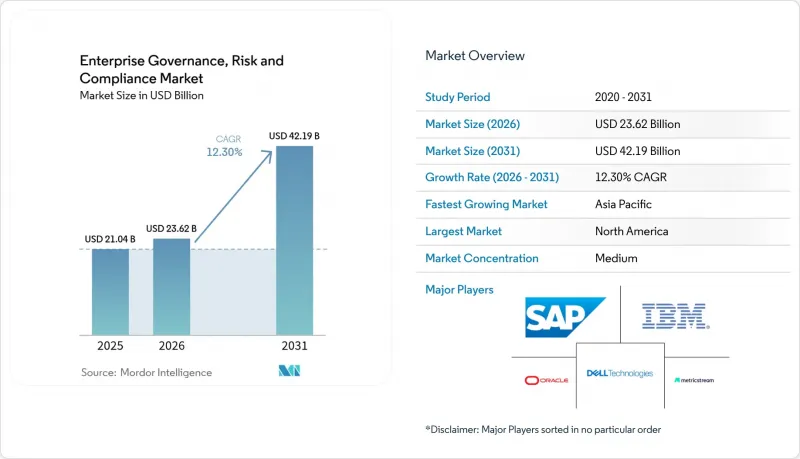
本報告按元件(軟體、服務)、部署方式(本地部署、雲端部署)、組織規模(中小企業、大型企業)、最終用戶產業(銀行、金融服務和保險、醫療保健、生命科學、製造業、IT和電信、能源和公用事業等)以及地區進行細分。市場預測以美元計價。
全球公司管治、風險與合規 (GRC) 市場趨勢與洞察
嚴格的政府法規和指令促進了平台整合。
由於監管活動的活性化,公司管治、風險和合規 (GRC) 市場持續擴張。隨著《資料保護條例》(DORA) 於 2025 年 1 月生效,歐盟金融機構必須建立資訊通訊技術 (ICT) 風險框架,涵蓋事件回應、彈性測試和第三方監督。目前,企業每天要監控超過 250 項監管變更,速度已超出人工處理能力。機器學習模型能夠分析新法規,評估其相關性,並在幾分鐘內將任務分配給相關負責人,使合規團隊能夠將資源重新分配到策略風險分析中。因此,提供多司法管轄區映射功能和自動更新引擎的供應商正迅速成為企業首選。雖然不合規可能面臨巨額罰款和聲譽損害,但早期採用者透過展現營運彈性贏得了投資者的信任。
網路安全威脅的增加正在加速 GRC 技術的整合。
預計到2024年,網路安全事件將激增75%,首席資訊安全安全長(CISO)被迫將安全態勢指標整合到核心管治儀錶板中,而不是孤立地看待它們。將策略檢查與威脅遙測資料疊加的單一主機可以減少重複工作,並縮短混合環境中漏洞修復所需的時間。已實施人工智慧賦能的GRC套件的醫療機構,其風險檢測率提高了37%,誤報率降低了42%,這充分體現了整合合規性和安全數據的價值。 70%的組織認為其目前的雲端風險分配流程效率低下,因此對集中式、獨立於雲端的控制措施的需求日益成長。提供可操作儀錶板而非原始警報的供應商正越來越受歡迎,因為它們減輕了用戶的負擔,使專家能夠專注於高影響威脅。
高昂的初始整合成本是舊有系統現代化改造的一大挑戰。
雖然主流套件的年度訂閱費從 5 萬美元到 50 萬美元不等,但實施成本通常是許可費的兩到六倍,這給使用過時 ERP 基礎設施的公司帶來了沉重的預算負擔。由於 SaaS 價格上漲了 11.3%,儘管員工人數沒有變化,供應商仍將價格提高了 25%,價格敏感度進一步加劇。將現代 GRC 工具與各公司專有的財務、人力資源和製造系統整合通常需要客製化 API 和變更管理程序,這會延長實施週期。基於結果的許可和低程式碼連接器越來越受歡迎,因為它們可以將資本支出轉化為營運費用,並透過可量化的風險降低指標來展示投資回報。
細分市場分析
到2025年,解決方案將佔總收入的66.72%,這凸顯了買家對端到端套件的偏好,這些套件將策略庫、審計追蹤、風險評分和事件回應整合到單一平台中。此主導佔有率反映了企業對單一供應商責任制以及在企業管治、風險和合規 (GRC) 市場所有功能中保持一致使用者體驗的重視程度。諮詢、整合和託管服務雖然絕對值較小,但預計到2031年將成長12.6%,因為買家越來越依賴外部專家進行法規解讀和複雜系統的實施。風險管理和審計管理模組成長最快,它們取代了基於電子表格的工作流程,並提供即時分析功能,高階主管可以透過行動應用程式進行追蹤。由於平均供應鏈中斷損失高達1.84億美元,企業現在將業務永續營運計畫與供應商記分卡直接關聯,因此對業務永續營運功能的需求激增。
儘管由於銀行和醫院需要將敏感記錄儲存在本地,到2025年本地部署仍佔總收入的53.40%,但隨著資訊長們越來越傾向於使用彈性運算來處理人工智慧工作負載,預計到2031年,雲端訂閱收入將以每年13.3%的速度成長。雲端平台正變得越來越吸引各類企業,從中小企業到跨國公司,因為它們可以自動升級、縮短引進週期並支援遠端團隊。透過資料保留規則(DORA)加強對第三方彈性的監管,促使企業要求對外部雲端供應商進行持續監控。雲端原生GRC套件的設計中已內建了此功能。混合模式將關鍵資料保留在本地,同時將分析遷移到雲端,這使得即使是風險規避型企業也能謹慎地嘗試採用雲端技術,而不會違反資料保留法規。
服務提供者透過提供客戶管理的加密金鑰和符合國家法令遵循的認證「主權雲端」區域,來降低潛在的安全漏洞。他們還利用基礎設施即程式碼 (IaC) 範本簡化部署流程,使整個環境的建置時間從數週縮短至數小時。由於人工智慧演算法需要大規模訓練資料集和可擴展的 GPU,雲端部署已成為預測性合規分析的首選方案,鞏固了雲端在企業管治、風險和合規 (GRC) 市場未來中的重要地位。
區域分析
在成熟的法規環境和充足的技術預算的支持下,預計到2025年,北美將佔全球整體收入的34.80%。金融機構每年在合規方面支出610億美元,其中99%的機構預計成本將會增加。這推動了對能夠降低成本率的自動化解決方案的需求。由於聯邦指南鼓勵自願報告和穩健運營,企業將對GRC(治理、風險和合規)的投資視為競爭優勢。 ServiceNow和Visa等夥伴關係表明,技術供應商正在攜手建立人工智慧工作流程,以增強爭議管理並確保合規性。
亞太地區預計將以12.9%的複合年成長率成為全球成長最快的地區。新加坡、澳洲和印度政府已推出符合英國反賄賂法的企業責任法規,迫使企業投資現代化的合規架構。此外,亞太地區的銀行業正面臨高達450億美元的合規成本,用於打擊金融犯罪,70%的企業預計2024年軟體支出將會增加。這些因素正在推動企業採用雲端原生技術,以應對快速的數位轉型。
其他好處:
- Excel格式的市場預測(ME)表
- 3個月的分析師支持
目錄
第1章:引言
- 市場分析與定義的前提條件
- 分析範圍
第2章 分析方法
第3章執行摘要
第4章 市場狀況
- 市場概覽
- 市場促進因素
- 政府的嚴格規章和指令
- 與數位轉型 (DX) 相關的網路安全威脅日益增加
- 遷移到整合風險管理平台
- 環境、社會及公司治理(ESG)報告面臨的壓力以及非財務資訊揭露規則
- 實施人工智慧驅動的合規預測分析
- 基於即時 GRC 指標的保險承保依賴關係
- 市場限制因素
- 缺乏熟練的GRC(治理、風險和合規)專家
- 傳統環境中較高的初始整合成本
- 多重雲端中資料居住和主權相關的複雜性
- 組織內部的 GRC 疲勞和過度警報生成問題
- 供應鏈分析
- 監理情勢
- 技術展望
- 波特五力模型
- 對影響市場的宏觀經濟因素進行評估
第5章 市場規模與成長預測
- 按組件
- 解決方案
- 政策與合規管理
- 審計管理
- 風險管理
- 事件管理
- 業務永續營運和災害復原
- 服務
- 諮詢
- 整合與實施
- 培訓和支持
- 解決方案
- 透過部署方法
- 現場
- 雲
- 按組織規模
- 小型企業
- 大公司
- 按最終用戶行業分類
- 銀行、金融服務和保險業 (BFSI)
- 醫學與生命科學
- 製造業
- 資訊科技/通訊
- 能源公用事業
- 零售和消費品
- 政府/公共部門
- 按地區
- 北美洲
- 美國
- 加拿大
- 墨西哥
- 南美洲
- 巴西
- 阿根廷
- 其他南美國家
- 歐洲
- 德國
- 英國
- 法國
- 俄羅斯
- 其他歐洲國家
- 亞太地區
- 中國
- 日本
- 印度
- 澳洲
- 韓國
- 其他亞太國家
- 中東
- 沙烏地阿拉伯
- 阿拉伯聯合大公國
- 土耳其
- 其他中東國家
- 非洲
- 南非
- 奈及利亞
- 其他非洲國家
- 北美洲
第6章 競爭情勢
- 市場集中度
- 策略趨勢
- 市佔率分析
- 公司簡介
- Dell Technologies(incl. RSA Security)
- IBM Corporation
- SAP SE/GRC Suite
- Oracle Corporation
- MetricStream Inc.
- Wolters Kluwer/Enablon
- SAS Institute Inc.
- Software AG
- NAVEX Global
- Thomson Reuters Corp.
- ServiceNow Inc.
- Riskonnect Inc.
- LogicManager Inc.
- OneTrust LLC
- Galvanize(Diligent)
- Ideagen Plc
- SAI Global
- AxiomSL(Adenza)
- Cura Software
- BWise(SandP Global)
- FutureShield Inc.
- Maclear LLC
- RSA Archer Suite
第7章 市場機會與未來展望
According to Mordor Intelligence, the enterprise governance risk compliance market size is expected to grow from USD 21.04 billion in 2025 to USD 23.62 billion in 2026 and is forecast to reach USD 42.19 billion by 2031 at 12.3% CAGR over 2026-2031.
This report is Segmented by Component (Software and Services), Deployment Model (On-Premises and Cloud), Organisation Size (Small and Medium Enterprises, Large Enterprises), End-User Industry (BFSI, Healthcare and Life Sciences, Manufacturing, IT and Telecom, Energy and Utilities, and More), and Geography. The Market Forecasts are Provided in Terms of Value (USD).
Global Enterprise Governance, Risk And Compliance Market Trends and Insights
Stringent government regulations and mandates drive platform consolidation
Heightened rulemaking continues to swell the enterprise governance risk compliance market as DORA, effective January 2025, obliges EU financial entities to embed ICT risk frameworks covering incident response, resilience testing, and third-party oversight. Firms now monitor more than 250 regulatory changes each day, a pace that outstrips manual processes. Machine-learning models parse new statutes, rank their relevance, and route tasks to accountable owners within minutes, enabling compliance teams to redeploy effort toward strategic risk analysis. Vendors offering multijurisdictional mapping and automated update engines have therefore moved to the top of enterprise shortlists. Failure to comply risks both material penalties and reputational damage, whereas early movers secure investor confidence by demonstrating operational resilience.
Rising cybersecurity threats accelerate GRC technology integration
Cyber incidents spiked 75% in 2024, pushing CISOs to embed security posture metrics into core governance dashboards instead of handling them in isolation. A single console that overlays policy checks onto threat telemetry cuts duplication and shrinks time to remediate vulnerabilities across hybrid environments. Healthcare providers adopting AI-enabled GRC suites recorded 37% stronger risk detection rates and 42% fewer false positives, illustrating the value of unifying compliance and security data. Because 70% of organizations label current cloud-risk assignment processes ineffective, appetite for centralised, cloud-agnostic controls has intensified. Suppliers that deliver actionable dashboards-rather than raw alerts-win traction by easing user fatigue and freeing specialists to focus on high-impact threats.
High initial integration costs challenge legacy system modernization
Annual subscriptions for leading suites range from USD 50,000 to USD 500,000, while implementation often costs two to six times the license fees, straining budgets for firms running ageing ERP backbones. SaaS inflation running at 11.3% further heightens price sensitivity as vendors impose 25% hikes despite flat headcount. Integrating modern GRC tools with bespoke finance, HR, and manufacturing systems often demands custom APIs and change-management programmes that extend timelines. Outcome-based licensing and low-code connectors are gaining popularity by shifting capital expenditure to operating expense and demonstrating payback through quantifiable risk-reduction metrics.
Other drivers and restraints analyzed in the detailed report include:
- AI-powered predictive compliance analytics transform risk management
- ESG reporting pressure creates new compliance categories
- Organizational GRC-fatigue impedes platform adoption
For complete list of drivers and restraints, kindly check the Table Of Contents.
Segment Analysis
Solutions generated 66.72% of 2025 revenue, underscoring buyer preference for end-to-end suites that blend policy libraries, audit trails, risk scoring, and incident response into one stack. This dominance reflects how enterprises value single-vendor accountability and consistent user experience across all functions of the enterprise governance risk compliance market. Consulting, integration, and managed services, though smaller in absolute value, are set to grow 12.6% through 2031 as buyers turn to external experts for regulatory interpretation and complex system rollouts. Risk Management and Audit Management modules experience the fastest take-up because they replace spreadsheet workflows and provide real-time analytics that executives can track on mobile apps. Demand for Business Continuity features surged after supply-chain shocks averaged USD 184 million in losses, prompting firms to link continuity plans directly to supplier scorecards.
On-premise installations retained 53.40% of 2025 revenue because banks and hospitals must store sensitive records locally, but cloud subscriptions will expand 13.3% annually through 2031 as CIOs favor elastic compute for AI workloads. Cloud platforms automate upgrades, shorten implementation cycles, and empower remote teams, making them attractive to SMEs and multinationals alike. Regulatory scrutiny on third-party resilience through DORA pushes firms to demand continuous oversight of external cloud providers-a capability that cloud-native GRC suites embed by design. Hybrid models, which keep critical data on-site while shifting analytics to the cloud, enable risk-averse firms to test the waters without breaching residency rules.
Providers mitigate perceived security gaps by offering customer-managed encryption keys and sovereign-cloud regions certified for local compliance regimes. They also streamline deployment through infrastructure-as-code templates that stand up full environments in hours rather than weeks. As AI algorithms require large training sets and scalable GPUs, cloud deployments become the default choice for predictive compliance analytics-cementing their role in the future landscape of the enterprise governance risk compliance market.
Complete Report Scope:
- By Component
- Solutions
- Policy and Compliance Management
- Audit Management
- Risk Management
- Incident Management
- Business Continuity and Disaster Recovery
- Services
- Consulting
- Integration and Implementation
- Training and Support
- Solutions
- By Deployment Model
- On-premises
- Cloud
- By Organisation Size
- Small and Medium Enterprises
- Large Enterprises
- By End-user Industry
- BFSI
- Healthcare and Life Sciences
- Manufacturing
- IT and Telecom
- Energy and Utilities
- Retail and Consumer Goods
- Government and Public Sector
- By Geography
- North America
- United States
- Canada
- Mexico
- South America
- Brazil
- Argentina
- Rest of South America
- Europe
- Germany
- United Kingdom
- France
- Russia
- Rest of Europe
- Asia-Pacific
- China
- Japan
- India
- Australia
- South Korea
- Rest of Asia-Pacific
- Middle East
- Saudi Arabia
- United Arab Emirates
- Turkey
- Rest of Middle East
- Africa
- South Africa
- Nigeria
- Rest of Africa
- North America
Geography Analysis
North America generated 34.80% of global revenue in 2025, supported by mature regulatory ecosystems and robust technology budgets. Financial institutions spend USD 61 billion annually on compliance, and 99% expect costs to rise, reinforcing demand for automated solutions that lower expense ratios. Federal guidelines reward self-reporting and resilient operations, so firms treat GRC investment as a competitive edge. Partnerships such as ServiceNow-Visa illustrate how technology vendors co-create AI workflows that enhance dispute management while ensuring regulatory adherence.
Asia-Pacific is projected to log a 12.9% CAGR, the highest globally. Governments in Singapore, Australia, and India introduce corporate liability rules mirroring the UK Bribery Act, compelling companies to invest in modern compliance architecture. APAC banks also confront USD 45 billion in financial-crime compliance costs, with 70% citing higher software spend in 2024, driving cloud-native uptake that aligns with rapid digitalization.
- Dell Technologies (incl. RSA Security)
- IBM Corporation
- SAP SE / GRC Suite
- Oracle Corporation
- MetricStream Inc.
- Wolters Kluwer / Enablon
- SAS Institute Inc.
- Software AG
- NAVEX Global
- Thomson Reuters Corp.
- ServiceNow Inc.
- Riskonnect Inc.
- LogicManager Inc.
- OneTrust LLC
- Galvanize (Diligent)
- Ideagen Plc
- SAI Global
- AxiomSL (Adenza)
- Cura Software
- BWise (SandP Global)
- FutureShield Inc.
- Maclear LLC
- RSA Archer Suite
Additional Benefits:
- The market estimate (ME) sheet in Excel format
- 3 months of analyst support
TABLE OF CONTENTS
1 INTRODUCTION
- 1.1 Study Assumptions and Market Definition
- 1.2 Scope of the Study
2 RESEARCH METHODOLOGY
3 EXECUTIVE SUMMARY
4 MARKET LANDSCAPE
- 4.1 Market Overview
- 4.2 Market Drivers
- 4.2.1 Stringent government regulations and mandates
- 4.2.2 Rising cybersecurity threats with digital transformation
- 4.2.3 Move toward integrated risk-management platforms
- 4.2.4 ESG reporting pressure and non-financial disclosure rules
- 4.2.5 AI-powered predictive compliance analytics adoption
- 4.2.6 Insurance underwriting dependencies on real-time GRC metrics
- 4.3 Market Restraints
- 4.3.1 Lack of skilled GRC professionals
- 4.3.2 High initial integration cost for legacy environments
- 4.3.3 Data-residency and sovereignty complexity in multi-cloud
- 4.3.4 Organisational GRC-fatigue and alert overload
- 4.4 Supply-Chain Analysis
- 4.5 Regulatory Landscape
- 4.6 Technological Outlook
- 4.7 Porter's Five Forces
- 4.7.1 Bargaining Power of Suppliers
- 4.7.2 Bargaining Power of Buyers
- 4.7.3 Threat of New Entrants
- 4.7.4 Threat of Substitutes
- 4.7.5 Intensity of Competitive Rivalry
- 4.8 Assesment of Macroeconomic Factors on the Market
5 MARKET SIZE AND GROWTH FORECASTS (VALUE)
- 5.1 By Component
- 5.1.1 Solutions
- 5.1.1.1 Policy and Compliance Management
- 5.1.1.2 Audit Management
- 5.1.1.3 Risk Management
- 5.1.1.4 Incident Management
- 5.1.1.5 Business Continuity and Disaster Recovery
- 5.1.2 Services
- 5.1.2.1 Consulting
- 5.1.2.2 Integration and Implementation
- 5.1.2.3 Training and Support
- 5.1.1 Solutions
- 5.2 By Deployment Model
- 5.2.1 On-premises
- 5.2.2 Cloud
- 5.3 By Organisation Size
- 5.3.1 Small and Medium Enterprises
- 5.3.2 Large Enterprises
- 5.4 By End-user Industry
- 5.4.1 BFSI
- 5.4.2 Healthcare and Life Sciences
- 5.4.3 Manufacturing
- 5.4.4 IT and Telecom
- 5.4.5 Energy and Utilities
- 5.4.6 Retail and Consumer Goods
- 5.4.7 Government and Public Sector
- 5.5 By Geography
- 5.5.1 North America
- 5.5.1.1 United States
- 5.5.1.2 Canada
- 5.5.1.3 Mexico
- 5.5.2 South America
- 5.5.2.1 Brazil
- 5.5.2.2 Argentina
- 5.5.2.3 Rest of South America
- 5.5.3 Europe
- 5.5.3.1 Germany
- 5.5.3.2 United Kingdom
- 5.5.3.3 France
- 5.5.3.4 Russia
- 5.5.3.5 Rest of Europe
- 5.5.4 Asia-Pacific
- 5.5.4.1 China
- 5.5.4.2 Japan
- 5.5.4.3 India
- 5.5.4.4 Australia
- 5.5.4.5 South Korea
- 5.5.4.6 Rest of Asia-Pacific
- 5.5.5 Middle East
- 5.5.5.1 Saudi Arabia
- 5.5.5.2 United Arab Emirates
- 5.5.5.3 Turkey
- 5.5.5.4 Rest of Middle East
- 5.5.6 Africa
- 5.5.6.1 South Africa
- 5.5.6.2 Nigeria
- 5.5.6.3 Rest of Africa
- 5.5.1 North America
6 COMPETITIVE LANDSCAPE
- 6.1 Market Concentration
- 6.2 Strategic Moves
- 6.3 Market Share Analysis
- 6.4 Company Profiles (includes Global-level Overview, Market-level Overview, Core Segments, Financials as available, Strategic Information, Market Rank/Share, Products and Services, Recent Developments)
- 6.4.1 Dell Technologies (incl. RSA Security)
- 6.4.2 IBM Corporation
- 6.4.3 SAP SE / GRC Suite
- 6.4.4 Oracle Corporation
- 6.4.5 MetricStream Inc.
- 6.4.6 Wolters Kluwer / Enablon
- 6.4.7 SAS Institute Inc.
- 6.4.8 Software AG
- 6.4.9 NAVEX Global
- 6.4.10 Thomson Reuters Corp.
- 6.4.11 ServiceNow Inc.
- 6.4.12 Riskonnect Inc.
- 6.4.13 LogicManager Inc.
- 6.4.14 OneTrust LLC
- 6.4.15 Galvanize (Diligent)
- 6.4.16 Ideagen Plc
- 6.4.17 SAI Global
- 6.4.18 AxiomSL (Adenza)
- 6.4.19 Cura Software
- 6.4.20 BWise (SandP Global)
- 6.4.21 FutureShield Inc.
- 6.4.22 Maclear LLC
- 6.4.23 RSA Archer Suite
7 MARKET OPPORTUNITIES AND FUTURE OUTLOOK
- 7.1 White-space and Unmet-Need Assessment

 2026年全球管治、風險管理與合規市場報告
 基於雲端的資訊管治市場規模、佔有率和成長分析:按服務產品、部署模式、應用、企業規模、產業垂直領域、資料類型和地區分類-2026-2033年產業預測
 政府和公共部門綠色IT軟體:市場佔有率分析、行業趨勢和統計數據以及成長預測(2026-2031年)
 企業管治、風險與合規市場:依產品、組件、部署模式、組織規模與產業分類-全球預測,2026-2032年2026年全球鏈上企業管治市場報告
 企業管治、風險和合規 (EGRC) 市場規模、佔有率和趨勢分析報告:按組件、軟體、服務、應用、組織規模、行業、地區和細分市場預測 (2026–2033)2026年全球企業管治、風險與合規(eGRC)市場報告2026年全球環境、社會與管治(ESG)報告軟體市場報告
 企業管治、風險與合規市場規模、佔有率、成長及全球產業分析:按類型、應用和地區分類的洞察,2026-2034 年預測2026年全球空中管治市場報告