


 |
市場調查報告書
商品編碼
2123088
數位版權管理(DRM):市場佔有率分析、產業趨勢與統計數據、成長預測(2026-2031)Digital Rights Management (DRM) - Market Share Analysis, Industry Trends & Statistics, Growth Forecasts (2026 - 2031) |
||||||

※ 本網頁內容可能與最新版本有所差異。詳細情況請與我們聯繫。
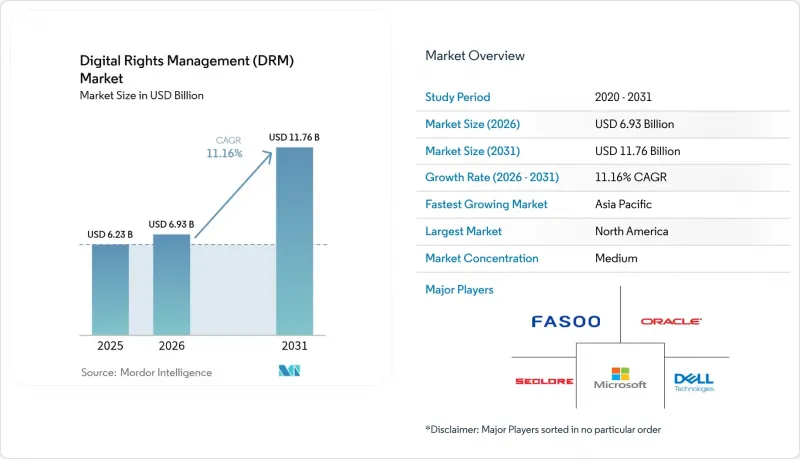
據 Mordor Intelligence 稱,數位版權管理 (DRM) 市場預計到 2026 年價值 69.3 億美元,高於 2025 年的 62.3 億美元,預計到 2031 年將達到 117.6 億美元。
預計從 2026 年到 2031 年,其複合年成長率將達到 11.16%。
本報告按組件(軟體、服務)、部署模式(本地部署、雲端部署)、最終用戶企業規模(中小企業、大型企業)、最終用戶產業(媒體娛樂、銀行、金融服務和保險、醫療保健等)以及地區(北美、南美、歐洲、亞太、中東和非洲)進行細分。市場預測以美元計價。
全球數位版權管理 (DRM) 市場趨勢與洞察
OTT影片和串流媒體訂閱的普及
OTT平台提供高價值的4K和8K內容,這需要強大的加密技術和涵蓋Widevine、FairPlay和PlayReady的多重DRM策略。直播體育賽事對低延遲保護的要求更高,尤其是在亞太地區以行動端為主的受眾群體中。平台營運商正在利用自適應位元率串流媒體和取證浮水印技術的組合來降低會話劫持的風險。從智慧電視到車載資訊娛樂系統,連網裝置的日益多樣化推動了對可跨晶片組無縫擴展的、基於標準的DRM的需求。如今,競爭的差異化重點在於提供強大的安全性,同時避免緩衝或解析度下降,從而在競爭日益激烈的內容市場中確保用戶留存。
自帶設備辦公 (BYOD) 和遠距辦公的資料安全需求
隨著混合辦公模式的普及,數位版權管理 (DRM) 的角色正從內容保護擴展到以文件為中心的資料安全框架。企業正在採用零信任原則,並要求對文件進行持久加密,使其隨文件傳輸,並在每個網路基地台驗證使用者身分。 「行動優先」的 DRM,例如 Fasoo 的 GPS 螢幕浮水印技術,可以在保護非託管 Android 和 iOS 裝置上的資料的同時,將行為遙測資料傳輸到安全營運中心。與身分和存取管理 (IAM) 平台的整合實現了即時撤銷進入許可權,滿足了稽核人員要求的可驗證控制要求。在監管嚴格的行業中,這種趨勢尤其明顯,因為違規罰款逐年增加。
持續存在的設備/格式不相容問題
生態系統的碎片化內容擁有者同時運行多種DRM實現方案,因為瀏覽器廠商正在逐步淘汰舊版模組。谷歌停止支援iOS的Widevine CDM後,迫使開發者為蘋果硬體整合FairPlay,這使其維護負擔加倍。舊款智慧電視和機上盒的安全性修補更新頻率低,導致授權鏈出現漏洞。對於同時擁有行動和桌面設備的公司而言,策略執行的標準化十分困難,這不僅增加了支援成本,也減緩了新內容格式的普及速度。
細分市場分析
到2025年,軟體平台將佔據數位版權管理(DRM)市場63.85%的佔有率,反映出市場對整合式授權伺服器、分析儀表板和規則引擎的強勁需求。同時,隨著越來越多的企業將多DRM編配和區塊鏈整合外包給專業公司,服務業預計將以17.32%的複合年成長率成長。對於缺乏內部專業知識的中小型企業而言,提供全天候許可伺服器監控和快速威脅情報更新服務的託管安全提供者是一個極具吸引力的選擇。
Adobe數位媒體部門預計在2025年第一季營收將達到42.3億美元,顯示市場對人工智慧驅動的數位版權管理(DRM)功能有著濃厚的興趣。諮詢服務正從實施階段擴展到持續的合規性審計,推動著服務合約轉向基於結果的模式。在整個預測期內,隨著量子加密先導計畫的出現,服務部門有望在彌合技能差距和鞏固其在不斷成長的支出中所佔佔有率方面發揮作用。
預計到2025年,雲端模式將佔據數位版權管理(DRM)市場56.10%的佔有率,複合年成長率(CAGR)為17.95%。集中式授權伺服器便於策略更新,並且具有可擴展性,能夠應對諸如體育賽事決賽等活動帶來的流量高峰。據IBM稱,82%的資料外洩事件發生在雲端環境中,這促使企業擴展DRM管理,將物件儲存層和SaaS儲存庫納入其中。
混合拓撲結構在創新素材保留在本地進行編輯,而分發金鑰則部署在區域雲端以滿足本地化需求的場景中正變得越來越流行。邊緣節點整合了輕量級DRM,能夠以亞秒延遲保護4K視訊串流,從而緩解頻寬不穩定市場中的緩衝申訴。在國防和公共安全領域,本地部署仍然普遍存在,因為這些領域空氣間隙環境為主。然而,即使在這些領域,人們也在探索基於私有雲端的金鑰管理方案,以降低營運成本。
區域分析
到2025年,北美將佔據數位版權管理(DRM)市場37.95%的佔有率。這得歸功於HIPAA、SOX和加州消費者隱私法案(CCPA)等嚴格的行業法規。金融機構和媒體集團主導多DRM技術的應用,並整合基於區塊鏈的授權匹配機制,以簡化版稅支付流程。美國雲端服務供應商正與加拿大廣播公司合作,部署跨境金鑰冗餘方案,在不犧牲延遲的前提下,滿足不同主權國家法律的衝突。
亞太地區預計到2031年將維持15.94%的複合年成長率,這主要得益於行動影片流量的激增以及印度、印尼和越南等國數據本地化法規。中國強制新車安裝DRM接收器的指令凸顯了監管趨勢的加速發展,迫使晶片組供應商整合成本最佳化的解密模組。印度電信業者正將DRM作為一項附加價值服務與獨立電影製作人捆綁銷售,並與之共享收益;而韓國教育科技公司則致力於保護用戶自帶設備(BYOD)平板電腦上的互動式教科書。隨著可互通的版權管理成為創新產業出口實現全球獲利的必要條件,全部區域的支出正在激增。
歐洲的穩定進展反映了《一般資料保護規則》(GDPR)和NIS2指令的實施浪潮,這兩項指令將對關鍵基礎設施營運商提出更高的網路彈性標準。媒體監管機構正在鼓勵多DRM合作,以實現跨境串流媒體的標準化,並支持建立泛歐內容入口網站。南歐廣播公司正在從傳統的CAS智慧卡遷移到整合DRM,從而將條件接收(CAS)成本降低了30%。同時,南美和非洲等新興樞紐地區正在部署承包DRM,以遏制非法IPTV服務並保護本地製作的電視劇,這得益於雲CDN價格的降低。隨著行動電話普及率和光纖部署的加速,這些地區的市場佔有率正在逐步成長。
其他好處:
- Excel格式的市場預測(ME)表
- 3個月的分析師支持
目錄
第1章:引言
- 研究假設和市場定義
- 調查範圍
第2章:調查方法
第3章執行摘要
第4章 市場狀況
- 市場概覽
- 市場促進因素
- OTT影片和串流服務的普及
- 自備設備辦公 (BYOD) 和遠端辦公環境下的強制性資料安全措施
- 與數位智慧財產權相關的訴訟和處罰案件數量增加
- 政府為確保數據主權所做的努力
- 基於區塊鏈的內容貨幣化智慧合約
- 人工智慧生成技術驅動的盜版深度造假激增,導致對數位版權管理(DRM)的需求不斷成長。
- 市場限制因素
- 設備和格式之間缺乏相容性的問題仍然存在。
- 使用者體驗對過度控制的反彈
- 開放原始碼水印技術解決了專有DRM帶來的挑戰。
- 量子運算對現有加密標準的威脅
- 產業價值鏈分析
- 監理情勢
- 技術展望
- 波特五力分析
第5章 市場規模與成長預測
- 按組件
- 軟體
- 服務
- 部署模式
- 現場
- 雲
- 按最終用戶公司規模分類
- 中小企業
- 大公司
- 按最終用戶行業分類
- 媒體與娛樂
- BFSI
- 資訊科技/通訊
- 衛生保健
- 教育
- 政府/公共部門
- 其他終端用戶產業(製造業、零售業等)
- 按地區
- 北美洲
- 美國
- 加拿大
- 墨西哥
- 南美洲
- 巴西
- 阿根廷
- 其他南美國家
- 歐洲
- 英國
- 德國
- 法國
- 義大利
- 西班牙
- 俄羅斯
- 其他歐洲國家
- 亞太地區
- 中國
- 日本
- 印度
- 韓國
- 澳洲和紐西蘭
- 其他亞太國家
- 中東和非洲
- 中東
- 沙烏地阿拉伯
- 阿拉伯聯合大公國
- 土耳其
- 其他中東國家
- 非洲
- 南非
- 奈及利亞
- 肯亞
- 其他非洲國家
- 中東
- 北美洲
第6章 競爭情勢
- 市場集中度
- 策略趨勢
- 市佔率分析
- 公司簡介
- Adobe Inc.
- Microsoft Corporation
- Google LLC(Widevine)
- Apple Inc.
- Oracle Corporation
- IBM Corporation
- Amazon Web Services Inc.(AWS Elemental)
- Dell Technologies Inc.
- SAP SE(NextLabs Inc.)
- Seclore Technology Pvt Ltd
- Fasoo Inc.
- Irdeto BV
- OpenText Corporation
- Locklizard Limited
- Vitrium Systems Inc.
- Bynder BV
- CapLinked Inc.
- Digify Pte Ltd
- FADEL Partners Inc.
- ArtistScope Pty Ltd
- Widevine Technologies Inc.(legacy)
第7章 市場機會與未來展望
According to Mordor Intelligence, digital rights management market size in 2026 is estimated at USD 6.93 billion, growing from 2025 value of USD 6.23 billion with 2031 projections showing USD 11.76 billion, growing at 11.16% CAGR over 2026-2031.
This report is Segmented by Component (Software, Services), Deployment Mode (On-Premises, Cloud), End-User Enterprise Size (Small and Medium Enterprises, Large Enterprises), End-User Industry (Media and Entertainment, BFSI, Healthcare, and More), and Geography (North America, South America, Europe, Asia Pacific, Middle East and Africa). The Market Forecasts are Provided in Terms of Value (USD).
Global Digital Rights Management (DRM) Market Trends and Insights
Proliferation of OTT Video and Streaming Subscriptions
OTT platforms distribute higher-value 4K and 8K assets that demand hardened encryption and multi-DRM strategies to span Widevine, FairPlay, and PlayReady. Live sports streaming intensifies low-latency protection requirements, especially across mobile-centric Asia Pacific audiences. Platform operators leverage adaptive bitrate streaming coupled with forensic watermarking to curb session hijacking. The diversity of connected devices from smart TVs to in-vehicle infotainment fuels demand for standards-based DRM that scales seamlessly across chipsets. Competitive differentiation now centers on delivering robust security without buffering or resolution downgrades, ensuring subscriber retention in an increasingly crowded content landscape.
BYOD and Remote-Work Data-Security Mandates
Permanent hybrid-work policies push DRM from content protection into file-centric data-security frameworks. Enterprises integrate Zero-Trust principles, requiring persistent encryption that travels with a document and authenticates user identity at every access point. Mobile-first DRM, exemplified by Fasoo's GPS-aware screen-watermarking, safeguards data on unmanaged Android and iOS devices while feeding behavioral telemetry into security operations centers . Integration with identity-and-access-management platforms enables real-time revocation, meeting auditors' insistence on demonstrable control. The driver is most pronounced in regulated verticals where fines for non-compliance escalate annually.
Persistent Device/Format Incompatibilities
Ecosystem fragmentation forces content owners to juggle multiple DRM implementations as browser vendors deprecate legacy modules. Google's discontinuation of Widevine CDM on iOS compels developers to integrate FairPlay for Apple hardware, doubling maintenance overhead. Older smart TVs and set-top boxes receive security patches irregularly, creating weak links in license enforcement chains. Enterprises with mixed mobile and desktop fleets struggle to standardize policy enforcement, elevating support costs and delaying rollout of new content formats.
Other drivers and restraints analyzed in the detailed report include:
- Rising Digital-IP Litigation and Penalties
- Government Push for Data-Sovereignty Compliance
- User-Experience Backlash Over Intrusive Controls
For complete list of drivers and restraints, kindly check the Table Of Contents.
Segment Analysis
Software platforms retained 63.85% of Digital Rights Management market share in 2025, reflecting entrenched demand for integrated license servers, analytics dashboards, and rules engines. Services, however, posted a 17.32% CAGR as organizations turned to specialists for multi-DRM orchestration and blockchain integration. Managed-security providers bundle 24X7 license-server monitoring with rapid threat-intel updates, appealing to SMEs that lack in-house expertise.
Adobe's Digital Media revenue of USD 4.23 billion in Q1 2025 underscores buyers' willingness to invest in AI-infused DRM capabilities. Consulting engagements now extend beyond deployment into continuous compliance auditing, supporting a shift toward outcome-based service contracts. Over the forecast horizon, services are expected to bridge skills gaps as quantum-safe encryption pilots emerge, cementing their share of incremental expenditure.
The cloud model represented 56.10% of Digital Rights Management market size in 2025 and is forecast to expand at 17.95% CAGR. Centralized license servers ease policy updates and scale elastically to support event-driven spikes such as live sports finals. IBM notes that 82% of data breaches occur in cloud venues, prompting enterprises to extend DRM controls into object-storage tiers and SaaS repositories.
Hybrid topologies flourish where creative assets remain on-premises for editing while distribution keys reside in regional clouds to satisfy localization mandates. Edge nodes embed lightweight DRM to secure 4K streams at sub-second latency, reducing buffering complaints in bandwidth-variable markets. On-premises deployments persist in defense and public-safety domains where air-gapped environments prevail, yet even these sectors explore private-cloud key management to cut operational overhead.
Complete Report Scope:
- By Component
- Software
- Services
- By Deployment Mode
- On-premises
- Cloud
- By End-user Enterprise Size
- Small and Medium Enterprises (SMEs)
- Large Enterprises
- By End-user Industry
- Media and Entertainment
- BFSI
- IT and Telecommunication
- Healthcare
- Education
- Government and Public Sector
- Others End-user Industry (Manufacturing, Retail, etc.)
- By Geography
- North America
- United States
- Canada
- Mexico
- South America
- Brazil
- Argentina
- Rest of South America
- Europe
- United Kingdom
- Germany
- France
- Italy
- Spain
- Russia
- Rest of Europe
- Asia Pacific
- China
- Japan
- India
- South Korea
- Australia and New Zealand
- Rest of Asia Pacific
- Middle East and Africa
- Middle East
- Saudi Arabia
- United Arab Emirates
- Turkey
- Rest of Middle East
- Africa
- South Africa
- Nigeria
- Kenya
- Rest of Africa
- Middle East
- North America
Geography Analysis
North America accounted for 37.95% of Digital Rights Management market in 2025, supported by stringent sectoral mandates such as HIPAA, SOX, and the California Consumer Privacy Act. Financial institutions and media conglomerates lead multi-DRM rollouts that integrate blockchain-anchored license reconciliation to streamline royalty settlements. U.S. cloud providers partner with Canadian broadcasters to deploy cross-border key-vault redundancy that satisfies rival sovereignty laws without sacrificing latency.
Asia Pacific is forecast to record a 15.94% CAGR through 2031, propelled by surging mobile video traffic and data-localization statutes in India, Indonesia, and Vietnam. China's directive mandating DRM receivers in new-model vehicles underscores regulatory acceleration, pushing chipset suppliers to embed cost-optimized decryption blocks. Indian telecom operators bundle DRM as a revenue-sharing value-add for independent filmmakers, while Korean edtech companies secure interactive textbooks across BYOD tablets. Regional spending rises sharply as creative-industry exports require interoperable rights management to monetize globally.
Europe's steady progression reflects the GDPR enforcement wave and the upcoming NIS2 directive that imposes higher cyber-resilience standards on critical-infrastructure operators. Media regulators encourage multi-DRM cooperation to standardize cross-border streaming, aiding pan-European content portals. Southern European broadcasters transition from legacy CAS smart-cards to converged DRM, trimming conditional-access costs by 30%. Meanwhile, emerging hubs in South America and Africa benefit from falling cloud-CDN pricing, adopting turnkey DRM to curb illegal IPTV services and protect locally produced drama series. These regions contribute incremental but rising shares as handset penetration and fiber rollout gather pace.
List of Companies Covered in this Report:
- Adobe Inc.
- Microsoft Corporation
- Google LLC (Widevine)
- Apple Inc.
- Oracle Corporation
- IBM Corporation
- Amazon Web Services Inc. (AWS Elemental)
- Dell Technologies Inc.
- SAP SE (NextLabs Inc.)
- Seclore Technology Pvt Ltd
- Fasoo Inc.
- Irdeto B.V.
- OpenText Corporation
- Locklizard Limited
- Vitrium Systems Inc.
- Bynder B.V.
- CapLinked Inc.
- Digify Pte Ltd
- FADEL Partners Inc.
- ArtistScope Pty Ltd
- Widevine Technologies Inc. (legacy)
Additional Benefits:
- The market estimate (ME) sheet in Excel format
- 3 months of analyst support
TABLE OF CONTENTS
1 INTRODUCTION
- 1.1 Study Assumptions and Market Definition
- 1.2 Scope of the Study
2 RESEARCH METHODOLOGY
3 EXECUTIVE SUMMARY
4 MARKET LANDSCAPE
- 4.1 Market Overview
- 4.2 Market Drivers
- 4.2.1 Proliferation of OTT video and streaming subscriptions
- 4.2.2 BYOD and remote-work data-security mandates
- 4.2.3 Rising digital-IP litigation and penalties
- 4.2.4 Government push for data-sovereignty compliance
- 4.2.5 Blockchain-anchored smart contracts for content monetisation
- 4.2.6 Generative-AI-driven piracy deepfakes escalating DRM demand
- 4.3 Market Restraints
- 4.3.1 Persistent device/format incompatibilities
- 4.3.2 User-experience backlash over intrusive controls
- 4.3.3 Open-source watermarking challenging proprietary DRM
- 4.3.4 Quantum-computing threat to current encryption standards
- 4.4 Industry Value--Chain Analysis
- 4.5 Regulatory Landscape
- 4.6 Technological Outlook
- 4.7 Porter's Five Forces Analysis
- 4.7.1 Bargaining Power of Suppliers
- 4.7.2 Bargaining Power of Consumers
- 4.7.3 Threat of New Entrants
- 4.7.4 Intensity of Competitive Rivalry
- 4.7.5 Threat of Substitutes
5 MARKET SIZE AND GROWTH FORECASTS (VALUE)
- 5.1 By Component
- 5.1.1 Software
- 5.1.2 Services
- 5.2 By Deployment Mode
- 5.2.1 On-premises
- 5.2.2 Cloud
- 5.3 By End-user Enterprise Size
- 5.3.1 Small and Medium Enterprises (SMEs)
- 5.3.2 Large Enterprises
- 5.4 By End-user Industry
- 5.4.1 Media and Entertainment
- 5.4.2 BFSI
- 5.4.3 IT and Telecommunication
- 5.4.4 Healthcare
- 5.4.5 Education
- 5.4.6 Government and Public Sector
- 5.4.7 Others End-user Industry (Manufacturing, Retail, etc.)
- 5.5 By Geography
- 5.5.1 North America
- 5.5.1.1 United States
- 5.5.1.2 Canada
- 5.5.1.3 Mexico
- 5.5.2 South America
- 5.5.2.1 Brazil
- 5.5.2.2 Argentina
- 5.5.2.3 Rest of South America
- 5.5.3 Europe
- 5.5.3.1 United Kingdom
- 5.5.3.2 Germany
- 5.5.3.3 France
- 5.5.3.4 Italy
- 5.5.3.5 Spain
- 5.5.3.6 Russia
- 5.5.3.7 Rest of Europe
- 5.5.4 Asia Pacific
- 5.5.4.1 China
- 5.5.4.2 Japan
- 5.5.4.3 India
- 5.5.4.4 South Korea
- 5.5.4.5 Australia and New Zealand
- 5.5.4.6 Rest of Asia Pacific
- 5.5.5 Middle East and Africa
- 5.5.5.1 Middle East
- 5.5.5.1.1 Saudi Arabia
- 5.5.5.1.2 United Arab Emirates
- 5.5.5.1.3 Turkey
- 5.5.5.1.4 Rest of Middle East
- 5.5.5.2 Africa
- 5.5.5.2.1 South Africa
- 5.5.5.2.2 Nigeria
- 5.5.5.2.3 Kenya
- 5.5.5.2.4 Rest of Africa
- 5.5.5.1 Middle East
- 5.5.1 North America
6 COMPETITIVE LANDSCAPE
- 6.1 Market Concentration
- 6.2 Strategic Moves
- 6.3 Market Share Analysis
- 6.4 Company Profiles (includes Global level Overview, Market level overview, Core Segments, Financials as available, Strategic Information, Market Rank/Share for key companies, Products and Services, and Recent Developments)
- 6.4.1 Adobe Inc.
- 6.4.2 Microsoft Corporation
- 6.4.3 Google LLC (Widevine)
- 6.4.4 Apple Inc.
- 6.4.5 Oracle Corporation
- 6.4.6 IBM Corporation
- 6.4.7 Amazon Web Services Inc. (AWS Elemental)
- 6.4.8 Dell Technologies Inc.
- 6.4.9 SAP SE (NextLabs Inc.)
- 6.4.10 Seclore Technology Pvt Ltd
- 6.4.11 Fasoo Inc.
- 6.4.12 Irdeto B.V.
- 6.4.13 OpenText Corporation
- 6.4.14 Locklizard Limited
- 6.4.15 Vitrium Systems Inc.
- 6.4.16 Bynder B.V.
- 6.4.17 CapLinked Inc.
- 6.4.18 Digify Pte Ltd
- 6.4.19 FADEL Partners Inc.
- 6.4.20 ArtistScope Pty Ltd
- 6.4.21 Widevine Technologies Inc. (legacy)
7 MARKET OPPORTUNITIES AND FUTURE OUTLOOK
- 7.1 White-space and Unmet-Need Assessment

 AI語音版權管理全球市場規模、佔有率、趨勢和成長分析報告(2026-2034年)全球企業權限管理解決方案市場規模、佔有率、趨勢和成長分析報告(2026-2034年)
 串流版權:市場佔有率分析、產業趨勢與統計、成長預測(2026-2031)
 網路版權市場-2026-2032年全球市場預測數位版權管理 (DRM) 市場:按元件、內容類型、平台類型、部署類型、產業和組織規模分類-2026-2032 年全球市場預測
 數位版權管理市場:按組件、部署方式、組織規模、最終用戶產業和地區分類
 媒體和娛樂產業數位版權管理市場:市場規模、佔有率和趨勢分析報告:按應用程式、公司規模、地區和細分市場預測(2026-2033 年)
 2026-2030年全球數位版權管理市場
 數位版權管理 (DRM) 市場報告:按元件、部署形式、企業規模、應用程式、最終用戶產業和地區分類 (2026–2034)全球反盜版市場規模、佔有率、趨勢和成長分析報告(2026-2034)