


 |
市場調查報告書
商品編碼
2123058
生物基1,4-丁二醇:市場佔有率分析、產業趨勢與統計、成長預測(2026-2031年)Bio-based 1,4-Butanediol - Market Share Analysis, Industry Trends & Statistics, Growth Forecasts (2026 - 2031) |
||||||

※ 本網頁內容可能與最新版本有所差異。詳細情況請與我們聯繫。
根據 Mordor Intelligence 預測,生物基 1,4-丁二醇的市場規模預計將在 2025 年達到 38.81 千噸,在 2026 年達到 42.46 千噸,在 2031 年達到 66.54 千噸,從 2026 年到 2031 年到 2031 年的複合年成長率為 2026 年的 2031 年。
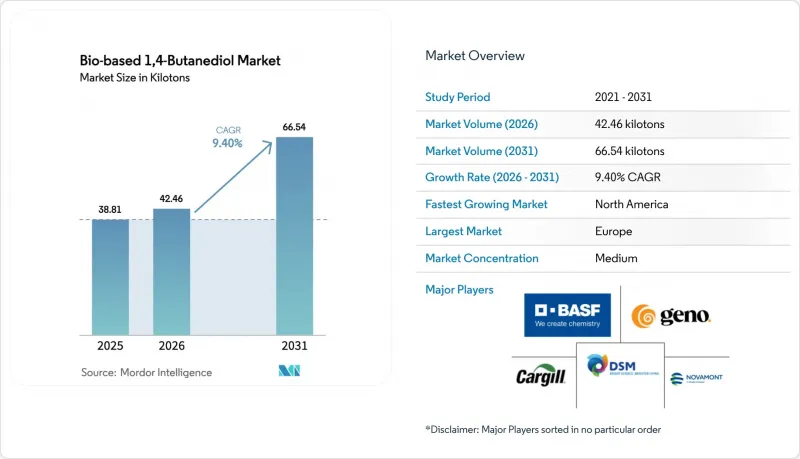
本報告按應用領域(四氫呋喃 (THF)、聚對聚丁烯對苯二甲酸酯(PBT)、γ-丁內酯 (GBL) 等)、終端用戶產業(汽車、電氣電子、紡織服裝、工業及其他)和地區(亞太地區、北美地區、歐洲及世界其他地區)進行細分。市場預測以噸為單位。
全球生物基1,4-丁二醇市場趨勢及洞察
聚對聚丁烯對苯二甲酸酯(PBT)需求激增
電動車架構需要能夠承受超過 150 度C高溫的 PBT 連接器、電池外殼和充電組件。由於這種材料可以模製成薄壁,組件重量可減輕高達 20%,這對於續航里程至關重要的電池平台而言是一項顯著優勢。生物基 BDO 可作為直接替代的前體,使加工商無需重新認證關鍵組件即可獲得可再生原料含量的認證。BASF的 REDcert2 認證生質能平衡 BDO 自 2024 年起已上市,在保持相當機械性能的同時,降低了碳排放。受 5G 部署和資料中心建設的推動,電子產業也正在經歷成長,預計到 2030 年,這將使 PBT 的需求以每年 8% 的速度成長。
全球和區域層級制定嚴格的碳減量法規。
歐盟的碳邊境調節機制(CBAM)對高排放進口產品徵收碳排放稅。 2026年,有機化學品被納入碳稅清單後,煤基丁烷二氧化物(BDO)的進口成本將增加每噸150至200歐元。加州的低碳燃料標準(LCFS)和美國的《通貨膨脹控制法案》(IRA)提供可交易的碳權額度和生產稅減免,使符合條件的生物基丁烷二氧化物的生產成本降低每公斤0.20至0.30美元。中國旨在2060年實現碳中和的「峰值碳中和」策略限制了新建煤基丁烷二氧化物設施的核准,並優先發展生物基生產路線。此外,歐洲的RED II計劃正在增加對四氫呋喃(THF)作為可再生燃料添加劑的需求。
由於原油價格波動,化石衍生的BDO與原油之間存在價格差異。
生物基BDO的價格與葡萄糖和蔗糖的成本密切相關,而這兩種糖的價格在收成不佳時會飆升;化石基BDO的價格則受石腦油和天然氣價格週期的影響。 2024年底,當原油價格跌破每桶70美元時,生物基BDO的溢價擴大至25%。在中國,煤基BDO的售價為每公斤1.60至1.80美元,比生物基BDO便宜高達30%,這給那些沒有永續性條款的加工商帶來了壓力。
細分市場分析
四氫呋喃 (THF) 預計在 2025 年將佔總銷售量的 48.40%,並將在 2031 年前以 9.62% 的複合年成長率持續成長,這主要得益於休閒和內衣對氨綸的強勁需求。隨著採用 Qore 公司生物基 BDO 生產的氨綸上市,碳足跡減少了 44%,THF 也成為生物基 1,4-丁二醇市場的主要應用之一。其次是 PBT 應用,這主要受電動車連接器和汽車 PBT 需求的推動,預計到 2030 年,汽車 PBT 的需求將增加 8%。 γ-丁內酯為特殊溶劑提供支持,而聚氨酯彈性體則迎合了綠色建築和低 VOC 趨勢。像曉星TNC越南工廠這樣的垂直整合項目,既滿足了PTMEG自身的需求,又保護了THF供應鏈免受原料價格波動的影響,並確保到2026年中期實現5萬噸氨綸產能的投產。
第二個應用領域雖然仍屬小眾,但盈利豐厚。 GBL 可用作農業化學品中間體的原料,而監管機構優先考慮經檢驗的生物基路線。隨著聚氨酯 (PU) 進入硬質隔熱材料領域,市場範圍正在擴大。這些多元化的銷售管道相結合,增強了生物基 1,4-丁二醇市場抵禦單一行業低迷的能力,並幫助供應商透過多年期合約平衡其生產組合。
區域分析
到2025年,歐洲將佔全球產量的75.01%。BASF的REDcert2認證生質能平衡BDO和諾瓦蒙特公司年產3萬噸的專用工廠將為此提供支援。碳邊境調節機制(CBAM)將從2026年起使進口化石基BDO的成本每噸增加150-200歐元,從而有效津貼區域生物基生產。德國、英國、法國和義大利佔歐洲需求的60%以上,主要得益於汽車產業PBT的消耗和大規模紡織加工中心。北歐國家在利用林業殘餘物作為原料方面取得了進展,而土耳其以出口為導向的紡織業則需要生物基PTMEG來滿足歐盟品牌規格要求。
預計北美將成為成長最快的地區,2026年至2031年的複合年成長率將達到9.87%。 Qore位於愛荷華州的6.5萬噸級工廠將於2026年開始商業化出貨,為美國萊卡(LYCRA)的氨綸生產線供應原料。 《通貨膨脹削減法案》的獎勵正在降低生物基丁二醇(bio-BDO)的現金成本,並吸引新的發酵項目。加州的低碳燃料標準(LCFS)積分和加拿大的無污染燃料法規正在促進用於燃料添加劑的四氫呋喃(THF)分子的生產。墨西哥的汽車生產基地正在推動生物基多溴聯苯醚(bio-PBT)的生產,並透過整合跨境供應鏈來支持區域成長。
亞太地區在全球產能中佔很大佔有率,中國生產商利用玉米和木薯等原料,以具競爭力的成本進行生產。曉星集團在越南投資10億美元的工廠將保障自身需求並降低供應風險。日本東麗和三菱等大型企業正在大力發展纖維素糖的生產,這些纖維素糖將被整合到其更廣泛的聚酯和尼龍業務中。韓國LG化學正致力於將生物基BDO應用於汽車和電子產業,而東南亞紡織產業叢集則正在採購可再生PTMEG,以滿足歐美品牌的需求。世界其他地區依賴進口,但隨著中東和南美紡織業的擴張,也出現了成長跡象,這些地區需要低碳原料來保持出口競爭力。
其他好處:
- Excel格式的市場預測(ME)表
- 3個月的分析師支持
目錄
第1章:引言
- 研究假設和市場定義
- 調查範圍
第2章:調查方法
第3章執行摘要
第4章 市場狀況
- 市場概覽
- 市場促進因素
- 對聚丁烯對苯二甲酸酯(PBT)的需求正在激增。
- 全球和區域層面的嚴格碳減排義務
- 品牌所有者為實現消費品 (CPG) 和汽車行業的淨零排放所做的努力。
- 生物發酵技術成本的快速下降
- 木質纖維素基原料(非食品產品)的商業化
- 市場限制因素
- 化石燃料衍生的BDO與原油價格之間的價格差異與原油價格波動的關係
- 亞太地區以外缺乏大規模發酵能力
- 涉及細菌菌株的智慧財產權訴訟正在減緩技術轉移協議的進展。
- 價值鏈分析
- 波特五力模型
- 專利分析
第5章 市場規模與成長預測
- 透過使用
- 四氫呋喃(THF)
- 聚丁烯對苯二甲酸酯(PBT)
- γ-丁內酯(GBL)
- 聚氨酯(PU)
- 其他用途
- 按最終用戶行業分類
- 車
- 電氣和電子設備
- 紡織服裝
- 工業及其他
- 按地區
- 北美洲
- 美國
- 加拿大
- 墨西哥
- 歐洲
- 德國
- 英國
- 法國
- 義大利
- 西班牙
- 俄羅斯
- 北歐國家
- 土耳其
- 其他歐洲國家
- 亞太地區
- 中國
- 印度
- 日本
- 韓國
- 印尼
- 馬來西亞
- 泰國
- 越南
- 其他亞太國家
- 世界其他地區
- 中東和非洲
- 南美洲
- 北美洲
第6章 競爭情勢
- 市場集中度
- 策略趨勢
- 市佔率和排名分析
- 公司簡介
- BASF
- DSM
- Genomatica Inc.
- Cargill, Incorporated
- Novamont SpA
- Global Bio-chem Technology Group Co. Ltd.
- Shandong Landian Biological Technology Co. Ltd
- Yuanli Science & Technology
- Toray Industries
- Mitsubishi Chemical Group
- Susteen Technologies
- Dairen Chemical Corporation
- LanzaTech Global
- Green Biologics Ltd.
- Asahi Kasei Corporation
- Corbion NV
- Lanxess AG
- LG Chem
第7章 市場機會與未來展望
According to Mordor Intelligence, the bio-based 1,4-Butanediol market size is projected to be 38.81 kilotons in 2025, 42.46 kilotons in 2026, and reach 66.54 kilotons by 2031, growing at a CAGR of 9.40% from 2026 to 2031.
This report is Segmented by Application (Tetrahydrofuran (THF), Polybutylene Terephthalate (PBT) Gamma-Butyrolactone (GBL), and More), End-User Industry (Automotive, Electrical and Electronics, Textile and Apparel, and Industrial and Others), and Geography (Asia-Pacific, North America, Europe, and Rest of the World). The Market Forecasts are Provided in Terms of Volume (Tons).
Global Bio-based 1,4-Butanediol Market Trends and Insights
Surging Demand for Polybutylene Terephthalate (PBT)
Electric-vehicle architectures require PBT connectors, battery housings, and charging components able to endure temperatures above 150 °C. The material's thin-wall moldability drops part weight by up to 20%, a benefit amplified in range-sensitive battery platforms. Bio-based BDO acts as a drop-in precursor, letting converters certify renewable content without requalifying critical parts. BASF's REDcert2-approved biomass-balance BDO, commercial since 2024, enables identical mechanical performance while trimming embedded carbon. The electronics sector adds upside as 5G rollouts and data-center buildouts fuel 8% annual PBT demand growth to 2030.
Stringent Global and Regional Carbon-Reduction Mandates
The EU Carbon Border Adjustment Mechanism levies carbon fees on high-emission imports, raising the landed cost of coal-derived BDO by EUR 150-200 per ton once organic chemicals join the scope in 2026. California's Low Carbon Fuel Standard and U.S. Inflation Reduction Act award tradable credits and production tax relief that shave USD 0.20-0.30 per kilogram from qualifying bio-BDO output. China's dual-carbon pathway, aiming for neutrality by 2060, curtails approvals for new coal-based BDO units while prioritizing bio-routes, and RED II lifts demand for THF as a renewable fuel additive in Europe.
Price Gap Versus Fossil BDO Amid Crude Volatility
Bio-BDO tracks glucose and sucrose costs, which surge during poor harvests, while fossil peers ride naphtha and natural-gas cycles. When crude slipped below USD 70 per barrel in late 2024, bio premiums widened to 25%. Chinese coal-based BDO sold at USD 1.60-1.80 per kilogram, undercutting bio alternatives by up to 30%, pressuring converters lacking sustainability clauses.
Other drivers and restraints analyzed in the detailed report include:
- Brand-Owner Net-Zero Commitments Across CPG and Automotive
- Rapid Cost Declines in Bio-Fermentation Technologies
- Limited Large-Scale Fermentation Capacity Outside Asia-Pacific
For complete list of drivers and restraints, kindly check the Table Of Contents.
Segment Analysis
Tetrahydrofuran (THF) secured 48.40% of 2025 volume and is on track for a 9.62% CAGR through 2031, buoyed by brisk spandex demand in athleisure and intimate apparel. The spandex launch using Qore's bio-BDO cut carbon footprints by 44%, turning THF into the flagship application within the bio-based 1,4-butanediol market. PBT applications follow, driven by electric-vehicle connector needs and a predicted 8% rise in automotive PBT demand to 2030. Gamma-butyrolactone supports specialty solvents, while polyurethane elastomers tap into green-building and low-VOC trends. Vertical integration projects such as Hyosung TNC's Vietnam complex secure captive PTMEG demand, insulating THF supply chains from feedstock volatility and locking in offtake for 50,000 tons of spandex capacity by mid-2026.
Second-tier applications remain niche yet profitable. GBL feeds agrochemical intermediates where regulatory approvals favor validated bio routes. PU's move into rigid insulation broadens market scope. These diverse outlets collectively reinforce the bio-based 1,4-butanediol market's resilience against single-industry downturns and help suppliers balance production portfolios over multi-year contracts.
Complete Report Scope:
- By Application
- Tetrahydrofuran (THF)
- Polybutylene Terephthalate (PBT)
- Gamma-Butyrolactone (GBL)
- Polyurethane (PU)
- Other Applications
- By End-user Industry
- Automotive
- Electrical & Electronics
- Textile and Apparel
- Industrial and Others
- By Geography
- North America
- United States
- Canada
- Mexico
- Europe
- Germany
- United Kingdom
- France
- Italy
- Spain
- Russia
- Nordic Countries
- Turkey
- Rest of Europe
- Asia-Pacific
- China
- India
- Japan
- South Korea
- Indonesia
- Malaysia
- Thailand
- Vietnam
- Rest of Asia-Pacific
- Rest of the World
- Middle-East and Africa
- South America
- North America
Geography Analysis
Europe held 75.01% of global volume in 2025, underpinned by BASF's REDcert2-approved biomass-balance BDO and Novamont's dedicated 30-kiloton plant. The Carbon Border Adjustment Mechanism lifts imported fossil BDO costs by EUR 150-200 per ton from 2026, effectively subsidizing regional bio output. Germany, the United Kingdom, France, and Italy contribute more than 60% of European demand, driven by automotive PBT consumption and a large textile converting base. Nordic initiatives exploit forestry residues as feedstock, while Turkey's export-oriented textile sector draws bio-PTMEG to meet EU brand specifications.
North America posts the fastest 2026-2031 trajectory at 9.87% CAGR. Qore's 65-kiloton Iowa facility ships commercial volumes from 2026, feeding LYCRA's U.S. spandex lines. Inflation Reduction Act incentives drop bio-BDO cash costs and attract new fermentation proposals. California's LCFS credits and Canada's Clean Fuel Regulations spur THF molecules for fuel additives. Mexico's vehicle production hub pulls bio-PBT, integrating cross-border supply chains and undergirding regional growth.
Asia-Pacific commands the bulk of global capacity, with Chinese producers leveraging corn and cassava streams at competitive cost. Hyosung TNC's USD 1 billion Vietnam build secures captive demand and lowers supply risk. Japanese majors Toray and Mitsubishi advance cellulosic sugar routes that integrate into wider polyester and nylon programs. South Korea's LG Chem positions bio-BDO for automotive and electronics accounts, and Southeast Asian textile clusters source renewable PTMEG to satisfy Western brands. The rest of the world leans on imports, yet growth pockets appear in Middle Eastern and South American textile expansions that require low-carbon feedstocks to preserve export competitiveness.
- BASF
- DSM
- Genomatica Inc.
- Cargill, Incorporated
- Novamont S.p.A.
- Global Bio-chem Technology Group Co. Ltd.
- Shandong Landian Biological Technology Co. Ltd
- Yuanli Science & Technology
- Toray Industries
- Mitsubishi Chemical Group
- Susteen Technologies
- Dairen Chemical Corporation
- LanzaTech Global
- Green Biologics Ltd.
- Asahi Kasei Corporation
- Corbion N.V.
- Lanxess AG
- LG Chem
Additional Benefits:
- The market estimate (ME) sheet in Excel format
- 3 months of analyst support
TABLE OF CONTENTS
1 Introduction
- 1.1 Study Assumptions & Market Definition
- 1.2 Scope of the Study
2 Research Methodology
3 Executive Summary
4 Market Landscape
- 4.1 Market Overview
- 4.2 Market Drivers
- 4.2.1 Surging demand for polybutylene terephthalate (PBT)
- 4.2.2 Stringent global and regional carbon-reduction mandates
- 4.2.3 Brand owners' net-zero commitments across CPG and automotive
- 4.2.4 Rapid cost declines in bio-fermentation technologies
- 4.2.5 Commercialisation of lignocellulosic feedstocks (non-food)
- 4.3 Market Restraints
- 4.3.1 Price gap vs. fossil BDO amid crude volatility
- 4.3.2 Limited large-scale fermentation capacity outside Asia-Pacific
- 4.3.3 Strain IP litigation slowing tech-transfer deals
- 4.4 Value Chain Analysis
- 4.5 Porter's Five Forces
- 4.5.1 Bargaining Power of Suppliers
- 4.5.2 Bargaining Power of Buyers
- 4.5.3 Threat of New Entrants
- 4.5.4 Threat of Substitutes
- 4.5.5 Competitive Rivalry
- 4.6 Patent Analysis
5 Market Size & Growth Forecasts (Volume)
- 5.1 By Application
- 5.1.1 Tetrahydrofuran (THF)
- 5.1.2 Polybutylene Terephthalate (PBT)
- 5.1.3 Gamma-Butyrolactone (GBL)
- 5.1.4 Polyurethane (PU)
- 5.1.5 Other Applications
- 5.2 By End-user Industry
- 5.2.1 Automotive
- 5.2.2 Electrical & Electronics
- 5.2.3 Textile and Apparel
- 5.2.4 Industrial and Others
- 5.3 By Geography
- 5.3.1 North America
- 5.3.1.1 United States
- 5.3.1.2 Canada
- 5.3.1.3 Mexico
- 5.3.2 Europe
- 5.3.2.1 Germany
- 5.3.2.2 United Kingdom
- 5.3.2.3 France
- 5.3.2.4 Italy
- 5.3.2.5 Spain
- 5.3.2.6 Russia
- 5.3.2.7 Nordic Countries
- 5.3.2.8 Turkey
- 5.3.2.9 Rest of Europe
- 5.3.3 Asia-Pacific
- 5.3.3.1 China
- 5.3.3.2 India
- 5.3.3.3 Japan
- 5.3.3.4 South Korea
- 5.3.3.5 Indonesia
- 5.3.3.6 Malaysia
- 5.3.3.7 Thailand
- 5.3.3.8 Vietnam
- 5.3.3.9 Rest of Asia-Pacific
- 5.3.4 Rest of the World
- 5.3.4.1 Middle-East and Africa
- 5.3.4.2 South America
- 5.3.1 North America
6 Competitive Landscape
- 6.1 Market Concentration
- 6.2 Strategic Moves
- 6.3 Market Share/Ranking Analysis
- 6.4 Company Profiles (includes Global level Overview, Market level overview, Core Segments, Financials as available, Strategic Information, Market Rank/Share, Products & Services, Recent Developments)
- 6.4.1 BASF
- 6.4.2 DSM
- 6.4.3 Genomatica Inc.
- 6.4.4 Cargill, Incorporated
- 6.4.5 Novamont S.p.A.
- 6.4.6 Global Bio-chem Technology Group Co. Ltd.
- 6.4.7 Shandong Landian Biological Technology Co. Ltd
- 6.4.8 Yuanli Science & Technology
- 6.4.9 Toray Industries
- 6.4.10 Mitsubishi Chemical Group
- 6.4.11 Susteen Technologies
- 6.4.12 Dairen Chemical Corporation
- 6.4.13 LanzaTech Global
- 6.4.14 Green Biologics Ltd.
- 6.4.15 Asahi Kasei Corporation
- 6.4.16 Corbion N.V.
- 6.4.17 Lanxess AG
- 6.4.18 LG Chem
7 Market Opportunities and Future Outlook
- 7.1 White-space and Unmet-need Assessment

 1,4-丁二醇:市佔率分析、產業趨勢與統計、成長預測(2026-2031)
 1,4-丁二醇市場:2026-2032年全球市場預測(依產品類型、製造流程、通路、應用及最終用途產業分類)
 1,4-丁二醇市場報告:按類型、衍生物、最終用途產業和地區分類(2026-2034 年)
 2026-2030年全球γ-丁內酯市場
 1,4-丁二醇全球市場規模、佔有率、趨勢和成長分析報告(2026-2034)2,3-丁二醇全球市場規模、佔有率、趨勢和成長分析報告(2026-2034年)
 丁二醇產能、產量、市場規模、平均價格及預測(2018-2034 年)
 1,4-丁二醇全球市場報告,2026年
 γ-戊內酯:全球市場佔有率和排名、總收入和需求預測(2025-2031 年)
 2,3-丁二醇的全球市場