


 |
市場調查報告書
商品編碼
2123015
MEMS感測器:市場佔有率分析、產業趨勢與統計、成長預測(2026-2031年)MEMS Sensor - Market Share Analysis, Industry Trends & Statistics, Growth Forecasts (2026 - 2031) |
||||||

※ 本網頁內容可能與最新版本有所差異。詳細情況請與我們聯繫。
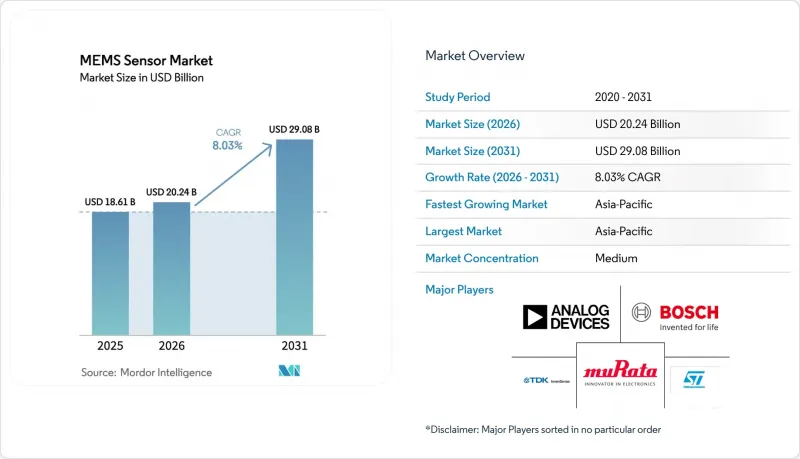
據 Mordor Intelligence 稱,2025 年 MEMS 感測器市值為 186.1 億美元,預計到 2031 年將達到 290.8 億美元,而 2026 年為 202.4 億美元,預測期(2026-2031 年)的複合年成長率為 8.03%。
本報告按感測器類型(壓力感測器、慣性感測器、麥克風感測器、環境感測器、微流體、射頻MEMS感測器等)、技術(電容式、壓阻式、壓電、光學式、熱式、磁隧道式等)、終端使用者產業(汽車、家用電子電器等)、應用領域(安全系統、導航等)和地區進行細分。市場預測以美元計價。
全球MEMS感測器市場趨勢與洞察
汽車產業安全問題日益受到關注
更嚴格的碰撞規避法規直接導致每輛車上慣性感測器、壓力感測器和麥克風的數量增加。美國國家公路交通安全管理局 (NHTSA) 已最終確定一項自動緊急煞車法規,要求乘用車製造商安裝多感測器套件,該套件能夠在 0.1 秒的延遲閾值內檢測障礙物、啟動煞車並記錄事件。歐洲新車安全評鑑協會 (Euro NCAP) 已在其 2025 年五星級評級標準中將主動安全標準的權重提高到 40%。這鼓勵歐洲汽車製造商增加冗餘陀螺儀和加速計,用於車道維持和側傾控制。中國新車安全評估協會 (China NCAP) 也採取了類似措施,引入了行人偵測法規,強制要求使用帶有風噪濾波功能的 MEMS 麥克風的外部聲學陣列。全球強制安裝的胎壓監測系統現在會傳輸壓力和溫度的組合數據,以延長感測器的使用壽命。另一方面,在電動車的線控刹車系統中,使用精度小於 1 毫巴的 MEMS 壓力感測器來保持踏板腳感。
自動化與工業4.0的興起
製造商正將用於振動、壓力和環境測量的微機電系統 (MEMS) 裝置整合到預測性維護框架中,以減少停機時間和材料浪費。西門子計畫在 2025 年將軸承故障率降低 23%,方法是在 12,000 台馬達上安裝三軸加速器,並將資料輸入機器學習模型。 IEC 63278 無線感測器標準在 MEMS 節點和可程式邏輯控制器 (PLC) 之間建立了通用介面,從而促進了多供應商環境下的工業部署。協作機器人正在利用六軸力和扭矩感測器進行即時抓取控制,將電子組裝線上的表面黏著技術缺陷減少了 18%。無塵室管理人員正在部署 MEMS檢測器來檢測顆粒物和揮發性有機化合物 (VOC),以維持 ISO 5 級空氣質量,並降低晶圓污染的風險。邊緣運算閘道器現在可以在本地處理原始振動數據,顯著降低雲端頻寬成本,同時在機器人焊接控制中實現亞 10 毫秒的反饋迴路。
由於介面複雜性,MEMS感測器的總體成本增加。
儘管最新的多感測器平台將加速計、陀螺儀和磁力計整合到單一封裝中,但每個軸仍需要專用的增益級、抗混疊濾波器和數千赫茲級的類比數位轉換器 (ADC)。這迫使設計人員選擇具有豐富 SPI 和 I2C 連接埠的微控制器,或添加協定橋接器,導致材料清單的成本增加 0.50 至 1.20 美元。感測器融合韌體需要浮點 DSP 模組,使功耗增加高達 25 mW,為輕薄穿戴裝置的溫度控管帶來挑戰。工廠校準設備必須執行多軸旋轉序列,使測試時間延長 30%,並增加高 G 值和高精度慣性感測器的單位製造成本。由於缺乏標準化的機械封裝,每推出一代新感測器都需要重新佈線 PCB,從而延遲了消費級設備的上市。
細分市場分析
到2025年,壓力感測器將佔據MEMS感測器市場35.25%的佔有率。這主要是因為北美、歐洲、中國和印度銷售的所有新乘用車現在都配備了直接式輪胎壓力監測模組。這些壓阻式感測器可承受-40 度C至125 度C的溫度範圍,滿足嚴格的精度要求,並透過超高速通訊鏈路與儀錶板中的診斷系統進行通訊。以絕緣體上矽(SOI)晶圓製造的工業壓力感測器能夠抵抗介質腐蝕,進而延長液壓系統、氣壓執行器和化學反應器的運作。
慣性感測器正逐漸成為消費性電子設備的主流。即使是售價低於 300 美元的中階智慧型手機,現在也配備了六軸運動追蹤功能,從而實現了無需外部信標的擴增實境(AR) 照片濾鏡和遊戲控制。 MEMS 麥克風承擔了行動電話90% 的語音輸入,而雙麥克風波束成形技術可將通話清晰度提升 20 分貝。用於測量濕度、溫度和氣體的環境感測器正擴大被整合到暖通空調 (HVAC) 恆溫器和空氣品質監測器中,以滿足室內空氣品質法規的要求。
在尖端領域,射頻MEMS開關和可變電容電容器正迅速普及。通訊設備製造商正將這些裝置整合到5G基地台中,以實現可變頻率相位陣列。 Qorvo最新的射頻MEMS開關可在24-44 GHz頻段內處理50 W的功率,插入損耗小於1 dB,其性能可與GaAs解決方案相媲美,同時驅動電壓更低。隨著電信業者不斷提高毫米波網路的密度,預計射頻領域的成長速度將超過整個MEMS感測器市場,維持9.79%的複合年成長率。
預計到2025年,電容式MEMS技術將佔總銷售額的46.19%,這主要得益於其在精確製程控制、廣泛的代工廠供貨以及經濟高效的晶圓層次電子構裝的優勢。光是意法半導體一家就將出貨超過20億個用於智慧型手機、汽車和工業機器人的電容式加速計和陀螺儀。壓電裝置則繼續應用於對性能要求極高的工業和醫療細分市場,在這些市場中,高線性度和寬溫度範圍比溫度漂移更為重要。
光學MEMS技術預計到2031年將以10.53%的複合年成長率成長,主要得益於自動駕駛汽車雷射雷達感測器和擴增實境(AR)頭顯微鏡陣列的市場成長。 MicroVision的100 Hz光束控制微鏡組件可實現200公尺處公分級物件偵測,這對於L3級自動駕駛至關重要。同時,矽光電工廠開始利用穿透矽通孔(TSV)將光學MEMS掃描器與雷射驅動器和訊號處理晶片整合在同一基板上,從而降低寄生電容並提高掃描速度。
在計時應用中,壓電共振器正在取代石英晶體。 SiTime 的微機電振盪器抗衝擊能力是石英晶體的 20 倍,無需機械微調可程式設計,目前已佔汽車乙太網路連接埠的 15%。熱隧道和磁隧道元件在流量感測和地磁導航領域佔據著雖小但成長迅速的細分市場。儘管製程多樣,異質整合技術仍在不斷發展。如今,感測器晶片透過氧化物鍵合晶圓堆疊在 ASIC 晶片之上,將晶片厚度保持在 0.6 毫米以下,從而製造出超薄穿戴裝置。
區域分析
預計到2025年,亞太地區將佔據MEMS感測器市場38.31%的佔有率,並在2031年之前保持9.25%的複合年成長率,成為該市場成長最快的地區。台積電(TSMC)計畫在2025年將其300mm MEMS晶片產能擴大30%,並將電容式慣性感測器的單晶片成本降低五分之一。在韓國,一個垂直整合的叢集將與國內感測器製造廠合作,每年生產1,500萬個電子穩定控制單元(ESC)。到2025年,中國智慧型手機組裝的出貨量將超過7億部,每部手機都將整合多個麥克風和動作感測器,並針對擴增實境(AR)功能進行了最佳化。在日本,MEMS振動感測器正被用於工業狀態監測,以延長汽車和電子工廠設備的使用壽命。在印度,一項將於 2025 年生效的法規強制要求在新乘用車上安裝輪胎壓力監測系統,這催生了對 2000 萬個感測器的需求,並推動了分階段生產計劃下的在地採購率。
預計到2025年,北美和歐洲合計佔全球銷售量的45%。雖然美國國家公路交通安全管理局(NHTSA)強制推行的碰撞避免系統使美國每輛乘用車安裝感測器的成本增加了150至300美元,但歐洲新車安全評鑑協會(Euro NCAP)在2025年評估中對主動安全性的重視程度提高,正在推動歐洲多軸慣性感測器的普及。西門子已證實,在其德國工廠的12,000台馬達中安裝三軸加速器後,軸承故障率降低了23%。美國食品藥物管理局(FDA)批准穿戴式裝置用於商業血糖值和血壓監測,將擴大2025年可覆蓋的感測器單元數量。Honeywell航空航太公司正在向美國低地球軌道衛星整合商銷售抗輻射陀螺儀。一家加拿大無人機系統開發公司正在為超視距(BVLOS)飛行作業整合耐高溫慣性測量單元。
儘管在南美和中東/非洲的市場佔有率較小,但這兩個地區都呈現出快速成長的趨勢。在巴西,到2025年將生產230萬輛汽車,每輛車都將配備胎壓監測模組,以滿足南方共同市場(Mercosur)的安全標準。在杜拜,到2025年將安裝1萬個基於MEMS的空氣品質測量節點,以支援交通堵塞管理工作。沙烏地阿拉伯的「2030願景」計畫對橋樑和隧道進行改造,加裝無線加速計陣列,以偵測疲勞裂縫。在南非的精密農業領域,氣壓感測器和土壤濕度感測器正被用於減少葡萄園25%的用水量。奈及利亞一家電信業者計劃在2025年新增5,000個基地台,並引進MEMS定時元件進行同步。
其他好處:
- Excel格式的市場預測(ME)表
- 3個月的分析師支持
目錄
第1章:引言
- 研究假設和市場定義
- 調查範圍
第2章:調查方法
第3章執行摘要
第4章 市場狀況
- 市場概覽
- 產業價值鏈分析
- 監理情勢
- 宏觀經濟因素對市場的影響
- 市場促進因素
- 汽車產業日益成長的安全隱患
- 自動化與工業4.0的興起
- 智慧型手機和穿戴式裝置的普及
- 對物聯網邊緣設備的需求日益成長
- 將MEMS感測器整合到微型無人機中,用於最後一公里配送。
- 在植入式醫療設備中採用生物相容性MEMS感測器
- 市場限制因素
- 由於介面複雜性,MEMS感測器的總體成本增加。
- MEMS製造程序缺乏標準化。
- 惡劣環境下包裝可靠性面臨的挑戰
- 特殊SOI晶圓的供應限制
- 技術展望
- 波特五力分析
第5章 市場規模與成長預測
- 依感測器類型
- 壓力感測器
- 慣性感測器
- 加速計
- 陀螺儀
- 磁力計
- 麥克風
- 環境感測器
- 微流體感測器
- RF MEMS
- 其他感測器類型
- 透過技術
- 電容式
- 壓阻式
- 壓電
- 光學
- 熱
- 磁隧道
- 其他技術
- 按最終用戶行業分類
- 車
- 家用電子產品
- 產業
- 衛生保健
- 航太/國防
- 電訊
- 農業
- 其他終端用戶產業
- 透過使用
- 安全系統
- 導航和定位
- 健康監測
- 結構健康監測
- 環境和氣候監測
- 擴增實境(AR)和虛擬實境(VR)
- 其他用途
- 按地區
- 北美洲
- 美國
- 加拿大
- 墨西哥
- 南美洲
- 巴西
- 阿根廷
- 其他南美國家
- 歐洲
- 德國
- 英國
- 法國
- 義大利
- 西班牙
- 俄羅斯
- 其他歐洲國家
- 亞太地區
- 中國
- 日本
- 印度
- 韓國
- 台灣
- 其他亞太國家
- 中東
- 沙烏地阿拉伯
- 阿拉伯聯合大公國
- 土耳其
- 其他中東國家
- 非洲
- 南非
- 奈及利亞
- 其他非洲國家
- 北美洲
第6章 競爭情勢
- 市場集中度
- 策略趨勢
- 市佔率分析
- 公司簡介
- STMicroelectronics NV
- Bosch Sensortec GmbH
- InvenSense Inc.(TDK)
- Analog Devices Inc.
- Murata Manufacturing Co. Ltd
- Kionix Inc.(ROHM)
- Infineon Technologies AG
- NXP Semiconductors NV
- Panasonic Corporation
- Omron Corporation
- TE Connectivity(First Sensor)
- SiTime Corporation
- Honeywell International Inc.
- Sensata Technologies Inc.
- Knowles Corporation
- Epson Toyocom(Seiko Epson)
- MEMSIC Inc.
- Microchip Technology Inc.
- Qorvo Inc.
- InnaLabs Ltd
- Robert Bosch GmbH(Automotive Sensors Division)
第7章 市場機會與未來展望
According to Mordor Intelligence, the MEMS sensor market size was valued at USD 18.61 billion in 2025 and is estimated to grow from USD 20.24 billion in 2026 to reach USD 29.08 billion by 2031, at a CAGR of 8.03% during the forecast period (2026-2031).
This report is Segmented by Sensor Type (Pressure, Inertial, Microphones, Environmental, Microfluidic, RF MEMS, and More), Technology (Capacitive, Piezoresistive, Piezoelectric, Optical, Thermal, Magnetic Tunnel, and More), End-User Industry (Automotive, Consumer Electronics, and More), Application (Safety Systems, Navigation, and More), and Geography. The Market Forecasts are Provided in Terms of Value (USD).
Global MEMS Sensor Market Trends and Insights
Growing Safety Concerns in The Automotive Industry
Tightening crash-avoidance regulations are translating directly into higher unit volumes of inertial sensors, pressure transducers, and microphones per vehicle. The United States National Highway Traffic Safety Administration finalized an automatic emergency-braking mandate that forces passenger-car makers to integrate multi-sensor suites able to detect obstacles, trigger braking, and record events within 0.1 second latency thresholds. Euro NCAP raised the weight of active-safety criteria to 40% of its 2025 five-star protocol, prompting European automakers to add redundant gyroscopes and accelerometers for lane-keeping and stability control. China NCAP followed with pedestrian-detection rules that require exterior acoustic arrays using MEMS microphones filtered for wind noise. Tire-pressure monitoring systems, mandated worldwide, now transmit combined pressure and temperature data to extend sensor life, while brake-by-wire architectures in electric vehicles depend on sub-millibar MEMS pressure sensors to preserve pedal feel.
Emergence of Automation and Industry 4.0
Manufacturers are embedding vibration, pressure, and environmental MEMS devices into predictive-maintenance frameworks that cut downtime and material waste. Siemens achieved a 23% bearing-failure reduction after fitting 12 000 electric motors with triaxial accelerometers feeding machine-learning models in 2025. The IEC 63278 wireless-sensor standard has created a common interface between MEMS nodes and programmable logic controllers, easing multivendor industrial adoption. Collaborative robots rely on six-axis force-torque sensors for real-time grip control, trimming surface-mount scrap by 18% in electronics assembly lines. Cleanroom managers deploy particulate and volatile-organic-compound MEMS detectors to maintain ISO Class 5 air, reducing wafer contamination risk. Edge compute gateways now process raw vibration data locally, slashing cloud bandwidth costs while enabling sub-10 ms feedback loops for robotic welding controls.
Increase in Overall Cost of MEMS Sensors Due to Interface Complexity
Modern multi-sensor platforms combine accelerometers, gyroscopes, and magnetometers within a single package, yet each axis still needs dedicated gain stages, anti-alias filters, and multi-kilohertz ADCs. Designers must therefore select microcontrollers with abundant SPI and I2C ports or add protocol bridges, adding USD 0.50 to USD 1.20 per node in bill-of-materials. Sensor-fusion firmware requires floating-point DSP blocks that raise power budgets by up to 25 mW and introduce thermal-management challenges in slim wearables. Factory calibration rigs must execute multi-axis rotation sequences, extending test time 30% and lifting per-unit manufacturing cost for high-g and precision inertial sensors. Absent standardized mechanical footprints, each new sensor generation triggers PCB reroutes that delay consumer-device launches.
Other drivers and restraints analyzed in the detailed report include:
- Proliferation of Smartphones and Wearables
- Rising Demand for IoT Edge Devices
- Lack of Standardized Fabrication Processes for MEMS
For complete list of drivers and restraints, kindly check the Table Of Contents.
Segment Analysis
Pressure sensors captured 35.25% of the MEMS sensor market share in 2025, primarily because every new passenger car sold in North America, Europe, China, and India now carries direct tire-pressure monitoring modules. These piezoresistive transducers withstand -40°C to 125°C, meet stringent accuracy requirements, and communicate over ultra-high-frequency links to in-dash diagnostics. Industrial pressure sensors fabricated on silicon-on-insulator wafers extend operating life in hydraulic systems, pneumatic actuators, and chemical reactors by resisting media corrosion.
Inertial sensors dominate consumer devices: six-axis motion tracking now ships in mid-tier smartphones priced below USD 300, enabling augmented-reality photo filters and game control without external beacons. MEMS microphones supply 90% of handset audio inputs, and dual-microphone beamforming has improved call clarity by 20 dB. Environmental sensors measuring humidity, temperature, and gases are increasingly built into HVAC thermostats and air-quality monitors to meet indoor-air regulations.
At the frontier, RF MEMS switches and tunable capacitors are gaining speed. Telecom OEMs embed these devices in 5G base stations to enable frequency-agile phased arrays. Qorvo's latest RF MEMS switch handles 50 W across 24-44 GHz and exhibits sub-1 dB insertion loss, demonstrating parity with GaAs solutions while offering lower drive voltage. As operators densify millimeter-wave networks, the RF subset is positioned to outpace the broader MEMS sensor market, sustaining its 9.79% CAGR.
Capacitive MEMS technology enjoyed a 46.19% revenue share in 2025 on the strength of refined process control, widespread foundry availability, and economical wafer-level packaging. STMicroelectronics alone shipped more than 2 billion capacitive accelerometers and gyroscopes for smartphones, automobiles, and industrial robots. Piezoresistive devices continue to serve harsh industrial and medical niches where strong linearity and wide temperature range outweigh temperature drift.
Optical MEMS is expanding at 10.53% CAGR through 2031 thanks to market pull from LiDAR sensors in autonomous vehicles and micro-mirror arrays in augmented-reality headsets. MicroVision's 100 Hz beam-steer micro-mirror assembly enables centimeter-level object detection at 200 m, critical for Level-3 autonomy. Meanwhile, silicon photonics foundries have begun integrating optical MEMS scanners with laser drivers and signal-processing chips on single substrates via through-silicon vias, trimming parasitic capacitance and improving scan speed.
Piezoelectric resonators are dethroning quartz in timing applications. SiTime's MEMS oscillators are 20 times more shock resistant than quartz, offering programmable frequencies without mechanical trimming, and already supply 15% of automotive Ethernet ports. Thermal and magnetic-tunnel devices fill smaller but growing niches in flow sensing and geomagnetic navigation. Despite process diversity, heterogeneous integration is advancing: sensor dies now stack atop ASICs using oxide-bonded wafers to cut height below 0.6 mm for ultra-thin wearables.
Complete Report Scope:
- By Sensor Type
- Pressure Sensors
- Inertial Sensors
- Accelerometers
- Gyroscopes
- Magnetometers
- Microphones
- Environmental Sensors
- Microfluidic Sensors
- RF MEMS
- Other Sensor Types
- By Technology
- Capacitive
- Piezoresistive
- Piezoelectric
- Optical
- Thermal
- Magnetic Tunnel
- Other Technologies
- By End-User Industry
- Automotive
- Consumer Electronics
- Industrial
- Healthcare
- Aerospace and Defense
- Telecommunications
- Agriculture
- Other End-User Industries
- By Application
- Safety Systems
- Navigation and Positioning
- Health Monitoring
- Structural Health Monitoring
- Environment and Climate Monitoring
- Augmented and Virtual Reality
- Other Applications
- By Geography
- North America
- United States
- Canada
- Mexico
- South America
- Brazil
- Argentina
- Rest of South America
- Europe
- Germany
- United Kingdom
- France
- Italy
- Spain
- Russia
- Rest of Europe
- Asia Pacific
- China
- Japan
- India
- South Korea
- Taiwan
- Rest of Asia Pacific
- Middle East
- Saudi Arabia
- United Arab Emirates
- Turkey
- Rest of Middle East
- Africa
- South Africa
- Nigeria
- Rest of Africa
- North America
Geography Analysis
Asia Pacific dominated the MEMS sensor market with 38.31% revenue share in 2025 and posted the fastest 9.25% CAGR through 2031. Taiwan Semiconductor Manufacturing Company boosted 300 mm MEMS capacity by 30% in 2025, cutting per-die cost for capacitive inertial sensors by one-fifth. South Korea's vertically integrated cluster pairs Hyundai Mobis with domestic sensor fabs, yielding annual production of 15 million electronic stability control units. China's smartphone assemblers shipped more than 700 million handsets in 2025, each embedding multiple microphones and motion sensors tailored for augmented-reality functions. Japan uses MEMS vibration sensors in industrial condition-monitoring to prolong tool life at automotive and electronics plants. India's 2025 regulation mandating tire-pressure monitoring on new passenger cars generated demand for 20 million sensors, encouraging local content under its phased-manufacturing program.
North America and Europe together accounted for 45% of 2025 revenue. The NHTSA crash-avoidance mandate adds USD 150-300 of sensor content per U.S. passenger vehicle, while Euro NCAP's 2025 scoring weight on active safety drives multi-axis inertial installs in Europe. Siemens rolled out triaxial accelerometers across 12 000 motors in German plants, confirming a 23% bearing-failure cut. FDA clearance of over-the-counter glucose monitors and blood-pressure wearables expanded addressable sensor units in 2025. Honeywell Aerospace sells radiation-hardened gyroscopes to U.S. low-Earth-orbit satellite integrators. Canadian unmanned-air-system developers integrate high-temperature-resistant inertial units for beyond-visual-line-of-sight operations.
South America, the Middle East and Africa contribute smaller shares but display localized surges. Brazil produced 2.3 million vehicles in 2025, equipping each with tire-pressure modules to meet Mercosur safety rules. Dubai installed 10 000 MEMS-based air-quality nodes in 2025, supporting congestion-management initiatives. Saudi Arabia's Vision 2030 projects retrofit bridges and tunnels with wireless accelerometer arrays to detect fatigue cracks. South Africa's precision-agriculture sector uses barometric and soil-moisture sensors to cut vineyard water consumption 25%. Nigeria's network operators added 5 000 base stations in 2025, installing MEMS timing devices for synchronization.
- STMicroelectronics NV
- Bosch Sensortec GmbH
- InvenSense Inc. (TDK)
- Analog Devices Inc.
- Murata Manufacturing Co. Ltd
- Kionix Inc. (ROHM)
- Infineon Technologies AG
- NXP Semiconductors NV
- Panasonic Corporation
- Omron Corporation
- TE Connectivity (First Sensor)
- SiTime Corporation
- Honeywell International Inc.
- Sensata Technologies Inc.
- Knowles Corporation
- Epson Toyocom (Seiko Epson)
- MEMSIC Inc.
- Microchip Technology Inc.
- Qorvo Inc.
- InnaLabs Ltd
- Robert Bosch GmbH (Automotive Sensors Division)
Additional Benefits:
- The market estimate (ME) sheet in Excel format
- 3 months of analyst support
TABLE OF CONTENTS
1 INTRODUCTION
- 1.1 Study Assumptions and Market Definition
- 1.2 Scope of the Study
2 RESEARCH METHODOLOGY
3 EXECUTIVE SUMMARY
4 MARKET LANDSCAPE
- 4.1 Market Overview
- 4.2 Industry Value-Chain Analysis
- 4.3 Regulatory Landscape
- 4.4 Impact of Macroeconomic Factors on the Market
- 4.5 Market Drivers
- 4.5.1 Growing Safety Concerns in the Automotive Industry
- 4.5.2 Emergence of Automation and Industry 4.0
- 4.5.3 Proliferation of Smartphones and Wearables
- 4.5.4 Rising Demand for IoT Edge Devices
- 4.5.5 Integration of MEMS Sensors in Microdrones for Last-Mile Delivery
- 4.5.6 Adoption of Bio-Compatible MEMS Sensors for Implantable Medical Devices
- 4.6 Market Restraints
- 4.6.1 Increase in Overall Cost of MEMS Sensors Due to Interface Complexity
- 4.6.2 Lack of Standardised Fabrication Processes for MEMS
- 4.6.3 Packaging Reliability Challenges in Harsh Environments
- 4.6.4 Supply Constraints of Specialised SOI Wafers
- 4.7 Technological Outlook
- 4.8 Porter's Five Forces Analysis
- 4.8.1 Bargaining Power of Suppliers
- 4.8.2 Bargaining Power of Buyers
- 4.8.3 Threat of New Entrants
- 4.8.4 Threat of Substitutes
- 4.8.5 Intensity of Competitive Rivalry
5 MARKET SIZE AND GROWTH FORECASTS (VALUE)
- 5.1 By Sensor Type
- 5.1.1 Pressure Sensors
- 5.1.2 Inertial Sensors
- 5.1.2.1 Accelerometers
- 5.1.2.2 Gyroscopes
- 5.1.2.3 Magnetometers
- 5.1.3 Microphones
- 5.1.4 Environmental Sensors
- 5.1.5 Microfluidic Sensors
- 5.1.6 RF MEMS
- 5.1.7 Other Sensor Types
- 5.2 By Technology
- 5.2.1 Capacitive
- 5.2.2 Piezoresistive
- 5.2.3 Piezoelectric
- 5.2.4 Optical
- 5.2.5 Thermal
- 5.2.6 Magnetic Tunnel
- 5.2.7 Other Technologies
- 5.3 By End-User Industry
- 5.3.1 Automotive
- 5.3.2 Consumer Electronics
- 5.3.3 Industrial
- 5.3.4 Healthcare
- 5.3.5 Aerospace and Defense
- 5.3.6 Telecommunications
- 5.3.7 Agriculture
- 5.3.8 Other End-User Industries
- 5.4 By Application
- 5.4.1 Safety Systems
- 5.4.2 Navigation and Positioning
- 5.4.3 Health Monitoring
- 5.4.4 Structural Health Monitoring
- 5.4.5 Environment and Climate Monitoring
- 5.4.6 Augmented and Virtual Reality
- 5.4.7 Other Applications
- 5.5 By Geography
- 5.5.1 North America
- 5.5.1.1 United States
- 5.5.1.2 Canada
- 5.5.1.3 Mexico
- 5.5.2 South America
- 5.5.2.1 Brazil
- 5.5.2.2 Argentina
- 5.5.2.3 Rest of South America
- 5.5.3 Europe
- 5.5.3.1 Germany
- 5.5.3.2 United Kingdom
- 5.5.3.3 France
- 5.5.3.4 Italy
- 5.5.3.5 Spain
- 5.5.3.6 Russia
- 5.5.3.7 Rest of Europe
- 5.5.4 Asia Pacific
- 5.5.4.1 China
- 5.5.4.2 Japan
- 5.5.4.3 India
- 5.5.4.4 South Korea
- 5.5.4.5 Taiwan
- 5.5.4.6 Rest of Asia Pacific
- 5.5.5 Middle East
- 5.5.5.1 Saudi Arabia
- 5.5.5.2 United Arab Emirates
- 5.5.5.3 Turkey
- 5.5.5.4 Rest of Middle East
- 5.5.6 Africa
- 5.5.6.1 South Africa
- 5.5.6.2 Nigeria
- 5.5.6.3 Rest of Africa
- 5.5.1 North America
6 COMPETITIVE LANDSCAPE
- 6.1 Market Concentration
- 6.2 Strategic Moves
- 6.3 Market Share Analysis
- 6.4 Company Profiles (includes Global Level Overview, Market Level Overview, Core Segments, Financials as Available, Strategic Information, Market Rank/Share for Key Companies, Products and Services, and Recent Developments)
- 6.4.1 STMicroelectronics NV
- 6.4.2 Bosch Sensortec GmbH
- 6.4.3 InvenSense Inc. (TDK)
- 6.4.4 Analog Devices Inc.
- 6.4.5 Murata Manufacturing Co. Ltd
- 6.4.6 Kionix Inc. (ROHM)
- 6.4.7 Infineon Technologies AG
- 6.4.8 NXP Semiconductors NV
- 6.4.9 Panasonic Corporation
- 6.4.10 Omron Corporation
- 6.4.11 TE Connectivity (First Sensor)
- 6.4.12 SiTime Corporation
- 6.4.13 Honeywell International Inc.
- 6.4.14 Sensata Technologies Inc.
- 6.4.15 Knowles Corporation
- 6.4.16 Epson Toyocom (Seiko Epson)
- 6.4.17 MEMSIC Inc.
- 6.4.18 Microchip Technology Inc.
- 6.4.19 Qorvo Inc.
- 6.4.20 InnaLabs Ltd
- 6.4.21 Robert Bosch GmbH (Automotive Sensors Division)
7 MARKET OPPORTUNITIES AND FUTURE OUTLOOK
- 7.1 White-Space and Unmet-Need Assessment

 2026年電子煙用微機電系統(MEMS)感測器全球市場報告
 MEMS壓力感測器:市場佔有率分析、產業趨勢與統計、成長預測(2026-2031年)
 MEMS感測器市場預測至2034年—按感測器類型、技術、封裝、應用、最終用戶和地區分類的全球分析
 工業MEMS感測器市場-全球產業規模、佔有率、趨勢、機會、預測:按類型、地區和競爭格局分類,2021-2031年MEMS元件市場預測至2034年-按感測器類型、執行器類型、應用和地區分類的全球分析
 MEMS麥克風感測器市場規模、佔有率和成長分析:按類型、方向性、應用和地區分類-產業預測,2026-2033年
 家用電子電器用MEMS聲學感測器市場:按感測器類型、介面、頻率範圍和應用分類-全球預測,2026-2032年
 MEMS壓力感測器市場機會、成長要素、產業趨勢分析及2026-2035年預測。
 先進MEMS感測器市場分析及預測(至2035年):依類型、產品類型、技術、應用、最終用戶、組件類型、材料類型、裝置、製程及功能分類MEMS感測器市場-全球產業規模、佔有率、趨勢、機會、預測:按類型、材料、終端用戶產業、地區和競爭格局分類,2021-2031年