


 |
市場調查報告書
商品編碼
2122969
MEMS壓力感測器:市場佔有率分析、產業趨勢與統計、成長預測(2026-2031年)MEMS Pressure Sensors - Market Share Analysis, Industry Trends & Statistics, Growth Forecasts (2026 - 2031) |
||||||

※ 本網頁內容可能與最新版本有所差異。詳細情況請與我們聯繫。
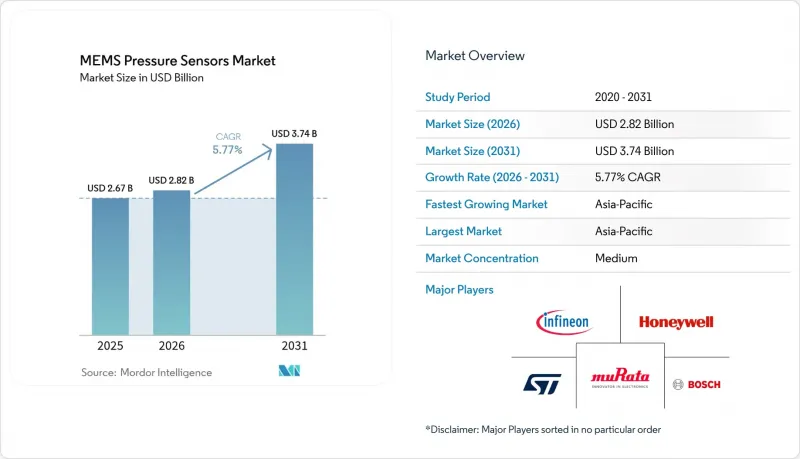
根據 Mordor Intelligence 預測,MEMS 壓力感測器市場將從 2025 年的 26.7 億美元成長到 2026 年的 28.2 億美元,然後在 2031 年達到 37.4 億美元,2026 年至 2031 年的複合年成長率為 5.77%。
本報告按應用領域(醫療、汽車、工業等)、類型(矽壓阻式、矽電容式)、技術(表壓式、絕對壓力式、差壓式)、壓力範圍(<10 kPa、10 kPa 至 100 kPa、≥100 kPa)和地區(北美、歐洲、亞太、中東和非洲、南美)進行細分。市場預測以美元計價。
全球MEMS壓力感測器市場趨勢及洞察
擴大高級駕駛輔助系統(ADAS)的應用
MEMS壓力感知器目前應用於煞車管路監測、電動車電池組熱迴路檢測以及進階資訊導航等領域。由於這些裝置必須能夠承受-40 度C至150 度C的溫度範圍並達到毫秒級的響應速度,汽車製造商要求使用符合ASIL標準的組件。矽電容式晶片架構使供應商能夠實現小於0.1%的滿量程線性度和小於2µA的待機電流,從而支援多感測器陣列,而不會增加車輛48V網路的負擔。
物聯網家用電器的普及
智慧型手機、穿戴式裝置和智慧家居設備都整合了面積小於 2 平方毫米的微型氣壓感測器,用於測量樓層位置、室內氣候條件、健身指標等。 Bosch Sensortec 的 BMP581 感測器在 1 Hz 頻率下功耗僅為 1.3 µA,同時保持 ±30 Pa 的精度,符合消費者對低功耗的更高要求。
整合多種介面標準的複雜性
汽車製造商面臨在單一ECU中共存多種匯流排標準(例如I2C、SPI、SENT和I3C)的挑戰,這需要額外的微控制器資源,並將檢驗週期延長至多12個月。此外,每種協議都需要單獨的網路安全和功能安全文檔,這增加了工程預算,並延遲了平台發布。
細分市場分析
預計到2025年,汽車產業的MEMS壓力感測器市場規模將達到10.2億美元,市佔率將達38.25%。這主要得益於胎壓監測系統(TPMS)、煞車管路診斷以及電動車(EV)的熱迴路應用。目前,原始設備製造商(OEM)對具備自我診斷功能和空中下載(OTA)韌體更新能力的感測器提出了更高的要求,這有助於提升車隊維護分析能力。到2025年,MEMS壓力感測器在醫療設備的市佔率仍將保持較小,但預計將以6.07%的複合年成長率成長,這主要得益於需要亞毫米級尺寸的連續血糖監測儀和植入式心血管平台等外形規格。
在工業自動化領域,採用LoRa技術的壓力感測器節點已被用於降低30%的維護成本;而航太專案則需要用於運載火箭的抗輻射加固型感測器。在家用電子電器領域,氣壓感測器的應用範圍正在擴展到擴增實境(AR)頭戴設備,目標是實現室內高度測量精度達到±0.5公尺。
預計到2025年,矽電容元件將佔總銷售額的52.96%,此類MEMS壓力感測器的市場規模預計將以每年7.57%的速度成長。這些元件在-40 度C至125 度C的溫度範圍內具有優異的線性度和小於0.05%/ 度C的漂移特性,使其適用於對安全性要求極高的ADAS(高級駕駛輔助系統)和醫療設備。壓阻式晶片由於其訊號鏈簡單,仍然是傳統類比ECU(電子控制單元)的首選,但其在惡劣環境下的應用受到溫度相關漏電流的限制。
採用TSV(矽通孔)中介層,可在隔膜下方實現ASIC的3D堆疊,進而降低Z方向的高度並提高抗電磁干擾能力。目前,碳化矽壓阻原型可承受超過300 度C的溫度,為未來在燃氣渦輪機和地下鑽探等領域的應用鋪平了道路。
區域分析
預計到2025年,亞太地區將佔全球銷售額的49.10%,並在2031年之前維持6.56%的複合年成長率。這一成長勢頭得益於智慧型手機組裝的強勁成長、電動汽車產量的不斷擴大以及政府對半導體產業的扶持。中國本土化進程推動了資本流入國內晶圓廠,而日本和韓國則在先進封裝的前端製程方面不斷提升自身技術水準。
北美位居第二,國防、航太和醫療產業的法規推動了高利潤感測器設計的發展。美國《晶片法案》(CHIPS Act)提供的津貼支持了新型300毫米MEMS生產線的推出,並降低了關鍵產業的供應風險。歐洲憑藉德國汽車工業的核心優勢以及鼓勵工業機械感測器升級的嚴格環境法規,仍然保持強勁勢頭。在中東和非洲,石油鑽井平台和海水淡化廠等需要在惡劣環境下使用的場所,對感測器的需求正在迅速成長。同時,南美洲的成長依賴巴西和阿根廷的汽車產量。區域安全和資料隱私法規有時會使跨境設計重複使用變得複雜,迫使供應商對韌體堆疊進行本地化。
其他好處:
- Excel格式的市場預測(ME)表
- 3個月的分析師支持
目錄
第1章:引言
- 研究假設和市場定義
- 調查範圍
第2章:調查方法
第3章執行摘要
第4章 市場狀況
- 市場概覽
- 宏觀經濟因素的影響
- 技術概述
- 聚對二甲苯在微機電系統壓力感測器的應用概述
- 產業價值鏈分析
- 波特五力分析
第5章 市場動態
- 市場促進因素
- 高級駕駛輔助系統(ADAS)的廣泛應用
- 物聯網家用電器的普及
- 快速的工業自動化和工業4.0的發展
- 醫療設備小型化進展
- 利用無人機進行大氣觀測的需求日益成長
- MEMS代工即服務加速了新創企業的創新。
- 市場限制因素
- 整合多種介面標準的複雜性
- 競爭加劇導致價格下降
- 尖端晶圓晶圓鍵合技術材料的供應鏈風險
- 高週疲勞條件下的校準漂移
第6章 市場規模與成長預測
- 透過使用
- 醫學領域
- 車
- 產業
- 航太/國防
- 家用電子產品
- 按類型
- 矽壓阻式
- 矽電容
- 透過技術
- 測量
- 絕對值
- 不同之處
- 按壓力範圍
- 小於 10 kPa
- 10 kPa~100 kPa
- 100 kPa 或以上
- 按地區
- 北美洲
- 美國
- 加拿大
- 墨西哥
- 歐洲
- 德國
- 英國
- 法國
- 俄羅斯
- 其他歐洲國家
- 亞太地區
- 中國
- 日本
- 印度
- 韓國
- 澳洲
- 其他亞太國家
- 中東和非洲
- 中東
- 沙烏地阿拉伯
- 阿拉伯聯合大公國
- 其他中東國家
- 非洲
- 南非
- 埃及
- 其他非洲國家
- 中東
- 南美洲
- 巴西
- 阿根廷
- 其他南美國家
- 北美洲
第7章 競爭情勢
- 市場集中度
- 策略趨勢
- 市佔率分析
- 公司簡介
- Robert Bosch GmbH(Bosch Sensortec)
- STMicroelectronics NV
- Murata Manufacturing Co., Ltd.
- Infineon Technologies AG
- Honeywell International Inc.
- Sensata Technologies, Inc.
- Amphenol Advanced Sensors(Amphenol Corporation)
- Omron Corporation
- Alps Alpine Co., Ltd.
- Goertek Inc.
- TE Connectivity Ltd.
- NXP Semiconductors NV
- InvenSense Inc.(TDK Corporation)
- ROHM Co., Ltd.
- Melexis NV
- Texas Instruments Incorporated
- First Sensor AG(TE Connectivity)
- SiTime Corporation
- MEMSensing Microsystems Co., Ltd.
第8章 市場機會與未來展望
- 評估閒置頻段和未滿足的需求
According to Mordor Intelligence, the MEMS pressure sensor market size is expected to grow from USD 2.67 billion in 2025 to USD 2.82 billion in 2026 and is forecast to reach USD 3.74 billion by 2031 at 5.77% CAGR over 2026-2031.
This report is Segmented by Application (Medical, Automotive, Industrial, and More), Type (Silicon Piezoresistive, and Silicon Capacitive), Technology (Gauge, Absolute, and Differential), Pressure Range (Below 10 KPa, 10 KPa - 100 KPa, and Above 100 KPa), and Geography (North America, Europe, Asia-Pacific, Middle East and Africa, South America). The Market Forecasts are Provided in Terms of Value (USD).
Global MEMS Pressure Sensors Market Trends and Insights
Growing Adoption of Advanced Driver Assistance Systems (ADAS)
MEMS pressure sensors now underpin brake-line monitoring, thermal loops in electric vehicle battery packs, and altitude-assisted navigation. Devices must withstand temperatures ranging from -40 °C to 150 °C and deliver a millisecond response, prompting automakers to specify ASIL-rated parts. Silicon-capacitive die architectures help vendors achieve <0.1% full-scale linearity and under-2 µA standby current, supporting multi-sensor arrays without draining vehicle 48 V networks.
Proliferation of IoT-Enabled Consumer Electronics
Smartphones, wearables, and smart-home gadgets embed barometric sensors measuring no larger than 2 mm2 to derive floor-level positioning, indoor climate cues, and fitness metrics. Bosch Sensortec's BMP581 consumes only 1.3 µA at 1 Hz while sustaining +-30 Pa accuracy, exemplifying the low-power benchmark consumers now expect.
Complexity of Integrating Multiple Interface Standards
Automakers face mixed I2C, SPI, SENT, and I3C buses within a single ECU, forcing the allocation of extra microcontroller resources and prolonging validation cycles by up to 12 months. Each protocol also demands separate cybersecurity and functional-safety documentation, straining engineering budgets and delaying platform launches.
Other drivers and restraints analyzed in the detailed report include:
- Rapid Industrial Automation and Industry 4.0 Rollout
- Rising Miniaturization in Medical Devices
- Price Erosion Due to Intensifying Competition
For complete list of drivers and restraints, kindly check the Table Of Contents.
Segment Analysis
The MEMS pressure sensor market size for the automotive sector reached USD 1.02 billion in 2025, accounting for a 38.25% share, driven by TPMS, brake-line diagnostics, and EV thermal loops. OEMs now request sensors with self-test routines and over-the-air firmware capability, enhancing fleet maintenance analytics. The MEMS pressure sensor market share for medical devices remains smaller in 2025 but displays a 6.07% CAGR outlook, driven by continuous glucose monitors and implantable cardiovascular platforms that require sub-millimeter form factors.
Industrial automation utilizes LoRa-enabled pressure nodes to reduce maintenance costs by 30%, while aerospace programs require radiation-hardened units for launch vehicles. Consumer electronics are extending barometric sensing to augmented-reality headsets, targeting an elevation accuracy of +-0.5 m indoors.
Silicon-capacitive elements accounted for 52.96% of 2025 revenue, with the MEMS pressure sensor market size for this type projected to expand at a 7.57% annual rate. Their superior linearity and drift of -40 °C to 125 °C, below 0.05%/°C, suit safety-critical ADAS and medical tools. Piezoresistive dies remain preferred for legacy analog ECUs due to their simple signal chains, but temperature-induced leakage limits their use in extreme environments.
The adoption of through-silicon-via interposers enables the 3D stacking of ASICs under the diaphragm, thereby shrinking the Z-height and boosting EMI immunity. Silicon-carbide piezoresistive prototypes now withstand temperatures exceeding 300 °C, paving the way for future deployment in gas turbines and down-hole drilling.
Complete Report Scope:
- By Application
- Medical
- Automotive
- Industrial
- Aerospace and Defense
- Consumer Electronics
- By Type
- Silicon Piezoresistive
- Silicon Capacitive
- By Technology
- Gauge
- Absolute
- Differential
- By Pressure Range
- Below 10 kPa
- 10 kPa - 100 kPa
- Above 100 kPa
- By Geography
- North America
- United States
- Canada
- Mexico
- Europe
- Germany
- United Kingdom
- France
- Russia
- Rest of Europe
- Asia-Pacific
- China
- Japan
- India
- South Korea
- Australia
- Rest of Asia-Pacific
- Middle East and Africa
- Middle East
- Saudi Arabia
- United Arab Emirates
- Rest of Middle East
- Africa
- South Africa
- Egypt
- Rest of Africa
- Middle East
- South America
- Brazil
- Argentina
- Rest of South America
- North America
Geography Analysis
Asia-Pacific commanded 49.10% of 2025 revenue and is on course to clock 6.56% CAGR through 2031. Strong smartphone assembly, expanding EV production, and government semiconductor incentives sustain momentum. China's localization drive channels capital into domestic fabs, while Japan and South Korea refine front-end process know-how for advanced packaging.
North America ranks second; defense, aerospace, and medical regulations favor high-margin sensor designs. U.S. CHIPS Act grants underwrite new 300 mm MEMS lines, de-risking supply for critical sectors. Europe remains steady, thanks to Germany's automotive core and stringent environmental regulations that drive sensor upgrades in industrial machinery. The Middle East and Africa register early traction in oil-rig and desalination plants that require harsh-environment sensors, whereas South America's growth is tied to vehicle output in Brazil and Argentina. Region-specific safety and data-privacy mandates occasionally complicate the reuse of cross-border design, nudging vendors to localize their firmware stacks.
- Robert Bosch GmbH (Bosch Sensortec)
- STMicroelectronics N.V.
- Murata Manufacturing Co., Ltd.
- Infineon Technologies AG
- Honeywell International Inc.
- Sensata Technologies, Inc.
- Amphenol Advanced Sensors (Amphenol Corporation)
- Omron Corporation
- Alps Alpine Co., Ltd.
- Goertek Inc.
- TE Connectivity Ltd.
- NXP Semiconductors N.V.
- InvenSense Inc. (TDK Corporation)
- ROHM Co., Ltd.
- Melexis NV
- Texas Instruments Incorporated
- First Sensor AG (TE Connectivity)
- SiTime Corporation
- MEMSensing Microsystems Co., Ltd.
Additional Benefits:
- The market estimate (ME) sheet in Excel format
- 3 months of analyst support
TABLE OF CONTENTS
1 NTRODUCTION
- 1.1 Study Assumptions and Market Definition
- 1.2 Scope of the Study
2 RESEARCH METHODOLOGY
3 EXECUTIVE SUMMARY
4 MARKET LANDSCAPE
- 4.1 Market Overview
- 4.2 Impact of Macroeconomic Factors
- 4.3 Technology Snapshot
- 4.4 Overview of the Use of Parylene in MEMS Pressure Sensors
- 4.5 Industry Value Chain Analysis
- 4.6 Porter's Five Forces Analysis
- 4.6.1 Bargaining Power of Suppliers
- 4.6.2 Bargaining Power of Buyers
- 4.6.3 Threat of New Entrants
- 4.6.4 Threat of Substitutes
- 4.6.5 Intensity of Competitive Rivalry
5 MARKET DYNAMICS
- 5.1 Market Drivers
- 5.1.1 Growing Adoption of Advanced Driver Assistance Systems (ADAS)
- 5.1.2 Proliferation of IoT-Enabled Consumer Electronics
- 5.1.3 Rapid Industrial Automation and Industry 4.0 Rollout
- 5.1.4 Rising Miniaturization in Medical Devices
- 5.1.5 Emerging Demand for Drone-Based Atmospheric Sensing
- 5.1.6 MEMS Foundry-as-a-Service Accelerating Start-Up Innovation
- 5.2 Market Restraints
- 5.2.1 Complexity of Integrating Multiple Interface Standards
- 5.2.2 Price Erosion Due to Intensifying Competition
- 5.2.3 Supply Chain Risks in Advanced Wafer Bonding Materials
- 5.2.4 Calibration Drift Under High Cycle Fatigue Conditions
6 MARKET SIZE AND GROWTH FORECASTS (VALUE)
- 6.1 By Application
- 6.1.1 Medical
- 6.1.2 Automotive
- 6.1.3 Industrial
- 6.1.4 Aerospace and Defense
- 6.1.5 Consumer Electronics
- 6.2 By Type
- 6.2.1 Silicon Piezoresistive
- 6.2.2 Silicon Capacitive
- 6.3 By Technology
- 6.3.1 Gauge
- 6.3.2 Absolute
- 6.3.3 Differential
- 6.4 By Pressure Range
- 6.4.1 Below 10 kPa
- 6.4.2 10 kPa - 100 kPa
- 6.4.3 Above 100 kPa
- 6.5 By Geography
- 6.5.1 North America
- 6.5.1.1 United States
- 6.5.1.2 Canada
- 6.5.1.3 Mexico
- 6.5.2 Europe
- 6.5.2.1 Germany
- 6.5.2.2 United Kingdom
- 6.5.2.3 France
- 6.5.2.4 Russia
- 6.5.2.5 Rest of Europe
- 6.5.3 Asia-Pacific
- 6.5.3.1 China
- 6.5.3.2 Japan
- 6.5.3.3 India
- 6.5.3.4 South Korea
- 6.5.3.5 Australia
- 6.5.3.6 Rest of Asia-Pacific
- 6.5.4 Middle East and Africa
- 6.5.4.1 Middle East
- 6.5.4.1.1 Saudi Arabia
- 6.5.4.1.2 United Arab Emirates
- 6.5.4.1.3 Rest of Middle East
- 6.5.4.2 Africa
- 6.5.4.2.1 South Africa
- 6.5.4.2.2 Egypt
- 6.5.4.2.3 Rest of Africa
- 6.5.4.1 Middle East
- 6.5.5 South America
- 6.5.5.1 Brazil
- 6.5.5.2 Argentina
- 6.5.5.3 Rest of South America
- 6.5.1 North America
7 COMPETITIVE LANDSCAPE
- 7.1 Market Concentration
- 7.2 Strategic Moves
- 7.3 Market Share Analysis
- 7.4 Company Profiles (includes Global level Overview, Market level overview, Core Segments, Financials as available, Strategic Information, Market Rank/Share for key companies, Products and Services, and Recent Developments)
- 7.4.1 Robert Bosch GmbH (Bosch Sensortec)
- 7.4.2 STMicroelectronics N.V.
- 7.4.3 Murata Manufacturing Co., Ltd.
- 7.4.4 Infineon Technologies AG
- 7.4.5 Honeywell International Inc.
- 7.4.6 Sensata Technologies, Inc.
- 7.4.7 Amphenol Advanced Sensors (Amphenol Corporation)
- 7.4.8 Omron Corporation
- 7.4.9 Alps Alpine Co., Ltd.
- 7.4.10 Goertek Inc.
- 7.4.11 TE Connectivity Ltd.
- 7.4.12 NXP Semiconductors N.V.
- 7.4.13 InvenSense Inc. (TDK Corporation)
- 7.4.14 ROHM Co., Ltd.
- 7.4.15 Melexis NV
- 7.4.16 Texas Instruments Incorporated
- 7.4.17 First Sensor AG (TE Connectivity)
- 7.4.18 SiTime Corporation
- 7.4.19 MEMSensing Microsystems Co., Ltd.
8 MARKET OPPORTUNITIES AND FUTURE OUTLOOK
- 8.1 White-Space and Unmet-Need Assessment

 2026年電子煙用微機電系統(MEMS)感測器全球市場報告
 MEMS感測器:市場佔有率分析、產業趨勢與統計、成長預測(2026-2031年)
 MEMS感測器市場預測至2034年—按感測器類型、技術、封裝、應用、最終用戶和地區分類的全球分析
 工業MEMS感測器市場-全球產業規模、佔有率、趨勢、機會、預測:按類型、地區和競爭格局分類,2021-2031年MEMS元件市場預測至2034年-按感測器類型、執行器類型、應用和地區分類的全球分析
 MEMS麥克風感測器市場規模、佔有率和成長分析:按類型、方向性、應用和地區分類-產業預測,2026-2033年
 家用電子電器用MEMS聲學感測器市場:按感測器類型、介面、頻率範圍和應用分類-全球預測,2026-2032年
 MEMS壓力感測器市場機會、成長要素、產業趨勢分析及2026-2035年預測。
 先進MEMS感測器市場分析及預測(至2035年):依類型、產品類型、技術、應用、最終用戶、組件類型、材料類型、裝置、製程及功能分類MEMS感測器市場-全球產業規模、佔有率、趨勢、機會、預測:按類型、材料、終端用戶產業、地區和競爭格局分類,2021-2031年