


 |
市場調查報告書
商品編碼
2123007
行動應用測試服務(MATS):市場佔有率分析、產業趨勢與統計數據、成長預測(2026-2031)Mobile Application Testing Services (MATS) - Market Share Analysis, Industry Trends & Statistics, Growth Forecasts (2026 - 2031) |
||||||

※ 本網頁內容可能與最新版本有所差異。詳細情況請與我們聯繫。
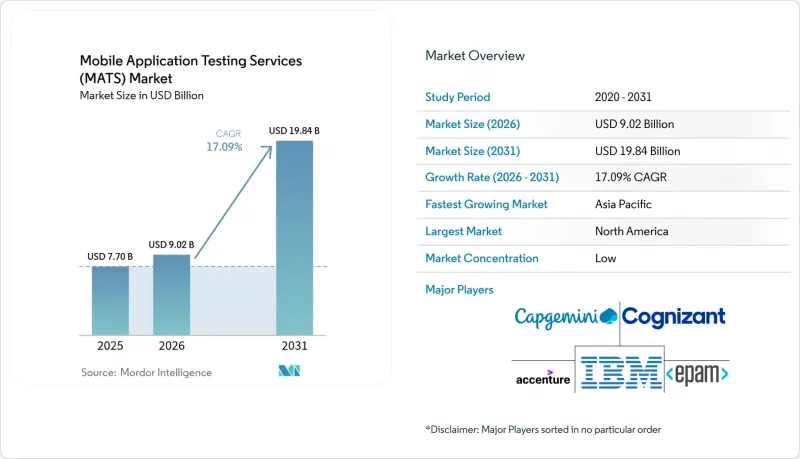
根據 Mordor Intelligence 預測,行動應用測試服務 (MATS) 市場將從 2025 年的 77 億美元成長到 2026 年的 90.2 億美元,然後在 2031 年達到 198.4 億美元,2026 年至 2031 年的複合年成長率為 17.09%。
本報告按應用程式類型(原生應用程式、Web 應用程式、其他)、服務類型(功能測試服務、效能和負載測試服務、其他)、測試方法(手動測試、自動化測試、其他)、最終用戶產業(遊戲、銀行、金融服務和保險、醫療保健和生命科學、其他)以及地區進行細分。市場預測以美元計價。
全球行動應用測試服務 (MATS) 市場趨勢與洞察
全球智慧型手機普及率上升
2025年,隨著5G設備平均價格降至200美元以下,印度、印尼和菲律賓的智慧型手機普及率激增。這催生了數千款針對不同網路環境和低配置設備的特定區域應用。對於行動應用測試服務市場的供應商而言,這意味著確保跨安卓分支系統的相容性工作量大幅增加,因為OEM廠商的調整可能會影響核心功能。設備覆蓋範圍必須涵蓋多個晶片組供應商和螢幕大小,迫使服務供應商擴展其真機雲端平台並最佳化測試案例的優先順序。無法自行維護這些設備矩陣的公司正在增加外包,從而為專業測試公司創造了持續的收入來源。
快速向敏捷和DevOps轉型需要持續測試。
財富 500 強企業的開發人員現在每天將程式碼部署到生產環境數十次,這模糊了開發和品質之間的界線。因此,測試環節向前推進,與每次程式碼提交並行運行,並體現在 CI/CD 管線的「可執行/不可執行」標準中。將 AI 輔助腳本產生功能整合到 Jenkins、GitLab 和 Azure DevOps 中的供應商,由於能夠將回饋週期從數小時縮短到數分鐘,因此訂單價格也隨之上漲。在行動應用測試服務市場,這些能夠縮短平均修復時間並支援數位產品團隊核心的「快速失敗」理念的合作夥伴備受青睞。
基礎設施和設備實驗室的高昂投資成本
建造一個擁有 1,000 台實體裝置(涵蓋 iOS 和 20 家 Android OEM 廠商)的實驗室需要 600 萬美元,每月更新費用為 5 萬美元。小規模的服務商無法將這些支出分攤到足夠的客戶身上,這限制了其價格競爭力。雲端設備集群雖然降低了資本支出 (CapEx),但會產生營運成本 (OpEx),例如按小時計費和區域資料中心使用費。這些限制因素正在減緩行動應用測試服務市場新參與企業的成長速度,而隨著細分市場的新參與企業追求規模經濟,併購活動卻在加速進行。
細分市場分析
到 2025 年,原生應用程式將佔據行動應用測試服務市場 52.10% 的佔有率,凸顯了企業對平台級效能以及攝影機、GPS 和生物識別API 的依賴。這一領域的強勁勢頭將確保對 Swift、Kotlin 和 Jetpack Compose 測試專家的持續高需求,以檢驗深度設備整合。漸進式 Web 應用 (PWA) 正以 18.15% 的複合年成長率快速成長,與原生應用測試模式不同,它需要進行跨瀏覽器相容性測試和 Service Worker檢驗。 PWA 的興起正促使服務供應商提供融合瀏覽器和設備叢集的整合測試套件,從而推動行動應用測試服務市場總支出的成長。
PWA 也吸引了尋求單一程式碼庫策略的中型零售商和 SaaS 供應商的注意。因此,測試合作夥伴需要展示其在離線快取、推播通知完整性以及跨 Chromium 分支和 WebKit 的安裝相容性方面的能力。隨著頻寬的增加,企業期望獲得更原生的使用者體驗,這也提高了對載入時間和動畫流暢度的基準要求。能夠提供原生和 PWA 建構平行效能分析的公司,可以在技術堆疊決策中獲得更大的影響力,並擴大市場佔有率。
預計到2025年,功能測試將佔行動應用測試服務市場規模的41.30%。這主要歸因於各行各業對使用者介面檢驗和回歸測試套件的持續需求。同時,隨著金融機構將零信任策略擴展到所有軟體元件,安全穿透測試正以17.95%的複合年成長率成長。提供OWASP MASVS合規性審計,並結合API模糊測試和運行時應用自保護檢查的供應商,正在縮短修復週期,從而為其更高的定價提供了合理依據。
隱私保護法的加強和備受矚目的資料外洩事件,使得行動穿透測試的預算分配優先順序不斷提升。行動滲透測試能夠模擬裝置root權限取得、網路層攔截以及惡意SDK嵌入等攻擊手段。那些將測試結果反映在DevSecOps儀錶板中,並在CI/CD管線中自動複測修補程式的供應商,正透過降低風險展現出切實的投資報酬率。這種連鎖反應推動了託管漏洞管理和紅隊服務的交叉銷售,並提升了整個行動應用測試服務產業的平均合約價值。
區域分析
預計到2025年,北美將佔總收入的37.10%,這主要得益於DevOps的廣泛應用和嚴格的合規要求。美國銀行和保險公司正在部署即時詐欺偵測應用程式,這些應用程式需要全天候安全掃描;而數位原生企業則將回歸測試套件外包,以管理每兩週一次的發布週期。加拿大市場的需求則受到醫療保健數位化和各省無障礙法律的推動,因此,涵蓋英語和法語應用程式的雙語測試需求依然旺盛。
預計亞太地區將維持最高的成長率,到2031年複合年成長率將達到17.82%。印度金融科技和社交電商的蓬勃發展,推動了涵蓋15種區域語言和許多低成本智慧型手機的大規模群眾外包測試宣傳活動。在中國的超級應用生態系統中,對熟悉小程式架構和國內合規性的服務供應商的需求日益成長,促使企業採用兼顧國內和出口版本的雙軌策略。日本和韓國5G的成熟部署,增加了AR/VR應用的負載,也擴大了行動應用測試服務市場供應商的設備實驗室規模。
在歐洲,受監管推動,市場呈現穩定成長態勢。隨著《歐洲無障礙法案》和GDPR處罰措施的實施,無障礙和隱私檢查已成為預算中不可或缺的項目。在德國,汽車產業的OTA更新測試需求強勁;而在英國,儘管脫歐後監管政策有所差異,金融領域的需求依然強勁。北歐客戶優先考慮永續性指標,要求供應商報告其測試實驗室的碳排放強度,這正成為行動應用測試服務產業新的差異化因素。
其他好處
- Excel格式的市場預測(ME)表
- 3個月的分析師支持
目錄
第1章:引言
- 研究假設和市場定義
- 調查範圍
第2章:調查方法
第3章執行摘要
第4章 市場狀況
- 市場概覽
- 市場促進因素
- 全球智慧型手機普及率上升
- 快速向敏捷和DevOps轉型需要持續測試。
- 利用人工智慧/機器學習、擴增實境/虛擬實境和 5G 的身臨其境型體驗應用程式的普及。
- 加強對行動應用安全和隱私的監管
- 原始設備製造商對汽車應用(車載資訊娛樂系統)測試的需求日益成長
- 永續性關鍵績效指標促進了電池消耗和碳排放的測試
- 市場限制因素
- 基礎設施和設備實驗室的高昂投資成本
- 設備和作業系統生態系統的碎片化使得自動計算投資回報率變得複雜。
- 應用程式內廣告技術 SDK 的日益複雜化導致測試不穩定。
- 用於使用 GenAI 進行測試的有限測試資料隱私框架
- 產業價值鏈分析
- 監理情勢
- 技術展望
- 波特五力分析
第5章 市場規模與成長預測
- 按應用程式類型
- 原生應用
- Web應用程式
- 混合應用
- 漸進式 Web 應用 (PWA)
- 按服務類型
- 功能測試服務
- 效能和負載測試服務
- 安全穿透測試服務
- 相容性和使用者體驗測試服務
- 測試自動化服務
- 測試方法
- 手動測試
- 自動化測試
- 雲端/雲端來源測試
- 按最終用戶行業分類
- 遊戲
- BFSI
- 醫療保健和生命科學
- 零售與電子商務
- 旅遊與飯店
- 媒體與娛樂
- 其他
- 按地區
- 北美洲
- 美國
- 加拿大
- 南美洲
- 巴西
- 阿根廷
- 其他南美國家
- 歐洲
- 德國
- 英國
- 法國
- 義大利
- 西班牙
- 荷蘭
- 其他歐洲國家
- 亞太地區
- 中國
- 印度
- 日本
- 韓國
- 澳洲
- 其他亞太國家
- 中東和非洲
- 中東
- 阿拉伯聯合大公國
- 沙烏地阿拉伯
- 其他中東國家
- 非洲
- 南非
- 奈及利亞
- 其他非洲地區
- 中東
- 北美洲
第6章 競爭情勢
- 市場集中度
- 策略趨勢
- 市佔率分析
- 公司簡介
- Accenture PLC
- Capgemini SE
- Cognizant Technology Solutions Corporation
- EPAM Systems Inc.
- International Business Machines Corporation
- Wipro Limited
- Tata Consultancy Services Limited
- Cigniti Technologies Limited
- Sauce Labs Inc.
- Amazon Web Services, Inc.(Device Farm)
- Applause App Quality, Inc.
- BrowserStack Limited
- Infosys Limited
- Qualitest Group Ltd.
- Tricentis GmbH
- Testlio Inc.
- Perfecto Mobile Ltd.(Perforce Software)
- Global App Testing Ltd.
- Testbirds GmbH
- Rainforest QA, Inc.
- BugRaptors QA Solutions Pvt. Ltd.
第7章 市場機會與未來展望
According to Mordor Intelligence, the mobile application testing services market size is expected to grow from USD 7.70 billion in 2025 to USD 9.02 billion in 2026 and is forecast to reach USD 19.84 billion by 2031 at 17.09% CAGR over 2026-2031.
This report is Segmented by Application Type (Native Apps, Web Apps, and More), Service Type (Functional Testing Services, Performance and Load Testing Services, and More), Testing Approach (Manual Testing, Automated Testing, and More), End-User Industry (Gaming, BFSI, Healthcare and Life Sciences, and More), and Geography. The Market Forecasts are Provided in Terms of Value (USD).
Global Mobile Application Testing Services (MATS) Market Trends and Insights
Rising Global Smartphone Penetration Accelerates Testing Demand
Smartphone adoption in India, Indonesia, and the Philippines climbed sharply in 2025 as the average 5G handset fell below USD 200, spawning thousands of localized apps targeting varied network conditions and lower-spec devices. For suppliers to this mobile application testing services market, the result is a surge in compatibility workloads across fragmented Android forks where OEM tweaks often break core functions. Device coverage must span multiple chipset vendors and screen sizes, pressuring service providers to expand real-device clouds and refine test-case prioritization. Enterprises unable to maintain these device matrices in-house increasingly outsource, creating recurring revenue streams for pure-play testing firms.
Rapid Shift to Agile and DevOps Demanding Continuous Testing
Fortune 500 developers now push code to production dozens of times a day, dissolving the wall between development and quality. Testing therefore moves upstream, runs in parallel with every commit, and feeds go/no-go gates in CI/CD pipelines. Vendors that plug AI-assisted script generation into Jenkins, GitLab, and Azure DevOps see stronger win rates because they compress feedback cycles from hours to minutes. The mobile application testing services market prizes such partners for lowering mean time to remediation and supporting the "fail-fast" ethos central to digital product teams.
High Infrastructure and Device-Lab Investment Costs
A lab with 1,000 real devices spanning iOS and 20 Android OEMs can cost USD 6 million to build and USD 50,000 per month to refresh. Smaller providers cannot amortize these outlays across enough clients, curbing their ability to compete on price. Cloud device farms alleviate capex but introduce opex tied to hourly usage and geographic data-center fees. This restraint slows new-entrant growth in the mobile application testing services market and accelerates M&A as niche players seek scale advantages.
Other drivers and restraints analyzed in the detailed report include:
- Proliferation of AI/ML, AR/VR and 5G Rich-Experience Apps
- Growing Regulatory Push for Mobile App Security and Privacy
- Fragmented Device/OS Ecosystem Complicates Automation ROI
For complete list of drivers and restraints, kindly check the Table Of Contents.
Segment Analysis
Native apps held 52.10% of the mobile application testing services market share in 2025, underscoring enterprise reliance on platform-level performance and camera, GPS, or biometric APIs. The segment's durability keeps demand high for Swift, Kotlin, and Jetpack Compose test specialists who validate deep device integrations. Progressive web apps, expanding at 18.15% CAGR, require cross-browser conformance testing and service-worker validation that differ from native test patterns. Their rise encourages providers to offer unified test suites blending browser and device farms, thereby broadening total addressable spend within the mobile application testing services market.
PWAs also attract mid-sized retailers and SaaS vendors seeking a single code-base strategy. Testing partners must therefore prove capability in offline caching, push-notification integrity, and installability across Chromium forks and WebKit. As bandwidth improves, enterprises expect near-native UX, raising the bar for load-time and animation smoothness benchmarks. Firms that can deliver side-by-side performance analytics for native versus PWA builds gain influence over tech-stack decisions, increasing wallet share.
Functional testing represented 41.30% of the mobile application testing services market size in 2025 as UI verification and regression suites remained table stakes across all industries. Yet security and penetration testing grows at 17.95% CAGR, propelled by financial institutions extending zero-trust policies to every software component. Providers bundling OWASP MASVS compliance audits with API fuzzing and runtime app self-protection checks shorten remediation cycles and justify premium fees.
Expanded privacy laws and high-profile breaches elevate budget priority for mobile pentests that simulate device rooting, network-layer interception, and malicious SDK inclusion. Vendors that feed findings into DevSecOps dashboards and retest patches automatically in CI/CD pipelines demonstrate tangible risk-reduction ROI. This pull through boosts their cross-sell of managed vulnerability management and red-team services, raising average contract value across the mobile application testing services industry.
Complete Report Scope:
- By Application Type
- Native Apps
- Web Apps
- Hybrid Apps
- Progressive Web Apps (PWA)
- By Service Type
- Functional Testing Services
- Performance and Load Testing Services
- Security and Pen-Testing Services
- Compatibility and UX Testing Services
- Test Automation Services
- By Testing Approach
- Manual Testing
- Automated Testing
- Crowd / Crowd-source Testing
- By End-User Industry
- Gaming
- BFSI
- Healthcare and Life Sciences
- Retail and E-Commerce
- Travel and Hospitality
- Media and Entertainment
- Other End-User Industries
- By Geography
- North America
- United States
- Canada
- South America
- Brazil
- Argentina
- Rest of South America
- Europe
- Germany
- United Kingdom
- France
- Italy
- Spain
- Netherlands
- Rest of Europe
- Asia-Pacific
- China
- India
- Japan
- South Korea
- Australia
- Rest of Asia-Pacific
- Middle East and Africa
- Middle East
- United Arab Emirates
- Saudi Arabia
- Rest of Middle East
- Africa
- South Africa
- Nigeria
- Rest of Africa
- Middle East
- North America
Geography Analysis
North America generated 37.10% of 2025 revenues, leveraging deep DevOps adoption and strict compliance mandates. U.S. banks and payers rolled out real-time fraud-detection apps that need 24X7 security scans, while digital-native brands outsource regression suites to manage bi-weekly release cadences. Canadian demand centers on healthcare digitization and provincial accessibility laws, sustaining premium for bilingual testing coverage across English and French apps.
Asia-Pacific posts the strongest 17.82% CAGR through 2031. India's fintech and social-commerce boom prompts large-scale crowd campaigns across 15 regional languages and myriad low-cost handsets. China's super-app ecosystems require providers versed in mini-program architectures and domestic compliance, creating two-track engagements covering both domestic and export builds. Mature 5G rollouts in Japan and South Korea elevate AR/VR app workloads, expanding the device lab footprint for vendors in the mobile application testing services market.
Europe shows steady growth underpinned by regulation. The European Accessibility Act and GDPR fine regime convert accessibility and privacy checks into non-negotiable budget lines. Germany leads demand via automotive OTA-update testing, while the U.K. remains strong in finance despite post-Brexit regulatory divergence. Nordic clients emphasize sustainability metrics, asking suppliers to report test-lab carbon intensity, a nascent differentiator within the mobile application testing services industry.
- Accenture PLC
- Capgemini SE
- Cognizant Technology Solutions Corporation
- EPAM Systems Inc.
- International Business Machines Corporation
- Wipro Limited
- Tata Consultancy Services Limited
- Cigniti Technologies Limited
- Sauce Labs Inc.
- Amazon Web Services, Inc. (Device Farm)
- Applause App Quality, Inc.
- BrowserStack Limited
- Infosys Limited
- Qualitest Group Ltd.
- Tricentis GmbH
- Testlio Inc.
- Perfecto Mobile Ltd. (Perforce Software)
- Global App Testing Ltd.
- Testbirds GmbH
- Rainforest QA, Inc.
- BugRaptors QA Solutions Pvt. Ltd.
Additional Benefits:
- The market estimate (ME) sheet in Excel format
- 3 months of analyst support
TABLE OF CONTENTS
1 INTRODUCTION
- 1.1 Study Assumptions and Market Definition
- 1.2 Scope of the Study
2 RESEARCH METHODOLOGY
3 EXECUTIVE SUMMARY
4 MARKET LANDSCAPE
- 4.1 Market Overview
- 4.2 Market Drivers
- 4.2.1 Rising global smartphone penetration
- 4.2.2 Rapid shift to agile and DevOps demanding continuous testing
- 4.2.3 Proliferation of AI/ML, AR/VR and 5G rich-experience apps
- 4.2.4 Growing regulatory push for mobile app security and privacy
- 4.2.5 Increasing OEM demand for in-vehicle app testing (IVI systems)
- 4.2.6 Sustainability KPIs driving battery-drain and carbon-aware testing
- 4.3 Market Restraints
- 4.3.1 High infrastructure and device-lab investment costs
- 4.3.2 Fragmented device/OS ecosystem complicates automation ROI
- 4.3.3 Rising complexity of in-app ad-tech SDKs causing test flakiness
- 4.3.4 Limited test-data privacy frameworks for GenAI-based testing
- 4.4 Industry Value Chain Analysis
- 4.5 Regulatory Landscape
- 4.6 Technological Outlook
- 4.7 Porter's Five Forces Analysis
- 4.7.1 Bargaining Power of Suppliers
- 4.7.2 Bargaining Power of Buyers
- 4.7.3 Threat of New Entrants
- 4.7.4 Threat of Substitute Products
- 4.7.5 Intensity of Competitive Rivalry
5 MARKET SIZE AND GROWTH FORECASTS (VALUE)
- 5.1 By Application Type
- 5.1.1 Native Apps
- 5.1.2 Web Apps
- 5.1.3 Hybrid Apps
- 5.1.4 Progressive Web Apps (PWA)
- 5.2 By Service Type
- 5.2.1 Functional Testing Services
- 5.2.2 Performance and Load Testing Services
- 5.2.3 Security and Pen-Testing Services
- 5.2.4 Compatibility and UX Testing Services
- 5.2.5 Test Automation Services
- 5.3 By Testing Approach
- 5.3.1 Manual Testing
- 5.3.2 Automated Testing
- 5.3.3 Crowd / Crowd-source Testing
- 5.4 By End-User Industry
- 5.4.1 Gaming
- 5.4.2 BFSI
- 5.4.3 Healthcare and Life Sciences
- 5.4.4 Retail and E-Commerce
- 5.4.5 Travel and Hospitality
- 5.4.6 Media and Entertainment
- 5.4.7 Other End-User Industries
- 5.5 By Geography
- 5.5.1 North America
- 5.5.1.1 United States
- 5.5.1.2 Canada
- 5.5.2 South America
- 5.5.2.1 Brazil
- 5.5.2.2 Argentina
- 5.5.2.3 Rest of South America
- 5.5.3 Europe
- 5.5.3.1 Germany
- 5.5.3.2 United Kingdom
- 5.5.3.3 France
- 5.5.3.4 Italy
- 5.5.3.5 Spain
- 5.5.3.6 Netherlands
- 5.5.3.7 Rest of Europe
- 5.5.4 Asia-Pacific
- 5.5.4.1 China
- 5.5.4.2 India
- 5.5.4.3 Japan
- 5.5.4.4 South Korea
- 5.5.4.5 Australia
- 5.5.4.6 Rest of Asia-Pacific
- 5.5.5 Middle East and Africa
- 5.5.5.1 Middle East
- 5.5.5.1.1 United Arab Emirates
- 5.5.5.1.2 Saudi Arabia
- 5.5.5.1.3 Rest of Middle East
- 5.5.5.2 Africa
- 5.5.5.2.1 South Africa
- 5.5.5.2.2 Nigeria
- 5.5.5.2.3 Rest of Africa
- 5.5.5.1 Middle East
- 5.5.1 North America
6 COMPETITIVE LANDSCAPE
- 6.1 Market Concentration
- 6.2 Strategic Moves
- 6.3 Market Share Analysis
- 6.4 Company Profiles (includes Global level Overview, Market level overview, Core Segments, Financials as available, Strategic Information, Market Rank/Share for key companies, Products and Services, and Recent Developments)
- 6.4.1 Accenture PLC
- 6.4.2 Capgemini SE
- 6.4.3 Cognizant Technology Solutions Corporation
- 6.4.4 EPAM Systems Inc.
- 6.4.5 International Business Machines Corporation
- 6.4.6 Wipro Limited
- 6.4.7 Tata Consultancy Services Limited
- 6.4.8 Cigniti Technologies Limited
- 6.4.9 Sauce Labs Inc.
- 6.4.10 Amazon Web Services, Inc. (Device Farm)
- 6.4.11 Applause App Quality, Inc.
- 6.4.12 BrowserStack Limited
- 6.4.13 Infosys Limited
- 6.4.14 Qualitest Group Ltd.
- 6.4.15 Tricentis GmbH
- 6.4.16 Testlio Inc.
- 6.4.17 Perfecto Mobile Ltd. (Perforce Software)
- 6.4.18 Global App Testing Ltd.
- 6.4.19 Testbirds GmbH
- 6.4.20 Rainforest QA, Inc.
- 6.4.21 BugRaptors QA Solutions Pvt. Ltd.
7 MARKET OPPORTUNITIES AND FUTURE OUTLOOK
- 7.1 White-Space and Unmet-Need Assessment

 2026年全球行動應用測試解決方案市場報告2026年全球軟體即服務(SaaS) 測試工具市場報告
 行動應用測試解決方案市場:分析與預測(至 2035 年)-按類型、產品類型、服務、技術、組件、應用、設備、部署模式、最終用戶、解決方案分類
 全球行動應用測試解決方案市場規模、佔有率、趨勢及成長分析報告(2026-2034)
 行動應用測試服務市場 - 全球產業規模、佔有率、趨勢、機會、預測:按應用程式類型、最終用戶產業、地區和競爭對手分類,2021-2031 年行動應用測試解決方案市場 - 全球產業規模、佔有率、趨勢、機會、預測:按類型、設備、最終用戶、地區和競爭對手分類,2021-2031 年
 行動測試市場:按平台、測試類型、設備類型、公司規模、應用類型和垂直行業分類 - 全球預測 2026-2032
 全球旅遊即服務 (MaaS) 技術市場預測(至 2032 年),按服務類型、交通方式、經營模式、應用和地區分類
 行動應用測試服務:全球市場佔有率和排名、總收入和需求預測(2025-2031 年)