


 |
市場調查報告書
商品編碼
2123005
選擇性雷射燒結:市場佔有率分析、產業趨勢與統計、成長預測(2026-2031)Selective Laser Sintering - Market Share Analysis, Industry Trends & Statistics, Growth Forecasts (2026 - 2031) |
||||||

※ 本網頁內容可能與最新版本有所差異。詳細情況請與我們聯繫。
據 Mordor Intelligence 稱,2025 年選擇性雷射燒結 (SLS) 市值為 48.1 億美元,預計到 2031 年將達到 134.8 億美元,而 2026 年為 57.3 億美元,預測期(2026-2031 年成長率)的複合年成長率為 18.69%。
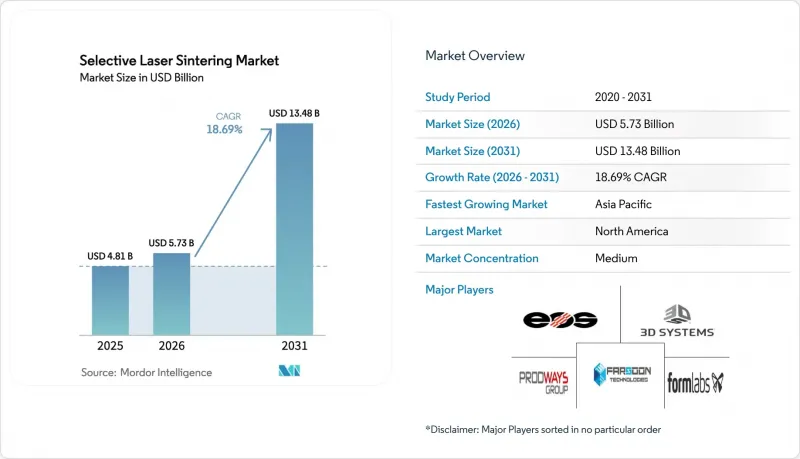
本報告按材料(金屬、塑膠、複合材料/先進聚合物、生物材料)、組件(硬體、軟體、服務)、終端用戶產業(汽車、航太/國防、醫療保健、電子及其他)、印表機類型(粉末層聚合物選擇性雷射燒結、金屬選擇性雷射燒結/直接金屬雷射燒結及其他)和地區進行細分。市場預測以美元計價。
全球選擇性雷射燒結(SLS)市場趨勢與洞察
透過數位化加速向備件倉庫轉型
製造商正以儲存在雲端庫中的加密CAD檔案取代滯銷庫存,僅在發生故障後才列印零件。這項策略已將渦輪增壓器的前置作業時間從九週縮短至一周,並將停機造成的損失降至最低。選擇性雷射燒結(SLS)技術在小批量航太和鐵路零件領域獲益最大,因為它無需昂貴的模具,而這些模具在50件或以下的產量中根本無法攤銷。儘管在監管機構確定文件管理器或印表機是否應對關鍵安全缺陷負責之前,責任歸屬問題仍未解決,但保險公司正在試點與經檢驗的製造日誌掛鉤的保險,一旦精算基準成熟,這種做法的普及速度可能會加快。
SLS技術在電動車輕量化零件中的主流化應用
電動車 (EV) 原始設備製造商 (OEM) 擴大指定使用 PA12-CF 支架和保形冷卻外殼,這不僅提高了熱效率,還能減輕 20-30% 的重量。選擇性雷射燒結 (SLS) 無需模具,可在 72 小時內交付經過檢驗的零件,顯著縮短了以往需要 6-9 個月的設計週期。雖然射出成型SLS 無需為每個週期準備新模具,這進一步提升了其價值提案。
每個建造週期的高耗能
聚合物選擇性雷射燒結(SLS)平台在12小時運作中消耗60-70千瓦時的電力,是射出成型生產同等產量所需能源的三倍。歐洲業者需支付每千瓦時0.22歐元的電費,他們透過離峰時段運作和與太陽能發電設施共址來降低此風險。金屬直接金屬雷射燒結(DMLS)設備由於需要增加氬氣填充和應力消除爐,面臨更大的能耗負擔,使得非航太應用的盈虧平衡產量超過500台。如果歐盟綠色交易下的能源稅進一步擴大,區域營運成本差異可能會進一步加劇,可能促使大批量生產項目跨大西洋遷移。
細分市場分析
2025年,隨著符合航太標準的鈦合金和因科鎳合金零件從原型過渡到實際應用,金屬領域在選擇性雷射燒結(SLS)市場中仍保持45.71%的佔有率。同時,生物材料領域預計將以19.43%的複合年成長率超越其他所有領域,這主要得益於市場對單價在2000美元至5000美元之間的可吸收顱腦和脊椎移植的需求,以及有利的報銷政策。如果醫院的採購流程持續維持目前的成長速度,預計到2031年,生物材料的選擇性雷射燒結(SLS)市場規模將超過10億美元。
塑膠,尤其是PA12和PA11,由於其粉末成本低於60美元/公斤,且即使含有50%的回收成分,加工安全性依然很高,因此在功能性原型製作領域仍佔據主導地位。碳纖維增強複合尼龍在無人機機架應用上越來越受歡迎,其剛性可與鋁媲美,而密度卻高出40%。同時,黏著劑噴塗金屬印表機在通用產品領域對金屬選擇性雷射燒結(SLS)構成了威脅,儘管在密度高於99.5%和疲勞壽命至關重要的領域,SLS仍然保持著優勢。
預計到2025年,硬體銷售額將佔總銷售額的73.27%,但由於印表機平均售價(ASP)下降以及售價低於2萬美元的入門級桌上型電腦的出現,該細分市場面臨壓力。隨著企業將粉末物流、符合ISO-13485標準的文件編制和蒸氣平滑處理等服務外包,與選擇性雷射燒結(SLS)相關的服務市場預計將快速成長。目前,服務已佔市場佔有率的26.73%,預計每年將成長約1個百分點,而硬體平均售價(ASP)的下降速度正在加速。
儘管軟體部門在以金額為準落後於其他部門,但它卻是價值的基石。能夠減少廢料的AI訂閱套餐帶來了15%至25%的利潤率波動,足以支撐每年5000至20000美元的許可費。工業OEM廠商目前正透過將切片軟體、遠端監控和預測性維護等服務捆綁銷售,來降低其進入桌面市場的難度,從而留住生態系統內的用戶。
區域分析
到2025年,北美將佔據36.34%的市場佔有率,這主要得益於工業印表機的普及,光是西雅圖和洛杉磯等航太中心就已安裝了超過2000台設備。馬薩諸塞州一家醫院已啟用一套獲得FDA批准的系統,可在48至72小時內列印手術導板,從而將術前規劃週期縮短了兩週。技術純熟勞工嚴重短缺,職缺平均長達60天,促使人們投資於粉末處理和電腦斷層掃描的自動化技術。加拿大的公務機項目和墨西哥的汽車裝配線需求正在逐步成長,但缺乏足夠的工程技術人才儲備來擴大生產規模。
亞太地區預計複合年成長率將達到19.11%,這主要得益於中國200億元人民幣的積層製造舉措(用於資助生產工廠)以及印度4800萬美元的操作人員培訓投資。中國電動車製造商正在使用PA12-CF支架來減輕幾公斤的重量並延長續航里程,而日本醫院正在試用PEEK顱骨板以減少MRI偽影。韓國主要電子產品製造商正在評估SLS技術在智慧型手錶製造中的應用,但蒸氣平滑製程可能會使每個組件的成本增加20-50美元,從而抵消成本節約。
在巴登-符騰堡州的歐洲汽車產業叢集中,符合聯合國歐洲經濟委員會(UN ECE)R100阻燃標準的玻璃纖維增強PA12歧管已被指定使用。在英國,用於渦輪葉片的鈦合金DMLS產能得以維持,但由於英國脫歐後粉末進口關稅的影響,預計材料成本將上漲8%至12%。在法國,DRG代碼已允許3D列印脊椎融合器納入保險報銷範圍,里昂的一家醫療機構正在推廣內部3D列印技術的應用。中東石油生產商和澳洲礦業公司正在進行試驗計畫,但由於高溫環境的挑戰,部署的設備數量仍不足50台。
其他好處
- Excel格式的市場預測(ME)表
- 3個月的分析師支持
目錄
第1章:引言
- 研究假設和市場定義
- 調查範圍
第2章:調查方法
第3章執行摘要
第4章 市場狀況
- 市場概覽
- 市場促進因素
- 透過數位化加速向備件倉庫轉型
- SLS技術在電動車輕量化零件中的主流化應用
- 透過政府津貼。
- 將人工智慧驅動的製程監控功能整合到SLS印表機中
- 擴大我們的醫用級聚合物粉末產品線。
- 透過近淨成形生產減少材料損耗
- 市場限制因素
- 每個建造週期的高耗能
- 新興國家熟練操作人員短缺
- 貿易關稅導致粉末供應鏈波動
- 對錶面處理的限制,需要高成本的後處理。
- 產業價值鏈分析
- 監理情勢
- 技術展望
- 波特五力分析
第5章 市場規模與成長預測
- 材料
- 金屬
- 塑膠
- 複合材料與先進聚合物
- 生物材料
- 按組件
- 硬體
- 軟體
- 服務
- 按最終用戶行業分類
- 車
- 航太/國防
- 衛生保健
- 電子設備
- 能源和工業設備
- 教育/研究
- 依印表機類型
- 粉末層聚合物SLS
- 金屬SLS/DMLS
- 高速燒結
- 混合SLS系統
- 按地區
- 北美洲
- 美國
- 加拿大
- 墨西哥
- 南美洲
- 巴西
- 阿根廷
- 其他南美國家
- 歐洲
- 德國
- 英國
- 法國
- 義大利
- 西班牙
- 其他歐洲國家
- 亞太地區
- 中國
- 印度
- 日本
- 韓國
- 澳洲和紐西蘭
- 其他亞太國家
- 中東
- 沙烏地阿拉伯
- 阿拉伯聯合大公國
- 土耳其
- 其他中東國家
- 非洲
- 南非
- 奈及利亞
- 埃及
- 其他非洲地區
- 北美洲
第6章 競爭情勢
- 市場集中度
- 策略趨勢
- 市佔率分析
- 公司簡介
- 3D Systems Inc.
- EOS GmbH Electro Optical Systems
- Farsoon Technologies
- Prodways Group
- Formlabs Inc.
- Ricoh Company Ltd.
- Concept Laser GmbH(General Electric)
- Renishaw PLC
- Sinterit Sp. z oo
- Sintratec AG
- Sharebot Srl
- Red Rock SLS
- HP Inc.
- Stratasys Ltd.
- SLM Solutions Group AG
- GE Additive
- Velo3D Inc.
- Desktop Metal Inc.
- Xact Metal
- Natural Robotics
- Z Rapid Tech
- Aerosint
- Eplus3D
- XYZ Printing Inc.
第7章 市場機會與未來展望
According to Mordor Intelligence, the selective laser sintering market size was valued at USD 4.81 billion in 2025 and estimated to grow from USD 5.73 billion in 2026 to reach USD 13.48 billion by 2031, at a CAGR of 18.69% during the forecast period (2026-2031).
This report is Segmented by Material (Metal, Plastics, Composite and Advanced Polymers, and Biomaterials), Component (Hardware, Software, and Services), End-User Industry (Automotive, Aerospace and Defense, Healthcare, Electronics, and More), Printer Type (Powder-Bed Polymer SLS, Metal SLS/DMLS, and More), and Geography. The Market Forecasts are Provided in Terms of Value (USD).
Global Selective Laser Sintering Market Trends and Insights
Digital Spare-Parts Warehousing
Manufacturers are replacing slow-moving stock with encrypted CAD files stored in cloud libraries and printing parts only after failure events. ABB cut turbocharger lead time from nine weeks to one week under this strategy, reducing downtime penalties. Low-runner aerospace and railway components benefit most because SLS removes the need for expensive molds that never amortize at volumes below 50 units. Liability remains unsettled as regulators decide whether file custodians or print operators bear responsibility for safety-critical failures, yet insurers are piloting coverage tied to verified build logs, which could accelerate adoption once actuarial benchmarks mature.
Mainstream Adoption for Lightweight EV Components
Electric-vehicle OEMs increasingly specify PA12-CF brackets and conformal-cooled housings that reduce mass by 20-30% while improving thermal efficiency. SLS eliminates tooling and delivers validated parts within 72 hours, truncating design cycles that once spanned six to nine months. Although per-part economics still favor injection molding above 5 000 units, platform proliferation in the EV sector is driving lower annual volumes per SKU, broadening SLS's addressable market. Battery-pack redesign frequency now averages 18 months; avoiding new tooling each cycle amplifies the value proposition.
High Energy Consumption per Build Cycle
Polymer SLS platforms draw 60-70 kWh over a 12-hour run, triple the energy required for comparable injection-molded volumes. European operators paying EUR 0.22/kWh mitigate exposure with off-peak scheduling or colocating alongside solar arrays. Metal DMLS machines intensify the burden by adding argon floods and stress-relief furnaces, pushing breakeven volumes above 500 units in non-aerospace applications. Energy taxes under the EU Green Deal, if expanded, could widen regional operating-cost gaps and encourage trans-Atlantic relocation of large-volume projects.
Other drivers and restraints analyzed in the detailed report include:
- AI-Driven Process Monitoring
- Expansion of Medical-Grade Polymer Powders
- Skilled Operator Shortage in Emerging Economies
For complete list of drivers and restraints, kindly check the Table Of Contents.
Segment Analysis
Metal retained 45.71 of % selective laser sintering market share in 2025 as aerospace-qualified titanium and Inconel parts transitioned from prototypes to flight hardware. Biomaterials, however, are projected to outpace all peers at a 19.43% CAGR, fueled by demand for resorbable cranial and spinal implants that command USD 2,000-5,000 per unit and ride favorable reimbursement frameworks. The selective laser sintering market for biomaterials is set to surpass USD 1 billion before 2031 if hospital procurement pipelines continue at current rates.
Plastics, chiefly PA12 and PA11, still dominate functional prototyping because powder costs stay below USD 60/kg and 50% recycled content remains process-safe. Composite nylons reinforced with carbon fibers are moving into drone frames, providing aluminum-like stiffness at 40% lower density. Meanwhile, binder-jet metal lines threaten metal SLS in commodity brackets, but SLS preserves an edge where >99.5% density and fatigue life matter.
Hardware contributed 73.27% of 2025 sales, but declining printer ASPs and desktop entry models under USD 20 000 pressure the segment. The selective laser sintering market size associated with services is forecast to jump as enterprises outsource powder logistics, ISO-13485 documentation, and vapor smoothing. Services already capture 26.73% share and will gain roughly one percentage point annually, whereas hardware ASP erosion accelerates.
Software lags in dollar terms yet underpins value; AI-subscription bundles that trim scrap unlock 15-25% margin swings and justify USD 5,000-20,000 annual licenses. Industrial OEMs now bundle slicers, remote monitoring, and predictive maintenance to lock users into ecosystems, blunting desktop cannibalization.
Complete Report Scope:
- By Material
- Metal
- Plastics
- Composite and Advanced Polymers
- Biomaterials
- By Component
- Hardware
- Software
- Services
- By End-User Industry
- Automotive
- Aerospace and Defense
- Healthcare
- Electronics
- Energy and Industrial Equipment
- Education and Research
- By Printer Type
- Powder-Bed Polymer SLS
- Metal SLS / DMLS
- High-Speed Sintering
- Hybrid SLS Systems
- By Geography
- North America
- United States
- Canada
- Mexico
- South America
- Brazil
- Argentina
- Rest of South America
- Europe
- Germany
- United Kingdom
- France
- Italy
- Spain
- Rest of Europe
- Asia-Pacific
- China
- India
- Japan
- South Korea
- Australia and New Zealand
- Rest of Asia-Pacific
- Middle East
- Saudi Arabia
- United Arab Emirates
- Turkey
- Rest of Middle East
- Africa
- South Africa
- Nigeria
- Egypt
- Rest of Africa
- North America
Geography Analysis
North America represented 36.34% of 2025 value, anchored by over 2 000 installed industrial printers in aerospace hubs of Seattle and Los Angeles. Hospitals in Massachusetts run FDA-cleared systems that print surgical guides within 48-72 hours, trimming pre-operative planning cycles by two weeks. Skilled-labor deficits intensify as vacancies linger for 60 days on average, driving automation investments in powder handling and CT scanning. Canada's business-jet programs and Mexico's automotive jig lines add incremental volumes but lack sufficient engineering pipelines to scale.
Asia-Pacific is forecast to post a 19.11% CAGR as China's CNY 20 billion additive-manufacturing initiative funds production plants, and India dedicates USD 48 million toward operator training. Chinese EV OEMs exploit PA12-CF brackets to shave kilograms and extend range, while Japan's hospitals trial PEEK cranial plates that reduce MRI artifacts. South Korean electronics majors evaluate SLS for smartwatch shells, although vapor-smooth steps add USD 20-50 per part and can offset cost gains.
Europe's automotive corridor in Baden-Wurttemberg specifies glass-filled PA12 manifolds that meet UN ECE R100 flammability rules. The United Kingdom maintains titanium DMLS capacity for turbine blades but faces 8-12% material-cost hikes after powder-import tariffs post-Brexit. France's DRG codes already reimburse 3D-printed spinal cages, spurring Lyon clinics to internalize printing. Middle Eastern oil producers and Australian miners run pilot programs, yet installed bases remain below 50 machines each due to high ambient-temperature challenges.
- 3D Systems Inc.
- EOS GmbH Electro Optical Systems
- Farsoon Technologies
- Prodways Group
- Formlabs Inc.
- Ricoh Company Ltd.
- Concept Laser GmbH (General Electric)
- Renishaw PLC
- Sinterit Sp. z o.o.
- Sintratec AG
- Sharebot S.r.l.
- Red Rock SLS
- HP Inc.
- Stratasys Ltd.
- SLM Solutions Group AG
- GE Additive
- Velo3D Inc.
- Desktop Metal Inc.
- Xact Metal
- Natural Robotics
- Z Rapid Tech
- Aerosint
- Eplus3D
- XYZ Printing Inc.
Additional Benefits:
- The market estimate (ME) sheet in Excel format
- 3 months of analyst support
TABLE OF CONTENTS
1 INTRODUCTION
- 1.1 Study Assumptions and Market Definition
- 1.2 Scope of the Study
2 RESEARCH METHODOLOGY
3 EXECUTIVE SUMMARY
4 MARKET LANDSCAPE
- 4.1 Market Overview
- 4.2 Market Drivers
- 4.2.1 Accelerating Shift Toward Digital Spare-Parts Warehousing
- 4.2.2 Mainstream Adoption of SLS for Lightweight EV Components
- 4.2.3 Government Grants Fueling Additive Manufacturing R&D
- 4.2.4 Integration of AI-Driven Process Monitoring in SLS Printers
- 4.2.5 Expansion of Medical-Grade Polymer Powders Portfolio
- 4.2.6 Near-Net-Shape Production Reducing Material Waste
- 4.3 Market Restraints
- 4.3.1 High Energy Consumption per Build Cycle
- 4.3.2 Skilled Operator Shortage in Emerging Economies
- 4.3.3 Powder Supply Chain Volatility Amid Trade Tariffs
- 4.3.4 Surface-Finish Limitations Requiring Costly Post-Processing
- 4.4 Industry Value-Chain Analysis
- 4.5 Regulatory Landscape
- 4.6 Technological Outlook
- 4.7 Porter's Five Forces Analysis
- 4.7.1 Bargaining Power of Buyers
- 4.7.2 Bargaining Power of Suppliers
- 4.7.3 Threat of New Entrants
- 4.7.4 Threat of Substitutes
- 4.7.5 Competitive Rivalry
5 MARKET SIZE AND GROWTH FORECASTS (VALUE)
- 5.1 By Material
- 5.1.1 Metal
- 5.1.2 Plastics
- 5.1.3 Composite and Advanced Polymers
- 5.1.4 Biomaterials
- 5.2 By Component
- 5.2.1 Hardware
- 5.2.2 Software
- 5.2.3 Services
- 5.3 By End-User Industry
- 5.3.1 Automotive
- 5.3.2 Aerospace and Defense
- 5.3.3 Healthcare
- 5.3.4 Electronics
- 5.3.5 Energy and Industrial Equipment
- 5.3.6 Education and Research
- 5.4 By Printer Type
- 5.4.1 Powder-Bed Polymer SLS
- 5.4.2 Metal SLS / DMLS
- 5.4.3 High-Speed Sintering
- 5.4.4 Hybrid SLS Systems
- 5.5 By Geography
- 5.5.1 North America
- 5.5.1.1 United States
- 5.5.1.2 Canada
- 5.5.1.3 Mexico
- 5.5.2 South America
- 5.5.2.1 Brazil
- 5.5.2.2 Argentina
- 5.5.2.3 Rest of South America
- 5.5.3 Europe
- 5.5.3.1 Germany
- 5.5.3.2 United Kingdom
- 5.5.3.3 France
- 5.5.3.4 Italy
- 5.5.3.5 Spain
- 5.5.3.6 Rest of Europe
- 5.5.4 Asia-Pacific
- 5.5.4.1 China
- 5.5.4.2 India
- 5.5.4.3 Japan
- 5.5.4.4 South Korea
- 5.5.4.5 Australia and New Zealand
- 5.5.4.6 Rest of Asia-Pacific
- 5.5.5 Middle East
- 5.5.5.1 Saudi Arabia
- 5.5.5.2 United Arab Emirates
- 5.5.5.3 Turkey
- 5.5.5.4 Rest of Middle East
- 5.5.6 Africa
- 5.5.6.1 South Africa
- 5.5.6.2 Nigeria
- 5.5.6.3 Egypt
- 5.5.6.4 Rest of Africa
- 5.5.1 North America
6 COMPETITIVE LANDSCAPE
- 6.1 Market Concentration
- 6.2 Strategic Moves
- 6.3 Market Share Analysis
- 6.4 Company Profiles (includes Global Level Overview, Market Level Overview, Core Segments, Financials as available, Strategic Information, Market Rank/Share, Products and Services, Recent Developments)
- 6.4.1 3D Systems Inc.
- 6.4.2 EOS GmbH Electro Optical Systems
- 6.4.3 Farsoon Technologies
- 6.4.4 Prodways Group
- 6.4.5 Formlabs Inc.
- 6.4.6 Ricoh Company Ltd.
- 6.4.7 Concept Laser GmbH (General Electric)
- 6.4.8 Renishaw PLC
- 6.4.9 Sinterit Sp. z o.o.
- 6.4.10 Sintratec AG
- 6.4.11 Sharebot S.r.l.
- 6.4.12 Red Rock SLS
- 6.4.13 HP Inc.
- 6.4.14 Stratasys Ltd.
- 6.4.15 SLM Solutions Group AG
- 6.4.16 GE Additive
- 6.4.17 Velo3D Inc.
- 6.4.18 Desktop Metal Inc.
- 6.4.19 Xact Metal
- 6.4.20 Natural Robotics
- 6.4.21 Z Rapid Tech
- 6.4.22 Aerosint
- 6.4.23 Eplus3D
- 6.4.24 XYZ Printing Inc.
7 MARKET OPPORTUNITIES AND FUTURE OUTLOOK
- 7.1 White-Space and Unmet-Need Assessment


