


 |
市場調查報告書
商品編碼
2123001
電子鼻:市場佔有率分析、產業趨勢與統計、成長預測(2026-2031)Electronic Nose - Market Share Analysis, Industry Trends & Statistics, Growth Forecasts (2026 - 2031) |
||||||

※ 本網頁內容可能與最新版本有所差異。詳細情況請與我們聯繫。
根據 Mordor Intelligence 預測,電子鼻市場規模將從 2025 年的 1.4628 億美元成長到 2026 年的 1.6421 億美元,到 2031 年將達到 2.9274 億美元,2026 年至 2031 年的複合年成長率為 12.26%。
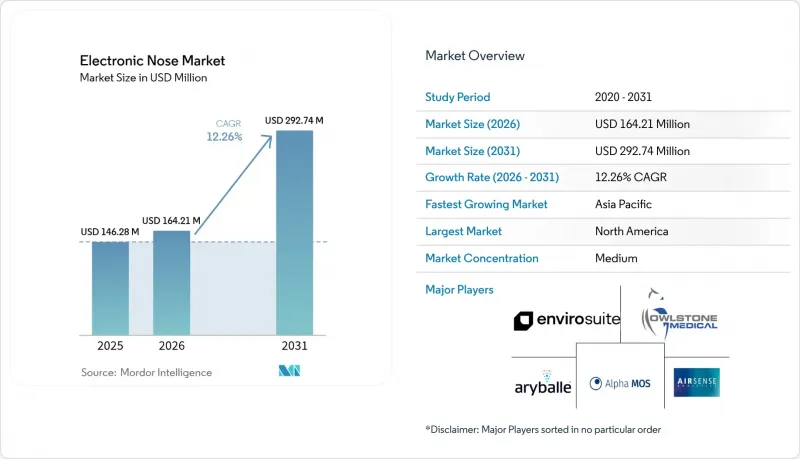
本報告按最終用戶(軍事和國防、醫療、食品和飲料等)、感測器技術(金屬氧化物半導體、石英晶共振器微天平等)、應用(疾病診斷、品管和保存期限預測等)以及地區(北美、南美、歐洲等)進行細分。市場預測以美元計價。
全球電子鼻市場趨勢與洞察
MEMS感測器陣列的快速小型化和成本降低
基於微機電系統(MEMS)的系統已小型化至信用卡大小,同時維持了95%以上的偵測精度。自2022年以來,半導體封裝的標準化以及中國、韓國和台灣地區晶圓製造廠的擴建,已使單位成本降低了40%至60%。三氧化鎢奈米棒加熱器可在0.5至1秒內完成識別,遠超傳統平台所需的10至30秒。佔空比控制策略已將功耗降低至250 度C下的160µW,為電池供電和穿戴式應用開闢了道路。因此,進入門檻降低,電子鼻市場正在滲透到家用電子電器、遠端醫療和智慧家庭生態系統。
將神經形態人工智慧整合到即時模式辨識中
一種仿照哺乳動物嗅球設計的脈衝神經網路,在功耗僅為 1 mW 的專用積體電路 (ASIC) 上,實現了超過 97% 的分類準確率,延遲低於 16 毫秒。對大規模語言模型的擴展,將化學特徵與上下文元元資料融合,提高了對重疊揮發性有機化合物 (VOC) 特徵的選擇性。邊緣部署減少了雲端流量,這對於礦山和加工廠的危險氣體警報至關重要。線上主動學習組能夠補償感測器漂移,無需手動重新校準即可保持 90% 以上的長期準確率。這些突破性進展為國防、醫療和工業安全領域的下一代自主氣味分析設備奠定了基礎。
惡劣環境下的感測器漂移和校準複雜性
金屬氧化物感測器在濕度和溫度波動下會產生顯著的基準漂移,需要每季重新校準,從而增加運行成本。七年的現場研究證實,煉油廠煙道塔和掩埋的感測器性能下降,需要更換。基於小波分解和機器學習的校正技術在一年的觀測期內可實現100%的識別準確率,但需要嵌入式運算能力,從而增加組件成本。另一方面,單類漂移方法可以將校準樣本數量減少70%,但仍依賴受控的訓練週期。在需要全天候運作的產業,例如石油化學加工,這種維護負擔被視為推廣應用的一大障礙。
細分市場分析
預計到2031年,醫療保健產業的複合年成長率將達到13.42%。受美國和德國有利的保險報銷試點計畫的推動,基於呼吸的癌症篩檢和氣喘監測設備的需求正在成長。食品飲料產業仍然是最大的垂直市場,電子鼻已被用於檢測肉類新鮮度、葡萄酒氧化和乳製品摻假。電子鼻的應用範圍正從加工廠擴展到快餐店,並且正在整合雲端儀錶板以進行日常產品審核。
受北約有毒氣體檢測要求和亞太地區國防現代化進程的推動,軍事、國防和國防安全保障領域預計到2025年將佔銷售額的9.05%。廢棄物管理公司正在部署氣味感測器,以符合歐盟成員國對掩埋排放的限制。工業安全和暖通空調(HVAC)公司透過將感測器陣列整合到通風系統中,並全天候監測二氧化碳和揮發性有機化合物(VOC),來減少與「病態建築症候群」相關的申訴。總體而言,預計醫療保健行業的高複合年成長率將在2030年以後超過食品飲料行業。
區域分析
北美佔據了電子鼻市場30.12%的佔有率,這得益於美國國立衛生研究院(NIH)的津貼以及美國食品藥物管理局(FDA)對呼吸診斷技術的早期批准。國防和國防安全保障部門在化學威脅檢測方面的支出進一步刺激了市場需求。史丹佛大學和麻省理工學院(MIT)等機構的產學研合作正在加速新產品的研發。
亞太地區預計將以13.72%的複合年成長率實現最高成長,這主要得益於中國、日本和印度在食品供應鏈數位化和智慧工廠建設方面的快速發展。台灣和韓國的半導體製造地為微機電系統(MEMS)晶片提供了經濟高效的生產模式,從而降低了該地區的平均售價(ASP)。深圳和班加羅爾的本土新創公司正在利用邊緣人工智慧技術開發低成本模組,以滿足咖哩新鮮度、米酒品質和都市區空氣污染等應用場景的需求。
在歐洲,強制要求工業設施實施持續監測的EN 13725:2022氣味排放法規正在推動市場發展。該地區的農產品出口商正在將電子鼻納入其生物安全協議,以保護與中東和亞洲的貿易。在南美洲以及中東和非洲,農產品出口檢驗和石油天然氣產業的甲烷檢測正在推動對電子鼻的需求,儘管需求基數仍然相對較低。
其他好處:
- Excel格式的市場預測(ME)表
- 3個月的分析師支持
目錄
第1章:引言
- 研究假設和市場定義
- 調查範圍
第2章:調查方法
第3章執行摘要
第4章 市場狀況
- 市場概覽
- 市場促進因素
- MEMS感測器陣列的快速小型化和成本降低
- 將神經形態人工智慧整合到即時模式辨識中
- 加強農產品出口國的生物安全要求
- 利用揮發性有機化合物(VOCs)的疾病診斷技術符合快速監管審查條件。
- 「氣味即服務」平台正在建立永續的收入來源。
- 透過邊緣到雲端分析降低總體擁有成本
- 市場限制因素
- 惡劣環境下的感測器漂移和校準複雜性。
- 關於呼吸切片檢查獲取的健康記錄的數據隱私問題
- 缺乏全球統一的氣味排放標準
- 攜帶式電子鼻設備的電池續航力短
- 產業供應鏈分析
- 監理情勢
- 技術展望
- 宏觀經濟因素對市場的影響
- 波特五力分析
第5章 市場規模與成長預測
- 按最終用戶行業分類
- 軍事/國防
- 衛生保健
- 食品/飲料
- 廢棄物管理(環境監測)
- 工業安全和暖通空調
- 感測器技術
- 金屬-氧化物-半導體(MOS)
- 晶體微天平(QCM)
- 場非對稱離子移動率譜(FAIMS)
- 導電聚合物
- 光學和光電離公式
- 透過使用
- 疾病診斷(呼吸分析)
- 品管和保存期限預測
- 有害氣體檢測
- 室內空氣品質監測
- 為研究和學術目的進行測試
- 按地區
- 北美洲
- 美國
- 加拿大
- 墨西哥
- 南美洲
- 巴西
- 阿根廷
- 其他南美國家
- 歐洲
- 德國
- 英國
- 法國
- 其他歐洲國家
- 亞太地區
- 中國
- 日本
- 印度
- 韓國
- 東南亞
- 其他亞太國家
- 中東和非洲
- 中東
- 沙烏地阿拉伯
- 阿拉伯聯合大公國
- 其他中東國家
- 非洲
- 南非
- 埃及
- 其他非洲國家
- 中東
- 北美洲
第6章 競爭情勢
- 市場集中度
- 策略趨勢
- 市佔率分析
- 公司簡介
- Alpha MOS SA
- Electronic Sensor Technology Inc.
- Plasmion GmbH
- Envirosuite Ltd.
- The eNose Company BV
- Airsense Analytics GmbH
- Sensigent LLC
- Common Invent BV
- E-Nose Pty Ltd.
- Owlstone Medical Ltd.
- Smart Nanotubes Technologies GmbH
- Scentroid Inc.
- Oizom Instruments Pvt Ltd.(Odosense)
第7章 市場機會與未來展望
According to Mordor Intelligence, the electronic nose market size is expected to grow from USD 146.28 million in 2025 to USD 164.21 million in 2026 and is forecast to reach USD 292.74 million by 2031 at 12.26% CAGR over 2026-2031.
This report is Segmented by End-User Vertical (Military and Defense, Healthcare, Food and Beverage, and More), Sensor Technology (Metal-Oxide Semiconductor, Quartz Crystal Microbalance, and More), Application (Disease Diagnosis, Quality Control and Shelf-Life Prediction, and More), and Geography (North America, South America, Europe, and More). The Market Forecasts are Provided in Terms of Value (USD).
Global Electronic Nose Market Trends and Insights
Rapid Miniaturization and Cost Decline of MEMS Sensor Arrays
MEMS-based systems now fit on credit-card footprints while maintaining >95% detection accuracy. Standardized semiconductor packaging and expanded wafer fabs in China, South Korea, and Taiwan have shaved 40-60% off unit costs since 2022. Tungsten-trioxide nanorod heaters enable 0.5-1 s identification, far outpacing legacy 10-30 s platforms.Duty-cycling strategies cut power draw to 160 µW at 250 °C, opening battery-operated and wearable use cases. The net result: entry barriers fall and the electronic nose market penetrates consumer electronics, telehealth, and smart-home ecosystems.
Integration of Neuromorphic AI for Real-Time Pattern Recognition
Spiking neural networks modeled on the mammalian olfactory bulb accomplish >97% classification accuracy with <16 ms latency on 1 mW ASICs. Large-language-model extensions fuse chemical signatures with contextual metadata, sharpening selectivity for overlapping VOC profiles. Edge implementations trim cloud traffic, critical for hazardous-gas alerts in mining and process plants. Online active-learning loops counter sensor drift, keeping long-term accuracy above 90% without manual recalibration. These breakthroughs underpin the next wave of autonomous odor-analysis devices across defense, healthcare, and industrial safety.
Sensor Drift and Calibration Complexity in Harsh Environments
Metal-oxide sensors exhibit pronounced baseline drift under humidity and temperature swings, forcing quarterly recalibration that inflates operating costs. Seven-year field studies confirm performance erosion necessitating sensor replacement in refinery stacks and landfills. Wavelet-decomposition and machine-learning compensation reach 100% identification over one-year horizons but demand embedded computing power, raising the bill of materials. While one-class drift schemes cut calibration samples by 70%, they still rely on controlled training cycles. Industries requiring 24/7 uptime, such as petrochemical processing, view these maintenance burdens as adoption barriers.
Other drivers and restraints analyzed in the detailed report include:
- Heightened Bio-security Mandates in Agri-Exporting Nations
- VOC-Based Disease Diagnostics Gaining Regulatory Fast-Track
- Data-Privacy Concerns for Breath-Biopsy Health Records
For complete list of drivers and restraints, kindly check the Table Of Contents.
Segment Analysis
Healthcare is projected to post a 13.42% CAGR through 2031. Breath-based oncology screening and asthma-monitoring devices drive demand, supported by favorable reimbursement pilots in the United States and Germany. Food and beverage remains the largest vertical, leveraging e-noses for meat freshness, wine oxidation, and dairy adulteration checks. Adoption spreads from processing plants to quick-service restaurants, integrating cloud dashboards for daily product audits.
Military, defense, and homeland security made up 9.05% revenue in 2025, propelled by toxic-gas detection requirements within NATO and Asia-Pacific defense modernization. Waste-management operators deploy odor sensors to comply with landfill emission caps in EU member states. Industrial safety and HVAC companies embed arrays in ventilation systems for 24/7 CO2 and VOC tracking, reducing sick-building complaints. Overall, healthcare's elevated CAGR positions it to eclipse food and beverage revenue post-2030.
Complete Report Scope:
- By End-user Vertical
- Military and Defence
- Healthcare
- Food and Beverage
- Waste Management (Environmental Monitoring)
- Industrial Safety and HVAC
- By Sensor Technology
- Metal-Oxide Semiconductor (MOS)
- Quartz Crystal Microbalance (QCM)
- Field Asymmetric Ion Mobility Spectrometry (FAIMS)
- Conducting Polymer
- Optical and Photo-Ionisation
- By Application
- Disease Diagnosis (Breath Analysis)
- Quality Control and Shelf-life Prediction
- Hazardous Gas Detection
- Indoor Air Quality Monitoring
- Research and Academic Testing
- By Geography
- North America
- United States
- Canada
- Mexico
- South America
- Brazil
- Argentina
- Rest of South America
- Europe
- Germany
- United Kingdom
- France
- Rest of Europe
- Asia-Pacific
- China
- Japan
- India
- South Korea
- South-East Asia
- Rest of Asia-Pacific
- Middle East and Africa
- Middle East
- Saudi Arabia
- United Arab Emirates
- Rest of Middle East
- Africa
- South Africa
- Egypt
- Rest of Africa
- Middle East
- North America
Geography Analysis
North America generated 30.12% of the electronic nose market, underpinned by NIH grants and early FDA clearances for breath diagnostics. Defense and homeland-security spending on chemical-threat detection further stimulates demand. Academic-industry collaborations at institutions such as Stanford and MIT accelerate new-product pipelines.
Asia-Pacific is projected to clock the fastest 13.72% CAGR as China, Japan, and India digitize food-supply chains and smart-factory lines. Semiconductor manufacturing hubs in Taiwan and South Korea offer cost-effective fabs for MEMS die, lowering regional ASPs. Local start-ups in Shenzhen and Bengaluru use edge AI to tailor low-cost modules for curry freshness, rice-wine quality, and urban air pollution use cases.
Europe is sustained by EN 13725:2022 odor-emission enforcement that obliges industrial sites to deploy continuous monitoring. The region's agri-exporters integrate e-noses in bio-security protocols to protect trade with the Middle East and Asia. In South America and the Middle East, and Africa, the demand for electronic nose is driven by agricultural export inspection and oil-and-gas methane detection respectively, albeit from a lower base.
- Alpha MOS SA
- Electronic Sensor Technology Inc.
- Plasmion GmbH
- Envirosuite Ltd.
- The eNose Company BV
- Airsense Analytics GmbH
- Sensigent LLC
- Common Invent BV
- E-Nose Pty Ltd.
- Owlstone Medical Ltd.
- Smart Nanotubes Technologies GmbH
- Scentroid Inc.
- Oizom Instruments Pvt Ltd. (Odosense)
Additional Benefits:
- The market estimate (ME) sheet in Excel format
- 3 months of analyst support
TABLE OF CONTENTS
1 INTRODUCTION
- 1.1 Study Assumptions and Market Definition
- 1.2 Scope of the Study
2 RESEARCH METHODOLOGY
3 EXECUTIVE SUMMARY
4 MARKET LANDSCAPE
- 4.1 Market Overview
- 4.2 Market Drivers
- 4.2.1 Rapid miniaturisation and cost decline of MEMS sensor arrays
- 4.2.2 Integration of neuromorphic AI for real-time pattern recognition
- 4.2.3 Heightened bio-security mandates in agri-exporting nations
- 4.2.4 VOC-based disease diagnostics gaining regulatory fast-track
- 4.2.5 Odour-as-a-service platforms unlocking recurring revenue
- 4.2.6 Edge-to-cloud analytics lowering total cost of ownership
- 4.3 Market Restraints
- 4.3.1 Sensor drift and calibration complexity in harsh environments
- 4.3.2 Data-privacy concerns for breath-biopsy health records
- 4.3.3 Absence of harmonised global odour emission standards
- 4.3.4 Limited battery life in portable e-nose devices
- 4.4 Industry Supply Chain Analysis
- 4.5 Regulatory Landscape
- 4.6 Technological Outlook
- 4.7 Impact of Macroeconomic Factors on the Market
- 4.8 Porter's Five Forces Analysis
- 4.8.1 Bargaining Power of Suppliers
- 4.8.2 Bargaining Power of Consumers
- 4.8.3 Threat of New Entrants
- 4.8.4 Threat of Substitutes
- 4.8.5 Intensity of Competitive Rivalry
5 MARKET SIZE AND GROWTH FORECASTS (VALUE)
- 5.1 By End-user Vertical
- 5.1.1 Military and Defence
- 5.1.2 Healthcare
- 5.1.3 Food and Beverage
- 5.1.4 Waste Management (Environmental Monitoring)
- 5.1.5 Industrial Safety and HVAC
- 5.2 By Sensor Technology
- 5.2.1 Metal-Oxide Semiconductor (MOS)
- 5.2.2 Quartz Crystal Microbalance (QCM)
- 5.2.3 Field Asymmetric Ion Mobility Spectrometry (FAIMS)
- 5.2.4 Conducting Polymer
- 5.2.5 Optical and Photo-Ionisation
- 5.3 By Application
- 5.3.1 Disease Diagnosis (Breath Analysis)
- 5.3.2 Quality Control and Shelf-life Prediction
- 5.3.3 Hazardous Gas Detection
- 5.3.4 Indoor Air Quality Monitoring
- 5.3.5 Research and Academic Testing
- 5.4 By Geography
- 5.4.1 North America
- 5.4.1.1 United States
- 5.4.1.2 Canada
- 5.4.1.3 Mexico
- 5.4.2 South America
- 5.4.2.1 Brazil
- 5.4.2.2 Argentina
- 5.4.2.3 Rest of South America
- 5.4.3 Europe
- 5.4.3.1 Germany
- 5.4.3.2 United Kingdom
- 5.4.3.3 France
- 5.4.3.4 Rest of Europe
- 5.4.4 Asia-Pacific
- 5.4.4.1 China
- 5.4.4.2 Japan
- 5.4.4.3 India
- 5.4.4.4 South Korea
- 5.4.4.5 South-East Asia
- 5.4.4.6 Rest of Asia-Pacific
- 5.4.5 Middle East and Africa
- 5.4.5.1 Middle East
- 5.4.5.1.1 Saudi Arabia
- 5.4.5.1.2 United Arab Emirates
- 5.4.5.1.3 Rest of Middle East
- 5.4.5.2 Africa
- 5.4.5.2.1 South Africa
- 5.4.5.2.2 Egypt
- 5.4.5.2.3 Rest of Africa
- 5.4.5.1 Middle East
- 5.4.1 North America
6 COMPETITIVE LANDSCAPE
- 6.1 Market Concentration
- 6.2 Strategic Moves
- 6.3 Market Share Analysis
- 6.4 Company Profiles (includes Global level Overview, Market level overview, Core Segments, Financials as available, Strategic Information, Market Rank/Share for key companies, Products and Services, and Recent Developments)
- 6.4.1 Alpha MOS SA
- 6.4.2 Electronic Sensor Technology Inc.
- 6.4.3 Plasmion GmbH
- 6.4.4 Envirosuite Ltd.
- 6.4.5 The eNose Company BV
- 6.4.6 Airsense Analytics GmbH
- 6.4.7 Sensigent LLC
- 6.4.8 Common Invent BV
- 6.4.9 E-Nose Pty Ltd.
- 6.4.10 Owlstone Medical Ltd.
- 6.4.11 Smart Nanotubes Technologies GmbH
- 6.4.12 Scentroid Inc.
- 6.4.13 Oizom Instruments Pvt Ltd. (Odosense)
7 MARKET OPPORTUNITIES AND FUTURE OUTLOOK
- 7.1 White-space and Unmet-need Assessment

 全球電子鼻市場規模、佔有率、趨勢和成長分析報告(2026-2034)
 機械嗅覺市場規模、佔有率和成長分析:按組件、技術、應用、最終用戶、部署類型和地區分類-2026-2033年產業預測
 電子鼻市場機會、成長要素、產業趨勢分析及2026-2035年預測。
 電子鼻市場規模、佔有率和成長分析:按感測器類型、應用、最終用戶和地區分類-2026-2033年產業預測
 全球電子鼻市場:依偵測類型、感測器類型、應用、終端用戶產業和地區分類-預測至2032年
 移動式氣味檢測終端市場預測至2034年:按技術、應用、最終用戶和地區分類的全球分析
 電子鼻市場報告:按類型、技術、終端應用產業和地區分類(2026-2034 年)
 電子鼻市場:按技術、應用、最終用戶和地區分類
 電子鼻市場:按技術、組件、應用和最終用戶分類-2026-2032年全球市場預測
 2026年全球電子鼻市場報告