


 |
市場調查報告書
商品編碼
2122999
商業生產力軟體:市場佔有率分析、產業趨勢與統計及成長預測(2026-2031)Business Productivity Software - Market Share Analysis, Industry Trends & Statistics, Growth Forecasts (2026 - 2031) |
||||||

※ 本網頁內容可能與最新版本有所差異。詳細情況請與我們聯繫。
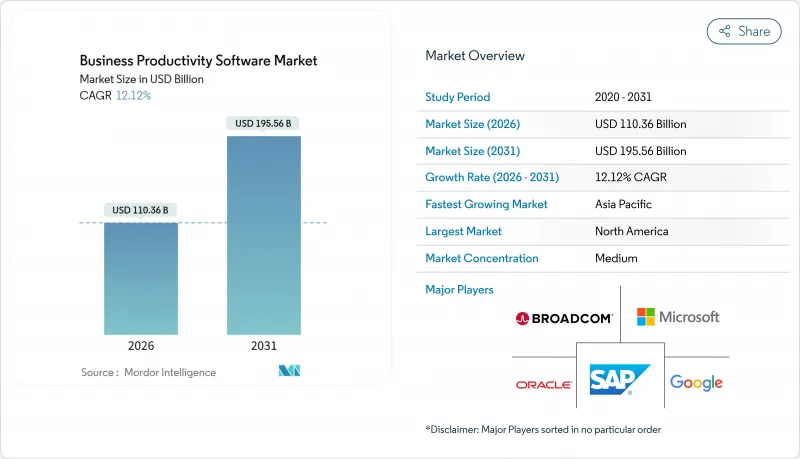
根據 Mordor Intelligence 預測,商業生產力軟體市場規模預計將在 2026 年達到 1,103.6 億美元,到 2031 年達到 1,955.6 億美元,預測期內複合年成長率為 12.12%。
本報告按部署方式(本地部署、雲端部署)、組織規模(大型企業、中小企業)、最終用戶產業(銀行、金融服務和保險、電信和IT、其他)、解決方案類型(內容協作和文件管理、電信和整合通訊、其他)以及地區進行細分。市場預測以美元計價。
全球商業生產力軟體市場趨勢與洞察
在整體業務應用程式中採用「雲端優先」的 SaaS(軟體即服務)方法。
企業正優先考慮提供持續功能更新、彈性容量和整合安全性的SaaS解決方案,從而加速淘汰本地基礎設施。微軟宣布其商業雲端收入在2024年將達到1,360億美元,這清楚地顯示了企業工作負載遷移的規模。金融機構將SaaS視為滿足其數位化營運彈性義務的一種途徑,而無需對其本地資料中心管理結構進行重大改造。諸如ISO/IEC 27017等標準化雲端安全框架正在縮短供應商實質審查週期,並進一步加速採購流程。隨著超大規模資料中心業者將運算密集型AI服務納入訂閱計劃,與本地部署相比,整體擁有成本(TCO)差距正在擴大。遷移模式越來越傾向於先「遷移」協作工作負載,然後在資料分類挑戰解決後逐步淘汰傳統內容管理系統。
整合到生產力套件中的生成式人工智慧輔助駕駛技術的普及
生成式人工智慧助理已從先導計畫發展成為核心介面,能夠簡化日常任務。微軟 365 Copilot 於 2023 年底正式發布,為 Outlook、Teams 和 Word 提供上下文相關的草稿撰寫、摘要和分析功能。 Google 於 2024 年初推出 Gemini for Workspace,將多模態模型整合到 Gmail 和 Docs 中。早期採用者報告稱,日常文件創建時間節省了 25% 至 30%,其中金融和法律領域的知識工作者採用率最高。歐盟人工智慧法規將職場人工智慧歸類為“高風險”,迫使供應商從設計階段就必須確保透明度並引入人工監督。當競爭對手專注於模型品質和延遲時,超大規模資料中心業者正在投資 GPU 容量,這使得雲端原生套件擁有獨立解決方案無法比擬的效能優勢。
網路主權法限制跨境資料存儲
目前,世界各國政府都在強制要求公民資料本地存儲,迫使供應商複製基礎設施,導致全球架構碎片化。中國的《個人資料保護法》禁止未經安全評估的跨境傳輸。俄羅斯強制要求個人資料在國內託管,迫使外國供應商與國內雲端服務供應商合作。印度的《數位個人資料保護法》草案也預計將實施類似的限制。這些法規將推高成本,削弱規模經濟,並可能導致人工智慧新技術的部署延遲,直到完成本地合規性評估。
細分市場分析
到2025年,雲端服務將佔據企業生產力軟體市場71.31%的佔有率,成為新增支出的主要來源,因為企業優先考慮的是敏捷性和可預測的營運成本。預計這一主導地位將持續,到2031年,該類別的複合年成長率預計將達到13.12%。供應商正抓住這一機遇,將運算密集型人工智慧輔助駕駛系統整合到雲端服務中,這些系統依賴大多數私有資料中心無法提供的超大規模GPU基礎設施。託管SaaS還具有合規性優勢,因為FedRAMP等框架會對獲準用於美國聯邦政府工作負載的雲端進行認證。
混合模式可以作為過渡階段,使組織能夠將其協作套件遷移到雲端,同時將對延遲敏感和敏感的工作負載保留在本地。
預計到2025年,大型企業將佔據企業生產力軟體市場52.36%的佔有率,這反映了它們複雜的全球營運和多年期支援合約。同時,預計到2031年,中小企業(SME)將以14.23%的年成長率成長,超過大型企業。基於收費量的定價模式將成本與實際使用量掛鉤,使中小企業能夠在無需承擔高額前期授權費用的情況下逐步擴大用戶群。在印度和越南等高成長地區,許多中小企業正在徹底放棄傳統伺服器,並將生產力套件作為其首筆企業IT投資。
中型企業有著獨特的需求,他們通常尋求能夠減少設定工作量的行業專屬範本。 Salesforce 的產業雲端平台整合了符合法規要求的流程,將部署時間從數月縮短至數週。對價格敏感的買家也青睞 Zoho 的捆綁套件,這些套件整合了 CRM、專案管理和協作功能,且用戶成本更低。在競爭日益激烈的市場中,供應商不再僅僅依靠功能數量來脫穎而出,而是透過利用人工智慧驅動的自動化和內建分析功能來贏得市場。
區域分析
北美地區擁有雄厚的軟體預算和成熟的雲端生態系,在商業生產力軟體市場佔據主導地位,預計到2025年將佔全球收入的39.87%。聯邦政府強制推行的零信任安全策略正在加速以身分為中心的安全模型的普及,各機構紛紛轉向提供持續身分驗證的套件。加拿大公共部門已將Microsoft 365 GCC High作為受保護資料的標準,這反映了國家法規如何加劇了供應商鎖定。儘管超大規模資料中心業者之間的競爭維持了價格競爭力,但投資自有AI加速器的成熟供應商在功能迭代速度方面具有優勢。
在歐洲,《數位營運韌性法案》正穩步推進,該法案加強了金融服務領域的網路安全和事件回應要求。德國、法國和英國已推出認證機制,以簡化安全雲端服務的公共採購流程。俄羅斯的本地化法案導致區域市場碎片化,為能夠在國內託管數據的本地供應商提供了更多市場佔有率。在北歐和東歐市場,SaaS 正作為更廣泛的數位主權計劃的一部分被廣泛採用,並且通常更傾向於選擇能夠保證本地處理的歐洲雲端服務提供者。
亞太地區成長最快,複合年成長率達14.83%,這主要得益於印度、新加坡和日本等主權雲端計畫強制要求資料儲存在國內。中國透過《個人資料保護法》推行嚴格的在地化政策,促使超大規模資料中心業者商與阿里雲和騰訊雲合作,提供聯合服務。澳洲和紐西蘭的監管機構正在修訂資訊安全標準並納入SaaS控制措施,兩國也保持著強勁的成長動能。南美、中東和非洲等新興市場儘管基數較小,但仍呈現兩位數成長,但外匯波動和通訊基礎設施的差異限制了其短期成長潛力。
其他好處
- Excel格式的市場預測(ME)表
- 3個月的分析師支持
目錄
第1章:引言
- 研究假設和市場定義
- 調查範圍
第2章:調查方法
第3章執行摘要
第4章 市場狀況
- 市場概覽
- 市場促進因素
- 整體業務應用程式均採用「雲端優先」SaaS 模式
- 整合到生產力套件中的生成式人工智慧輔助駕駛技術的普及
- 全球合規標準中強制實施混合工作工具
- 面向現場工作人員的產業特定低程式碼工作平台
- 透過將生態系統轉變為基於使用量的收費系統,啟動中小企業 (SMB) 的升級週期。
- 一個無摩擦、API優先、擴充性的跨套件工作流程生態系統。
- 市場限制因素
- 網路主權法限制跨境資料存儲
- 由於SaaS的無序擴張,導致整合疲勞和授權合理化問題。
- 由於整合人員短缺,導致複雜工作流程的實施延誤。
- 生成式人工智慧模型缺乏透明度,阻礙了企業風險管理。
- 產業價值鏈分析
- 技術展望
- 波特五力分析
- 宏觀經濟因素對市場的影響
第5章 市場規模與成長預測
- 不同的發展
- 現場
- 雲
- 按組織規模
- 大公司
- 小型企業
- 按最終用戶行業分類
- BFSI
- 通訊/IT
- 製造業
- 媒體、娛樂、出版
- 運輸/物流
- 零售與電子商務
- 醫療保健和生命科學
- 政府/公共部門
- 其他終端使用者產業(教育、公共產業)
- 按解決方案類型
- 內容協作與文件管理
- 通訊和整合通訊
- 專案、工作和任務管理
- 商業智慧與分析
- 低程式碼/無程式碼自動化
- 數位資產創新工具
- 安全性和合規性附加元件
- 按地區
- 北美洲
- 美國
- 加拿大
- 墨西哥
- 歐洲
- 德國
- 英國
- 法國
- 義大利
- 西班牙
- 俄羅斯
- 其他歐洲國家
- 亞太地區
- 中國
- 日本
- 印度
- 韓國
- ASEAN
- 澳洲和紐西蘭
- 其他亞太國家
- 南美洲
- 巴西
- 阿根廷
- 其他南美國家
- 中東
- 沙烏地阿拉伯
- 阿拉伯聯合大公國
- 土耳其
- 其他中東國家
- 非洲
- 南非
- 奈及利亞
- 其他非洲地區
- 北美洲
第6章 競爭情勢
- 市場集中度
- 策略趨勢
- 市佔率分析
- 公司簡介
- Microsoft Corporation
- Google LLC
- Oracle Corporation
- Broadcom Inc.(Symantec)
- SAP SE
- Salesforce Inc.
- IBM Corporation
- VMware Inc.
- Amazon Web Services Inc.
- Atlassian Corporation
- ServiceNow Inc.
- Adobe Inc.
- Monday.com Ltd.
- Asana Inc.
- Zoho Corporation
- Citrix Systems Inc.
- Dropbox Inc.
- Smartsheet Inc.
- Slack Technologies LLC
- AppScale Systems Inc.
第7章 市場機會與未來展望
According to Mordor Intelligence, the business productivity software market size stood at USD 110.36 billion in 2026 and is projected to reach USD 195.56 billion by 2031, reflecting a 12.12% CAGR over the forecast period.
This report is Segmented by Deployment (On-Premise, and Cloud), Organisation Size (Large Enterprises, and Small and Medium Enterprises), End-User Industry (BFSI, Telecommunications and IT, and More), Solution Type (Content Collaboration and Document Management, Communication and Unified Communications, and More), and Geography. The Market Forecasts are Provided in Terms of Value (USD).
Global Business Productivity Software Market Trends and Insights
Cloud-First SaaS Adoption Across Line-of-Business Apps
Organizations continue to retire on-premises infrastructure in favor of SaaS solutions that deliver continuous feature updates, elastic capacity, and integrated security. Microsoft disclosed USD 136 billion in commercial cloud revenue in 2024, underscoring the scale of enterprises' workload shifts. Financial institutions see SaaS as a pathway to meet digital operational resilience obligations without overhauling internal data center controls. Standardized cloud security frameworks such as ISO/IEC 27017 shorten vendor due diligence cycles, further accelerating procurement. As hyperscalers bundle compute-intensive AI services into subscription tiers, the total cost of ownership gap relative to on-premises deployments widens. Migration patterns increasingly favor lift-and-shift for collaboration workloads first, followed by phased retirement of legacy content management systems once data-classification hurdles are cleared.
Proliferation of Gen-AI Copilots Embedded in Productivity Suites
Generative-AI assistants have moved from pilot projects to core interfaces that streamline everyday tasks. Microsoft 365 Copilot reached general availability in late 2023, offering context-aware drafting, summarization, and analysis across Outlook, Teams, and Word. Google answered with Gemini for Workspace in early 2024, embedding multimodal models into Gmail and Docs. Early adopters report 25-30% time savings on routine correspondence, though usage is highest among knowledge workers in finance and legal professions. The European Union AI Act classifies in-workplace AI as high-risk, driving vendors to incorporate transparency and human-oversight features by design. As competition centers on model quality and latency, hyperscalers are investing in GPU capacity, giving cloud-native suites a performance edge that standalone point solutions struggle to match.
Cyber-Sovereignty Laws Restricting Cross-Border Data Residency
Governments now mandate local storage of citizen data, forcing vendors to replicate infrastructure and fragmenting global architectures. China's personal information protection law bars cross-border transfers without security assessments. Russia requires in-country hosting for personal data, compelling foreign providers to partner with domestic clouds. India's draft digital personal data protection bill is poised to impose similar restrictions. These rules inflate costs, reduce economies of scale, and can delay rollout of new AI features until local compliance reviews finish.
Other drivers and restraints analyzed in the detailed report include:
- Hybrid-Work Tooling Mandates in Global Compliance Standards
- Vertical-Specific Low-Code Work Platforms for Frontline Workers
- Rising SaaS Sprawl Driving Consolidation Fatigue and License Rationalization
For complete list of drivers and restraints, kindly check the Table Of Contents.
Segment Analysis
Cloud-based offerings accounted for 71.31% share of the business productivity software market in 2025, capturing the majority of new spending as enterprises prioritize agility and predictable operating costs. This dominance is expected to extend, with the category projected to log a 13.12% CAGR through 2031. Vendors capitalize by embedding compute-intensive AI copilots that rely on hyperscale GPU infrastructure unavailable in most private data centers. Compliance readiness also favors managed SaaS, as frameworks such as FedRAMP authorize approved clouds for United States federal workloads.
Hybrid models serve as a stepping stone, allowing organizations to keep latency-sensitive or classified workloads on-premises while shifting collaboration suites to the cloud.
Large enterprises represented 52.36% share of the business productivity software market in 2025 revenue, reflecting complex global rollouts and multiyear support contracts. Yet SMEs are forecast to grow at 14.23% through 2031, outpacing their larger counterparts. Usage-based billing aligns costs with actual utilization, enabling smaller firms to scale seats incrementally without heavy upfront licensing outlays. In high-growth regions such as India and Vietnam, many SMEs are adopting productivity suites as their first enterprise IT investment, bypassing legacy servers entirely.
Mid-market organizations face distinct needs, often seeking vertical templates that cut configuration effort. Salesforce Industry Clouds pre-bundle regulatory workflows, shortening deployment from months to weeks. Price-sensitive buyers are also gravitating toward bundled suites from Zoho that integrate CRM, project management, and collaboration at lower per-user rates. As competition intensifies, vendors differentiate through AI-powered automation and embedded analytics rather than pure feature count.
Complete Report Scope:
- By Deployment
- On-Premise
- Cloud
- By Organisation Size
- Large Enterprises
- Small and Medium Enterprises
- By End-User Industry
- BFSI
- Telecommunications and IT
- Manufacturing
- Media, Entertainment and Publishing
- Transportation and Logistics
- Retail and E-commerce
- Healthcare and Life Sciences
- Government and Public Sector
- Other End-User Industries (Education, Utilities)
- By Solution Type
- Content Collaboration and Document Management
- Communication and Unified Communications
- Project, Work and Task Management
- Business Intelligence and Analytics
- Low-Code / No-Code Automation
- Digital Asset and Creative Tools
- Security and Compliance Add-ons
- By Geography
- North America
- United States
- Canada
- Mexico
- Europe
- Germany
- United Kingdom
- France
- Italy
- Spain
- Russia
- Rest of Europe
- Asia Pacific
- China
- Japan
- India
- South Korea
- ASEAN
- Australia and New Zealand
- Rest of Asia Pacific
- South America
- Brazil
- Argentina
- Rest of South America
- Middle East
- Saudi Arabia
- United Arab Emirates
- Turkey
- Rest of Middle East
- Africa
- South Africa
- Nigeria
- Rest of Africa
- North America
Geography Analysis
North America controlled 39.87% of 2025 revenue, underpinned by high software budgets and mature cloud ecosystems in the business productivity software market. Federal zero-trust mandates accelerated the adoption of identity-centric security models, prompting agencies to migrate to suites offering continuous authorization. Canada's public sector standardized on Microsoft 365 GCC High for protected-class data, demonstrating how national regulations reinforce vendor lock-in. Hyperscaler competition keeps pricing competitive, but feature velocity favors incumbents that invest in proprietary AI accelerators.
Europe advances steadily as the digital operational resilience act multiplies cybersecurity and incident-response requirements for financial services. Germany, France, and the United Kingdom deploy certification schemes that streamline public procurement of secure clouds. Russia's localization law fragments the region, opening share for domestic vendors able to host data in-country. Nordic and Eastern European markets adopt SaaS as part of broader digital-sovereignty agendas, often favoring European cloud operators that guarantee local processing.
Asia Pacific is the fastest-growing region at a 14.83% CAGR, propelled by sovereign-cloud initiatives in India, Singapore, and Japan that require national data residency. China enforces strict localization via the personal information protection law, prompting hyperscalers to pair with Alibaba Cloud and Tencent Cloud for joint offerings. Australia and New Zealand maintain robust adoption as regulators update information-security standards to include SaaS controls. Emerging markets in South America, the Middle East, and Africa post double-digit expansion from a small base, although currency volatility and connectivity gaps temper near-term upside.
- Microsoft Corporation
- Google LLC
- Oracle Corporation
- Broadcom Inc. (Symantec)
- SAP SE
- Salesforce Inc.
- IBM Corporation
- VMware Inc.
- Amazon Web Services Inc.
- Atlassian Corporation
- ServiceNow Inc.
- Adobe Inc.
- Monday.com Ltd.
- Asana Inc.
- Zoho Corporation
- Citrix Systems Inc.
- Dropbox Inc.
- Smartsheet Inc.
- Slack Technologies LLC
- AppScale Systems Inc.
Additional Benefits:
- The market estimate (ME) sheet in Excel format
- 3 months of analyst support
TABLE OF CONTENTS
1 INTRODUCTION
- 1.1 Study Assumptions and Market Definition
- 1.2 Scope of the Study
2 RESEARCH METHODOLOGY
3 EXECUTIVE SUMMARY
4 MARKET LANDSCAPE
- 4.1 Market Overview
- 4.2 Market Drivers
- 4.2.1 Cloud-First Saas Adoption Across Line-Of-Business Apps
- 4.2.2 Proliferation Of Gen-Ai Copilots Embedded In Productivity Suites
- 4.2.3 Hybrid-Work Tooling Mandates In Global Compliance Standards
- 4.2.4 Vertical-Specific Low-Code Work Platforms For Frontline Workers
- 4.2.5 Ecosystem Shift To Usage-Based Pricing Unlocking Smb Upgrade Cycles
- 4.2.6 Zero-Friction Api-First Extensibility Ecosystems For Cross-Suite Workflows
- 4.3 Market Restraints
- 4.3.1 Cyber-Sovereignty Laws Restricting Cross-Border Data Residency
- 4.3.2 Rising Saas Sprawl Driving Consolidation Fatigue And Licence Rationalisation
- 4.3.3 Scarcity Of Integration Talent Delaying Complex Workflow Roll-Outs
- 4.3.4 Generative-Ai Model Opacity Triggering Enterprise Risk-Control Freezes
- 4.4 Industry Value Chain Analysis
- 4.5 Technological Outlook
- 4.6 Porter's Five Forces Analysis
- 4.6.1 Bargaining Power of Suppliers
- 4.6.2 Bargaining Power of Buyers
- 4.6.3 Threat of New Entrants
- 4.6.4 Threat of Substitutes
- 4.6.5 Intensity of Competitive Rivalry
- 4.7 Impact of Macroeconomic Factors on the Market
5 MARKET SIZE AND GROWTH FORECASTS (VALUE)
- 5.1 By Deployment
- 5.1.1 On-Premise
- 5.1.2 Cloud
- 5.2 By Organisation Size
- 5.2.1 Large Enterprises
- 5.2.2 Small and Medium Enterprises
- 5.3 By End-User Industry
- 5.3.1 BFSI
- 5.3.2 Telecommunications and IT
- 5.3.3 Manufacturing
- 5.3.4 Media, Entertainment and Publishing
- 5.3.5 Transportation and Logistics
- 5.3.6 Retail and E-commerce
- 5.3.7 Healthcare and Life Sciences
- 5.3.8 Government and Public Sector
- 5.3.9 Other End-User Industries (Education, Utilities)
- 5.4 By Solution Type
- 5.4.1 Content Collaboration and Document Management
- 5.4.2 Communication and Unified Communications
- 5.4.3 Project, Work and Task Management
- 5.4.4 Business Intelligence and Analytics
- 5.4.5 Low-Code / No-Code Automation
- 5.4.6 Digital Asset and Creative Tools
- 5.4.7 Security and Compliance Add-ons
- 5.5 By Geography
- 5.5.1 North America
- 5.5.1.1 United States
- 5.5.1.2 Canada
- 5.5.1.3 Mexico
- 5.5.2 Europe
- 5.5.2.1 Germany
- 5.5.2.2 United Kingdom
- 5.5.2.3 France
- 5.5.2.4 Italy
- 5.5.2.5 Spain
- 5.5.2.6 Russia
- 5.5.2.7 Rest of Europe
- 5.5.3 Asia Pacific
- 5.5.3.1 China
- 5.5.3.2 Japan
- 5.5.3.3 India
- 5.5.3.4 South Korea
- 5.5.3.5 ASEAN
- 5.5.3.6 Australia and New Zealand
- 5.5.3.7 Rest of Asia Pacific
- 5.5.4 South America
- 5.5.4.1 Brazil
- 5.5.4.2 Argentina
- 5.5.4.3 Rest of South America
- 5.5.5 Middle East
- 5.5.5.1 Saudi Arabia
- 5.5.5.2 United Arab Emirates
- 5.5.5.3 Turkey
- 5.5.5.4 Rest of Middle East
- 5.5.6 Africa
- 5.5.6.1 South Africa
- 5.5.6.2 Nigeria
- 5.5.6.3 Rest of Africa
- 5.5.1 North America
6 COMPETITIVE LANDSCAPE
- 6.1 Market Concentration
- 6.2 Strategic Moves
- 6.3 Market Share Analysis
- 6.4 Company Profiles (includes Global level Overview, Market level overview, Core Segments, Financials as available, Strategic Information, Market Rank/Share for key companies, Products and Services, Recent Developments)
- 6.4.1 Microsoft Corporation
- 6.4.2 Google LLC
- 6.4.3 Oracle Corporation
- 6.4.4 Broadcom Inc. (Symantec)
- 6.4.5 SAP SE
- 6.4.6 Salesforce Inc.
- 6.4.7 IBM Corporation
- 6.4.8 VMware Inc.
- 6.4.9 Amazon Web Services Inc.
- 6.4.10 Atlassian Corporation
- 6.4.11 ServiceNow Inc.
- 6.4.12 Adobe Inc.
- 6.4.13 Monday.com Ltd.
- 6.4.14 Asana Inc.
- 6.4.15 Zoho Corporation
- 6.4.16 Citrix Systems Inc.
- 6.4.17 Dropbox Inc.
- 6.4.18 Smartsheet Inc.
- 6.4.19 Slack Technologies LLC
- 6.4.20 AppScale Systems Inc.
7 MARKET OPPORTUNITIES AND FUTURE OUTLOOK
- 7.1 White-space and Unmet-need Assessment


