


 |
市場調查報告書
商品編碼
2122998
專用LTE:市場佔有率分析、產業趨勢與統計、成長預測(2026-2031年)Private LTE - Market Share Analysis, Industry Trends & Statistics, Growth Forecasts (2026 - 2031) |
||||||

※ 本網頁內容可能與最新版本有所差異。詳細情況請與我們聯繫。
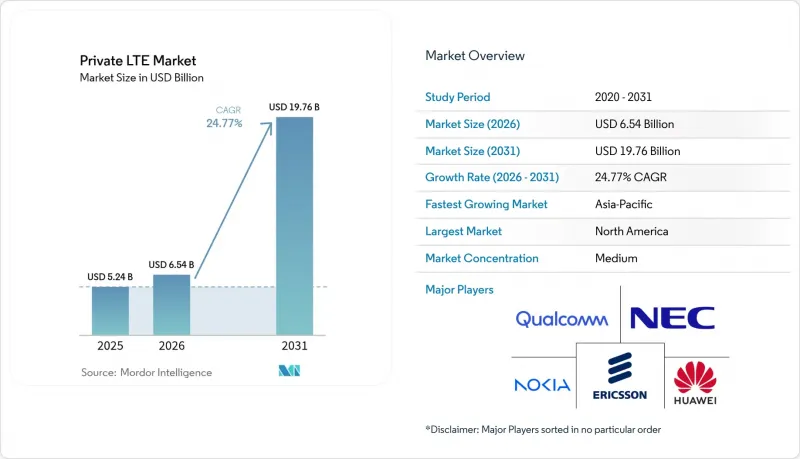
根據 Mordor Intelligence 預測,私有 LTE 市場規模將從 2025 年的 52.4 億美元成長到 2026 年的 65.4 億美元,到 2031 年將達到 197.6 億美元,2026 年至 2031 年的複合年成長率為 24.77%。
本報告按組件(基礎設施、服務)、技術(頻分雙工 (FDD)、時分雙工 (TDD))、部署模式(集中式 (C-RAN)、分散式)、終端用戶產業(製造業、能源和公共產業、其他)以及地區進行細分。市場預測以美元 (USD) 為單位。
全球專用LTE市場趨勢與洞察
頻段自由化正在推動企業採用率的激增。
主要亮點
- 監管機構正在重新分配中頻段頻率,使企業能夠以前所未有的方式,在CBRS等框架下獲得更高品質的頻段。截至2023年底,已部署約37萬個CBRS終端,凸顯了共用頻寬如何降低授權門檻,並促進網路所有權的民主化。經濟實惠且干擾可控的存取方式,為此前缺乏資源獲得獨家許可的中型企業打開了私人LTE市場的大門。除美國外,德國、日本和澳洲也在發放本地許可證,使工廠、港口和公共產業能夠建造自己的覆蓋區域。這項政策轉變正在擴大供應商生態系統,刺激小型基地台創新,並催生出一批預計在未來三年內部署私有LTE網路的新型工業設施。
工業IoT正在推動製造業的變革。
智慧工廠的部署目前依賴可靠的無線骨幹網,能夠以低於30毫秒的延遲維護數千個感測器。近79%的早期採用者表示,在部署專用LTE網路以支援自動導引運輸車(AGV)、基於擴增實境的維護和數位孿生技術後的六個月內,他們實現了投資回報(ROI)。低波動性的連接提高了生產線的平衡性和效率,從而促進了預測性維護、品質分析和工廠整體能源最佳化。隨著初始網路投入運作,製造商不斷發現新的應用場景,例如場地管理和用於保障工人安全的穿戴式設備,這在專用LTE市場形成了一種自我強化的普及曲線。
資本密集度是推廣應用的一大障礙。
部署專用LTE網路涉及無線和核心設備、容錯回程傳輸、安裝工作,以及根據地區不同而產生的頻率使用費。尤其對於中型企業而言,初始成本往往超過內部投資的損益平衡點。由於基於營運支出(OPEX)的訂閱協議能夠減輕資本支出負擔,並使支出與生產力提升保持一致,因此人們對網路即服務(NaaS)合約的興趣日益濃厚。量化諸如增強網路安全和避免停機等無形收益仍然是一項挑戰,這延長了預算週期。雖然開放式RAN硬體有可能降低單位成本,但缺乏蜂窩技術專業知識的組織可能會發現,整合相關的額外開銷會抵消這些節省。
細分市場分析
到2025年,基礎設施領域將佔專用LTE市場的62.40%,反映出企業在小型基地台、封包核心網路和傳輸設備方面投入了大量資金。然而,由於企業依賴系統整合商來避免內部技能短缺,業務收益的複合年成長率(CAGR)更快,達到17.85%。託管服務包涵蓋設計、整合和全天候運營,為工廠和公共產業提供可預測的預算,同時加快價值實現速度。雖然待開發區案對專業服務的需求依然旺盛,但持續的託管合約在新訂單中所佔比例越來越高。
儘管無線接取網路仍佔據最大的資本投資佔有率,但企業越來越重視現場核心系統,以確保強大的安全措施。將多個工廠區域連接到雲端控制面板時,升級傳輸回程傳輸至關重要。供應商目前正在推廣「網路一體化」套件,其中包含預先配置的核心網和小型基地台,可當天運作。 Pente Networks 的一款此類套件在 2025 年洛杉磯山火期間保障了緊急應變團隊的通訊。這凸顯了承包解決方案如何將專用 LTE 市場拓展到科技買家群體之外。
預計到2025年,時分雙工(TDD)將佔總營收的54.30%,維持16.55%的最高複合年成長率。視訊監控和遙測等非對稱流量非常適合TDD的動態分配,從而在有限的中頻頻道內實現吞吐量最大化。此外,TDD與CBRS頻寬分配相一致,鞏固了其作為新型專用LTE市場部署首選方案的地位。
頻分雙工 (FDD) 在對延遲敏感的控制系統中仍然佔據一定地位,因為在這些系統中,嚴格分離上行鏈路和下行鏈路至關重要。然而,現代調度器已將時分雙工 (TDD) 的抖動降低到 10 毫秒以下,縮小了先前存在的差距。隨著即將到來的 5G 版本發布,TDD 的數值規格預計將進一步完善,確保企業在向 5G NR 載波聚合過渡的過程中,目前的投資仍然有效。
區域分析
預計到2025年,北美將佔全球收入的37.50%,這主要得益於CBRS框架以及成熟的無線設備、終端機和整合商合作夥伴生態系統。截至2024年底,全球將有超過4700個專用LTE和5G網路運作,其中相當一部分集中在美國。製造業、醫療保健和公共產業領域的本地5G先導計畫將推動市場需求,而超大規模資料中心業者邊緣區域將有助於在主要大都會圈實現低延遲工作負載的卸載。
預計亞太地區在2026年至2031年間將達到12.6%的最高複合年成長率。在中國,國家支持的工廠和礦山網路正在部署;在日本,毫米波和中頻段的本地5G牌照正在發放;在韓國,園區核心網路正利用高密度光纖骨幹網路進行建設。在印度,近期頻率政策的調整使得汽車和製藥工廠的試點計畫得以進行。在澳大利亞,已有超過50個私有LTE系統投入運營,主要用於簡化偏遠地區鐵礦石和鋰的開採。根據澳洲通訊與媒體管理局(ACMA)預測,到2027年,該國市場規模預計將達到6.95億澳元。
根據GSMA的數據,歐洲在5G部署方面排名全球第二,截至2023年中期,約佔全球私有網路部署量的40%。德國3.7-3.8 GHz頻段的在地化授權正在加速製造業的部署,而英國的共用存取框架則簡化了港口和農場的授權流程。歐洲5G觀察站的報告指出,到2024年3月,73%的先導頻段將被分配,從而為工業網路建立強大的頻率基礎。沃達豐承諾在2,500個地點部署開放式無線存取網(RAN),預計將降低整個歐洲大陸的部署成本,從而間接惠及尋求承包私有LTE專案的企業客戶。
其他好處
- Excel格式的市場預測(ME)表
- 3個月的分析師支持
目錄
第1章:引言
- 研究假設和市場定義
- 調查範圍
第2章:調查方法
第3章執行摘要
第4章 市場狀況
- 市場概覽
- 市場促進因素
- 頻率頻段的放鬆管制與CBRS的商業化
- 工業IoT和工業4.0的普及
- 在惡劣環境下對關鍵任務型超可靠低延遲電路 (URLLC) 的需求。
- 向 5G SA 的無縫過渡路徑
- 本地邊緣人工智慧的頻寬需求
- 透過開放式無線接取網路(Open RAN)小型基地台生態系統降低整體擁有成本(TCO)
- 市場限制因素
- 巨額資本支出(CAPEX)和不確定的投資回報率(ROI)
- 綜合人員短缺
- 設備頻段支援碎片化
- 私人5G試點計畫導致預算蠶食
- 價值鏈分析
- 監理情勢
- 技術展望
- 波特五力分析
- 投資分析
第5章 市場規模與成長預測
- 按組件
- 基礎設施
- 無線存取網(RAN)
- 核心(EPC/5GC)
- 回程傳輸運輸
- 服務
- 專業服務
- 託管服務
- 基礎設施
- 透過技術
- 頻分雙工(FDD)
- 時分雙工(TDD)
- 按部署模式
- 集中式(C-RAN)
- 去中心化
- 頻譜
- 持牌
- 免執照頻段(MulteFire,5GHz)
- 共用(CBRS、LAA)
- 按最終用戶行業分類
- 製造業
- 能源與公共產業
- 採礦、石油和天然氣
- 運輸/物流
- 公安/國防
- 衛生保健
- 公司和校園
- 其他
- 按地區
- 北美洲
- 美國
- 加拿大
- 南美洲
- 巴西
- 阿根廷
- 其他南美國家
- 歐洲
- 德國
- 英國
- 法國
- 義大利
- 西班牙
- 其他歐洲國家
- 亞太地區
- 中國
- 日本
- 印度
- 韓國
- 其他亞太國家
- 中東和非洲
- 中東
- 阿拉伯聯合大公國
- 沙烏地阿拉伯
- 卡達
- 以色列
- 其他中東國家
- 非洲
- 南非
- 奈及利亞
- 其他非洲地區
- 中東
- 北美洲
第6章 競爭情勢
- 市場集中度
- 策略趨勢
- 市佔率分析
- 公司簡介
- Nokia
- Ericsson
- Huawei Technologies
- NEC Corp.
- Qualcomm
- Druid Software
- Sierra Wireless
- JMA Wireless
- Ruckus Networks(CommScope)
- Celona
- Airspan Networks
- Cisco Systems
- ZTE Corp.
- Samsung Electronics
- Airspan Networks
- Athonet(HPE)
- Motorola Solutions
- Mavenir Systems
- Amazon AWS Private 5G
- Verizon Business
- General Dynamics Mission Systems
第7章 市場機會與未來展望
According to Mordor Intelligence, the private LTE market size is expected to grow from USD 5.24 billion in 2025 to USD 6.54 billion in 2026 and is forecast to reach USD 19.76 billion by 2031 at 24.77% CAGR over 2026-2031.
This report is Segmented by Component (Infrastructure and Services), Technology (Frequency-Division Duplexing (FDD) and Time Division Duplex (TDD)), Deployment Model (Centralized (C-RAN), Distributed), End-User Industry (Industrial (Manufacturing, Energy and Utilities, Mining and Oil and Gas), and More), and Geography. The Market Forecasts are Provided in Terms of Value (USD).
Global Private LTE Market Trends and Insights
Spectrum Liberalization Unlocks Enterprise Deployment Surge
Key Highlights
- Regulators are reallocating mid-band frequencies, giving enterprises unprecedented access to high-quality spectrum under frameworks such as CBRS. Around 370,000 CBRS devices had been deployed by end-2023, underscoring how shared bands reduce licensing hurdles and democratize network ownership.Affordable, interference-managed access has opened the private LTE market to mid-sized firms that previously lacked resources for exclusive licences. Beyond the United States, Germany, Japan, and Australia have issued local licences that let factories, ports, and utilities implement bespoke coverage footprints. The policy shift is expanding vendor ecosystems, stimulating small-cell innovation, and creating a pipeline of new industrial sites expected to deploy private LTE networks over the next three years.
Industrial IoT Drives Manufacturing Transformation
Smart-factory rollouts now hinge on reliable wireless backbones capable of sustaining thousands of sensors with latencies below 30 ms. Nearly 79% of early adopters said they achieved positive ROI within six months after installing private LTE to support automated guided vehicles, AR-assisted maintenance, and digital twins. Low-variance connectivity improves line-balance efficiency, which in turn drives predictive maintenance, quality analytics, and plant-wide energy optimisation. Manufacturers consistently discover incremental use cases, such as yard management and worker-safety wearables, once the initial network is live, creating a self-reinforcing adoption curve inside the private LTE market.
Capital Intensity Creates Adoption Barriers
Private LTE deployments involve radio and core equipment, resilient backhaul, site works and, in some regions, spectrum fees. Upfront costs often exceed internal hurdle rates, especially for mid-tier firms. Interest in network-as-a-service contracts is rising because OPEX subscriptions reduce capital shock and match spending to productivity gains. Quantifying intangible benefits such as cyber-hardening and downtime avoidance remains challenging, prolonging budget cycles. Open RAN hardware promises lower unit prices, yet integration overheads can erase savings for organisations lacking cellular expertise.
Other drivers and restraints analyzed in the detailed report include:
- Mission-Critical Communications Enable Remote Operations
- Seamless Migration Path Toward 5G SA
- Integration Complexity Slows Implementation Velocity
For complete list of drivers and restraints, kindly check the Table Of Contents.
Segment Analysis
The infrastructure segment held 62.40% of the private LTE market in 2025, reflecting heavy spending on small cells, packet cores, and transport gear. Yet, services revenue is rising faster at a 17.85% CAGR because organisations lean on system integrators to sidestep internal skills shortages. Managed offerings bundle design, integration, and 24/7 operations, giving factories and utilities predictable budgets while accelerating time-to-value. Professional services demand remains high during greenfield projects, but recurring managed contracts are capturing a larger share of new bookings.
Radio access networks still account for the biggest slice of capital, though enterprises increasingly emphasise onsite core systems to enforce security policies. Transport backhaul upgrades are non-negotiable when connecting multiple plant zones to cloud dashboards. Vendors now promote "network-in-a-box" kits-pre-configured core plus small cells-capable of same-day activation. One such kit from Pente Networks maintained communications for emergency crews during the 2025 Los Angeles wildfires, highlighting how turnkey packaging broadens the private LTE market beyond technically-savvy buyers.
Time-division duplexing captured 54.30% of revenue in 2025 and is projected to sustain the highest 16.55% CAGR. Asymmetric traffic in video surveillance and telemetry favours TDD's dynamic allocation, maximising throughput within scarce mid-band channels. TDD also aligns with CBRS band allocations, reinforcing its position as the default in new private LTE market deployments.
Frequency-division duplexing retains a foothold in latency-sensitive control systems where strict separation of uplink and downlink is prized. However, modern schedulers reduce TDD jitter to sub-10 ms, narrowing the historical gap. Upcoming 5G releases will further refine TDD numerologies, assuring enterprises that today's investment will remain relevant once they transition to 5G NR carrier aggregation.
Complete Report Scope:
- By Component
- Infrastructure
- Radio Access (RAN)
- Core (EPC/5GC)
- Backhaul and Transport
- Services
- Professional Services
- Managed Services
- Infrastructure
- By Technology
- Frequency-Division Duplexing (FDD)
- Time-Division Duplexing (TDD)
- By Deployment Model
- Centralised (C-RAN)
- Distributed
- By Spectrum
- Licensed
- Unlicensed (MulteFire, 5 GHz)
- Shared (CBRS, LAA)
- By End-user Industry
- Manufacturing
- Energy and Utilities
- Mining and Oil and Gas
- Transportation and Logistics
- Public Safety and Defense
- Healthcare
- Enterprise / Campuses
- Others
- By Geography
- North America
- United States
- Canada
- South America
- Brazil
- Argentina
- Rest of South America
- Europe
- Germany
- United Kingdom
- France
- Italy
- Spain
- Rest of Europe
- Asia Pacific
- China
- Japan
- India
- South Korea
- Rest of Asia Pacific
- Middle East and Africa
- Middle East
- United Arab Emirates
- Saudi Arabia
- Qatar
- Israel
- Rest of Middle East
- Africa
- South Africa
- Nigeria
- Rest of Africa
- Middle East
- North America
Geography Analysis
North America led with 37.50% of 2025 revenue thanks to the CBRS framework and a mature ecosystem of radio, device, and integrator partners. More than 4,700 private LTE and 5G networks were operational worldwide by end-2024, and a substantial share was in the United States. Local 5G pilots in manufacturing, healthcare, and utilities amplify demand, while hyperscaler edge zones make low-latency workload offload straightforward across major metros.
Asia-Pacific records the fastest 12.6% CAGR from 2026 to 2031. China deploys state-backed factory and mine networks, Japan issues local 5G licences in millimetre and mid-bands, and South Korea capitalises on its dense fibre backbone to host campus cores. India's recent spectrum policy changes have unlocked trials in automotive and pharmaceutical plants. Australia already operates more than 50 private LTE systems, primarily to streamline remote-area iron ore and lithium extraction, and its market is forecast to hit AUD 695 million by 2027, according to ACMA.
Europe ranks second in deployment count, holding roughly 40% of global private installations by mid-2023, according to GSMA. Germany's 3.7-3.8 GHz local licences spur manufacturing adoption; the United Kingdom's Shared Access framework simplifies licences for ports and farms. The European 5G Observatory reports that 73% of pioneer bands were assigned by March 2024, forming a solid spectral foundation for industrial networks. Vodafone's pledge to roll out open RAN on 2,500 sites is expected to reduce equipment costs across Continental Europe, indirectly benefiting enterprise buyers seeking turnkey private LTE projects.
- Nokia
- Ericsson
- Huawei Technologies
- NEC Corp.
- Qualcomm
- Druid Software
- Sierra Wireless
- JMA Wireless
- Ruckus Networks (CommScope)
- Celona
- Airspan Networks
- Cisco Systems
- ZTE Corp.
- Samsung Electronics
- Airspan Networks
- Athonet (HPE)
- Motorola Solutions
- Mavenir Systems
- Amazon AWS Private 5G
- Verizon Business
- General Dynamics Mission Systems
Additional Benefits:
- The market estimate (ME) sheet in Excel format
- 3 months of analyst support
TABLE OF CONTENTS
1 INTRODUCTION
- 1.1 Study Assumptions and Market Definition
- 1.2 Scope of the Study
2 RESEARCH METHODOLOGY
3 EXECUTIVE SUMMARY
4 MARKET LANDSCAPE
- 4.1 Market Overview
- 4.2 Market Drivers
- 4.2.1 Spectrum liberalization and CBRS commercialization
- 4.2.2 Industrial IoT and Industry 4.0 uptake
- 4.2.3 Mission-critical URLLC demand in harsh sites
- 4.2.4 Seamless migration path toward 5G SA
- 4.2.5 On-prem edge-AI bandwidth requirements
- 4.2.6 Lower TCO via Open RAN small-cell ecosystems
- 4.3 Market Restraints
- 4.3.1 High CAPEX and uncertain ROI
- 4.3.2 Scarcity of integration talent
- 4.3.3 Fragmented device-band support
- 4.3.4 Budget cannibalisation by private 5G pilots
- 4.4 Value Chain Analysis
- 4.5 Regulatory Landscape
- 4.6 Technological Outlook
- 4.7 Porter's Five Forces Analysis
- 4.7.1 Bargaining Power of Suppliers
- 4.7.2 Bargaining Power of Buyers/Consumers
- 4.7.3 Threat of New Entrants
- 4.7.4 Threat of Substitutes
- 4.7.5 Intensity of Competitive Rivalry
- 4.8 Investment Analysis
5 MARKET SIZE AND GROWTH FORECASTS (VALUE)
- 5.1 By Component
- 5.1.1 Infrastructure
- 5.1.1.1 Radio Access (RAN)
- 5.1.1.2 Core (EPC/5GC)
- 5.1.1.3 Backhaul and Transport
- 5.1.2 Services
- 5.1.2.1 Professional Services
- 5.1.2.2 Managed Services
- 5.1.1 Infrastructure
- 5.2 By Technology
- 5.2.1 Frequency-Division Duplexing (FDD)
- 5.2.2 Time-Division Duplexing (TDD)
- 5.3 By Deployment Model
- 5.3.1 Centralised (C-RAN)
- 5.3.2 Distributed
- 5.4 By Spectrum
- 5.4.1 Licensed
- 5.4.2 Unlicensed (MulteFire, 5 GHz)
- 5.4.3 Shared (CBRS, LAA)
- 5.5 By End-user Industry
- 5.5.1 Manufacturing
- 5.5.2 Energy and Utilities
- 5.5.3 Mining and Oil and Gas
- 5.5.4 Transportation and Logistics
- 5.5.5 Public Safety and Defense
- 5.5.6 Healthcare
- 5.5.7 Enterprise / Campuses
- 5.5.8 Others
- 5.6 By Geography
- 5.6.1 North America
- 5.6.1.1 United States
- 5.6.1.2 Canada
- 5.6.2 South America
- 5.6.2.1 Brazil
- 5.6.2.2 Argentina
- 5.6.2.3 Rest of South America
- 5.6.3 Europe
- 5.6.3.1 Germany
- 5.6.3.2 United Kingdom
- 5.6.3.3 France
- 5.6.3.4 Italy
- 5.6.3.5 Spain
- 5.6.3.6 Rest of Europe
- 5.6.4 Asia Pacific
- 5.6.4.1 China
- 5.6.4.2 Japan
- 5.6.4.3 India
- 5.6.4.4 South Korea
- 5.6.4.5 Rest of Asia Pacific
- 5.6.5 Middle East and Africa
- 5.6.5.1 Middle East
- 5.6.5.1.1 United Arab Emirates
- 5.6.5.1.2 Saudi Arabia
- 5.6.5.1.3 Qatar
- 5.6.5.1.4 Israel
- 5.6.5.1.5 Rest of Middle East
- 5.6.5.2 Africa
- 5.6.5.2.1 South Africa
- 5.6.5.2.2 Nigeria
- 5.6.5.2.3 Rest of Africa
- 5.6.5.1 Middle East
- 5.6.1 North America
6 COMPETITIVE LANDSCAPE
- 6.1 Market Concentration
- 6.2 Strategic Moves
- 6.3 Market Share Analysis
- 6.4 Company Profiles (includes Global level Overview, Market level overview, Core Segments, Financials as available, Strategic Information, Market Rank/Share for key companies, Products and Services, and Recent Developments)
- 6.4.1 Nokia
- 6.4.2 Ericsson
- 6.4.3 Huawei Technologies
- 6.4.4 NEC Corp.
- 6.4.5 Qualcomm
- 6.4.6 Druid Software
- 6.4.7 Sierra Wireless
- 6.4.8 JMA Wireless
- 6.4.9 Ruckus Networks (CommScope)
- 6.4.10 Celona
- 6.4.11 Airspan Networks
- 6.4.12 Cisco Systems
- 6.4.13 ZTE Corp.
- 6.4.14 Samsung Electronics
- 6.4.15 Airspan Networks
- 6.4.16 Athonet (HPE)
- 6.4.17 Motorola Solutions
- 6.4.18 Mavenir Systems
- 6.4.19 Amazon AWS Private 5G
- 6.4.20 Verizon Business
- 6.4.21 General Dynamics Mission Systems
7 MARKET OPPORTUNITIES AND FUTURE OUTLOOK
- 7.1 White-space and Unmet-need Assessment

 全球專用LTE市場規模、佔有率、趨勢和成長分析報告(2026-2034年)
 專用LTE市場規模、佔有率、趨勢和預測:按組件、技術、頻段、部署模式、產業和地區分類,2026-2034年
 2026年全球專用LTE市場報告
 專用LTE市場分析及預測(至2035年):依類型、產品類型、服務、技術、組件、應用、部署類型、最終用戶、解決方案及模式分類
 2026-2030年全球專用LTE市場日本專用LTE市場報告(依組件、技術、頻段、部署模式、產業垂直領域及地區分類,2026-2034年)
 私有LTE市場規模、佔有率和成長分析(按組件、頻段、技術、部署模式、最終用戶和地區分類)-2026-2033年產業預測
 專用LTE市場機會、成長促進因素、產業趨勢分析及預測(2026-2035年)
 私有LTE及5G網路生態系(2025-2030)-機會、挑戰、策略、產業及預測
 全球專用LTE市場-產業規模、佔有率、趨勢、機會和預測,按技術(FDD和TDD)、應用(公共安全、物流與供應鏈管理以及資產管理)、地區和競爭格局分類,2020-2030年預測