

 |
市場調查報告書
商品編碼
2122989
邊緣運算:市場佔有率分析、產業趨勢與統計及成長預測(2026-2031 年)Edge Computing - Market Share Analysis, Industry Trends & Statistics, Growth Forecasts (2026 - 2031) |
||||||

※ 本網頁內容可能與最新版本有所差異。詳細情況請與我們聯繫。
根據 Mordor Intelligence 預測,邊緣運算市場規模預計將在 2026 年達到 2,577.6 億美元,到 2031 年達到 4,799.7 億美元,複合年成長率為 13.24%。
這凸顯了向分散式處理架構的決定性轉變,這種架構最大限度地減少了往返延遲,並符合新的資料主權法規。
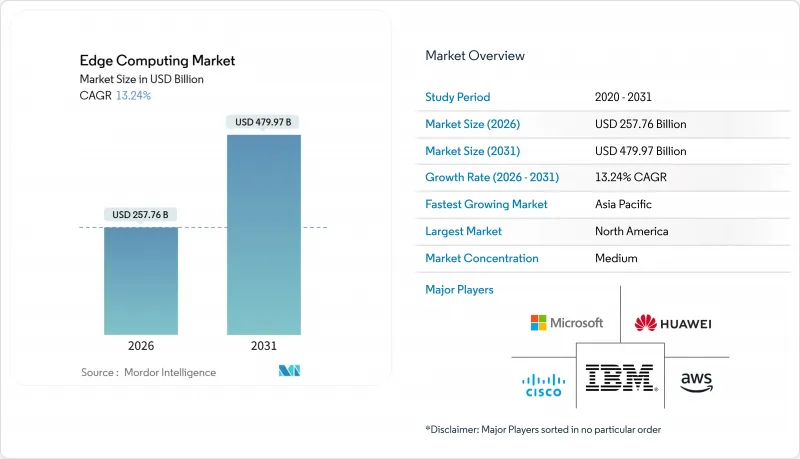
5G獨立組網的部署、跨司法管轄區的強制性資料在地化以及人工智慧終端的爆炸性成長,正推動網路邊緣的需求。同時,ASIC和系統晶片價格的下降降低了本地推理處理的進入門檻。本報告按組件(硬體、軟體、服務)、部署模式(本地部署、雲端部署)、終端用戶產業(能源與公共產業、其他)、應用程式(影像分析與監控、自動駕駛汽車與無人機、其他)、組織規模(大型企業、中小企業)和地區進行細分。市場預測以美元計價。
全球邊緣運算市場趨勢與洞察
透過 5G 部署推廣超低延遲應用場景
獨立的5G核心網路目前正將流量導向基地台的微型資料中心,從而將往返延遲降低到10毫秒以下。到2025年中期,亞洲營運商將部署180萬個支援邊緣運算的5G基地台,從而支援工廠自動化和遠端手術先導計畫。然而,在歐洲,儘管無線覆蓋率很高,但多接取邊緣運算的普及率有限,且普及速度緩慢,因為許多業者仍依賴4G核心網路。 3.5GHz頻段授權現在包含邊緣託管條款,鼓勵營運商將無線設備和運算資源部署在同一位置。供應商正在將編配軟體與無線設備捆綁在一起,使企業能夠透過熟悉的雲端API部署容器化工作負載。這使得5G成為行動、遊戲和工業控制等領域超可靠、低延遲邊緣應用的主要部署管道。
物聯網終端數量的激增和邊緣資料引力
到2025年,企業物聯網連線數將超過190億,產生Exabyte的遙測數據,將使回程傳輸線路飽和,並推高數據傳輸成本。目前,單一汽車工廠每天產生Terabyte的資料流,但其中只有一小部分資料值得長期存儲,分析處理正逐漸轉移到現場閘道器。邊緣處理降低了雲端使用成本,強化了控制迴路,並將設備運轉率提高了兩位數。此外,IEC 62443安全指南要求進行本地異常檢測,以保護操作技術(OT)免受網路故障的影響。隨著人工智慧模型被整合到瓦級晶片上,企業發送的是分析結果而非原始數據,這進一步加速了數據在邊緣位置聚合的趨勢。這一趨勢正在將預算從中央伺服器重新分配到更具環境適應性的節點和車隊管理軟體上。
擴大分散式節點中的網路攻擊面
每增加一個邊緣閘道器,就會產生一個新的入口點,而 Mirai 的變種病毒已經開始利用工業控制器上的易受攻擊憑證發動 DDoS 攻擊。儘管 NIST 的網路安全框架 2.0 現在包含了針對邊緣運算的特定控制措施,但許多中小企業缺乏實施安全啟動、憑證輪替和微隔離所需的人員。韌體更新周期長達五到七年,這意味著在發現新的漏洞後,設備仍會在很長一段時間內處於易受攻擊的狀態。供應鏈指南要求使用簽名韌體,但在關鍵基礎設施之外,這項要求的實施仍然不足。保險公司已將潛在的安全漏洞風險納入保費計算,預計到 2025 年,邊緣部署的保費將上漲 12%。如果沒有自動化修復機制和更強大的安全基準,安全性問題可能會延緩邊緣運算的普及。
細分市場分析
隨著客戶將資本投資轉向營運預算,業務收益預計將超過設備銷售收入。儘管硬體在2025年仍佔邊緣運算市場的47.13%,但預計到2031年,託管服務將以13.87%的年均成長率成長,這主要得益於超大規模資料中心業者提供的配套服務,這些服務將運算、編配和安全功能整合在訂閱定價模式下。戴爾報告稱,其邊緣基礎設施收入成長了19%,服務覆蓋率達到68%,這得益於客戶對生命週期管理的需求。惠普企業(Hewlett Packard Enterprise)的「GreenLake」合約消除了容量規劃風險,並加快了部署人工智慧偵測系統的工廠實現價值的速度,因為這些合約是按工作負載收費的。由於DRAM和NAND快閃記憶體成本波動,硬體持續商品化,原始設計製造商(ODM)之間的競爭壓低了伺服器的平均售價(ASP),促使供應商專注於軟體差異化和專業服務。
包括精簡版 Kubernetes 發行版和最終一致性資料庫在內的邊緣原生軟體預計到 2031 年將以 13.45% 的速度成長。 Red Hat OpenShift 和 SUSE Rancher 正在爭奪企業控制平面的主導,而開放原始碼的K3s 則在資源受限的部署環境中不斷擴大市場佔有率。像 Capgemini Engineering 這樣的系統整合商在 2024 年的 OT 邊緣相關交易量成長了 34%,這反映出市場對將現場流程轉換為微服務架構的專業知識的需求。總體而言,服務正在將一次性利潤轉化為多年現金流,為供應商即使在硬體邊際利潤趨於穩定後也能獲取長期價值奠定了基礎。
到 2025 年,雲端連接系統將佔邊緣運算市場 58.19% 的佔有率,預計到 2031 年將以 13.61% 的複合年成長率成長,這主要得益於 AWS Wavelength、Azure Edge Zones 和 Google Distributed Cloud超大規模資料中心業者API 引入營運商設施。這些服務無需專有邊緣 SDK 即可實現亞毫秒延遲,從而減輕了開發人員的負擔。微軟正在將 Azure Edge Zones 擴展到 47 個都會區,並公開推廣從雲端到工廠車間的單一控制平面管理。
在嚴格監管的行業中,外部資料傳輸被禁止(例如藥品批記錄、PCI-DSS 卡資料、安全關鍵型自動化系統等),當地部門仍然普遍存在。然而,即使在這些領域,越來越多的組織也開始採用雲端原生編配,以避免工具鏈不一致的問題。混合拓撲結構將位於企業防火牆後的閘道器硬體與雲端管理的配置結合,從而在資料位置要求和維運敏捷性之間取得平衡。歐盟資料法中的資料可攜性條款正在加速這一趨勢。由於企業必須證明其已做好切換準備,因此開放的 Kubernetes 正在成為比專有邊緣堆疊更受歡迎的選擇。
區域分析
受超大規模資料中心業者以及Verizon和AT&T率先推出獨立網路5G服務的推動,北美地區預計在2025年將佔全球5G支出的33.91%。光是在美國,就有108個AWS Wavelength可用區和23個Azure Edge可用區運作,為全美各地的開發者提供低延遲的終端節點。在加拿大,貝爾和Telus正在部署多接取邊緣運算,以支援資源開採點的工業IoT;而在墨西哥,工廠正在T-MEC協議引入的近岸外包激勵措施下部署邊緣品質檢測技術。
亞太地區預計到2031年將以14.21%的複合年成長率成長,這主要得益於中國移動180萬個支援邊緣運算的5G基地台。印度的「數位印度」舉措已選定100個智慧城市,利用邊緣技術提供市政服務。在東南亞,隨著製造業的持續轉移,邊緣技術的應用也正在加速發展。日本NTT Docomo和韓國SK Telecom正在將邊緣運算整合到自動駕駛汽車試驗中。在澳大利亞,邊緣運算正被應用於回程傳輸能力有限的偏遠礦區。
預計到2025年,歐洲將佔全球支出的約24%,這得益於歐盟資料法的主權要求以及已記錄的1836個節點。德國、法國和荷蘭佔了其中61%的佔有率,涵蓋汽車、金融和醫療保健等產業。沙烏地阿拉伯的NEOM和阿拉伯聯合大公國的杜拜智慧城市等大型大型企劃正在推動中東地區的需求,而南美地區的需求則主要集中在巴西的工業自動化和阿根廷的電信現代化建設。區域支出趨勢反映了政策舉措。美國的《晶片與科學法案》正在向該國半導體產業投資520億美元,而歐盟的「數位十年」計畫旨在2030年安裝1萬個節點,從而確保永續的資本投資管道。
其他好處
- Excel格式的市場預測(ME)表
- 3個月的分析師支持
目錄
第1章:引言
- 研究假設和市場定義
- 調查範圍
第2章:調查方法
第3章執行摘要
第4章 市場狀況
- 市場概覽
- 市場促進因素
- 透過 5G 部署推廣超低延遲應用場景
- 物聯網終端數量的激增和邊緣資料引力
- 關於資料主權的監管義務(例如,歐盟資料法)
- 降低邊緣推理加速器專用積體電路/系統單晶片的成本。
- 能源效率目標推動微型資料中心發展(ESG)
- RISC-V晶片架構的興起使得客製化邊緣晶片的實現成為可能。
- 市場限制因素
- 擴大分散式節點中的網路攻擊面
- 異質邊緣堆疊部署和管理的技能差距
- 互通性與標準碎片化(MEC、Open-RAN、LF Edge)
- 現有工業設施維修的投資報酬率低
- 產業價值鏈分析
- 監理情勢
- 技術展望
- 波特五力分析
- 宏觀經濟因素對市場的影響
第5章 市場規模與成長預測
- 按組件
- 硬體
- 軟體
- 服務
- 部署模式
- 現場
- 雲
- 按最終用戶行業分類
- 製造業和工業
- 能源與公共產業
- 醫療保健和生命科學
- 零售與電子商務
- 銀行、金融服務和保險(BFSI)
- 通訊/IT
- 其他
- 透過使用
- 工業IoT(IIoT) 和預測性維護
- 影像分析和監控
- 自動駕駛汽車和無人機
- 其他
- 按組織規模
- 大公司
- 小型企業
- 按地區
- 北美洲
- 美國
- 加拿大
- 墨西哥
- 歐洲
- 德國
- 英國
- 法國
- 俄羅斯
- 其他歐洲國家
- 亞太地區
- 中國
- 日本
- 印度
- 韓國
- 澳洲
- 其他亞太國家
- 中東和非洲
- 中東
- 沙烏地阿拉伯
- 阿拉伯聯合大公國
- 其他中東國家
- 非洲
- 南非
- 埃及
- 其他非洲地區
- 中東
- 南美洲
- 巴西
- 阿根廷
- 南美洲其他地區
- 北美洲
第6章 競爭情勢
- 市場集中度
- 策略趨勢
- 市佔率分析
- 公司簡介
- Amazon Web Services, Inc.
- Microsoft Corporation
- Cisco Systems Inc.
- Huawei Technologies Co. Ltd.
- IBM Corporation
- Hewlett Packard Enterprise(HPE)
- Dell Technologies Inc.
- Google LLC(Alphabet Inc.)
- Intel Corporation
- NVIDIA Corporation
- Juniper Networks Inc.
- Advantech Co. Ltd.
- ADLINK Technology Inc.
- Schneider Electric SE
- Siemens AG
- Capgemini Engineering
- MachineShop Inc.
- Vapor IO Inc.
- Litmus Automation
- FogHorn Systems
- Lumen Technologies Inc.
第7章 市場機會與未來展望
According to Mordor Intelligence, the edge computing market size reached USD 257.76 billion in 2026 and is projected to advance to USD 479.97 billion by 2031 at a 13.24% CAGR, underscoring a decisive pivot toward distributed processing architectures that minimize round-trip latency and comply with emerging data-sovereignty rules.
5G standalone roll-outs, jurisdictional data-localization mandates, and an explosion of AI-enabled endpoints concentrate demand at the network perimeter, while declining ASIC and system-on-chip prices lower the entry barrier for on-premise inference. This report is Segmented by Component (Hardware, Software, Services), Deployment Mode (On-Premise, and Cloud), End-User Industry (Energy and Utilities, and More), Application (Video Analytics and Surveillance, Autonomous Vehicles and Drones, and More), Organisation Size (Large Enterprises, and Small and Medium Enterprises), and Geography. The Market Forecasts are Provided in Terms of Value (USD).
Global Edge Computing Market Trends and Insights
5G Roll-Out Catalysing Ultra-Low-Latency Use-Cases
Standalone 5G cores now steer traffic to base-station micro data centers, trimming round-trip latency below 10 milliseconds. Asian operators had installed 1.8 million edge-enabled 5G sites by mid-2025, enabling factory automation and remote-surgery pilots. Europe shows slower uptake because many carriers still depend on 4G cores, limiting multi-access edge compute despite high radio coverage. Spectrum licenses in the 3.5 GHz band now include edge-hosting clauses, pushing telcos to colocate compute with radios. Equipment vendors bundle orchestration software with radios, letting enterprises deploy container workloads through familiar cloud APIs. These conditions make 5G the primary on-ramp for ultra-reliable low-latency edge applications across mobility, gaming, and industrial control.
Proliferation of IoT Endpoints and Data Gravity at the Edge
Enterprise IoT connections exceeded 19 billion in 2025, producing exabyte-scale telemetry that swamps backhaul links and raises egress fees. A single automotive plant now streams terabytes daily, yet only a fraction of that data merits long-term storage, pushing analytics to on-site gateways. Edge processing lowers cloud bills and tightens control loops, boosting equipment uptime by double-digit percentages. IEC 62443 security guidelines further mandate local anomaly detection to shield operational technology from network faults. As AI models compress onto watt-scale chips, companies ship insights rather than raw data, reinforcing the gravity of the pull toward edge locations. This dynamic reallocates budget from central servers to ruggedized nodes and fleet-management software.
Cyber-Attack Surface Expansion at Distributed Nodes
Each edge gateway adds another ingress point, and Mirai variants already exploit weak credentials on industrial controllers for DDoS campaigns. NIST's Cybersecurity Framework 2.0 now includes edge-specific controls, yet many SMEs lack the staff to implement secure boot, certificate rotation, and microsegmentation. Firmware refresh cycles stretch five to seven years, leaving devices exposed long after new vulnerabilities appear. Supply-chain directives require signed firmware, but enforcement outside critical infrastructure sectors remains patchy. Insurance premiums for edge deployments climbed 12% in 2025 as carriers priced in the likelihood of breaches. Without automated remediation and stronger baseline hardening, security fears could deter late adopters.
Other drivers and restraints analyzed in the detailed report include:
- Regulatory Data-Sovereignty Mandates (EU Data Act)
- Declining ASIC/SoC Costs for Edge Inference Accelerators
- Skills Gap in Deploying and Managing Heterogeneous Edge Stacks
For complete list of drivers and restraints, kindly check the Table Of Contents.
Segment Analysis
Services revenue is on track to eclipse appliance sales as customers shift capital outlays into operational budgets. In 2025, hardware still accounted for 47.13% of the edge computing market, yet managed services are forecast to grow at 13.87% annually through 2031, supported by hyperscaler bundles that fuse compute, orchestration, and security under subscription pricing. Dell noted a 19% jump in edge-infrastructure revenue, but its services attach rate hit 68% as clients demanded lifecycle management. Hewlett Packard Enterprise's GreenLake contracts, billed per workload, eliminate capacity-planning risk and improve time-to-value for factories retrofitting AI inspection. Hardware commoditization persists as DRAM and NAND costs fluctuate; ODM rivalry tempers server ASPs, prompting vendors to focus on software differentiation and professional services.
Edge-native software, including slim Kubernetes distributions and eventually consistent databases, grows at 13.45% through 2031. Red Hat OpenShift and SUSE Rancher square off for enterprise control-plane dominance, while open-source K3s captures resource-constrained deployments. System integrators such as Capgemini Engineering saw OT-edge engagements rise 34% in 2024, reflecting demand for domain expertise to translate shop-floor processes into microservice architectures. Overall, services convert one-time margin into multiyear cash flows, positioning vendors to capture long-run value once hardware marginal gains plateau.
Cloud-connected installations commanded 58.19% of the edge computing market share in 2025 and will expand at a 13.61% CAGR through 2031 as AWS Wavelength, Azure Edge Zones, and Google Distributed Cloud push hyperscaler APIs into carrier facilities. These offerings deliver sub-10-millisecond latency without demanding proprietary edge SDKs, lowering developer friction. Microsoft expanded Azure Edge Zones to 47 metro areas and publicly promotes single-control-plane management from the cloud to the factory floor.
On-premise deployments persist in regulated verticals that bar external data transit - pharma batch records, PCI-DSS card data, and safety-critical automation. Even there, organizations increasingly adopt cloud-native orchestration to avoid divergent toolchains. Hybrid topologies blend gateway hardware installed behind corporate firewalls with cloud-managed configuration, striking a balance between data residency and operational agility. EU Data Act portability clauses accelerate this pattern because enterprises must demonstrate switching readiness, favoring open Kubernetes over proprietary edge stacks.
Complete Report Scope:
- By Component
- Hardware
- Software
- Services
- By Deployment Mode
- On-Premise
- Cloud
- By End-User Industry
- Manufacturing and Industrial
- Energy and Utilities
- Healthcare and Life Sciences
- Retail and E-Commerce
- Banking, Financial Services, and Insurance (BFSI)
- Telecommunications and IT
- Other End-User Industries
- By Application
- Industrial IoT and Predictive Maintenance
- Video Analytics and Surveillance
- Autonomous Vehicles and Drones
- Other Applications
- By Organisation Size
- Large Enterprises
- Small and Medium Enterprises
- By Geography
- North America
- United States
- Canada
- Mexico
- Europe
- Germany
- United Kingdom
- France
- Russia
- Rest of Europe
- Asia-Pacific
- China
- Japan
- India
- South Korea
- Australia
- Rest of Asia-Pacific
- Middle East and Africa
- Middle East
- Saudi Arabia
- United Arab Emirates
- Rest of Middle East
- Africa
- South Africa
- Egypt
- Rest of Africa
- Middle East
- South America
- Brazil
- Argentina
- Rest of South America
- North America
Geography Analysis
North America commanded 33.91% of 2025 spending, anchored by hyperscaler footprints and early standalone 5G launches from Verizon and AT&T. The United States alone hosts 108 AWS Wavelength zones and 23 Azure Edge Zones, giving developers nationwide low-latency endpoints. Canada's Bell and Telus added multi-access edge compute to support industrial IoT across resource-extraction sites, while Mexican factories deploy edge quality inspection under nearshoring incentives introduced by the T-MEC accord.
Asia-Pacific is forecast to expand at a 14.21% CAGR through 2031, driven by China Mobile's 1.8 million edge-enabled 5G base stations. India's Digital India initiative earmarked 100 smart cities for edge-powered municipal services, while Southeast Asia's manufacturing migration is accelerating local edge adoption. Japan's NTT Docomo and South Korea's SK Telecom integrate edge into autonomous vehicle pilots, while Australia exploits edge compute in remote mining where satellite backhaul is constrained.
Europe held roughly 24% of global spend in 2025, buoyed by the EU Data Act's sovereignty requirements and 1,836 documented nodes. Germany, France, and the Netherlands host 61% of these installations, covering automotive, finance, and healthcare. Smart-city mega-projects in Saudi Arabia's NEOM and the UAE's Dubai Smart City spearhead Middle East demand, whereas South America clusters center on Brazilian industrial automation and Argentine telecom modernization. Regional spending profiles mirror policy commitments: the U.S. CHIPS and Science Act injects USD 52 billion into domestic semiconductors, and the EU Digital Decade targets 10,000 nodes by 2030, ensuring sustained capex pipelines.
- Amazon Web Services, Inc.
- Microsoft Corporation
- Cisco Systems Inc.
- Huawei Technologies Co. Ltd.
- IBM Corporation
- Hewlett Packard Enterprise (HPE)
- Dell Technologies Inc.
- Google LLC (Alphabet Inc.)
- Intel Corporation
- NVIDIA Corporation
- Juniper Networks Inc.
- Advantech Co. Ltd.
- ADLINK Technology Inc.
- Schneider Electric SE
- Siemens AG
- Capgemini Engineering
- MachineShop Inc.
- Vapor IO Inc.
- Litmus Automation
- FogHorn Systems
- Lumen Technologies Inc.
Additional Benefits:
- The market estimate (ME) sheet in Excel format
- 3 months of analyst support
TABLE OF CONTENTS
1 INTRODUCTION
- 1.1 Study Assumptions and Market Definition
- 1.2 Scope of the Study
2 RESEARCH METHODOLOGY
3 EXECUTIVE SUMMARY
4 MARKET LANDSCAPE
- 4.1 Market Overview
- 4.2 Market Drivers
- 4.2.1 5G Roll-Out Catalysing Ultra-Low-Latency Use-Cases
- 4.2.2 Proliferation of IoT Endpoints and Data Gravity at the Edge
- 4.2.3 Regulatory Data-Sovereignty Mandates (e.g., EU Data Act)
- 4.2.4 Declining ASIC/SoC Costs for Edge Inference Accelerators
- 4.2.5 Energy-Efficiency Targets Driving Micro-Data-Centres (ESG)
- 4.2.6 Rise of RISC-V and Chiplet Architectures Enabling Custom Edge Silicon
- 4.3 Market Restraints
- 4.3.1 Cyber-Attack Surface Expansion at Distributed Nodes
- 4.3.2 Skills Gap in Deploying and Managing Heterogeneous Edge Stacks
- 4.3.3 Inter-Operability and Standards Fragmentation (MEC, Open-RAN, LF Edge)
- 4.3.4 Inefficient ROI for Brown-Field Industrial Retro-Fits
- 4.4 Industry Value Chain Analysis
- 4.5 Regulatory Landscape
- 4.6 Technological Outlook
- 4.7 Porter's Five Forces Analysis
- 4.7.1 Bargaining Power of Suppliers
- 4.7.2 Bargaining Power of Buyers
- 4.7.3 Threat of New Entrants
- 4.7.4 Threat of Substitutes
- 4.7.5 Intensity of Competitive Rivalry
- 4.8 Impact of Macroeconomic Factors on the Market
5 MARKET SIZE AND GROWTH FORECASTS (VALUE)
- 5.1 By Component
- 5.1.1 Hardware
- 5.1.2 Software
- 5.1.3 Services
- 5.2 By Deployment Mode
- 5.2.1 On-Premise
- 5.2.2 Cloud
- 5.3 By End-User Industry
- 5.3.1 Manufacturing and Industrial
- 5.3.2 Energy and Utilities
- 5.3.3 Healthcare and Life Sciences
- 5.3.4 Retail and E-Commerce
- 5.3.5 Banking, Financial Services, and Insurance (BFSI)
- 5.3.6 Telecommunications and IT
- 5.3.7 Other End-User Industries
- 5.4 By Application
- 5.4.1 Industrial IoT and Predictive Maintenance
- 5.4.2 Video Analytics and Surveillance
- 5.4.3 Autonomous Vehicles and Drones
- 5.4.4 Other Applications
- 5.5 By Organisation Size
- 5.5.1 Large Enterprises
- 5.5.2 Small and Medium Enterprises
- 5.6 By Geography
- 5.6.1 North America
- 5.6.1.1 United States
- 5.6.1.2 Canada
- 5.6.1.3 Mexico
- 5.6.2 Europe
- 5.6.2.1 Germany
- 5.6.2.2 United Kingdom
- 5.6.2.3 France
- 5.6.2.4 Russia
- 5.6.2.5 Rest of Europe
- 5.6.3 Asia-Pacific
- 5.6.3.1 China
- 5.6.3.2 Japan
- 5.6.3.3 India
- 5.6.3.4 South Korea
- 5.6.3.5 Australia
- 5.6.3.6 Rest of Asia-Pacific
- 5.6.4 Middle East and Africa
- 5.6.4.1 Middle East
- 5.6.4.1.1 Saudi Arabia
- 5.6.4.1.2 United Arab Emirates
- 5.6.4.1.3 Rest of Middle East
- 5.6.4.2 Africa
- 5.6.4.2.1 South Africa
- 5.6.4.2.2 Egypt
- 5.6.4.2.3 Rest of Africa
- 5.6.4.1 Middle East
- 5.6.5 South America
- 5.6.5.1 Brazil
- 5.6.5.2 Argentina
- 5.6.5.3 Rest of South America
- 5.6.1 North America
6 COMPETITIVE LANDSCAPE
- 6.1 Market Concentration
- 6.2 Strategic Moves
- 6.3 Market Share Analysis
- 6.4 Company Profiles (includes Global Level Overview, Market Level Overview, Core Segments, Financials as Available, Strategic Information, Market Rank/Share for Key Companies, Products and Services, Recent Developments)
- 6.4.1 Amazon Web Services, Inc.
- 6.4.2 Microsoft Corporation
- 6.4.3 Cisco Systems Inc.
- 6.4.4 Huawei Technologies Co. Ltd.
- 6.4.5 IBM Corporation
- 6.4.6 Hewlett Packard Enterprise (HPE)
- 6.4.7 Dell Technologies Inc.
- 6.4.8 Google LLC (Alphabet Inc.)
- 6.4.9 Intel Corporation
- 6.4.10 NVIDIA Corporation
- 6.4.11 Juniper Networks Inc.
- 6.4.12 Advantech Co. Ltd.
- 6.4.13 ADLINK Technology Inc.
- 6.4.14 Schneider Electric SE
- 6.4.15 Siemens AG
- 6.4.16 Capgemini Engineering
- 6.4.17 MachineShop Inc.
- 6.4.18 Vapor IO Inc.
- 6.4.19 Litmus Automation
- 6.4.20 FogHorn Systems
- 6.4.21 Lumen Technologies Inc.
7 MARKET OPPORTUNITIES AND FUTURE OUTLOOK
- 7.1 White-Space and Unmet-Need Assessment

 工業邊緣運算:市場佔有率分析、產業趨勢與統計及成長預測(2026-2031 年)
 2026-2030年全球工業邊緣運算市場
 全球邊緣運算市場規模、佔有率、趨勢和成長分析報告(2026-2034)
 工業邊緣運算平台市場預測至2034年-按平台類型、部署模式、技術、應用、最終用戶和地區分類的全球分析網格邊緣運算市場預測至2034年—按組件、部署模式、應用、最終用戶和地區分類的全球分析
 醫療保健產業邊緣運算市場:全球市場預測(2026-2032年)人工智慧邊緣運算市場 - 全球市場預測(2026-2032年)
 全球邊緣運算市場:依產品/服務、應用、部署模式、組織規模、產業和地區分類-預測至2031年邊緣運算市場預測至2034年-全球分析(按組件、部署位置、應用、產業、最終用戶和地區分類)-產業特定分析邊緣運算市場:按元件、網路連接、部署類型、應用程式、最終用戶和組織規模分類-2026-2032年全球市場預測