


 |
市場調查報告書
商品編碼
2122944
金屬加工設備:市場佔有率分析、產業趨勢與統計、成長預測(2026-2031)Metal Fabrication Equipment - Market Share Analysis, Industry Trends & Statistics, Growth Forecasts (2026 - 2031) |
||||||

※ 本網頁內容可能與最新版本有所差異。詳細情況請與我們聯繫。
據 Mordor Intelligence 稱,2025 年金屬加工設備市值為 665.4 億美元,預計到 2031 年將達到 869.6 億美元,而 2026 年為 696.8 億美元,預測期(2026-2031 年)複合年成長率為 4.53%。
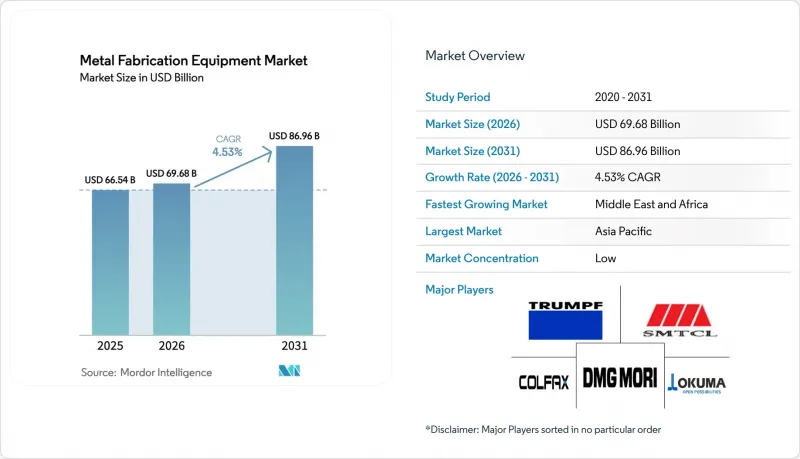
本報告按「設備類型」(機械加工、切割、焊接/連接設備、成型設備等)、「終端用戶產業」(汽車、建築、航太等)和「地區」(北美、南美、歐洲、亞太、中東和非洲)對產業進行分類。報告提供了上述所有細分市場的市場規模和預測(以美元計)。
全球金屬加工設備市場趨勢及洞察
汽車產量擴大和車型更新周期縮短
汽車製造商正將車型更新周期從七年縮短至四年以內,導致沖壓生產線、雷射切割機和機器人焊接單元等設備的升級換代更加頻繁。北美地區的電池式電動車(BEV)工廠目前每個新平台最多配備12台伺服壓力機和多套光纖雷射落料系統。一級供應商報告稱,每新增一百萬輛純電動車,大約需要240台CNC加工中心和320個機器人焊接工位。印度和東南亞國協的獎勵計畫進一步加速了高精度齒輪加工機床的訂單成長。隨著設計轉向結構性電池組,對能夠以小於±0.05毫米的重複精度成形薄鋁板的設備的需求日益成長。
建築和基礎設施投資的擴張
沙烏地阿拉伯、印度和印尼正在進行的大型企劃需要大型彎折壓床、水刀切割機和自動潛弧焊接來滿足緊迫的試運行進度。光是NEOM計畫預計到2030年就將消耗超過2600萬噸加工鋼材,因此需要具備現場鋼板成型和雷射切割能力。美國和歐洲的氣候適應型公共工程項目增加了對不銹鋼的需求,用於防洪堤和高架鐵路走廊。預製和模組化建築的興起也推動了對能夠加工150毫米厚鋼板而無需二次倒角的數控等離子切割機的訂單成長。提供整合成型、連接和檢測的承包工程單元的供應商訂單積壓量最大。
鋼鐵和非鐵金屬價格波動
2024年,熱軋鋼卷鋼價格在每噸650美元至950美元之間波動,迫使加工商每季重新談判契約,並將機器採購推遲四個多月。鋁價波動幅度高達31%,對航太和電動車電池機殼製造業的利潤率帶來壓力。銅價在2025年3月一度突破每噸1萬美元,之後開始回落,使得電氣設備製造商難以預測材料需求。由於許多歐洲服務中心將庫存減少了18%,下游切割機和折彎機械加工商的前置作業時間隨之延長。此類價格波動促使買家更傾向於選擇提供租賃或計量收費模式的設備供應商,以節省現金。
細分市場分析
預計到2025年,機械加工仍將佔據金屬加工設備市場30.56%的最大市場佔有率,凸顯其在複雜引擎缸體、渦輪盤和工業齒輪箱成型中的核心作用。市場需求集中在五軸和高扭矩水平加工中心,這類設備即使在長時間連續運作的情況下也能保持±4微米或更小的定位精度。同時,預計到2031年,切割系統將以6.78%的複合年成長率成長,成為金屬加工設備市場中成長最快的領域。功率為8千瓦或以上的光纖雷射平台在3毫米厚的低碳鋼上可實現超過每分鐘100公尺的切割速度,與等離子切割相比,其加工效率提高了40%,同時將熱影響區厚度控制在20微米以內。提供結合套料軟體和自動噴嘴更換器解決方案的供應商,能夠大幅降低材料成本,相當於150萬美元的投資。
為了滿足電池外殼和液化天然氣低溫儲罐的孔隙率要求,焊接和連接生產線正在向光纖雷射焊接和摩擦攪拌焊接流程轉型。在所有產品類別中,自動化模組(例如機器人上下料、進程內測量和視覺引導的焊接追蹤)能夠使產品脫穎而出,並為供應商在下一輪產能擴張週期中佔據有利地位。
區域分析
預計到2025年,亞太地區將佔全球銷售額的46.76%,鞏固其在金屬加工設備市場的領先地位。中國的「雙循環」政策旨在2027年實現數控系統70%的國內自給率,這推動了政府支持的國內製造商獲得大規模訂單。印度的獎勵措施已為光纖雷射切割機和伺服壓力機提供了2,590億印度盧比(約31億美元)的補貼,從日本和德國進口的設備也激增了34%。東南亞國協正受益於電子和汽車產業的外國直接投資(FDI),僅越南一國就預計在2024年吸引82億美元的投資用於金屬密集型組裝建設。
預計中東和非洲地區將錄得最高成長率,到2031年年均複合成長率將達到6.23%。沙烏地阿拉伯公共投資基金(PIF)已向NEOM計畫投資5,000億美元,用於採購本地雷射加工和鈑金軋延設備,以支持鋼鐵基礎建設。阿拉伯聯合大公國(阿拉伯聯合大公國)正在為2030年世博會後的專案推廣模組化建築技術,優先採用承包機器人焊接單元,以最大限度地減少對技術純熟勞工的需求。南非正在加速可再生能源相關產品的生產,以實現太陽能追蹤器框架和風力渦輪機塔架的在地化生產。
預計2024年北美第二波「回流」浪潮將推動企業搬遷公告數量激增78%,需求主要集中在美國中西部和墨西哥的汽車產業走廊。買家優先考慮符合IEC 62443標準的遠端監控設備,以降低勒索軟體風險。在加拿大航太叢集,對主軸轉速超過30,000轉/分的五軸加工中心的需求依然強勁。在歐洲,低碳鋼的轉型正在加速,迫使加工商採用能夠補償再生合金差異的自適應加工中心。預計2024年德國的產量將下降3.1%,但仍將保持其區域中心地位,而義大利、西班牙和波蘭則繼續透過出口導向設備生產實現成長。南美洲雖然規模較小,但巴西汽車產業對彎折壓床和焊接機器人的需求持續穩定。
其他好處:
- Excel格式的市場預測(ME)表
- 3個月的分析師支持
目錄
第1章:引言
- 研究假設和市場定義
- 調查範圍
第2章:調查方法
第3章執行摘要
第4章 市場狀況
- 市場概覽
- 市場促進因素
- 汽車產量擴大和車型更新周期縮短
- 建築和基礎設施投資的擴張
- 航太製造業需求增加
- 重工業供應鏈中的近岸外包
- 離岸風力發電機機塔架的建設
- 混合增材/減材製造單元
- 市場限制因素
- 鋼鐵原料與非鐵金屬價格的波動
- 新一代數控系統需要大量的資金投入。
- 熟練焊工和工具機員短缺
- 網路工具機的網路安全風險
- 價值供應鏈分析
- 監理情勢
- 技術展望
- 產業吸引力—五力分析
- 新進入者的威脅
- 買方的議價能力
- 供應商的議價能力
- 替代品的威脅
- 競爭公司之間的競爭
第5章 市場規模與成長預測
- 設備類型/按工藝
- 加工
- 加工中心
- 車床
- 鑽孔、研磨、搪光、拋光
- 齒輪切割盤
- 其他搬運和切割設備
- 切割
- 雷射切割
- 等離子切割
- 水刀
- 其他(鋸子、切割機等)
- 焊接和連接設備
- 電弧焊接
- 氧燃料焊接
- 雷射光束焊接
- 其他焊接方法
- 模具
- 鈑金成型(彎折壓床/彎曲、沖孔/切割槽、剪切、沖壓、輥壓成型)
- 塊狀成型(鍛造)
- 其他壓力機和金屬成型機
- 其他類型的設備(物料輸送、工件夾持、自動化等)
- 加工
- 按最終用戶行業分類
- 車
- 建造
- 航太
- 電氣和電子設備
- 工業機械/重型設備
- 造船/造船
- 鐵路
- 能源/石油和天然氣
- 其他行業(暖通空調及家用電器、金屬家具等)
- 按地區
- 北美洲
- 美國
- 加拿大
- 其他北美國家
- 南美洲
- 巴西
- 阿根廷
- 其他南美國家
- 歐洲
- 英國
- 德國
- 法國
- 義大利
- 西班牙
- 其他歐洲國家
- 亞太地區
- 中國
- 印度
- 日本
- 澳洲
- 東協(印尼、泰國、菲律賓、馬來西亞、越南)
- 其他亞太國家
- 中東和非洲
- 沙烏地阿拉伯
- 阿拉伯聯合大公國
- 土耳其
- 南非
- 其他中東和非洲國家
- 北美洲
第6章 競爭情勢
- 市場集中度
- 策略趨勢
- 市佔率分析
- 公司簡介
- Trumpf
- Amada
- DMG MORI
- Yamazaki Mazak
- Bystronic
- Shenyang Machine Tool
- Okuma
- FANUC
- Lincoln Electric
- ESAB Corp.
- Hypertherm
- Doosan Machine Tools
- Haas Automation
- Atlas Copco
- Colfax(Howden)
- Koike Aronson
- Mitsubishi Electric(MC Machinery)
- Prima Industrie
- Salvagnini
- Sandvik
第7章 市場機會與未來展望
According to Mordor Intelligence, the metal fabrication equipment market size was valued at USD 66.54 billion in 2025 and is estimated to grow from USD 69.68 billion in 2026 to reach USD 86.96 billion by 2031, at a CAGR of 4.53% during the forecast period (2026-2031).
This report Segments the Industry Into by Equipment Type (Machining, Cutting, Welding & Joining Equipment, Forming, and More), by End-User Industry (Automotive, Construction, Aerospace, and More), and by Geography (North America, South America, Europe, Asia Pacific, and the Middle East and Africa). The Report Offers Market Size and Forecasts in Value (USD) for all the Above Segments.
Global Metal Fabrication Equipment Market Trends and Insights
Growing Automotive Production & Model Refresh Cycles
Automakers are compressing model-refresh intervals from seven to under four years, driving frequent retooling of press lines, laser cutters, and robotic welding cells. North American battery-electric vehicle plants now specify up to twelve servo presses and multiple fiber-laser blanking systems for each new platform. Tier-1 suppliers report that every one million incremental battery-electric cars requires about 240 CNC machining centers and 320 robotic welding stations. Incentive programs in India and ASEAN further accelerate orders for high-precision gear-cutting machines. As designs shift toward structural battery packs, demand rises for equipment capable of forming thin-gauge aluminum with repeatability below +-0.05 millimeters.
Expanding Construction & Infrastructure Investments
Megaprojects across Saudi Arabia, India, and Indonesia necessitate heavy-duty press brakes, waterjet cutters, and automated submerged-arc welders to meet compressed commissioning schedules. NEOM alone will consume more than 26 million metric tons of fabricated steel by 2030, requiring on-site plate-forming and laser-cutting capacity. Climate-resilient public works programs in the United States and Europe add stainless-steel demand for flood barriers and elevated rail corridors. The rise of prefabricated, modular buildings also boosts orders for CNC plasma cutters that can process 150-millimeter plate without secondary beveling. Suppliers offering turnkey cells that blend forming, joining, and inspection enjoy the largest order backlogs.
Volatile Raw-Steel & Non-Ferrous Prices
Hot-rolled coil steel fluctuated between USD 650 and USD 950 per metric ton in 2024, causing fabricators to renegotiate contracts quarterly and delay machine purchases by more than four months . Aluminum tracked a 31% price swing, squeezing margins in aerospace and EV battery-enclosure work. Copper peaked above USD 10,000 per metric ton in March 2025 before easing, complicating material forecasts for electrical-equipment shops. Many European service centers cut inventories by 18%, stretching lead times for downstream cutters and brake operators. Such volatility forces buyers to favor equipment suppliers offering leasing or pay-per-use models that preserve cash.
Other drivers and restraints analyzed in the detailed report include:
- Rising Demand from Aerospace Manufacturing
- Near-Shoring of Heavy-Fabrication Supply Chains
- High Cap-Ex Requirement for Next-Gen CNC Systems
For complete list of drivers and restraints, kindly check the Table Of Contents.
Segment Analysis
Machining retained the largest 30.56% metal fabrication equipment market share in 2025, underscoring its central role in shaping complex engine blocks, turbine disks, and industrial gearboxes. Demand concentrates in five-axis and high-torque horizontal centers capable of maintaining positional accuracy below +-4 microns across extended shifts. Meanwhile, cutting systems are forecast to expand at a 6.78% CAGR to 2031, marking the highest pace within the metal fabrication equipment market. Fiber-laser platforms above 8 kW deliver cut speeds surpassing 100 meters per minute on 3-millimeter mild steel, offering a 40% throughput edge over plasma while producing heat-affected zones under 20 microns. Suppliers bundling nesting software with automatic nozzle changers provide quantifiable material savings that justify the USD 1.5 million investment.
Welding and joining lines transition toward fiber-laser and friction-stir processes to meet porosity limits in battery housings and LNG cryogenic tanks. Across all categories, automation modules such as robotic load/unload, in-process metrology, and vision-guided seam tracking differentiate offerings and position vendors for the next cycle of capacity additions.
Complete Report Scope:
- By Equipment Type / Process
- Machining
- Machining Centres
- Lathe Machines
- Drilling, Grinding, Honing & Lapping
- Gear-Cutting Machines
- Other Handling & Cutting Equipment
- Cutting
- Laser Cutting
- Plasma Cutting
- Waterjet
- Others (Sawing & Cut-off Machines, etc)
- Welding & Joining Equipment
- Arc Welding
- Oxy-fuel Welding
- Laser-Beam Welding
- Other Welding Types
- Forming
- Sheet metal forming (press brakes/bending, punching/notching, shearing, stamping, roll forming)
- Bulk forming (forging)
- Other Presses & Metal-Forming Machines
- Other Equipment Types (Material Handling, Workholding & Automation, etc.)
- Machining
- By End-user Industry
- Automotive
- Construction
- Aerospace
- Electrical & Electronics
- Industrial Machinery / Heavy Eequipment
- Shipbuilding & Marine
- Rail
- Energy / Oil & Gas
- Other Industries (HVAC & appliances, metal furniture, etc)
- By Geography
- North America
- United States
- Canada
- Rest of North America
- South America
- Brazil
- Argentina
- Rest of South America
- Europe
- United Kingdom
- Germany
- France
- Italy
- Spain
- Rest of Europe
- Asia-Pacific
- China
- India
- Japan
- Australia
- ASEAN (Indonesia, Thailand, Philippines, Malaysia, Vietnam)
- Rest of Asia-Pacific
- Middle East and Africa
- Saudi Arabia
- United Arab Emirates
- Turkey
- South Africa
- Rest of Middle East and Africa
- North America
Geography Analysis
Asia-Pacific captured 46.76% of global 2025 revenue, affirming its status as the volume leader in the metal fabrication equipment market. China's dual-circulation policy targets 70% domestic self-sufficiency in CNC systems by 2027, spurring large government-backed orders for local builders. India's incentive schemes converted INR 259 billion (USD 3.1 billion) into subsidies for fiber-laser cutters and servo presses, producing a 34% jump in equipment imports from Japan and Germany. ASEAN countries benefit from electronics and automotive FDI, with Vietnam alone attracting USD 8.2 billion in 2024 for metal-intensive assembly lines.
The Middle East and Africa region will log the fastest 6.23% CAGR through 2031. Saudi Arabia's Public Investment Fund channels USD 500 billion into NEOM, procuring on-site laser and plate-rolling assets for its steel-heavy infrastructure. The UAE expands modular construction techniques for post-Expo 2030 projects, favoring turnkey robotic welding cells that minimize skilled-labor requirements. South Africa accelerates renewable-energy fabrication to localize solar-tracker frames and wind towers.
North America's second reshoring wave produces a 78% surge in announced relocations during 2024, concentrating demand in the U.S. Midwest and Mexican automotive corridor. Buyers prioritize machines with remote monitoring compliant with IEC 62443 to mitigate ransomware risk. Canada's aerospace clusters maintain demand for five-axis machining centers with spindle speeds above 30,000 rpm. Europe transitions to low-carbon steel, pushing fabricators to adopt adaptive machining centers capable of compensating for recycled alloy variability. Germany remains the regional anchor despite a 3.1% contraction in 2024 output, while Italy, Spain, and Poland grow through export-oriented equipment production. South America remains modest in scale, yet Brazil's automotive sector sustains regular purchase cycles for press brakes and welding robots.
- Trumpf
- Amada
- DMG MORI
- Yamazaki Mazak
- Bystronic
- Shenyang Machine Tool
- Okuma
- FANUC
- Lincoln Electric
- ESAB Corp.
- Hypertherm
- Doosan Machine Tools
- Haas Automation
- Atlas Copco
- Colfax (Howden)
- Koike Aronson
- Mitsubishi Electric (MC Machinery)
- Prima Industrie
- Salvagnini
- Sandvik
Additional Benefits:
- The market estimate (ME) sheet in Excel format
- 3 months of analyst support
TABLE OF CONTENTS
1 Introduction
- 1.1 Study Assumptions & Market Definition
- 1.2 Scope of the Study
2 Research Methodology
3 Executive Summary
4 Market Landscape
- 4.1 Market Overview
- 4.2 Market Drivers
- 4.2.1 Growing automotive production & model refresh cycles
- 4.2.2 Expanding construction & infrastructure investments
- 4.2.3 Rising demand from aerospace manufacturing
- 4.2.4 Near-shoring of heavy-fabrication supply chains
- 4.2.5 Offshore wind-turbine tower build-outs
- 4.2.6 Hybrid additive-subtractive fabrication cells
- 4.3 Market Restraints
- 4.3.1 Volatile raw-steel & non-ferrous prices
- 4.3.2 High cap-ex requirement for next-gen CNC systems
- 4.3.3 Shortage of skilled welders & machinists
- 4.3.4 Cyber-security risk in connected machine tools
- 4.4 Value / Supply-Chain Analysis
- 4.5 Regulatory Landscape
- 4.6 Technological Outlook
- 4.7 Industry Attractiveness - Porter's Five Forces
- 4.7.1 Threat of New Entrants
- 4.7.2 Bargaining Power of Buyers
- 4.7.3 Bargaining Power of Suppliers
- 4.7.4 Threat of Substitutes
- 4.7.5 Intensity of Competitive Rivalry
5 Market Size & Growth Forecasts (Value, In USD Billion)
- 5.1 By Equipment Type / Process
- 5.1.1 Machining
- 5.1.1.1 Machining Centres
- 5.1.1.2 Lathe Machines
- 5.1.1.3 Drilling, Grinding, Honing & Lapping
- 5.1.1.4 Gear-Cutting Machines
- 5.1.1.5 Other Handling & Cutting Equipment
- 5.1.2 Cutting
- 5.1.2.1 Laser Cutting
- 5.1.2.2 Plasma Cutting
- 5.1.2.3 Waterjet
- 5.1.2.4 Others (Sawing & Cut-off Machines, etc)
- 5.1.3 Welding & Joining Equipment
- 5.1.3.1 Arc Welding
- 5.1.3.2 Oxy-fuel Welding
- 5.1.3.3 Laser-Beam Welding
- 5.1.3.4 Other Welding Types
- 5.1.4 Forming
- 5.1.4.1 Sheet metal forming (press brakes/bending, punching/notching, shearing, stamping, roll forming)
- 5.1.4.2 Bulk forming (forging)
- 5.1.4.3 Other Presses & Metal-Forming Machines
- 5.1.5 Other Equipment Types (Material Handling, Workholding & Automation, etc.)
- 5.1.1 Machining
- 5.2 By End-user Industry
- 5.2.1 Automotive
- 5.2.2 Construction
- 5.2.3 Aerospace
- 5.2.4 Electrical & Electronics
- 5.2.5 Industrial Machinery / Heavy Eequipment
- 5.2.6 Shipbuilding & Marine
- 5.2.7 Rail
- 5.2.8 Energy / Oil & Gas
- 5.2.9 Other Industries (HVAC & appliances, metal furniture, etc)
- 5.3 By Geography
- 5.3.1 North America
- 5.3.1.1 United States
- 5.3.1.2 Canada
- 5.3.1.3 Rest of North America
- 5.3.2 South America
- 5.3.2.1 Brazil
- 5.3.2.2 Argentina
- 5.3.2.3 Rest of South America
- 5.3.3 Europe
- 5.3.3.1 United Kingdom
- 5.3.3.2 Germany
- 5.3.3.3 France
- 5.3.3.4 Italy
- 5.3.3.5 Spain
- 5.3.3.6 Rest of Europe
- 5.3.4 Asia-Pacific
- 5.3.4.1 China
- 5.3.4.2 India
- 5.3.4.3 Japan
- 5.3.4.4 Australia
- 5.3.4.5 ASEAN (Indonesia, Thailand, Philippines, Malaysia, Vietnam)
- 5.3.4.6 Rest of Asia-Pacific
- 5.3.5 Middle East and Africa
- 5.3.5.1 Saudi Arabia
- 5.3.5.2 United Arab Emirates
- 5.3.5.3 Turkey
- 5.3.5.4 South Africa
- 5.3.5.5 Rest of Middle East and Africa
- 5.3.1 North America
6 Competitive Landscape
- 6.1 Market Concentration
- 6.2 Strategic Moves
- 6.3 Market Share Analysis
- 6.4 Company Profiles (includes Global level Overview, Market level overview, Core Segments, Financials as available, Strategic Information, Market Rank/Share, Products & Services, Recent Developments)
- 6.4.1 Trumpf
- 6.4.2 Amada
- 6.4.3 DMG MORI
- 6.4.4 Yamazaki Mazak
- 6.4.5 Bystronic
- 6.4.6 Shenyang Machine Tool
- 6.4.7 Okuma
- 6.4.8 FANUC
- 6.4.9 Lincoln Electric
- 6.4.10 ESAB Corp.
- 6.4.11 Hypertherm
- 6.4.12 Doosan Machine Tools
- 6.4.13 Haas Automation
- 6.4.14 Atlas Copco
- 6.4.15 Colfax (Howden)
- 6.4.16 Koike Aronson
- 6.4.17 Mitsubishi Electric (MC Machinery)
- 6.4.18 Prima Industrie
- 6.4.19 Salvagnini
- 6.4.20 Sandvik
7 Market Opportunities & Future Outlook
- 7.1 White-space & Unmet-need Assessment

 2026年全球裝飾性直髮器市場報告
 電動開捲機市場規模、佔有率和成長分析:按類型、產能、應用、最終用途、分銷和地區分類-2026-2033年產業預測
 金屬加工設備市場報告:按類型、應用和地區分類 2026-2034 年
 軋輥市場:按產品類型、應用、最終用戶和地區分類
 繞線機市場:2026-2032年全球市場預測(按型號、材料、線圈形狀、額定輸出、最終用戶和應用分類)
 印度金屬加工產業:市場佔有率分析、產業趨勢與統計、成長預測(2026-2031)鈑金加工設備市場:按設備類型、技術、產業和最終用戶分類-2026-2032年全球預測特種模具及工具、模具組、夾具及固定裝置市場:依產品類型、機器類型、材料、最終用戶產業、應用及通路分類-全球預測,2026-2032年
 全球開捲機市場規模、佔有率、趨勢和成長分析報告(2026-2034)
 珠寶機械市場規模、佔有率和趨勢分析報告:按產品、最終用途、運作方法、地區和細分市場預測,2026-2033年