


 |
市場調查報告書
商品編碼
2122912
溫度控管技術:市場佔有率分析、產業趨勢與統計、成長預測(2026-2031)Thermal Management Technologies - Market Share Analysis, Industry Trends & Statistics, Growth Forecasts (2026 - 2031) |
||||||

※ 本網頁內容可能與最新版本有所差異。詳細情況請與我們聯繫。
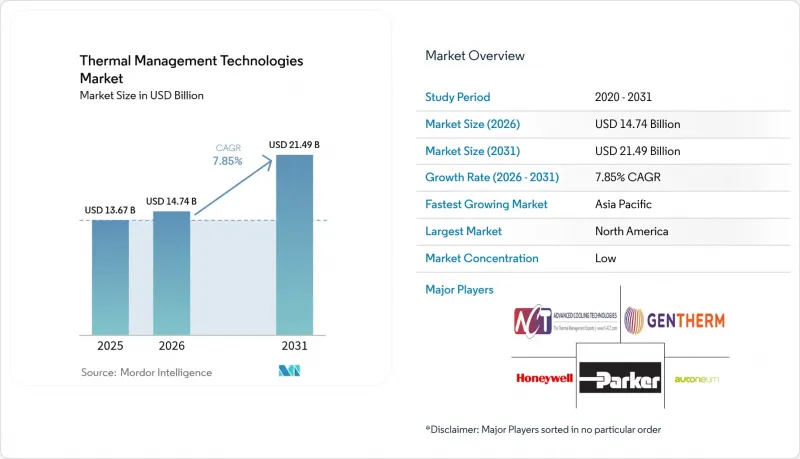
據 Mordor Intelligence 稱,2025 年溫度控管技術市場價值為 136.7 億美元,預計到 2031 年將達到 214.9 億美元,而 2026 年為 147.4 億美元,預測期(2026-2031 年)的複合年成長率為 7.85%。
本報告按產品類型(軟體、硬體等)、冷卻技術(風冷、水冷等)、材料(金屬:鋁、銅;非金屬:陶瓷、石墨、聚合物等)、終端用戶行業(電腦和資料中心、家用電子電器等)以及地區進行細分。市場預測以美元(USD)計價。
全球溫度控管技術市場趨勢及洞察
高效能運算設備的需求日益成長
專為人工智慧和圖形處理設計的處理器,其熱設計功耗 (TDP) 如今已超過 400 瓦,傳統的風冷散熱片無法應對如此高的功耗,因此必須轉向液冷系統,以實現更高的對流係數。電晶體、片上加速器和邊緣運算模組的高密度堆疊,以及無風扇機殼的出現,進一步增加了對能夠即時調節流量的軟體定義冷卻系統的需求。量子系統對低溫環境的要求更高,模糊了 IT 和低溫工程之間的界線。能源消耗法規獎勵資訊長 (CIO) 實施預測性溫度控管,以平衡功耗和運作。這些因素共同推動了溫度控管技術市場的發展,導致冷卻子系統的數量和每個機架的組件成本不斷增加。
電動汽車電池溫度控管技術的快速普及
透過管道輸送至矩形和圓柱形電池單元的液冷迴路,可將電池組溫度維持在 15–35 度C的狹窄範圍內,從而最大限度地保持電池容量,同時避免熱失控。採用固體化學成分改變了散熱曲線,迫使原始設備製造商 (OEM) 重新考慮散熱板的形狀和冷卻液的黏度。嵌入式演算法現在可以分析駕駛方式、環境天氣狀況和快速充電電流,以防止熱點並延長保固。曾經僅限於伺服器的浸沒式冷卻解決方案,目前正在為需要更輕管道的賽道型電動車進行原型開發。隨著每個新平台的推出,溫度控管技術市場與汽車設計週期的融合度越來越高,電池冷卻也從單純的通用組件轉變為核心差異化因素。
關於兩相浸沒式解決方案的可靠性問題
營運負責人仍擔憂用於循環關鍵基板的介電槽中可能存在的化學劣化和顆粒物污染問題。由於更換週期和流體控制設備成本,營運成本高於預期。保險承保人和擔保提供者尚未發布明確的故障率數據,這使得財富 500 強企業的 IT 團隊保持謹慎。此外,有關處置的環境法規也日趨複雜,這減緩了主流應用的速度,並阻礙了溫度控管技術市場的短期成長。
細分市場分析
硬體仍是溫度控管技術市場的基礎,預計到2025年將佔銷售額的58.05%,涵蓋散熱器、均熱板、液冷頭、介面墊等產品。然而,軟體編配層9.05%的複合年成長率表明,市場正朝著數據驅動的最佳化方向發展,從而進一步挖掘現有散熱設備的性能。基於人工智慧的韌體能夠學習散熱特性,並主動調節水泵和風扇轉速,顯著降低功耗和噪音。隨著這些技術的大規模應用,將提高OEM廠商的利潤率,降低終端用戶的整體擁有成本(TCO),並形成良性循環,最終推動溫度控管技術市場的擴張。
新創公司正在整合機器視覺感測器,即時繪製熱點移動軌跡,並將數據傳輸至神經網路,從而在毫秒內調整氣流向量。界面材料也不斷發展,添加石墨烯的膏體比傳統潤滑脂的導電性高出幾個數量級。更聰明的程式碼和更優異的表面效能相輔相成,帶來多重優勢。更低的接合溫度提高了可靠性指標,並支援更嚴格的設計要求和更輕的散熱結構。這些技術的進步正在不斷擴大溫度控管技術市場,其應用範圍涵蓋消費性電子設備、電動車電池組和工業自動化單元。
風冷組件憑藉其多功能性和較低的初始成本,在2025年佔了47.10%的銷售額。然而,從均熱板、熱管到浸沒式框架等雙相冷卻解決方案,預計到2031年將以8.86%的複合年成長率成長,並在兆瓦級資料中心中從傳統機架式散熱器手中奪取市場佔有率。晶片級直接冷卻(DTC)板透過縮短流路長度和提高熱通量閾值來減少機架的整體面積。對於高階工作站和邊緣AI設備,混合冷卻迴路可根據工作負載強度在風冷和液冷模式之間切換,在滿足散熱設計要求的同時,無需使用過大的風扇。
儘管浸沒式冷卻器能夠實現最陡峭的溫度梯度,但由於資本支出 (CAPEX) 和風險方面的擔憂,其在測試實驗室之外的應用仍然有限。另一方面,熱電模組在一些對溫度控制要求高於效率的特定應用領域,例如雷射雷達校準系統和用於衛星通訊的相位陣列,正逐漸獲得青睞。這種更廣泛的選擇使設計人員能夠建立合適規模的系統,從而進一步鞏固了溫度控管技術市場的成長勢頭。
區域分析
預計到2025年,北美將佔全球銷售額的39.35%。這主要得益於雲端巨頭超大規模資料中心的擴張,以及政府為下一代電池冷卻計畫提供的慷慨電動車獎勵。密集的半導體製造廠和研發設施網路正在縮短從技術發現到商業化的反饋週期,該地區在專利和試點生產線方面也持續領先。隨著政策制定者將能源獨立和資料主權置於優先地位,對配備液冷系統的資料中心維修的投資正在增加,從而支撐了對溫度控管技術的潛在需求。
同時,預計到2031年,亞太地區的複合年成長率將達到8.58%,位居全球之首。這主要得益於中國、韓國和台灣地區將先進的冷卻技術直接整合到組裝線中,無需後期維修。中國沿海地區正在建造的電池超級工廠部署了數公里長的冷卻水道和數百萬噸石墨片,而深圳和首爾的行動電話廠商則在最佳化其人工智慧旗艦機型的微型風扇應用。此外,5G網路密度的不斷提升也帶來了數千個無線單元,每個單元都配備了客製化設計的冷板,從而推動了該地區對溫度控管技術的需求。
在歐洲,成熟的汽車供應鏈與積極的碳減排法規相輔相成,這些法規鼓勵在電動車動力系統和工業馬達中採用高效的溫度控管硬體。歐洲的航太和國防生態系統正在經歷一個快速成長、利潤豐厚的細分市場,其中陶瓷和熱電組件被指定用於高空無人機和衛星航空電子設備。北歐新興的資料中心叢集在低溫環境下運作,仍需要智慧控制系統來利用自然冷卻,同時避免冷凝風險。這些趨勢確立了歐洲在全球溫度控管技術市場中強大的、由監管主導的地位。
其他好處:
- Excel格式的市場預測(ME)表
- 3個月的分析師支持
目錄
第1章:引言
- 研究假設和市場定義
- 調查範圍
第2章:調查方法
第3章執行摘要
第4章 市場狀況
- 市場概覽
- 市場促進因素
- 高效能運算設備的需求日益成長
- 電動汽車電池溫度控管技術的快速普及
- 隨著電子設備體積越來越小,熱通量卻在增加。
- 5G 的部署正在推動先進溫度控管解決方案的發展。
- 為了提高人工智慧資料中心的永續性,人們正在推動液冷技術的轉變。
- 固態電池的新溫度控管需求
- 市場限制因素
- 關於兩相浸沒式解決方案的可靠性問題
- 先進相變材料和石墨複合材料高成本
- PFAS基TIMs相關的監理不確定性
- 超薄裝置的設計複雜性
- 產業價值鏈分析
- 監理情勢
- 技術展望
- 波特五力分析
- 產業價值鏈分析
- 宏觀經濟因素對市場的影響
第5章 市場規模與成長預測
- 依產品類型
- 軟體
- 硬體
- 基板
- 介面
- 按類型分類的冷卻技術
- 空冷式
- 液冷
- 兩相冷卻
- 混合冷卻
- 熱電冷卻
- 材料
- 金屬(鋁、銅)
- 非金屬(陶瓷、石墨、聚合物)
- 相變材料
- 複合材料
- 按最終用途行業分類
- 電腦與資料中心
- 家用電子產品
- 汽車/電動車
- 電訊
- 可再生能源
- 航太/國防
- 工業設備
- 其他終端用戶產業
- 按地區
- 北美洲
- 南美洲
- 歐洲
- 亞太地區
- 中東和非洲
第6章 競爭情勢
- 市場集中度
- 策略趨勢
- 市佔率分析
- 公司簡介
- Parker-Hannifin Corporation
- Advanced Cooling Technologies, Inc.
- Honeywell International Inc.
- Gentherm Incorporated
- Autoneum Holding AG
- Hydro Extruded Solutions AS(formerly Sapa Extrusions Inc.)
- AllCell Technologies LLC
- Thermacore, Inc.
- Laird Thermal Systems Ltd.
- Pentair plc
- Outlast Technologies LLC
- Boyd Corporation
- Celsia Inc.
- Aavid Thermalloy LLC
- Furukawa Electric Co., Ltd.
- Henkel AG and Co. KGaA
- Rogers Corporation
- 3M Company
- Panasonic Holdings Corporation
- Dow Inc.
- TTM Technologies, Inc.
- CoolIT Systems Inc.
- Delta Electronics, Inc.
- Noctua GmbH
- Sunonwealth Electric Machine Industry Co., Ltd.
第7章 市場機會與未來展望
According to Mordor Intelligence, the thermal management technologies market size was valued at USD 13.67 billion in 2025 and estimated to grow from USD 14.74 billion in 2026 to reach USD 21.49 billion by 2031, at a CAGR of 7.85% during the forecast period (2026-2031).
This report is Segmented by Product Type (Software, Hardware, and More), Cooling Technology (Air Cooling, Liquid Cooling, and More), Material (Metal-Based Al Cu, Non-Metal Ceramic Graphite Polymer, and More), End-Use Industry (Computers and Data Centers, Consumer Electronics, and More), and Geography. The Market Forecasts are Provided in Terms of Value USD.
Global Thermal Management Technologies Market Trends and Insights
Growing Demand for High-Performance Computing Devices
Processors aimed at AI and graphics workloads now post thermal design power numbers above 400 W, overwhelming legacy air fins and pushing operators toward liquid loops that deliver higher convective coefficients. Denser transistor stacking, on-chip accelerators, and edge boxes packed into fan-less enclosures intensify the hunt for software-defined cooling that modulates flow rates on the fly. Quantum systems raise the bar further by requiring sub-Kelvin environments that blur lines between IT and cryogenics. Regulatory energy caps give CIOs a financial incentive to adopt predictive thermal orchestration that balances power draw against uptime. Together these factors lift the thermal management technologies market by expanding both the unit count of cooling subsystems and the bill of materials per rack.
Surging Adoption of EV Battery Thermal Management
Liquid loops threaded through prismatic and cylindrical cells keep pack temperatures inside the narrow 15-35 °C window that maximizes capacity retention while averting thermal runaway. Solid-state chemistries change heat generation profiles, forcing OEMs to rethink plate geometries and coolant viscosities. Embedded algorithms now parse driving style, ambient weather, and fast-charge currents to pre-empt hotspots, extending warranty cycles. Immersion solutions, once confined to servers, are being prototyped for track-oriented EVs seeking lighter plumbing. Each new platform pushes the thermal management technologies market deeper into automotive design cycles, turning battery cooling from a commodity into a core differentiator.
Reliability Concerns Over Two-Phase Immersion Fluids
Operators remain wary of chemical degradation and particulate contamination in dielectric baths that circulate around mission-critical boards. Replacement cycles and fluid conditioning equipment drive operating expenses higher than anticipated. Insurance underwriters and warranty providers have yet to publish definitive failure-rate data, contributing to a cautious stance among Fortune-500 IT teams. Environmental regulations on disposal add another layer of complexity, slowing mainstream adoption and trimming near-term growth for the thermal management technologies market.
Other drivers and restraints analyzed in the detailed report include:
- Miniaturization of Electronics Increasing Heat Flux
- 5G Rollout Driving Advanced Thermal Solutions
- High Cost of Advanced PCMs and Graphite Composites
For complete list of drivers and restraints, kindly check the Table Of Contents.
Segment Analysis
Hardware still underpins the thermal management technologies market with 58.05% revenue in 2025, spanning heat sinks, vapor chambers, liquid blocks, and interface pads. Yet the 9.05% CAGR logged by software orchestration layers signals a pivot toward data-driven optimization that ekes out more capacity from installed cooling assets. AI-based firmware now learns thermal signatures and pre-emptively tunes pump speed or fan rpm, slashing power draw and noise. At scale, these functions widen margins for OEMs and reduce total cost of ownership for end users, reinforcing the adoption loop that enlarges the thermal management technologies market.
Start-ups are integrating machine-vision sensors that map hotspot migration in real time, feeding neural nets that adjust airflow vectors within milliseconds. Interface materials are likewise evolving, with graphene-doped pastes outclassing legacy greases by an order of magnitude in conductivity. The interplay between smarter code and better surfaces yields compound gains: lower junction temperatures boost reliability metrics, permitting tighter design envelopes and lighter thermal envelopes. Each increment rolls up to expand thermal management technologies market size across consumer devices, EV packs, and industrial automation cells.
Air-based assemblies delivered 47.10% of 2025 turnover, buoyed by universal compatibility and low upfront cost. Even so, two-phase solutions, spanning vapor chambers, heat pipes, and immersion frames, are on pace for a 8.86% CAGR to 2031, stealing share from legacy rack coolers in megawatt-class data halls. Direct-to-chip plates cut fluid path length and raise heat-flux thresholds, shrinking total rack footprint. For premium workstations and edge AI boxes, hybrid loops toggle between air and liquid modes based on workload intensity, ensuring thermal compliance without oversizing fans.
Immersion baths promise the steepest thermal gradient, yet capex and perceived risk still limit deployment beyond test labs. Meanwhile, thermoelectric modules find niche adoption where pinpoint temperature control outweighs efficiency penalties, such as lidar calibration units and sat-com phased arrays. Collectively, the widening palette of options lets designers right-size systems, reinforcing the growth arc of the thermal management technologies market.
Complete Report Scope:
- By Product Type
- Software
- Hardware
- Substrate
- Interface
- By Cooling Technology
- Air Cooling
- Liquid Cooling
- Two-Phase Cooling
- Hybrid Cooling
- Thermoelectric Cooling
- By Material
- Metal-Based (Al, Cu)
- Non-Metal (Ceramic, Graphite, Polymer)
- Phase-Change Materials
- Composites
- By End-Use Industry
- Computers and Data Centers
- Consumer Electronics
- Automotive and EVs
- Telecommunications
- Renewable Energy
- Aerospace and Defense
- Industrial Equipment
- Other End-User Industries
- By Geography
- North America
- South America
- Europe
- Asia Pacific
- Middle East and Africa
Geography Analysis
North America booked 39.35% of global receipts in 2025, powered by hyperscale build-outs from cloud giants and generous EV incentives that bankroll next-generation battery cooling projects. A dense network of semiconductor fabs and research labs shortens the feedback loop between discovery and commercial rollout, keeping the region ahead on patents and pilot lines. Policymaker emphasis on energy independence and data-sovereignty strengthens investment in liquid-based datacenter retrofits, anchoring base demand for the thermal management technologies market.
Asia-Pacific, however, supplies the fastest 8.58% CAGR to 2031 as China, South Korea, and Taiwan integrate advanced cooling directly on the assembly line, eliminating aftermarket retrofits. Battery-gigafactory construction across coastal China pulls in kilometers of coolant channels and megatons of graphite sheets, while handset OEMs in Shenzhen and Seoul refine micro-blower adoption for AI-enhanced flagship phones. Parallel 5G densification adds thousands of radio units, each with bespoke cold plates, lifting regional volumes for the thermal management technologies market.
Europe balances mature automotive supply chains with aggressive carbon-reduction statutes that encourage high-efficiency thermal hardware in EV drivetrains and industrial motors. The continent's aerospace and defense ecosystems specify ceramic and thermoelectric kits for high-altitude drones and satellite avionics, adding high-margin niches. Emerging data-center clusters in the Nordics run colder ambient air, yet still require smart controls to capitalize on free-cooling without risking condensation. These dynamics cement a steady, regulation-driven role for Europe within the global thermal management technologies market.
- Parker-Hannifin Corporation
- Advanced Cooling Technologies, Inc.
- Honeywell International Inc.
- Gentherm Incorporated
- Autoneum Holding AG
- Hydro Extruded Solutions AS (formerly Sapa Extrusions Inc.)
- AllCell Technologies LLC
- Thermacore, Inc.
- Laird Thermal Systems Ltd.
- Pentair plc
- Outlast Technologies LLC
- Boyd Corporation
- Celsia Inc.
- Aavid Thermalloy LLC
- Furukawa Electric Co., Ltd.
- Henkel AG and Co. KGaA
- Rogers Corporation
- 3M Company
- Panasonic Holdings Corporation
- Dow Inc.
- TTM Technologies, Inc.
- CoolIT Systems Inc.
- Delta Electronics, Inc.
- Noctua GmbH
- Sunonwealth Electric Machine Industry Co., Ltd.
Additional Benefits:
- The market estimate (ME) sheet in Excel format
- 3 months of analyst support
TABLE OF CONTENTS
1 INTRODUCTION
- 1.1 Study Assumptions and Market Definition
- 1.2 Scope of the Study
2 RESEARCH METHODOLOGY
3 EXECUTIVE SUMMARY
4 MARKET LANDSCAPE
- 4.1 Market Overview
- 4.2 Market Drivers
- 4.2.1 Growing demand for high-performance computing devices
- 4.2.2 Surging adoption of EV battery thermal management
- 4.2.3 Miniaturization of electronics increasing heat flux
- 4.2.4 5G rollout driving advanced thermal solutions
- 4.2.5 AI data-center sustainability push toward liquid cooling
- 4.2.6 Emerging thermal needs of solid-state batteries
- 4.3 Market Restraints
- 4.3.1 Reliability concerns over two-phase immersion fluids
- 4.3.2 High cost of advanced PCMs and graphite composites
- 4.3.3 Regulatory uncertainty around PFAS-based TIMs
- 4.3.4 Design complexity in ultra-slim devices
- 4.4 Industry Value Chain Analysis
- 4.5 Regulatory Landscape
- 4.6 Technological Outlook
- 4.7 Porter's Five Forces Analysis
- 4.7.1 Bargaining Power of Suppliers
- 4.7.2 Bargaining Power of Consumers
- 4.7.3 Threat of New Entrants
- 4.7.4 Intensity of Competitive Rivalry
- 4.7.5 Threat of Substitutes
- 4.8 Industry Value Chain Analysis
- 4.9 Impact of Macroeconomic Factors on the Market
5 MARKET SIZE AND GROWTH FORECASTS (VALUE)
- 5.1 By Product Type
- 5.1.1 Software
- 5.1.2 Hardware
- 5.1.3 Substrate
- 5.1.4 Interface
- 5.2 By Cooling Technology
- 5.2.1 Air Cooling
- 5.2.2 Liquid Cooling
- 5.2.3 Two-Phase Cooling
- 5.2.4 Hybrid Cooling
- 5.2.5 Thermoelectric Cooling
- 5.3 By Material
- 5.3.1 Metal-Based (Al, Cu)
- 5.3.2 Non-Metal (Ceramic, Graphite, Polymer)
- 5.3.3 Phase-Change Materials
- 5.3.4 Composites
- 5.4 By End-Use Industry
- 5.4.1 Computers and Data Centers
- 5.4.2 Consumer Electronics
- 5.4.3 Automotive and EVs
- 5.4.4 Telecommunications
- 5.4.5 Renewable Energy
- 5.4.6 Aerospace and Defense
- 5.4.7 Industrial Equipment
- 5.4.8 Other End-User Industries
- 5.5 By Geography
- 5.5.1 North America
- 5.5.2 South America
- 5.5.3 Europe
- 5.5.4 Asia Pacific
- 5.5.5 Middle East and Africa
6 COMPETITIVE LANDSCAPE
- 6.1 Market Concentration
- 6.2 Strategic Moves
- 6.3 Market Share Analysis
- 6.4 Company Profiles (includes Global level Overview, Market level overview, Core Segments, Financials as available, Strategic Information, Market Rank/Share for key companies, Products and Services, and Recent Developments)
- 6.4.1 Parker-Hannifin Corporation
- 6.4.2 Advanced Cooling Technologies, Inc.
- 6.4.3 Honeywell International Inc.
- 6.4.4 Gentherm Incorporated
- 6.4.5 Autoneum Holding AG
- 6.4.6 Hydro Extruded Solutions AS (formerly Sapa Extrusions Inc.)
- 6.4.7 AllCell Technologies LLC
- 6.4.8 Thermacore, Inc.
- 6.4.9 Laird Thermal Systems Ltd.
- 6.4.10 Pentair plc
- 6.4.11 Outlast Technologies LLC
- 6.4.12 Boyd Corporation
- 6.4.13 Celsia Inc.
- 6.4.14 Aavid Thermalloy LLC
- 6.4.15 Furukawa Electric Co., Ltd.
- 6.4.16 Henkel AG and Co. KGaA
- 6.4.17 Rogers Corporation
- 6.4.18 3M Company
- 6.4.19 Panasonic Holdings Corporation
- 6.4.20 Dow Inc.
- 6.4.21 TTM Technologies, Inc.
- 6.4.22 CoolIT Systems Inc.
- 6.4.23 Delta Electronics, Inc.
- 6.4.24 Noctua GmbH
- 6.4.25 Sunonwealth Electric Machine Industry Co., Ltd.
7 MARKET OPPORTUNITIES AND FUTURE OUTLOOK
- 7.1 White-space and Unmet-Need Assessment

 全球蒸汽室市場預測(至2034年)-按類型、材料、應用、最終用戶和地區分類的分析散熱器市場預測至2034年-按產品類型、材質、製造流程、冷卻技術、應用和地區分類的全球分析
 熱導板:全球市場
 熱電冷卻器市場:按類型、設計、溫度範圍、最終用戶、國家和地區分類-全球產業分析、市場規模、市場佔有率及2026年至2033年預測先進導熱界面材料市場預測至2034年-全球材料類型、基體材料、填充材、導熱係數、形狀、應用、終端用戶產業和地區分析
 溫度控管市場:全球市場預測,2026-2032年熱電冷卻器市場-2026-2032年全球市場預測
 HBM中的溫度控管和TIM:市場佔有率分析、行業趨勢和統計數據以及成長預測(2026-2031年)溫度控管材料市場預測至2034年-按材料類型、產品類型、導熱係數、應用、產業和地區分類的全球分析
 全球溫度控管技術市場規模、佔有率、趨勢和成長分析報告(2026-2034年)