


 |
市場調查報告書
商品編碼
2099794
HBM中的溫度控管和TIM:市場佔有率分析、行業趨勢和統計數據以及成長預測(2026-2031年)HBM Thermal Management and TIM - Market Share Analysis, Industry Trends & Statistics, Growth Forecasts (2026 - 2031) |
||||||

※ 本網頁內容可能與最新版本有所差異。詳細情況請與我們聯繫。
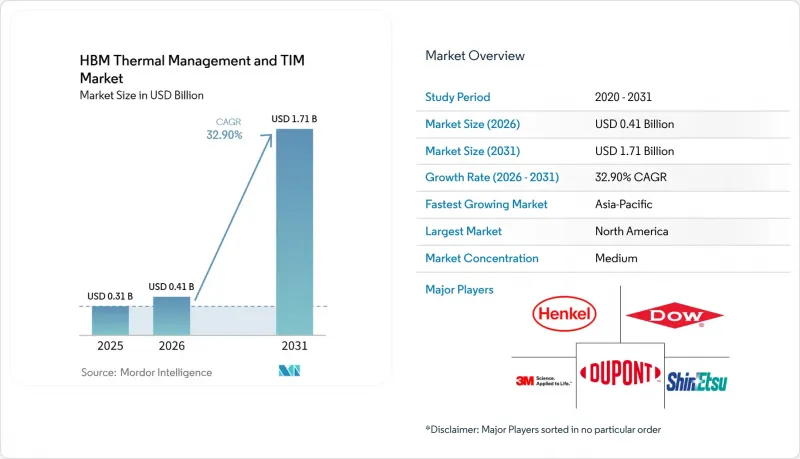
據 Mordor Intelligence 稱,HBM溫度控管和 TIM 市場預計將從 2025 年的 3.1 億美元成長到 2026 年的 4.1 億美元,到 2031 年達到 17.1 億美元,預計 2026 年至 2031 年的複合年成長率為 32.90%。
本報告按解決方案類型(導熱界面材料、散熱器和導熱增強組件、主動式和先進冷卻解決方案)、導熱界面材料類型(矽基導熱界面材料等)、應用(晶片貼裝和晶片板貼裝等)、終端用戶行業(人工智慧加速器和GPU等)以及地區進行細分。市場預測以美元計價。
全球HBM溫度控管及TIM市場趨勢及洞察
人工智慧加速器的功率密度正在迅速提高。
HBM 和 TIM 市場的溫度控管主要是為了因應 GPU 功耗的急劇成長。如文獻所述,GPU 功耗已從 NVIDIA H100 系統的最高 700 W 提升至 Blackwell B200 的 1000 W 和 B300 的 1400 W。這種成長降低了封裝的整體散熱裕度,因為 GPU 晶片和 HBM 堆疊現在在相同的封裝尺寸內共用更緊密的散熱路徑。控制結溫現在不僅依賴提高體導熱性,還依賴多個界面處的低電阻,這使得先前幾代加速器適用的材料選擇越來越不適用。此外,NVIDIA 將液冷與降低大型 AI 設施的營運成本聯繫起來,這為客戶提供了經濟獎勵,促使他們在下一代記憶體節點量產之前就提高散熱規格。在 HBM溫度控管和 TIM 市場,這種轉變正促使供應商的討論從簡單地強調導熱性轉向支援封裝開發階段的協同設計、介面匹配和模擬能力。因此,能夠在設計週期的早期階段幫助客戶平衡計算矽層和儲存層之間的熱流的供應商,在設計採納方面正獲得更有利的地位。
增加 HBM 堆疊高度可提高封裝熱通量。
HBM 和 TIM 市場的溫度控管也受到記憶體堆疊高度不斷增加的推動。這是因為將於 2025 年 4 月發布的 JEDEC HBM4 標準支援高達 16 層的堆疊,晶片密度為 32 Gb,立方體容量高達 64 GB。隨著每增加一層,發熱面積增大,下層晶片的散熱垂直路徑也隨之延長,堆疊本身的形狀就成為散熱的阻礙因素。 Imec 在其關於 GPU 上 3D HBM 的研究中揭示了這個問題的嚴重性。研究報告稱,在不採取任何措施的情況下,GPU 的峰值溫度為 141.7 度C,而透過改變封裝結構和散熱方式,溫度降至 70.8 度C年 5 月,SK 海力士針對 iHBM 也提出了類似的問題。 iHBM 在 D2D PHY 層中整合了一個冷卻元件 (ICE),與間接冷卻方式相比,熱阻降低了 30% 以上。對於 HBM溫度控管和 TIM 市場供應商而言,這意味著堆疊級界面正朝著更細的鍵合線、更局部的熱點以及超出許多現有矽膠產品檢驗範圍的性能要求發展。這種轉變提升了能夠在極細鍵合線下保持熱性能,同時又不影響其在反覆熱應力下可靠性的配方的價值。
對長期運行的人工智慧和高效能運算部署有嚴格的可靠性要求
由於超大規模和高效能運算 (HPC) 硬體預期使用壽命較長,高密度記憶體 (HBM) 的溫度控管和導熱介面材料 (TIM) 市場面臨明顯的限制。這是因為操作員需要在系統更換前,持續高負載運行 5 至 7 年。雖然石墨烯增強凝膠和鎵基液態金屬等尖端材料在實驗室中表現出色,但與現有的矽基系統相比,它們的生產規模和實際應用記錄仍然有限。 2025 年 IEEE THERMINIC 的一項研究表明,大型晶片封裝中 TIM1 的劣化高度局部,並且其形態受組裝中的翹曲以及材料在熱機械應力下的行為的影響。這意味著,對於決定部署長壽命基礎設施的買家而言,僅憑體導熱係數無法充分預測運作可靠性。一旦某種材料獲得認證並投入使用,運營商通常不願意在其生命週期中途更換,因為更換需要拆卸和重新檢驗。這導致 HBM溫度控管和 TIM 市場出現“認證鎖定”,減緩了在受控測試條件下可能超越現有材料熱性能的新化學成分的採用。
細分市場分析
2025年,導熱界面材料(TIM)在HBM的溫度控管和TIM市佔率中佔比高達53.83%。這反映了TIM在人工智慧加速器封裝的晶片貼裝、封裝蓋和散熱器介面等環節的長期應用。這一地位得益於TIM優異的性能和深厚的應用經驗,因為許多目前的封裝設計仍然依賴已在自動化生產和組裝流程中認證的矽基和聚合物基材料。然而,隨著客戶對配方性能的要求不斷提高,此類材料的性能水平也在持續提升,這些配方即使在經受循環測試或翹曲變形後,仍能保持較低的電阻,同時確保良好的軟性。根據2025年發表在《ACS應用能源材料》上的一項研究,垂直排列的石墨烯陣列在石墨烯含量為30.07 wt%時,實現了90.5 W m⁻¹K⁻¹的體積導熱係數,遠超傳統矽膠墊的典型範圍。在 HBM溫度控管和 TIM 市場,這些結果意義重大,因為它們將促進 TIM1 和相關高溫介面從實驗室檢驗過渡到早期商業樣品。
散熱片和導熱增強組件佔據著至關重要的中間位置,既支援現有的帶蓋封裝,也支援在HBM堆疊級溫度控管中備受關注的新型蓋整合式散熱路徑概念。 「主動式和先進冷卻解決方案」預計到2031年將以33.49%的複合年成長率成長,並且隨著平台級冷卻越來越靠近封裝,有望成為成長最快的解決方案類型。 NVIDIA在2025年對Rubin的說明表明,未來的發展方向是全液冷系統,該系統無需風扇,並使用更高溫度的冷卻劑,從而改變了下游散熱材料必須滿足的邊界條件。 Frore Systems在2026年3月進一步推動了這一發展方向,該公司以16.4億美元的企業估值籌集了1.43億美元,用於擴展其LiquidJet平台,這表明資本也在向封裝整合式主動冷卻概念流動。
2025年,矽基導熱界面材料(TIM)在HBM溫度控管和TIM市場中佔42.19%的比重。這反映了其廣泛的認證記錄、良好的機械性能以及與現有自動化點膠製程的兼容性。複合年成長率(CAGR)是指成長率超過前一年兩倍。石墨烯和碳基TIM預計到2031年將以34.08%的最高複合年成長率成長,這得益於其更高的理論導熱係數上限以及作為下一代熱點控制解決方案的巨大潛力。正如文章開頭引用的ACS應用能源材料研究報告所解釋的那樣,人們對它們的興趣持續成長。石墨烯具有優異的固有導熱性能,可以融入體材料結構中,如果能夠克服加工方面的挑戰,其性能將遠超傳統的填料基系統。在HBM溫度控管和TIM市場,問題不再是富碳系統能否有效運行,而是能否在確保穩定的鍵合線、潔淨的加工工藝和可重複的封裝可靠性的前提下實現規模化生產。因此,這一領域並沒有立即擺脫現有的矽基系統,而是在成長潛力和商業化準備之間尋求平衡。
陶氏化學於2026年5月推出的「DOWSIL TC-3120導熱凝膠」表明,現有矽供應商仍在不斷突破性能極限,其導熱係數接近12 W/m·K,適用於高密度光電模組介面。在矽污染問題較為突出的領域,非矽導熱界面材料和相變材料仍然至關重要。萊爾德公司的「Tpcm 7000」以7.5 W/m·K的導熱係數樹立了行業標桿,並在原料階段通過2000小時的老化測試驗證了其可靠性。液態金屬系統也持續受到關注,銦泰公司的鎵基「Indalloy」配方效能接近44 W m-1K-1,目標應用為裸晶AI伺服器處理器和ASIC中的TIM0和TIM1。因此,HBM 的溫度控管和 TIM 產業的發展方向並不一致,因為最佳化學成分仍取決於密封性、污染風險、可製造性以及目標界面的位置。
區域分析
到2025年,亞太地區將佔據HBM溫度控管和導熱界面材料(TIM)市場64.96%的佔有率。這反映了該地區HBM製造、先進封裝及相關半導體材料產能的集中度。韓國依然是中心,三星電子和SK海力士在全球HBM供應鏈中扮演著核心角色;而台灣則透過其人工智慧加速器計畫相關的大規模先進封裝活動,為封裝環節提供支援。亞太地區HBM溫度控管和導熱介面材料市場的發展也得益於更高HBM堆疊和更複雜封裝佈局的加速普及。這推動了對記憶體和計算晶片附近經認證的介面材料的需求。 JEDEC於2025年發布的HBM4標準以及SK海力士於2026年推出的iHBM,都進一步鞏固了該地區在製定下一代封裝設計可操作的散熱要求方面的作用。此外,日本也在材料開發和製程技術方面展現出戰略價值,瓦克公司擴大了其本地矽膠導熱界面材料 (TIM) 的生產能力,而新能源產業技術綜合開發機構 (NEDO) 則支持旨在降低矽膠導熱界面材料製造成本的製造創新。
預計到2031年,北美將以33.81%的複合年成長率(CAGR)實現最高成長,這主要得益於人工智慧資料中心的快速擴張以及對採用液冷散熱解決方案的高密度計算叢集的需求。 NVIDIA對液冷經濟性的探討清楚地闡釋了該地區為何發展如此迅猛,因為散熱基礎設施的決策如今會影響大規模人工智慧設施的系統性能和營運成本。北美HBM溫度控管和導熱界面材料(TIM)市場也受益於當前產業政策下國內半導體封裝業務的擴張,這使得市場需求不再局限於超大規模伺服器。這種協同效應將組件級材料需求與封裝、基板和散熱硬體的大規模擴張聯繫起來。
儘管歐洲市場佔有率相對較小,但憑藉其強大的電子和汽車產業基礎,歐洲在技術領域仍然舉足輕重,這推動了對合規性、可靠性和研發主導封裝開發的需求。該地區的RoHS和REACH框架對於使用重金屬或特殊填料系統的供應商至關重要,要求其選擇的材料必須滿足工業和行動應用領域日益嚴格的合規性要求。在南美洲、中東和非洲,由於當地HBM產能有限且先進封裝活動不足,與HBM直接相關的導熱界面材料(TIM)的需求仍處於起步階段。然而,隨著中東部分地區未來的人工智慧基礎設施規劃從規劃階段過渡到持續的硬體安裝階段,可能為HBM溫度控管和導熱介面材料(TIM)市場創造更多機會。
其他好處:
- Excel格式的市場預測(ME)表
- 3個月的分析師支持
目錄
第1章:引言
- 研究假設和市場定義
- 調查範圍
第2章:調查方法
第3章執行摘要
第4章 市場狀況
- 市場概覽
- 市場促進因素
- 提高人工智慧加速器的功率密度
- 隨著 HBM 堆疊高度的增加,封裝的熱通量也隨之增加。
- 記憶體和邏輯電路聯合封裝的藍圖提高了散熱性能認證的標準。
- HBM供應鏈中先進半導體封裝技術的應用
- 對封裝級熱仿真和設計實施服務的需求被低估了。
- HBM 的熱裕度不足,正在推動高性能導熱界面材料 (TIM) 在超大規模設計中的應用。
- 市場限制因素
- 對長期運行的人工智慧和高效能運算部署有嚴格的可靠性要求
- 材料認證週期減緩了其向商業規模擴張的速度。
- 用於先進TIM配方的高純度填料系統的供應有限。
- 3D堆疊記憶體中熱機械應力導致良率降低的風險。
- 供應鏈分析
- 監理情勢
- 技術展望
- 波特五力分析
- 宏觀經濟因素對市場的影響
第5章 市場規模與成長預測
- 按解決方案類型
- 熱界面材料
- 散熱器和導熱性增強組件
- 主動冷卻和先進冷卻解決方案
- 鈦金屬型
- 矽基導熱界面材料
- 非矽基導油材料
- 相變材料
- 液態金屬界面材料
- 石墨烯和碳基導熱界面材料
- 銦和金屬合金導電界面材料
- 透過使用
- 晶片黏接和尖端黏合
- 中介層和矽橋的溫度控管
- HBM堆疊的熱界面材料
- 封裝體與散熱器之間的連接處
- 先進的異構封裝
- 按最終用途行業分類
- AI加速器與GPU
- 資料中心
- 高效能運算
- 車
- 溝通
- 家用電子產品
- 按地區
- 北美洲
- 美國
- 加拿大
- 墨西哥
- 歐洲
- 德國
- 英國
- 法國
- 義大利
- 其他歐洲國家
- 亞太地區
- 中國
- 日本
- 韓國
- 台灣
- 印度
- 其他亞太國家
- 南美洲
- 中東和非洲
- 北美洲
第6章 競爭情勢
- 市場集中度
- 策略趨勢
- 市佔率分析
- 公司簡介
- Henkel AG and Co. KGaA
- Dow Inc.
- DuPont de Nemours, Inc.
- Shin-Etsu Chemical Co., Ltd.
- 3M Company
- Laird Thermal Systems, Inc.
- Parker-Hannifin Corporation
- Fujipoly America Corporation
- Momentive Performance Materials Inc.
- Honeywell International Inc.
- Indium Corporation
- Eaton Corporation
- Saint-Gobain SA
- Rogers Corporation
- Wacker Chemie AG
- Panasonic Holdings Corporation
- Nitto Denko Corporation
- Shenzhen FRD Science and Technology Co., Ltd.
- Suzhou Tianmai Thermal Technology Co., Ltd.
- Resonac Holdings Corporation
第7章 市場機會與未來展望
According to Mordor Intelligence, the HBM thermal management and TIM market size is expected to increase from USD 0.31 billion in 2025 to USD 0.41 billion in 2026 and reach USD 1.71 billion by 2031, growing at a CAGR of 32.90% over 2026-2031.
This report is Segmented by Solution Type (Thermal Interface Materials, Heat Spreaders and Thermal Enhancement Components, and Active and Advanced Cooling Solutions), TIM Type (Silicone-Based TIM, and More), Application (Die Attach and Chip Boarding, and More), End Use Industry (AI Accelerators and GPUs, and More), and Geography. The Market Forecasts are Provided in Terms of Value (USD).
Global HBM Thermal Management and TIM Market Trends and Insights
AI Accelerator Power Density Escalation
The HBM thermal management and TIM market is responding first to the sharp rise in GPU power envelopes, which moved from up to 700 W in NVIDIA H100 systems to 1,000 W in the Blackwell B200 path and to 1,400 W in the B300 path described in the source material. That increase reduces the thermal margin across the entire package because the GPU die and the HBM stack must now share a much tighter heat-reduction path within the same footprint. Material choices that worked for earlier accelerator generations are becoming less suitable as junction temperature control now depends on lower resistance at multiple interfaces rather than just better bulk conductivity. NVIDIA also tied liquid cooling to lower operating costs in large AI facilities, giving customers a financial incentive to raise thermal specifications before the next memory node even reaches volume deployment. In the HBM thermal management and TIM market, this shift is driving supplier discussions away from simple conductivity claims toward co-design support, interface matching, and simulation capabilities during package development. Suppliers that can help customers balance heat flow between compute silicon and memory layers earlier in the design cycle are therefore gaining stronger design-in positions.
HBM Stack Height Growth Increasing Package Heat Flux
The HBM thermal management and TIM market is also being pushed by taller memory stacks, because JEDEC's HBM4 standard, published in April 2025, supports up to 16-high stacks with 32 Gb die density and a maximum cube capacity of 64 GB. Each added tier expands the heat-generating area while lengthening the vertical path through which lower dies must release heat, making stack geometry itself a thermal constraint. Imec showed the scale of this issue when its 3D HBM-on-GPU study reported peak GPU temperatures of 141.7°C without mitigation, while a package with structural and cooling changes reduced them to 70.8°C. SK hynix addressed the same problem in May 2026 with iHBM, which places Integrated Cooling Elements at the D2D PHY layer and lowers thermal resistance by more than 30% versus indirect cooling approaches. For suppliers in the HBM thermal management and TIM market, this means stack-level interfaces are moving toward thinner bondlines, more localized hot spots, and performance requirements that extend beyond the validated range of many current silicone products. That shift raises the value of formulations that can hold thermal performance at very thin bondlines without sacrificing reliability under repeated thermal stress.
Tight Reliability Windows for Long-Life AI and HPC Deployments
The HBM thermal management and TIM market faces a clear brake from the long service life expected in hyperscale and HPC hardware, because operators want systems to run under sustained heavy use for 5 to 7 years before replacement. Advanced materials such as graphene-enhanced gels and gallium-based liquid metals still have limited production scale and field history compared with incumbent silicone systems, even when their lab performance looks stronger. IEEE THERMINIC research in 2025 showed that TIM1 degradation in large die packages can be highly localized and shaped by assembly warpage and by material behavior under thermomechanical stress. This means bulk thermal conductivity alone does not predict field reliability well enough for buyers making long-life infrastructure decisions. Once a material is qualified and deployed, operators are reluctant to change it mid-cycle because replacement requires disassembly and renewed validation. That creates qualification lock-in in the HBM thermal management and TIM market, slowing the adoption of novel chemistries even when they can exceed the incumbent's thermal performance in controlled testing.
Other drivers and restraints analyzed in the detailed report include:
- Co-Packaged Memory and Logic Roadmaps Raising Thermal Qualification Thresholds
- Advanced Semiconductor Packaging Adoption in HBM Supply Chains
- Material Qualification Cycles Delaying Commercial Scale-Up
For complete list of drivers and restraints, kindly check the Table Of Contents.
Segment Analysis
Thermal Interface Materials held 53.83% of the HBM thermal management and TIM market share in 2025, which reflected their long-established role across die attach, package lid, and heatsink interfaces in AI accelerator packages. That position came from installed base depth as much as from performance, because many current package designs still rely on silicone and polymer systems that are already qualified in automated production and assembly flows. Even so, the performance ladder in this category is moving upward as customers seek formulations that maintain lower resistance without sacrificing compliance during cycling and warpage. Research published in ACS Applied Energy Materials in 2025 showed that vertically aligned graphene arrays achieved a bulk thermal conductivity of 90.5 W m-1 K-1 at 30.07 wt% graphene loading, far above the range typical of conventional silicone pads. In the HBM thermal management and TIM market, that result matters because it supports the move from laboratory validation toward early commercial sampling for TIM1 and related high-heat interfaces.
Heat spreaders and thermal enhancement components occupy an important middle ground, supporting both current lidded packages and newer lid-integrated thermal path concepts that are gaining attention in HBM stack-level management. Active and Advanced Cooling Solutions is projected to expand at a 33.49% CAGR through 2031, making it the fastest-growing solution type as platform-level cooling moves closer to the package. NVIDIA's 2025 commentary on Rubin described a fully liquid-cooled system direction with fan removal and warmer coolant, which changes the boundary conditions that downstream thermal materials must meet. Frore Systems reinforced that direction in March 2026 when it raised USD 143 million at a USD 1.64 billion valuation to scale its LiquidJet platform, showing that capital is also moving toward package-integrated active cooling concepts.
Silicone-Based TIM accounted for 42.19% of the HBM thermal management and TIM market in 2025, reflecting its broad qualification base, mechanical compliance, and compatibility with existing automated dispensing processes. Graphene and Carbon-Based TIM is projected to record the fastest CAGR of 34.08% through 2031, as it offers a much higher theoretical conductivity ceiling and a stronger path toward next-generation hot-spot control. The same ACS Applied Energy Materials study cited in the input explains why interest remains high; graphene can translate its strong intrinsic thermal properties into bulk structures that deliver far better performance than legacy filler systems when processing challenges are addressed. In the HBM thermal management and TIM market, the issue is no longer whether carbon-rich systems can perform, but whether they can do so at scale with stable bondlines, clean processing, and repeatable package reliability. That is why the segment still balances growth potential against commercial readiness rather than moving immediately away from incumbent silicon systems.
Dow's launch of DOWSIL TC-3120 Thermal Gel in May 2026 showed that incumbent silicone suppliers are still raising the performance ceiling, with thermal conductivity near 12 W/m*K and positioning for dense optical and electronic module interfaces. Non-silicone TIM and phase change materials remain relevant where silicone contamination is a concern, and Laird's Tpcm 7000 provided a premium benchmark with 7.5 W/mK thermal conductivity and reliability across 2,000 aging test hours in the source material. Liquid metal systems continue to gain interest, with Indium's gallium-based Indalloy formulations approaching 44 W m-1 K-1 and targeting TIM0 and TIM1 use in bare-die AI server processors and ASICs. The HBM thermal management and TIM industry is therefore not moving in a single direction, since the winning chemistry still depends on containment, contamination risk, manufacturability, and the interface position being served.
Complete Report Scope:
- By Solution Type
- Thermal Interface Materials
- Heat Spreaders and Thermal Enhancement Components
- Active and Advanced Cooling Solutions
- By TIM Type
- Silicone-Based TIM
- Non-Silicone TIM
- Phase Change Materials
- Liquid Metal TIM
- Graphene and Carbon-Based TIM
- Indium and Metal Alloy TIM
- By Application
- Die Attach and Chip Bonding
- Interposer and Silicon Bridge Thermal Management
- HBM Stack Thermal Interface
- Package-to-Heatsink Interface
- Advanced Heterogeneous Packaging
- By End Use Industry
- AI Accelerators and GPUs
- Data Centers
- High-Performance Computing
- Automotive
- Telecom
- Consumer Electronics
- By Geography
- North America
- United States
- Canada
- Mexico
- Europe
- Germany
- United Kingdom
- France
- Italy
- Rest of Europe
- Asia-Pacific
- China
- Japan
- South Korea
- Taiwan
- India
- Rest of Asia-Pacific
- South America
- Middle East and Africa
- North America
Geography Analysis
Asia-Pacific held 64.96% of the HBM thermal management and TIM market share in 2025, which reflected the region's concentration of HBM manufacturing, advanced packaging, and supporting semiconductor materials capacity. South Korea remained central because Samsung Electronics and SK hynix anchor global HBM supply, while Taiwan supports the package side through large-scale advanced packaging activity tied to AI accelerator programs. The HBM thermal management and TIM market in Asia-Pacific is also supported by the faster adoption of taller HBM stacks and more complex package layouts, which increase the need for qualified interface materials near the memory and compute dies. JEDEC's HBM4 release in 2025 and SK hynix's iHBM launch in 2026 both reinforced the region's role in setting practical thermal requirements for the next wave of package design. Japan also held strategic value through materials development and process work, with Wacker expanding local silicone TIM capacity and NEDO supporting manufacturing innovation to lower silicone TIM production costs.
North America is projected to post the fastest CAGR at 33.81% through 2031, driven by rapid AI data center buildout and the need to support denser compute clusters with liquid-ready thermal solutions. NVIDIA's own discussion of liquid-cooling economics shows why this region is moving quickly, as thermal infrastructure decisions now affect both system performance and operating costs in large AI facilities. The HBM thermal management and TIM market in North America also benefits from domestic semiconductor packaging expansion under the current industrial policy, which broadens demand beyond hyperscale servers alone. That combination links component-level materials demand with a larger buildout in package, board, and cooling hardware.
Europe held a smaller position, but it remained technically important because its electronics and automotive base keeps demand focused on compliance, reliability, and research-led package development. The region's RoHS and REACH frameworks still matter for suppliers using metal-rich or specialized filler systems, as material selection must align with stricter compliance requirements in industrial and mobility applications. South America, the Middle East, and Africa remained early-stage in direct HBM-related TIM demand, as local HBM production and advanced packaging activity remain limited. Even so, later-period AI infrastructure programs in parts of the Middle East could create incremental opportunity for the HBM thermal management and thermal interface material (TIM) market if local compute capacity moves from deployment planning to sustained hardware installation.
- Henkel AG and Co. KGaA
- Dow Inc.
- DuPont de Nemours, Inc.
- Shin-Etsu Chemical Co., Ltd.
- 3M Company
- Laird Thermal Systems, Inc.
- Parker-Hannifin Corporation
- Fujipoly America Corporation
- Momentive Performance Materials Inc.
- Honeywell International Inc.
- Indium Corporation
- Eaton Corporation
- Saint-Gobain S.A.
- Rogers Corporation
- Wacker Chemie AG
- Panasonic Holdings Corporation
- Nitto Denko Corporation
- Shenzhen FRD Science and Technology Co., Ltd.
- Suzhou Tianmai Thermal Technology Co., Ltd.
- Resonac Holdings Corporation
Additional Benefits:
- The market estimate (ME) sheet in Excel format
- 3 months of analyst support
TABLE OF CONTENTS
1 INTRODUCTION
- 1.1 Study Assumptions and Market Definition
- 1.2 Scope of the Study
2 RESEARCH METHODOLOGY
3 EXECUTIVE SUMMARY
4 MARKET LANDSCAPE
- 4.1 Market Overview
- 4.2 Market Drivers
- 4.2.1 AI Accelerator Power Density Escalation
- 4.2.2 HBM Stack Height Growth Increasing Package Heat Flux
- 4.2.3 Co-Packaged Memory and Logic Roadmaps Raising Thermal Qualification Thresholds
- 4.2.4 Advanced Semiconductor Packaging Adoption in HBM Supply Chains
- 4.2.5 Underreported Demand for Package-Level Thermal Simulation and Design-In Services
- 4.2.6 HBM Thermal Failure Margins Driving Premium TIM Adoption in Hyperscale Designs
- 4.3 Market Restraints
- 4.3.1 Tight Reliability Windows for Long-Life AI and HPC Deployments
- 4.3.2 Material Qualification Cycles Delaying Commercial Scale-Up
- 4.3.3 Limited Supply of High-Purity Filler Systems for Advanced TIM Formulations
- 4.3.4 Yield Loss Risk From Thermal-Mechanical Stress in 3D Stacked Memory
- 4.4 Supply Chain Analysis
- 4.5 Regulatory Landscape
- 4.6 Technological Outlook
- 4.7 Porter's Five Forces Analysis
- 4.7.1 Threat of New Entrants
- 4.7.2 Bargaining Power of Suppliers
- 4.7.3 Bargaining Power of Buyers
- 4.7.4 Threat of Substitutes
- 4.7.5 Intensity of Competitive Rivalry
- 4.8 Impact of Macroeconomic Factors on the Market
5 MARKET SIZE AND GROWTH FORECASTS (VALUE)
- 5.1 By Solution Type
- 5.1.1 Thermal Interface Materials
- 5.1.2 Heat Spreaders and Thermal Enhancement Components
- 5.1.3 Active and Advanced Cooling Solutions
- 5.2 By TIM Type
- 5.2.1 Silicone-Based TIM
- 5.2.2 Non-Silicone TIM
- 5.2.3 Phase Change Materials
- 5.2.4 Liquid Metal TIM
- 5.2.5 Graphene and Carbon-Based TIM
- 5.2.6 Indium and Metal Alloy TIM
- 5.3 By Application
- 5.3.1 Die Attach and Chip Bonding
- 5.3.2 Interposer and Silicon Bridge Thermal Management
- 5.3.3 HBM Stack Thermal Interface
- 5.3.4 Package-to-Heatsink Interface
- 5.3.5 Advanced Heterogeneous Packaging
- 5.4 By End Use Industry
- 5.4.1 AI Accelerators and GPUs
- 5.4.2 Data Centers
- 5.4.3 High-Performance Computing
- 5.4.4 Automotive
- 5.4.5 Telecom
- 5.4.6 Consumer Electronics
- 5.5 By Geography
- 5.5.1 North America
- 5.5.1.1 United States
- 5.5.1.2 Canada
- 5.5.1.3 Mexico
- 5.5.2 Europe
- 5.5.2.1 Germany
- 5.5.2.2 United Kingdom
- 5.5.2.3 France
- 5.5.2.4 Italy
- 5.5.2.5 Rest of Europe
- 5.5.3 Asia-Pacific
- 5.5.3.1 China
- 5.5.3.2 Japan
- 5.5.3.3 South Korea
- 5.5.3.4 Taiwan
- 5.5.3.5 India
- 5.5.3.6 Rest of Asia-Pacific
- 5.5.4 South America
- 5.5.5 Middle East and Africa
- 5.5.1 North America
6 COMPETITIVE LANDSCAPE
- 6.1 Market Concentration
- 6.2 Strategic Moves
- 6.3 Market Share Analysis
- 6.4 Company Profiles (includes Global Level Overview, Market Level Overview, Core Segments, Financials as available, Strategic Information, Market Rank/Share, Products and Services, Recent Developments)
- 6.4.1 Henkel AG and Co. KGaA
- 6.4.2 Dow Inc.
- 6.4.3 DuPont de Nemours, Inc.
- 6.4.4 Shin-Etsu Chemical Co., Ltd.
- 6.4.5 3M Company
- 6.4.6 Laird Thermal Systems, Inc.
- 6.4.7 Parker-Hannifin Corporation
- 6.4.8 Fujipoly America Corporation
- 6.4.9 Momentive Performance Materials Inc.
- 6.4.10 Honeywell International Inc.
- 6.4.11 Indium Corporation
- 6.4.12 Eaton Corporation
- 6.4.13 Saint-Gobain S.A.
- 6.4.14 Rogers Corporation
- 6.4.15 Wacker Chemie AG
- 6.4.16 Panasonic Holdings Corporation
- 6.4.17 Nitto Denko Corporation
- 6.4.18 Shenzhen FRD Science and Technology Co., Ltd.
- 6.4.19 Suzhou Tianmai Thermal Technology Co., Ltd.
- 6.4.20 Resonac Holdings Corporation
7 MARKET OPPORTUNITIES AND FUTURE OUTLOOK
- 7.1 White-Space and Unmet-Need Assessment

 全球蒸汽室市場預測(至2034年)-按類型、材料、應用、最終用戶和地區分類的分析散熱器市場預測至2034年-按產品類型、材質、製造流程、冷卻技術、應用和地區分類的全球分析
 熱導板:全球市場
 熱電冷卻器市場:按類型、設計、溫度範圍、最終用戶、國家和地區分類-全球產業分析、市場規模、市場佔有率及2026年至2033年預測先進導熱界面材料市場預測至2034年-全球材料類型、基體材料、填充材、導熱係數、形狀、應用、終端用戶產業和地區分析
 溫度控管市場:全球市場預測,2026-2032年
 溫度控管技術:市場佔有率分析、產業趨勢與統計、成長預測(2026-2031)熱電冷卻器市場-2026-2032年全球市場預測溫度控管材料市場預測至2034年-按材料類型、產品類型、導熱係數、應用、產業和地區分類的全球分析
 全球溫度控管技術市場規模、佔有率、趨勢和成長分析報告(2026-2034年)