


 |
市場調查報告書
商品編碼
2122904
自動識別系統:市場佔有率分析、行業趨勢和統計數據、成長預測(2026-2031 年)Automatic Identification System - Market Share Analysis, Industry Trends & Statistics, Growth Forecasts (2026 - 2031) |
||||||

※ 本網頁內容可能與最新版本有所差異。詳細情況請與我們聯繫。
根據 Mordor Intelligence 預測,自動辨識系統 (AIS) 市場規模將從 2025 年的 4.102 億美元成長到 2026 年的 4.3727 億美元,到 2031 年將達到 6.0206 億美元,2026 年至 2031 年的複合年成長率為 6.6%。
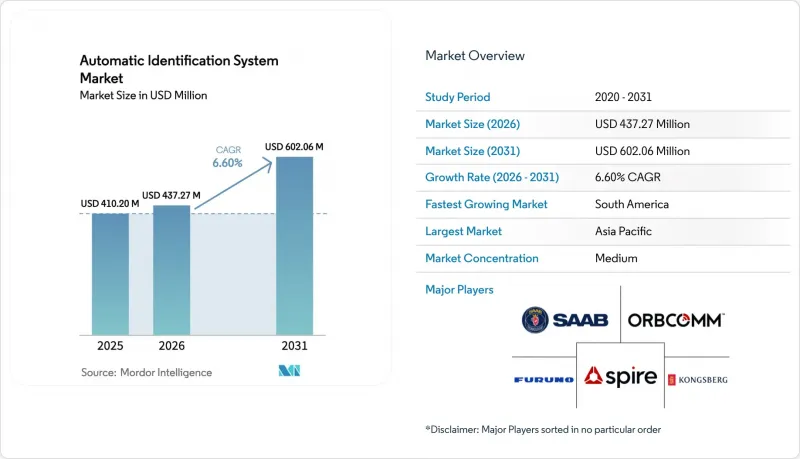
本報告按應用領域(船隊管理、船舶追蹤與監控及其他)、平台(船上AIS應答器、陸基站)、組件類別(A類應答器、B類應答器、AIS基地台、AIS接收器和閘道器)、解決方案(陸地AIS及其他)和地區進行細分。市場預測以美元計價。
全球自動識別系統市場趨勢與洞察
國際海事組織2024年授權擴大了對漁船的適用範圍。
國際海事組織(IMO)現已強制要求長度超過24公尺的漁船安裝AIS(自動識別系統),將先前不受SOLAS公約約束的船隊納入監管範圍。歐洲和亞太地區的合規工作最為積極,歐洲已有85%的漁船配備了B類應答器,而亞太地區的造船廠正在努力清理積壓的改裝訂單。該法規旨在打擊非法、未報告和無管制(IUU)捕撈活動,據估計,IUU捕撈每年造成200億美元的損失。衛星營運商從中受益,因為遠洋漁船很少在地面基地台的覆蓋範圍內航行。由於分階段推廣以及大量老舊漁船需要經濟高效的設備,預計到2025年,市場需求將保持強勁。這種成長也帶動了分析服務合約的增加,因為漁業管理部門不僅需要位置數據,還需要具有警報功能的即時地圖和儀錶板。
海上貿易量的成長正在推動基礎設施的數位化。
海運已恢復至疫情前水平,2018年至2023年間,非洲貨櫃船到港量和全球整體油輪到港量分別成長了20%和38%。這一復甦也暴露了營運中的盲點。巴拿馬運河因乾旱造成的擁擠以及紅海武裝無人機的威脅,迫使業者利用AIS系統提升情境察覺。從阿布達比到拉各斯,各地政府都在部署船舶交通管理系統,該系統能夠收集高密度AIS數據,並將船舶到港預測資訊提供給卡車運輸入口網站。對於供應商而言,隨著新增塔台和分析許可證的推出,每個終端的價值都在提升,重新運作了自動識別系統(AIS)的市場機會。由於港口若沒有公分級精度和低延遲的追蹤能力,就無法最佳化泊位分配,因此設備升級週期正在加快。
資料完整性問題會損害系統的可靠性。
由於惡意行為者試圖透過偽裝成油輪或非法捕魚船隊來逃避制裁,欺騙行為的發生頻率增加。 AIS 缺乏原生加密功能,因此容易受到身分資訊交換和虛假船舶資訊的植入攻擊。新加坡海峽和霍爾木茲海峽的頻段擁擠也增加了偵測難度。保險公司擔心,如果在碰撞調查中發現航跡篡改,將承擔相應的責任。三菱重工的「AIRIS」等衛星影像融合工具可以指出 AIS 位置資料和船舶輪廓之間的差異,但其實施成本仍然很高。除非 VDES 升級能夠迅速部署,否則持續存在的信任缺失可能會阻礙自動識別系統 (AIS) 市場的成長,尤其是在安全至關重要的自主導航領域。
細分市場分析
到2025年,船舶追蹤和監控市場規模將達到1.5605億美元,佔整個自動識別系統(AIS)市場的38.05%。航運公司正在將AIS數據與機艙遙測數據相結合,以評估碳排放強度,並透過重新規劃航線來避開堵塞,同時降低燃油成本和排放。隨著班輪聯盟部署需要數千個貨櫃即時位置資料的端到端控制塔,預計該細分市場仍將保持最大規模。班輪公司轉向多年期軟體即服務(SaaS)契約,將AIS與預測性調度和脫碳儀錶板結合,AIS市場也因此受益。
海上安保和搜救(SAR)領域正快速成長,預計將以7.55%的複合年成長率成長,這主要得益於國際海事組織(IMO)的溫室氣體戰略,該戰略將強制要求從2026年開始報告碳強度指數(CII)。監管機構和租船人現在要求提供每次航行的詳細二氧化碳排放基準,而自動識別系統(AIS)提供的帶時間戳的速度和距離數據將被納入這些計算中。隨著越來越多的船旗國採用市場機制,例如歐盟的排放交易體系,受排放合規工具的推動,自動識別系統(AIS)市場規模可能會成長兩倍。銷售用於計算每次航行「油井到航道」二氧化碳當量(CO2e)的疊加應用程式介面(API)的供應商正在獲得高額的經常性收入,並與純粹的硬體競爭對手形成差異化優勢。
根據《國際海上人命安全公約》(SOLAS)的規定,所有總噸位超過300噸的貨船都必須至少每6秒傳輸一次船舶識別和位置信息,因此船載應答器在自動識別系統(AIS)市場中佔據了71.95%的收入佔有率。由於安裝是強制性的,A類應答器的更換週期固定為大約5年。製造商正在推出內建加密晶片的VDES相容型號,並以15-20%的溢價出售。
儘管陸上基地台市場目前僅佔整體市場的不到三分之一,但其複合年成長率 (CAGR) 仍高達 7.42%,這主要得益於極地貿易的擴張、離岸風力發電電場的建設以及國防監測合約的增加。每增加一顆新的微型衛星,衛星的回訪頻率就會提高,從而降低延遲,實現近即時服務水平,這對於自主導航船舶的航線至關重要。對於採用混合方案的營運商而言,衛星可以彌補沿海通訊塔無法接收訊號的「通訊盲區」。這種混合模式使自動識別系統 (AIS) 市場成為一個涵蓋硬體和連接服務的市場,從而保護供應商免受商品化風險的影響。
區域分析
亞太地區擁有全球十大最繁忙貨櫃港口中的九個,並在「一帶一路」計劃的推動下,大力投資港口數位化升級,預計到2025年,港口數位化升級將佔全球收入的41.78%,佔最大佔有率。中國正在絲綢之路沿線的海上樞紐部署沿海基地台,而日本則在資助人工智慧控制的渡輪導航系統,該系統能夠獲取AIS資料並將其用於防撞演算法。印度海軍正在透過將美國捐贈的數據融合中心與價值1.25億美元的沿海監測塔連接起來,來擴展其對AIS資訊的國防需求。在聯合國港口績效指數中排名第一的新加坡,正在向碼頭營運商授權增值AIS分析服務,以實現15小時或更短的泊位週轉時間。商業貨物運輸、海軍安全和政府強制排放追蹤的協同作用,確保了亞太地區繼續保持其在自動識別系統市場的中心地位。
歐洲佔27.12%的市場佔有率,主要得益於其嚴格的安全標準和脫碳措施。即將推出的M級航標燈法規將允許遊艇船主進入AIS市場,從而將目標市場擴展到商業航運之外。挪威冰區服務公司將AIS與雷達和光學衛星結合,為極地航行提供保障,體現了歐洲在北極地區的專業技術。歐盟綠色交易的資金津貼了像Windward這樣的新創公司,該公司透過分析AIS行為模式來識別試圖規避制裁的“影子船隊”,並將合規挑戰轉化為軟體訂閱收入。
北美地區佔據23.96%的市場佔有率,這得益於美國海岸警衛隊嚴格的AIS部署規定以及大規模的海上態勢感知國防採購。 Saildrone和Palantir等技術合作夥伴將資訊輸入到依賴AIS指紋的敏感資料湖中。加拿大的CII報告指南與國際海事組織(IMO)的調查方法一致,並有助於採購受監管的資料平台。
儘管規模較小,但南美洲是自動識別系統 (AIS) 市場成長最快的地區,複合年成長率 (CAGR) 高達 7.47%,這主要得益於巴西的海上開採設施和阿根廷的糧食碼頭正在推動出口通道的數位轉型。 AD Ports 在中東和非洲的舉措,包括下一代船舶交通管理資訊系統 (VTMIS),正在逐步增加監控塔的安裝數量和分析許可證的發放數量。
其他好處
- Excel格式的市場預測(ME)表
- 3個月的分析師支持
目錄
第1章:引言
- 研究假設和市場定義
- 調查範圍
第2章:調查方法
第3章執行摘要
第4章 市場狀況
- 市場概覽
- 市場促進因素
- 國際海事組織自 2024 年起對長度超過 24 公尺的漁船實施強制性規定。
- 海上貿易和海上運輸量增加
- 利用AIS分析進行停靠港最佳化
- 北極航道對遠距AIS的需求
- AIS動態保險費
- CII/GHG報告中對基於AIS資料的必要性
- 市場限制因素
- 資料擁塞和欺騙事件
- 人口稠密和偏遠海域的觀測範圍和網路存在空白。
- 沿海地區5G甚高頻頻段重新分配的風險
- 自主導航中的衛星AIS延遲
- 產業價值鏈分析
- 監理情勢
- 技術展望
- 波特五力分析
第5章 市場規模與成長預測
- 透過使用
- 車隊管理
- 船舶追蹤和監控
- 日本海上保全廳搜救隊
- 其他
- 按平台
- 船上AIS應答器
- 陸基地站
- 按組件類
- A類應答器
- B類應答器
- AIS基地台
- AIS接收器/閘道器
- 透過解決方案
- 地面型AIS
- 衛星AIS(Sat-AIS)
- 混合AIS服務
- 按地區
- 北美洲
- 美國
- 加拿大
- 墨西哥
- 南美洲
- 巴西
- 阿根廷
- 智利
- 其他南美國家
- 歐洲
- 英國
- 德國
- 法國
- 義大利
- 西班牙
- 其他歐洲國家
- 亞太地區
- 中國
- 日本
- 印度
- 韓國
- 澳洲
- 新加坡
- 馬來西亞
- 其他亞太國家
- 中東和非洲
- 中東
- 沙烏地阿拉伯
- 阿拉伯聯合大公國
- 土耳其
- 其他中東國家
- 非洲
- 南非
- 奈及利亞
- 其他非洲地區
- 中東
- 北美洲
第6章 競爭情勢
- 市場集中度
- 策略趨勢
- 市佔率分析
- 公司簡介
- Saab AB
- Furuno Electric Co., Ltd.
- Spire Global Inc.
- ORBCOMM Inc.
- Garmin Ltd.
- Kongsberg Gruppen ASA
- True Heading(Shiptron Trading BV)
- Japan Radio Co., Ltd.
- CNS Systems AB
- Wartsila Corp.
- Simrad(Brunswick Corp.)
- L3Harris Technologies Inc.
- exactEarth Ltd.
- SRT Marine Systems plc
- MarineTraffic
- Thales Group
- Weatherdock AG
- Comnav Marine Ltd.
- Iridium Communications Inc.
- ACR Electronics(DSG)
第7章 市場機會與未來展望
According to Mordor Intelligence, the automatic identification system market size is expected to grow from USD 410.2 million in 2025 to USD 437.27 million in 2026 and is forecast to reach USD 602.06 million by 2031 at 6.6% CAGR over 2026-2031.
This report is Segmented by Application (Fleet Management, Vessel Tracking and Monitoring, and More), Platform (Vessel-Based AIS Transponders, and On-Shore-Based Stations), Component/Class (Class A Transponders, Class B Transponders, AIS Base Stations, and AIS Receivers/Gateways), Solution (Terrestrial AIS, and More), and Geography. The Market Forecasts are Provided in Terms of Value (USD).
Global Automatic Identification System Market Trends and Insights
IMO 2024 Mandate Expands Fishing Vessel Coverage
The International Maritime Organization now compels fishing vessels longer than 24 m to carry AIS, capturing a fleet previously outside the original SOLAS rules. Compliance activity is most intense in Europe, where 85% of eligible boats already carry Class B transponders, and in Asia-Pacific yards that are working through retrofit backlogs. The regulation is framed as an enforcement weapon against illegal, unreported, and unregulated fishing that drains USD 20 billion annually. Satellite operators benefit because remote-water fishing fleets seldom sail within range of terrestrial towers. Demand will remain elevated into 2025, given the phased roll-out and the large installed base of older vessels needing cost-sensitive equipment. Growth also ripples into analytics subscriptions because fisheries agencies want real-time maps and alerting dashboards rather than raw positions.
Rising Maritime Trade Volumes Drive Infrastructure Digitalization
Maritime cargo returned to pre-pandemic velocity, and port calls for container ships in Africa and tanker calls worldwide rose 20% and 38%, respectively, between 2018 and 2023. The rebound exposed operational blind spots: drought-fueled congestion at the Panama Canal and armed drone threats in the Red Sea both pushed operators toward AIS-enabled situational awareness. Authorities from Abu Dhabi to Lagos are installing vessel-traffic-management suites that ingest high-density AIS feeds and publish arrival predictions to trucking portals. For suppliers, every new tower and analytics license renews the Automatic Identification System market opportunity at a higher value per endpoint. Equipment refresh cycles accelerate because ports cannot optimize berth allocation without centimeter-accurate, low-latency tracking.
Data Integrity Challenges Undermine System Reliability
Spoofing frequency escalated as bad actors camouflaged sanction-evading tankers and illegal fishing fleets; AIS lacks native encryption, making it vulnerable to identity swaps and phantom ship insertions. Detection is difficult amid spectrum crowding in the Singapore Strait and Strait of Hormuz. Insurers worry about liability when collision investigations reveal falsified tracks. Satellite imagery fusion tools like Mitsubishi Heavy Industries' AIRIS flag discrepancies between AIS position and hull silhouette, but adoption costs remain high. Unless the VDES upgrade rolls out quickly, lingering trust deficits could restrain the Automatic Identification System market, especially for safety-critical autonomous navigation.
Other drivers and restraints analyzed in the detailed report include:
- Port Optimization Analytics: Transform Operational Efficiency
- Arctic Shipping Routes Demand Extended AIS Coverage
- VHF Spectrum Reallocation Threatens Traditional AIS Operations
For complete list of drivers and restraints, kindly check the Table Of Contents.
Segment Analysis
Vessel Tracking and Monitoring accounted for USD 156.05 million, translating into 38.05% of the Automatic Identification System market in 2025. Operators integrate AIS feeds with engine-room telemetry to benchmark carbon intensity and reroute vessels away from congestion, cutting bunker bills and emissions simultaneously. The segment will keep its numerical lead because liner shipping alliances roll out end-to-end control towers that require real-time position data for thousands of boxes. The Automatic Identification System market benefits as liners move from annual license purchases to multi-year software-as-a-service contracts that bundle AIS with predictive scheduling and decarbonization dashboards.
Maritime Security and SAR is the breakout opportunity, projected to expand at a 7.55% CAGR on the back of IMO's greenhouse-gas strategy, which mandates Carbon Intensity Indicator reporting beginning in 2026. Regulators and charterers now demand voyage-granular CO2 baselines; AIS offers the time-stamped speed and distance inputs that populate these formulas. The Automatic Identification System market size attributable to emissions compliance tools could triple as more flag states adopt market-based measures like the European Union's emissions trading scheme. Vendors selling overlay APIs that calculate well-to-wake CO2e per voyage extract high recurring revenue, distancing themselves from pure hardware competitors.
Vessel-based transponders represented 71.95% of the Automatic Identification System market revenue because SOLAS regulations obligate every cargo ship above 300 GT to broadcast identity and position at least every 6 seconds. The mandatory nature of carriage locks in a replacement cycle of roughly five years for Class A units. Manufacturers are shipping VDES-ready models with embedded encryption chips, commanding 15-20% price premiums.
On-Shore-Based Stations, though still less than one-third the size, is charting a robust 7.42% CAGR, propelled by expanding polar trade, offshore wind construction, and defense surveillance contracts. Each new microsatellite adds revisit frequency, lowering latency toward near-real-time service levels essential for autonomous-vessel corridors. For hybrid operators, satellite fills the black holes where coastal towers cannot hear. This hybridization cements the Automatic Identification System market as both a hardware and connectivity play, insulating suppliers from commoditization.
Complete Report Scope:
- By Application
- Fleet Management
- Vessel Tracking and Monitoring
- Maritime Security and SAR
- Other Applications
- By Platform
- Vessel-based AIS Transponders
- On-Shore-based Stations
- By Component / Class
- Class A Transponders
- Class B Transponders
- AIS Base Stations
- AIS Receivers / Gateways
- By Solution
- Terrestrial AIS
- Satellite AIS (Sat-AIS)
- Hybrid AIS Services
- By Geography
- North America
- United States
- Canada
- Mexico
- South America
- Brazil
- Argentina
- Chile
- Rest of South America
- Europe
- United Kingdom
- Germany
- France
- Italy
- Spain
- Rest of Europe
- Asia-Pacific
- China
- Japan
- India
- South Korea
- Australia
- Singapore
- Malaysia
- Rest of Asia-Pacific
- Middle East and Africa
- Middle East
- Saudi Arabia
- United Arab Emirates
- Turkey
- Rest of Middle East
- Africa
- South Africa
- Nigeria
- Rest of Africa
- Middle East
- North America
Geography Analysis
Asia-Pacific generates the largest slice of revenue, 41.78% in 2025, because it hosts nine of the world's ten busiest container ports and channels vast Belt and Road investments into digital-port upgrades. China deploys shore-based towers along Silk Road maritime nodes, while Japan funds AI-steered ferry pilots that ingest AIS feeds for collision-avoidance algorithms. India's Navy is wiring USD 125 million worth of coastal surveillance towers to U.S.-donated data-fusion centers, amplifying defense demand for AIS intelligence. Singapore, ranked top on the UN port-performance index, licenses value-added AIS analytics to terminal operators who target berth-turnaround times below 15 hours. This confluence of commercial freight, naval security, and government-mandated emissions tracking ensures Asia-Pacific remains the anchor of the Automatic Identification System market.
Europe holds a 27.12% share, driven by stringent safety codes and decarbonization policy. The forthcoming Class M beacon rule pushes pleasure-craft owners into the Automatic Identification System market, expanding the addressable base beyond commercial shipping. Norway's Ice Service showcases Europe's specialized Arctic competence, blending AIS with radar and optical satellites to safeguard polar voyages. EU green-deal funding channels grants to start-ups like Windward that analyze AIS behavioral patterns to flag sanctions-evading "shadow fleets," turning compliance pain points into software-subscription revenue.
North America maintains a 23.96% share on the back of the U.S. Coast Guard's strict AIS carriage rules and substantial defense procurement for maritime domain awareness. Tech partnerships, such as Saildrone with Palantir, feed classified data lakes that rely on AIS fingerprints. Canada's CII reporting guidance aligns with IMO methodology and triggers procurement of rule-ready data platforms.
South America, while smaller, is the Automatic Identification System market's fastest-growing geography at 7.47% CAGR, thanks to Brazilian offshore rigs and Argentine grain terminals that digitize export corridors. Middle East and African initiatives, including AD Ports' next-gen VTMIS, add incremental tower installations and analytics licenses.
- Saab AB
- Furuno Electric Co., Ltd.
- Spire Global Inc.
- ORBCOMM Inc.
- Garmin Ltd.
- Kongsberg Gruppen ASA
- True Heading (Shiptron Trading B.V.)
- Japan Radio Co., Ltd.
- CNS Systems AB
- Wartsila Corp.
- Simrad (Brunswick Corp.)
- L3Harris Technologies Inc.
- exactEarth Ltd.
- SRT Marine Systems plc
- MarineTraffic
- Thales Group
- Weatherdock AG
- Comnav Marine Ltd.
- Iridium Communications Inc.
- ACR Electronics (DSG)
Additional Benefits:
- The market estimate (ME) sheet in Excel format
- 3 months of analyst support
TABLE OF CONTENTS
1 INTRODUCTION
- 1.1 Study Assumptions and Market Definition
- 1.2 Scope of the Study
2 RESEARCH METHODOLOGY
3 EXECUTIVE SUMMARY
4 MARKET LANDSCAPE
- 4.1 Market Overview
- 4.2 Market Drivers
- 4.2.1 IMO 2024 mandate for longer than 24 m fishing vessels
- 4.2.2 Rising maritime trade and traffic volumes
- 4.2.3 Port-call optimisation via AIS-analytics
- 4.2.4 Arctic shipping lanes demand long-range AIS
- 4.2.5 AIS-driven dynamic insurance premiums
- 4.2.6 CII/GHG reporting needs AIS?based data
- 4.3 Market Restraints
- 4.3.1 Data congestion and spoofing incidents
- 4.3.2 Range/coverage gaps in dense and remote seas
- 4.3.3 Coastal 5G VHF spectrum re-allocation risk
- 4.3.4 Sat-AIS latency for autonomous navigation
- 4.4 Industry Value Chain Analysis
- 4.5 Regulatory Landscape
- 4.6 Technological Outlook
- 4.7 Porter's Five Forces Analysis
- 4.7.1 Bargaining Power of Suppliers
- 4.7.2 Bargaining Power of Buyers
- 4.7.3 Threat of New Entrants
- 4.7.4 Threat of Substitutes
- 4.7.5 Competitive Rivalry
5 MARKET SIZE AND GROWTH FORECASTS (VALUES)
- 5.1 By Application
- 5.1.1 Fleet Management
- 5.1.2 Vessel Tracking and Monitoring
- 5.1.3 Maritime Security and SAR
- 5.1.4 Other Applications
- 5.2 By Platform
- 5.2.1 Vessel-based AIS Transponders
- 5.2.2 On-Shore-based Stations
- 5.3 By Component / Class
- 5.3.1 Class A Transponders
- 5.3.2 Class B Transponders
- 5.3.3 AIS Base Stations
- 5.3.4 AIS Receivers / Gateways
- 5.4 By Solution
- 5.4.1 Terrestrial AIS
- 5.4.2 Satellite AIS (Sat-AIS)
- 5.4.3 Hybrid AIS Services
- 5.5 By Geography
- 5.5.1 North America
- 5.5.1.1 United States
- 5.5.1.2 Canada
- 5.5.1.3 Mexico
- 5.5.2 South America
- 5.5.2.1 Brazil
- 5.5.2.2 Argentina
- 5.5.2.3 Chile
- 5.5.2.4 Rest of South America
- 5.5.3 Europe
- 5.5.3.1 United Kingdom
- 5.5.3.2 Germany
- 5.5.3.3 France
- 5.5.3.4 Italy
- 5.5.3.5 Spain
- 5.5.3.6 Rest of Europe
- 5.5.4 Asia-Pacific
- 5.5.4.1 China
- 5.5.4.2 Japan
- 5.5.4.3 India
- 5.5.4.4 South Korea
- 5.5.4.5 Australia
- 5.5.4.6 Singapore
- 5.5.4.7 Malaysia
- 5.5.4.8 Rest of Asia-Pacific
- 5.5.5 Middle East and Africa
- 5.5.5.1 Middle East
- 5.5.5.1.1 Saudi Arabia
- 5.5.5.1.2 United Arab Emirates
- 5.5.5.1.3 Turkey
- 5.5.5.1.4 Rest of Middle East
- 5.5.5.2 Africa
- 5.5.5.2.1 South Africa
- 5.5.5.2.2 Nigeria
- 5.5.5.2.3 Rest of Africa
- 5.5.5.1 Middle East
- 5.5.1 North America
6 COMPETITIVE LANDSCAPE
- 6.1 Market Concentration
- 6.2 Strategic Moves
- 6.3 Market Share Analysis
- 6.4 Company Profiles (includes Global level Overview, Market level overview, Core Segments, Financials as available, Strategic Information, Market Rank/Share for key companies, Products and Services, and Recent Developments)
- 6.4.1 Saab AB
- 6.4.2 Furuno Electric Co., Ltd.
- 6.4.3 Spire Global Inc.
- 6.4.4 ORBCOMM Inc.
- 6.4.5 Garmin Ltd.
- 6.4.6 Kongsberg Gruppen ASA
- 6.4.7 True Heading (Shiptron Trading B.V.)
- 6.4.8 Japan Radio Co., Ltd.
- 6.4.9 CNS Systems AB
- 6.4.10 Wartsila Corp.
- 6.4.11 Simrad (Brunswick Corp.)
- 6.4.12 L3Harris Technologies Inc.
- 6.4.13 exactEarth Ltd.
- 6.4.14 SRT Marine Systems plc
- 6.4.15 MarineTraffic
- 6.4.16 Thales Group
- 6.4.17 Weatherdock AG
- 6.4.18 Comnav Marine Ltd.
- 6.4.19 Iridium Communications Inc.
- 6.4.20 ACR Electronics (DSG)
7 MARKET OPPORTUNITIES AND FUTURE OUTLOOK
- 7.1 White-space and Unmet-need Assessment

 自動識別系統 (AIS) 市場:按組件、平台類型、通訊類型、技術類型、船舶類型、應用和最終用戶分類—2026-2032 年全球市場預測
 自動識別和資料擷取(AIDC) 市場規模、佔有率、趨勢和預測:按產品、產品類型、產業和地區分類,2026-2034 年船舶自動識別系統市場報告:按船型、組件、平台、應用和地區分類,2026-2034年
 自動識別系統(AIS)市場:規模、佔有率、成長率、全球產業分析、按類型、應用和地區分類以及未來預測(2026-2034 年)ID卡證件閱讀器市場:按閱讀器類型、最終用戶、應用、分銷管道分類,全球預測(2026-2032年)
 醫療保健自動識別和資料收集市場:依產品、技術、應用和地區,至2036年全球預測
 自動識別與資料擷取(AIDC):市場佔有率分析、產業趨勢與統計、成長預測(2026-2031)全球堅固型工業手持閱讀器市場(按類型、連接方式、作業系統、操作模式、價格範圍、應用和最終用戶產業分類)預測(2026-2032年)
 自動識別系統 (AIS) 市場規模、佔有率和成長分析(按類別、平台、應用、最終用戶和地區分類)—2026-2033 年行業預測
 AIT防止的全球市場:2024-2029年