


 |
市場調查報告書
商品編碼
2122897
汽車和交通運輸連接器:市場佔有率分析、行業趨勢和統計數據以及成長預測(2026-2031 年)Automotive And Transportation Connector - Market Share Analysis, Industry Trends & Statistics, Growth Forecasts (2026 - 2031) |
||||||

※ 本網頁內容可能與最新版本有所差異。詳細情況請與我們聯繫。
據 Mordor Intelligence 稱,汽車和運輸連接器市場預計到 2026 年價值 150.2 億美元,高於 2025 年的 143.5 億美元,預計到 2031 年將達到 189.1 億美元。
預計從 2026 年到 2031 年,其複合年成長率將達到 4.69%。
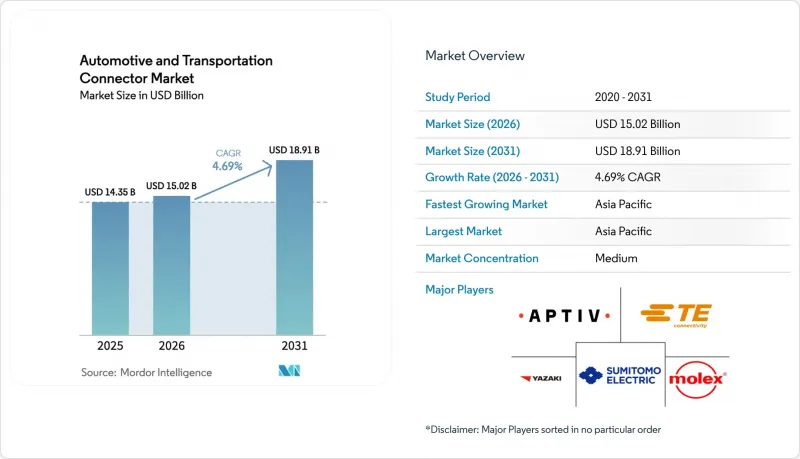
本報告按產品類型(線對板連接器、闆對板連接器、其他)、應用領域(安全防護、汽車線束及配電、其他)、車輛類型(乘用車、輕型商用車、其他)、動力系統、配銷通路和地區進行細分。市場預測以美元計價。
全球汽車及交通運輸連接器市場趨勢及洞察
電氣化的快速發展正在推動高壓連接器的需求。
與同等內燃機汽車相比,電動車所需的銅量大約是其三倍,這顯著提高了連接器電流容量和爬電距離的設計要求。 TE Connectivity 的 AMP+ 系列連接器已支援 800V 架構,採用防觸電外殼和最佳化的隔離通道,能夠承受超過 350A 的充電電流。隨著電流的不斷成長,浸沒式冷卻連接器組件應運而生,以確保超快速充電過程中的熱極限。能夠提供介電強度、抗振性和自動化製造能力均衡組合的供應商,正逐漸成為全球電動車專案的首選供應商。
ADAS(高級駕駛輔助系統)與資訊娛樂系統的整合正在推動對高速數據連接器的需求。
自動駕駛原型每天產生超過 4TB 的數據,因此需要一種能夠以低於 1dB 的插入損耗傳輸 20GHz 訊號的連接器系統,同時還要能夠承受高振動。 Aptiv 的 H-MTD 微型同軸連接器系列在密封的汽車外殼內滿足 56Gbps 的面積較小。向 1000BASE-T1 等乙太網路標準的過渡將線束簡化為單對雙絞線,從而有助於豪華車實現輕量化目標。連接器可靠的電磁干擾 (EMI) 性能直接影響基於攝影機的感測器融合的精度,而這種融合對於支援 L3 級自動駕駛至關重要。
銅價波動推高了物料清單成本。
全球銅供應無法滿足電氣化所帶來的需求成長。美國地質調查局(USGS)指出,礦石品位下降推高了採礦成本,導致銅價波動,預計2024年平均價格將達到每噸8,490美元。因此,連接器的材料清單(BOM)審查頻率更高,工程團隊正在考慮使用鋁合金製造一些不太關鍵的電源引腳,儘管鋁合金的導電性仍然較低。目前,回收銅佔全球銅消費量的32%,但由於汽車級銅的潔淨度要求,其應用仍有限。
細分市場分析
2025年,線對板(WTB)設計將佔銷售額的39.12%,凸顯其在儀器板領域的持久地位。然而,在汽車和交通運輸連接器市場,目前主要的研發工作集中在高壓組件上,預計到2031年,其複合年成長率將達到9.17%。高電流連接器類別受益於工作電壓為800V的碳化矽(SiC)逆變器的普及,這些逆變器需要更大的爬電距離和液冷引腳。隨著雷達和攝影機數量的增加,射頻和同軸連接器也重新變得重要。為了滿足全球安全標準,JAE等供應商正在將電磁鎖和緊急釋放功能整合到200A CHAdeMO插頭中。
儘管基板對板夾層式封裝仍然是標準ECU封裝的主流,但區域專用硬體的採用已將引腳密度提升至每英吋120個以上。將訊號和50A刀片整合於單一接頭內的混合式外殼減少了SKU數量,並簡化了自動化貼片流程。因此,模組整合商現在不再將連接器視為通用連接點,而是將其視為功能性子系統,從而在汽車和運輸連接器市場中保持了高階定價。
預計到2025年,車輛佈線和配電支出將佔總支出的37.74%,而隨著攝影機、雷達和雷射雷達感測器的快速普及,高級駕駛輔助系統(ADAS)和自動駕駛電子設備的複合年成長率(CAGR)預計將達到11.74%。這一成長趨勢使得ADAS互聯成為專業供應商提高利潤率的最快途徑。駕駛座娛樂平台也緊跟著,因為身臨其境型顯示器和空中昇級需要多Gigabit的骨幹網路。
隨著電動車銷量的成長,汽車和交通運輸領域動力傳動系統和電池系統的連接器市場預計將會擴大,而屏蔽式高壓介面可望實現規模經濟。同時,安全模組在滿足 ISO 26262 診斷要求的同時,透過將冗餘電源引腳整合到單一外殼中,最大限度地減少了空間浪費。
區域分析
到2025年,亞太地區將佔全球銷售額的45.05%,這反映了其作為全球最大的汽車組裝中心和成長最快的電動車叢集的地位。中國整車製造商對高壓和電池管理連接器的需求集中,而日本和韓國則為全球高階品牌提供精密基板對板連接器和同軸連接器。印尼2024年乘用車產量預計達到140萬輛,凸顯了東南亞作為二級生產中心的崛起,加速了當地連接器模具的開發,即便美國採購法規收緊了對中國製造零件的認證要求。
在北美,豪華卡車對防護等級超過IP68的密封圓形電源連接器的需求依然強勁。 《通貨膨脹控制法案》為國內電池工廠提供獎勵,刺激了高壓端子的本地供應。加拿大銅產量在2024年達到508,250噸,為該地區的沖壓成型企業提供了穩定的原料供應,從而對沖了價格波動風險。連接器製造商也面臨著將於2027年生效的關於使用美國製造零件的限制(禁止使用中國製造的車載資訊服務模組),這加速了雙源認證的取得。
在歐洲,先進的電動車生產與進口激增帶來的成本壓力並存。德國在2024年生產了135萬輛電動車,但同年歐盟製造商卻失去了53,669個工作機會。歐盟委員會的「戰略對話」計畫正利用「地平線基金」投資建造一個可互通的10BASE-T1S網路,以減輕線束重量。同時,中東和非洲的計畫正利用海灣國家智慧城市建設的投資以及在南非的出口合約。英國承諾從2027年起將工業用電價格降低25%,旨在恢復連接器壓接加工產業的競爭。
其他好處
- Excel格式的市場預測(ME)表
- 3個月的分析師支持
目錄
第1章:引言
- 研究假設和市場定義
- 調查範圍
第2章:調查方法
第3章執行摘要
第4章 市場狀況
- 市場概覽
- 市場促進因素
- 電氣化的快速發展正在推動高壓連接器的需求。
- ADAS(高級駕駛輔助系統)與資訊娛樂系統的整合正在推動對高速數據連接器的需求。
- 向基於區域的電子電氣架構的轉變正在推動對高基板邊連接器的需求。
- 由於符合安全關鍵系統(ISO 26262、UN R155)的要求,可靠性要求有所提高。
- 遷移到Gigabit乙太網路和 FAKRA-Mini 同軸介面
- 內燃機車中新型48V子系統的出現
- 市場限制因素
- 銅價波動導致物料清單成本上升
- 地方採購義務限制了低成本採購。
- 因連接器密封或壓接缺陷而召回。
- 汽車無線感測器節點的增加導致有線連接埠的減少。
- 價值供應鏈分析
- 監理情勢
- 技術展望
- 波特五力模型
第5章 市場規模與成長預測
- 依產品類型
- 線對板連接器
- 闆對板連接器
- 線對線連接器
- 高壓/電動車連接器
- 射頻/同軸連接器
- 模組化混合連接器
- 透過使用
- 安全保障
- 車輛線路和配電
- 駕駛座、連網和娛樂 (CCE)
- 動力傳動系統電池系統
- 高級駕駛輔助系統和自動駕駛
- 按車輛類型
- 搭乘用車
- 輕型商用車
- 中型和大型商用車輛
- 摩托車
- 透過推進力
- 內燃機車
- 油電混合車
- 插電式混合動力電動車
- 電池式電動車
- 透過分銷管道
- OEM
- 售後市場
- 按地區
- 北美洲
- 美國
- 加拿大
- 其他北美國家
- 南美洲
- 巴西
- 阿根廷
- 其他南美國家
- 歐洲
- 德國
- 英國
- 法國
- 義大利
- 西班牙
- 俄羅斯
- 其他歐洲國家
- 亞太地區
- 中國
- 日本
- 韓國
- 印度
- 其他亞太國家
- 中東和非洲
- 沙烏地阿拉伯
- 阿拉伯聯合大公國
- 埃及
- 土耳其
- 南非
- 其他中東和非洲國家
- 北美洲
第6章 競爭情勢
- 市場集中度
- 策略趨勢
- 市佔率分析
- 公司簡介
- TE Connectivity
- Yazaki Corporation
- Aptiv PLC
- Amphenol Corporation
- Molex(Koch Industries)
- Sumitomo Electric Industries
- Lear Corporation
- Leoni AG
- Korea Electric Terminal(KET)
- Rosenberger Hochfrequenztechnik
- Luxshare Precision Industry
- JST Mfg.
- HARTING Technology Group
- Furukawa Electric
- ITT Cannon
- Hirose Electric
- Japan Aviation Electronics(JAE)
第7章 市場機會與未來展望
According to Mordor Intelligence, the automotive and transportation connector market size in 2026 is estimated at USD 15.02 billion, growing from 2025 value of USD 14.35 billion with 2031 projections showing USD 18.91 billion, growing at 4.69% CAGR over 2026-2031.
This report is Segmented by Product Type (Wire-To-Board Connectors, Board-To-Board Connectors, and More), Application (Safety and Security, Body Wiring and Power Distribution, and More), Vehicle Type (Passenger Cars, Light Commercial Vehicles, and More), Propulsion, Sales Channel, and Geography. The Market Forecasts are Provided in Terms of Value (USD).
Global Automotive And Transportation Connector Market Trends and Insights
Electrification Surge Spurring High-Voltage Connector Demand
Electric vehicles require nearly three times more copper than comparable combustion models, driving a parallel jump in connector amperage and creepage design discipline. TE Connectivity's AMP+ range already supports 800 V architectures, using touch-safe housings and optimized insulation paths that withstand charging currents above 350 A . Immersion-cooled connector assemblies are emerging as currents climb, ensuring thermal limits during ultra-fast charging sessions. Suppliers capable of balancing dielectric strength, vibration resistance, and automated manufacturability gain preferred-source status among global EV programs.
ADAS and Infotainment Integration Driving High-Speed Data Connectors
Autonomous prototypes generate over 4 TB of data per day, dictating connector systems that endure high vibration while transmitting 20 GHz signals at under-1 dB insertion loss. Aptiv's H-MTD miniature coax family meets 56 Gbps requirements within a sealed automotive housing, shrinking footprint versus legacy FAKRA designs. Ethernet shifts such as 1000BASE-T1 simplify wiring harnesses to a single twisted pair, supporting weight reduction targets on premium vehicles. Reliable connector EMI performance directly shapes camera-based sensor fusion accuracy that underpins level-3 autonomy.
Copper-Price Volatility Inflating BOM Costs
Global copper supply lags electrification demand, and the US Geological Survey notes declining ore grades lift extraction costs, contributing to price swings that averaged USD 8,490 per tonne in 2024. Connector bills of material are therefore indexed more frequently, and engineering teams test aluminum alloys for non-critical power pins even though conductivity remains lower. Recycling now covers 32% of worldwide copper consumption, but automotive-grade cleanliness limits still confine the practice .
Other drivers and restraints analyzed in the detailed report include:
- Shift to Zonal Architectures Boosting High-Density Board-Edge Connectors
- Safety-Critical Compliance Heightening Reliability Needs
- Local-Sourcing Mandates Limiting Procurement Flexibility
For complete list of drivers and restraints, kindly check the Table Of Contents.
Segment Analysis
Wire-to-board designs kept 39.12% of 2025 revenue, confirming their evergreen role in instrumentation panels, yet the automotive and transportation connector market now directs major R&D toward high-voltage assemblies that will grow 9.17% CAGR to 2031. The high-current category benefits from silicon-carbide inverters operating at 800 V, which demand reinforced creepage gaps and liquid-cooled pins. RF & coax connectors also gain renewed relevance as radar and camera counts increase. Suppliers such as JAE incorporate electromagnetic locks and emergency unmating in 200 A CHAdeMO plugs to satisfy global safety codes.
Standard ECU packaging still leans on board-to-board mezzanine decks, but zonal hardware elevates density beyond 120 pins per inch. Hybrid housings that mix signal and 50 A blades inside one header reduce SKU count and simplify automated pick-and-place. As a result, module integrators now treat the connector as a functional sub-system rather than a commodity fastening point, sustaining premium pricing inside the automotive and transportation connector market.
Body wiring and power distribution commanded 37.74% of 2025 spend, yet ADAS and autonomous electronics will log a 11.74% CAGR as camera, radar, and lidar sensor proliferation intensifies. That uptrend positions ADAS connectivity as the fastest pathway to margin expansion for specialized suppliers. Cockpit entertainment platforms follow closely because immersive displays and over-the-air upgrades need multi-gigabit backbones.
The automotive and transportation connector market size for powertrain and battery systems is projected to climb in tandem with EV unit growth, opening space for scale economies on shielded high-voltage interfaces. Meanwhile, safety-security modules integrate redundant power pins within a single housing, limiting space overhead while meeting ISO 26262 diagnostics requirements.
Complete Report Scope:
- By Product Type
- Wire-to-Board Connectors
- Board-to-Board Connectors
- Wire-to-Wire Connectors
- High-Voltage/EV Connectors
- RF & Coax Connectors
- Modular/Hybrid Connectors
- By Application
- Safety and Security
- Body Wiring and Power Distribution
- Cockpit, Connectivity and Entertainment (CCE)
- Powertrain and Battery Systems
- Advanced Driver-Assistance/Autonomous
- By Vehicle Type
- Passenger Cars
- Light Commercial Vehicles
- Medium and Heavy Commercial Vehicles
- Two-Wheelers
- By Propulsion
- Internal-Combustion Engine Vehicles
- Hybrid Electric Vehicles
- Plug-in Hybrid Electric Vehicles
- Battery Electric Vehicles
- By Sales Channel
- OEM
- Aftermarket
- By Geography
- North America
- United States
- Canada
- Rest of North America
- South America
- Brazil
- Argentina
- Rest of South America
- Europe
- Germany
- United Kingdom
- France
- Italy
- Spain
- Russia
- Rest of Europe
- Asia Pacific
- China
- Japan
- South Korea
- India
- Rest of Asia Pacific
- Middle East and Africa
- Saudi Arabia
- United Arab Emirates
- Egypt
- Turkey
- South Africa
- Rest of Middle East and Africa
- North America
Geography Analysis
Asia-Pacific contributed 45.05% of 2025 revenue, reflecting its position as both the world's largest vehicle assembly hub and the fastest-growing electric-mobility cluster. Chinese OEMs generate concentrated demand for high-voltage and battery-management connectors, while Japan and Korea supply precision board-to-board and coaxial formats for global premium nameplates. Indonesia's passenger-car output of 1.4 million units in 2024 underscored Southeast Asia's rise as a secondary production base that stimulates local connector tooling even as US sourcing rules tighten qualification paths for Chinese-made parts.
North America maintains premium-truck demand that favors sealed circular power connectors rated beyond IP68. The Inflation Reduction Act channels incentives into domestic battery plants, spurring localized high-voltage terminal supply. Canadian copper output of 508,250 tonnes in 2024 shores up raw-material availability for regional stamping operations that hedge price shocks. Connector makers also confront upcoming U.S. content rules slated for 2027 that bar Chinese telematics modules, accelerating dual-source qualifications.
Europe combines advanced EV production with cost pressure from surging imports. Germany built 1.35 million electric cars in 2024, yet EU manufacturers lost 53,669 jobs in the same year. The European Commission's Strategic Dialogue is funneling Horizon funds into interoperable 10BASE-T1S networking to cut harness weight, while Middle East and African projects tap Gulf smart-city investments and South-African export contracts. The UK's pledge to lower industrial power tariffs by 25% from 2027 aims to restore connector stamping competitiveness.
- TE Connectivity
- Yazaki Corporation
- Aptiv PLC
- Amphenol Corporation
- Molex (Koch Industries)
- Sumitomo Electric Industries
- Lear Corporation
- Leoni AG
- Korea Electric Terminal (KET)
- Rosenberger Hochfrequenztechnik
- Luxshare Precision Industry
- JST Mfg.
- HARTING Technology Group
- Furukawa Electric
- ITT Cannon
- Hirose Electric
- Japan Aviation Electronics (JAE)
Additional Benefits:
- The market estimate (ME) sheet in Excel format
- 3 months of analyst support
TABLE OF CONTENTS
1 Introduction
- 1.1 Study Assumptions & Market Definition
- 1.2 Scope of the Study
2 Research Methodology
3 Executive Summary
4 Market Landscape
- 4.1 Market Overview
- 4.2 Market Drivers
- 4.2.1 Electrification Surge Spurring High-Voltage Connector Demand
- 4.2.2 ADAS and Infotainment Integration Driving High-Speed Data Connectors
- 4.2.3 Shift to Zonal E/E Architectures Boosting High-Density Board-Edge Connectors
- 4.2.4 Safety-Critical Compliance (ISO 26262, UN R155) Heightening Reliability Needs
- 4.2.5 Migration to Gigabit Ethernet and FAKRA-Mini Coax Interfaces
- 4.2.6 Emerging 48 V Sub-Systems in ICE Vehicles
- 4.3 Market Restraints
- 4.3.1 Copper-Price Volatility Inflating BOM Costs
- 4.3.2 Local-Sourcing Mandates Limiting Low-Cost Procurement
- 4.3.3 Recalls from Connector Seal or Crimp Failures
- 4.3.4 Rising In-Vehicle Wireless Sensor Nodes Reducing Hard-Wired Ports
- 4.4 Value / Supply-Chain Analysis
- 4.5 Regulatory Landscape
- 4.6 Technological Outlook
- 4.7 Porter's Five Forces
- 4.7.1 Threat of New Entrants
- 4.7.2 Bargaining Power of Buyers
- 4.7.3 Bargaining Power of Suppliers
- 4.7.4 Threat of Substitutes
- 4.7.5 Competitive Rivalry
5 Market Size & Growth Forecasts (Value, USD)
- 5.1 By Product Type
- 5.1.1 Wire-to-Board Connectors
- 5.1.2 Board-to-Board Connectors
- 5.1.3 Wire-to-Wire Connectors
- 5.1.4 High-Voltage/EV Connectors
- 5.1.5 RF & Coax Connectors
- 5.1.6 Modular/Hybrid Connectors
- 5.2 By Application
- 5.2.1 Safety and Security
- 5.2.2 Body Wiring and Power Distribution
- 5.2.3 Cockpit, Connectivity and Entertainment (CCE)
- 5.2.4 Powertrain and Battery Systems
- 5.2.5 Advanced Driver-Assistance/Autonomous
- 5.3 By Vehicle Type
- 5.3.1 Passenger Cars
- 5.3.2 Light Commercial Vehicles
- 5.3.3 Medium and Heavy Commercial Vehicles
- 5.3.4 Two-Wheelers
- 5.4 By Propulsion
- 5.4.1 Internal-Combustion Engine Vehicles
- 5.4.2 Hybrid Electric Vehicles
- 5.4.3 Plug-in Hybrid Electric Vehicles
- 5.4.4 Battery Electric Vehicles
- 5.5 By Sales Channel
- 5.5.1 OEM
- 5.5.2 Aftermarket
- 5.6 By Geography
- 5.6.1 North America
- 5.6.1.1 United States
- 5.6.1.2 Canada
- 5.6.1.3 Rest of North America
- 5.6.2 South America
- 5.6.2.1 Brazil
- 5.6.2.2 Argentina
- 5.6.2.3 Rest of South America
- 5.6.3 Europe
- 5.6.3.1 Germany
- 5.6.3.2 United Kingdom
- 5.6.3.3 France
- 5.6.3.4 Italy
- 5.6.3.5 Spain
- 5.6.3.6 Russia
- 5.6.3.7 Rest of Europe
- 5.6.4 Asia Pacific
- 5.6.4.1 China
- 5.6.4.2 Japan
- 5.6.4.3 South Korea
- 5.6.4.4 India
- 5.6.4.5 Rest of Asia Pacific
- 5.6.5 Middle East and Africa
- 5.6.5.1 Saudi Arabia
- 5.6.5.2 United Arab Emirates
- 5.6.5.3 Egypt
- 5.6.5.4 Turkey
- 5.6.5.5 South Africa
- 5.6.5.6 Rest of Middle East and Africa
- 5.6.1 North America
6 Competitive Landscape
- 6.1 Market Concentration
- 6.2 Strategic Moves
- 6.3 Market Share Analysis
- 6.4 Company Profiles (includes Global Level Overview, Market Level Overview, Core Segments, Financials as Available, Strategic Information, Market Rank/Share for Key Companies, Products and Services, SWOT Analysis, and Recent Developments)
- 6.4.1 TE Connectivity
- 6.4.2 Yazaki Corporation
- 6.4.3 Aptiv PLC
- 6.4.4 Amphenol Corporation
- 6.4.5 Molex (Koch Industries)
- 6.4.6 Sumitomo Electric Industries
- 6.4.7 Lear Corporation
- 6.4.8 Leoni AG
- 6.4.9 Korea Electric Terminal (KET)
- 6.4.10 Rosenberger Hochfrequenztechnik
- 6.4.11 Luxshare Precision Industry
- 6.4.12 JST Mfg.
- 6.4.13 HARTING Technology Group
- 6.4.14 Furukawa Electric
- 6.4.15 ITT Cannon
- 6.4.16 Hirose Electric
- 6.4.17 Japan Aviation Electronics (JAE)
7 Market Opportunities & Future Outlook
- 7.1 White-space & Unmet-Need Assessment

 汽車連接器市場預測至2034年-全球分析(依連接器類型、連接方式、密封方式、額定電流、安裝方式、材質、車輛類型、驅動系統、應用、最終用戶和地區分類)
 汽車與運輸連接器市場報告:趨勢、預測和競爭分析(至2035年)
 汽車連接器:市場佔有率分析、產業趨勢與統計、成長預測(2026-2031)
 汽車連接器市場:2026-2032年全球市場預測(按產品類型、額定電流、安裝方式、材質、車輛類型、應用和最終用戶分類)
 商用車連接器市場分析及預測(至2035年):類型、產品類型、技術、組件、應用、材質、最終用戶、功能、安裝配置、解決方案汽車連接器市場分析及預測(至2035年):類型、產品類型、技術、組件、應用、材質、最終用戶、功能、安裝配置
 汽車連接器市場規模、佔有率、趨勢和預測:按連接方式、連接器類型、系統類型、車輛類型、應用和地區分類,2026-2034 年汽車動力系統連接器市場報告:趨勢、預測和競爭分析(至2035年)日本汽車連接器市場規模、佔有率、趨勢和預測:按連接類型、連接器類型、系統類型、車輛類型、應用和地區分類,2026-2034年
 汽車連接器市場-全球產業規模、佔有率、趨勢、機會和預測:按連接類型、應用、車輛類型、地區和競爭格局分類,2021-2031年