


 |
市場調查報告書
商品編碼
2120372
汽車連接器:市場佔有率分析、產業趨勢與統計、成長預測(2026-2031)Automotive Connector - Market Share Analysis, Industry Trends & Statistics, Growth Forecasts (2026 - 2031) |
||||||

※ 本網頁內容可能與最新版本有所差異。詳細情況請與我們聯繫。
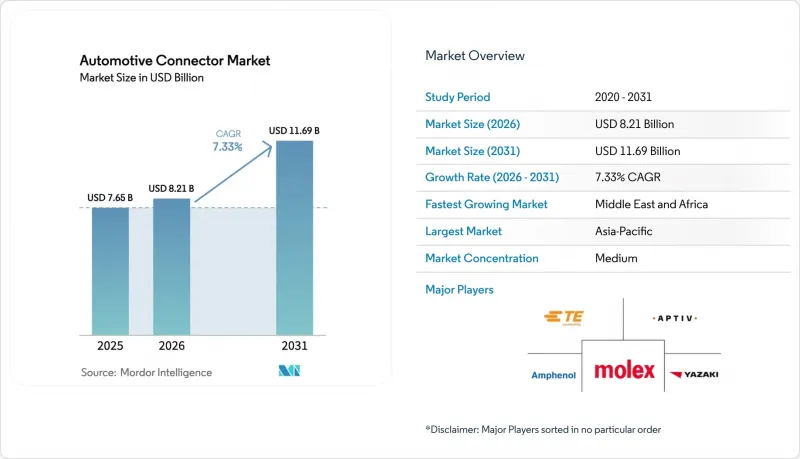
根據 Mordor Intelligence 預測,汽車連接器市場規模將從 2025 年的 76.5 億美元成長到 2026 年的 82.1 億美元,然後在 2031 年達到 116.9 億美元,2026 年至 2031 年的複合年成長率為 7.33%。
本報告按應用領域(動力傳動系統、安全防護及其他)、車輛類型(乘用車、輕型商用車及其他)、驅動方式(內燃機車輛、混合動力車輛及其他)、連接器類型(線對線連接及其他)、連接密封類型(密封、非密封)和地區進行細分。市場預測以價值(美元)和銷售量(單位)表示。
全球汽車連接器市場趨勢及洞察
加速電氣化和高壓電動動力傳動系統
高能量架構正從400伏特電池組轉變為800伏特電池組轉變,這要求連接器能夠承受更高的持續電流並保持低接觸電阻。 CharIN兆瓦級充電系統於2024年完成,其認證的介面能夠為商用卡車提供高達3.75兆瓦的功率,這需要重新設計端子形狀和液冷通道。對鋰離子電池熱失控的擔憂迫使原始設備製造商(OEM)採用符合UL 94 V-0標準的阻燃外殼,這縮小了樹脂的選擇範圍並增加了成本。冗餘的高壓互鎖引腳使每個連接器增加了2-4個引腳位置,提高了引腳密度並收緊了公差。這些需求共同促使人們重新評估供應鏈的優先事項,並增加對高壓測試實驗室和自動化密封生產線的投資。
向基於區域的電子電氣架構的轉變正在推動高密度連接器的發展。
基於區域的策略透過減少實體介面數量來集中資料流量,同時將來自電控系統(ECU) 的測量資料聚合到區域運算節點,從而減少高達 30% 的佈線。這些節點上的連接器通常有 50 個或更多引腳,單一插錯的影響會被放大,因此原始設備製造商 (OEM) 要求採用輔助鎖定功能和帶鍵顏色編碼。供應商正在對連接器外殼進行標準化,無論電壓或訊號類型如何,以降低庫存複雜性,這項選擇也加速了全球平台的部署。雖然這種整合減少了零件種類,但性能要求很高,因此需要能夠處理從低功耗感測器鏈路到高電流電源幹線等各種應用且尺寸不變的連接器系列。
銅和金屬商品價格波動
2025年,銅仍是連接器生產的關鍵材料。主要地區的供應中斷,加上投機交易,導致銅價大幅波動。一級供應商雖然進行了避險,但仍面臨溢價波動的風險,這擠壓了它們的利潤空間。鈀是高可靠性電鍍的關鍵材料,其價格走勢與銅類似,年初達到高峰後,隨著汽車產量的下降而回落。為了應對這一局面,主要製造商透過減少電鍍層數和引入選擇性電鍍技術來降低貴金屬消耗。同時,沒有避險策略的中小型企業面臨巨大的利潤壓力,尤其是那些受長期合約約束、價格調整空間有限的企業。
細分市場分析
預計到2025年,動力傳動系統連接器將佔據34.01%的市場佔有率,這反映了它們在實現引擎控制、排放氣體管理和動力總成效率方面發揮的關鍵作用。道路上行駛的大量內燃機和混合動力汽車支撐了這一市場主導地位,這些車輛需要堅固耐用的連接器系統,即使在嚴苛的熱力和機械條件下也能確保可靠的訊號傳輸。汽車製造商持續將動力傳動系統可靠性放在首位,從而推動了對能夠承受振動、潮濕和溫度波動的超耐用連接器的需求。同時,儘管由於OEM現代化和向智慧動力傳動系統總成架構的轉變,電氣化進程正在加速,但該細分市場仍具有重要的結構性意義。
同時,高級駕駛輔助系統(ADAS)和自動駕駛系統是成長最快的應用領域,預計2031年年複合成長率(CAGR)將達到17.76%。感測器、雷達、LiDAR、攝影機和網域控制器的日益普及,推動了對高速、高密度連接器的需求,以實現快速可靠的資料傳輸。這一趨勢反映了汽車產業正向更高層級的自動駕駛技術(例如L2+和L3)轉型,這些技術需要複雜的數據路徑和可靠的連接系統。
到2025年,乘用車將佔據最大的市場佔有率,達到54.87%,這充分展現了乘用車在全球汽車生產中的主導地位及其所整合電子系統的多樣性。隨著舒適性、安全性和互聯功能在主流車型中日益普及,每輛車的連接器數量也持續成長。汽車製造商正擴大將先進的資訊娛樂系統、高級駕駛輔助系統(ADAS)和節能型配電系統融入車輛中,而這些系統都高度依賴連接器的密度和可靠性。這個大眾市場細分領域廣泛的功能增強,支撐了成熟市場和新興市場對乘用車連接器的持續需求。
相較之下,摩托車細分市場是成長最快的細分市場,複合年成長率高達11.48%,這主要得益於亞洲地區快速的電氣化進程以及連網摩托車的日益普及。隨著車載資訊系統、電池管理系統和LED照明等技術被應用於踏板車和摩托車,連接器的複雜程度和每輛車的零件數量都在穩步提升,這使得這個傳統上電子元件較少的細分市場轉變為一個高成長的機遇。
區域分析
預計到2025年,亞太地區將成為全球最大的銷售市場佔有率,佔總銷售額的39.07%,並保持強勁成長勢頭,這得益於中國在雙軌制政策下大力推廣電池式電動車(BEV)。為了減少物流佔用空間並滿足準時交貨的需求,立訊精密等本地供應商正在大型電動車工廠附近位置建廠。在印度,「FAME II」獎勵正在加速摩托車電動化進程,推動了對經濟成本績效且經久耐用的、適用於熱帶氣候的連接器的需求。日本正利用其在微型連接器領域數十年的專業經驗,為早期自動駕駛原型提供高度可靠的連接解決方案。同時,韓國正根據其不斷擴大的電池產能,投資興建高壓檢驗實驗室。包括印尼和越南在內的東南亞國家正在從全球原始設備製造商(OEM)獲得組裝項目訂單,這些OEM正在將業務拓展到中國以外的地區,這促使連接器製造商擴大其區域技術中心。
在北美,受《通貨膨脹控制法案》(IRA)國內採購要求的推動,美國本土電動車產量正在擴大,促使多家大型連接器公司擴建其在美國的組裝,以獲得聯邦稅額扣抵。墨西哥的巴希奧走廊憑藉其地理位置接近性和自由貿易優惠,縮短了向美國工廠交付產品的前置作業時間,從而鞏固了其作為近岸外包中心的地位。在歐洲,德國透過推廣800V系統和軟體定義平台,維持了其技術領先地位,這催生了動力傳動系統和車身領域對低電感、高速連接器的需求。在英國,需要超低延遲通訊鏈路的自動駕駛先導計畫仍在進行中,但脫歐後的監管差異增加了認證的複雜性。在法國、義大利和西班牙,隨著平台電氣化程度的提高,連接器需求保持穩定;而在俄羅斯,由於制裁導致的進口限制,正在推動當地轉向本土替代方案。
在南美洲,隨著巴西從疫情造成的衝擊中恢復,生產也正在復甦。隨著整車製造商(OEM)實現子系統本地化,本地連接器的採用率雖然緩慢,但正在穩步提高。中東和非洲地區是該地區成長最快的地區,預計到2031年,其年複合成長率(CAGR)將達到15.17%,這主要得益於沙烏地阿拉伯大力推動電動車(EV)製造(包括公共投資基金的支持)以及埃及在貿易協定的推動下促進了組裝業務的發展。阿拉伯聯合大公國(阿拉伯聯合大公國)正利用其物流優勢,將自身打造成為區域分銷中心。土耳其正在加強其以出口導向汽車項目為中心的二級供應鏈,而南非則在其沿海製造群中推進混合動力汽車和純電動化。在包括奈及利亞和肯亞在內的撒哈拉以南非洲市場,電動摩托車的引入尚處於起步階段,需要堅固耐用、易於維護且適用於當地維修基礎設施的連接器。
其他好處:
- Excel格式的市場預測(ME)表
- 3個月的分析師支持
目錄
第1章:引言
- 研究假設和市場定義
- 調查範圍
第2章:調查方法
第3章執行摘要
第4章 市場狀況
- 市場概覽
- 市場促進因素
- 加速電氣化和高壓電動動力傳動系統
- 向基於區域的電子電氣架構的轉變正在推動高密度連接器的發展。
- ADAS和自動駕駛功能的快速普及
- 需要高速數據鏈路的軟體定義車輛
- 車載資訊娛樂和連接設備的激增
- 全球更嚴格的安全和排放氣體法規
- 市場限制因素
- 銅和金屬商品價格波動劇烈
- 高性能樹脂(PPS、LCP)供不應求
- 汽車在嚴苛環境下的可靠性挑戰
- 當訊號速率超過 10 Gbps 時,電磁干擾合規性面臨的挑戰
- 價值供應鏈分析
- 波特五力分析
第5章 市場規模與成長預測
- 透過使用
- 動力傳動系統
- 安全保障
- 車輛線路和配電
- 舒適、便利、娛樂
- 導航和儀錶板類
- 進階駕駛輔助系統與自動駕駛系統
- 充電和能源管理(電動車)
- 車輛類型
- 搭乘用車
- 輕型商用車
- 中型和重型商用車輛
- 摩托車
- 巴士和長途汽車
- 依推進類型
- 內燃機車
- 混合動力電動車(HEV)
- 插電式混合動力車(PHEV)
- 電池式電動車(BEV)
- 燃料電池汽車(FCEV)
- 依連接器類型
- 線對線連接
- 導線連接到電路板
- 基板之間
- I/O 和循環
- FFC/FPC 和微型
- 高速/高電壓
- 連接部件的密封件需另外購買。
- 預密封
- 已拆封
- 按地區
- 北美洲
- 美國
- 加拿大
- 其他北美國家
- 南美洲
- 巴西
- 阿根廷
- 其他南美國家
- 歐洲
- 德國
- 英國
- 法國
- 義大利
- 西班牙
- 俄羅斯
- 其他歐洲國家
- 亞太地區
- 中國
- 日本
- 印度
- 韓國
- 印尼
- 越南
- 菲律賓
- 澳洲
- 紐西蘭
- 其他亞太國家
- 中東和非洲
- 沙烏地阿拉伯
- 阿拉伯聯合大公國
- 土耳其
- 南非
- 埃及
- 奈及利亞
- 其他中東和非洲國家
- 北美洲
第6章 競爭情勢
- 市場集中度
- 策略趨勢
- 市佔率分析
- 公司簡介
- TE Connectivity Ltd
- Yazaki Corporation
- Aptiv PLC
- Molex Inc.(Koch Industries)
- Sumitomo Wiring Systems Ltd
- Luxshare Precision Industry Co., Ltd
- Hirose Electric Co., Ltd
- JST Mfg Co., Ltd
- Amphenol Corporation
- Furukawa Electric Co., Ltd
- Rosenberger Hochfrequenztechnik GmbH
- Leoni AG
第7章 市場機會與未來展望
According to Mordor Intelligence, the automotive connector market size is expected to grow from USD 7.65 billion in 2025 to USD 8.21 billion in 2026 and is forecast to reach USD 11.69 billion by 2031 at a 7.33% CAGR over 2026-2031.
This report is Segmented by Application (Powertrain, Safety and Security, and More), Vehicle Type (Passenger Cars, Light Commercial Vehicles, and More), Propulsion Type (ICE Vehicles, Hybrid Electric Vehicles, and More), Connector Type (Wire-To-Wire and More), Connection Sealing (Sealed and Unsealed), and Geography. The Market Forecasts are Provided in Terms of Value (USD) and Volume (Units).
Global Automotive Connector Market Trends and Insights
Accelerating Electrification and Higher-Voltage E-Powertrains
High-energy architectures are shifting from 400-volt to 800-volt packs, compelling connectors to sustain a significantly higher level of continuous current with low contact resistance . The CharIN Megawatt Charging System, completed in 2024, ratified interfaces that deliver up to 3.75 MW to commercial trucks, forcing redesigns of terminal geometries and liquid-cooling channels . Lithium-ion thermal-runaway concerns push OEMs toward flame-retardant housings compliant with UL 94 V-0, narrowing resin options and nudging costs higher. Redundant high-voltage interlock pins add two to four positions per connector, increasing pin density and tightening tolerance envelopes. Collectively, these demands are rewriting supply-chain priorities and steering capital toward high-voltage test labs and automated sealing lines.
Shift to Zonal E/E Architectures Driving High-Density Connectors
Zonal strategies aggregate scores from electronic control units into regional compute nodes, reducing wiring mass by up to 30% while centralizing data traffic through fewer physical interfaces. Connectors in these nodes routinely exceed 50 positions, enlarging the consequence of a single mating fault and prompting OEMs to require secondary-lock features and keyed color coding. Suppliers are standardizing housings across voltage and signal types to curb inventory complexity, a choice that also accelerates global platform rollouts. The consolidation cuts unique part numbers but elevates performance expectations, favoring connector families that scale from low-power sensor links to high-current power trunks without dimensional changes.
Volatile Copper and Metal Commodity Prices
In 2025, copper remained a critical component in connector production. Supply disruptions in key regions, combined with speculative trading, led to significant price fluctuations. While tier-one suppliers hedged, they still faced risks from varying premiums, which squeezed their margins. Palladium, vital for high-reliability plating, followed a similar trajectory as copper, peaking early in the year and then declining alongside a dip in auto output. In response, major manufacturers reduced the number of plating layers and implemented selective deposition techniques, thereby cutting their precious metal consumption. Conversely, smaller firms lacking hedging strategies felt significant margin pressures, especially when bound by long-term contracts that limited their ability to adjust prices.
Other drivers and restraints analyzed in the detailed report include:
- Rapid ADAS and Autonomous Functionality Penetration
- Software-Defined Vehicles Requiring High-Speed Data Links
- Shortage of High-Performance Resins (PPS, LCP)
For complete list of drivers and restraints, kindly check the Table Of Contents.
Segment Analysis
Powertrain connectors hold a commanding 34.01% share in 2025, reflecting their foundational role in enabling engine control, emissions management, and drivetrain efficiency. This dominance is driven by the sheer volume of ICE and hybrid vehicles on the road, where robust connector systems ensure reliable signal transmission in harsh thermal and mechanical environments. Automakers continue to prioritize powertrain reliability, which reinforces demand for high-durability connectors that withstand vibration, moisture, and temperature fluctuations. At the same time, OEM modernization and the shift toward intelligent powertrain architectures keep this segment structurally significant even as electrification accelerates.
On the other hand, ADAS and autonomous systems are the fastest-growing application areas, with a projected CAGR of 17.76% through 2031. The increasing use of sensors, radars, lidars, cameras, and domain controllers is driving demand for high-speed, high-density connectors that enable quick, reliable data transmission. This trend reflects the automotive industry's move toward higher levels of autonomy, such as Level 2+ and Level 3, which require advanced data pathways and highly reliable connectivity systems.
Passenger cars account for the largest share at 54.87% in 2025, underscoring their dominance in global vehicle production and the diversity of electronic systems they incorporate. As comfort, safety, and connectivity features proliferate in mainstream models, the number of connectors per vehicle continues to rise sharply. Automotive OEMs are increasingly embedding advanced infotainment, ADAS, and energy-efficient power distribution systems, all of which depend heavily on connector density and reliability. This broad feature expansion in mass-market segments anchors the sustained demand for connectors in passenger cars across mature and emerging markets.
In contrast, two-wheelers are the fastest-growing segment, with an 11.48% CAGR, driven by rapid electrification in Asia and the rising adoption of connected two-wheelers. As scooters and motorcycles integrate telematics, battery management systems, and LED lighting, connector sophistication and unit count per vehicle are steadily increasing, elevating this traditionally low-electronics segment into a high-growth opportunity.
Complete Report Scope:
- By Application
- Powertrain
- Safety and Security
- Body Wiring and Power Distribution
- Comfort, Convenience and Entertainment
- Navigation and Instrumentation
- ADAS and Autonomous Systems
- Charging and Energy Management (EV)
- By Vehicle Type
- Passenger Cars
- Light Commercial Vehicles
- Medium and Heavy Commercial Vehicles
- Two-Wheelers
- Bus and Coach
- By Propulsion Type
- Internal Combustion Engine (ICE) Vehicles
- Hybrid Electric Vehicles (HEV)
- Plug-in Hybrid Electric Vehicles (PHEV)
- Battery Electric Vehicles (BEV)
- Fuel-Cell Electric Vehicles (FCEV)
- By Connector Type
- Wire-to-Wire
- Wire-to-Board
- Board-to-Board
- I/O and Circular
- FFC/FPC and Micro
- High-Speed / High-Voltage
- By Connection Sealing
- Sealed
- Unsealed
- By Geography
- North America
- United States
- Canada
- Rest of North America
- South America
- Brazil
- Argentina
- Rest of South America
- Europe
- Germany
- United Kingdom
- France
- Italy
- Spain
- Russia
- Rest of Europe
- Asia-Pacific
- China
- Japan
- India
- South Korea
- Indonesia
- Vietnam
- Philippines
- Australia
- New Zealand
- Rest of Asia-Pacific
- Middle East and Africa
- Saudi Arabia
- United Arab Emirates
- Turkey
- South Africa
- Egypt
- Nigeria
- Rest of Middle East and Africa
- North America
Geography Analysis
Asia-Pacific led with 39.07% of global revenue in 2025 and maintains robust momentum as China increases battery electric vehicle adoption under its dual-credit policy. Local suppliers such as Luxshare Precision situate factories next to major EV plants, shrinking logistics footprints and meeting just-in-time schedules. India accelerates two-wheeler electrification through the FAME II incentive, uplifting demand for cost-sensitive yet durable connectors suited to tropical climates. Japan leans on decades of micro-connector expertise to deliver high-reliability links for early autonomous prototypes, while South Korea funds high-voltage validation labs aligned with its battery-cell capacity build-out. Southeast Asian countries, including Indonesia and Vietnam, gain assembly program commitments from global OEMs seeking diversification beyond China, encouraging connector makers to add regional technical centers.
North America advances as domestic EV production scales under IRA domestic-content rules, prompting several large connector companies to expand U.S. assembly lines to secure eligibility for federal tax credits. Mexico's Bajio corridor reinforces its standing as a near-shoring nexus, where proximity and free-trade benefits lower lead times for United States plants. Europe sustains technology leadership through Germany's push for 800-V systems and software-defined platforms, demanding low-inductance, high-speed connectors across powertrain and body domains. The United Kingdom remains active in autonomous pilot projects seeking ultra-low-latency links, although regulatory divergence post-Brexit heightens certification complexity. France, Italy, and Spain steady their connector demand amid platform electrification, while Russia sees constrained imports due to sanctions, prompting sourcing shifts toward regional alternatives.
South America revives production volumes as Brazil recovers from pandemic disruptions; local connector content grows slowly yet steadily as OEMs localize more subsystems. The Middle East and Africa post the fastest regional CAGR of 15.17% through 2031, anchored by Saudi Arabia's EV manufacturing drive, supported by the Public Investment Fund, and by Egypt's trade-agreement-catalyzed assembly activity. The United Arab Emirates leverages its logistics strengths to become a regional distribution hub. Turkey consolidates its tier-two supply chains around export-oriented vehicle programs, while South Africa progresses toward hybrid and battery-electrification in its coastal manufacturing clusters. Sub-Saharan markets, including Nigeria and Kenya, see initial uptake of electric two-wheelers, which demand rugged, easily serviceable connectors well suited to local repair infrastructure.
- TE Connectivity Ltd
- Yazaki Corporation
- Aptiv PLC
- Molex Inc. (Koch Industries)
- Sumitomo Wiring Systems Ltd
- Luxshare Precision Industry Co., Ltd
- Hirose Electric Co., Ltd
- J.S.T. Mfg Co., Ltd
- Amphenol Corporation
- Furukawa Electric Co., Ltd
- Rosenberger Hochfrequenztechnik GmbH
- Leoni AG
Additional Benefits:
- The market estimate (ME) sheet in Excel format
- 3 months of analyst support
TABLE OF CONTENTS
1 Introduction
- 1.1 Study Assumptions and Market Definition
- 1.2 Scope of the Study
2 Research Methodology
3 Executive Summary
4 Market Landscape
- 4.1 Market Overview
- 4.2 Market Drivers
- 4.2.1 Accelerating Electrification and Higher-Voltage E-Powertrains
- 4.2.2 Shift to Zonal E/E Architectures Driving High-Density Connectors
- 4.2.3 Rapid ADAS and Autonomous Functionality Penetration
- 4.2.4 Software-Defined Vehicles Requiring High-Speed Data Links
- 4.2.5 Surge in In-Vehicle Infotainment and Connectivity Units
- 4.2.6 Stricter Global Safety and Emission Mandates
- 4.3 Market Restraints
- 4.3.1 Volatile Copper and Metal Commodity Prices
- 4.3.2 Shortage of High-Performance Resins (PPS, LCP)
- 4.3.3 Reliability Challenges in Harsh Automotive Environments
- 4.3.4 EMI Compliance Hurdles at More than 10 Gbps Signal Speeds
- 4.4 Value / Supply-Chain Analysis
- 4.5 Porter's Five Forces Analysis
- 4.5.1 Threat of New Entrants
- 4.5.2 Bargaining Power of Buyers
- 4.5.3 Bargaining Power of Suppliers
- 4.5.4 Threat of Substitutes
- 4.5.5 Intensity of Competitive Rivalry
5 Market Size and Growth Forecasts (Value (USD) and Volume (Units))
- 5.1 By Application
- 5.1.1 Powertrain
- 5.1.2 Safety and Security
- 5.1.3 Body Wiring and Power Distribution
- 5.1.4 Comfort, Convenience and Entertainment
- 5.1.5 Navigation and Instrumentation
- 5.1.6 ADAS and Autonomous Systems
- 5.1.7 Charging and Energy Management (EV)
- 5.2 By Vehicle Type
- 5.2.1 Passenger Cars
- 5.2.2 Light Commercial Vehicles
- 5.2.3 Medium and Heavy Commercial Vehicles
- 5.2.4 Two-Wheelers
- 5.2.5 Bus and Coach
- 5.3 By Propulsion Type
- 5.3.1 Internal Combustion Engine (ICE) Vehicles
- 5.3.2 Hybrid Electric Vehicles (HEV)
- 5.3.3 Plug-in Hybrid Electric Vehicles (PHEV)
- 5.3.4 Battery Electric Vehicles (BEV)
- 5.3.5 Fuel-Cell Electric Vehicles (FCEV)
- 5.4 By Connector Type
- 5.4.1 Wire-to-Wire
- 5.4.2 Wire-to-Board
- 5.4.3 Board-to-Board
- 5.4.4 I/O and Circular
- 5.4.5 FFC/FPC and Micro
- 5.4.6 High-Speed / High-Voltage
- 5.5 By Connection Sealing
- 5.5.1 Sealed
- 5.5.2 Unsealed
- 5.6 By Geography
- 5.6.1 North America
- 5.6.1.1 United States
- 5.6.1.2 Canada
- 5.6.1.3 Rest of North America
- 5.6.2 South America
- 5.6.2.1 Brazil
- 5.6.2.2 Argentina
- 5.6.2.3 Rest of South America
- 5.6.3 Europe
- 5.6.3.1 Germany
- 5.6.3.2 United Kingdom
- 5.6.3.3 France
- 5.6.3.4 Italy
- 5.6.3.5 Spain
- 5.6.3.6 Russia
- 5.6.3.7 Rest of Europe
- 5.6.4 Asia-Pacific
- 5.6.4.1 China
- 5.6.4.2 Japan
- 5.6.4.3 India
- 5.6.4.4 South Korea
- 5.6.4.5 Indonesia
- 5.6.4.6 Vietnam
- 5.6.4.7 Philippines
- 5.6.4.8 Australia
- 5.6.4.9 New Zealand
- 5.6.4.10 Rest of Asia-Pacific
- 5.6.5 Middle East and Africa
- 5.6.5.1 Saudi Arabia
- 5.6.5.2 United Arab Emirates
- 5.6.5.3 Turkey
- 5.6.5.4 South Africa
- 5.6.5.5 Egypt
- 5.6.5.6 Nigeria
- 5.6.5.7 Rest of Middle East and Africa
- 5.6.1 North America
6 Competitive Landscape
- 6.1 Market Concentration
- 6.2 Strategic Moves
- 6.3 Market Share Analysis
- 6.4 Company Profiles (includes Global Level Overview, Market Level Overview, Core Segments, Financials as Available, Strategic Information, Market Rank/Share for Key Companies, Products and Services, SWOT Analysis, and Recent Developments)
- 6.4.1 TE Connectivity Ltd
- 6.4.2 Yazaki Corporation
- 6.4.3 Aptiv PLC
- 6.4.4 Molex Inc. (Koch Industries)
- 6.4.5 Sumitomo Wiring Systems Ltd
- 6.4.6 Luxshare Precision Industry Co., Ltd
- 6.4.7 Hirose Electric Co., Ltd
- 6.4.8 J.S.T. Mfg Co., Ltd
- 6.4.9 Amphenol Corporation
- 6.4.10 Furukawa Electric Co., Ltd
- 6.4.11 Rosenberger Hochfrequenztechnik GmbH
- 6.4.12 Leoni AG
7 Market Opportunities and Future Outlook
- 7.1 White-space and Unmet-Need Assessment

 汽車連接器市場預測至2034年-全球分析(依連接器類型、連接方式、密封方式、額定電流、安裝方式、材質、車輛類型、驅動系統、應用、最終用戶和地區分類)
 汽車和交通運輸連接器:市場佔有率分析、行業趨勢和統計數據以及成長預測(2026-2031 年)
 汽車與運輸連接器市場報告:趨勢、預測和競爭分析(至2035年)
 汽車連接器市場:2026-2032年全球市場預測(按產品類型、額定電流、安裝方式、材質、車輛類型、應用和最終用戶分類)
 商用車連接器市場分析及預測(至2035年):類型、產品類型、技術、組件、應用、材質、最終用戶、功能、安裝配置、解決方案汽車連接器市場分析及預測(至2035年):類型、產品類型、技術、組件、應用、材質、最終用戶、功能、安裝配置
 汽車連接器市場規模、佔有率、趨勢和預測:按連接方式、連接器類型、系統類型、車輛類型、應用和地區分類,2026-2034 年汽車動力系統連接器市場報告:趨勢、預測和競爭分析(至2035年)日本汽車連接器市場規模、佔有率、趨勢和預測:按連接類型、連接器類型、系統類型、車輛類型、應用和地區分類,2026-2034年
 汽車連接器市場-全球產業規模、佔有率、趨勢、機會和預測:按連接類型、應用、車輛類型、地區和競爭格局分類,2021-2031年