


 |
市場調查報告書
商品編碼
2122891
驅蟲劑:市場佔有率分析、產業趨勢與統計、成長預測(2026-2031)Insect Repellent - Market Share Analysis, Industry Trends & Statistics, Growth Forecasts (2026 - 2031) |
||||||

※ 本網頁內容可能與最新版本有所差異。詳細情況請與我們聯繫。
據估計,到 2026 年,驅蟲劑市場規模將達到 114 億美元,高於 2025 年的 106.9 億美元,預計到 2031 年將達到 157.1 億美元。
預計從 2026 年到 2031 年,其複合年成長率將達到 6.62%。
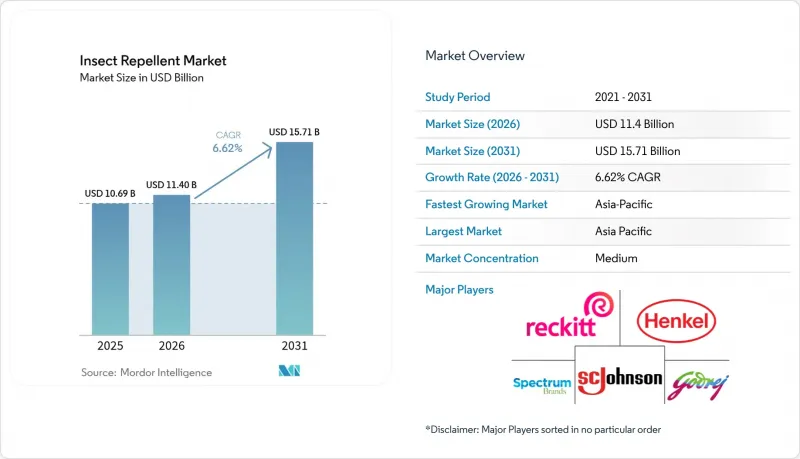
本報告按產品類型(引誘劑、香薰、噴霧劑/氣霧劑、地墊、液體蒸發器等)、成分類型(天然驅蟲劑和傳統驅蟲劑)、最終用戶(成人和兒童)、配銷通路(超級市場/大賣場、便利商店、在線零售商等)和地區進行細分。市場預測以美元(USD)為單位。
全球驅蚊劑市場趨勢及洞察
蟲媒疾病增加
全球範圍內,由媒介傳播的感染疾病呈上升趨勢。世界衛生組織(世衛組織)在2024年9月發布的情況說明書中指出,蚊子、蜱蟲和其他節肢動物傳播的疾病每年可能導致超過70萬人死亡。氣候變遷正將這些媒介的棲息地向北擴展,使瘧疾和登革熱的威脅蔓延至曾經被認為安全的溫帶地區。根據美國疾病管制與預防中心(CDC)統計,2024年北美、中美洲、南美洲和加勒比海地區報告的登革熱病例超過1,300萬例。預計2025年,這些地區的登革熱感染率仍將居高不下。這一激增導致這些新風險地區對驅蟲劑的需求增加。此外,攜帶瘧疾的昆蟲對除蟲菊精類殺蟲劑的抗藥性已成為全球關注的問題,影響了超過80%的監測區域。這種抗藥性正在推動消費者對替代活性成分的需求,並刺激新配方的創新。為了因應這些挑戰,各國衛生部門正在加強個人防護措施的建議。特別是,美國疾病管制與預防中心(CDC)已將避蚊胺(DEET)、派卡瑞丁(picaridin)和IR3535列為有效防護攜帶疾病昆蟲的首選產品。
戶外休閒活動增加
疫情帶來的生活方式改變顯著提高了戶外休閒的參與度。例如,根據戶外基金會(Outdoor Foundation)統計,到2024年,美國將有超過6,340萬人至少進行過一次健行。這是自2010年以來的最高參與率,比過去15年增加了約31個百分點。隨著消費者擴大將驅蟲措施納入休閒裝備,探險旅遊和戶外運動裝備的銷售與驅蟲劑市場的成長直接相關。這一趨勢不僅限於露營和健行等傳統活動,也擴展到戶外餐飲、節慶慶典和都市區綠地利用等領域,使市場不再局限於自然愛好者。此外,建築、農業和園林綠化等領域的專業戶外工作者,這些群體往往容易被忽視,但他們也顯著推動了對商用驅蟲劑的需求。
與其他害蟲防治方法的競爭
替代性驅蚊技術正日益蠶食傳統驅蚊產品的市場。儘管其有效性仍有爭議,但諸如Permethrin處理的衣物、蚊帳和電子設備等產品依然吸引了消費者的目光。系統性綜述表明,電子驅蚊器並不能有效減少蚊蟲叮咬。然而,消費者仍然青睞這些產品,因為它們方便易用且「不含化學物質」。經Permethrin處理的衣物比外用驅蚊劑具有更持久的驅蚊效果,但這種優勢也帶來了市場替代風險,尤其對於戶外工作者和相關人員而言。在住宅環境中,結合環境改造、生物防治和物理屏障的綜合蟲害管理(IPM)策略正在減少人們對個人驅蚊產品的依賴。此外,儘管科學證據表明超音波驅蚊功能無效,但聲稱具備超音波驅蚊功能的智慧型手機應用程式的興起,凸顯了消費者對替代技術的尋求,並可能減緩人們從傳統產品轉向其他產品的進程。
細分市場分析
到2025年,噴霧劑和氣霧劑產品將佔據45.72%的市場佔有率,其便利性、便攜性和快速起效等特點吸引了眾多消費者,推動了市場成長。同時,液體蒸發器是成長最快的細分市場,預計到2031年將達到7.32%的年複合成長率(CAGR)。這項快速成長得益於空間防護技術的進步以及消費者對免手動、持續性蟲害控制方式的需求轉變。儘管人們對燃燒副產物有所擔憂,但線圈產品在價格敏感的市場中仍保持著強勁的地位,而墊狀產品則介於傳統線圈和現代液體系統之間。用於綜合蟲害管理(IPM)的誘餌產品由於監管障礙和複雜的施用方法,在成長方面面臨挑戰。
液態煙霧驅蚊器尤其受益於緩釋機制和揮發性除蟲菊精類配方的取得專利的創新。 2024年7月,Godrage Consumer Products公司推出了lenofluthrin,這是印度首個專為液態煙霧驅蚊器研發的國產驅蚊分子。這些先進配方承諾每盒驅蚊劑可提供12小時的防護,並確保活性成分的穩定釋放。這項創新滿足了消費者對更持久防護的需求,並減少了頻繁補噴的需求。穿戴式裝置和電子驅蚊器等新興產品類別正在將驅蚊功能融入日常用品中,但由於其有效性和成本降低尚未得到檢驗,目前市場佔有率仍然有限。
到2025年,傳統驅蚊劑將佔據82.10%的市場佔有率,這得益於數十年來經實踐驗證的有效性、監管部門的批准以及DEET、派卡瑞丁和除蟲菊精類類製劑成熟的生產基礎設施。同時,天然驅蚊劑正處於成長階段,預計到2031年將以8.05%的年複合成長率(CAGR)成長。這一快速成長的驅動力來自消費者健康意識的提高以及對植物來源活性成分(例如檸檬桉油和各種精油混合物)的監管支持。成長率的差異凸顯了消費者優先事項的轉變。如今,只要安全性和環境永續性改善,許多消費者就能接受驅蚊效果持續時間較短的情況。
研究已證實天然成分的有效性。例如,對羥基苯甲酸-3,8-二醇(PMD)在適當濃度下使用時,對主要媒介昆蟲的驅避效果與避蚊胺(DEET)相當。此外,奈米乳化技術等進步提高了植物來源成分的穩定性和生物利用度。這項創新技術解決了植物來源驅蟲劑傳統上面臨的挑戰,例如快速分解和功效不穩定。雖然天然產品的溢價越來越被市場接受,這意味著利潤空間可能更大,但植物來源成分的採購難題可能會限制市場佔有率的快速擴張。
區域分析
到2025年,亞太地區將佔全球銷售額的49.10%,預計到2031年將維持9.15%的最高複合年成長率。這主要得益於大眾對登革熱和瘧疾的持續關注。政府主導的宣傳宣傳活動,加上大眾媒體的推動,顯著擴大了驅蚊產品的覆蓋範圍。印度的「晚安閃光」(活性成分:氟氯菊酯)充分展現了本土強大的研發實力,不僅降低了進口成本,也提高了供應穩定性。隨著可支配收入的增加,都市區正擴大從傳統的蚊香轉向液體驅蚊劑,進一步擴大了本土驅蚊產品市場。
北美地區雖然略遜於其他地區,但其市場規模依然可觀,主要驅動力來自戶外休閒活動和蚊媒疾病的流行。 2024年,美國零售額達到了驚人的3.769億美元。該地區消費者對植物來源成分產品偏好,這使得創新公司能夠制定高價並獲得高利潤。此外,氣候變遷延長了北部各州的蚊蟲活躍期,使得驅蚊產品的月度需求量比以往夏季高峰期更為穩定。
歐洲的成長受到嚴格的化學品法規制約,該行業正轉向符合生態毒理學標準的天然配方。德國和法國在推廣永續性認證和引領可回收包裝的應用方面處於領先地位。
在非洲和中東,捐助者資助的措施加強了瘧疾流行地區的物資分發,使低收入社區更容易獲得驅蚊劑。
同時,在拉丁美洲,城市向熱帶地區的擴張導致與病原體的接觸增加,從而導致各種產品的供應激增,並增加了對當地生產的投資。
其他好處:
- Excel格式的市場預測(ME)表
- 3個月的分析師支持
目錄
第1章:引言
- 研究假設和市場定義
- 調查範圍
第2章:調查方法
第3章執行摘要
第4章 市場狀況
- 市場概覽
- 市場促進因素
- 蟲媒疾病增加
- 戶外休閒活動增加
- 擁有寵物的家庭數量增加
- 消費者偏好轉向天然產品
- 快速的技術進步推動創新
- 政府和公共衛生宣傳活動
- 市場限制因素
- 透過替代保護措施實現競爭
- 消費者對化學品的健康擔憂
- 殺蟲劑抗藥性
- 仿冒品商品流通狀況
- 供應鏈分析
- 監理情勢
- 技術展望
- 波特五力模型
第5章 市場規模與成長預測
- 依產品類型
- 餵食
- 線圈
- 噴霧/氣霧劑
- 驅蚊墊
- 液體汽化器
- 其他產品類型
- 依成分類型
- 天然驅蟲劑
- 傳統驅蟲劑
- 最終用戶
- 成人
- 孩子們
- 透過分銷管道
- 超級市場和大賣場
- 便利商店
- 線上零售商店
- 其他分銷管道
- 按地區
- 北美洲
- 美國
- 加拿大
- 墨西哥
- 其他北美國家
- 南美洲
- 巴西
- 阿根廷
- 哥倫比亞
- 智利
- 其他南美國家
- 歐洲
- 英國
- 德國
- 法國
- 義大利
- 西班牙
- 俄羅斯
- 瑞典
- 比利時
- 波蘭
- 荷蘭
- 其他歐洲國家
- 亞太地區
- 中國
- 日本
- 印度
- 泰國
- 新加坡
- 印尼
- 韓國
- 澳洲
- 紐西蘭
- 其他亞太國家
- 中東和非洲
- 阿拉伯聯合大公國
- 南非
- 沙烏地阿拉伯
- 奈及利亞
- 埃及
- 摩洛哥
- 土耳其
- 其他中東和非洲國家
- 北美洲
第6章 競爭情勢
- 市場集中度
- 策略趨勢
- 市佔率分析
- 公司簡介
- SC Johnson & Son Inc.
- Reckitt Benckiser Group PLC
- Spectrum Brands Holdings Inc.
- Godrej Consumer Products Ltd.
- Dabur India Ltd.
- Henkel AG & Co. KGaA
- Newell Brands Inc.
- Enesis Group
- Quantum Health
- Jyothy Labs Limited
- Sawyer Products Inc.
- Avon Products Inc.
- Tender Corporation(Natrapel)
- Kao Corporation
- The Coleman Company, Inc.
- Merck KGaA(IR3535)
- 3M
- Coleman(Repel brand)
- Wondercide Inc.
- Sawyer Products, Inc.
- Enesis Group
第7章 市場機會與未來展望
According to Mordor Intelligence, insect repellent market size in 2026 is estimated at USD 11.4 billion, growing from 2025 value of USD 10.69 billion with 2031 projections showing USD 15.71 billion, growing at 6.62% CAGR over 2026-2031.
This report is Segmented by Product Type (Bait, Coils, Sprays/Aerosols, Mats, Liquid Vaporizer, and More), by Ingredient Type (Natural Insect Repellent and Conventional Insect Repellent), by End User (Adults and Kids/Children), by Distribution Channel (Supermarkets/Hypermarkets, Convenience Stores, Online Retail Stores, and More), and by Geography. The Market Forecasts are Provided in Terms of Value (USD).
Global Insect Repellent Market Trends and Insights
Rise in Vector-borne Diseases
Vector-borne diseases are on the rise worldwide. The World Health Organization (WHO) highlighted in its September 2024 factsheet that over 700,000 deaths occur annually due to diseases spread by mosquitoes, ticks, and other arthropods. Climate change is pushing vector habitats further north, bringing malaria and dengue threats to temperate regions that were once safe. According to the Centers for Disease Control and Prevention, in 2024, more than 13 million cases of dengue were reported in North, Central, and South America and the Caribbean. Dengue transmission in these areas remains high in 2025. This surge has led to a heightened demand for repellents in these newly at-risk areas. Furthermore, pyrethroid resistance in malaria vectors is now a global concern, affecting over 80% of monitored sites. This resistance is steering consumers towards alternative active ingredients and spurring innovation in new formulations. In response to these challenges, government health agencies are amplifying their recommendations for personal protective measures. Notably, the CDC has highlighted DEET, picaridin, and IR3535 as top choices for effective protection against disease vectors.
Increasing Outdoor Recreational Activities
In the wake of pandemic-induced lifestyle changes, outdoor recreation saw a notable uptick in participation. For example, the Outdoor Foundation reported that in 2024, over 63.4 million individuals in the U.S. engaged in hiking activities at least once. This marks the highest participation rate since 2010, showcasing a growth of approximately 31 percentage points over the past 15 years. As consumers increasingly incorporate pest protection into their recreational gear, sales in adventure tourism and outdoor sports equipment have seen a direct correlation with the growth of the repellent market. This trend isn't limited to traditional activities like camping and hiking; it now encompasses outdoor dining, festivals, and the use of urban green spaces, expanding the market's reach beyond just wilderness enthusiasts. Moreover, professional outdoor workers from sectors like construction, agriculture, and landscaping, often overlooked, are significantly boosting the demand for commercial-grade repellents.
Competition from Alternative Protection Methods
Alternative protection technologies are increasingly encroaching on the traditional repellent market. Products like permethrin-treated clothing, bed nets, and electronic devices are drawing consumer interest, even as evidence of their efficacy remains mixed. Systematic reviews indicate that electronic mosquito repellents fail to offer measurable protection against mosquito landings. Yet, consumers continue to adopt them, swayed by their perceived convenience and the allure of being chemical-free. While permethrin-treated clothing boasts a longer protection duration than topical repellents, this advantage poses a substitution risk in the market, especially for outdoor professionals and military users. In residential settings, integrated pest management strategies, merging environmental tweaks, biological controls, and physical barriers, are diminishing the dependence on personal repellent products. Furthermore, the rise of smartphone apps touting ultrasonic repellent features, despite scientific evidence debunking their effectiveness, underscores a consumer trend: a willingness to explore alternative technologies, potentially postponing the shift away from traditional products.
Other drivers and restraints analyzed in the detailed report include:
- Growing Pet Ownership
- Shifting Consumer Preferences Towards Natural Products
- Consumer Health Concerns Over Chemicals
For complete list of drivers and restraints, kindly check the Table Of Contents.
Segment Analysis
In 2025, sprays and aerosols command the market with a 45.72% share, capitalizing on their convenience, portability, and instant application appeal to a wide range of consumers. Meanwhile, liquid vaporizers are the fastest-growing segment, boasting a 7.32% CAGR through 2031. This surge is fueled by tech advancements in spatial protection and a consumer shift towards hands-free, continuous coverage. While coils hold their ground in price-sensitive markets, despite concerns over combustion byproducts, mats strike a balance between traditional coils and modern liquid systems. Bait products, tailored for integrated pest management, face growth challenges due to regulatory hurdles and complex applications.
Liquid vaporizers are reaping the rewards of patent innovations, especially in controlled-release mechanisms and volatile pyrethroid formulations. Notably, in July 2024, Godrej Consumer Products unveiled 'Renofluthrin', India's inaugural indigenous mosquito repellent molecule, tailored for liquid vaporizers. These advanced formulations promise 12-hour protection per cartridge, ensuring a steady release of active ingredients. This innovation meets consumer demands for prolonged efficacy, reducing the need for frequent reapplications. Emerging categories like wearable devices and electronic dispensers are weaving repellent delivery into everyday products, but their market presence is still modest, awaiting validation of efficacy and a drop in costs.
In 2025, conventional insect repellents command an 82.10% market share, bolstered by decades of proven efficacy, regulatory endorsements, and a well-established manufacturing base for DEET, picaridin, and pyrethroid formulations. Meanwhile, natural insect repellents are on a growth trajectory, boasting an 8.05% CAGR through 2031. This surge is fueled by a rising consumer health consciousness and regulatory backing for botanical active ingredients, such as oil of lemon eucalyptus and various essential oil blends. The disparity in growth rates underscores a shift in consumer priorities: many now prefer shorter protection durations if it means enhanced safety and environmental sustainability.
Research underscores the efficacy of natural ingredients. For instance, PMD (para-menthane-3,8-diol) matches DEET's performance against major vector species, provided it's used in the right concentrations. Furthermore, advancements like nano-emulsion technologies bolster the stability and bioavailability of botanical ingredients. This innovation addresses the traditional challenges of plant-based repellents, such as swift degradation and variable efficacy. While there's a growing acceptance of premium pricing for natural products, hinting at potential margin expansions, challenges in sourcing botanical ingredients could temper swift market share growth.
Complete Report Scope:
- By Product Type
- Bait
- Coils
- Sprays/Aerosols
- Mats
- Liquid Vaporizer
- Other Product Types
- By Ingredient Type
- Natural Insect Repellent
- Conventional Insect Repellent
- By End User
- Adults
- Kids/Children
- By Distribution Channel
- Supermarkets/Hypermarkets
- Convenience Stores
- Online Retail Stores
- Other Distribution Channels
- By Geography
- North America
- United States
- Canada
- Mexico
- Rest of North America
- South America
- Brazil
- Argentina
- Colombia
- Chile
- Rest of South America
- Europe
- United Kingdom
- Germany
- France
- Italy
- Spain
- Russia
- Sweden
- Belgium
- Poland
- Netherlands
- Rest of Europe
- Asia-Pacific
- China
- Japan
- India
- Thailand
- Singapore
- Indonesia
- South Korea
- Australia
- New Zealand
- Rest of Asia-Pacific
- Middle East and Africa
- United Arab Emirates
- South Africa
- Saudi Arabia
- Nigeria
- Egypt
- Morocco
- Turkey
- Rest of Middle East and Africa
- North America
Geography Analysis
In 2025, the Asia-Pacific region accounted for 49.10% of global revenue, and the region also registers the strongest regional CAGR at 9.15% during the period to 2031, primarily driven by the ongoing public health focus on dengue and malaria. Government-led awareness initiatives, bolstered by mass media campaigns, have significantly increased the adoption of repellents. A testament to local research and development capabilities, India's Goodknight Flash, featuring Renofluthrin, not only cuts down on import costs but also fortifies supply resilience. With rising disposable incomes, urban households are upgrading from traditional coils to liquid vaporizers, further expanding the regional insect repellent market.
North America, while trailing, boasts substantial figures, largely due to outdoor recreational activities and the spread of insect-borne diseases. In 2024, retail sales in the U.S. reached an impressive USD 376.9 million. The region's strong preference for botanical ingredients allows for premium pricing and higher margins for innovators. Additionally, climate change has lengthened the mosquito season in northern states, leading to a more consistent monthly demand for insect repellents, rather than the previously sharp summer peak.
Europe's growth is tempered by stringent chemical regulations, pushing the industry towards natural formulations that align with eco-toxicology standards. Germany and France are at the forefront, championing sustainability certifications and driving the adoption of recyclable packaging.
In the Middle East and Africa, donor-funded initiatives are bolstering distribution in malaria-prone areas, making repellents more accessible to lower-income communities.
Meanwhile, Latin America's urban sprawl into tropical regions is increasing contact with disease vectors, prompting a surge in diverse product offerings and investments in localized manufacturing.
- S.C. Johnson & Son Inc.
- Reckitt Benckiser Group PLC
- Spectrum Brands Holdings Inc.
- Godrej Consumer Products Ltd.
- Dabur India Ltd.
- Henkel AG & Co. KGaA
- Newell Brands Inc.
- Enesis Group
- Quantum Health
- Jyothy Labs Limited
- Sawyer Products Inc.
- Avon Products Inc.
- Tender Corporation (Natrapel)
- Kao Corporation
- The Coleman Company, Inc.
- Merck KGaA (IR3535)
- 3M
- Coleman (Repel brand)
- Wondercide Inc.
- Sawyer Products, Inc.
- Enesis Group
Additional Benefits:
- The market estimate (ME) sheet in Excel format
- 3 months of analyst support
TABLE OF CONTENTS
1 INTRODUCTION
- 1.1 Study Assumptions and Market Definition
- 1.2 Scope of the Study
2 RESEARCH METHODOLOGY
3 EXECUTIVE SUMMARY
4 MARKET LANDSCAPE
- 4.1 Market Overview
- 4.2 Market Drivers
- 4.2.1 Rise in Vector-borne Diseases
- 4.2.2 Increasing Outdoor Recreational Activities
- 4.2.3 Growing Pet Ownership
- 4.2.4 Shifting Consumer Preferences Towards Natural Products
- 4.2.5 Rapid Technological Advancements Driving Innovation
- 4.2.6 Government and Public Health Campaigns
- 4.3 Market Restraints
- 4.3.1 Competition from Alternative Protection Methods
- 4.3.2 Consumer Health Concerns Over Chemicals
- 4.3.3 Insecticide Resistance
- 4.3.4 Availability of Counterfeit Products
- 4.4 Supply-Chain Analysis
- 4.5 Regulatory Landscape
- 4.6 Technological Outlook
- 4.7 Porter's Five Forces
- 4.7.1 Threat of New Entrants
- 4.7.2 Bargaining Power of Buyers
- 4.7.3 Bargaining Power of Suppliers
- 4.7.4 Threat of Substitutes
- 4.7.5 Competitive Rivalry
5 MARKET SIZE AND GROWTH FORECASTS
- 5.1 By Product Type
- 5.1.1 Bait
- 5.1.2 Coils
- 5.1.3 Sprays/Aerosols
- 5.1.4 Mats
- 5.1.5 Liquid Vaporizer
- 5.1.6 Other Product Types
- 5.2 By Ingredient Type
- 5.2.1 Natural Insect Repellent
- 5.2.2 Conventional Insect Repellent
- 5.3 By End User
- 5.3.1 Adults
- 5.3.2 Kids/Children
- 5.4 By Distribution Channel
- 5.4.1 Supermarkets/Hypermarkets
- 5.4.2 Convenience Stores
- 5.4.3 Online Retail Stores
- 5.4.4 Other Distribution Channels
- 5.5 By Geography
- 5.5.1 North America
- 5.5.1.1 United States
- 5.5.1.2 Canada
- 5.5.1.3 Mexico
- 5.5.1.4 Rest of North America
- 5.5.2 South America
- 5.5.2.1 Brazil
- 5.5.2.2 Argentina
- 5.5.2.3 Colombia
- 5.5.2.4 Chile
- 5.5.2.5 Rest of South America
- 5.5.3 Europe
- 5.5.3.1 United Kingdom
- 5.5.3.2 Germany
- 5.5.3.3 France
- 5.5.3.4 Italy
- 5.5.3.5 Spain
- 5.5.3.6 Russia
- 5.5.3.7 Sweden
- 5.5.3.8 Belgium
- 5.5.3.9 Poland
- 5.5.3.10 Netherlands
- 5.5.3.11 Rest of Europe
- 5.5.4 Asia-Pacific
- 5.5.4.1 China
- 5.5.4.2 Japan
- 5.5.4.3 India
- 5.5.4.4 Thailand
- 5.5.4.5 Singapore
- 5.5.4.6 Indonesia
- 5.5.4.7 South Korea
- 5.5.4.8 Australia
- 5.5.4.9 New Zealand
- 5.5.4.10 Rest of Asia-Pacific
- 5.5.5 Middle East and Africa
- 5.5.5.1 United Arab Emirates
- 5.5.5.2 South Africa
- 5.5.5.3 Saudi Arabia
- 5.5.5.4 Nigeria
- 5.5.5.5 Egypt
- 5.5.5.6 Morocco
- 5.5.5.7 Turkey
- 5.5.5.8 Rest of Middle East and Africa
- 5.5.1 North America
6 COMPETITIVE LANDSCAPE
- 6.1 Market Concentration
- 6.2 Strategic Moves
- 6.3 Market Share Analysis
- 6.4 Company Profiles (includes Global level Overview, Market level overview, Core Segments, Financials as available, Strategic Information, Market Rank/Share for key companies, Products and Services, and Recent Developments)
- 6.4.1 S.C. Johnson & Son Inc.
- 6.4.2 Reckitt Benckiser Group PLC
- 6.4.3 Spectrum Brands Holdings Inc.
- 6.4.4 Godrej Consumer Products Ltd.
- 6.4.5 Dabur India Ltd.
- 6.4.6 Henkel AG & Co. KGaA
- 6.4.7 Newell Brands Inc.
- 6.4.8 Enesis Group
- 6.4.9 Quantum Health
- 6.4.10 Jyothy Labs Limited
- 6.4.11 Sawyer Products Inc.
- 6.4.12 Avon Products Inc.
- 6.4.13 Tender Corporation (Natrapel)
- 6.4.14 Kao Corporation
- 6.4.15 The Coleman Company, Inc.
- 6.4.16 Merck KGaA (IR3535)
- 6.4.17 3M
- 6.4.18 Coleman (Repel brand)
- 6.4.19 Wondercide Inc.
- 6.4.20 Sawyer Products, Inc.
- 6.4.21 Enesis Group
7 MARKET OPPORTUNITIES AND FUTURE OUTLOOK

 全球驅蠅劑市場規模、佔有率、趨勢和成長分析報告(2026-2034)
 驅蚊濕紙巾市場規模、佔有率和成長分析:按活性成分、產品類型、分銷管道、應用、最終用戶和地區分類-產業預測,2026-2033年
 昆蟲驅避劑活性成分市場-2026-2032年全球市場預測滅蠅市場:2026-2032年全球市場預測(依劑型、活性成分、包裝類型、應用及通路分類)
 昆蟲驅避劑市場機會、成長促進因素、產業趨勢分析及2026-2035年預測。
 驅蟲劑市場報告:趨勢、預測和競爭分析(至2035年)寵物驅蟲劑市場機會、成長要素、產業趨勢分析及2026-2035年預測。
 驅蟲劑市場報告:按害蟲類型、產品類型、銷售管道和地區分類(2026-2034 年)
 驅蟲劑市場規模、佔有率和趨勢分析報告:按害蟲類型、產品類型、配方、地區和細分市場預測(2026-2033 年)殺蟲劑市場:2026年至2032年全球市場預測(依害蟲類型、產品類型、添加劑、配方技術、施用方法、通路和最終用戶分類)