


 |
市場調查報告書
商品編碼
2083379
昆蟲驅避劑市場機會、成長促進因素、產業趨勢分析及2026-2035年預測。Insect Repellent Market Opportunity, Growth Drivers, Industry Trend Analysis, and Forecast 2026 - 2035 |
||||||

2025年全球驅蟲劑市場價值59億美元,預計2035年將以6%的複合年成長率成長至106億美元。
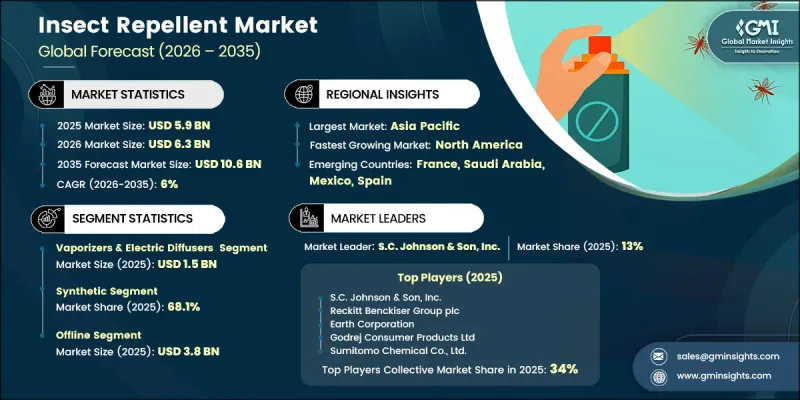
此成長主要受媒介傳播疾病發生率上升、消費者行為中預防性醫療保健意識增強以及全球市場戶外休閒活動參與度提高等因素驅動。產品開發策略日益注重延長防護時間、提高安全性以及擴大對更多種類害蟲的有效性。同時,消費者的購買行為正轉向全年使用,驅蟲產品正逐漸從季節性產品轉變為必需的健康保健品。分銷管道也在不斷發展,產品擴大滲透到藥局和健康相關零售網路中。儘管對植物來源和低毒性配方的需求不斷成長,加速了整個價值鏈的創新,但製造商仍在便攜性、便利性和持久驅蟲效果方面展開競爭。因此,該產業正持續投資於新型活性成分、先進劑型和高級產品定位策略。
| 市場範圍 | |
|---|---|
| 開始年份 | 2025 |
| 預測期 | 2026-2035 |
| 起始金額 | 59億美元 |
| 預測金額 | 106億美元 |
| 複合年成長率 | 6% |
到 2025 年,預計蒸發器和電擴散器市場規模將達到 15 億美元,成為主要產品類型,因為在室內環境中,持續的驅蟲效果至關重要,尤其是在蚊蟲相關的健康風險持續存在的地區。
合成製劑領域憑藉其已證實的功效、成本效益和成熟的分銷網路,預計到 2025 年將佔據 68.1% 的市場佔有率。 DEET 等活性成分因其對攜帶疾病的昆蟲具有高效性以及長期獲得監管部門的批准,在全球範圍內繼續被廣泛使用。
預計2025年,北美驅蟲劑市場規模將達11億美元。該地區的成長也得益於法規核准的進展,這些進展支持了新型活性成分的引入,並擴大了植物來源和新一代驅蟲劑配方的創新範圍。
目錄
第1章:調查方法和範圍
第2章執行摘要
第3章 行業洞察
- 產業生態系分析
- 供應商情況
- 利潤率
- 每個階段增加的價值
- 影響價值鏈的因素
- 影響產業的因素
- 成長促進因素
- 蟲媒疾病增加
- 都市化和氣候變遷
- 戶外和旅遊活動增加
- 產業潛在風險與挑戰
- 健康與安全問題
- 監管和合規障礙
- 機會
- 天然和有機產業的擴張
- 產品多元化
- 成長促進因素
- 成長潛力分析
- 監理框架
- 美國環保署註冊和低風險農藥指南(北美)
- 歐盟除生物劑法規(BPR)框架
- 世界衛生組織預認證與病媒控制指南
- 監理趨勢與未來政策變化
- 價格趨勢
- 按地區
- 依產品類型
- 波特的分析
- PESTLE分析
- 價格分析
- 2022-2025年歷史價格趨勢分析
- 依球員類型分類的定價策略(高級球員、超值球員、成本加成球員)
- 按產品形式和原料類型分類的價格基準。
- 貿易數據分析
- 2022-2025年進出口數量及價值趨勢
- 主要貿易路線及關稅的影響
- 人工智慧和生成式人工智慧對市場的影響
- 人工智慧正在改變軸承的設計、測試和品管。
- GenAI 的自動化領域用例和實施藍圖
- 人工智慧在精密製造領域的風險、限制與監管考量
- 目前分銷基礎設施和通路滲透情況
- 按地區與業務類型(現代貿易與傳統貿易)分類的銷售管道分佈
- 最後一公里基礎設施差異和新通路的轉變(電子商務的普及)
第4章 競爭情勢
- 介紹
- 企業市佔率分析
- 按地區
- 企業矩陣分析
- 主要市場公司的競爭分析
- 競爭定位矩陣
- 價格與永續性定位
- 產品線及市場滲透率
- 創新與規模矩陣
- 主要進展
- 併購
- 夥伴關係和聯盟
- 新產品發布
- 業務拓展計劃
第5章 市場估算與預測:依產品類型分類,2022-2035年
- 霧化器和電香薰機
- 噴霧劑和氣霧劑
- 乳霜、乳液、凝膠
- 精油和滾珠
- 墊
- 線圈
- 戳
- 擦拭巾
- 穿戴式裝置、貼片和功能性配件
- 其他物品(蠟燭、食品、超音波設備)
第6章 市場估算與預測:依成分分類,2022-2035年
- 合成
- 自然的
第7章 市場估算與預測:依昆蟲類型分類,2022-2035年
- 驅蚊劑
- 蟎蟲驅避劑
- 昆蟲及常見吸血昆蟲驅避劑
- 驅蠅劑
- 驅除黑蠅和蠓蟲的驅避劑
- 多種昆蟲/廣域驅蟲劑
- 其他(跳蚤、黃蜂、螞蟻)
第8章 市場估計與預測:依價格分類,2022-2035年
- 低的
- 中等的
- 高的
第9章 市場估計與預測:依最終用途分類,2022-2035年
- 住宅
- 商業(旅館業、餐飲業、旅遊業)
- 醫療設施
- 工業和商用(農業、林業、建築業)
- 畜牧業及動物畜牧業
- 軍事/國防
- 戶外休閒(露營、健行、運動)
第10章 市場估價與預測:依通路分類,2022-2035年
- 線上
- 電子商務網站
- 公司網站
- 離線
- 超級市場和大賣場
- 藥局/藥局
- 其他
第11章 市場估價與預測:按地區分類,2022-2035年
- 北美洲
- 美國
- 加拿大
- 歐洲
- 德國
- 英國
- 法國
- 義大利
- 西班牙
- 亞太地區
- 中國
- 日本
- 印度
- 澳洲
- 韓國
- 拉丁美洲
- 巴西
- 墨西哥
- 阿根廷
- 中東和非洲
- 南非
- 沙烏地阿拉伯
- UAE
第12章:公司簡介
- 世界公司
- SC Johnson & Son, Inc.
- Reckitt Benckiser Group plc
- Spectrum Brands Holdings, Inc.
- Godrej Consumer Products Ltd
- Dabur India Limited
- Henkel AG & Co. KGaA
- Newell Brands Inc.
- 當地公司
- Sumitomo Chemical Co., Ltd.
- PT. Enesis Group
- Earth Corporation
- Jyothy Laboratories Ltd
- Dainihon Jochugiku Co., Ltd.(KINCHO)
- Haw Par Corporation Limited
- Quantum Health
- 新興企業
- Thermacell Repellents, Inc.
- Sawyer Products
- Murphy's Naturals
- Wondercide
- WS Badger Company
- Insect Shield, LLC
- Adventure Ready Brands
The Global Insect Repellent Market was valued at USD 5.9 billion in 2025 and is estimated to grow at a CAGR of 6% to reach USD 10.6 billion by 2035.
Growth is supported by the rising incidence of vector-borne diseases, stronger emphasis on preventive healthcare purchasing behavior, and growing participation in outdoor recreational activities across global markets. Product development strategies are increasingly focused on improving protection duration, enhancing safety profiles, and expanding multi-insect efficacy coverage. At the same time, consumer purchasing behavior is shifting toward year-round usage, with repellents increasingly positioned as essential health and wellness products rather than seasonal commodities. Distribution channels are also evolving, with stronger penetration into pharmacy and health-focused retail networks. Rising demand for botanical-based and low-toxicity formulations is accelerating innovation across the value chain, while manufacturers continue to compete on portability, convenience, and long-lasting protection performance. As a result, the industry is witnessing sustained investment in novel active ingredients, advanced delivery formats, and premium product positioning strategies.
| Market Scope | |
|---|---|
| Start Year | 2025 |
| Forecast Year | 2026-2035 |
| Start Value | $5.9 Billion |
| Forecast Value | $10.6 Billion |
| CAGR | 6% |
The vaporizers and electric diffusers segment accounted for USD 1.5 billion in 2025, making it the leading product category due to their strong adoption in indoor environments where continuous protection is prioritized, particularly in regions with persistent mosquito-related health risks.
The synthetic formulations segment held 68.1% share in 2025, supported by proven effectiveness, cost efficiency, and well-established distribution networks. Active ingredients such as DEET continue to hold widespread usage globally due to their high efficacy against disease-carrying insects and long-standing regulatory acceptance.
North America Insect Repellent Market accounted for USD 1.1 billion in 2025. Growth in the country is further reinforced by evolving regulatory approvals that support the introduction of new active ingredients and expand the scope for innovation in botanical and next-generation repellent formulations.
Key market participants include S.C. Johnson & Son, Inc., Reckitt Benckiser Group plc, Spectrum Brands Holdings, Inc., Godrej Consumer Products Ltd, Dabur India Limited, Henkel AG & Co. KGaA, Newell Brands Inc., Sumitomo Chemical Co., Ltd., PT. Enesis Group, Earth Corporation, Jyothy Laboratories Ltd, Dainihon Jochugiku Co., Ltd., Haw Par Corporation Limited, Quantum Health, Thermacell Repellents, Inc., Sawyer Products, Murphy's Naturals, Wondercide, W.S. Badger Company, Insect Shield, LLC, and Adventure Ready Brands. Companies in the insect repellent market are strengthening their competitive position by expanding portfolios of multi-format products, including sprays, vaporizers, wearable solutions, and long-duration protection systems. Many manufacturers are investing in botanical and low-toxicity formulations to align with rising consumer preference for safer and more natural ingredients. Strategic focus is also placed on improving product efficacy through advanced active ingredient research and extended protection technologies. Firms are increasingly strengthening pharmacy and health retail distribution channels while simultaneously expanding direct-to-consumer and e-commerce presence. Branding strategies are shifting toward positioning repellents as year-round preventive health essentials rather than seasonal items.
Table of Contents
Chapter 1 Methodology and Scope
- 1.1 Market scope and definition
- 1.2 Research design
- 1.2.1 Research approach
- 1.2.2 Data collection methods
- 1.3 Data mining sources
- 1.3.1 Global
- 1.3.2 Regional/Country
- 1.4 Base estimates and calculations
- 1.4.1 Base year calculation
- 1.4.2 Key trends for market estimation
- 1.5 Primary research and validation
- 1.5.1 Primary sources
- 1.6 Forecast model
- 1.7 Research assumptions and limitations
Chapter 2 Executive Summary
- 2.1 Industry 360° synopsis
- 2.2 Key market trends
- 2.2.1 Regional
- 2.2.2 Product type
- 2.2.3 Ingredient
- 2.2.4 Insect type
- 2.2.5 Price
- 2.2.6 End use
- 2.2.7 Distribution channel
Chapter 3 Industry Insights
- 3.1 Industry ecosystem analysis
- 3.1.1 Supplier landscape
- 3.1.2 Profit margin
- 3.1.3 Value addition at each stage
- 3.1.4 Factor affecting the value chain
- 3.2 Industry impact forces
- 3.2.1 Growth drivers
- 3.2.1.1 Rising vector-borne diseases
- 3.2.1.2 Urbanization & climate change
- 3.2.1.3 Increasing outdoor & travel activities
- 3.2.2 Industry pitfalls & challenges
- 3.2.2.1 Health & safety concerns
- 3.2.2.2 Regulatory & compliance barriers
- 3.2.3 Opportunities
- 3.2.3.1 Natural & organic segment expansion
- 3.2.3.2 Product diversification
- 3.2.1 Growth drivers
- 3.3 Growth potential analysis
- 3.4 Regulatory framework
- 3.4.1 EPA registration & minimum risk pesticide guidelines (north america)
- 3.4.2 EU biocidal products regulation (BPR) framework
- 3.4.3 Who prequalification & vector control guidelines
- 3.4.4 Regulatory trends & upcoming policy changes
- 3.5 Price trends
- 3.5.1 By region
- 3.5.2 By product type
- 3.6 Porter's analysis
- 3.7 PESTEL analysis
- 3.8 Pricing analysis (driven by primary research)
- 3.8.1 Historical price trend analysis (2022-2025)
- 3.8.2 Pricing strategy by player type (premium / value / cost-plus)
- 3.8.3 Price benchmarking across product formats & ingredient types
- 3.9 Trade data analysis (driven by paid database)
- 3.9.1 Import/export volume & value trends (2022-2025)
- 3.9.2 Key trade corridors & tariff impact (HS Code 8418 - refrigerators & freezers)
- 3.10 Impact of AI & generative AI on the market
- 3.10.1 AI-driven disruption of bearing design, testing & quality control
- 3.10.2 GenAI use cases & adoption roadmap by automation segment
- 3.10.3 Risks, limitations & regulatory considerations for AI in precision manufacturing
- 3.11 Distribution infrastructure & channel penetration landscape (driven by primary research)
- 3.11.1 Channel coverage by region & format (modern trade vs. Traditional trade)
- 3.11.2 Last-mile infrastructure gaps & emerging channel shifts (e-commerce penetration)
Chapter 4 Competitive Landscape, 2025
- 4.1 Introduction
- 4.2 Company market share analysis
- 4.2.1 By region
- 4.2.1.1 North America
- 4.2.1.2 Europe
- 4.2.1.3 Asia Pacific
- 4.2.1.4 Latin America
- 4.2.1.5 Middle East and Africa
- 4.2.1 By region
- 4.3 Company matrix analysis
- 4.4 Competitive analysis of major market players
- 4.5 Competitive positioning matrix
- 4.5.1 Price vs. sustainability positioning
- 4.5.2 Product range vs. market penetration
- 4.5.3 Innovation vs. scale matrix
- 4.6 Key developments
- 4.6.1 Mergers & acquisitions
- 4.6.2 Partnerships & collaborations
- 4.6.3 New product launches
- 4.6.4 Expansion plans
Chapter 5 Market Estimates and Forecast, By Product Type, 2022 - 2035 (USD Billion) (Thousand Units)
- 5.1 Key trends
- 5.2 Vaporizers & electric diffusers
- 5.3 Sprays & aerosols
- 5.4 Creams, lotions & gels
- 5.5 Oils & roll-ons
- 5.6 Mats
- 5.7 Coils
- 5.8 Sticks
- 5.9 Wipes
- 5.10 Wearables, patches & treated accessories
- 5.11 Others (candles, baits, ultrasonic devices)
Chapter 6 Market Estimates and Forecast, By Ingredient, 2022 - 2035 (USD Billion) (Thousand Units)
- 6.1 Key trends
- 6.2 Synthetic
- 6.3 Natural
Chapter 7 Market Estimates and Forecast, By Insect Type, 2022 - 2035 (USD Billion) (Thousand Units)
- 7.1 Key trends
- 7.2 Mosquito repellents
- 7.3 Tick repellents
- 7.4 Bug & general biting insect repellents
- 7.5 Fly repellents
- 7.6 Gnat & midge repellents
- 7.7 Multi-insect / broad-spectrum repellents
- 7.8 Others (flea, wasp, ant)
Chapter 8 Market Estimates and Forecast, By Price, 2022 - 2035 (USD Billion) (Thousand Units)
- 8.1 Key trends
- 8.2 Low
- 8.3 Medium
- 8.4 High
Chapter 9 Market Estimates and Forecast, By End Use, 2022 - 2035 (USD Billion) (Thousand Units)
- 9.1 Key trends
- 9.2 Residential
- 9.3 Commercial (hospitality, food service & tourism)
- 9.4 Healthcare & institutional
- 9.5 Industrial & professional (agriculture, forestry, construction)
- 9.6 Livestock & animal husbandry
- 9.7 Military & defense
- 9.8 Outdoor & recreational (camping, hiking, sports)
Chapter 10 Market Estimates and Forecast, By Distribution Channel, 2022 - 2035 (USD Billion) (Thousand Units)
- 10.1 Key trends
- 10.2 Online
- 10.2.1 E-commerce websites
- 10.2.2 Company websites
- 10.3 Offline
- 10.3.1 Supermarkets & hypermarkets
- 10.3.2 Pharmacies & drug stores
- 10.3.3 Others
Chapter 11 Market Estimates and Forecast, By Region, 2022 - 2035 (USD Billion) (Thousand Units)
- 11.1 Key trends
- 11.2 North America
- 11.2.1 U.S.
- 11.2.2 Canada
- 11.3 Europe
- 11.3.1 Germany
- 11.3.2 UK
- 11.3.3 France
- 11.3.4 Italy
- 11.3.5 Spain
- 11.4 Asia Pacific
- 11.4.1 China
- 11.4.2 Japan
- 11.4.3 India
- 11.4.4 Australia
- 11.4.5 South Korea
- 11.5 Latin America
- 11.5.1 Brazil
- 11.5.2 Mexico
- 11.5.3 Argentina
- 11.6 Middle East and Africa
- 11.6.1 South Africa
- 11.6.2 Saudi Arabia
- 11.6.3 UAE
Chapter 12 Company Profiles
- 12.1 Global players
- 12.1.1 S.C. Johnson & Son, Inc.
- 12.1.2 Reckitt Benckiser Group plc
- 12.1.3 Spectrum Brands Holdings, Inc.
- 12.1.4 Godrej Consumer Products Ltd
- 12.1.5 Dabur India Limited
- 12.1.6 Henkel AG & Co. KGaA
- 12.1.7 Newell Brands Inc.
- 12.2 Regional players
- 12.2.1 Sumitomo Chemical Co., Ltd.
- 12.2.2 PT. Enesis Group
- 12.2.3 Earth Corporation
- 12.2.4 Jyothy Laboratories Ltd
- 12.2.5 Dainihon Jochugiku Co., Ltd. (KINCHO)
- 12.2.6 Haw Par Corporation Limited
- 12.2.7 Quantum Health
- 12.3 Emerging players
- 12.3.1 Thermacell Repellents, Inc.
- 12.3.2 Sawyer Products
- 12.3.3 Murphy's Naturals
- 12.3.4 Wondercide
- 12.3.5 W.S. Badger Company
- 12.3.6 Insect Shield, LLC
- 12.3.7 Adventure Ready Brands

 全球驅蠅劑市場規模、佔有率、趨勢和成長分析報告(2026-2034)
 驅蚊濕紙巾市場規模、佔有率和成長分析:按活性成分、產品類型、分銷管道、應用、最終用戶和地區分類-產業預測,2026-2033年
 驅蟲劑:市場佔有率分析、產業趨勢與統計、成長預測(2026-2031)
 昆蟲驅避劑活性成分市場-2026-2032年全球市場預測滅蠅市場:2026-2032年全球市場預測(依劑型、活性成分、包裝類型、應用及通路分類)
 驅蟲劑市場報告:趨勢、預測和競爭分析(至2035年)
 寵物驅蟲劑市場機會、成長要素、產業趨勢分析及2026-2035年預測。
 驅蟲劑市場報告:按害蟲類型、產品類型、銷售管道和地區分類(2026-2034 年)
 驅蟲劑市場規模、佔有率和趨勢分析報告:按害蟲類型、產品類型、配方、地區和細分市場預測(2026-2033 年)殺蟲劑市場:2026年至2032年全球市場預測(依害蟲類型、產品類型、添加劑、配方技術、施用方法、通路和最終用戶分類)