


 |
市場調查報告書
商品編碼
2122872
隔熱塗層:市場佔有率分析、行業趨勢和統計數據、成長預測(2026-2031 年)Thermal Barrier Coatings - Market Share Analysis, Industry Trends & Statistics, Growth Forecasts (2026 - 2031) |
||||||

※ 本網頁內容可能與最新版本有所差異。詳細情況請與我們聯繫。
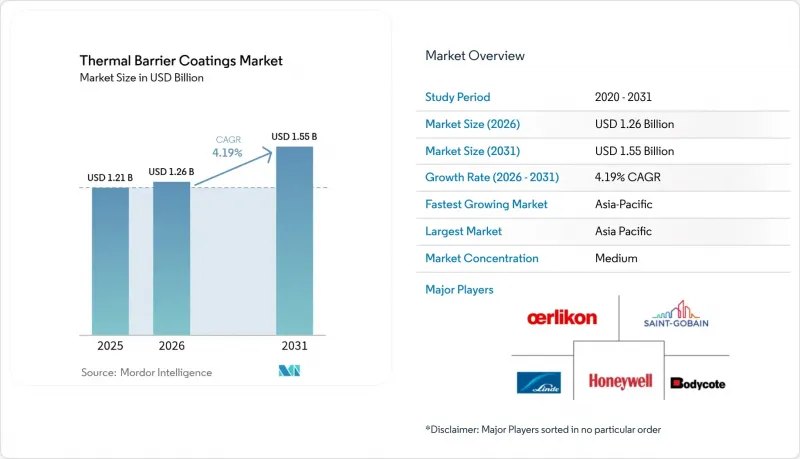
預計到 2026 年,隔熱塗層市場價值將達到 12.6 億美元,高於 2025 年的 12.1 億美元,預計到 2031 年將達到 15.5 億美元。
預計 2026 年至 2031 年的複合年成長率為 4.19%。
本報告按產品(金屬、陶瓷等)、塗層技術(空氣等離子噴塗(APS)、高速氧燃料噴塗(HVOF)等)、塗層材料(釔安定氧化鋯(8YSZ)、稀土元素鋯酸鹽(GdZrO、Lazro等))、北美用戶產業(航太、歐洲發電廠等地區(亞太地區(亞太地區)和地區(亞太地區)。
全球隔熱塗佈市場趨勢及洞察
航太引擎需求增加
新一代渦輪扇引擎的燃燒溫度目前已接近1650 度C,這要求使用能夠承受渦輪高溫段劇烈熱循環的多層陶瓷材料。稀土元素鋯酸鹽的晶格熱導率低於傳統的8YSZ,因此,能夠將金屬溫度控制在臨界閾值以下的雙層層級構造已獲得多項專利。通用電氣航空航太公司已撥款10億美元用於陶瓷基質材料及相關塗層的研發,預計到2025年完成,這表明強大的溫度控管能力對於燃料中性推進系統至關重要。永續航空燃料的出現進一步加劇了這個問題,因為新的燃燒化學改變了燃燒室內的熱通量,從而提升了配備原位狀態監測感測器的智慧塗層的價值。
工業用燃氣渦輪機應用範圍擴大
中國、印度和海灣國家的聯合循環發電廠運作溫度超過攝氏1500度C,以實現50%以上的熱效率,這使得人們對具有進氣冷卻功能的抗應變塗層和氫氣相容燃燒器產生了濃厚的興趣。隨著電力公司對設備進行現代化改造以穩定可再生能源為主的電網,渦輪燃燒溫度每提高1%,燃料成本就會降低,隔熱塗層的市場也不斷擴大。供應商現在提供具有功能梯度結構的煙囪,可在10分鐘內有效緩解從空載到滿載轉換過程中的熱衝擊。
氧化鋯和稀土元素穩定劑的價格波動
2020年全球鋯砂產量下降了28%,至今尚未完全恢復,塗料生產商面臨價格飆升的風險,利潤空間受到擠壓。釔的生產仍集中在中國礦山,預計2022年產量僅45噸,而額定產能為1500噸,持續為隔熱塗料市場帶來地緣政治風險。主要供應商正在策略性地增加庫存,並轉向使用钆等替代摻雜劑,以降低這些風險帶來的影響。
細分市場分析
到2025年,陶瓷面塗層將佔整個隔熱塗料市場55.58%的佔有率,這主要得益於釔安定氧化鋯(YSZ)系統無與倫比的隔熱性能。隨著航太產業的領導者致力於對結合鋯酸钆和8YSZ的雙層層級構造進行認證,以提高其抗CMAS性能,陶瓷產品隔熱塗料的市場規模預計將持續擴大。
儘管金屬結合塗層僅為底層,但由於採用了新型MCrAlY化學成分,能夠形成均勻的氧化鋁層並延緩剝落,因此其複合年成長率高達5.74%。金屬間化合物塗層和梯度塗層在電廠維修工程中越來越受歡迎,尤其適用於零件壽命超過25,000小時的情況。高熵合金塗層目前仍處於研究階段,但預計在更寬的溫度範圍內具有相穩定性。
預計到2025年,空氣等離子噴塗將佔據41.20%的市場佔有率,其優勢在於材料相容性廣,且在渦輪葉片、整流罩和燃燒室面板等領域具有經濟高效的生產效率。目前,數位孿生模型能夠即時調節焊槍電流,將孔隙率控制在±1%以內,從而為品質要求極高的航太供應鏈提供支援。
等離子噴塗-PVD技術正以5.33%的複合年成長率成長,因為低壓蒸氣羽流沉積的柱狀微結構能夠根據熱循環發生形變。電子束PVD仍然是寬體引擎單晶葉片的首選工藝,而HVOF技術正在石油和天然氣閥門的耐磨塗層領域佔據主導地位。溶液前驅體等離子噴塗和CVD技術則佔據了對高密度、無裂紋薄膜要求較高的細分市場。
區域分析
預計到2025年,亞太地區將佔據隔熱塗料市場34.90%的佔有率,並在2031年之前以4.98%的複合年成長率成長。該地區受益於中國50吉瓦燃氣渦輪機建設計畫和日本垂直整合的飛機引擎供應鏈(該供應鏈同時為國內和出口部件提供塗層服務)。韓國造船廠正在為雙燃料液化天然氣引擎採用陶瓷煙囪,而印度的民用航太生態系統中,專門為單通道噴射機提供噴塗服務的獨立噴塗車間數量也在增加。
北美憑藉其強大的航太航太供應商基礎,在超音速技術研究領域投入大量資金。美國能源局正在資助高溫研究,探索適用於1700 度C渦輪進口溫度的釔鋁石榴石(YAG)材料的各種變體。加拿大在蒙特利爾為區域噴氣機項目提供塗層技術支持,而墨西哥巴希奧叢集則為全球汽車原始設備製造商(OEM)提供渦輪部件塗層服務,從而支持一體化供應鏈。
儘管產能成長放緩,歐洲的技術水準依然領先。德國汽車製造商正在對其渦輪增壓器生產線進行改造,以增設噴塗室以保護其智慧財產權。英國和法國正利用「地平線歐洲」計畫的津貼相變陶瓷的研究。東歐較低的人事費用吸引了塗層代工企業,但為了符合REACH法規,這些企業必須迅速投資於減排系統。中東等新興地區正在利用燃氣渦輪機的大規模售後市場項目,而在南美洲,重油發電裝置正在進行塗層處理以減少硫化。
其他好處:
- Excel格式的市場預測(ME)表
- 3個月的分析師支持
目錄
第1章:引言
- 研究假設和市場定義
- 調查範圍
第2章:調查方法
第3章執行摘要
第4章 市場狀況
- 市場概覽
- 市場促進因素
- 航太引擎需求增加
- 工業用燃氣渦輪機的廣泛應用
- 提高高性能汽車和賽車引擎的效率。
- 高超音速飛機熱防護研發計劃
- 在海事和國防領域得到更廣泛的應用
- 市場限制因素
- 氧化鋯和稀土元素穩定劑的價格波動
- 對等離子噴塗設備的排放氣體和粉塵制定更嚴格的健康、安全和環境標準。
- 是否有合適的替代方案
- 價值鏈分析
- 波特五力模型
第5章 市場規模與成長預測
- 依產品類型
- 金屬
- 陶瓷製品
- 金屬間化合物
- 其他產品(金屬和玻璃複合材料等)
- 透過塗層技術
- 空氣等離子噴塗(APS)
- 高速氧燃料(HVOF)
- 電子束物理氣相沉積(EB-PVD)
- 化學氣相沉積(CVD)
- 等離子噴塗-PVD(PS-PVD)
- 溶液前驅體等離子噴塗(SPPS)
- 透過塗層材料
- 釔安定氧化鋯(8YSZ)
- 稀土元素鋯酸鹽(GdZrO、LaZrO)
- 氧化鋁和莫來石
- MCrAlY黏結層
- 高熵合金塗層
- 按最終用戶行業分類
- 航太
- 發電廠
- 車
- 石油和天然氣
- 其他終端用戶產業(鐵路、船舶等)
- 按地區
- 亞太地區
- 中國
- 印度
- 日本
- 韓國
- 其他亞太國家
- 北美洲
- 美國
- 加拿大
- 墨西哥
- 歐洲
- 德國
- 英國
- 義大利
- 法國
- 其他歐洲國家
- 南美洲
- 巴西
- 阿根廷
- 其他南美國家
- 中東和非洲
- 沙烏地阿拉伯
- 南非
- 其他中東和非洲國家
- 亞太地區
第6章 競爭情勢
- 市場集中度
- 策略趨勢
- 市佔率和排名分析
- 公司簡介
- AandA Thermal Spray Coatings
- APS Materials, Inc.
- Bodycote
- Cincinnati Thermal Spray, Inc.
- General Electric Company
- Hayden Cororation
- Honeywell International Inc.
- KECO Coatings
- Linde Plc.
- Metallic Bonds, Ltd.
- Northwest Mettech Corp.,
- OC Oerlikon Management AG
- Astro Alloys Inc.
- Saint-Gobain
- Sulzer Ltd.
- Tech Line Coatings Industries, Inc.
- Turbine Surface Technologies
- ZIRCOTEC
第7章 市場機會與未來展望
According to Mordor Intelligence, thermal barrier coatings market size in 2026 is estimated at USD 1.26 billion, growing from 2025 value of USD 1.21 billion with 2031 projections showing USD 1.55 billion, growing at 4.19% CAGR over 2026-2031.
This report Segments the Industry by Product (Metal, Ceramic, and More), Coating Technology (Air Plasma Spray (APS), High-Velocity Oxygen Fuel (HVOF), and More), Coating Material (Yttria-Stabilized Zirconia (8YSZ), Rare-Earth Zirconates (GdZrO, Lazro), and More), End-User Industry (Aerospace, Power Plants, and More) and Geography (Asia-Pacific, North America, Europe, and More).
Global Thermal Barrier Coatings Market Trends and Insights
Increasing Demand from Aerospace Engines
Next-generation turbofan cores now burn near 1,650 °C, forcing turbine hot sections to adopt multi-layer ceramics that can survive intense thermal cycling. Rare-earth zirconates deliver lower lattice thermal conductivity than conventional 8YSZ, prompting new patents in double-layer architectures that keep metal temperatures below critical thresholds. GE Aerospace earmarked USD 1 billion in 2025 for ceramic matrix composites and allied coatings, signaling that fuel-neutral propulsion hinges on robust thermal management. Sustainable aviation fuels add complexity because new flame chemistries alter heat flux in combustors, raising the value of smart coatings with in-situ health sensors.
Rising Installation of Industrial Gas Turbines
Combined-cycle plants in China, India, and the Gulf are running at >1,500 °C to chase mid-fifties thermal efficiency, so inlet air cooling and hydrogen-capable combustors are sharpening the focus on strain-tolerant coatings. Every percentage point of turbine firing-temperature gain trims fuel cost, which propels the thermal barrier coatings market as utilities modernize fleets to stabilize grids dominated by renewables. Vendors now field functionally graded stacks that dampen thermal shock when ramping from idle to full load in under ten minutes.
Volatile Prices of Zirconia and Rare-Earth Stabilizers
Global zircon sand output slipped by 28% during 2020 and has not fully recovered, exposing coat producers to price spikes that erode margin. Yttrium remains heavily concentrated in Chinese mines, where output reached only 45 t in 2022 against nameplate capacity of 1,500 t, maintaining geopolitical risk for the thermal barrier coatings market. Leading suppliers have turned to strategic stock builds and alternate dopants such as gadolinium to cap exposure.
Other drivers and restraints analyzed in the detailed report include:
- Efficiency Push in High-Performance Automotive and Motorsport Engines
- Hypersonic Vehicle Thermal-Protection R&D Programs
- Tightening HSE Norms on Plasma-Spray Shop Emissions and Dust
For complete list of drivers and restraints, kindly check the Table Of Contents.
Segment Analysis
Ceramic top coats contributed 55.58% to the thermal barrier coatings market in 2025, underscoring the unmatched thermal insulation offered by yttria-stabilized zirconia systems. The thermal barrier coatings market size for ceramic products is expected to keep expanding as aerospace primes qualify double-layer stacks that pair gadolinium zirconate with 8YSZ for better CMAS resistance.
Metal bond coats, while only a sub-layer, register the quickest growth at 5.74% CAGR, thanks to new MCrAlY chemistries that form uniform alumina scales and delay spallation. Intermetallic and graded coats are spreading in power-plant retrofit programs where component lives stretch beyond 25,000 h. High-entropy alloy coats remain a research subject but they promise phase stability across wider temperature bands.
Air plasma spray held 41.20% share in 2025, favoured for its wide material window and economical throughput across turbine vanes, shrouds, and combustor panels. Digital twin models now adjust torch current in real time to keep porosity within +-1%, supporting the quality-centric aerospace supply chain.
Plasma spray-PVD is climbing at a 5.33% CAGR because its low-pressure vapour plume deposits columnar microstructures that flex with thermal cycles. Electron-beam PVD stays the premium choice for single-crystal blades in wide-body engines, whereas HVOF dominates wear-resistant coatings in oil and gas valves. Solution precursor plasma spray and CVD occupy niches where dense, crack-free films are mandatory.
Complete Report Scope:
- By Product Type
- Metal
- Ceramic
- Intermetallic
- Other Products (Metal-Glass Composite, etc.)
- By Coating Technology
- Air Plasma Spray (APS)
- High-Velocity Oxygen Fuel (HVOF)
- Electron-Beam PVD (EB-PVD)
- Chemical Vapor Deposition (CVD)
- Plasma Spray-PVD (PS-PVD)
- Solution Precursor Plasma Spray (SPPS)
- By Coating Material
- Yttria-Stabilized Zirconia (8YSZ)
- Rare-Earth Zirconates (GdZrO, LaZrO)
- Alumina and Mullite
- MCrAlY Bond Coats
- High-Entropy Alloy Coats
- By End-user Industry
- Aerospace
- Power Plants
- Automotive
- Oil and Gas
- Other End-user Industries (Railways, Marine, etc.)
- By Geography
- Asia-Pacific
- China
- India
- Japan
- South Korea
- Rest of Asia-Pacific
- North America
- United States
- Canada
- Mexico
- Europe
- Germany
- United Kingdom
- Italy
- France
- Rest of Europe
- South America
- Brazil
- Argentina
- Rest of South America
- Middle East and Africa
- Saudi Arabia
- South Africa
- Rest of Middle East and Africa
- Asia-Pacific
Geography Analysis
Asia-Pacific held a 34.90% share of the thermal barrier coatings market in 2025 and is set to grow at 4.98% CAGR to 2031. The region gains from China's 50-GW gas-turbine build-out program and Japan's vertically integrated aero-engine supply chain that coats both domestic and export components. South Korea's shipyards adopt ceramic stacks on dual-fuel LNG engines, and India's private aerospace ecosystem adds independent spray shops dedicated to single-aisle jets.
North America benefits from its strong aerospace tier base, standing as the largest spender on hypersonic R&D. The U.S. Department of Energy funds ultra-high temperature research that explores yttrium-aluminium-garnet variants suited for 1,700 °C turbine inlet temperatures. Canada supports coatings for regional-jet programs in Montreal, while Mexico's Bajio cluster coats turbo parts for global auto OEMs, feeding integrated supply chains.
Europe remains technology-rich despite lower installed capacity growth. Germany's carmakers retrofit turbocharger lines with in-house spray booths to protect intellectual property. The UK and France channel Horizon Europe grants to phase-shifting ceramic research. Eastern Europe's lower labour cost lures contract coaters, but compliance with REACH regulation obliges rapid investment in abatement systems. Emerging regions such as the Middle East leverage large gas-turbine aftermarket deals, whereas South America applies coatings on heavy-fuel power units to mitigate sulphidation.
- AandA Thermal Spray Coatings
- APS Materials, Inc.
- Bodycote
- Cincinnati Thermal Spray, Inc.
- General Electric Company
- Hayden Cororation
- Honeywell International Inc.
- KECO Coatings
- Linde Plc.
- Metallic Bonds, Ltd.
- Northwest Mettech Corp.,
- OC Oerlikon Management AG
- Astro Alloys Inc.
- Saint-Gobain
- Sulzer Ltd.
- Tech Line Coatings Industries, Inc.
- Turbine Surface Technologies
- ZIRCOTEC
Additional Benefits:
- The market estimate (ME) sheet in Excel format
- 3 months of analyst support
TABLE OF CONTENTS
1 Introduction
- 1.1 Study Assumptions and Market Definition
- 1.2 Scope of the Study
2 Research Methodology
3 Executive Summary
4 Market Landscape
- 4.1 Market Overview
- 4.2 Market Drivers
- 4.2.1 Increasing Demand from Aerospace Engine
- 4.2.2 Rising Installation of Industrial Gas Turbines
- 4.2.3 Efficiency Push in High-Performance Automotive and Motorsport Engines
- 4.2.4 Hypersonic Vehicle Thermal-Protection Research and Development Programs
- 4.2.5 Growing Usage in Marine and Defense Applications
- 4.3 Market Restraints
- 4.3.1 Volatile Prices of Zirconia and Rare-Earth Stabilizers
- 4.3.2 Tightening HSE Norms on Plasma-Spray Shop Emissions and Dust
- 4.3.3 Availability of Suitable Alternatives
- 4.4 Value Chain Analysis
- 4.5 Porter's Five Forces
- 4.5.1 Bargaining Power of Suppliers
- 4.5.2 Bargaining Power of Buyers
- 4.5.3 Threat of New Entrants
- 4.5.4 Threat of Substitutes
- 4.5.5 Degree of Competition
5 Market Size and Growth Forecasts (Value)
- 5.1 By Product Type
- 5.1.1 Metal
- 5.1.2 Ceramic
- 5.1.3 Intermetallic
- 5.1.4 Other Products (Metal-Glass Composite, etc.)
- 5.2 By Coating Technology
- 5.2.1 Air Plasma Spray (APS)
- 5.2.2 High-Velocity Oxygen Fuel (HVOF)
- 5.2.3 Electron-Beam PVD (EB-PVD)
- 5.2.4 Chemical Vapor Deposition (CVD)
- 5.2.5 Plasma Spray-PVD (PS-PVD)
- 5.2.6 Solution Precursor Plasma Spray (SPPS)
- 5.3 By Coating Material
- 5.3.1 Yttria-Stabilized Zirconia (8YSZ)
- 5.3.2 Rare-Earth Zirconates (GdZrO, LaZrO)
- 5.3.3 Alumina and Mullite
- 5.3.4 MCrAlY Bond Coats
- 5.3.5 High-Entropy Alloy Coats
- 5.4 By End-user Industry
- 5.4.1 Aerospace
- 5.4.2 Power Plants
- 5.4.3 Automotive
- 5.4.4 Oil and Gas
- 5.4.5 Other End-user Industries (Railways, Marine, etc.)
- 5.5 By Geography
- 5.5.1 Asia-Pacific
- 5.5.1.1 China
- 5.5.1.2 India
- 5.5.1.3 Japan
- 5.5.1.4 South Korea
- 5.5.1.5 Rest of Asia-Pacific
- 5.5.2 North America
- 5.5.2.1 United States
- 5.5.2.2 Canada
- 5.5.2.3 Mexico
- 5.5.3 Europe
- 5.5.3.1 Germany
- 5.5.3.2 United Kingdom
- 5.5.3.3 Italy
- 5.5.3.4 France
- 5.5.3.5 Rest of Europe
- 5.5.4 South America
- 5.5.4.1 Brazil
- 5.5.4.2 Argentina
- 5.5.4.3 Rest of South America
- 5.5.5 Middle East and Africa
- 5.5.5.1 Saudi Arabia
- 5.5.5.2 South Africa
- 5.5.5.3 Rest of Middle East and Africa
- 5.5.1 Asia-Pacific
6 Competitive Landscape
- 6.1 Market Concentration
- 6.2 Strategic Moves
- 6.3 Market Share(%)/Ranking Analysis
- 6.4 Company Profiles (includes Global level Overview, Market level overview, Core Segments, Financials as available, Strategic Information, Market Rank/Share for key companies, Products and Services, and Recent Developments)
- 6.4.1 AandA Thermal Spray Coatings
- 6.4.2 APS Materials, Inc.
- 6.4.3 Bodycote
- 6.4.4 Cincinnati Thermal Spray, Inc.
- 6.4.5 General Electric Company
- 6.4.6 Hayden Cororation
- 6.4.7 Honeywell International Inc.
- 6.4.8 KECO Coatings
- 6.4.9 Linde Plc.
- 6.4.10 Metallic Bonds, Ltd.
- 6.4.11 Northwest Mettech Corp.,
- 6.4.12 OC Oerlikon Management AG
- 6.4.13 Astro Alloys Inc.
- 6.4.14 Saint-Gobain
- 6.4.15 Sulzer Ltd.
- 6.4.16 Tech Line Coatings Industries, Inc.
- 6.4.17 Turbine Surface Technologies
- 6.4.18 ZIRCOTEC
7 Market Opportunities and Future Outlook
- 7.1 White-space and Unmet-need Assessment

 高性能陶瓷和隔熱塗層市場預測至2034年—按塗層類型、材料類型、技術、應用和地區分類的全球分析隔熱塗料市場:預測至2034年-全球分析(依塗料、塗裝流程、黏合塗料、組件、應用、終端使用者產業和地區分類)
 隔熱塗料:市場佔有率分析、產業趨勢與統計、成長預測(2026-2031)
 隔熱塗料市場:2026-2032年全球市場預測(依塗層技術、零件類型、基材、溫度範圍、塗層結構及最終用途產業分類)可再生隔熱包裝市場預測至2034年—按材料類型、包裝形式、應用、最終用戶和地區分類的全球分析
 隔熱塗料市場報告:按產品、應用和地區分類(2026-2034 年)
 全球耐熱阻隔塗層市場規模、佔有率、趨勢和成長分析報告(2026-2034年)
 隔熱塗佈市場-全球產業規模、佔有率、趨勢、機會、預測:按產品、最終用戶產業、地區和競爭對手分類,2021-2031年全球防風雨塗料市場:按技術、塗料類型、應用、最終用戶和分銷管道分類的預測(2026-2032 年)
 隔熱市場規模、佔有率和成長分析(按產品、技術、塗層組合、應用和地區分類)—產業預測(2026-2033 年)