


 |
市場調查報告書
商品編碼
2122378
隔熱塗料:市場佔有率分析、產業趨勢與統計、成長預測(2026-2031)Thermal Insulation Coatings - Market Share Analysis, Industry Trends & Statistics, Growth Forecasts (2026 - 2031) |
||||||

※ 本網頁內容可能與最新版本有所差異。詳細情況請與我們聯繫。
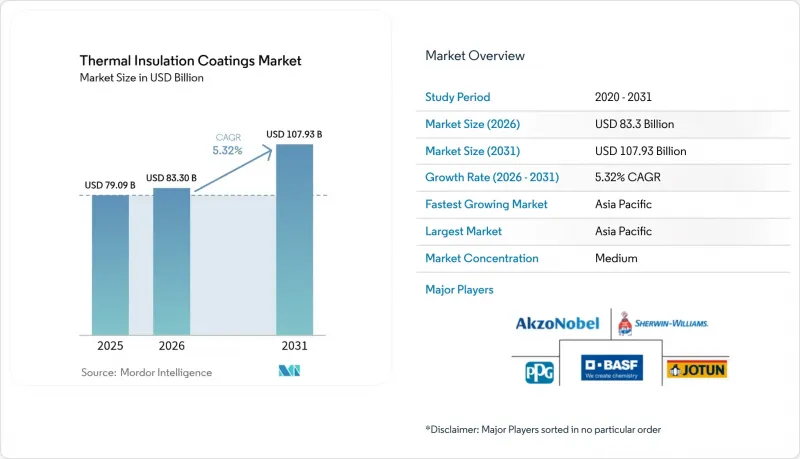
據 Mordor Intelligence 稱,2025 年隔熱塗料市值為 790.9 億美元,預計到 2031 年將達到 1079.3 億美元,而 2026 年為 833 億美元,預測期內(2026-2031 年)的複合年成長率為 5.32%。
本報告按樹脂類型(丙烯酸樹脂、環氧樹脂、聚氨酯樹脂等)、塗層形式(液體噴塗、粉末、真空沉澱)、應用(建築圍護結構、工業設備和管道、儲存槽和容器等)、最終用戶行業(建築和施工、工業和製造業、汽車等)以及地區(亞太地區、北美地區、歐洲地區等)進行分類。
全球隔熱塗料市場趨勢及洞察
新建煉油廠
全球煉油廠的擴張持續推動隔熱塗料市場的發展。印度、中國和阿拉伯沿岸地區的新建煉油廠均指定使用多層環氧樹脂隔熱層來保護蒸餾塔和熱交換器殼體,這些設備的運作溫度範圍在200 度C至800 度C之間。專案業主擴大將耐腐蝕性和數位化厚度監測功能整合到同一塗層包裝中,以減少意外運作並延長設備使用壽命。能夠應對常溫和循環溫度環境的認證供應商有機會參與大型資本項目。
區域供熱和製冷網路的擴建
第四代區域供熱冷凍網路的供水溫度較低,因此需要運作能夠承受反覆熱循環並降低管線損耗的塗層。丹麥一家地方政府能源合作社的研究表明,先進的保溫技術可將年度熱損耗降低幾個百分點,並提高熱泵效率。德國和瑞典的類似維修工程則指定使用氣凝膠底漆,以達到更嚴格的保溫目標。
大量資金需求
等離子噴塗室、自動化龍門架和可控環境固化爐的成本可能高達數百萬美元,這限制了新參與企業的產能。因此,大規模綜合製造商主導長期供應契約,而小規模承包商在資金籌措方面面臨巨大的障礙。諸如近期關於多元化化工集團內部業務剝離的討論等資產組合重組,凸顯了資本密集商業環境帶來的壓力。
細分市場分析
環氧樹脂系統憑藉其卓越的附著力和耐化學性,適用於煉油廠管道、船舶甲板和海上平台等應用,預計到2025年將佔據隔熱塗料市場35.74%的佔有率。這些產品在亞太和中東地區規劃的防護襯裡專案中佔據了相當可觀的隔熱塗料市場。改良後的配方中加入了中空玻璃微珠,在不影響漆膜韌性的前提下,將導熱係數控制在0.180 W m-1K-1以下。
目前銷售額僅為個位數的二氧化矽氣凝膠塗層,預計到2031年將達到5.74%的複合年成長率。其極低的導熱係數(0.015 W m⁻¹ K⁻¹)使其能夠在常壓下應用,而先前這些應用需要真空絕熱板。製造商透過將氣凝膠粉末共分散在環氧樹脂基體中,實現了機械強度和近乎超高的隔熱性能,這使得該領域在未來規範制定中具有極其重要的影響力。在航太領域,熵穩定氧化物和YSZ平台正瞄準運作溫度高於1200 度C的渦輪葉片蒙皮,預示著技術交叉融合的更多機會。
預計到2025年,液體噴塗線將佔據隔熱塗料市場44.72%的佔有率,並以6.21%的複合年成長率持續領先於其他噴塗方式。其主要優勢包括可對焊接和徑向曲面進行無縫塗覆,以及透過整合機器人的噴頭提高生產效率。目前,製造工廠正在利用視覺分析技術測量濕膜厚度,並自動調整噴槍速度,以最大限度地減少過噴並提高成品率。粉末塗裝線在網格殼體結構和某些管道外表面仍然發揮著至關重要的作用,其靜電吸附可確保形成均勻的塗層。
區域分析
預計到2025年,亞太地區將佔全球銷售額的39.62%,主要得益於中國、印度和韓國的一系列大型企劃。各地區政府都在優先發展煉油自給自足,直接推動了隔熱塗料市場的成長。此外,日本的液化天然氣冷鏈終端以及為東南亞島嶼供氣的浮體式儲存再氣化裝置(FSRU)也增強了市場成長動能。
在北美,航太推進計畫和重工業區製程熱電氣化試點計畫正在推動市場成長。聯邦經濟獎勵策略加速了區域供熱系統的維修,促使地方政府公共產業採用能夠減少輸配熱損耗的先進塗層材料。諸如加拿大《2020年國家建築能源規範》等提高牆體組裝隔熱性能要求的法規,也支撐了噴塗陶瓷微球產品的持續需求。
歐洲在政策主導的脫碳領域保持主導地位,擁有最密集的區域供熱市場,並持續推動塗層規格的改進,使其具備在實際環境之外經受熱循環考驗的耐久性。隨著新建重工業設施的減少,人們的關注點正轉向在老舊工業園區安裝高溫熱泵系統,塗層可降低熱油迴路中的傳導損失。同時,在中東和非洲,石油相關資本投資項目正推動塗層在石化工業園區得到更廣泛的應用;而在南美礦區,塗層則被用於保護製程容器免受強酸和全天劇烈溫度波動的影響。
其他好處
- Excel格式的市場預測(ME)表
- 3個月的分析師支持
目錄
第1章:引言
- 研究假設和市場定義
- 調查範圍
第2章:調查方法
第3章執行摘要
第4章 市場狀況
- 市場概覽
- 市場促進因素
- 新建煉油廠
- 區域供熱和製冷網路的擴建
- 對建築業的需求增加
- 重工業製程熱的電氣化
- 液化天然氣冷鏈物流激增
- 市場限制因素
- 大量資金需求
- 原料(環氧樹脂和聚氨酯)價格波動
- 超高溫資產應用範圍的限制
- 供應鏈分析
- 波特五力模型
第5章 市場規模與成長預測
- 依樹脂類型
- 丙烯酸纖維
- 環氧樹脂
- 聚氨酯
- 釔安定氧化鋯(YSZ)
- 其他樹脂類型(例如二氧化矽氣凝膠型等)
- 按塗層類型
- 液體噴霧
- 粉末
- 真空沉澱
- 透過使用
- 建築圍護結構(牆體、屋頂)
- 工業設備和管道
- 儲存槽和容器
- 汽車零件
- 船體和甲板結構
- 航太和渦輪機零件
- 按最終用戶行業分類
- 建築/施工
- 工業和製造業
- 車
- 海上
- 其他終端用戶產業(食品加工、製藥)
- 按地區
- 亞太地區
- 中國
- 印度
- 日本
- 韓國
- 其他亞太國家
- 北美洲
- 美國
- 加拿大
- 墨西哥
- 歐洲
- 德國
- 英國
- 法國
- 義大利
- 其他歐洲國家
- 南美洲
- 巴西
- 阿根廷
- 其他南美國家
- 中東和非洲
- 沙烏地阿拉伯
- 南非
- 其他中東和非洲國家
- 亞太地區
第6章 競爭情勢
- 市場集中度
- 策略趨勢
- 市佔率和排名分析
- 公司簡介
- AkzoNobel NV
- BASF
- Behr Process LLC
- DAW SE
- Dow
- Evonik Industries AG
- Hempel A/S
- Jotun
- Kansai Paint Co., Ltd
- Mascoat
- Nippon Paint Holdings Co., Ltd
- OC Oerlikon Management AG
- PPG Industries, Inc.
- RPM International
- Sharpshell Engineering
- Sika AG
- Synavax
- The Sherwin-Williams Company
第7章 市場機會與未來展望
According to Mordor Intelligence, the thermal insulation coatings market size was valued at USD 79.09 billion in 2025 and estimated to grow from USD 83.3 billion in 2026 to reach USD 107.93 billion by 2031, at a CAGR of 5.32% during the forecast period (2026-2031).
This report is Segmented by Resin Type (Acrylic, Epoxy, Polyurethane, and More), Coating Form (Liquid Spray, Powder, Vacuum-Deposited), Application (Building Envelope, Industrial Equipment and Pipelines, Storage Tanks and Vessels, and More), End-User Industry (Building and Construction, Industrial/Manufacturing, Automotive, and More), and Geography (Asia Pacific, North America, Europe, and More).
Global Thermal Insulation Coatings Market Trends and Insights
Construction of New Refineries
Global refinery buildouts continue to anchor the thermal insulation coatings market. New complexes in India, China, and the Arabian Gulf specify multilayer epoxy barriers for distillation towers and heat-exchanger shells that run between 200 °C and 800 °C. Project owners increasingly bundle corrosion resistance and digital thickness monitoring into the same coating package to curb unplanned outages and extend asset life. Suppliers that can certify systems for both normal and cyclic temperature environments gain access to the largest capital projects pipeline.
Expansion of District Heating and Cooling Networks
Fourth-generation district-heating grids operate at lower supply temperatures, demanding coatings capable of reducing distribution losses while surviving repetitive thermal cycling. Denmark's municipal energy cooperatives demonstrate that advanced insulation can shave multiple percentage points from annual heat losses, thereby improving heat-pump efficiency. Similar retrofits across Germany and Sweden specify aerogel-infused primers to meet the stricter heat-retention targets.
High Capital Requirement
Plasma-spray booths, automated gantries, and controlled-atmosphere curing ovens can cost several million USD, limiting new-entrant capacity. Large integrated producers therefore dominate long-run supply contracts, while smaller applicators face financing hurdles. Portfolio restructuring, as seen in recent divestiture discussions inside diversified chemistry groups, underscores capital intensity pressures.
Other drivers and restraints analyzed in the detailed report include:
- Increasing Demand for Construction Industry
- Electrification of Process-Heat in Heavy Industry
- Volatile Raw-Material (Epoxy and PU) Prices
For complete list of drivers and restraints, kindly check the Table Of Contents.
Segment Analysis
Epoxy systems retained a 35.74% share of the thermal insulation coatings market in 2025, buoyed by strong adhesion and chemical resistance that suit refinery piping, marine deck plates, and offshore platforms. They underpin a significant portion of the thermal insulation coatings market size for protective-lining projects scheduled across APAC and the Middle East. Enhanced formulations embed hollow-glass microspheres to bring thermal conductivity below 0.180 W m-1 K-1 without sacrificing film toughness.
Silica-aerogel coatings, while holding only single-digit revenue today, record a 5.74% CAGR to 2031. Ultra-low conductivity readings of 0.015 W m-1 K-1 unlock ambient-pressure applications that once demanded vacuum-insulated panels. Manufacturers co-disperse aerogel powder into epoxy matrices to combine mechanical strength with near-super-insulating performance, giving the segment outsized influence on future specifications. At the aerospace frontier, entropy-stabilized oxide and YSZ platforms target turbine-blade skins running above 1,200 °C, suggesting further technology crossover opportunities.
Liquid spray lines captured 44.72% of thermal insulation coatings market share in 2025 and continue to outpace other forms at a 6.21% CAGR. Their chief advantages include seamless coverage on weld seams and radius bends, plus production-rate gains from robot-integrated spray heads. Process yards now deploy vision analytics to gauge wet-film thickness and self-correct gun speed, minimizing overspray and improving yield. Powder lines remain relevant in gridshell architecture and certain pipeline externals where electrostatic attraction ensures uniform film builds.
Complete Report Scope:
- By Resin Type
- Acrylic
- Epoxy
- Polyurethane
- Yttria-Stabilised Zirconia (YSZ)
- Other Resin Types (Silica Aerogel-Based, etc.)
- By Coating Form
- Liquid Spray
- Powder
- Vacuum-Deposited
- By Application
- Building Envelope (Walls, Roofs)
- Industrial Equipment and Pipelines
- Storage Tanks and Vessels
- Automotive Components
- Marine Hull and Deck Structures
- Aerospace and Turbine Parts
- By End-user Industry
- Building and Construction
- Industrial/Manufacturing
- Automotive
- Marine
- Others (Food Processing, Pharma)
- By Geography
- Asia Pacific
- China
- India
- Japan
- South Korea
- Rest of Asia Pacific
- North America
- United States
- Canada
- Mexico
- Europe
- Germany
- United Kingdom
- France
- Italy
- Rest of Europe
- South America
- Brazil
- Argentina
- Rest of South America
- Middle-East and Africa
- Saudi Arabia
- South Africa
- Rest of Middle-East and Africa
- Asia Pacific
Geography Analysis
Asia-Pacific holds 39.62% of 2025 revenue, reflecting megaproject pipelines in China, India, and South Korea. Regional governments prioritize refinery self-sufficiency, which directly inflates the thermal insulation coatings market. Added momentum comes from LNG cold-chain terminals in Japan and floating storage regasification units serving Southeast Asian islands.
North America is assisted by aerospace propulsion programs and process-heat electrification pilots in heavy industry alleys. Federal stimulus packages encourage district-energy retrofits, steering municipal utilities toward advanced coating overlays that lower distribution losses. Regulations like Canada's National Energy Code for Buildings 2020, which lifts thermal-resistance requirements for wall assemblies, anchor recurrent demand for spray-applied ceramic microsphere products.
Europe maintains leadership in policy-driven decarbonization and commands the densest district-heating market, fostering continuous specification upgrades for coatings with validated ex-situ thermal-cycling endurance. Scarcity of new-build heavy industry shifts focus to retrofitting aging industrial parks with high-temperature heat-pump systems, where coatings moderate conductive losses on hot-oil loops. Meanwhile, the Middle-East and Africa leverages oil-capex programs to expand adoption in petrochemical parks, whereas South America's mining belts employ coatings to buffer process vessels against aggressive acids and wide daily temperature swings.
- AkzoNobel N.V.
- BASF
- Behr Process LLC
- DAW SE
- Dow
- Evonik Industries AG
- Hempel A/S
- Jotun
- Kansai Paint Co., Ltd
- Mascoat
- Nippon Paint Holdings Co., Ltd
- OC Oerlikon Management AG
- PPG Industries, Inc.
- RPM International
- Sharpshell Engineering
- Sika AG
- Synavax
- The Sherwin-Williams Company
Additional Benefits:
- The market estimate (ME) sheet in Excel format
- 3 months of analyst support
TABLE OF CONTENTS
1 Introduction
- 1.1 Study Assumptions and Market Definition
- 1.2 Scope of the Study
2 Research Methodology
3 Executive Summary
4 Market Landscape
- 4.1 Market Overview
- 4.2 Market Drivers
- 4.2.1 Construction of New Refineries
- 4.2.2 Expansion of District Heating and Cooling Networks
- 4.2.3 Increasing demand for the construction industry
- 4.2.4 Electrification of Process-Heat in Heavy Industry
- 4.2.5 Surge in LNG Cold-Chain Logistics
- 4.3 Market Restraints
- 4.3.1 High Capital Requirement
- 4.3.2 Volatile Raw-Material (Epoxy and PU) Prices
- 4.3.3 Limited Applicability in Ultra High Temperature Assets
- 4.4 Supply Chain Analysis
- 4.5 Porter's Five Forces
- 4.5.1 Bargaining Power of Suppliers
- 4.5.2 Bargaining Power of Buyers
- 4.5.3 Threat of New Entrants
- 4.5.4 Threat of Substitutes
- 4.5.5 Competitive Rivalry
5 Market Size and Growth Forecasts (Value)
- 5.1 By Resin Type
- 5.1.1 Acrylic
- 5.1.2 Epoxy
- 5.1.3 Polyurethane
- 5.1.4 Yttria-Stabilised Zirconia (YSZ)
- 5.1.5 Other Resin Types (Silica Aerogel-Based, etc.)
- 5.2 By Coating Form
- 5.2.1 Liquid Spray
- 5.2.2 Powder
- 5.2.3 Vacuum-Deposited
- 5.3 By Application
- 5.3.1 Building Envelope (Walls, Roofs)
- 5.3.2 Industrial Equipment and Pipelines
- 5.3.3 Storage Tanks and Vessels
- 5.3.4 Automotive Components
- 5.3.5 Marine Hull and Deck Structures
- 5.3.6 Aerospace and Turbine Parts
- 5.4 By End-user Industry
- 5.4.1 Building and Construction
- 5.4.2 Industrial/Manufacturing
- 5.4.3 Automotive
- 5.4.4 Marine
- 5.4.5 Others (Food Processing, Pharma)
- 5.5 By Geography
- 5.5.1 Asia Pacific
- 5.5.1.1 China
- 5.5.1.2 India
- 5.5.1.3 Japan
- 5.5.1.4 South Korea
- 5.5.1.5 Rest of Asia Pacific
- 5.5.2 North America
- 5.5.2.1 United States
- 5.5.2.2 Canada
- 5.5.2.3 Mexico
- 5.5.3 Europe
- 5.5.3.1 Germany
- 5.5.3.2 United Kingdom
- 5.5.3.3 France
- 5.5.3.4 Italy
- 5.5.3.5 Rest of Europe
- 5.5.4 South America
- 5.5.4.1 Brazil
- 5.5.4.2 Argentina
- 5.5.4.3 Rest of South America
- 5.5.5 Middle-East and Africa
- 5.5.5.1 Saudi Arabia
- 5.5.5.2 South Africa
- 5.5.5.3 Rest of Middle-East and Africa
- 5.5.1 Asia Pacific
6 Competitive Landscape
- 6.1 Market Concentration
- 6.2 Strategic Moves
- 6.3 Market Share(%)/Ranking Analysis
- 6.4 Company Profiles (includes Global level Overview, Market level overview, Core Segments, Financials as available, Strategic Information, Market Rank/Share for key companies, Products and Services, and Recent Developments)
- 6.4.1 AkzoNobel N.V.
- 6.4.2 BASF
- 6.4.3 Behr Process LLC
- 6.4.4 DAW SE
- 6.4.5 Dow
- 6.4.6 Evonik Industries AG
- 6.4.7 Hempel A/S
- 6.4.8 Jotun
- 6.4.9 Kansai Paint Co., Ltd
- 6.4.10 Mascoat
- 6.4.11 Nippon Paint Holdings Co., Ltd
- 6.4.12 OC Oerlikon Management AG
- 6.4.13 PPG Industries, Inc.
- 6.4.14 RPM International
- 6.4.15 Sharpshell Engineering
- 6.4.16 Sika AG
- 6.4.17 Synavax
- 6.4.18 The Sherwin-Williams Company
7 Market Opportunities and Future Outlook
- 7.1 White-space and Unmet-Need Assessment

 高性能陶瓷和隔熱塗層市場預測至2034年—按塗層類型、材料類型、技術、應用和地區分類的全球分析隔熱塗料市場:預測至2034年-全球分析(依塗料、塗裝流程、黏合塗料、組件、應用、終端使用者產業和地區分類)
 隔熱塗層:市場佔有率分析、行業趨勢和統計數據、成長預測(2026-2031 年)
 隔熱塗料市場:2026-2032年全球市場預測(依塗層技術、零件類型、基材、溫度範圍、塗層結構及最終用途產業分類)可再生隔熱包裝市場預測至2034年—按材料類型、包裝形式、應用、最終用戶和地區分類的全球分析
 隔熱塗料市場報告:按產品、應用和地區分類(2026-2034 年)
 全球耐熱阻隔塗層市場規模、佔有率、趨勢和成長分析報告(2026-2034年)
 隔熱塗佈市場-全球產業規模、佔有率、趨勢、機會、預測:按產品、最終用戶產業、地區和競爭對手分類,2021-2031年全球防風雨塗料市場:按技術、塗料類型、應用、最終用戶和分銷管道分類的預測(2026-2032 年)
 隔熱市場規模、佔有率和成長分析(按產品、技術、塗層組合、應用和地區分類)—產業預測(2026-2033 年)