


 |
市場調查報告書
商品編碼
2122864
照明塔:市場佔有率分析、產業趨勢與統計、成長預測(2026-2031)Light Tower - Market Share Analysis, Industry Trends & Statistics, Growth Forecasts (2026 - 2031) |
||||||

※ 本網頁內容可能與最新版本有所差異。詳細情況請與我們聯繫。
2025 年照明塔市場價值 48.7 億美元,預計到 2031 年將達到 62.8 億美元,而 2026 年為 50.8 億美元,預測期(2026-2031 年)複合年成長率為 4.32%。
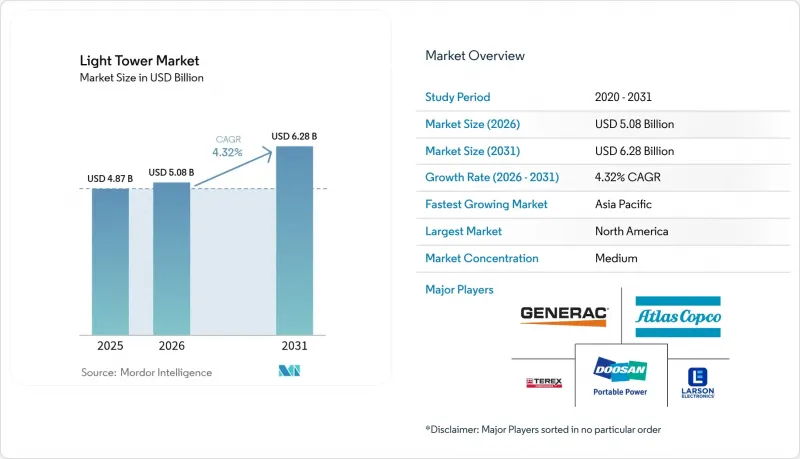
本報告按類型(LED照明塔等)、動力來源(柴油動力、太陽能混合動力等)、桅杆高度(30英尺以下等)、移動方式(移動式/拖車式、滑橇式/固定式)、所有權類型(租賃/租借、直接購買)、終端用戶行業(建築、石油天然氣、其他)和地區進行細分。市場預測以美元計價。
全球照明塔市場趨勢與洞察
北美全天候基礎設施維修計畫迅速擴展
橋樑、機場和高速公路的維修工程需要全天候作業,因此對能夠跨班次運作的高功率明塔的需求持續成長。美國土木工程師協會 (ASCE) 指出,基礎建設存在 9.1 兆美元的缺口,這導致夜間施工計畫加快,照明需求也隨之增加。市政預算也反映了這種緊迫性,例如聖地牙哥市在 2025 年至 2029 年間累計4.5137 億美元用於街道照明昇級,這表明可攜式設備將被廣泛採購。目前,設備規格強調更大的燃料箱容量和用於監控運作時間的遠端資訊處理功能。製造商正在透過諸如 Allmand 的「Maxi-Lite」等設計來應對這一需求,該設計可連續運作175 小時,滿足了承包商減少加油頻率的要求。
歐洲租賃車隊迅速轉向LED照明
歐洲租賃公司正競相降低營運成本,這推動了照明設備從金屬鹵化物燈轉向LED燈的轉變。人口密集都市區日益嚴格的噪音和廢氣排放法規也加速了這項轉型,因為LED照明設備能夠降低油耗和維護成本。 Generac Mobile的GLT系列產品現已推出符合嚴格市政標準的可調式LED陣列和混合模式。在公共合約中評估永續性標準時,率先採用者在競標中佔優勢。這種維修趨勢也改變了殘值計算方式,LED燈具的轉售價格更高。這項優勢也體現在租賃收費系統中,節能型燈具更受青睞。
氫燃料塔需要較高的初始資本支出(CAPEX)。
燃料電池裝置消除了燃燒排放,但其成本是傳統柴油車型的三到四倍。採購部門優先考慮投資回收期,因此即使預期在整個生命週期中可以節省成本,他們也常常推遲採購。由於加氫基礎設施有限,燃料電池的部署僅限於試點計畫和一些備受矚目的活動。隨著氫能樞紐的擴張和堆疊價格的下降,燃料電池的普及門檻有望降低,但短期內,其成長可能仍會受到緊張的資本預算和項目競標壓力的限制。
細分市場分析
預計到2025年,LED照明塔將維持61.35%的市場佔有率,並以4.38%的複合年成長率持續成長。 LED照明塔具有能耗低、燈泡壽命超過5萬小時等優點,從而降低了燃料消耗和維護週期,使其成為租賃競標中的標準配置,並在永續性指標方面得分很高。明亮的白光可以提高工作場所的能見度,降低事故率,並符合監管安全檢查清單的要求。歐洲都市區的建築承包商擴大指定使用低眩光LED陣列,以符合噪音和光污染法規。
金屬鹵化物燈系統仍應用於一些特定的重工業領域,在這些領域,極高的單燈流明輸出比燃油消耗更為重要。製造商正透過採用堅固的外殼和快速啟動的燈泡來縮短預熱時間,以應對這一需求。產品創新涵蓋了兩種照明形式。阿特拉斯·科普柯的“Hilight V4+”展示了設計效率如何與照明性能相輔相成,它採用模製座艙罩保護組件,並允許將16檯燈具裝載到13米長的卡車上。 LED和金屬鹵化物燈的共存保持了組件供應鏈的多樣性,而研發預算正轉向固態技術。
到2025年,柴油動力照明塔將佔據照明塔市場69.20%的佔有率。這得益於完善的燃料供應基礎設施和久經考驗的可靠性。電子控制的Tier-4引擎可減少排放氣體和怠速時間,而自動啟動/停止功能則可依實際照明需求調整運作時間,進而降低燃料成本。這些改良使得柴油動力照明塔即使在偏遠地區和光照條件及電池性能難以預測的惡劣環境下,也能保持競爭力。
預計太陽能混合動力設計將以6.91%的複合年成長率實現最高成長。整合式太陽能板在白天為車輛電池充電,從而實現夜間靜音運行;只有當電池電量低於閾值時,小型引擎才會啟動。阿特拉斯·科普柯的「HiLight BI+4」將鋰離子電池組與微型柴油引擎結合,在典型的一周運作中可將碳排放量減少一半以上。氫燃料電池原型機,例如TCP集團計劃在2025年完成的500台機組,具有實現現場零排放的潛力,但目前成本仍過高。直接連接到電網的照明塔在隧道挖掘和陸上電力可用的大型活動中發揮著獨特的作用,這展現了照明塔市場更廣泛的技術組合的多樣性。
區域分析
2025年,北美以33.60%的市佔率領先照明塔市場。強制性的基礎設施現代化改造、嚴格的安全法規以及頻繁的極端天氣事件,共同支持了全年不間斷的需求。美國土木工程師協會(ASCE)強調了投資缺口,正是這些缺口導致了夜間施工的必要性。航空業的貢獻尤其突出,曼尼托巴省的2024/2025年策略就包括跑道照明維修,以滿足加拿大運輸部的相關規定。大型租賃公司正在利用Total Control等數位化平台最佳化車輛分配,該平台允許承包商在一個統一的控制面板上整合和操作照明塔、發電機和水泵。
亞太地區是成長最快的地區,複合年成長率達5.12%,主要得益於大型採礦活動、都市區成長以及可再生能源基礎設施的擴張。在澳大利亞,計畫需要高桿燈塔來照亮綿延數英里的交通道路。在其他地區,快速的城市擴張需要高度柔軟性的拖車單元,用於橋樑、鐵路和綜合用途開發項目。彭博新能源財經估計,2050年實現淨零排放需要89兆美元的能源投資,這意味著電網和可再生能源設施將面臨長期資本流入,而建設階段則需要臨時照明。
歐洲仍然是一個龐大的市場,其特點是嚴格遵守排放法規和不斷成長的租賃市場。都市區環境法規和碳定價機制推動了LED和混合產品的普及率高於全球平均。政府對低排放設備的獎勵正在縮短下一代塔架的投資回收期。隨著石油、天然氣和公共產業公司在偏遠沙漠地區採用太陽能混合裝置,中東和非洲市場正穩步成長。南美洲的需求隨大宗商品週期波動。智利和巴西的銅礦和鐵礦石需要高聳的桅杆和適合山區地形的堅固底盤。光纖電纜的鋪設也推動了設備訂單的成長,網路安裝人員需要在日落後進行挖溝和連接工作時使用聚光照明設備。
其他好處:
- Excel格式的市場預測(ME)表
- 3個月的分析師支持
目錄
第1章:引言
- 研究假設和市場定義
- 調查範圍
第2章:調查方法
第3章執行摘要
第4章 市場狀況
- 市場概覽
- 市場促進因素
- 北美全天候基礎設施維修計畫迅速擴展
- 在歐洲,租賃車輛更換為LED燈的進程正在快速推進。
- 在中東和北非(MENA)地區偏遠的油氣開採地點推廣太陽能混合塔的應用。
- 嚴格的第四階段和第五階段排放氣體法規正在推動混合動力汽車的普及。
- 澳洲的大型採礦計畫正在加速對高桅杆(超過 60 英尺)的需求。
- 東協地區災害救助資金的激增正在推動行動照明塔的部署。
- 市場限制因素
- 氫燃料塔的初始資本投資相對較高。
- 北歐寒冷氣候導致電池耗盡並運作關機
- 柴油價格波動正在扭曲租賃定價模型。
- 歐盟都市區臨時照明許可的複雜程序。
- 產業生態系分析
- 技術展望
- 波特五力分析
第5章 市場規模與成長預測
- 按類型
- LED燈塔
- 金屬鹵化物照明塔
- 透過電源
- 配備柴油引擎
- 太陽能混合動力
- 氫燃料電池型
- 直接併網/電池供電
- 按桅杆高度
- 不到30英尺
- 30-60英尺
- 超過60英尺
- 透過移動性
- 移動式/拖車式
- 滑橇/固定
- 自有車型
- 出租/租賃
- 直接購買
- 按最終用戶行業分類
- 建造
- 石油和天然氣
- 礦業
- 工業和製造業
- 基礎建設(公路、鐵路、機場、港口)
- 活動、運動、娛樂
- 軍事、緊急救援與災害救援
- 按地區
- 北美洲
- 美國
- 加拿大
- 墨西哥
- 歐洲
- 德國
- 英國
- 法國
- 義大利
- 西班牙
- 北歐國家(丹麥、瑞典、挪威、芬蘭)
- 其他歐洲國家
- 亞太地區
- 中國
- 日本
- 韓國
- 印度
- 東南亞
- 澳洲
- 其他亞太國家
- 南美洲
- 巴西
- 阿根廷
- 其他南美國家
- 中東
- 波灣合作理事會(GCC)成員國
- 土耳其
- 其他中東國家
- 非洲
- 南非
- 奈及利亞
- 其他非洲國家
- 北美洲
第6章 競爭情勢
- 市場集中度
- 策略趨勢
- 市佔率分析
- 公司簡介
- Atlas Copco AB
- Generac Power Systems Inc.(Generac Mobile)
- Terex Corp.
- Doosan Portable Power
- Wacker Neuson SE
- Trime Srl
- Allmand Bros. Inc.(Briggs and Stratton)
- Larson Electronics LLC
- Wanco Inc.
- Xylem Inc.(Seltorque)
- JC Bamford Excavators Ltd.
- United Rentals Inc.
- BMI Group(Genergy)
- Lind Equipment Ltd.
- Colorado Standby
- Youngman Richardson and Co. Ltd.
- Westquip Diesel Sales Ltd.
- Inmesol Gensets SL
- Atlas Luminaires Inc.
- The Will-Burt Company
第7章 市場機會與未來展望
According to Mordor Intelligence, the light tower market size was valued at USD 4.87 billion in 2025 and estimated to grow from USD 5.08 billion in 2026 to reach USD 6.28 billion by 2031, at a CAGR of 4.32% during the forecast period (2026-2031).
This report is Segmented by Type (LED Light Towers, and More), Power Source (Diesel Powered, Solar-Hybrid Powered, and More), Mast Height (Below 30 Ft, and More), Mobility (Mobile/Trailer-Mounted, and Skid/Fix-Mounted), Ownership Model (Rental/Leased, and Direct Purchase), End-User Industry (Construction, Oil and Gas, and More), and Geography. The Market Forecasts are Provided in Terms of Value (USD).
Global Light Tower Market Trends and Insights
Booming 24 X 7 Infrastructure-Repair Programs in North America
Round-the-clock bridge, airport, and highway refurbishments create sustained demand for high-output towers able to operate for multiple shifts. The American Society of Civil Engineers lists a USD 9.1 trillion infrastructure gap that accelerates night-work schedules and heightens lighting requirements. Municipal budgets mirror this urgency; San Diego earmarked USD 451.37 million for streetlight upgrades across 2025-2029, signaling widespread procurement of portable units. Equipment spec sheets now highlight extended fuel tanks and telematics for up-time monitoring. Manufacturers respond with designs like Allmand's Maxi-Lite, featuring a 175-hour runtime, a specification that meets contractor requests for fewer refuels.
Rapid Shift Toward LED Retrofit in Rental Fleets across Europe
European rental houses compete on total operating cost, prompting fleet conversions from metal-halide to LED. Restrictions on noise and exhaust in dense urban zones speed the switch, as LED fixtures cut fuel burn and maintenance visits. Generac Mobile's GLT series now offers adjustable LED arrays and hybrid variants that meet strict municipal standards. Early adopters gain tender advantages when public contracts score sustainability criteria. The retrofit trend has also shifted residual-value calculations, with LED units achieving higher resale prices, a benefit reflected in rental rate structures that favor energy-efficient models.
High Initial CAPEX for Hydrogen-Fuel Towers
Fuel-cell units eliminate combustion emissions but cost three to four times more than conventional diesel models. Procurement departments focused on payback periods often defer purchases despite lifecycle savings. Limited refueling infrastructure confines deployments to pilot sites and high-profile events. As hydrogen hubs expand and stack prices fall, adoption barriers are expected to recede, yet near-term growth remains tempered by tight capital budgets and project bid pressures.
Other drivers and restraints analyzed in the detailed report include:
- Rising Deployment of Solar-Hybrid Towers at Remote Oil and Gas Pads in MENA
- Stringent Tier-4 and Stage V Emission Norms Fueling Hybrid-Powered Adoption
- Operational Downtime Due to Battery Drain in Cold Nordic Climates
For complete list of drivers and restraints, kindly check the Table Of Contents.
Segment Analysis
LED towers retained 61.35% share of the light tower market in 2025 and continue growing at a 4.38% CAGR. Reduced wattage and bulb lifespans beyond 50,000 hours cut fuel burn and service intervals, making LED the default specification for rental bids that score on sustainability metrics. Bright white output improves worksite visibility, reducing accident rates and aligning with regulatory safety checklists. Construction contractors in urban Europe increasingly specify low-glare LED arrays to comply with noise and light-pollution ordinances.
Metal-halide systems persist in niche heavy-industrial applications where very high lumen output per fixture is prioritized over fuel use. Manufacturers respond with ruggedized housings and quick-strike lamps to shorten warm-up times. Product innovation extends across both formats; Atlas Copco's Hilight V4+ protects components under a molded canopy and fits 16 units per 13-m truck, showcasing how design efficiency supplements lighting performance. The coexistence of LED and metal-halide keeps component supply chains diversified yet tilts R&D budgets toward solid-state technologies.
Diesel-powered towers accounted for 69.20% of the light tower market share in 2025, benefiting from ubiquitous fueling infrastructure and field-proven reliability. Tier-4 engines with electronic management cut emissions and idle time, while automatic start-stop functions align runtime with real light demand, trimming fuel bills. These enhancements enable diesel units to remain competitive in remote or extreme environments where solar exposure or battery performance is uncertain.
Solar-hybrid designs post the highest 6.91% CAGR forecast. Integrated panels charge onboard batteries by day, allowing silent night operations, with small engines activating only under low-state-of-charge thresholds. Atlas Copco's HiLight BI+4 matches lithium-ion packs with a micro-diesel engine, cutting carbon dioxide output by more than half across a standard workweek. Hydrogen fuel-cell prototypes, like TCP Group's 500-unit fleet completed in 2025, promise zero-local-emission performance but remain cost-intensive. Direct grid-connected towers fill specialized roles in tunneling and large events where shore power exists, demonstrating the diversified technology mix inside the broader light tower market.
Complete Report Scope:
- By Type
- LED Light Towers
- Metal-Halide Light Towers
- By Power Source
- Diesel Powered
- Solar-Hybrid Powered
- Hydrogen Fuel-Cell Powered
- Direct Grid/Battery Powered
- By Mast Height
- Below 30 ft
- 30 - 60 ft
- Above 60 ft
- By Mobility
- Mobile/Trailer-Mounted
- Skid/Fix-Mounted
- By Ownership Model
- Rental/Leased
- Direct Purchase
- By End-user Industry
- Construction
- Oil and Gas
- Mining
- Industrial and Manufacturing
- Infrastructure (Road, Rail, Airport, Ports)
- Events, Sports and Entertainment
- Military, Emergency and Disaster Relief
- By Geography
- North America
- United States
- Canada
- Mexico
- Europe
- Germany
- United Kingdom
- France
- Italy
- Spain
- Nordics (Denmark, Sweden, Norway, Finland)
- Rest of Europe
- Asia-Pacific
- China
- Japan
- South Korea
- India
- Southeast Asia
- Australia
- Rest of Asia-Pacific
- South America
- Brazil
- Argentina
- Rest of South America
- Middle East
- Gulf Cooperation Council Countries
- Turkey
- Rest of Middle East
- Africa
- South Africa
- Nigeria
- Rest of Africa
- North America
Geography Analysis
North America led the light tower market with a 33.60% share in 2025. Infrastructure renewal mandates, stringent safety regulations, and frequent extreme-weather events sustain year-round demand. The American Society of Civil Engineers underscores the investment gap that drives night construction schedules. Manitoba's 2024/2025 strategy includes runway light upgrades to meet Transport Canada rules, highlighting aviation's contribution. Rental giants leverage digital platforms such as Total Control to optimize fleet allocation, enabling contractors to combine towers, generators, and pumps within unified dashboards.
Asia Pacific is the fastest-growing region at 5.12% CAGR, propelled by mega-mining activities, urban population growth, and expanding renewable-energy infrastructure. Australian projects necessitate high-mast towers to illuminate haul roads spanning several kilometers. Elsewhere, rapid urban expansion requires flexible trailer units for bridge, rail, and mixed-use developments. BloombergNEF estimates USD 89 trillion in energy investments are needed for net-zero by 2050, signaling long-term capital flows into grid and renewable installations that will require temporary lighting during build-out phases.
Europe remains a sizable market characterized by strict emission compliance and sophisticated rental penetration. LED and hybrid adoption rates exceed global averages due to urban environmental restrictions and carbon-pricing mechanisms. Government incentives for low-emission equipment increase the payback speed of next-generation towers. The Middle East and Africa register steady growth as oil, gas, and utility operators embrace solar-hybrid units for remote desert sites. South America's demand varies by commodity cycle; copper and iron ore mines in Chile and Brazil procure taller masts and robust chassis suited for mountainous terrain. Telecommunications fiber rollouts also spur equipment orders, as network installers require spot illumination for trenching and splice work after daylight.
- Atlas Copco AB
- Generac Power Systems Inc. (Generac Mobile)
- Terex Corp.
- Doosan Portable Power
- Wacker Neuson SE
- Trime S.r.l.
- Allmand Bros. Inc. (Briggs and Stratton)
- Larson Electronics LLC
- Wanco Inc.
- Xylem Inc. (Seltorque)
- J C Bamford Excavators Ltd.
- United Rentals Inc.
- BMI Group (Genergy)
- Lind Equipment Ltd.
- Colorado Standby
- Youngman Richardson and Co. Ltd.
- Westquip Diesel Sales Ltd.
- Inmesol Gensets SL
- Atlas Luminaires Inc.
- The Will-Burt Company
Additional Benefits:
- The market estimate (ME) sheet in Excel format
- 3 months of analyst support
TABLE OF CONTENTS
1 INTRODUCTION
- 1.1 Study Assumptions and Market Definition
- 1.2 Scope of the Study
2 RESEARCH METHODOLOGY
3 EXECUTIVE SUMMARY
4 MARKET LANDSCAPE
- 4.1 Market Overview
- 4.2 Market Drivers
- 4.2.1 Booming 24x7 Infrastructure-Repair Programs in North America
- 4.2.2 Rapid Shift Toward LED Retrofit in Rental Fleets across Europe
- 4.2.3 Rising Deployment of Solar-Hybrid Towers at Remote Oil and Gas Pads in MENA
- 4.2.4 Stringent Tier-4 and Stage V Emission Norms Fueling Hybrid-Powered Adoption
- 4.2.5 Mega-Mining Projects in Australia Accelerating High-Mast (Above 60 ft) Demand
- 4.2.6 Disaster-Relief Funding Surge Driving Mobile Towers in ASEAN
- 4.3 Market Restraints
- 4.3.1 High Initial CAPEX for Hydrogen-Fuel Towers
- 4.3.2 Operational Downtime Due to Battery-Drain in Cold Nordic Climates
- 4.3.3 Volatile Diesel Prices Distorting Rental Pricing Models
- 4.3.4 Complex Permitting for Temporary Lighting in EU Urban Zones
- 4.4 Industry Ecosystem Analysis
- 4.5 Technological Outlook
- 4.6 Porter's Five Forces Analysis
- 4.6.1 Bargaining Power of Suppliers
- 4.6.2 Bargaining Power of Consumers
- 4.6.3 Threat of New Entrants
- 4.6.4 Threat of Substitute Products
- 4.6.5 Intensity of Competitive Rivalry
5 MARKET SIZE AND GROWTH FORECASTS (VALUES)
- 5.1 By Type
- 5.1.1 LED Light Towers
- 5.1.2 Metal-Halide Light Towers
- 5.2 By Power Source
- 5.2.1 Diesel Powered
- 5.2.2 Solar-Hybrid Powered
- 5.2.3 Hydrogen Fuel-Cell Powered
- 5.2.4 Direct Grid/Battery Powered
- 5.3 By Mast Height
- 5.3.1 Below 30 ft
- 5.3.2 30 - 60 ft
- 5.3.3 Above 60 ft
- 5.4 By Mobility
- 5.4.1 Mobile/Trailer-Mounted
- 5.4.2 Skid/Fix-Mounted
- 5.5 By Ownership Model
- 5.5.1 Rental/Leased
- 5.5.2 Direct Purchase
- 5.6 By End-user Industry
- 5.6.1 Construction
- 5.6.2 Oil and Gas
- 5.6.3 Mining
- 5.6.4 Industrial and Manufacturing
- 5.6.5 Infrastructure (Road, Rail, Airport, Ports)
- 5.6.6 Events, Sports and Entertainment
- 5.6.7 Military, Emergency and Disaster Relief
- 5.7 By Geography
- 5.7.1 North America
- 5.7.1.1 United States
- 5.7.1.2 Canada
- 5.7.1.3 Mexico
- 5.7.2 Europe
- 5.7.2.1 Germany
- 5.7.2.2 United Kingdom
- 5.7.2.3 France
- 5.7.2.4 Italy
- 5.7.2.5 Spain
- 5.7.2.6 Nordics (Denmark, Sweden, Norway, Finland)
- 5.7.2.7 Rest of Europe
- 5.7.3 Asia-Pacific
- 5.7.3.1 China
- 5.7.3.2 Japan
- 5.7.3.3 South Korea
- 5.7.3.4 India
- 5.7.3.5 Southeast Asia
- 5.7.3.6 Australia
- 5.7.3.7 Rest of Asia-Pacific
- 5.7.4 South America
- 5.7.4.1 Brazil
- 5.7.4.2 Argentina
- 5.7.4.3 Rest of South America
- 5.7.5 Middle East
- 5.7.5.1 Gulf Cooperation Council Countries
- 5.7.5.2 Turkey
- 5.7.5.3 Rest of Middle East
- 5.7.6 Africa
- 5.7.6.1 South Africa
- 5.7.6.2 Nigeria
- 5.7.6.3 Rest of Africa
- 5.7.1 North America
6 COMPETITIVE LANDSCAPE
- 6.1 Market Concentration
- 6.2 Strategic Moves
- 6.3 Market Share Analysis
- 6.4 Company Profiles {(includes Global level Overview, Market level overview, Core Segments, Financials as available, Strategic Information, Market Rank/Share for key companies, Products and Services, and Recent Developments)}
- 6.4.1 Atlas Copco AB
- 6.4.2 Generac Power Systems Inc. (Generac Mobile)
- 6.4.3 Terex Corp.
- 6.4.4 Doosan Portable Power
- 6.4.5 Wacker Neuson SE
- 6.4.6 Trime S.r.l.
- 6.4.7 Allmand Bros. Inc. (Briggs and Stratton)
- 6.4.8 Larson Electronics LLC
- 6.4.9 Wanco Inc.
- 6.4.10 Xylem Inc. (Seltorque)
- 6.4.11 J C Bamford Excavators Ltd.
- 6.4.12 United Rentals Inc.
- 6.4.13 BMI Group (Genergy)
- 6.4.14 Lind Equipment Ltd.
- 6.4.15 Colorado Standby
- 6.4.16 Youngman Richardson and Co. Ltd.
- 6.4.17 Westquip Diesel Sales Ltd.
- 6.4.18 Inmesol Gensets SL
- 6.4.19 Atlas Luminaires Inc.
- 6.4.20 The Will-Burt Company
7 MARKET OPPORTUNITIES AND FUTURE OUTLOOK
- 7.1 White-space and Unmet-need Assessment

 照明塔市場:2026-2032年全球市場預測(依產品類型、電源、照明技術、升降機構、塔高、照度能力及應用分類)
 行動照明塔市場機會、成長要素、產業趨勢分析及2026-2035年預測。
 LED太陽能照明塔市場預測至2034年—全球產品類型、類別、額定功率、電源、技術、應用和區域分析拖車式太陽能照明塔市場預測—按產品類型、塔型、應用和地區分類的全球分析—2034年
 照明塔市場:按類型、動力來源、提升方式、最終用途產業和地區分類
 全球商用照明塔市場規模、佔有率、趨勢和成長分析報告(2026-2034年)戶外太陽能壁燈市場按產品類型、價格範圍、技術、安裝類型、應用和分銷管道分類,全球預測(2026-2032年)2026 年至 2035 年電動行動照明塔市場的機會、成長要素、產業趨勢分析與預測。全球照明塔市場規模、佔有率、趨勢和成長分析報告(2026-2034)
 太陽能戶外LED照明市場-全球產業規模、佔有率、趨勢、機會及預測(按功率、應用、最終用戶、地區和競爭格局分類,2021-2031年)