

 |
市場調查報告書
商品編碼
1959652
2026 年至 2035 年電動行動照明塔市場的機會、成長要素、產業趨勢分析與預測。Electric Mobile Light Tower Market Opportunity, Growth Drivers, Industry Trend Analysis, and Forecast 2026 - 2035 |
||||||

2025 年全球電動移動照明塔市場價值 4.476 億美元,預計到 2035 年將達到 8.114 億美元,年複合成長率為 6.1%。
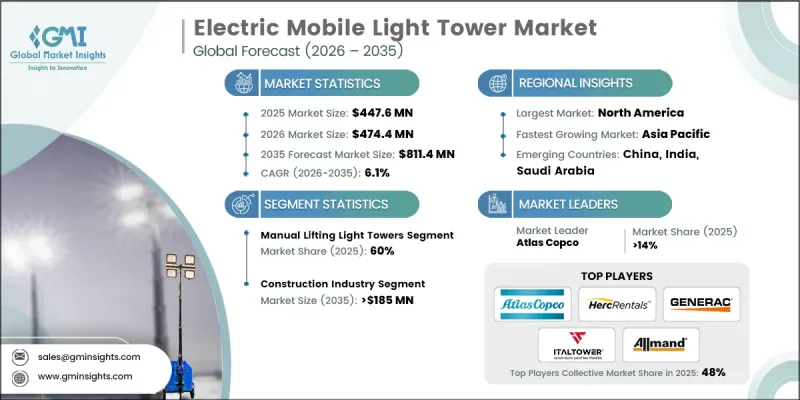
從柴油動力照明塔向電力照明塔的轉變,是由脫碳目標、監管支援和財政獎勵推動的,這些措施能夠降低總體擁有成本、提高營運合規性並增加計劃資金籌措管道。日益成長的能源安全和燃料供應不穩定問題,促使承包商、市政當局和工業運營商採用電池供電、插電式和太陽能照明解決方案,以減少對柴油的依賴並最大限度地減少加油物流。乾淨科技成本的降低和產能的提高,使得電力照明塔更容易被全球租賃公司和終端用戶所接受。需要夜間運作的大型基礎設施項目增加了對行動照明的需求,而都市區則傾向於選擇更安靜、零排放的設備。在快速發展的新興市場,對移動式電力照明塔的潛在需求正在擴大,尤其是在計劃中。針對高性能電池、先進電力電子和氫能系統的公共資金和產業政策,正在提高照明塔的運作里程、充電柔軟性和整體可靠性。
| 市場範圍 | |
|---|---|
| 開始年份 | 2025 |
| 預測年份 | 2026-2035 |
| 起始值 | 4.476億美元 |
| 預測金額 | 8.114億美元 |
| 複合年成長率 | 6.1% |
預計到2025年,手動升降照明塔將佔據60%的市場佔有率,並在2035年之前以5.3%的複合年成長率成長。這些照明塔因其簡單的機械升降機構、便捷的現場維護以及只需少量培訓即可由小型團隊操作等優點而備受歡迎。為了減少對社區的影響和工人的輻射暴露,買家擴大將手動升降系統與低噪音的電力動力傳動系統相結合,使這些型號成為都市區、公共產業和活動應用的理想選擇。手動升降設計尤其受到租賃公司的青睞,因為它們便攜、面積小、液壓部件少且檢查程序簡單,從而減少了停機時間,並可在計劃之間快速部署。其簡便性與安靜的電力運作相結合,為各種工作環境提供了一種經濟高效且可靠的解決方案。
預計到2025年,建設產業將佔全球市場佔有率的22%,到2035年將達到1.85億美元。承包商越來越依賴電動移動照明塔,以便在長時間工作期間保持符合規範的照明,同時最大限度地減少排放氣體和噪音污染。整合LED照明的電池供電解決方案能夠幫助建築公司降低營運成本並實現永續性目標,尤其是在環境法規嚴格的都市區和住宅。
預計到2025年,美國電動行動照明塔市場規模將達到1.088億美元,主要得益於節能型LED和混合照明系統,它們具有性能更優、能耗更低、運作時間更長等優勢。作業現場電氣化程度的不斷提高以及走廊充電網路的擴展,正在推動租賃車隊採用不依賴柴油的電池供電照明解決方案,並進一步加速其在建築、工業和市政領域的應用。
目錄
第1章:調查方法和範圍
第2章執行摘要
第3章業界考察
- 生態系分析
- 原物料供應及採購分析
- 製造能力評估
- 供應鏈韌性與風險因素
- 電力分配網路分析
- 監理情勢
- 影響產業的因素
- 促進因素
- 產業潛在風險與挑戰
- 成長潛力分析
- 波特五力分析
- PESTEL 分析
- 技術與創新現狀
- 電池能源儲存系統(BESS)的整合
- 鋰離子電池與鉛酸電池技術比較
- 太陽能混合整合技術
- 價格趨勢分析,2022-2035年
- 新機會與趨勢
- 投資分析及未來展望
第4章 競爭情勢
- 介紹
- 企業市佔率分析:按地區分類
- 北美洲
- 歐洲
- 亞太地區
- 中東和非洲
- 拉丁美洲
- 主要進展
- 併購
- 夥伴關係與合作
- 新產品發布
- 業務拓展計劃及資金籌措
- 競爭性標竿分析
- 創新與永續性現狀
第5章 市場規模及預測:依技術分類,2022-2035年
- 手動升降系統
- 液壓升降系統
第6章 市場規模與預測:依應用領域分類,2022-2035年
- 建造
- 基礎設施建設
- 石油和天然氣
- 礦業
- 軍事/國防
- 緊急/災害救援
- 其他
第7章 市場規模及預測:依地區分類,2022-2035年
- 北美洲
- 美國
- 加拿大
- 墨西哥
- 歐洲
- 德國
- 英國
- 法國
- 義大利
- 西班牙
- 俄羅斯
- 亞太地區
- 中國
- 日本
- 印度
- 澳洲
- 韓國
- 中東和非洲
- 沙烏地阿拉伯
- 阿拉伯聯合大公國
- 卡達
- 伊朗
- 南非
- 拉丁美洲
- 巴西
- 阿根廷
第8章:公司簡介
- Alrouf
- Allmand
- Atlas Copco
- Axiom Equipment Group
- Boss LTR
- Chicago Pneumatic
- Generac
- Grandwatt Electric
- Herc Rentals
- Italtower
- Larson Electronic
- Metrolite
- Olikara Lighting Towers
- Pramac
- Tower Light
- TRIME
- United Rentals
- Wanco
The Global Electric Mobile Light Tower Market was valued at USD 447.6 million in 2025 and is estimated to grow at a CAGR of 6.1% to reach USD 811.4 million by 2035.
The shift from diesel-powered to electric light towers is being driven by decarbonization targets, regulatory support, and financial incentives that improve the total cost of ownership, operational compliance, and access to project financing. Rising energy security concerns and fuel supply volatility are encouraging contractors, municipalities, and industrial operators to adopt battery, plug-in, and solar-powered lighting solutions that reduce diesel dependency and minimize refueling logistics. Falling costs for clean technologies, along with expanded production capacities, are making electric light towers more accessible to rental fleets and end users worldwide. Large-scale infrastructure programs requiring nighttime operations are increasing demand for mobile lighting while favoring quieter, zero-emission equipment in urban areas. Emerging markets with rapid infrastructure development are expanding the addressable base for electric mobile light towers, particularly where projects prioritize noise and air quality management. Public funding and industrial policies targeting higher-performance batteries, advanced power electronics, and hydrogen systems are enhancing operational range, charging flexibility, and overall tower reliability.
| Market Scope | |
|---|---|
| Start Year | 2025 |
| Forecast Year | 2026-2035 |
| Start Value | $447.6 Million |
| Forecast Value | $811.4 Million |
| CAGR | 6.1% |
The manual lifting light towers segment accounted for 60% share in 2025 and is expected to grow at a CAGR of 5.3% through 2035. These towers remain popular because they offer simple mechanical elevation, fast field serviceability, and minimal training requirements for smaller crews. Buyers increasingly pair manual lifting systems with low-noise electric powertrains to reduce community disruption and worker exposure, making these models ideal for urban, utility, and event applications. Manual lifting designs are particularly favored in rental fleets due to portability, compact footprints, fewer hydraulic components, and straightforward inspection routines, which reduce downtime and allow quicker deployment between projects. Their simplicity, combined with quieter electric operation, provides a cost-effective and reliable solution for diverse work environments.
The construction industry represented 22% share in 2025 and is projected to reach USD 185 million by 2035. Contractors increasingly rely on electric mobile light towers to maintain compliant illumination during extended work hours while minimizing emissions and noise pollution at job sites. Battery-powered solutions, often integrated with LED lighting, allow construction operators to reduce operational costs and meet sustainability goals, particularly in urban and residential areas where environmental regulations are strict.
U.S. Electric Mobile Light Tower Market was valued at USD 108.8 million in 2025, driven by energy-efficient LED and hybrid lighting systems that enhance performance, reduce power consumption, and extend operational uptime. Expanding jobsite electrification and corridor-based charging networks are supporting rental fleets in deploying battery-powered lighting solutions without relying on diesel refueling, further encouraging uptake across construction, industrial, and municipal applications.
Key players in the Global Electric Mobile Light Tower Market include Alrouf, Allmand, Atlas Copco, Axiom Equipment Group, Boss LTR, Chicago Pneumatic, Generac, Grandwatt Electric, Herc Rentals, Italtower, Larson Electronics, Metrolite, Olikara Lighting Towers, Pramac, Tower Light, TRIME, United Rentals, and Wanco. Companies in the Electric Mobile Light Tower Market are focusing on strengthening their position by investing in R&D to improve battery capacity, charging speed, and energy efficiency. Partnerships with energy providers, rental operators, and municipalities enable integrated lighting solutions that reduce operational costs and increase adoption. Expansion into emerging regions, standardization of modular tower designs, and development of hybrid and solar-assisted solutions help broaden market reach. Manufacturers are also improving service networks, offering predictive maintenance and extended warranties, and enhancing fleet management software to optimize uptime and efficiency. By combining technology innovation, strategic alliances, and strong after-sales support, companies are solidifying their market presence and accelerating the transition from diesel to electric mobile lighting systems.
Table of Contents
Chapter 1 Methodology & Scope
- 1.1 Research design
- 1.1.1 Research approach
- 1.1.2 Data collection methods
- 1.2 Base estimates and calculations
- 1.2.1 Base year calculation
- 1.2.2 Market estimates & forecast parameters
- 1.3 Forecast
- 1.3.1 Key trends for market estimates
- 1.3.2 Quantified market impact analysis
- 1.3.2.1 Mathematical impact of growth parameters on forecast
- 1.3.3 Scenario analysis framework
- 1.4 Primary research and validation
- 1.4.1 Some of the primary sources (but not limited to)
- 1.5 Data mining sources
- 1.5.1 Paid Sources
- 1.5.2 Sources, by region
- 1.6 Research trail & scoring components
- 1.6.1 Research trail components
- 1.6.2 Scoring components
- 1.7 Research transparency addendum
- 1.7.1 Source attribution framework
- 1.7.2 Quality assurance metrics
- 1.7.3 Our commitment to trust
- 1.8 Market definitions
Chapter 2 Executive Summary
- 2.1 Industry synopsis, 2022 - 2035
- 2.1.1 Business trends
- 2.1.2 Technology trends
- 2.1.3 Application trends
- 2.1.4 Regional trends
Chapter 3 Industry Insights
- 3.1 Industry ecosystem analysis
- 3.1.1 Raw material availability & sourcing analysis
- 3.1.2 Manufacturing capacity assessment
- 3.1.3 Supply chain resilience & risk factors
- 3.1.4 Distribution network analysis
- 3.2 Regulatory landscape
- 3.3 Industry impact forces
- 3.3.1 Growth drivers
- 3.3.2 Industry pitfalls & challenges
- 3.4 Growth potential analysis
- 3.5 Porter's analysis
- 3.5.1 Bargaining power of suppliers
- 3.5.2 Bargaining power of buyers
- 3.5.3 Threat of new entrants
- 3.5.4 Threat of substitutes
- 3.6 PESTEL analysis
- 3.6.1 Political factors
- 3.6.2 Economic factors
- 3.6.3 Social factors
- 3.6.4 Technological factors
- 3.6.5 Legal factors
- 3.6.6 Environmental factors
- 3.7 Technology & Innovation Landscape
- 3.7.1 Battery energy storage systems (BESS) integration
- 3.7.2 Lithium-Ion vs lead-acid technology comparison
- 3.7.3 Solar-hybrid integration technologies
- 3.8 Price trend analysis, 2022-2035
- 3.9 Emerging opportunities & trends
- 3.10 Investment analysis & future prospects
Chapter 4 Competitive Landscape, 2025
- 4.1 Introduction
- 4.2 Company market share analysis, by region, 2025
- 4.2.1 North America
- 4.2.2 Europe
- 4.2.3 Asia Pacific
- 4.2.4 Middle East & Africa
- 4.2.5 Latin America
- 4.3 Key developments
- 4.3.1 Mergers & acquisitions
- 4.3.2 Partnerships & collaborations
- 4.3.3 New product launches
- 4.3.4 Expansion plans and funding
- 4.4 Competitive benchmarking
- 4.5 Innovation & sustainability landscape
Chapter 5 Market Size and Forecast, By Technology, 2022 - 2035 (USD Million & '000 Units)
- 5.1 Key trends
- 5.2 Manual lifting system
- 5.3 Hydraulic lifting system
Chapter 6 Market Size and Forecast, By Application, 2022 - 2035 (USD Million & '000 Units)
- 6.1 Key trends
- 6.2 Construction
- 6.3 Infrastructure development
- 6.4 Oil & gas
- 6.5 Mining
- 6.6 Military & defense
- 6.7 Emergency & disaster relief
- 6.8 Others
Chapter 7 Market Size and Forecast, By Region, 2022 - 2035 (USD Million & '000 Units)
- 7.1 Key trends
- 7.2 North America
- 7.2.1 U.S.
- 7.2.2 Canada
- 7.2.3 Mexico
- 7.3 Europe
- 7.3.1 Germany
- 7.3.2 UK
- 7.3.3 France
- 7.3.4 Italy
- 7.3.5 Spain
- 7.3.6 Russia
- 7.4 Asia Pacific
- 7.4.1 China
- 7.4.2 Japan
- 7.4.3 India
- 7.4.4 Australia
- 7.4.5 South Korea
- 7.5 Middle East & Africa
- 7.5.1 Saudi Arabia
- 7.5.2 UAE
- 7.5.3 Qatar
- 7.5.4 Iran
- 7.5.5 South Africa
- 7.6 Latin America
- 7.6.1 Brazil
- 7.6.2 Argentina
Chapter 8 Company Profiles
- 8.1 Alrouf
- 8.2 Allmand
- 8.3 Atlas Copco
- 8.4 Axiom Equipment Group
- 8.5 Boss LTR
- 8.6 Chicago Pneumatic
- 8.7 Generac
- 8.8 Grandwatt Electric
- 8.9 Herc Rentals
- 8.10 Italtower
- 8.11 Larson Electronic
- 8.12 Metrolite
- 8.13 Olikara Lighting Towers
- 8.14 Pramac
- 8.15 Tower Light
- 8.16 TRIME
- 8.17 United Rentals
- 8.18 Wanco

 照明塔:市場佔有率分析、產業趨勢與統計、成長預測(2026-2031)
 照明塔市場:2026-2032年全球市場預測(依產品類型、電源、照明技術、升降機構、塔高、照度能力及應用分類)
 行動照明塔市場機會、成長要素、產業趨勢分析及2026-2035年預測。
 LED太陽能照明塔市場預測至2034年—全球產品類型、類別、額定功率、電源、技術、應用和區域分析拖車式太陽能照明塔市場預測—按產品類型、塔型、應用和地區分類的全球分析—2034年
 照明塔市場:按類型、動力來源、提升方式、最終用途產業和地區分類
 全球商用照明塔市場規模、佔有率、趨勢和成長分析報告(2026-2034年)戶外太陽能壁燈市場按產品類型、價格範圍、技術、安裝類型、應用和分銷管道分類,全球預測(2026-2032年)全球照明塔市場規模、佔有率、趨勢和成長分析報告(2026-2034)
 太陽能戶外LED照明市場-全球產業規模、佔有率、趨勢、機會及預測(按功率、應用、最終用戶、地區和競爭格局分類,2021-2031年)